
SERP Scraping: Methods, APIs, Workflows, and Best Practices
This guide explains:
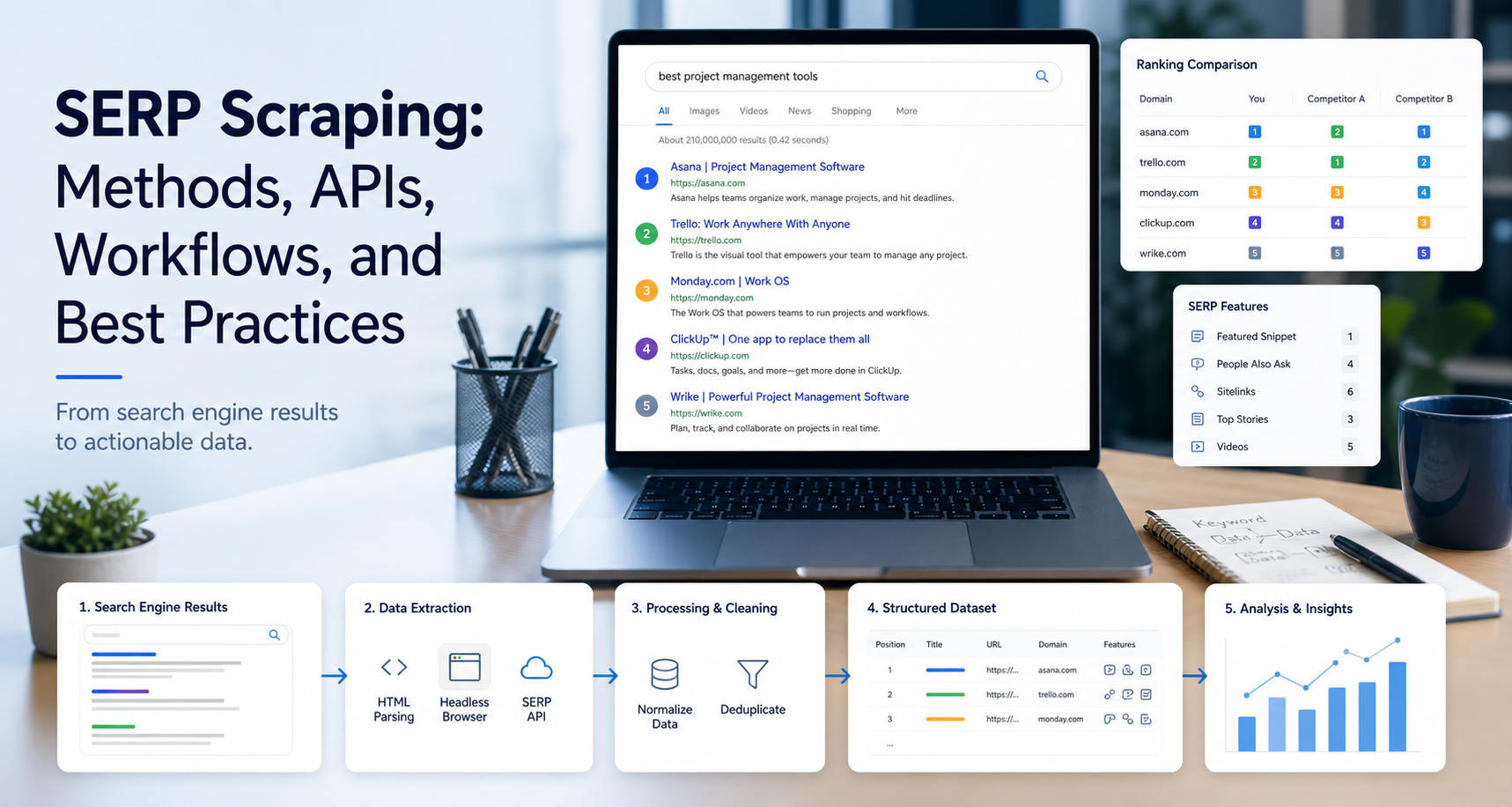
SERP scraping is the automated collection of information from search engine results pages. A SERP scraper can capture organic rankings, advertisements, featured snippets, People Also Ask questions, local results, shopping listings, images, and other search features, then convert them into structured data for analysis.
The right approach depends on the data you need, how often you need it, the locations and devices you must represent, and how much infrastructure you are prepared to maintain. A managed SERP API is often the most practical option for recurring production workloads, while a custom scraper may suit narrow, controlled projects. Neither approach removes the need to review search-engine terms, crawler instructions, privacy obligations, and applicable laws.
What Is SERP Scraping?
SERP scraping is the process of automatically retrieving and parsing the results displayed by a search engine for one or more queries. The output is usually transformed from HTML into structured fields such as position, title, destination URL, displayed URL, snippet, result type, location, device, and collection time.
Modern search pages contain much more than ten organic links. Depending on the query, a Google SERP scraper may encounter advertisements, featured snippets, local packs, People Also Ask results, images, videos, shopping listings, news modules, knowledge panels, related searches, and AI-generated result experiences. Current managed tools such as the Apify Google Search Results Scraper and Oxylabs SERP Scraper API illustrate the range of result types and localization controls that production SERP systems may support.
SERP scraping is not the same as crawling every page listed in the results. It collects information from the search results page itself. Retrieving the full text, product data, or other content from each destination requires a separate page-extraction workflow.
For the LycheeIP implementation details behind this step, review rotating residential proxies.
For the LycheeIP implementation details behind this step, review static residential proxies.
For the official technical reference behind this point, see MDN HTTP overview.
What Is the Difference Between a SERP Scraper and a SERP API?
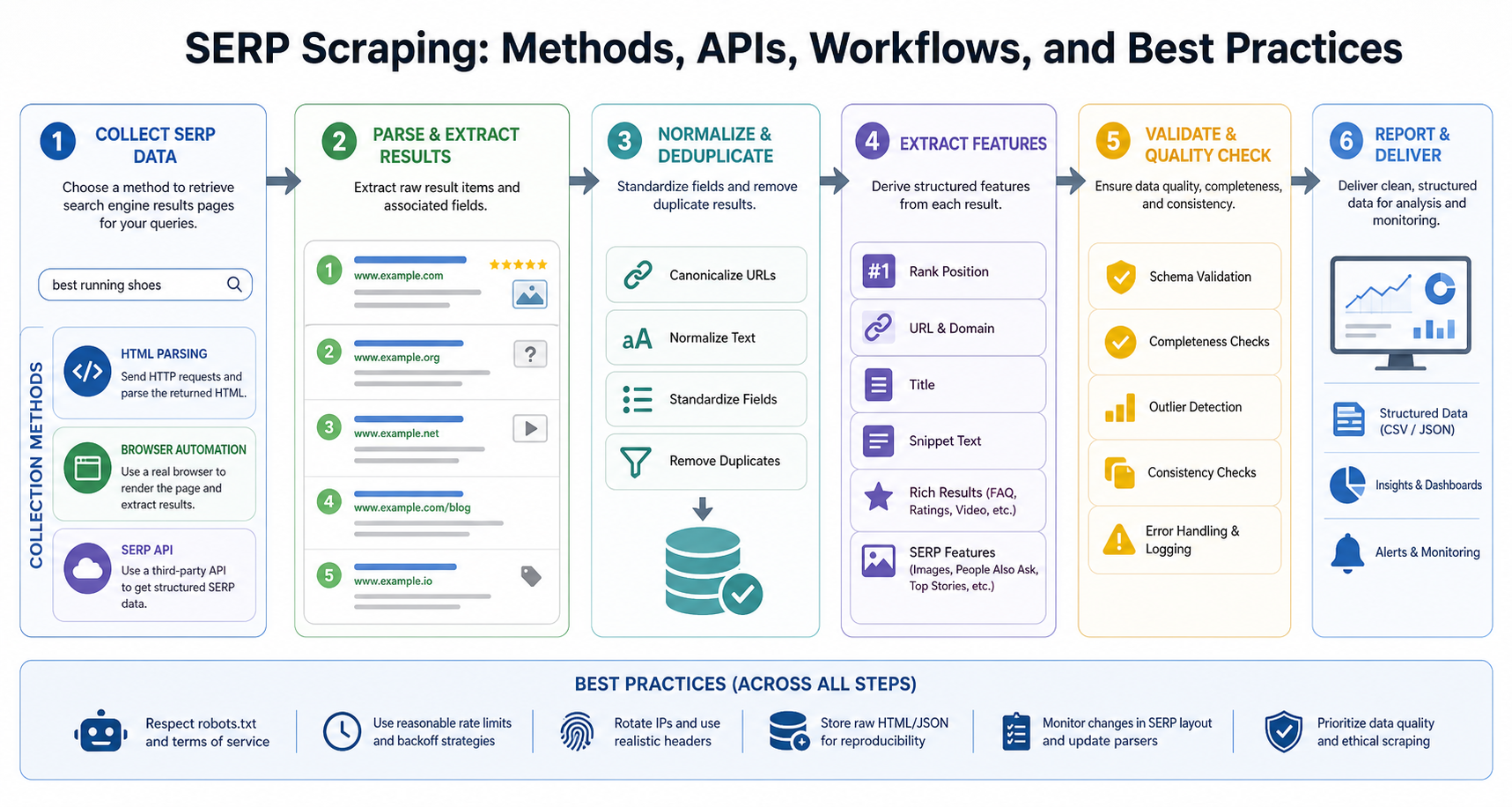
A SERP scraper is the underlying system that retrieves and parses search results. A SERP API is an interface that lets another application request those results without directly managing the retrieval infrastructure.
With a custom SERP scraper, your team may need to manage:
- Query construction
- HTTP requests or browser sessions
- Geographic routing
- Search-engine response changes
- HTML parsing
- Retries and error handling
- Data normalization
- Rate controls
- Monitoring
- Infrastructure capacity
With a managed SERP API, the provider handles much of that work and returns structured data, commonly as JSON. You still need to define the queries, validate the output, monitor costs, and confirm that the provider’s coverage matches your use case.
A managed API therefore reduces infrastructure responsibility. It does not remove your responsibility for data quality, appropriate use, security, or compliance.
For the official technical reference behind this point, see Playwright documentation.
How Does SERP Scraping Work?
A dependable SERP scraping workflow has five main layers.
1. Query-definition layer
The system defines the search context, including:
- Search term
- Search engine
- Country
- Language
- City or coordinate, when supported
- Desktop or mobile device
- Search domain
- Result page or result depth
- Date and time of collection
These settings are part of the data, not merely configuration details. A result collected for a mobile user in New York should not be treated as equivalent to a desktop result collected from a different country.
2. Retrieval layer
The system sends the query through one of the following methods:
- An official search API
- A managed SERP scraping API
- A direct HTTP request
- A browser automation framework
The retrieval method determines how much control, maintenance, rendering support, and operational risk your team carries.
3. Network and session layer
The search engine may interpret the request using signals such as the source network, IP location, language settings, device type, cookies, account state, and previous session activity.
This is where proxy infrastructure may be relevant for authorized geographic testing or distributed collection. However, changing the IP address does not automatically change every browser, cookie, account, or device signal.
4. Parsing and normalization layer
The response must be converted into a stable data model. The parser may need to distinguish among:
- Organic results
- Paid results
- Local results
- Featured snippets
- People Also Ask questions
- News
- Images
- Videos
- Shopping results
- Knowledge panels
- AI-generated search features
A scraper that successfully downloads a page can still fail at this stage. For example, the HTML may be retrieved correctly while titles, ranking positions, or result types are parsed incorrectly.
5. Validation and storage layer
The structured output should be checked, timestamped, and stored with enough context to reproduce or investigate the result later.
For important monitoring systems, store both normalized fields and a limited raw-response or page-snapshot reference where permitted. This makes it easier to diagnose parser errors and changes in SERP layout.
SERP Scraping Methods Compared
The following comparison can help you select an appropriate architecture.
| Method | Best for | Main advantage | Main tradeoff | Maintenance burden | Typical output |
|---|---|---|---|---|---|
| Official search API | Supported applications with requirements that fit the API | Clear documentation and structured responses | Coverage, availability, and result-format limitations | Low to moderate | Structured JSON |
| Managed SERP API | Recurring rank tracking, monitoring, research, and production data pipelines | Retrieval, localization, parsing, and infrastructure are bundled | Vendor cost, dependency, and feature-specific limits | Low | JSON, HTML, or both |
| Custom HTTP scraper | Narrow experiments and technically simple result pages | Maximum control with low initial compute needs | Fragile parsing and limited support for dynamic layouts | High | Raw HTML plus custom output |
| Browser automation | Interactive or JavaScript-dependent search experiences | Browser-level rendering and interaction | Higher compute, latency, and operational complexity | Very high | Rendered HTML, screenshots, or parsed fields |
| Manual collection | Very small, infrequent research tasks | No engineering investment | Slow, difficult to repeat, and prone to inconsistent recording | Low technical burden | Spreadsheet or notes |
Official search APIs
An official API should be evaluated first when it covers the required data. It may offer clearer documentation and a more stable interface than page scraping.
However, official APIs may not reproduce the complete public search page. They can also have significant availability or scope limitations. For example, Google’s Custom Search JSON API is closed to new customers, and existing customers have until January 1, 2027, to transition to another solution. It returns results from a configured Programmable Search Engine rather than acting as a complete replacement for every feature on the public Google results page.
Managed SERP APIs
A managed SERP API is usually the lowest-maintenance option for teams that need structured search results repeatedly.
Depending on the provider, a managed API may support:
- Multiple search engines
- Country and language targeting
- City or coordinate-level targeting
- Organic and paid results
- Rich-result extraction
- Raw HTML
- Parsed JSON
- Scheduled jobs
- Retries
- Cloud storage delivery
Do not choose a provider solely because it advertises a large feature list. Test whether it returns the specific fields, locations, devices, and result types your system needs.
Custom HTTP scrapers
A direct HTTP scraper gives your team control over request construction, response storage, parsing, and deployment. It can work for small or controlled tasks where the response is stable and does not depend heavily on browser execution.
The main problem is maintenance. A selector that works today may fail after a layout change. The response may also differ by region, device, session, or request context.
A production system therefore needs more than a request and a few CSS selectors. It needs schema validation, monitoring, retry limits, alerting, and a plan for layout changes.
Browser automation
Browser automation tools such as Playwright can operate a real browser environment. This is useful when the required result depends on JavaScript rendering, interaction, scrolling, or browser-specific behavior.
The tradeoff is cost and complexity. Browser sessions consume more memory and processing time than simple HTTP requests. They also create more components to monitor, including browser versions, dependencies, page-load states, timeouts, session profiles, and rendering failures.
Use a browser because the task requires browser behavior, not because it seems more sophisticated.
How to Choose the Right SERP Scraping Method
Use this five-factor SERP fit check before selecting a tool or architecture.
1. Define the exact data shape
List the fields you need.
For example:
- Top 10 organic results
- Paid advertisements
- Local pack positions
- People Also Ask questions
- AI-generated result features
- Featured snippets
- Shopping listings
- Image or video results
- Raw HTML
- Screenshots
A basic rank tracker and an AI Overview monitoring system do not have the same technical requirements.
2. Define the search context
Determine which variables must be controlled:
- Country
- State or city
- Coordinates
- Language
- Desktop or mobile
- Search domain
- Signed-in or signed-out context
- Result depth
- Collection frequency
If location precision matters, confirm how the provider interprets location instead of assuming that a country parameter recreates a specific local user’s experience.
3. Calculate the operational scale
Estimate:
- Number of keywords
- Number of locations
- Number of devices
- Number of search engines
- Collection frequency
- Required result depth
- Retry allowance
A campaign monitoring 200 keywords weekly is very different from a platform collecting thousands of localized queries every hour.
4. Set the acceptable maintenance burden
Ask who will handle:
- Parser updates
- Browser upgrades
- Failed requests
- Infrastructure scaling
- Data-schema changes
- Proxy configuration
- Monitoring
- Incident response
A custom scraper can appear inexpensive until engineering and maintenance time are included.
5. Define validation requirements
Decide how you will determine whether a result is correct.
A successful API response does not prove that:
- The intended location was applied
- The ranking order is accurate
- Paid and organic results were separated correctly
- Rich-result fields were parsed correctly
- Duplicate results were removed
- The response represents the intended device
- The data was collected at the expected time
The best method is the one that produces the required data with an acceptable combination of accuracy, repeatability, cost, maintenance, and policy risk.
What Is the Best Way to Scrape Google SERPs?
There is no universally best Google SERP scraping method.
For recurring production workloads, a managed SERP API is often the most practical starting point because it reduces the need to maintain retrieval, localization, browser, parsing, and retry infrastructure.
A custom scraper may be appropriate when:
- The project is narrow
- Collection volume is limited
- The team needs complete control over raw responses
- The required data is not available through a suitable API
- Engineering resources are available for ongoing maintenance
Browser automation may be appropriate when the required information depends on rendering or interaction that an HTTP-based method cannot reproduce reliably.
An official API should be preferred when it directly supports the use case. However, teams must confirm current availability and whether the API returns the same type of data they expect from the public SERP.
Do not select a method based only on its initial setup speed. Compare the total system burden, including failures, parser updates, validation, storage, monitoring, and policy review.
A Nine-Step SERP Scraping Workflow
Step 1: Define the authorized use case
Document why the data is needed, which search engines are involved, who will use the data, and how long it will be retained.
Review applicable terms, policies, privacy obligations, contractual restrictions, and internal governance requirements before collection begins.
Step 2: Create a query matrix
Build a table containing every combination of:
- Keyword
- Search engine
- Country or city
- Language
- Device
- Result depth
- Frequency
This prevents accidental mixing of different search contexts.
Step 3: Check for an appropriate API
Evaluate official APIs, licensed data sources, and managed SERP APIs before building a custom retrieval system.
Confirm whether each option supports the exact result types and locations you need.
Step 4: Design the output schema
Define stable fields before collecting at scale.
At minimum, consider:
| Field group | Example fields |
|---|---|
| Query context | Query, engine, domain, language, country, city, device |
| Collection context | Timestamp, job ID, source method, page number |
| Result identity | Position, result type, title, destination URL, displayed URL |
| Result content | Snippet, sitelinks, rating, price, answer text |
| Feature context | Organic, advertisement, local, PAA, image, video, AI feature |
| Validation | Parse status, missing fields, duplicate flag, schema version |
Step 5: Run a small sample
Test a limited set of queries that represent:
- Branded and non-branded searches
- Informational and commercial intent
- Local searches
- Mobile and desktop
- Queries with rich features
- Queries with few results
- Queries that change frequently
Do not scale until the sample output has been reviewed manually.
Step 6: Validate against visible results
Compare selected records with manually observed search pages collected under a similar location and device context.
Look for:
- Missing results
- Incorrect ordering
- Misclassified advertisements
- Duplicate listings
- Truncated titles
- Wrong destination URLs
- Incorrect local results
- Missing SERP features
Step 7: Add monitoring and retry controls
Track:
- Request success rate
- Parsing success rate
- Empty-result frequency
- Average response time
- Missing required fields
- Unusual ranking changes
- Duplicate frequency
- Cost per usable result
Retries should be limited and logged. Repeating a failed request indefinitely can increase cost and create unnecessary traffic without fixing the underlying problem.
Step 8: Scale gradually
Increase query volume in controlled stages. Review data quality, costs, latency, and errors at each stage.
A workflow that succeeds for ten queries may fail when concurrency, locations, devices, and result depth increase.
Step 9: Review the system continuously
Search layouts, provider capabilities, API availability, policies, and pricing can change. Schedule regular reviews of:
- Parser accuracy
- Required fields
- Search features
- Location behavior
- Tool documentation
- Provider limits
- Internal and external links
- Legal and compliance requirements
For the LycheeIP implementation details behind this step, review AI-powered browser automation hub.
How to Validate SERP Scraping Data
Validation should examine the complete workflow, not just whether the request returned a response.
Use the following checklist:
- Confirm that the intended query was sent.
- Record the search engine and domain.
- Record the country, language, location, and device.
- Store the collection timestamp.
- Confirm that organic and paid results are separated.
- Check that rankings begin and increment correctly.
- Confirm that destination URLs are complete.
- Detect duplicate listings.
- Validate required fields and data types.
- Flag unknown result types rather than discarding them.
- Compare a sample with manually observed results.
- Monitor sudden increases in empty or incomplete responses.
- Version the parser and output schema.
- Retain enough diagnostic information to investigate failures.
A valid connection proves only that the system communicated with the endpoint. It does not prove that the intended SERP was collected or parsed correctly.
For the LycheeIP implementation details behind this step, review LycheeIP proxy infrastructure.
Common SERP Scraping Problems and How to Diagnose Them
| Symptom | Likely cause | First check | Recommended next step |
|---|---|---|---|
| Empty result set | Blocked response, unsupported query, parser failure, or incorrect parameters | Inspect response status and raw response | Test one query manually and verify required parameters |
| Rankings differ from manual search | Location, device, language, personalization, or timing mismatch | Compare the complete search context | Re-run with matched location, device, and timestamp |
| Paid results appear as organic | Parser classification error | Inspect the result labels and raw markup | Update classification rules and add test cases |
| Local pack is missing | Location was too broad or the provider does not support the feature | Verify city or coordinate input | Use a method with suitable local targeting |
| Results disappear after an update | Search layout or parser schema changed | Review recent raw responses | Update selectors or provider integration |
| Duplicate URLs appear | The same destination is present in multiple result blocks | Compare result type and canonicalized URL | Deduplicate only after preserving feature context |
| Requests become slow | Browser rendering, retries, concurrency pressure, or provider latency | Review response-time and retry logs | Reduce concurrency and isolate the slow stage |
| Data works locally but fails on a server | Environment, DNS, firewall, browser dependency, or network differences | Compare runtime and network configuration | Reproduce with the same versions and request settings |
| Wrong country results are returned | Location parameter or network route is misaligned | Inspect detected IP location and query parameters | Correct the location configuration and retest |
| A successful response contains incomplete fields | Unsupported result type or parser drift | Check schema warnings and raw response | Preserve the raw result and update the parser |
Why Search Results Are Difficult to Reproduce Exactly
Search results can vary across time and context. Two systems may submit the same keyword and still receive different pages because of differences in:
- Country
- City or coordinates
- Language
- Device
- Search domain
- IP location
- Cookies
- Account state
- Previous activity
- Search-engine experiments
- Collection time
- Index updates
- Result personalization
Managed SERP tools commonly expose country, language, device, or detailed location controls because these variables materially affect the result context. Apify, for example, documents country, language, mobile or desktop, and exact-location inputs, while Oxylabs describes country, city, and coordinate-level targeting.
Reproducibility therefore means recording and controlling the important variables. It does not mean that every future request will return an identical page.
Where Proxy Infrastructure Fits
A proxy operates at the network layer. It can change the route, source IP address, apparent network location, and, depending on the service, session routing.
It does not control:
- Query logic
- HTML selectors
- Browser automation code
- Cookies
- Account history
- JavaScript execution
- Data parsing
- Schema validation
- Search-engine policy
- Legal authorization
A proxy cannot repair a broken parser or guarantee that a search engine will accept a request.
For an authorized custom workflow, the proxy type should match the network requirement:
| Proxy category | Potential fit | Main consideration |
|---|---|---|
| Datacenter proxy | Development, repeatable server routing, and lower-friction public data tasks | Hosting-network IPs may be treated differently by some targets |
| Dynamic residential proxy | Distributed or location-sensitive public-web testing | IP rotation must align with the query and session model |
| Static residential proxy | Workflows that require a more consistent network identity | Long-lived sessions require careful cookie and state management |
LycheeIP currently provides dynamic residential proxies, static residential proxies, and static datacenter proxies. These options should be evaluated as network infrastructure, not as replacements for compliant automation, parsing, validation, or monitoring.
Teams building a custom SERP collection system can review the available LycheeIP proxy infrastructure after confirming that the problem genuinely originates in the network layer.
Legitimate Uses of SERP Scraping
SEO rank tracking
Teams can monitor where selected pages appear for defined queries, locations, languages, and devices.
The useful output is not just the ranking number. It should also record the competing URLs, result features, timestamp, and search context.
SERP feature monitoring
A company can track the appearance of:
- Featured snippets
- People Also Ask questions
- Local packs
- Video results
- Shopping results
- News results
- AI-generated result features
This helps teams understand how the structure of the search page changes, not merely whether a page moved from one organic position to another.
Local search verification
Businesses with several locations can compare search visibility across cities or regions.
Location-sensitive monitoring should use precise and documented geographic settings. A country-level result is not a substitute for a city-level observation.
Advertising and brand visibility research
Authorized teams can study whether advertisements, brand mentions, reviews, or other public result features appear for relevant searches.
The workflow should avoid collecting unnecessary personal data and should preserve the distinction between advertisements, organic results, local listings, and third-party content.
Search and market research
Researchers can analyze how search engines surface public information for a defined set of questions.
The methodology should document query selection, dates, locations, devices, result depth, and known limitations. SERP data is a ranked sample produced by the search engine, not a complete representation of everything available on the web.
SERP Scraping Is Not Full-Page Website Scraping
A SERP scraper helps you discover and classify search results. It does not automatically retrieve the complete content of every listed website.
A complete research pipeline may contain two separate stages:
- SERP discovery: Collect ranked URLs, snippets, result types, and search context.
- Destination-page extraction: Visit selected URLs and extract permitted page content.
Keep these stages separate. They have different:
- Data schemas
- Failure modes
- permissions and policies
- Rate limits
- Parsing requirements
- Storage needs
- Quality checks
A SERP API may be the right tool for rank positions and search features but the wrong tool for extracting full article text or product-page details.
When Should You Avoid SERP Scraping?
SERP scraping may not be appropriate when:
- An official or licensed data source already provides the required information.
- The use case lacks authorization or a legitimate operational purpose.
- The project requires protected, private, or account-restricted information.
- Search-engine terms or machine-readable instructions prohibit the intended activity.
- The team cannot implement reasonable rate controls.
- The workflow cannot validate the collected data.
- A small manual sample would answer the question more efficiently.
- The actual need is full-page content rather than search-result metadata.
- The cost of maintaining a custom scraper exceeds the value of the data.
- Legal or compliance questions remain unresolved.
Do not add browser automation, proxy rotation, or other infrastructure merely because it is available. Use the simplest compliant method that satisfies the actual requirement.
Legal, Policy, and Ethical Considerations
SERP scraping involves more than technical access. Teams should consider:
- Search-engine terms
- Website and service-specific policies
- Robots directives
- Rate limits
- Copyright
- Privacy and data-protection requirements
- Data licensing
- Contractual obligations
- Security controls
- Applicable laws
- Data-retention practices
The Robots Exclusion Protocol is standardized in RFC 9309, and Google explains that a robots.txt file is used to manage crawler access and traffic. Robots instructions should be reviewed, but they are not a substitute for examining terms, authorization, privacy, copyright, and other legal considerations.
Google’s current Terms of Service address the use of automated means in violation of machine-readable instructions. Requirements can vary by service and can change, so teams should review the current terms and relevant service-specific policies before implementation.
Public visibility does not automatically settle contractual, privacy, copyright, or authorization questions. This article does not provide legal advice. Organizations with material legal or regulatory exposure should consult qualified counsel.
Common SERP Scraping Mistakes
Collecting rankings without context
A ranking has limited value when the location, language, device, search domain, and timestamp are missing.
Treating every result as organic
Advertisements, local listings, featured snippets, videos, shopping blocks, and other modules require separate classification.
Assuming an API response is automatically accurate
Structured JSON can still contain missing, misclassified, duplicated, or stale fields.
Scaling before validating
A parser error multiplied across thousands of queries creates a larger bad dataset, not a better one.
Using a proxy to solve an application-layer problem
A proxy changes network routing. It does not fix selectors, browser code, query construction, or data validation.
Ignoring schema drift
New result types and layout changes can introduce fields your existing schema does not recognize. Unknown result types should be logged and investigated rather than silently discarded.
Comparing unmatched search contexts
Desktop and mobile results, or searches from different locations and times, should not be compared as if they were identical observations.
Choosing only by price per request
The cheapest request can become expensive if the results require extensive cleaning, return incomplete fields, or create frequent engineering incidents.
Use LycheeIP Proxies for Reliable SERP Data Collection
Final Takeaway
SERP scraping turns search results into structured data for rank tracking, local verification, feature monitoring, research, and other legitimate workflows. The central decision is not simply whether to use a scraper. It is whether an official API, managed SERP API, custom HTTP collector, or browser-based system best fits the required data, scale, location precision, maintenance capacity, and policy constraints.
Start with a small, authorized test. Define the complete search context, validate the output manually, monitor parser quality, and scale only after the workflow produces reliable data.
When a custom implementation requires geographic routing or a choice among network types, evaluate LycheeIP’s proxy options against the real workload. Treat proxies as one infrastructure layer within a broader system that still needs careful query design, compliant collection, parsing, validation, and monitoring.
Frequently Asked Questions
What is SERP scraping?
SERP scraping is the automated extraction of information from search engine results pages. It can collect organic rankings, advertisements, snippets, local results, People Also Ask questions, images, videos, and other search features.
What is a SERP scraper?
A SERP scraper is a program or managed service that retrieves a search results page and converts its contents into usable data. The scraper may use direct HTTP requests, browser automation, a managed API, or a combination of these methods.
What is a SERP scraping API?
A SERP scraping API accepts search parameters such as a keyword, country, language, location, and device, then returns search-result data through an API response. The provider usually manages retrieval, parsing, retries, and some localization infrastructure.
What is the best SERP scraping tool?
The best tool depends on the required search engines, SERP features, locations, devices, request volume, output format, and maintenance capacity. Test several representative queries and compare field completeness, localization, reliability, documentation, cost per usable result, and support rather than relying on a universal ranking.
Can Google SERPs be scraped without an API?
A team can technically build a custom HTTP or browser-based collector, but it must manage request behavior, parsing, failures, layout changes, validation, and compliance. An API is often easier to maintain for recurring production work, while a custom approach may suit narrow or highly specialized projects.
Is Google SERP scraping legal?
There is no universal answer that applies to every project or jurisdiction. The analysis may depend on the data collected, method of access, search-engine terms, machine-readable instructions, privacy, copyright, contractual obligations, and applicable laws. Obtain qualified legal advice when the project creates meaningful legal or compliance exposure.
What is the best way to scrape multiple search engines?
Use a provider or architecture that supports each required search engine through clearly defined, engine-specific parameters and schemas. Do not assume that a parser built for Google will interpret Bing, Baidu, Yandex, or another engine correctly, because their result types and page structures differ.
Do I need proxies for SERP scraping?
Not every SERP workflow requires separate proxy infrastructure. Managed SERP APIs often include their own retrieval network. A custom system may use proxies for authorized geographic routing or distributed collection, but proxies do not fix parsing errors, session-state problems, inappropriate request behavior, or policy restrictions.
How often should SERP data be collected?
The appropriate frequency depends on how quickly the monitored queries change and how the data will be used. High-value or rapidly changing queries may require more frequent collection, while stable informational keywords may be checked less often. Avoid collecting more often than the decision or analysis requires. Embedded anchor text Destination Article section Reason for placement Status Dynamic residential proxies LycheeIP Dynamic Residential Proxies Where Proxy Infrastructure Fits Supports evaluation of rotating and location-sensitive network routing Embedded Static residential proxies LycheeIP Static Residential Proxies Where Proxy Infrastructure Fits Supports discussion of more consistent network identities Embedded Static datacenter proxies LycheeIP Datacenter Proxies Where Proxy Infrastructure Fits Supports evaluation of server-based proxy infrastructure Embedded LycheeIP proxy infrastructure LycheeIP Homepage Proxy section and conclusion Provides a neutral next step for comparing available proxy categories Embedded Hyperlinked source Claim supported Article section Source type Date accessed Google Custom Search JSON API API purpose, closure to new customers, and January 1, 2027 transition deadline SERP Scraping Methods Compared Official Google documentation July 24, 2026 Google Search Results Scraper on Apify Supported SERP feature extraction, localization inputs, devices, and structured exports Definition and localization sections Official product documentation July 24, 2026 Oxylabs SERP Scraper API Search-engine coverage, structured data, HTML output, and geographic targeting Definition, method comparison, and localization Official product documentation July 24, 2026 Playwright documentation Browser automation framework reference Browser Automation Official framework documentation July 24, 2026 Google robots.txt guidance Purpose and limitations of robots.txt Legal, Policy, and Ethical Considerations Official Google documentation July 24, 2026 RFC 9309 Robots Exclusion Protocol standard Legal, Policy, and Ethical Considerations Internet standard July 24, 2026 Google Terms of Service Automated access and machine-readable instruction considerations Legal, Policy, and Ethical Considerations Official policy July 24, 2026 LycheeIP Dynamic Residential Proxies Current availability of dynamic residential proxy infrastructure Where Proxy Infrastructure Fits Official LycheeIP product page July 24, 2026 LycheeIP Static Residential Proxies Current availability of static residential proxy infrastructure Where Proxy Infrastructure Fits Official LycheeIP product page July 24, 2026 LycheeIP Datacenter Proxies Current availability of static datacenter proxy infrastructure Where Proxy Infrastructure Fits Official LycheeIP product page July 24, 2026
Related LycheeIP Guides and Resources

Recommended Articles
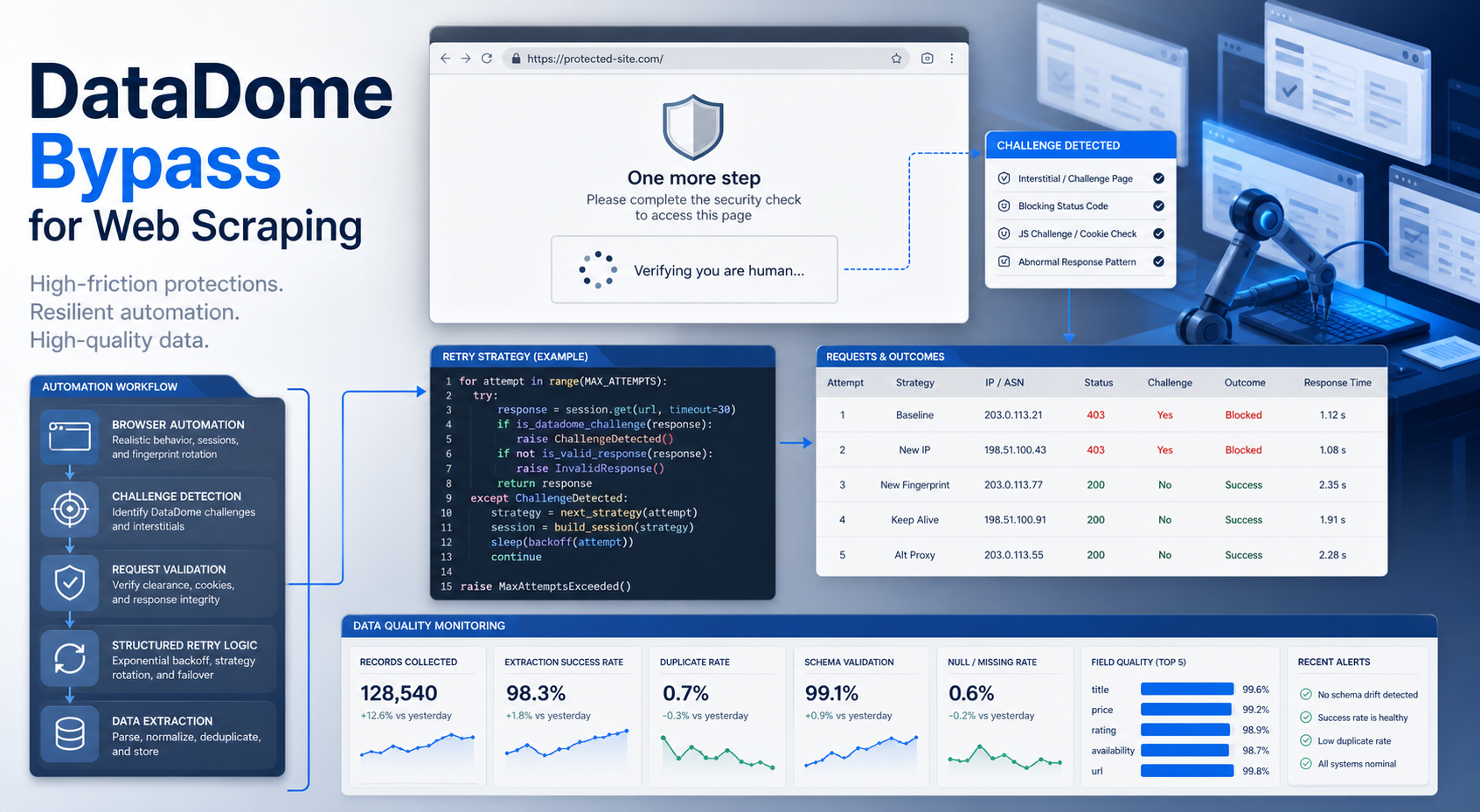
DataDome Bypass for Web Scraping
DataDome Bypass for Web Scraping
View Details
Web Scraping Rate Limiting: How to Handle 429s, Backoff, and Concurrency
Web scraping rate limiting is the engineering discipline of keeping an authorized collection workload inside a target service's acceptable request envelope. When that envelope is exceeded, a server may respond with HTTP 429 Too Many Requests, delay responses, or apply other controls.
View Details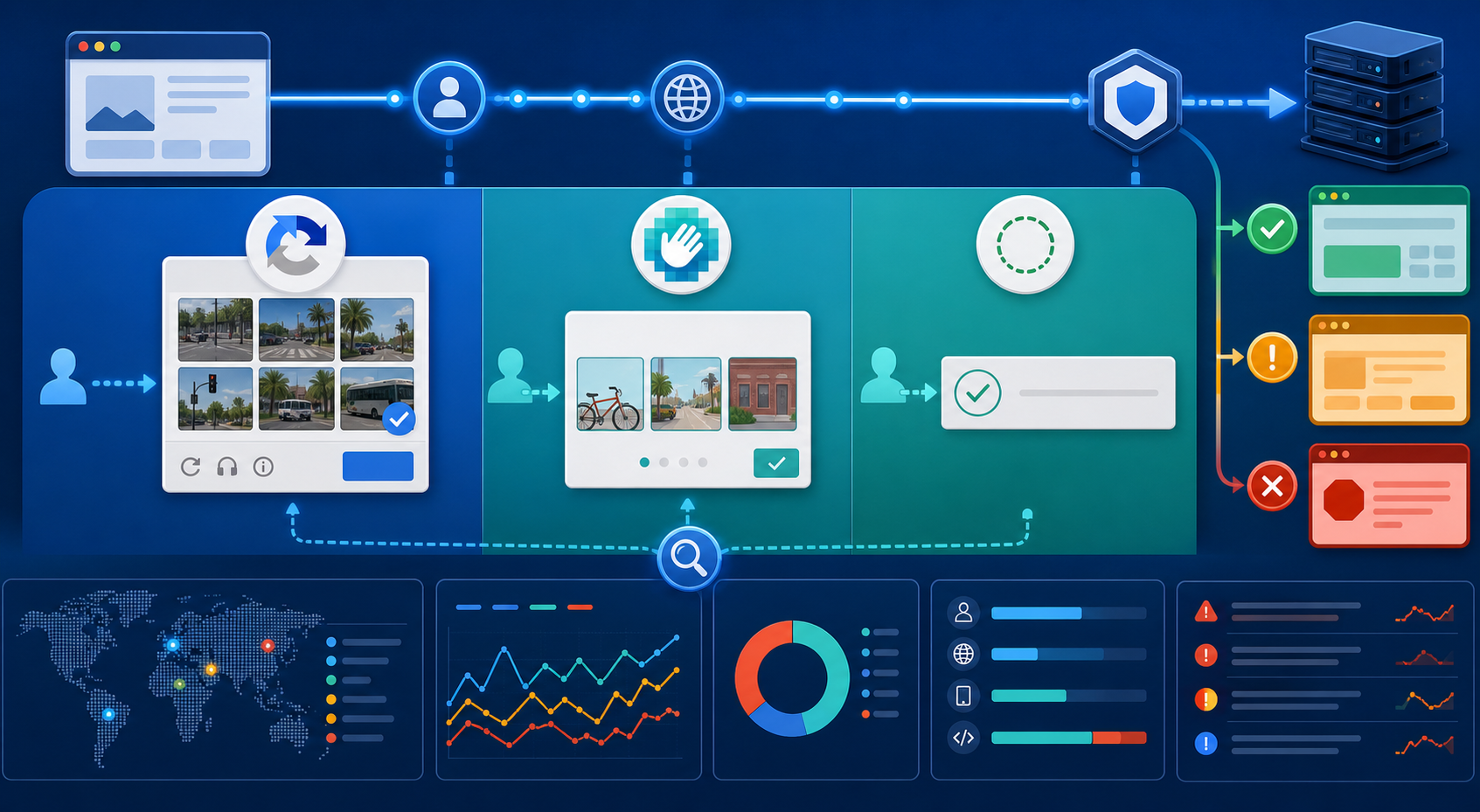
reCAPTCHA vs hCaptcha vs Cloudflare Turnstile: What Scraping Teams Need to Know
If an authorized data-collection workflow suddenly stops at a verification screen, identifying the protection system matters before you change code, browser settings, or proxy infrastructure. reCAPTCHA vs hCaptcha vs Turnstile is not simply a branding comparison. The three systems can expose different browser flows, token models, risk decisions, and failure symptoms.
View Details
Browser Automation Proxies: IPs, Geo-Targeting, Sessions, and AI Agents
A browser automation proxy belongs to the network layer of Playwright, Selenium, cloud-browser, and AI-agent workflows. It changes how browser traffic is routed and can affect the source IP address, geographic egress, and session continuity seen by a destination site. It does not improve an AI model's reasoning, repair browser logic, or guarantee that a website will accept the session.
View Details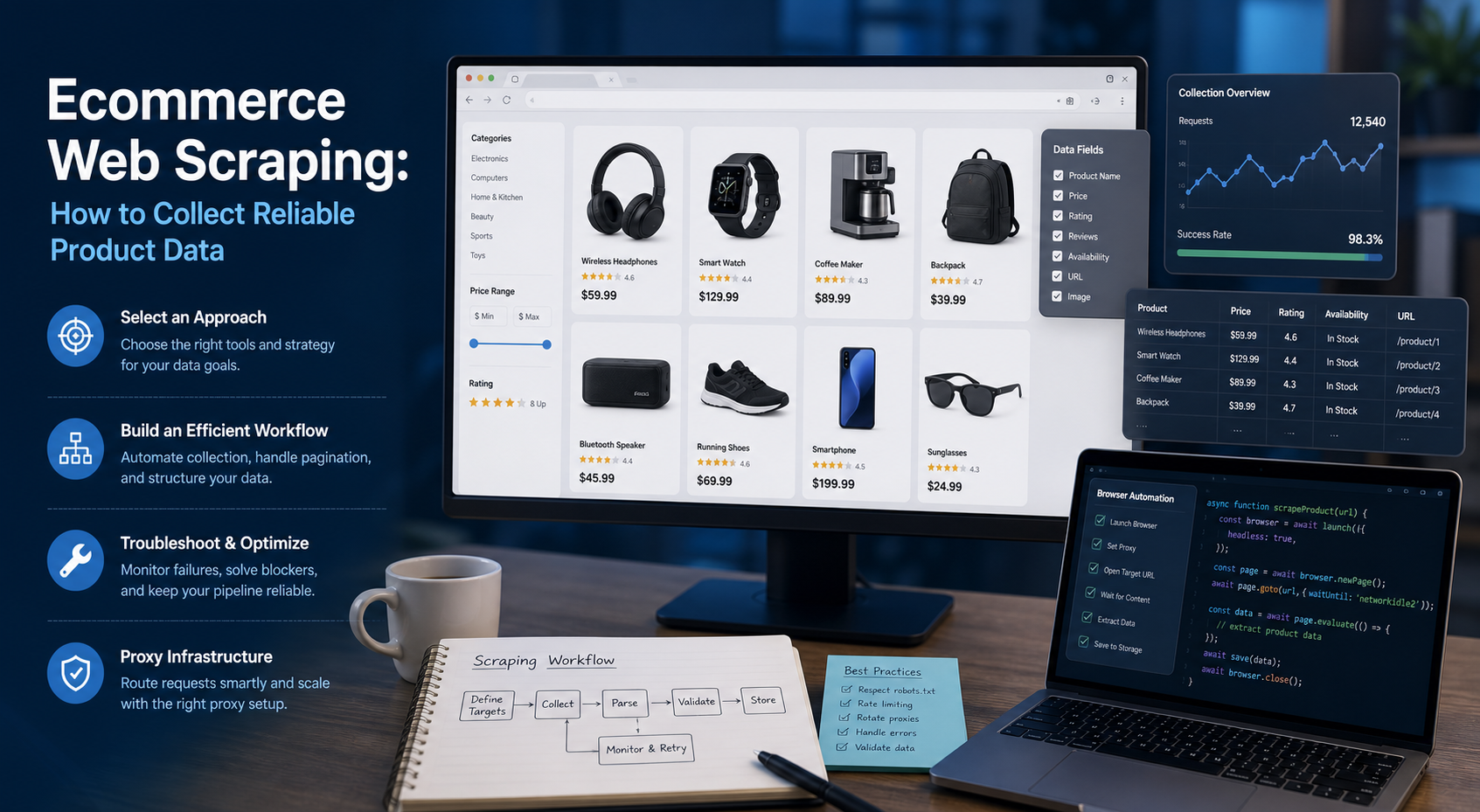
Ecommerce Web Scraping: How to Collect Reliable Product Data
Ecommerce web scraping is the automated collection of publicly accessible product information from online stores. Teams use it to gather prices, availability, variants, ratings, seller details, and catalog changes for legitimate tasks such as competitive research, assortment monitoring, brand protection, and data quality checks.
View Details