
Web Scraping Ecommerce Websites With Python: A Practical Guide
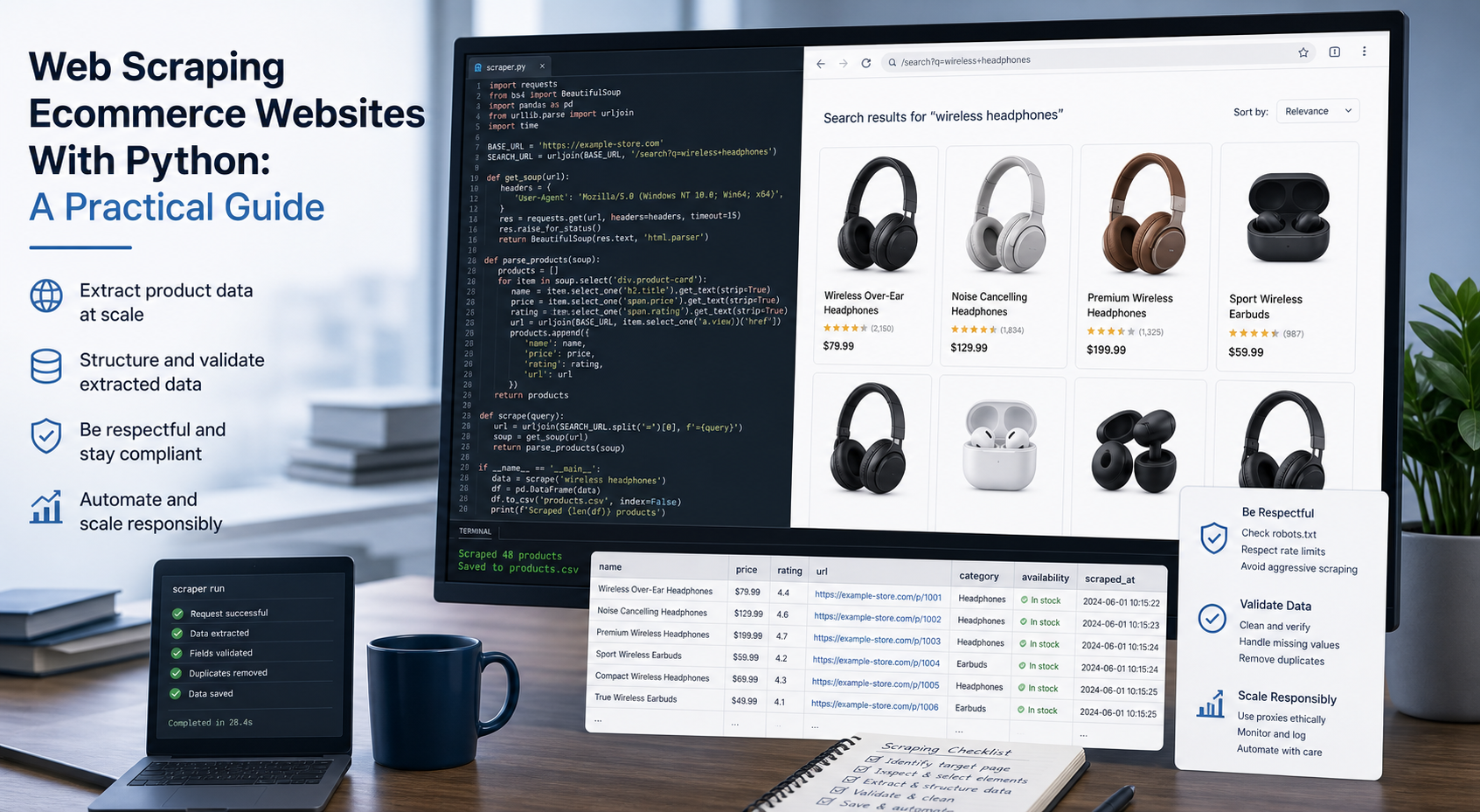
What this guide covers
Recommended meta title: Web Scraping Ecommerce Websites With Python: Guide Recommended meta description: Learn how to scrape ecommerce websites with Python using Requests, Beautiful Soup, Playwright, and Scrapy, with validation and scaling guidance. URL slug: /web-scraping-ecommerce-websites-python/
Web scraping ecommerce websites with Python means using a Python program to collect permitted product information, such as names, prices, availability, ratings, and URLs, and convert it into structured data. The right method depends on how the store delivers that information. Requests and Beautiful Soup work well when product data is present in the returned HTML. Playwright is more appropriate when JavaScript renders the catalog after the page loads. Scrapy becomes useful when a permitted project must crawl many pages, manage queues, and export records reliably.
The main limitation is that ecommerce pages change frequently. A script that downloads a page successfully can still collect incomplete, duplicated, localized, or stale data. A dependable workflow therefore includes source selection, careful pacing, structured extraction, validation, logging, and ongoing maintenance.
What Is Ecommerce Web Scraping?
Ecommerce web scraping is the automated extraction of structured information from online storefronts. Typical fields include product title, SKU, price, currency, stock status, category, rating, review count, seller, image URL, and product URL.
A scraper is not the same as a browser or a proxy. The scraper controls which pages to request, which fields to extract, and how to store them. A browser automation framework renders and interacts with a page. A proxy changes the network route or source IP. The validation layer determines whether the collected records are complete and correct. Changing one layer does not automatically repair a problem in another.
Common legitimate uses include authorized price monitoring, catalog reconciliation, localization quality assurance, public market research, stock monitoring, and checking whether a retailer's own product pages match its internal feed.
For the LycheeIP implementation details behind this step, review LycheeIP proxy infrastructure.
For the LycheeIP implementation details behind this step, review AI-powered browser automation hub.
For the official technical reference behind this point, see MDN HTTP overview.
Choose the Right Python Approach Before Writing Code
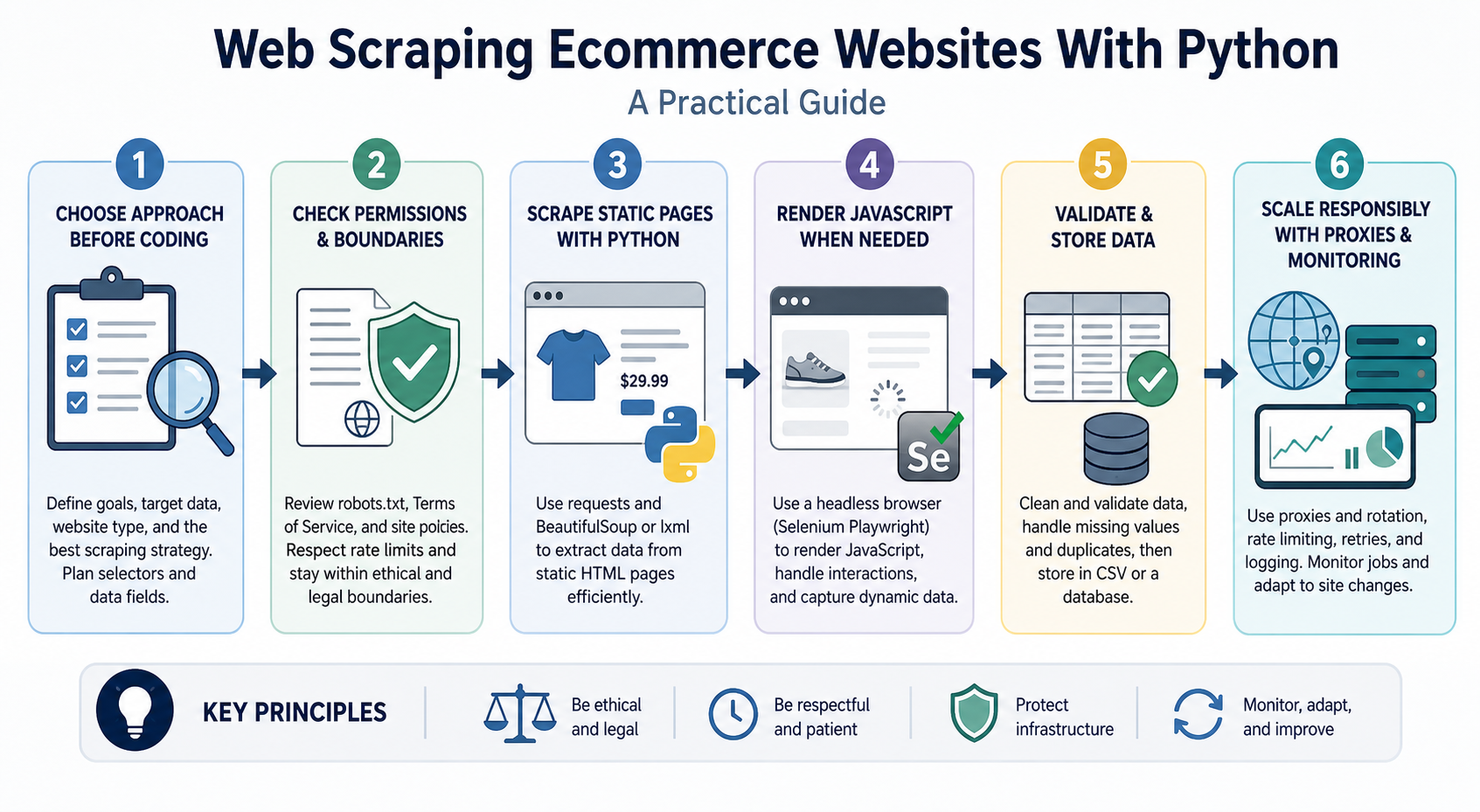
Use the simplest approach that can reliably access the permitted data source. An official API, merchant feed, or licensed dataset is usually more stable than parsing presentation HTML. When no suitable structured source is available, inspect how the page is delivered before choosing a library.
| Approach | Best for | Main advantage | Main tradeoff | Choose it when |
|---|---|---|---|---|
| Official API or data feed | Stable, authorized product access | Structured fields and clearer contracts | May require approval, payment, or limited coverage | The retailer or platform provides a suitable source |
| Requests plus Beautiful Soup | Static HTML catalogs | Lightweight, fast, and easy to debug | Does not execute browser JavaScript | Product data exists in the initial HTML response |
| Playwright | JavaScript-rendered pages and required interactions | Runs a real browser engine and supports resilient locators | Higher CPU, memory, and maintenance cost | The required data appears only after rendering or interaction |
| Scrapy | Larger focused crawls and repeatable pipelines | Queues, concurrency controls, retries, item pipelines, and exports | More project structure than a small script | You must crawl many permitted URLs or run the job repeatedly |
| Managed extraction API | Teams that do not want to operate browsers and network infrastructure | Outsources part of rendering and retrieval | Ongoing cost and provider dependency | Internal engineering time is more constrained than vendor budget |
Requests documentation recommends setting explicit timeouts in production code and using raiseforstatus() to surface unsuccessful HTTP responses. Beautiful Soup supports CSS selectors through .select() and .select_one(). Playwright's locator model adds auto-waiting and retryability for browser interactions, while Scrapy provides a high-level crawling framework and built-in feed exports.
Use the Source, Render, Scale, and Verify Framework
Before building the scraper, answer four questions.
1. Source: Is There a Better Source Than Page HTML?
Check for an official API, product feed, sitemap, licensed dataset, or structured data embedded in the page. Many ecommerce pages expose product information through JSON-LD using Schema.org types such as Product and Offer. When that structured data is complete and permitted for your use, it may be less brittle than deeply nested CSS selectors.
2. Render: Is the Data Present in the Response HTML?
Use your browser's page source or a small Requests test to compare the returned HTML with the visible page. If product cards are absent from the response but appear after the browser loads, JavaScript is probably populating them. In that case, inspect whether a permitted public JSON source exists or use browser automation.
3. Scale: How Many Pages and How Often?
A one-page research task does not need the same architecture as a daily catalog monitor. Define the number of products, crawl frequency, allowed request rate, expected data volume, storage format, and failure tolerance before selecting concurrency or infrastructure.
4. Verify: How Will You Know the Output Is Correct?
Define required fields, accepted currencies, deduplication keys, stock-value mappings, freshness thresholds, and sample checks before the first full run. A successful HTTP response proves only that the server returned something. It does not prove that your selectors found the correct product data.
Check Permission, Policies, and Crawl Boundaries
Before scraping, review the website's terms, robots directives, published rate limits, data licensing conditions, copyright considerations, privacy obligations, and any contract that applies to your access. The Robots Exclusion Protocol standard describes rules that crawlers are requested to honor, but it also states that robots rules are not a form of access authorization. Authorization and compliance must be assessed separately.
Prefer public pages and approved data sources. Do not collect protected account data, payment information, personal data, or content behind access controls without explicit authorization. Do not use automation to overwhelm a service or to circumvent security controls. When the legal position is important, obtain advice from qualified counsel.
Step-by-Step: Scrape a Static Ecommerce Catalog With Python
The following example uses Books to Scrape, a demonstration catalog that explicitly says it is intended for web-scraping practice. The site contains 1,000 fictional product records across 50 pages, and its prices and ratings have no real commercial meaning.
Step 1: Install the Dependencies
python -m pip install requests beautifulsoup4
Step 2: Run the Scraper
from future import annotations
import csv
import time
from pathlib import Path
from urllib.parse import urljoin, urlsplit
import requests
from bs4 import BeautifulSoup, Tag
START_URL = "https://books.toscrape.com/"
OUTPUTFILE = Path("ecommerceproducts.csv")
REQUESTDELAYSECONDS = 1.0
MAX_PAGES = 50
def textornone(element: Tag | None) -> str | None:
"""Return clean text from an element, or None when it is missing."""
return element.get_text(" ", strip=True) if element else None
def issameorigin(baseurl: str, candidateurl: str) -> bool:
"""Prevent pagination from accidentally leaving the approved domain."""
base = urlsplit(base_url)
candidate = urlsplit(candidate_url)
return (base.scheme, base.netloc) == (candidate.scheme, candidate.netloc)
def parse_products(
html: str,
page_url: str,
) -> list[dict[str, str | None]]:
"""Extract product records from one catalog page."""
soup = BeautifulSoup(html, "html.parser")
cards = soup.select("article.product_pod")
if not cards:
raise RuntimeError(
"No product cards were found. "
"Check the response body and selectors."
)
records: list[dict[str, str | None]] = []
for card in cards:
titlelink = card.selectone("h3 a")
relativeproducturl = (
titlelink.get("href") if titlelink else None
)
product_url = (
urljoin(pageurl, relativeproduct_url)
if isinstance(relativeproducturl, str)
else None
)
ratingelement = card.selectone("p.star-rating")
rating_classes = (
rating_element.get("class", [])
if rating_element
else []
)
rating = next(
(
name
for name in rating_classes
if name != "star-rating"
),
None,
)
records.append(
{
"title": (
title_link.get("title")
if title_link
else None
),
"price": textornone(
card.selectone("p.pricecolor")
),
"availability": textornone(
card.select_one("p.availability")
),
"rating": rating,
"producturl": producturl,
"sourcepage": pageurl,
}
)
return records
def findnextpage(
html: str,
page_url: str,
) -> str | None:
"""Return the next catalog URL and remain on one origin."""
soup = BeautifulSoup(html, "html.parser")
nextlink = soup.selectone("li.next a")
if not next_link:
return None
href = next_link.get("href")
if not isinstance(href, str):
return None
nexturl = urljoin(pageurl, href)
if not issameorigin(STARTURL, nexturl):
raise RuntimeError(
f"Refusing to follow an off-domain URL: {next_url}"
)
return next_url
def scrape_catalog() -> list[dict[str, str | None]]:
"""Crawl pages politely and return deduplicated records."""
session = requests.Session()
session.headers.update(
{
"User-Agent": "AuthorizedCatalogResearchBot/1.0",
"Accept-Language": "en-US,en;q=0.9",
}
)
currenturl: str | None = STARTURL
visited_pages: set[str] = set()
seen_products: set[str] = set()
products: list[dict[str, str | None]] = []
while currenturl and len(visitedpages) < MAX_PAGES:
if currenturl in visitedpages:
raise RuntimeError(
f"Pagination loop detected at {current_url}"
)
visitedpages.add(currenturl)
response = session.get(
current_url,
timeout=(5, 20),
)
response.raiseforstatus()
for record in parse_products(
response.text,
current_url,
):
producturl = record.get("producturl")
dedupe_key = (
product_url
or f"{record.get('title')}|{record.get('price')}"
)
if dedupekey in seenproducts:
continue
seenproducts.add(dedupekey)
products.append(record)
currenturl = findnext_page(
response.text,
current_url,
)
if current_url:
time.sleep(REQUESTDELAYSECONDS)
return products
def save_csv(
records: list[dict[str, str | None]],
) -> None:
"""Write records to a UTF-8 CSV file."""
fieldnames = [
"title",
"price",
"availability",
"rating",
"product_url",
"source_page",
]
with OUTPUT_FILE.open(
"w",
newline="",
encoding="utf-8",
) as file:
writer = csv.DictWriter(
file,
fieldnames=fieldnames,
)
writer.writeheader()
writer.writerows(records)
if name == "main":
catalog = scrape_catalog()
save_csv(catalog)
print(
f"Saved {len(catalog)} products to {OUTPUT_FILE}"
)
The script uses a session, explicit connect and read timeouts, status checking, same-origin pagination, a request delay, duplicate detection, and CSV output. The urljoin() function converts relative product and pagination links into absolute URLs, while the same-origin check prevents an unexpected link from moving the crawler to another host.
Step 3: Adapt the Selectors to Your Approved Target
The selectors in the example belong to the demonstration site. For another ecommerce website, inspect one product card and map each required field:
| Field | Common source | Validation question |
|---|---|---|
| Product name | Heading, link title, or JSON-LD name | Is the full name captured, not a shortened display label? |
| Product URL | Product anchor | Is it absolute, canonical, and on the expected domain? |
| SKU or GTIN | Product details or structured data | Is it stable enough to use as a deduplication key? |
| Price | Visible price or Offer.price | Did you also capture currency and sale status? |
| Availability | Stock label or Offer.availability | Are values normalized consistently? |
| Rating | Rating element or structured data | Is the scale known, and is review count present? |
| Seller | Marketplace offer block | Is the seller the platform, a merchant, or both? |
| Timestamp | Your collection process | Can you prove when the record was observed? |
Do not assume that the visible text is the best source. Product structured data may provide a cleaner SKU, currency, availability value, or canonical URL, but it must still be checked against the visible page and the permitted use case. Schema.org documents Product, Offer, price, currency, rating, and related ecommerce properties.
For the LycheeIP implementation details behind this step, review static residential proxies.
How to Scrape JavaScript-Rendered Ecommerce Sites
If Requests returns HTML but your product selector finds nothing, first save and inspect the response body. The page may be returning a challenge, redirect, error template, consent page, or HTML shell that expects JavaScript to fetch the catalog. Empty Beautiful Soup results are commonly reported when the desired elements are not present in the downloaded source.
For a permitted JavaScript-rendered catalog, Playwright can load the page and wait for a stable locator before extraction. Playwright recommends locators that reflect user-facing attributes or explicit testing contracts because long CSS or XPath chains are more likely to break when the DOM changes.
python -m pip install playwright
playwright install chromium
import os
from playwright.syncapi import syncplaywright
TARGETURL = os.environ["TARGETURL"]
PRODUCT_CARD = os.environ.get(
"PRODUCT_CARD",
"article.product-card",
)
with sync_playwright() as playwright:
browser = playwright.chromium.launch(
headless=True,
)
page = browser.new_page()
page.goto(
TARGET_URL,
wait_until="domcontentloaded",
timeout=30_000,
)
cards = page.locator(PRODUCT_CARD)
cards.first.wait_for(
state="visible",
timeout=15_000,
)
products = []
for index in range(cards.count()):
card = cards.nth(index)
products.append(
{
"title": (
card.locator("h2, h3")
.first
.inner_text()
.strip()
),
"price": (
card.locator("[data-price], .price")
.first
.inner_text()
.strip()
),
}
)
browser.close()
print(products)
This is a template, not a universal selector set. Replace the product-card, title, and price locators with stable selectors for the authorized target. Avoid fixed sleeps when a meaningful element, response, or application state can be awaited.
When to Use Scrapy Instead of a Standalone Script
Move to Scrapy when the project needs queues, many URLs, recurring crawls, configurable concurrency, item pipelines, or multiple export formats. Scrapy describes itself as a high-level crawling and scraping framework, and its feed export system can serialize scraped items to formats and storage backends without custom CSV-writing code.
For respectful rate control, Scrapy's AutoThrottle extension adjusts delay based on load while honoring concurrency and delay settings. It is not permission to increase traffic until a site fails. Set conservative limits based on the website's published policies and your authorization.
A production Scrapy project commonly separates:
- Spiders that discover pages and emit raw items
- Item loaders or parsing functions that normalize fields
- Pipelines that validate, deduplicate, and store records
- Settings that control delays, concurrency, robots behavior, retries, and logging
- Monitoring that tracks response codes, field completeness, crawl volume, and selector failures
Where Proxies Fit in Ecommerce Scraping
A proxy belongs to the network layer. It can change the source IP, route, or requested geography, but it does not execute JavaScript, repair selectors, normalize prices, manage cookies correctly, or verify data quality.
For an authorized workflow, a proxy may be relevant when the team must validate public product availability or presentation from different locations, separate approved network workloads, or operate a distributed collection system. It should not be treated as a guarantee that a website will accept a request.
The choice should match the session requirement:
- Dynamic residential proxies are relevant when an approved workflow needs rotating or sticky sessions and geographic targeting. LycheeIP's current product page lists both rotating and sticky session options and coverage across more than 200 countries and regions.
- Static residential proxies are more suitable when a permitted task needs a stable residential IP over a longer session. The current LycheeIP page lists HTTP, HTTPS, and SOCKS5 support.
- Static datacenter proxies may fit high-throughput, stable-IP workloads where residential routing is unnecessary. LycheeIP's current datacenter page lists HTTP, HTTPS, SOCKS5, API support, and unlimited traffic.
Start without proxy complexity when direct, permitted access is reliable. Add network infrastructure only after confirming that the failure or requirement actually belongs to the network layer.
A Production Ecommerce Scraping Architecture
A maintainable system separates collection from validation and storage.
| Layer | Responsibility | Key controls |
|---|---|---|
| Target and policy | Defines approved pages and access conditions | Allowlist, terms review, robots review, rate limits |
| Scheduler | Decides what to collect and when | Frequency, priorities, recrawl windows |
| Fetcher | Retrieves HTML, JSON, or rendered pages | Timeouts, delays, retries, status handling |
| Browser | Executes required JavaScript interactions | Stable locators, browser versions, resource limits |
| Network | Provides routing and location where justified | Proxy type, session policy, geography, authentication |
| Parser | Extracts source fields | Versioned selectors, structured-data parsing |
| Normalizer | Converts values into a common schema | Currency, decimal, availability, timestamps |
| Validator | Detects incomplete or implausible records | Required fields, ranges, duplicate checks, samples |
| Storage | Preserves current and historical data | Upserts, snapshots, lineage, retention |
| Monitoring | Detects breakage and drift | Error rates, zero-result alerts, field coverage, freshness |
This separation matters because a 200 response with zero products is a fetching or rendering clue, while a product with the wrong currency is usually a parsing, localization, or normalization problem.
For the LycheeIP implementation details behind this step, review rotating residential proxies.
For the official technical reference behind this point, see Playwright documentation.
Ecommerce Scraping Troubleshooting Table
| Symptom | Likely cause | First check | Recommended next step |
|---|---|---|---|
| Status 200 but no products | JavaScript rendering, changed selector, consent page, or challenge response | Save the response HTML and search for a known product name | Correct the selector, use a permitted structured source, or render with Playwright |
| 403 or 429 responses | Access denied or request rate is too high | Review response headers, policies, and recent request volume | Stop or slow the crawl, confirm authorization, and follow the site's approved access method |
| Prices are missing | Price is loaded separately, hidden in variants, or stored in JSON-LD | Compare visible page, source, and structured data | Extract the correct offer and capture currency plus sale context |
| Duplicate products | Pagination overlap, tracking URLs, variants, or unstable keys | Compare canonical URL, SKU, and variant identifiers | Define a stable deduplication key and store variants explicitly |
| Scraper works locally but fails on a server | Environment, DNS, TLS, browser dependency, region, or server network policy | Compare status, final URL, headers, and browser logs | Align dependencies and network configuration before changing parsing code |
| Pagination repeats forever | Relative URL error or repeated next link | Log every visited page URL | Maintain a visited-page set and enforce same-origin rules |
| Product count suddenly drops | Layout change, experiment, category filter, or blocked response | Compare historical counts and inspect a sample page | Pause publishing, update selectors, and backfill only after validation |
| Currency or stock values vary | Localization, cookies, geography, or seller differences | Record locale, currency, seller, and source location | Normalize with context instead of overwriting distinct offers |
| Data is stale | Cached page, delayed feed, wrong endpoint, or infrequent recrawl | Compare collection timestamp with the visible page | Review cache behavior and set a justified refresh schedule |
Validate the Data Before Using It
A technically successful crawl can still produce a bad dataset. Run these checks before the output enters pricing, analytics, search, or machine-learning systems:
- Confirm that every required field has an explicit completeness threshold.
- Compare a random sample against the visible product pages.
- Store source URL, collection time, currency, locale, and seller context.
- Normalize whitespace and availability values without discarding the original text.
- Use SKU, GTIN, or canonical URL where available, but verify that the identifier is stable.
- Check for duplicate URLs, duplicate SKUs, and unexpected product-count changes.
- Flag zero prices, impossible ratings, unknown currencies, and malformed URLs.
- Track HTTP status distribution and the percentage of pages with zero extracted items.
- Keep raw snapshots or hashes when auditability and change detection matter.
- Re-run validation after selector, browser, proxy, or deployment changes.
A fluent CSV or JSON file is not proof of accuracy. Validation must compare the output with the source and the business rules that will consume it.
Practical Ecommerce Scraping Use Cases
Authorized Price and Availability Monitoring
A retailer or brand can monitor its own public catalog, approved reseller pages, or licensed partner sources to identify price changes and stock gaps. The record should include seller, currency, product variant, collection time, and source URL so that comparisons remain meaningful.
Catalog Reconciliation
Teams can compare storefront pages with an internal product information management system to find missing descriptions, outdated images, incorrect prices, or inconsistent availability labels.
Localization and Geographic Quality Assurance
A permitted workflow can verify whether a product, price, language, or promotion appears correctly in different supported locations. Geographic routing may help here, but the test must also control cookies, locale, account state, and currency settings.
Public Market Research
Researchers can collect permitted public product attributes to study assortment, category structure, or price ranges. The methodology should document exclusions, collection timing, missing records, and changes in page structure.
Feed and Structured-Data Auditing
Brands can compare visible product information with JSON-LD, merchant feeds, or marketplace submissions to catch mismatched prices, availability, and identifiers.
When Not to Scrape an Ecommerce Website
Do not build a scraper when a suitable official API, licensed feed, or direct data export already solves the problem more reliably. Do not proceed when the use case lacks authorization, depends on protected or private information, conflicts with contractual restrictions, or requires circumventing access controls.
Scraping is also a poor choice when the team cannot maintain selectors, validate output, monitor failures, or respond to policy and page changes. A small amount of unreliable data can be more damaging than no data when it drives pricing, inventory, compliance, or customer-facing decisions.
Use LycheeIP Proxies for Python Ecommerce Scraping
Key Takeaway
For web scraping ecommerce websites with Python, begin with the source rather than the library. Prefer an approved API or feed when available. Use Requests and Beautiful Soup for static HTML, Playwright for required browser rendering, and Scrapy for larger repeatable crawls. Add proxy infrastructure only when an authorized network or geographic requirement justifies it, then validate every stage before scaling.
For teams assessing network-layer requirements, review the available proxy categories on the LycheeIP homepage and test a small authorized workflow before increasing crawl volume.
Frequently Asked Questions
How Do You Scrape an Ecommerce Website Using Python?
First confirm that the use is permitted and check whether an official API or feed is available. If product data is present in the initial HTML, use Requests to retrieve the page and Beautiful Soup to extract fields. Use Playwright when JavaScript must render the catalog, and use Scrapy when the project requires a larger recurring crawl.
Do People Still Use Python for Scraping Webpages?
Yes. Python remains well suited to web scraping because it has mature HTTP, parsing, browser automation, crawling, validation, and data-processing libraries. The correct tool still depends on the page architecture and the scale of the permitted workflow.
Is Beautiful Soup or Playwright Better for Ecommerce Scraping?
Beautiful Soup is the simpler choice when the required data already exists in the downloaded HTML. Playwright is more appropriate when JavaScript rendering or browser interaction is necessary, but it consumes more resources and adds browser-maintenance work.
Why Does Beautiful Soup Return an Empty List?
The selector may be wrong, the layout may have changed, or the desired content may be inserted by JavaScript and therefore absent from the response HTML. Save the response body, verify the final URL and status, search for a known product name, and inspect whether the server returned a challenge or consent page before changing tools.
What Ecommerce Data Should a Scraper Collect?
The minimum useful schema usually includes product name, product URL, identifier, price, currency, availability, seller, and collection timestamp. Depending on the use case, add category, variant, rating, review count, image URL, promotion, and location context.
Do I Need Proxies for Web Scraping Ecommerce Sites?
Not always. Direct access is simpler when it is permitted and reliable. Proxies become relevant when an authorized workflow has a genuine routing, geographic, workload-separation, or session requirement, but they do not fix JavaScript rendering, selectors, cookies, or data-quality errors.
How Should Pagination Be Handled?
Extract the next-page URL from the current page, resolve relative links safely, restrict the crawl to the approved origin, and keep a set of visited URLs. Also set a maximum page count so a broken pagination rule cannot create an endless loop.
Is Ecommerce Web Scraping Legal?
There is no universal answer. The analysis can depend on authorization, website terms, access controls, copyright, privacy, data licensing, contracts, the data collected, and the jurisdiction. Review the applicable rules and obtain qualified legal advice when the risk is material.
Can I Scrape Product Pages Behind a Login?
Only when you have explicit authorization and the automation complies with the account, contract, privacy, and security requirements that apply. Do not automate access to protected data merely because you possess credentials. Linked source What it supports Type Requests Quickstart Timeouts, exceptions, and raiseforstatus() Official documentation Beautiful Soup documentation HTML parsing and CSS selectors Official documentation Playwright Python locators Locator behavior, auto-waiting, and selector guidance Official documentation Scrapy documentation Crawling framework capabilities Official documentation Scrapy Feed Exports Structured item export Official documentation Scrapy AutoThrottle Adaptive crawl-delay controls Official documentation Robots Exclusion Protocol RFC 9309 Meaning and limitations of robots rules Internet standard Schema.org Product Product, offer, price, currency, and rating properties Structured-data vocabulary Books to Scrape Safe demonstration catalog used in the tutorial Demonstration website LycheeIP dynamic residential proxies Current rotation, session, and geographic claims Official product page LycheeIP static residential proxies Current protocol and static residential positioning Official product page LycheeIP static datacenter proxies Current protocol, API, traffic, and datacenter positioning Official product page
Related LycheeIP Guides and Resources

Recommended Articles

Best Real Estate Scrapers in 2026
Best Real Estate Scrapers in 2026
View Details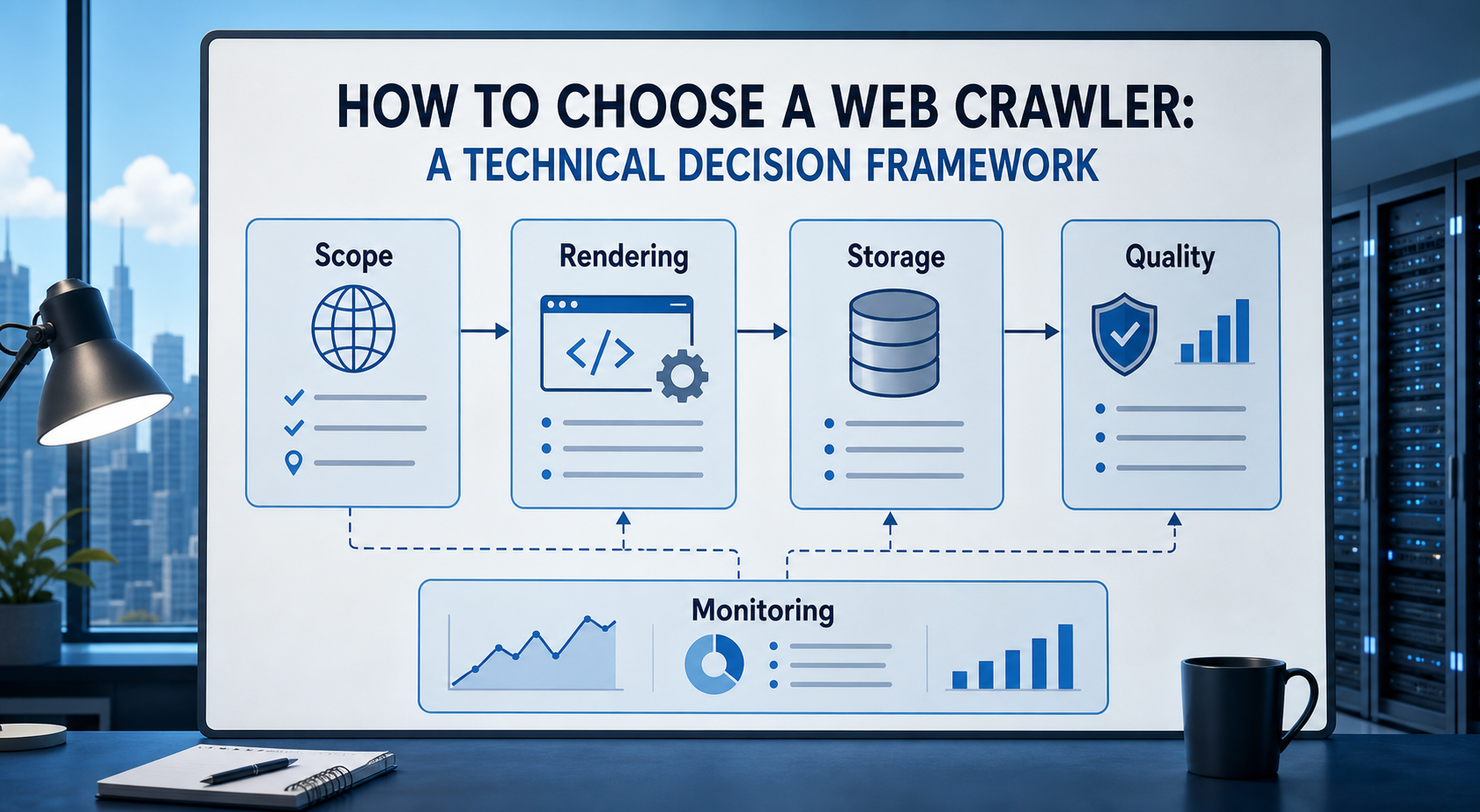
How to Choose a Web Crawler: A Technical Decision Framework
The wrong way to choose a web crawler is to begin with a list of products. The right starting point is the system you need to build. Before comparing tools, define:
View Details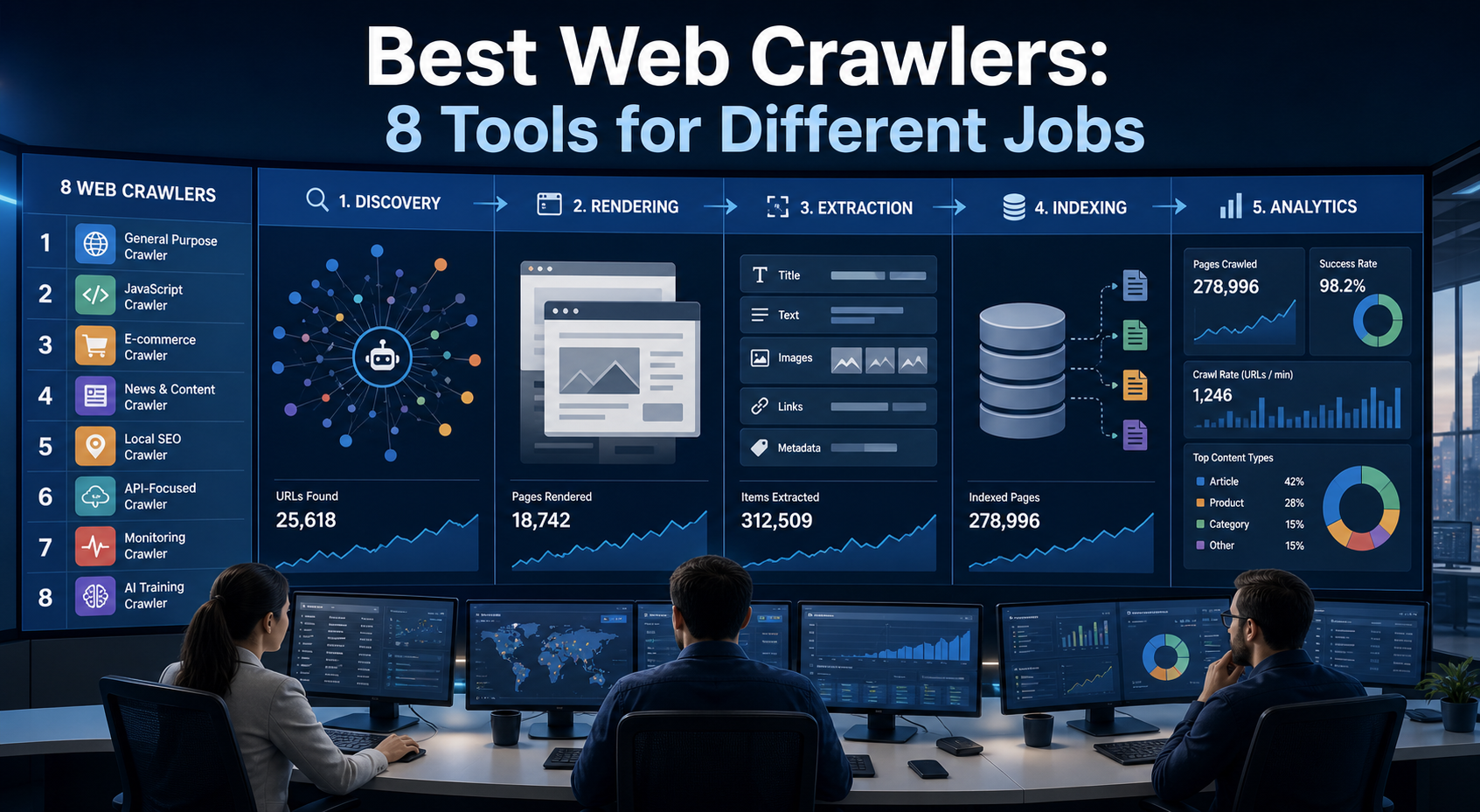
Best Web Crawlers: 8 Tools for Different Jobs
There is no single best web crawler for every project. A technical SEO audit, an AI knowledge pipeline, an internet archive, and a distributed search index may all involve crawling URLs, but they require different capabilities. The most useful way to compare web crawler tools is therefore to ask what job each one was designed to perform. This guide evaluates eight strong options across:
View Details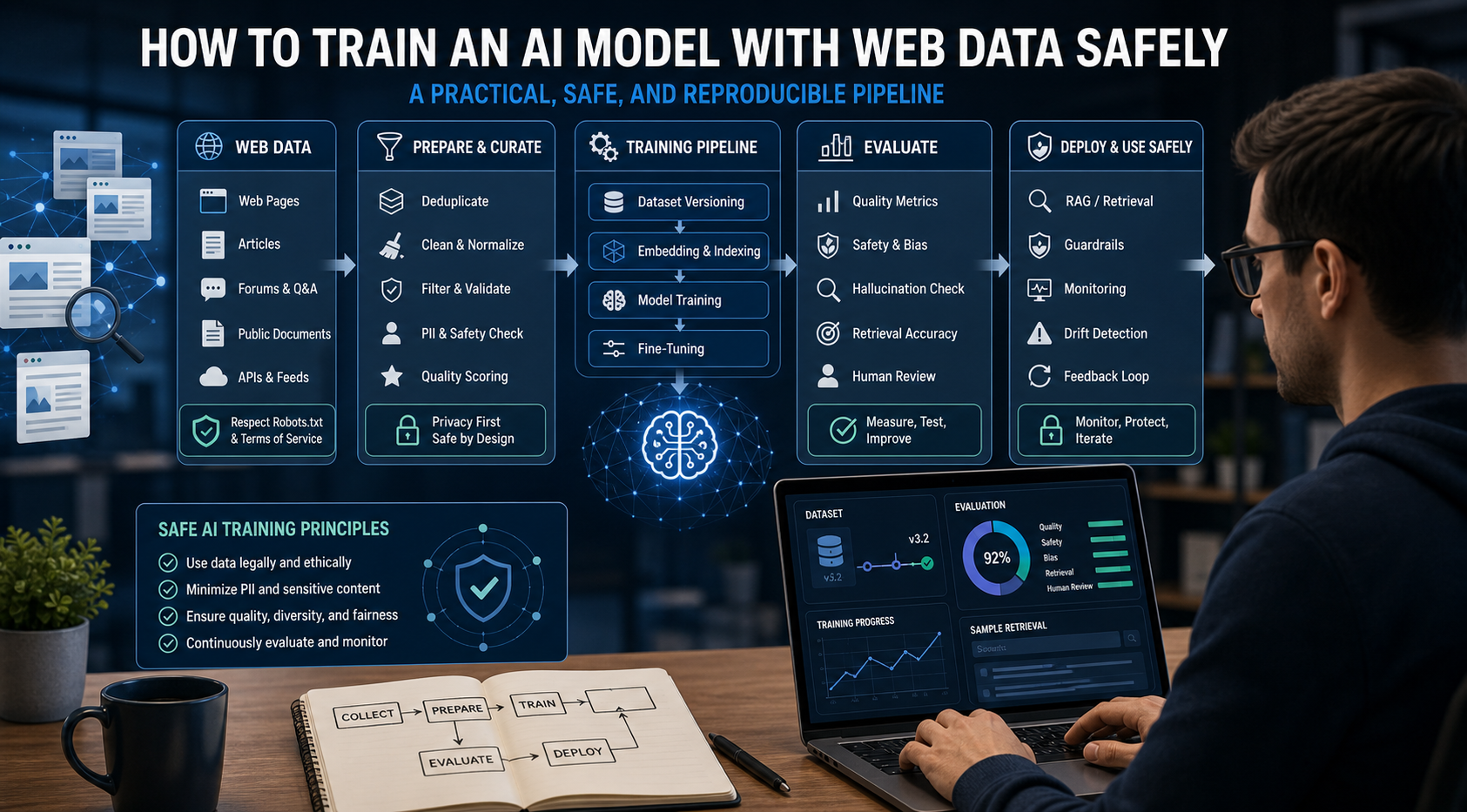
How to Train an AI Model With Web Data Safely
To train an AI model with web data, start by deciding whether you actually need training. Then collect representative sources, preserve provenance, remove duplicates and low-quality content, create leakage-resistant splits, build a baseline, fine-tune or train the appropriate model, and evaluate on real held-out examples before deployment.
View Details
Synthetic Data vs Real Web Data for AI Training
The useful question is no longer whether synthetic data will replace real web data. For most AI teams, it will not. The better question is which data source should do which job.
View Details