
Best Real Estate Scrapers in 2026
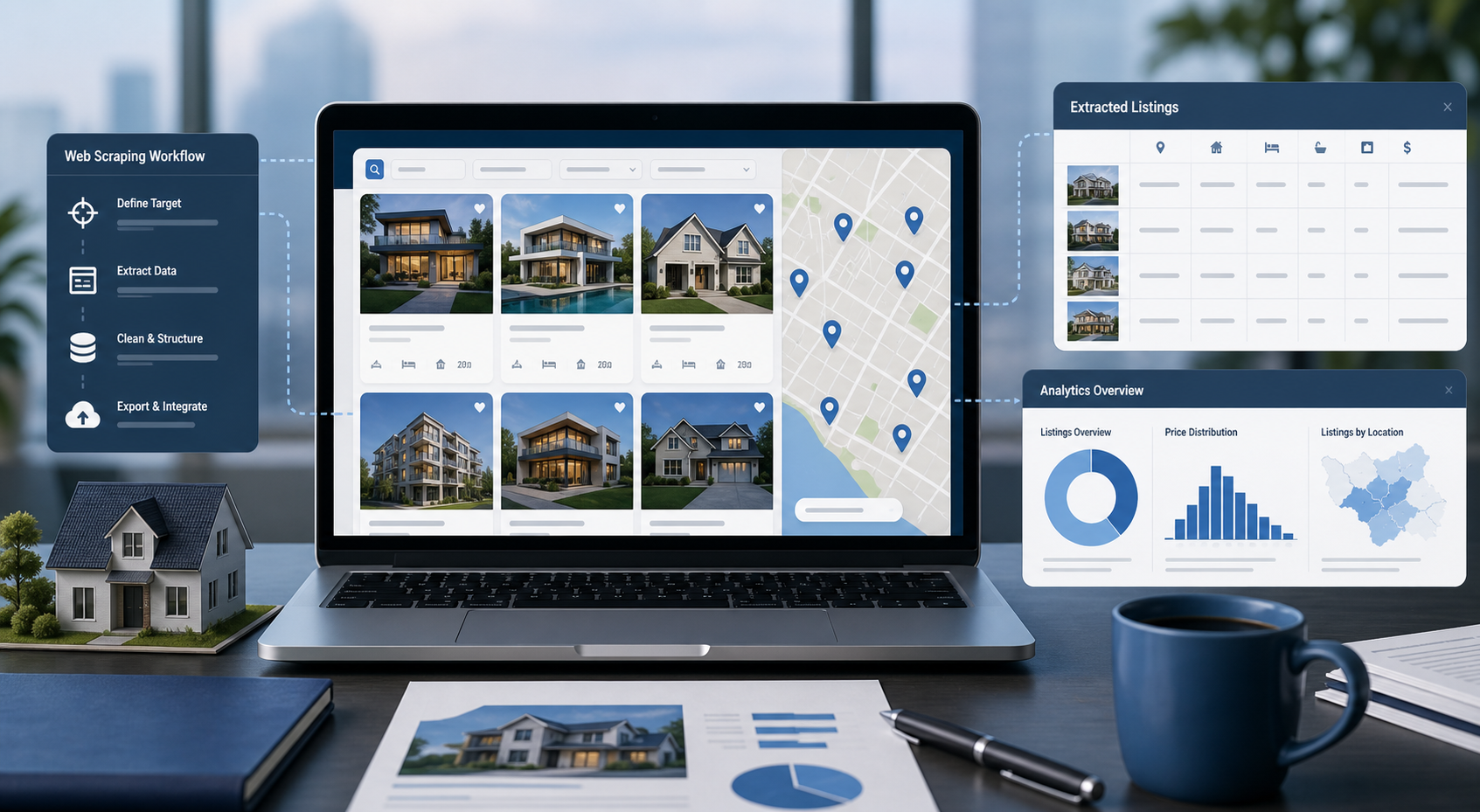
Real estate scraping can look deceptively simple. Find a property page, extract the address, price, bedrooms, bathrooms, and square footage, then repeat.
Production workloads become more complicated.
Property listings change. Pages rely on JavaScript. Search results use pagination or infinite scrolling. The same property may appear on multiple portals. Addresses may be formatted differently. Listings disappear after a sale. Price changes need to be distinguished from entirely new properties.
That means the best real estate scraper is not necessarily the tool that extracts the most fields from one page.
What Is a Real Estate Scraper?
A real estate scraper is software that converts information displayed on property websites into structured data.
For the official technical reference behind this point, see Playwright documentation.
Depending on the source, that data may include:
- property address
- asking price
- listing status
- bedrooms and bathrooms
- floor area
- lot size
- property type
- photos
- amenities
- agent or brokerage information
- listing URL
- geographic coordinates
- historical price information
The output may be delivered as JSON, CSV, spreadsheets, database records, API responses, or scheduled exports.
Real estate scraping tools also come in several different forms.
For the LycheeIP implementation details behind this step, review LycheeIP proxy infrastructure.
Prebuilt property scrapers
These are designed for known sources such as Zillow, Redfin, Realtor.com, Zoopla, Rightmove, or other property portals.
They usually require less configuration because the extraction logic is already defined.
General scraping APIs
You submit URLs and receive HTML or structured output. The provider may handle browser rendering, proxy infrastructure, retries, and other access-related components.
You normally retain more responsibility for defining the property schema.
For the LycheeIP implementation details behind this step, review rotating residential proxies.
For the LycheeIP implementation details behind this step, review scaling lead scraping with n8n.
For the official technical reference behind this point, see MDN HTTP overview.
No-code scraping platforms
These allow business users to select fields visually instead of writing extraction code.
They work well for research, monitoring, and relatively straightforward workflows.
Custom crawler stacks
Engineering teams may build crawlers using their preferred framework and separately manage parsing, browser automation, scheduling, storage, proxies, and validation.
This provides maximum control but creates more components to maintain.
Understanding these categories matters because comparing a visual scraper directly with a managed property API based only on monthly price tells you very little about which one is actually appropriate.
The 7 Best Real Estate Scrapers by Use Case
Apify Best suited to: Prebuilt property workflows Approach: Actor marketplace Main consideration: Actor quality varies
Oxylabs Best suited to: Dedicated property extraction APIs Approach: Managed API Main consideration: More infrastructure than small projects need
Browse AI Best suited to: Monitoring without code Approach: No-code robots Main consideration: Less developer-level control
Octoparse Best suited to: Visual extraction workflows Approach: No-code desktop/cloud Main consideration: Complex workflows still need configuration
ScrapingBee Best suited to: Developer-controlled scraping Approach: General scraping API Main consideration: Property parsing remains your responsibility
ScraperAPI Best suited to: Scalable URL collection Approach: Scraping API Main consideration: Credit consumption varies by features
Zyte API Best suited to: Custom production pipelines Approach: Full-stack scraping API Main consideration: Best suited to teams comfortable building extraction logic
There is no universal winner. Each addresses a different part of the real estate data problem.
- Apify: Best for Ready-Made Real Estate Scrapers
Apify is particularly useful when you want an existing property scraper instead of building everything from scratch.
Its platform uses applications called Actors, and its marketplace contains multiple property-focused Actors. Current options include tools targeting Zillow, Realtor.com, Redfin and multi-source real estate collection. Some Actors can normalize data from several portals into a common output structure.
Why it works well
The marketplace model dramatically reduces initial development time.
Instead of creating selectors, pagination logic, storage, and scheduling independently, you can start with an existing Actor and integrate its output into your application.
Apify also works well when your requirements change frequently because different Actors can be combined within the same platform.
Main limitation
An Actor marketplace introduces another variable: maintenance quality.
Some scrapers are maintained directly by professional developers or Apify, while others are community projects. Portal support, update frequency, pricing, field coverage, and reliability can therefore differ substantially between Actors.
For production use, test the specific Actor rather than evaluating Apify as though every marketplace scraper behaves identically.
Best for: teams that want to deploy portal-specific extraction quickly without building every crawler themselves.
- Oxylabs: Best for Dedicated Real Estate Scraper APIs
Oxylabs provides a real-estate-focused scraping API covering property websites including Zillow, Redfin, and Zoopla. Its current product materials describe extraction of fields such as pricing, location, property type, and amenities, with delivery through HTML or cloud-storage workflows.
For the LycheeIP implementation details behind this step, review AI-powered browser automation hub.
Sources:
- https://oxylabs.io/products/scraper-api/real-estate
- https://oxylabs.io/products/scraper-api/real-estate/zillow
This makes it different from a generic extraction library.
Much of the collection infrastructure is handled as a service.
Why it works well
A dedicated API is useful when property data is already part of a production application.
Instead of maintaining separate network access infrastructure, browser execution, and request handling, developers can focus on transforming and consuming the returned data.
Main limitation
A managed platform can be excessive for a one-time spreadsheet or a small research project.
Its value becomes clearer when data availability and recurring collection matter more than having the lowest possible entry cost.
Best for: proptech products, analytics platforms, and engineering teams operating recurring property-data pipelines.
- Browse AI: Best for No-Code Property Monitoring
Some real estate projects do not need millions of pages.
They need to answer questions such as:
- Did this property decrease in price?
- Has a new listing appeared?
- Is the property still available?
- Has its status changed?
- Has new inventory appeared within a particular search?
Browse AI is well suited to these workflows because it combines extraction and monitoring.
Its real estate product pages describe robots that can turn property listings into structured records and monitor price changes, new listings, and status updates without requiring code.
Why it works well
Monitoring is often more valuable than repeatedly rebuilding entire datasets.
For example, an acquisition team may already have 5,000 properties in its database. Recollecting everything daily is less efficient than identifying the records that changed.
Main limitation
No-code convenience can eventually become restrictive when you need complex transformation logic, large distributed pipelines, or tight integration with custom infrastructure.
Best for: investors, analysts, agencies, researchers, and operations teams that need recurring property monitoring without engineering a crawler.
- Octoparse: Best for Visual Extraction Workflows
Octoparse is another no-code option, but its strength is building visual extraction workflows.
The company provides real estate templates and documentation for extracting information from property sites, including Zillow and Realtor-related workflows.
A user can identify elements such as property title, address, price, and other fields through the visual interface rather than creating CSS or XPath selectors manually.
Why it works well
Octoparse can bridge the gap between a fixed template and custom programming.
An analyst who understands the desired dataset but does not want to build a Python crawler can still create fairly detailed extraction logic.
Main limitation
No-code does not mean no maintenance.
A major redesign of a property portal can still require the workflow to be reviewed or retrained.
Best for: analysts and business teams that need more customization than a one-click template but do not want to maintain scraping code.
- ScrapingBee: Best for Simple Developer Integration
ScrapingBee provides a general web scraping API rather than a dedicated real estate database.
Its platform supports functionality such as JavaScript rendering, rotating and premium proxies, geotargeting, screenshots, and extraction capabilities depending on the selected plan or request configuration.
Why it works well
For developers, that simplicity can be valuable.
Your application can control:
- which property pages are requested
- what fields are extracted
- how records are normalized
- where the data is stored
- how duplicates are detected
Meanwhile, ScrapingBee manages much of the web-access layer.
Main limitation
It is not inherently a property intelligence system.
Your team still needs to determine how a Zillow record maps to a Redfin record, what constitutes the same property, how price history is stored, and how incomplete fields are handled.
Best for: developers who want infrastructure assistance but want to retain control over their property-data model.
- ScraperAPI: Best for General-Purpose Collection at Scale
ScraperAPI provides another API-first approach.
Its documentation supports capabilities including JavaScript rendering and geotargeting, while higher request complexity can consume additional credits.
Sources:
- https://docs.scraperapi.com/control-and-optimization/supported-parameters
- https://docs.scraperapi.com/data-pipeline/creating-a-datapipeline-project/input-and-parameters
Its DataPipeline product also supports recurring collection parameters and country-level targeting.
Why it works well
This approach makes sense when real estate is only one of several sources your organization collects.
Instead of deploying a specialized infrastructure stack for every website category, developers can use a common request layer.
Main limitation
Credit-based pricing needs to be evaluated against your actual target configuration.
A request requiring additional processing may have a different effective cost than a simple HTML request.
Best for: technical teams operating high-volume or multi-industry web collection.
- Zyte API: Best for Custom Production Data Pipelines
Zyte API combines web access, browser rendering, and extraction capabilities in one platform. Zyte's documentation also provides automatic extraction and configurable AI-based extraction options.
For real estate teams, this is useful when the goal is not simply to scrape one portal but to build a maintainable data acquisition architecture.
Why it works well
A team can separate its crawler into logical layers:
- URL discovery
- page acquisition
- data extraction
- normalization
- validation
- storage
- monitoring
This architecture becomes increasingly valuable as the number of sources grows.
Main limitation
Teams seeking a one-click Zillow exporter may find a more specialized template easier.
Best for: engineering organizations building custom and long-lived web-data platforms.
What Should You Compare Before Choosing a Real Estate Scraper?
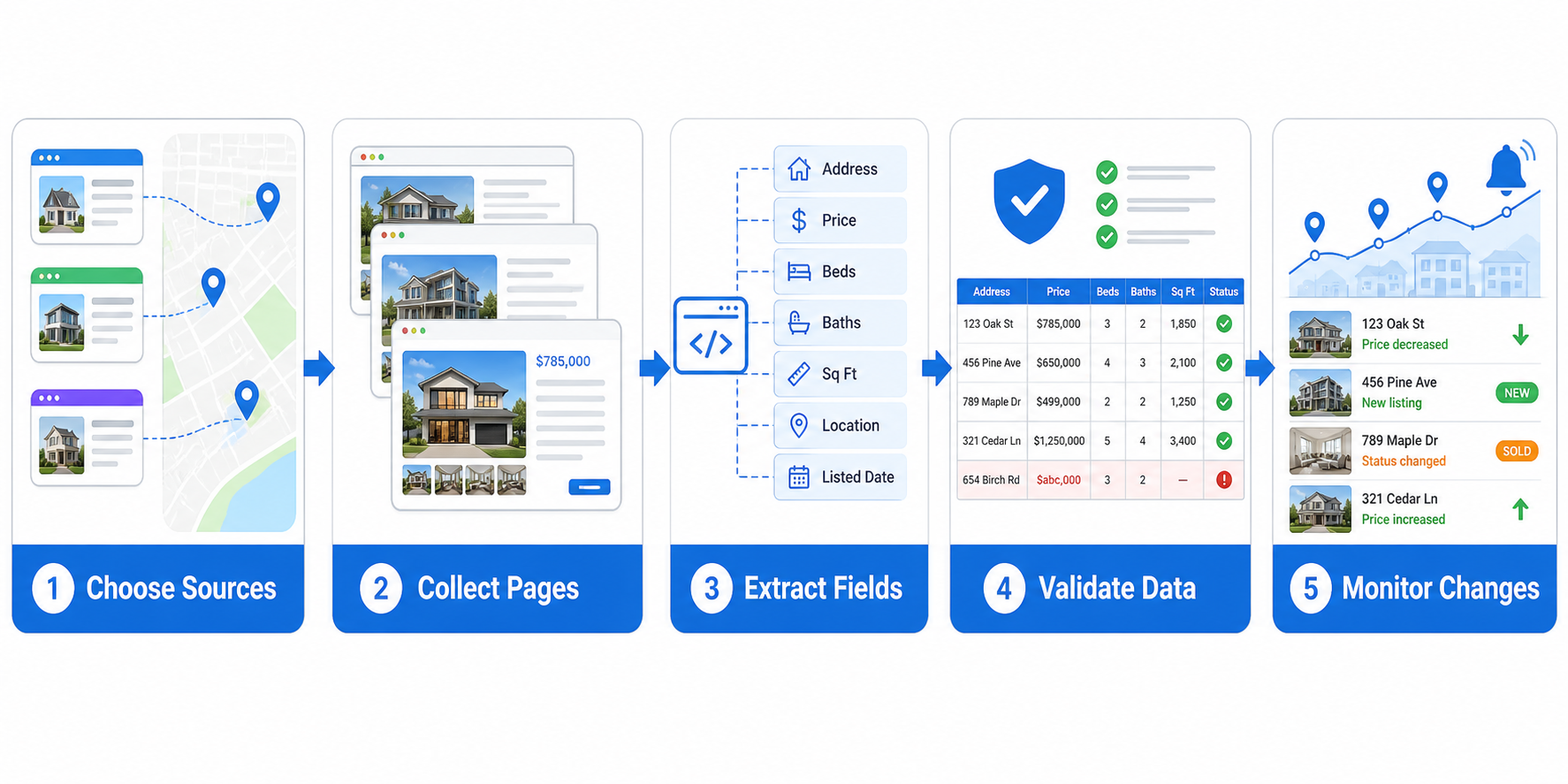
Tool features matter, but your data requirements matter more.
Use the following criteria.
- Portal coverage
Write down the sources you actually need.
A tool supporting 100 websites is not automatically better if your project depends on two portals it handles poorly.
Test your priority sources individually.
- Search-page and detail-page support
Search results may provide basic fields such as:
- address
- price
- bedrooms
- bathrooms
Individual listing pages may provide much richer attributes.
Determine whether you need discovery data, detailed property records, or both.
- Data freshness
Ask how frequently the data needs to change.
A quarterly market report has very different requirements from a product that alerts investors within hours of a price reduction.
- Schema consistency
This is one of the most overlooked problems in property scraping.
One portal might label a field as livingArea.
Another might use squareFeet.
Another may combine several floor-area definitions.
Your production database needs a normalized schema that can distinguish those meanings rather than simply renaming everything.
- Listing identity and deduplication
URLs are not always reliable property identifiers.
A property may:
- appear on several portals
- be relisted
- change agent
- receive a new URL
- disappear and later return
Good property-data systems therefore need a strategy for identifying the underlying property independently of the current listing URL.
- Monitoring capability
If your goal involves price intelligence or inventory changes, ask whether the tool can run automatically and expose differences between observations.
Continuous monitoring can be more useful than raw extraction volume.
- Error visibility
A production system should distinguish between:
- no listings found
- source page changed
- access denied
- extraction failed
- timeout
- incomplete response
- duplicate data
Treating all of those outcomes as an empty dataset can corrupt downstream analysis.
A Proxy Is Not the Same Thing as a Real Estate Scraper
This distinction is particularly important for LycheeIP readers.
A scraper determines:
- what pages to visit
- what fields to extract
- how pagination works
- how data is transformed
A proxy controls the network path used to make the request.
Those are separate layers.
LycheeIP provides proxy infrastructure across several proxy categories rather than acting as a property-data parser. Its materials describe residential, ISP, datacenter, and mobile-oriented proxy options for developer workflows.
That means a custom real estate crawler may use LycheeIP at the network layer while handling extraction with Python, Crawlee, Scrapy, Playwright, or another scraping framework.
Keeping the layers separate also lets engineering teams choose infrastructure based on target difficulty instead of paying for the most expensive request path everywhere.
How to Validate Real Estate Data Before You Trust It
Getting HTTP responses is not the same as collecting reliable data.
Production workflows should validate the dataset itself.
Check record completeness
Measure how often important fields are missing.
For example:
- address completeness
- price completeness
- property type completeness
- coordinate completeness
A successful request returning incomplete listings is still a data-quality failure.
Monitor record counts
A sudden fall from 20,000 listings to 500 may indicate:
- a source redesign
- pagination failure
- filtering error
- blocked collection
- extraction failure
Do not automatically interpret the result as a real change in inventory.
Detect duplicates
Create repeatable property keys using appropriate combinations of identifiers rather than relying solely on URLs.
Track observation time
Property data becomes more valuable when every record includes when it was observed.
Without timestamps, you cannot reliably reconstruct:
- price reductions
- listing duration
- inventory movement
- relisting behavior
Store raw observations when practical
Keeping selected raw responses or snapshots can make debugging much easier when a parser produces unexpected results.
Real Estate Scraping Costs More Than the Subscription Price
When comparing tools, estimate total operating cost rather than simply monthly pricing.
Include:
- scraping platform fees
- proxy usage
- browser rendering
- engineering time
- parser maintenance
- retries
- storage
- data cleaning
- monitoring
- failed request volume
A tool that appears inexpensive but requires constant manual repair may cost more than a managed service.
Likewise, using a premium collection path for pages that can be retrieved through simpler infrastructure can unnecessarily increase cost.
Measure cost per usable property record, not merely cost per request.
Responsible Real Estate Data Collection
Publicly visible data should not automatically be treated as unrestricted data.
The IETF's Robots Exclusion Protocol provides a standardized way for site operators to communicate crawler preferences, while explicitly noting that robots.txt is not itself a form of access authorization.
Legal considerations can also depend on jurisdiction, authorization, contractual restrictions, the type of information collected, and what you later do with the data. Personal data introduces additional obligations in jurisdictions governed by frameworks such as the GDPR.
For business-critical collection, evaluate the site's terms, applicable law, privacy implications, request load, and whether an official API, licensed feed, or commercial dataset would be more appropriate.
Power real estate data collection with LycheeIP proxy infrastructure
How to Choose the Right Real Estate Scraper
A simple decision framework works better than looking for a universal number-one tool.
Choose Apify when you want ready-made property scrapers and marketplace flexibility.
Choose Oxylabs when you want a managed API specifically suited to production real estate extraction.
Choose Browse AI when recurring monitoring matters more than developer control.
Choose Octoparse when non-developers need to build custom visual extraction workflows.
Choose ScrapingBee when developers want a straightforward web-access API while keeping their own extraction logic.
Choose ScraperAPI when real estate forms part of a broader high-volume scraping environment.
Choose Zyte API when you are building a custom, long-term extraction architecture.
And if you build the crawler yourself, treat proxy infrastructure as a separate architectural decision rather than confusing the proxy with the scraper.
Frequently Asked Questions
What is the best real estate scraper?
There is no single best option for every project. Apify is useful for ready-made scrapers, Browse AI and Octoparse suit no-code workflows, while Oxylabs, ScrapingBee, ScraperAPI, and Zyte are better suited to different developer and production requirements.
Can I scrape property prices automatically?
Yes. Property scraping workflows can collect asking prices on a schedule and compare observations over time. The difficult part is maintaining consistent property identifiers so that a new observation is correctly recognized as a price change rather than a new property.
Do I need proxies for real estate scraping?
Not every target requires the same network infrastructure. Start with the simplest permitted approach that works reliably and only introduce additional infrastructure when the target, location requirements, or scale justify it.
Is a Zillow scraper the same as a real estate scraper?
A Zillow scraper targets one specific property platform. A broader real estate scraper may support several portals or allow you to create extraction rules for arbitrary property websites.
Should I buy property data instead of scraping it?
Sometimes. If the exact dataset already exists with acceptable freshness, licensing, coverage, and cost, purchasing it may eliminate considerable engineering work. Scraping becomes more attractive when you need custom fields, sources, update frequencies, or transformations that existing datasets do not provide. Conclusion Choosing the best real estate scraper starts with the dataset you want, not the vendor list. Define your sources, fields, update frequency, scale, output format, and acceptable maintenance burden first. Then evaluate tools against those requirements. For small workflows, a no-code scraper may be all you need. For a property intelligence platform, schema consistency, monitoring, validation, and reliable infrastructure matter far more. The strongest real estate data systems treat collection as a pipeline rather than a one-time scrape. That means designing for change, measuring data quality, detecting failures early, and choosing each layer of the stack for the job it actually performs.
Related LycheeIP Guides and Resources

Recommended Articles
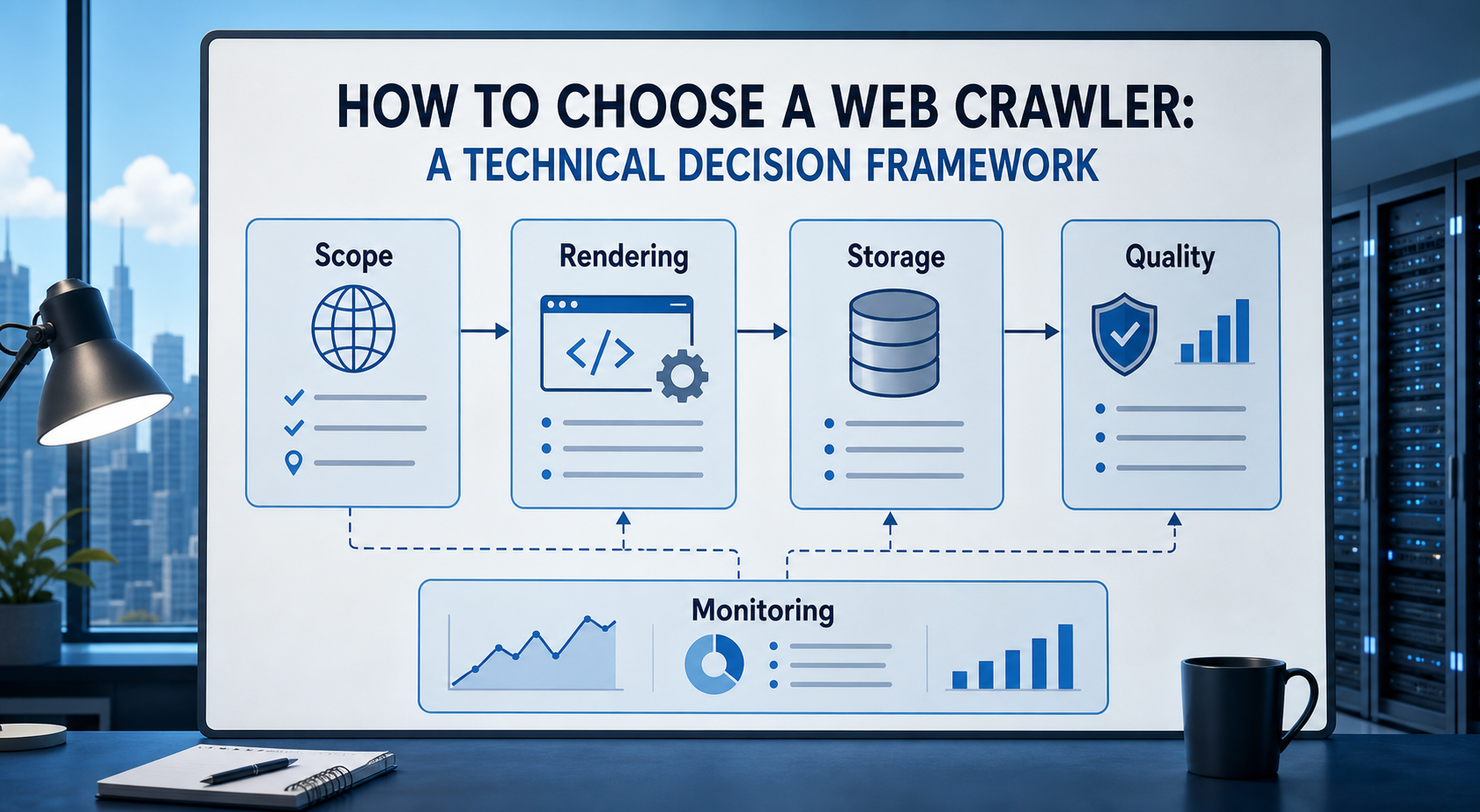
How to Choose a Web Crawler: A Technical Decision Framework
The wrong way to choose a web crawler is to begin with a list of products. The right starting point is the system you need to build. Before comparing tools, define:
View Details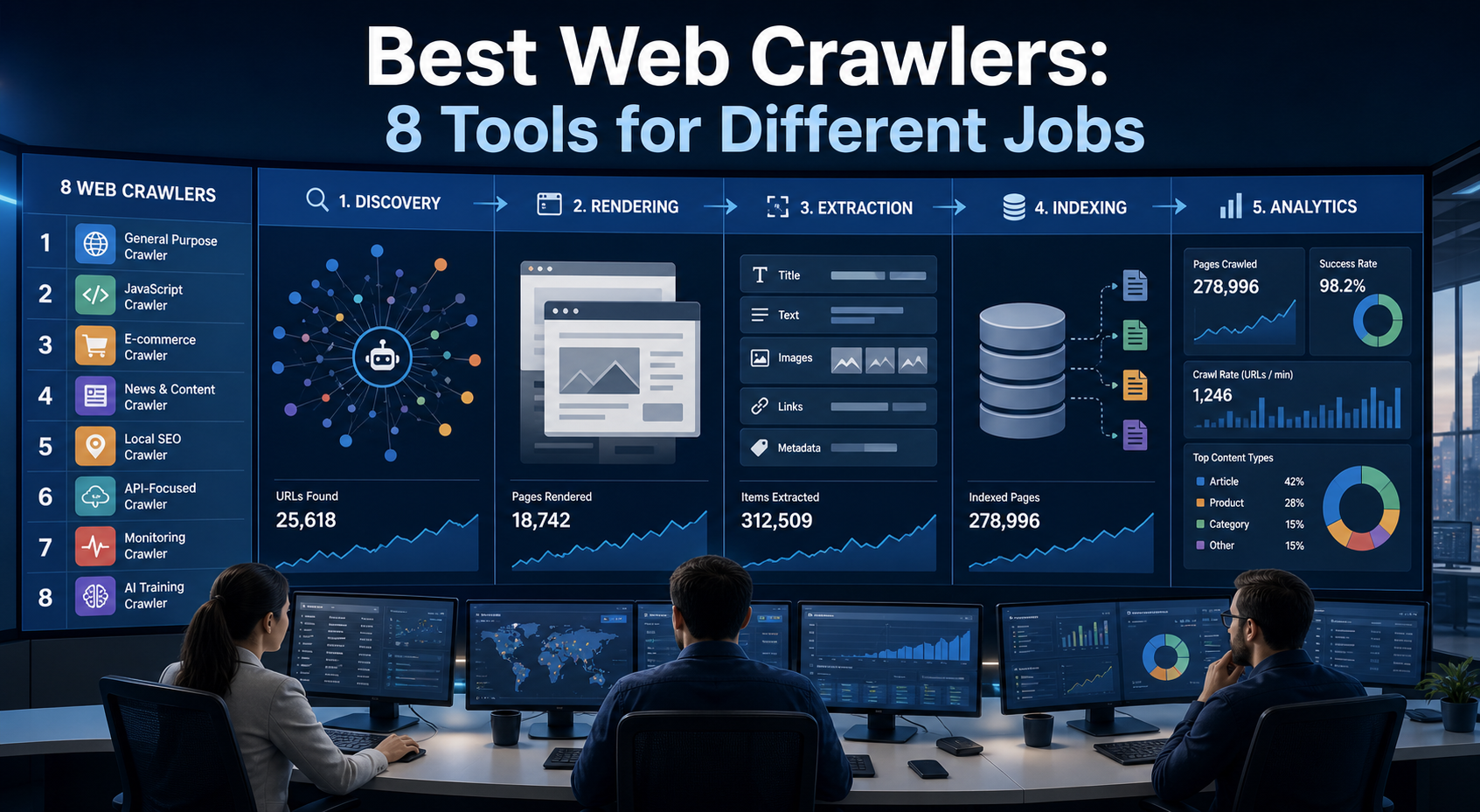
Best Web Crawlers: 8 Tools for Different Jobs
There is no single best web crawler for every project. A technical SEO audit, an AI knowledge pipeline, an internet archive, and a distributed search index may all involve crawling URLs, but they require different capabilities. The most useful way to compare web crawler tools is therefore to ask what job each one was designed to perform. This guide evaluates eight strong options across:
View Details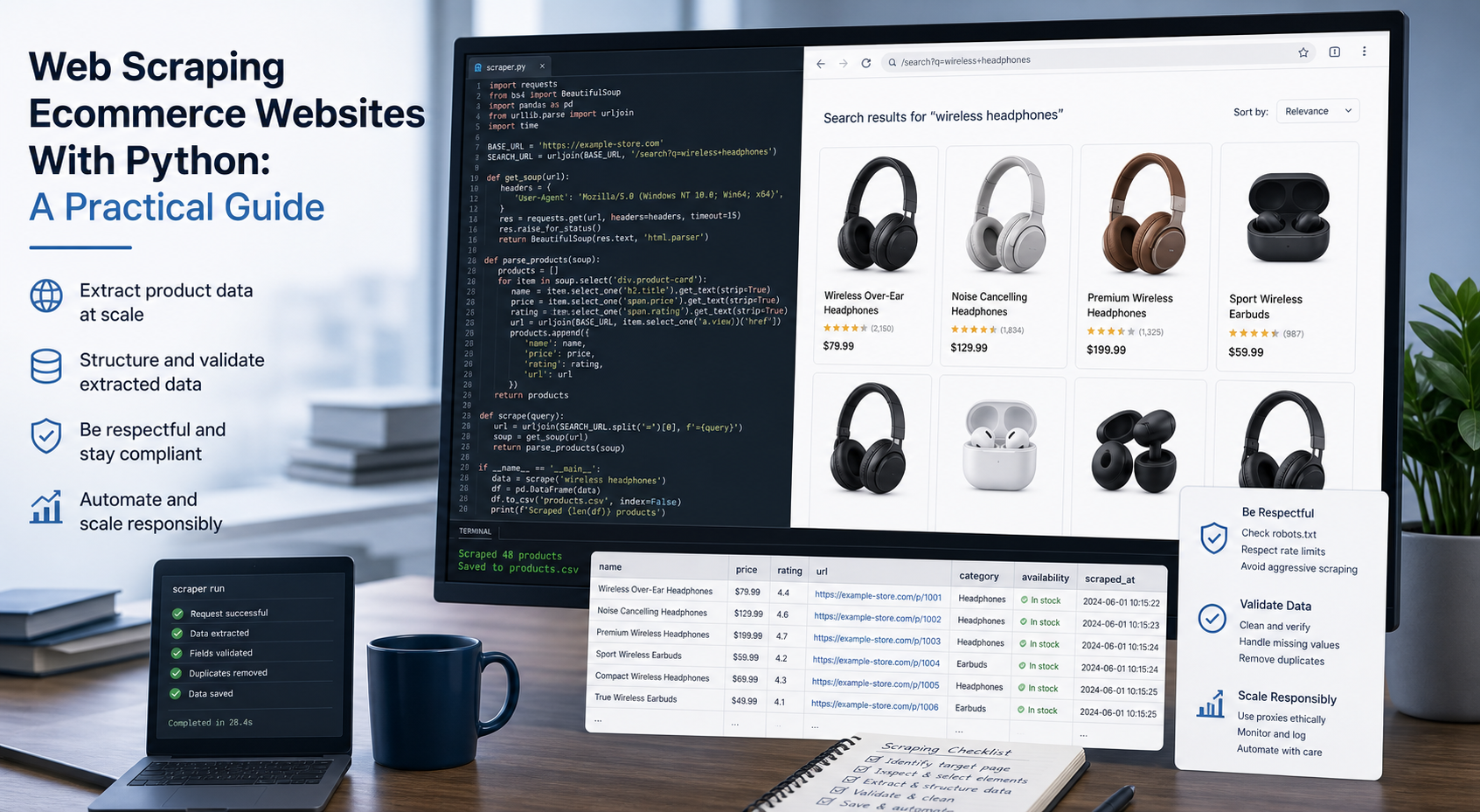
Web Scraping Ecommerce Websites With Python: A Practical Guide
Recommended meta title: Web Scraping Ecommerce Websites With Python: Guide Recommended meta description: Learn how to scrape ecommerce websites with Python using Requests, Beautiful Soup, Playwright, and Scrapy, with validation and scaling guidance. URL slug: /web-scraping-ecommerce-websites-python/
View Details
How to Train an AI Model With Web Data Safely
To train an AI model with web data, start by deciding whether you actually need training. Then collect representative sources, preserve provenance, remove duplicates and low-quality content, create leakage-resistant splits, build a baseline, fine-tune or train the appropriate model, and evaluate on real held-out examples before deployment.
View Details
Synthetic Data vs Real Web Data for AI Training
The useful question is no longer whether synthetic data will replace real web data. For most AI teams, it will not. The better question is which data source should do which job.
View Details