
Synthetic Data vs Real Web Data for AI Training

The useful question is no longer whether synthetic data will replace real web data. For most AI teams, it will not. The better question is which data source should do which job.
The useful question is no longer whether synthetic data will replace real web data. For most AI teams, it will not. The better question is which data source should do which job.
Real web data is strongest when a model needs contact with current language, real customer behavior, changing products, rare phrasing, and the messy distribution of the outside world. Synthetic data is strongest when a team needs controlled examples, more coverage of a known gap, privacy-aware test records, or repeatable simulations.
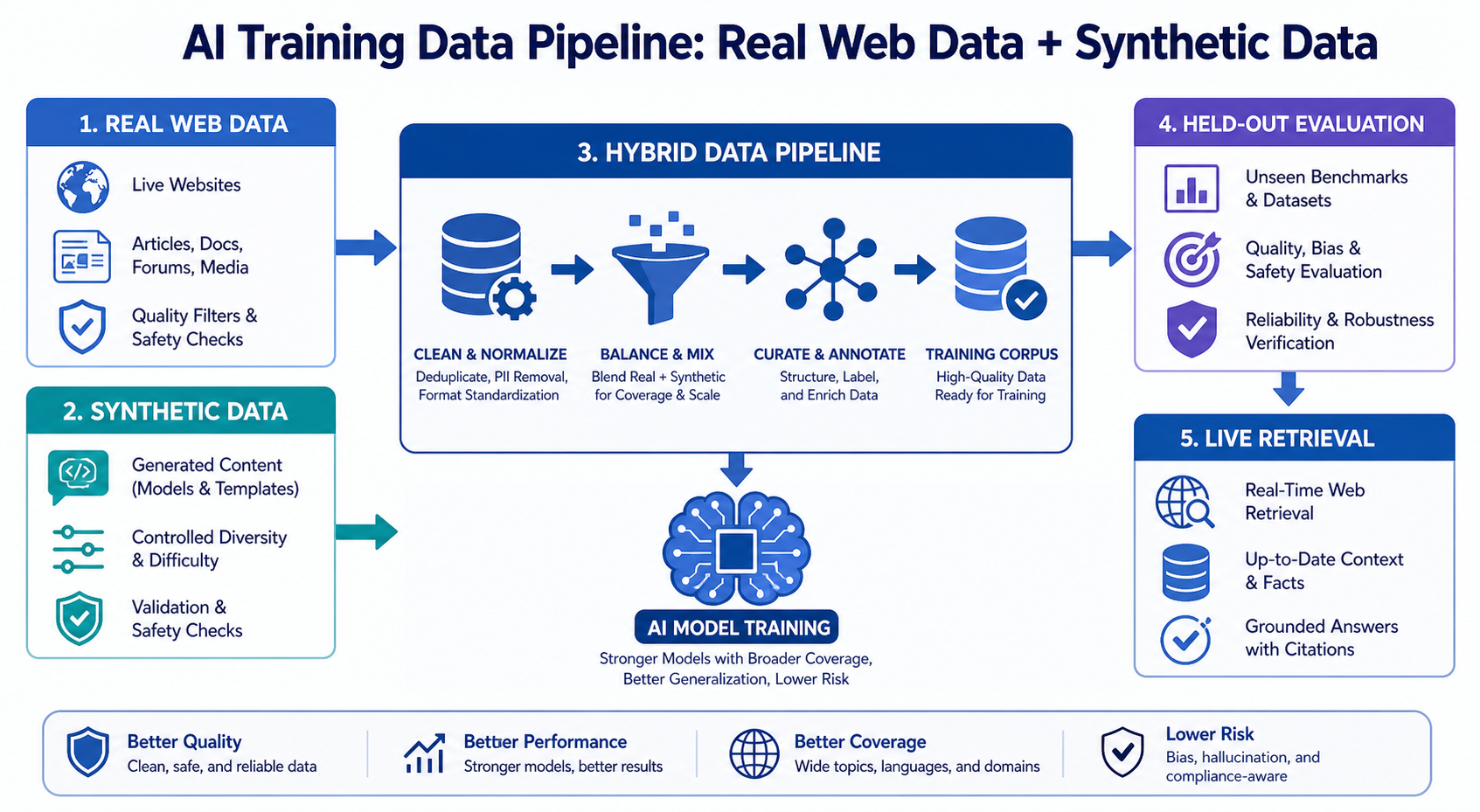
That makes synthetic data vs real web data a pipeline design decision, not a philosophical contest. A strong AI system may use real data to define reality, synthetic data to expand targeted scenarios, a held-out real dataset for evaluation, and live web retrieval to keep outputs current after training.
The Difference That Matters: Observed Data vs Constructed Data
Real web data records information that appeared in actual public web environments. Depending on the project, this may include product pages, documentation, forums, news pages, job listings, reviews, public filings, code, PDFs, images, or structured responses from public endpoints.
Synthetic data is constructed rather than directly observed. A rule engine, simulator, generative model, rendering pipeline, or statistical model creates examples intended to represent a target distribution or task.
The distinction matters because each source fails in a different way.
Real web data can be duplicated, stale, spammy, imbalanced, legally sensitive, or contaminated by automated content. Synthetic data can inherit generator bias, overrepresent easy patterns, hide rare cases, and produce examples that look plausible while missing how the real world behaves.
A data strategy should therefore ask two questions for every dataset:
- What does this data preserve from reality?
- What error does the method of collection or generation introduce?
Those questions are more useful than labeling one source as "authentic" and the other as "fake."
For the official technical reference behind this point, see MDN HTTP overview.
Where Real Web Data Has the Strongest Advantage
It captures the distribution you actually have to serve
Production systems encounter spelling mistakes, mixed terminology, incomplete context, slang, local phrasing, unusual page layouts, conflicting claims, and changing product descriptions. Real web data contains these irregularities because people and organizations produced the source material for real purposes.
That complexity is valuable when the model will operate in an open environment. A customer support classifier trained only on polished synthetic tickets may perform well in a lab and struggle with short, angry, multilingual, or badly formatted messages. A shopping model may understand clean catalog examples but miss how merchants vary attributes, units, and product naming.
Real data exposes the model to the distribution it must survive.
It is essential for freshness-sensitive systems
Training freezes knowledge into model parameters at a point in time. Markets, prices, laws, software documentation, product inventories, security advisories, and news continue to change.
For these use cases, the solution is often not "train again on more data." It is to connect the system to live or frequently refreshed web data through retrieval, search, or a structured data pipeline.
This is why real web data matters beyond pretraining. Historical web corpora can support model development, while live web data can ground a retrieval-augmented generation system or agent at inference time.
It gives you a credible evaluation anchor
A synthetic test set can verify whether a model handles a scenario the generator knows how to create. It cannot prove that the model handles the full range of real production cases.
A held-out real dataset is therefore one of the most important controls in a hybrid pipeline. It helps answer whether synthetic augmentation improved the target task or simply made the model better at recognizing the generator's patterns.
Where Synthetic Data Creates Real Value
Synthetic data is useful when it is generated for a defined purpose. The strongest use cases are usually targeted rather than indiscriminate.
Filling known coverage gaps
Suppose a fraud model has millions of normal events but very few examples of a specific attack pattern. A simulator or generator can produce controlled variations of the rare scenario so the team can test detection behavior.
The same idea applies to language tasks. If a model consistently fails on a narrow instruction type, a team can generate candidate examples, review them, and add high-quality cases to the training set.
The key is that the gap is measured first. "Generate more data" is not a strategy. "Increase verified examples for these five failure categories" is.
Creating controlled counterfactuals
Synthetic data can change one variable while holding others constant. That makes it valuable for fairness checks, robustness tests, and causal-style analysis.
For example, an evaluation set can preserve the intent of a customer request while varying geography, writing style, or product category. If the model's result changes unexpectedly, the team has a clear investigation path.
Real web data rarely arrives in such neat pairs.
Simulating environments that are expensive or dangerous to reproduce
Robotics, autonomous systems, security testing, industrial inspection, and computer vision often use simulation because collecting every physical scenario would be slow, expensive, or unsafe.
Synthetic environments also make experiments repeatable. The same scenario can be rerun after a model or policy update.
Producing privacy-aware development data
Synthetic records may reduce direct exposure to personal information when they are generated and validated appropriately. But synthetic does not automatically mean anonymous or risk free.
A generator can memorize training records. Poorly designed synthetic datasets can preserve rare combinations that point back to individuals. Privacy teams still need provenance, disclosure-risk testing, access controls, and a clear understanding of the source data used to build the generator.
Treat privacy as an engineering and governance process, not a label attached to the word "synthetic."
The Hidden Risk: Synthetic Feedback Loops
One of the most important developments in the synthetic data debate is research on recursive training.
A 2024 Nature paper by Ilia Shumailov and co-authors showed that repeatedly training generative models on recursively generated data can degrade the learned distribution. The problem is often described as model collapse. Rare parts of the original distribution can disappear first, while later generations may lose broader structure.
This does not mean any synthetic data causes collapse. The training setup matters.
Separate 2024 work by Matthias Gerstgrasser and colleagues found that accumulating synthetic data alongside the original real data avoided collapse in the experimental settings they studied, while replacing the original data with successive synthetic generations did not.
The practical lesson is straightforward: do not create an unlabeled feedback loop where model output quietly becomes the next model's reality.
Track data provenance. Preserve high-quality real anchors. Measure rare-case performance. Identify AI-generated content when possible. And test synthetic-heavy changes against a held-out real distribution.
A Better Way to Compare Synthetic and Real Web Data
The following decision criteria are more useful than a simple pros-and-cons list.
- Real-world language and behavior: Real web data is strong. Synthetic data depends on generator fidelity.
- Current information: Real web data is strong when collected recently. Synthetic data is weak unless grounded in current sources.
- Rare scenario coverage: Real web data is often sparse. Synthetic data can be targeted deliberately.
- Experimental control: Real web data is limited. Synthetic data is strong.
- Natural noise and edge cases: Real web data is strong. Synthetic data often underrepresents them.
- Privacy exposure: Real web data requires careful handling. Synthetic data can reduce direct exposure, but still needs testing.
- Scale: Real web data can be costly to collect and process. Synthetic data can be generated rapidly.
- Provenance: Real web data can retain source URLs and timestamps. Synthetic data needs generator, prompt, model, and seed tracking.
- Evaluation credibility: Representative held-out real data is a strong anchor. Synthetic data is useful for targeted tests but weaker as the only benchmark.
The right answer changes by stage of the AI lifecycle.
Choose Data by Stage of the AI Lifecycle
For the LycheeIP implementation details behind this step, review AI-powered browser automation hub.
For the LycheeIP implementation details behind this step, review AI browser automation setup guide.
For the LycheeIP implementation details behind this step, review Claude-powered AI operating system.
For the official technical reference behind this point, see Anthropic documentation.
Pretraining: maximize breadth without losing provenance
Foundation model pretraining needs broad coverage and diversity. Real web data remains valuable because it contains the long tail of human expression, domain vocabulary, code, and knowledge.
Synthetic data can supplement areas where curated examples are scarce, but teams should be cautious about large-scale recursive generation that is not traceable to a measured coverage objective.
For web-derived corpora, collection is only the first step. Deduplication, language detection, spam filtering, document quality scoring, source balancing, and near-duplicate detection can matter as much as raw volume.
Fine-tuning: optimize for demonstrated behavior
Fine-tuning is usually narrower. The dataset should show the behavior you want the model to learn.
Here synthetic data can be very effective because examples can be generated around a defined task. The safest workflow is human- or rule-reviewed generation, not a blind dump of model outputs.
Start with real examples of successful behavior. Build an error taxonomy. Generate additional cases for measured weaknesses. Review them. Then train and compare against a baseline.
Evaluation: keep real data as the anchor
Use synthetic evaluation cases for edge conditions, adversarial prompts, and controlled variations. But maintain a real, held-out evaluation set that reflects production traffic or the actual web distribution you care about.
Do not let the same generator create the training examples and the only test set. That creates a common blind spot: the system may learn the generator's style and then be graded by the same style.
RAG and agents: prioritize fresh real data
Retrieval-augmented generation and web-connected agents need current sources. Synthetic data can help test the retrieval pipeline, generate query variants, or simulate failure modes, but it cannot substitute for the live facts the system is expected to retrieve.
For these systems, freshness, source coverage, extraction reliability, document timestamps, and citation traceability should be first-class metrics.
For the LycheeIP implementation details behind this step, review LycheeIP proxy infrastructure.
A Practical Hybrid Data Workflow
A hybrid strategy works best when each source has a written job description.
1. Define the target behavior
Write the production task in measurable terms. "Improve the model" is too vague. Better objectives include reducing unsupported answers on current pricing questions, improving recall for a rare intent class, or increasing extraction accuracy on a defined group of page templates.
2. Build a real-data baseline
Collect representative real examples. Preserve source, timestamp, geography, language, and acquisition method where relevant.
Do not clean away every irregularity. Some noise is part of the production environment.
3. Create an error taxonomy
Run a baseline model and group failures. Typical categories include missing context, rare terminology, formatting variation, ambiguous intent, temporal staleness, and insufficient negative examples.
4. Generate synthetic data only for measured gaps
Create synthetic examples that target the error categories. Vary difficulty and wording. For structured tasks, validate schema and constraints automatically. For open-ended tasks, use expert review or a rigorous acceptance rubric.
5. Deduplicate across real and synthetic sources
Near duplicates can inflate apparent dataset size and contaminate evaluation splits. Use content hashes for exact duplicates and embedding, MinHash, or locality-sensitive methods for near-duplicate detection depending on scale.
6. Split before aggressive augmentation
Create train, validation, and test boundaries before generating close variants of existing examples. Otherwise, a synthetic paraphrase of a training example may leak into the test set.
For web data, consider splitting by source domain, entity, customer, or time period rather than using only random row splits.
7. Track provenance
Every synthetic record should be traceable to its generation method. Store the generator model or rule version, prompt template, source examples, validation status, and generation date.
Every real web record should retain the source URL or source identifier, collection timestamp, and transformation history where policy allows.
8. Evaluate on multiple distributions
At minimum, compare performance on:
- held-out real data
- targeted synthetic edge cases
- recent production samples
- rare or high-cost failure categories
A model that improves on average but loses the long tail may still be worse for the business.
Common Mistakes AI Teams Make With Data Choice
Mistake 1: using synthetic scale to hide weak data design
A million generated examples do not fix an unclear task definition. If the examples encode inconsistent answers, the model learns inconsistency at scale.
Mistake 2: treating scraped data as ready-to-train data
Web collection produces raw material. Training data needs quality controls, deduplication, normalization, provenance, and a sampling strategy.
Mistake 3: measuring only aggregate accuracy
Aggregate scores can hide failure on minority patterns or rare scenarios. Track slice-level metrics for the categories that matter.
Mistake 4: losing the boundary between generated and observed content
When provenance disappears, teams cannot measure whether model quality changes as synthetic content increases. This is especially risky when future collection pipelines may recrawl AI-generated material from the public web.
Mistake 5: using training to solve a freshness problem
If the answer changes every day, weekly, or monthly, retrieval may be a better architecture than repeated fine-tuning.
Use LycheeIP to collect real web data for AI systems
How to Decide: Real, Synthetic, or Hybrid?
Use real web data first when the task depends on current facts, natural language variation, authentic behavior, or real-world evaluation.
Use synthetic data first when you need controlled scenarios, explicit counterfactuals, simulated environments, or targeted augmentation for a measured failure mode.
Use a hybrid approach when the model needs both real-world grounding and broader edge-case coverage. In practice, this is the most common pattern for mature AI systems because training, evaluation, and retrieval have different data needs.
The important part is not choosing a fixed percentage of synthetic data. There is no universal ratio that is correct across tasks. The right mixture should be determined by evaluation against the production distribution.
Frequently Asked Questions
Is synthetic data better than real data for AI training?
Not universally. Synthetic data is better for controlled generation and targeted coverage. Real data is better for representing actual language, behavior, and current conditions. Many systems benefit from using both for different purposes.
Can an AI model be trained only on synthetic data?
It can be done for some narrow or simulated tasks, but teams should test carefully for domain gap and recursive-generation effects. For open-world models, real data remains an important grounding and evaluation source.
Is synthetic data automatically private?
No. Synthetic data can reduce direct use of personal records, but privacy depends on how the generator was trained, whether rare records can be inferred, and how the synthetic set is validated and governed.
What is model collapse?
Model collapse describes degradation that can occur in recursive training loops when generated data replaces or distorts the original distribution. Research has shown that rare parts of a distribution can be lost early in the process.
Should real web data be used for RAG or fine-tuning?
It can support both. Use fine-tuning to teach behavior or task patterns. Use retrieval when the system needs facts that change or must be traced to current sources. Conclusion Synthetic data is not the replacement for real web data, and real web data is not a complete training strategy by itself. The stronger approach is to assign each dataset a purpose. Let real web data define the world the model must understand. Use synthetic data to expand measured gaps and create controlled tests. Keep held-out real data as an evaluation anchor. Use live retrieval when freshness matters. The teams that get this right will not be the ones with the largest undifferentiated dataset. They will be the ones that can explain where each example came from, why it is in the pipeline, what failure it addresses, and how model performance changes on real production distributions.
Related LycheeIP Guides and Resources

Recommended Articles

Best Real Estate Scrapers in 2026
Best Real Estate Scrapers in 2026
View Details
How to Choose a Web Crawler: A Technical Decision Framework
The wrong way to choose a web crawler is to begin with a list of products. The right starting point is the system you need to build. Before comparing tools, define:
View Details
Best Web Crawlers: 8 Tools for Different Jobs
There is no single best web crawler for every project. A technical SEO audit, an AI knowledge pipeline, an internet archive, and a distributed search index may all involve crawling URLs, but they require different capabilities. The most useful way to compare web crawler tools is therefore to ask what job each one was designed to perform. This guide evaluates eight strong options across:
View Details
Web Scraping Ecommerce Websites With Python: A Practical Guide
Recommended meta title: Web Scraping Ecommerce Websites With Python: Guide Recommended meta description: Learn how to scrape ecommerce websites with Python using Requests, Beautiful Soup, Playwright, and Scrapy, with validation and scaling guidance. URL slug: /web-scraping-ecommerce-websites-python/
View Details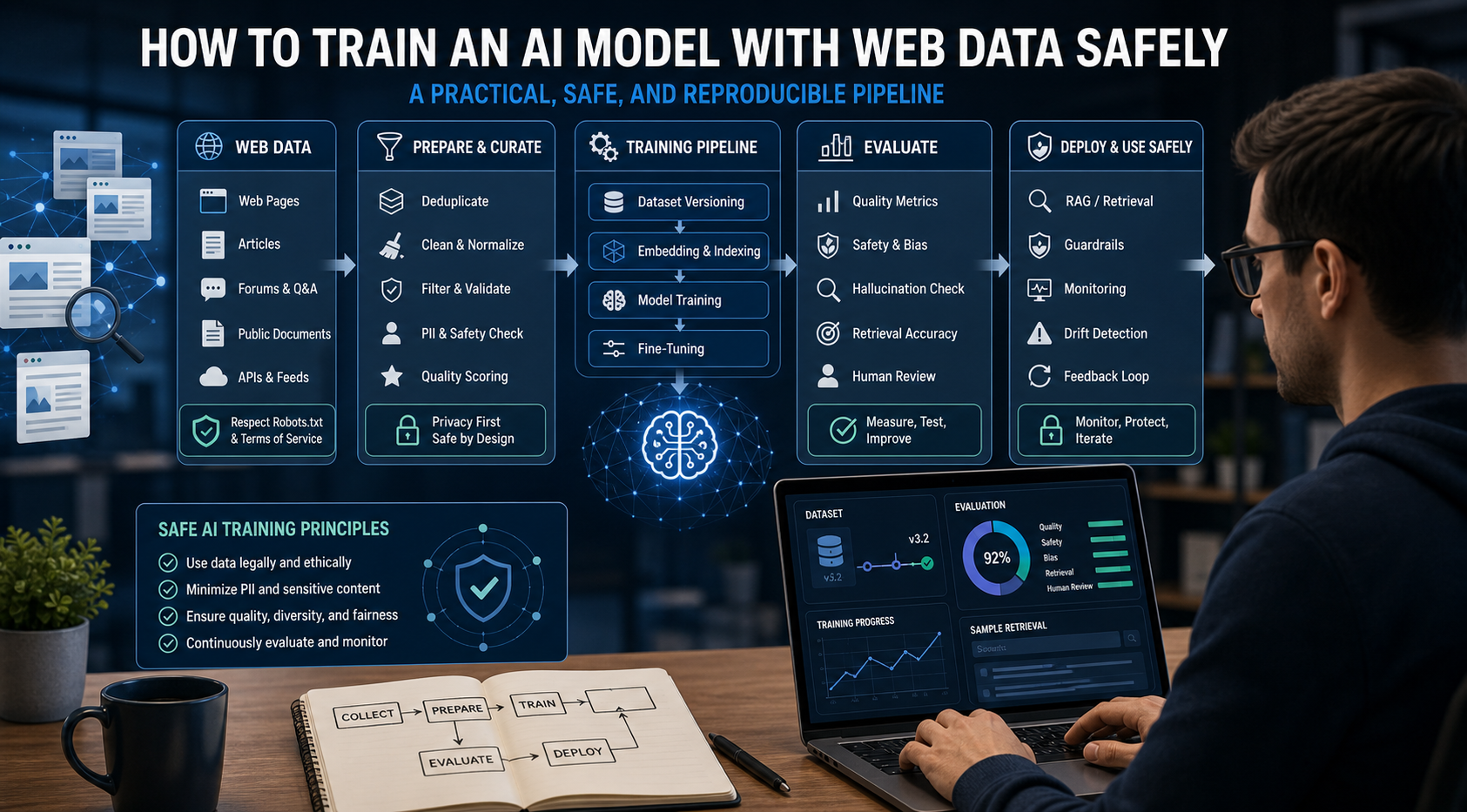
How to Train an AI Model With Web Data Safely
To train an AI model with web data, start by deciding whether you actually need training. Then collect representative sources, preserve provenance, remove duplicates and low-quality content, create leakage-resistant splits, build a baseline, fine-tune or train the appropriate model, and evaluate on real held-out examples before deployment.
View Details