
Akamai Bypass for Web Scraping
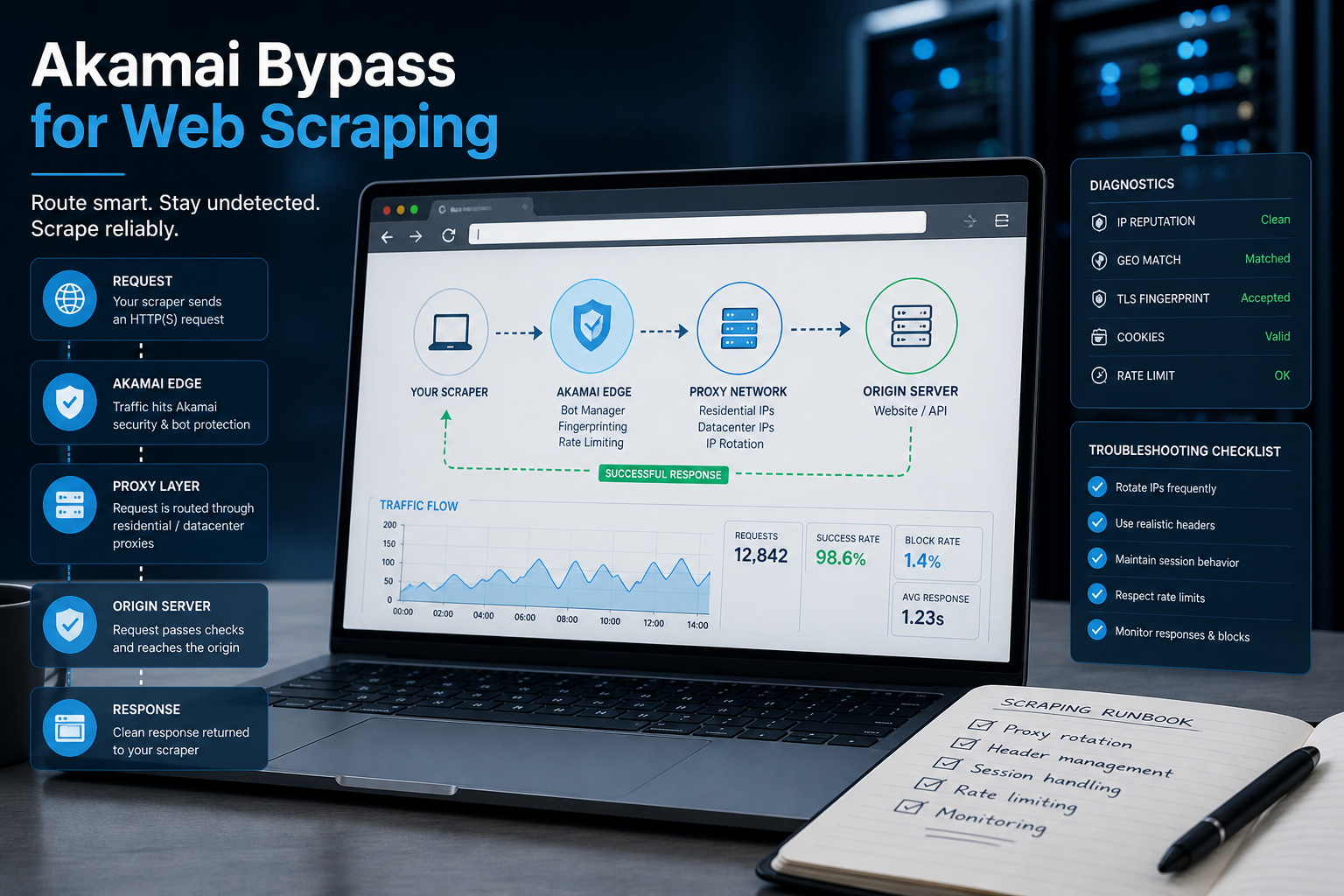
The tempting response is to keep changing headers, IP addresses, browsers, and request settings until something works.
Searching for an "Akamai bypass" usually starts with a practical problem: a crawler that worked on one website suddenly receives a 403 response, a challenge page, incomplete HTML, or inconsistent results on another.
That is a poor production strategy.
Akamai Bot Manager is designed to evaluate automation using multiple detection methods rather than one isolated signal. Akamai's documentation describes validated-bot recognition, request anomaly analysis, active detection, and behavioral detection, while its Bot Manager product also uses browser fingerprinting and AI-based behavioral analysis.
What Does Akamai Actually Do?
Akamai is widely known for content delivery and edge infrastructure, but its security products also sit between a site's visitors and application infrastructure.
Bot Manager helps website owners distinguish different forms of automated traffic and decide what should happen to them.
Importantly, not all bots are treated as inherently malicious.
Akamai's documentation distinguishes recognized bots, custom bot categories, transparent detection, active browser-oriented checks, and behavioral detection. Site owners can classify known internal or vendor automation differently from unwanted automated traffic.
That distinction creates an important lesson for data teams:
The long-term engineering objective should be reliable access appropriate to the relationship with the target, not merely making automation indistinguishable from a human.
Why Does Akamai Block Automated Requests?
There is rarely one universal cause.
Akamai describes analyzing request anomalies, browser characteristics, behavior, and other indicators when classifying automation. Its Bot Manager product assigns risk information to requests and can challenge traffic considered suspicious.
For a data collector, failures generally fall into several practical categories.
Request characteristics
A programmatic client may behave differently from a standard browser at the network or HTTP layer.
Browser requirements
The website itself may depend heavily on client-side JavaScript.
A raw HTTP response may therefore be incomplete even when no security product is blocking it.
Network reputation or geography
Some applications respond differently based on the origin of the request, network reputation, or geographic location.
Request volume
Sending too much traffic in a short period can trigger rate limits or protective controls.
Session inconsistency
Applications may expect a sequence of related requests to maintain coherent session state.
Authorization
Some pages are simply not intended for public automated access.
Changing infrastructure does not change the authorization boundary.
Understanding which category you are dealing with can save considerable engineering time.
Step 1: Confirm That Akamai Is Actually the Problem
Do not redesign your crawler simply because you received HTTP 403.
A 403 response means the server understood the request but refused it. It does not tell you which system made the decision.
Possible causes include:
- Akamai bot protection
- application authorization
- account permissions
- geographic restrictions
- WAF policy
- expired session state
- source-specific rate rules
- site configuration
Likewise, a 429 response usually indicates that the current request rate is too high, but the rate limit could come from the application itself rather than Akamai.
Start by comparing:
- working browser behavior
- your permitted automated workflow
- response status
- response body
- redirect chain
- content type
- cookies and session state
- request timing
- geographic context
The goal is diagnosis, not evasion.
Step 2: Determine Whether You Need Scraping at All
Before investing engineering effort into Akamai-related collection, check whether the information is available through a cleaner channel.
For the LycheeIP implementation details behind this step, review scaling lead scraping with n8n.
For the official technical reference behind this point, see HTTP Semantics standard.
Possibilities include:
- official APIs
- public feeds
- downloadable files
- sitemaps
- partner integrations
- licensed datasets
- customer APIs
- data exports
- vendor agreements
For a business-critical dataset, an official interface may outperform a browser-based collection system even if the API is less flexible.
Why?
Because browser pages are optimized for human interaction, not stable machine contracts.
An API or feed may offer more predictable schemas, clearer update semantics, and lower maintenance.
Step 3: Establish the Minimum Access Architecture
A common scraping mistake is starting with the most complicated infrastructure possible.
Instead, separate the workflow into layers.
Layer 1: Discovery
How do you identify the URLs that need to be visited?
Layer 2: Acquisition
How is the page retrieved?
Layer 3: Rendering
Does the content require a browser to execute JavaScript?
Layer 4: Extraction
How are fields converted into structured records?
Layer 5: Validation
How do you know that the returned response contains actual data rather than an error or challenge?
Layer 6: Storage
How are observations stored and versioned?
This separation makes Akamai-related problems easier to investigate.
For example, replacing your proxy provider will not fix a broken parser. Switching to browser rendering will not fix an authorization problem. Rewriting selectors will not fix HTTP 429.
When Should You Use a Browser?
A browser should solve a rendering requirement, not automatically be your default response to every blocked HTTP request.
Browser automation can help when a permitted page requires:
- JavaScript execution
- client-side navigation
- dynamic loading
- interactive state
- browser APIs
But browsers introduce costs.
Every instance consumes more CPU and memory than a lightweight HTTP request. High browser concurrency can therefore increase infrastructure requirements dramatically.
For large crawls, an efficient architecture may use simple requests where possible and browsers only for pages that genuinely require them.
For the LycheeIP implementation details behind this step, review LycheeIP proxy infrastructure.
For the LycheeIP implementation details behind this step, review AI-powered browser automation hub.
Where Do Proxies Fit?
Proxies provide a network routing layer.
They can be useful for legitimate requirements such as:
- geographic testing
- localized content verification
- separating workloads
- maintaining suitable network routes
- distributing authorized collection infrastructure
They do not replace:
- authorization
- browser rendering
- data extraction
- schema validation
- rate control
LycheeIP's proxy portfolio provides several network types, allowing developers to match infrastructure to application requirements rather than treating every page identically.
For example, inexpensive network infrastructure may be adequate for open targets, while location-sensitive research may require a different routing profile.
That is an infrastructure optimization decision, not permission to ignore a site's access controls.
Akamai 403 vs. 429 vs. Challenge Responses
Immediate 403 Possible interpretation: Access, security, geo, account, or request-policy issue Better next step: Verify authorization and access path first
429 after several requests Possible interpretation: Request rate exceeded Better next step: Reduce concurrency and implement backoff
Browser receives page, HTTP client receives incomplete content Possible interpretation: JavaScript or browser-dependent content Better next step: Determine whether browser rendering is necessary
HTML response contains a challenge instead of expected content Possible interpretation: Security verification occurred Better next step: Do not treat it as successful extraction
Intermittent failures Possible interpretation: Load, rate, session, network, or policy variation Better next step: Add observability and isolate variables
Valid HTML but missing records Possible interpretation: Parser or dynamic-content failure Better next step: Validate page structure and extraction logic
This diagnostic model prevents one of the most expensive mistakes in scraping operations: treating every failure as "bad proxies."
Prevent Retry Storms
Suppose 30 percent of your requests begin failing.
A naive crawler immediately retries every failed URL.
The retries fail too.
Workers then retry those failures again.
Suddenly the target receives more traffic precisely when the system is already signaling a problem.
That can turn a small issue into a severe rate problem.
Production crawlers should use:
- bounded retries
- exponential backoff
- concurrency limits
- failure classification
- circuit breakers
- retry budgets
HTTP 429 should generally result in less pressure, not more.
The same principle applies to repeated security challenges.
A rising challenge rate is an operational signal that should be investigated rather than attacked with more concurrency.
Treat Challenge Pages as Data-Quality Failures
One of the biggest anti-bot scraping problems occurs after the request technically "succeeds."
Imagine your crawler expects a product page and receives HTTP 200.
Your pipeline marks it successful.
But the body is actually a verification page.
For the LycheeIP implementation details behind this step, review rotating residential proxies.
For the official technical reference behind this point, see MDN HTTP overview.
The parser produces:
- null title
- null price
- null inventory
- empty description
Those records now enter your warehouse and look like real product changes.
That can be worse than a hard failure.
Validate successful responses using application-specific expectations.
For example:
- expected fields exist
- minimum record count is met
- page type matches the URL
- content is not suspiciously small
- known error templates are absent
- historical values have not collapsed unexpectedly
Success should mean usable data, not simply HTTP 200.
Monitor the Right Metrics
For production scraping, monitor at least four layers.
Access metrics
- status-code distribution
- timeout rate
- challenge rate
- average response latency
Extraction metrics
- parser failure rate
- missing fields
- records extracted per page
Data metrics
- duplicate rate
- null rate
- unusual value changes
- sudden record-count drops
Cost metrics
- requests per usable record
- browser minutes
- bandwidth consumption
- retry volume
- engineering maintenance
These metrics help distinguish an Akamai problem from a crawler problem.
Akamai's Good-Bot Model Matters
Akamai's documentation includes explicit support for recognized and custom-categorized bots. Site operators can define automation they know and choose how that traffic should be treated.
This provides a useful option that "bypass" articles often overlook.
If your company:
- supplies a service to the website owner
- has a commercial data agreement
- runs a partner integration
- performs authorized monitoring
- operates approved automation
ask whether the bot can be explicitly recognized or allowed.
A properly identified integration can be more stable than continuously trying to resemble ordinary browser traffic.
Build vs. Managed Infrastructure
For authorized data collection, you generally have three architectural choices.
Build the stack yourself
You control:
- crawler logic
- browser execution
- proxy routing
- scheduling
- retries
- storage
- validation
This maximizes flexibility.
It also means your engineering team owns every failure.
Combine specialized infrastructure
You might use:
- a crawler framework
- LycheeIP for appropriate proxy routing
- your own parser
- cloud storage
- monitoring infrastructure
This gives you control while outsourcing specific layers.
Use a managed scraping platform
A managed scraping API may handle several acquisition components for you.
This can reduce operational effort but also reduces fine-grained control.
The right choice depends on whether your competitive advantage comes from running scraping infrastructure or from what you do with the resulting data.
A Better Production Workflow for Akamai-Protected Targets
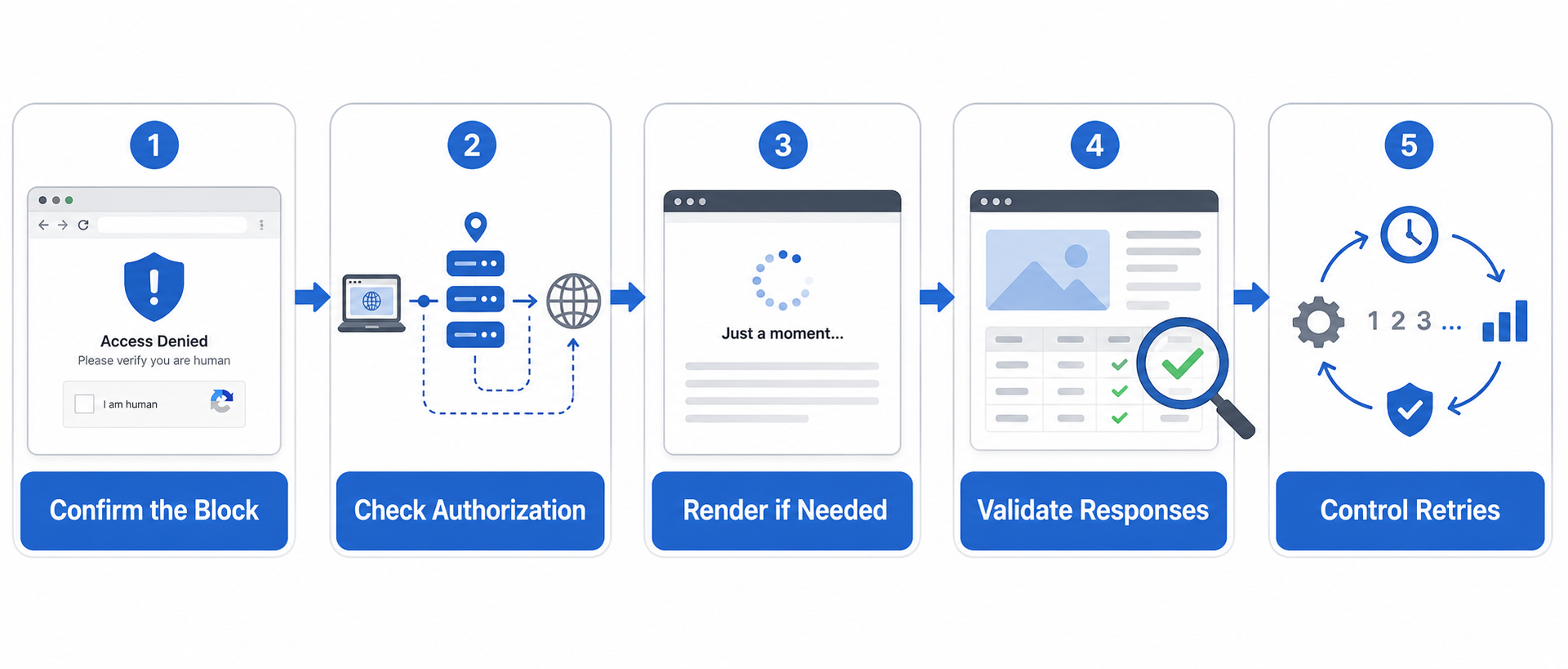
For legitimate data projects, use this sequence.
- Define the exact data requirement.
Determine the fields, pages, geography, frequency, and acceptable freshness.
- Confirm the access basis.
Check whether the target is public, authenticated, licensed, contractual, or otherwise authorized.
- Look for a first-party interface.
Evaluate APIs, feeds, exports, and partner options.
- Start with the simplest collection method.
Do not introduce browsers or expensive infrastructure before they are necessary.
- Limit request pressure.
Set reasonable concurrency and request budgets.
- Add rendering only where required.
Keep lightweight pages on lightweight infrastructure.
- Validate every response.
Separate access success from extraction success.
- Monitor failure categories.
Do not collapse 403, 429, timeout, parser failure, and empty dataset into one error.
- Escalate intelligently.
If the source is strategically important, seek an approved integration or managed solution rather than building an endless workaround treadmill.
robots.txt, Authorization, and Responsible Collection
robots.txt is useful, but its role is often misunderstood.
RFC 9309 standardizes the Robots Exclusion Protocol and describes how service owners communicate crawler preferences. The specification also explicitly states that those directives are not a form of access authorization.
Legal analysis is more complicated than "public page equals legal scraping."
In the United States, even federal CFAA enforcement policy distinguishes between contractual restrictions, public access, and access that has been expressly revoked.
Other laws, contractual claims, privacy obligations, intellectual-property issues, or jurisdiction-specific rules can still apply.
Stabilize authorized web data workflows with LycheeIP proxy infrastructure
Therefore:
- evaluate authorization
- review terms
- avoid accessing private accounts or restricted areas without permission
- minimize unnecessary load
- assess privacy implications
- obtain legal advice for high-risk or business-critical collection
Frequently Asked Questions
Why is Akamai blocking my scraper?
Possible causes include bot classification, request anomalies, rate limits, geographic restrictions, application authorization, or incomplete browser-dependent behavior. Diagnose the response before changing infrastructure.
Can a proxy alone bypass Akamai?
No universal proxy configuration solves Akamai Bot Manager. Akamai uses multiple detection methods, and proxy routing addresses only the network layer.
Does HTTP 403 always mean Akamai blocked me?
No. A 403 can originate from the application, account permissions, a firewall, geographic restrictions, or other security systems.
Does HTTP 429 mean I need more proxies?
Not necessarily. It means the current request pattern is encountering a rate limit. The first response should normally be to reduce request pressure and implement backoff.
Should I always use Playwright or another browser?
No. Use browser rendering where the page genuinely depends on client-side execution. Running browsers for every URL increases compute, memory, and operational complexity.
Is robots.txt permission to scrape?
No. RFC 9309 explicitly says robots rules are not access authorization.
What is the most maintainable approach to Akamai-protected data?
For business-critical data, prioritize official APIs, feeds, contractual integrations, approved bots, or another stable access mechanism where available. If scraping is appropriate, build observability and data validation into the workflow instead of relying on one access trick. Conclusion The most useful way to think about an Akamai bypass is not "Which trick gets this request through?" The better question is:
Why is this workflow failing, and what architecture will continue producing accurate data next month?
Akamai intentionally evaluates automation across several dimensions. That makes one-off workarounds fragile by design. Production teams get better results by separating access, rendering, extraction, network routing, validation, and permission into distinct decisions. Reduce unnecessary request pressure, measure challenge and failure rates, validate the data itself, and use approved machine-access paths whenever they exist. That produces something far more valuable than a temporary bypass: a maintainable data collection system.
Related LycheeIP Guides and Resources

Recommended Articles
Browser Security Settings Most Users Never Touch
Stop leaving your personal data wide open. We reveal the crucial security toggles buried in your browser that instantly lock down your passwords and hide your daily web traffic.
View Details
Stop Saving Passwords in Your Browser
Letting Chrome or Safari remember your passwords feels incredibly convenient, but it is a massive security risk. Discover the hidden dangers of browser autofill and exactly what you should be using instead.
View Details
Should You Pay for a Browser? The Case For and Against
Are you currently paying for your free browser with your personal data? Discover if upgrading to a paid tool like Brave Origin is the ultimate privacy hack or just a complete waste of your cash.
View Details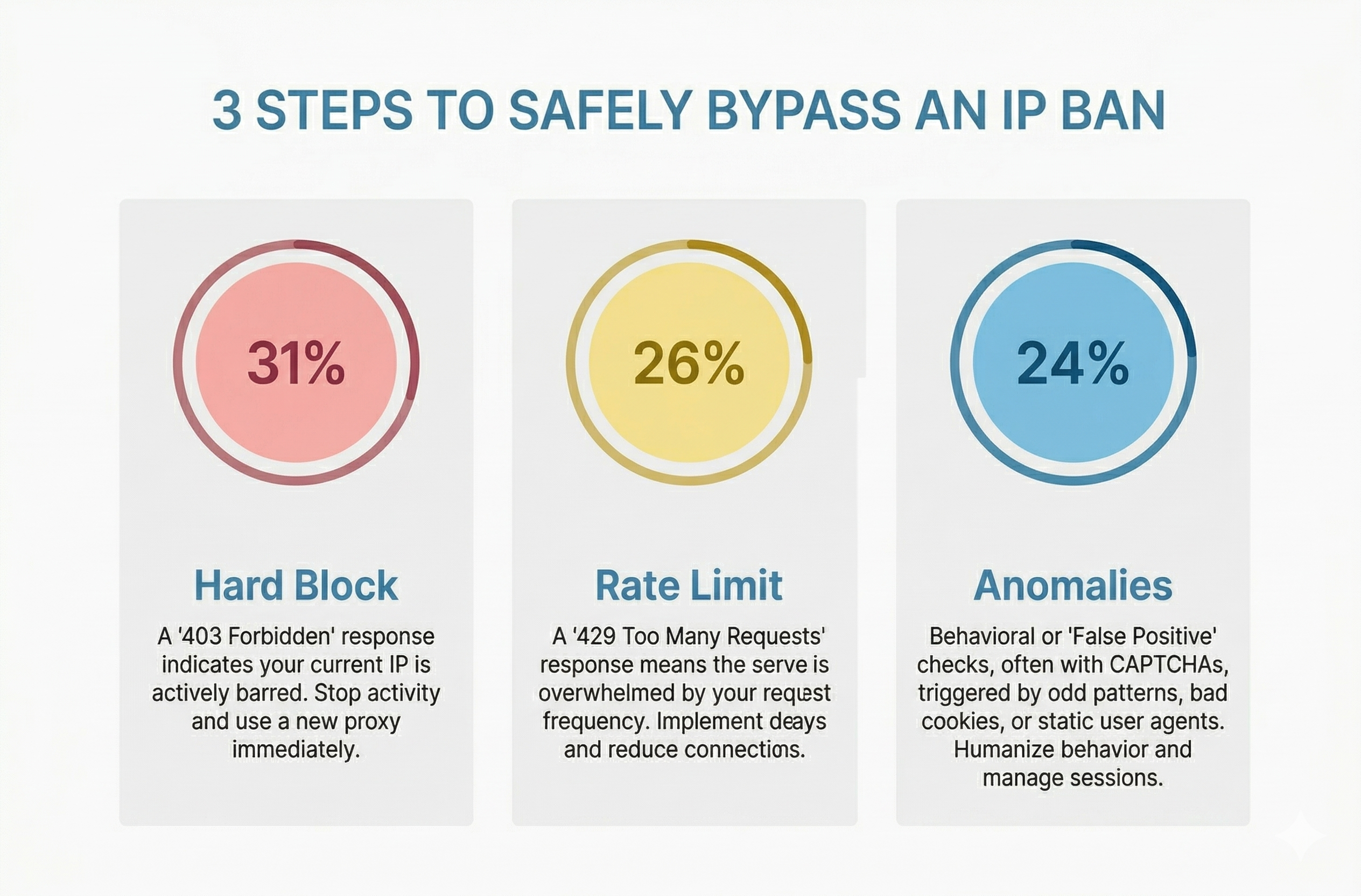
How to Bypass an IP Ban Safely by Diagnosing 403s, 429s, and False Positives
Diagnose 403s, 429s, and false positives quickly. Use this technical checklist to recover network access, reduce blocks, and scale data pipelines safely.
View Details
Open Source Security: Shannon AI Pen Testing Walkthrough
Does autonomous pentesting really work? Follow along as we point this open source AI at a vulnerable app to see if it can find, exploit, and validate real security flaws completely on its own.
View Details