
DataDome Bypass for Web Scraping
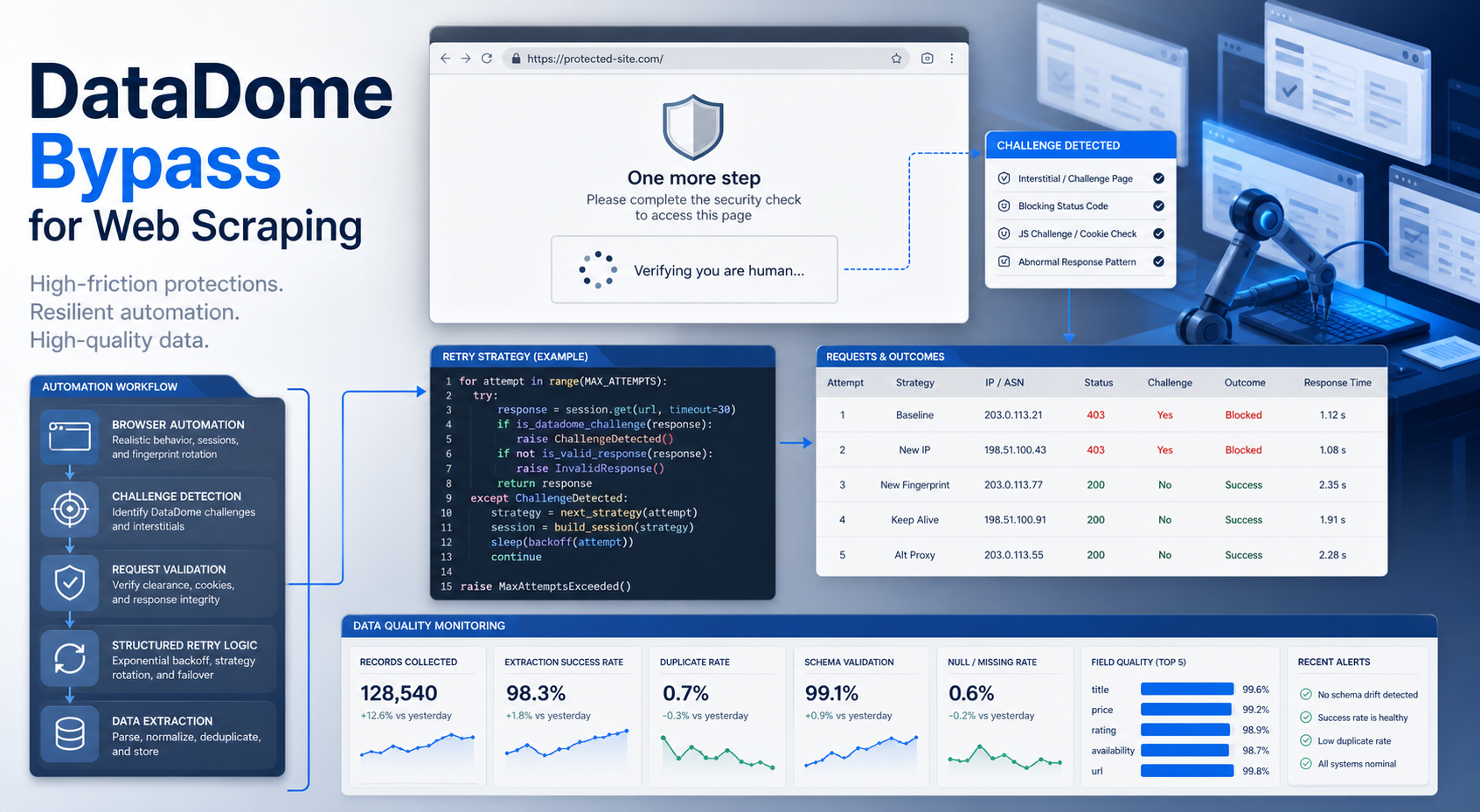
A DataDome bypass problem rarely begins with DataDome itself.
It usually begins with a broken pipeline.
Yesterday your collector returned thousands of valid records.
Today it returns:
- HTTP 403
- a CAPTCHA
- an intermediate verification screen
- suspiciously empty HTML
- dramatically fewer records
- inconsistent results between a browser and your crawler
At that point, many teams focus entirely on getting the next request through.
Production systems need to solve a larger problem.
How do you know why DataDome is responding differently, and how do you prevent that response from degrading the accuracy, cost, and reliability of your entire dataset?
DataDome is designed around multiple layers of bot detection. Its documentation describes server-side request analysis together with client-side behavioral and device signals. It can allow, block, challenge, or further verify traffic depending on its assessment.
That means there is no single universal DataDome bypass technique. More importantly, a one-time workaround is not the same as a maintainable data pipeline.
What Is DataDome?
DataDome is a bot and online-fraud protection platform used across websites, applications, APIs, and other digital infrastructure.
Its Bot Protect materials say it continuously evaluates requests using both client-side and server-side signals to distinguish humans, legitimate automated agents, and malicious automation.
For a scraping developer, there are two important implications.
First, the decision may involve more than an IP address.
Second, evaluation can continue across a session rather than ending after the first successful page request.
That is why a crawler may initially work and later encounter challenges.
How DataDome Evaluates Traffic
You do not need to reverse-engineer DataDome to understand its architecture.
The company's own technical documentation reveals the important categories.
Server-side request analysis
DataDome's integration can intercept HTTP requests, submit them for analysis, and enforce the resulting decision.
This means the request itself provides signals before your crawler even receives application content.
Client-side signals
The DataDome JavaScript integration collects behavioral and device information from browsers to enrich detection.
A simple HTTP client therefore operates in a different environment from a full browser.
Device verification
DataDome's Device Check can run JavaScript on a user's device when additional verification is required.
Its documentation describes inspecting technical information relating to the browser, screen, environment, hardware characteristics, JavaScript execution, and rendering behavior.
Depending on the result, the user may be allowed, blocked, or presented with an additional CAPTCHA challenge.
Continuous risk assessment
DataDome says its Bot Protect platform analyzes hundreds of client-side and server-side signals and continuously assesses behavior and intent.
This explains why simply receiving one successful request does not prove that a long crawl will behave identically.
Why Does My Scraper Get a DataDome 403?
A 403 response is evidence that access was denied.
It is not a diagnosis.
Possible causes include:
- bot classification
- application authorization
- geographic policy
- account restrictions
- session problems
- excessive request activity
- upstream WAF rules
- target-specific policies
Before modifying your architecture, establish what actually happened.
Check:
- response status
- response body
- redirect chain
- request timing
- content type
- expected page structure
- authenticated state
- geographic context
- whether ordinary authorized browser access succeeds
Changing five variables simultaneously may occasionally make a request work, but it teaches you almost nothing about the root cause.
The Bigger Risk: A Block That Looks Like Valid Data
Hard failures are easy to notice.
Soft failures are more dangerous.
Suppose a real estate crawler expects 20 property records.
The request returns HTTP 200, so the job is marked successful.
But the body is actually a verification page.
The scraper finds zero listings.
Your pipeline records:
0 properties available.
Now a security challenge has become a false business signal.
The same thing can happen with:
- product prices
- job listings
- flight availability
- marketplace inventory
- SERP results
- hotel rooms
- financial data
- news monitoring
This is why DataDome handling should be treated as a data-quality problem, not simply an HTTP problem.
Validate the Response Before Parsing the Dataset
Every scraping pipeline should have a response-validation layer.
Before trusting extracted records, check whether the response matches the expected page type.
Possible validation signals include:
Expected schema
If every product page should contain a title and product identifier, the absence of both is suspicious.
Minimum record expectations
If a category historically returns hundreds of records and suddenly returns zero, flag the result for review.
Structural fingerprints
A listing page should contain the expected major sections or semantic elements.
Response size
An unexpectedly small page may represent an error shell rather than genuine content.
Redirect behavior
Unexpected redirects can indicate login, verification, geographic routing, or policy responses.
Historical comparison
Large changes should be distinguished from scraper failures before being accepted as genuine market movement.
This validation layer protects the dataset regardless of which anti-bot product the target uses.
DataDome Troubleshooting by Symptom
Immediate 403 What it may mean: Policy, authorization, bot detection, geo, or WAF rule Recommended investigation: Confirm access requirements and response source
CAPTCHA or verification page What it may mean: Additional proof requested Recommended investigation: Do not classify response as valid source content
First pages work, later pages fail What it may mean: Rate, session, or ongoing risk evaluation Recommended investigation: Reduce load and examine session behavior
Browser works, basic request does not What it may mean: JavaScript or browser context may be required Recommended investigation: Determine whether permitted browser rendering is necessary
Results vary by geography What it may mean: Location affects source output or security policy Recommended investigation: Validate target geography and routing
Zero records returned unexpectedly What it may mean: Block, parser failure, or true empty result Recommended investigation: Validate response before writing data
Large retry spike What it may mean: System is amplifying failures Recommended investigation: Introduce retry budgets and circuit breakers
Avoid the Retry Amplification Problem
A fragile crawler treats every failure identically:
- request fails
- retry immediately
- retry again
- increase concurrency
- generate even more failures
This creates two problems.
First, operational cost increases.
Second, the target receives even more traffic during an already degraded state.
A better system classifies failures before deciding whether to retry.
Use:
- exponential backoff
- maximum retry counts
- randomized retry timing
- queue-level rate limits
- concurrency ceilings
- circuit breakers
- target-specific retry policies
If challenge or block rates suddenly increase, stopping part of the workload may be more useful than generating thousands of additional failed requests.
Do Residential Proxies Automatically Solve DataDome Blocks?
No.
A proxy changes the network path of a request.
DataDome's documented detection model uses much more than network information. Its client-side systems can inspect browser and device characteristics, while server-side systems evaluate request information and behavior.
For the LycheeIP implementation details behind this step, review rotating residential proxies.
Therefore, thinking of the problem as:
"Which IP should I use?"
is too narrow.
The more useful question is:
"Which layer is failing?"
The possible answer may be network routing, but it could also be:
- browser requirements
- account state
- request volume
- source permissions
- data extraction
- source-page changes
- geographic mismatch
LycheeIP fits specifically within the network layer of such a workflow. Its proxy portfolio allows developers to select different proxy categories for appropriate applications rather than confusing proxy routing with the rest of the scraper.
Browser Automation Has a Cost
If a permitted target requires genuine browser functionality, running a browser can be appropriate.
But browser automation is not free infrastructure.
For the LycheeIP implementation details behind this step, review LycheeIP proxy infrastructure.
For the LycheeIP implementation details behind this step, review static residential proxies.
Compared with lightweight HTTP requests, browsers typically require more:
- memory
- CPU
- startup time
- orchestration
- monitoring
- failure handling
At 10 pages, the difference barely matters.
At 10 million pages, architecture matters enormously.
A mature collection platform should therefore classify targets.
For the official technical reference behind this point, see MDN HTTP overview.
Tier 1: Lightweight collection
Use normal HTTP acquisition where the page is accessible and fully rendered in the response.
Tier 2: JavaScript-dependent collection
Use browser rendering where the content genuinely depends on JavaScript.
Tier 3: Restricted or high-friction sources
Reassess whether scraping is the correct acquisition method at all. Consider APIs, feeds, licensed data, or direct permission.
This prevents expensive browser infrastructure from becoming the default for every source.
Session Consistency Matters
Some websites expect a sequence of requests to belong to the same interaction.
If your infrastructure constantly changes critical session characteristics, you can create problems independently of DataDome.
For legitimate browser workflows, maintain coherent:
- authentication
- session cookies
- geographic context
- application state
Do not treat every URL as though it belongs to a completely unrelated user when the application itself expects continuity.
This is especially relevant for multi-step public workflows where navigation state is required to produce the correct content.
For the LycheeIP implementation details behind this step, review AI-powered browser automation hub.
Build Your DataDome Workflow Around Observability
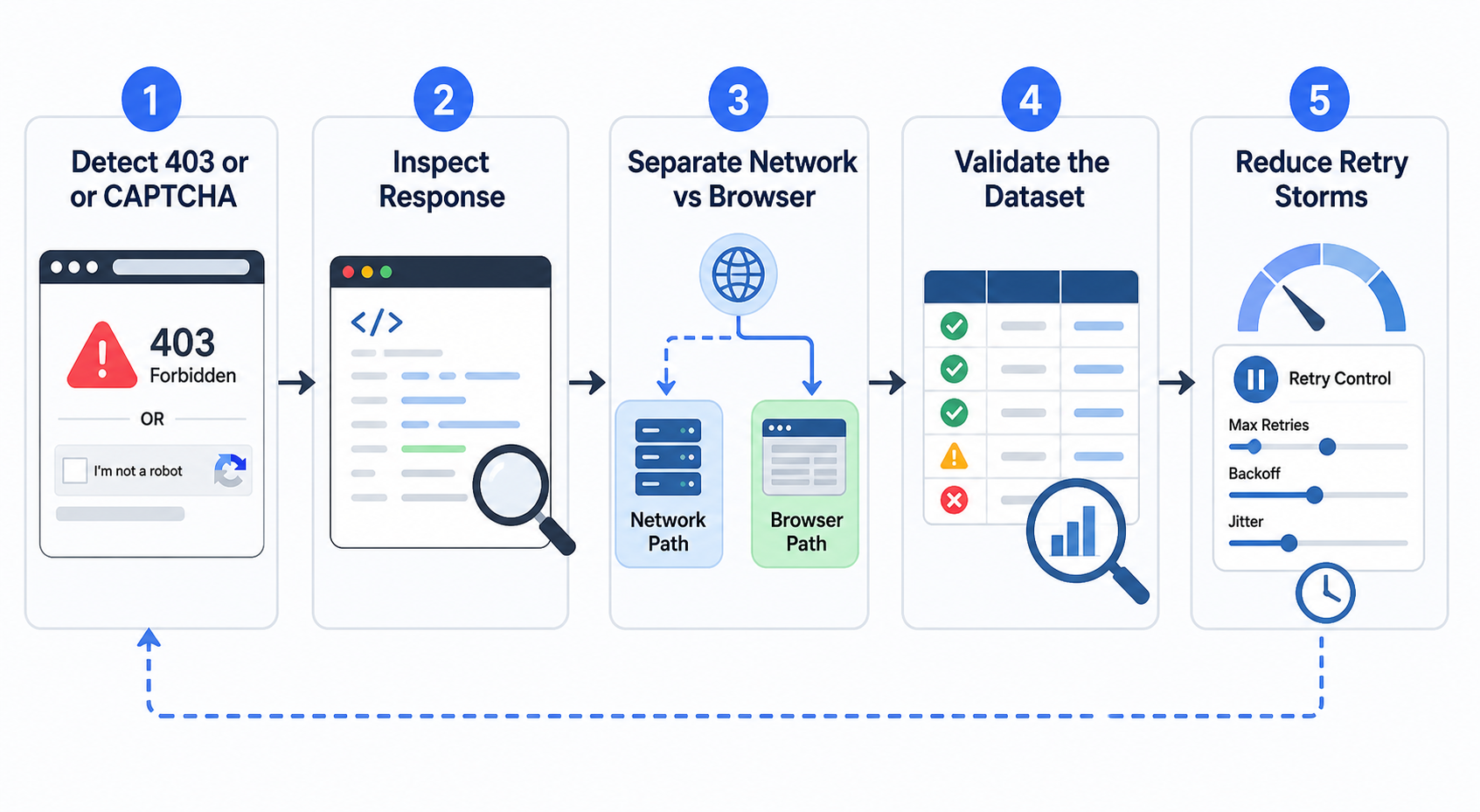
You cannot improve what you cannot distinguish.
Track the following metrics separately.
HTTP outcomes
Measure:
- 2xx
- 3xx
- 403
- 429
- 5xx
- timeout
Security outcomes
For the official technical reference behind this point, see OWASP automated threats guidance.
Where your pipeline can identify them reliably, track:
- challenge responses
- verification responses
- CAPTCHA responses
Parsing outcomes
Measure:
- valid extraction
- invalid schema
- missing required fields
- parser exception
- zero-record page
Dataset outcomes
Monitor:
- record count
- duplicate rate
- field completeness
- unusual price or value changes
- geographic distribution
- stale records
This lets your operations team see whether a drop in data volume occurred because the real-world market changed or because collection quality collapsed.
Measure Cost Per Valid Record
Raw request cost can be misleading.
Imagine two systems.
System A
- 1 million requests
- low infrastructure cost
- 70 percent usable data
- high retry rate
System B
- fewer requests
- higher acquisition cost per request
- substantially less cleaning and retry overhead
Without measuring the full workflow, you cannot know which system is economically better.
Track:
total collection cost divided by validated records delivered
Include:
- proxy traffic
- API credits
- browser compute
- retries
- storage
- processing
- engineering maintenance
The cheapest request is irrelevant if it does not produce trustworthy data.
A More Maintainable DataDome Collection Architecture
For legitimate public-data projects, structure the pipeline in stages.
- Define the dataset
Specify:
- required URLs
- required fields
- geographic coverage
- collection frequency
- acceptable latency
- expected record counts
- Confirm the appropriate access path
Ask whether an API, feed, licensed dataset, export, or partnership exists.
- Select the simplest acquisition method
Use lightweight collection where possible.
- Introduce browser rendering only where required
Do not pay browser costs for static content.
- Use network infrastructure for actual network requirements
Choose proxy types based on geography, session characteristics, and permitted workload requirements.
- Control concurrency
Start conservatively and scale using measured performance.
- Validate every response
Never equate HTTP success with data success.
- Monitor drift
Watch both source-page structure and collection failure rates.
- Stop bad data before it reaches consumers
Quarantine abnormal batches instead of silently writing them to production tables.
The New Development to Watch: Verifiable AI Agents
One of the most interesting changes in bot management is that the web is gradually moving beyond the simple distinction between "human" and "bot."
DataDome now documents AI-agent identification as part of its Agentic Trust architecture.
Its system describes a layered identification model using methods such as cryptographic verification, trusted IP information, reverse DNS, network attribution, and client or server fingerprinting.
This matters well beyond DataDome.
For years, scraping discussions have often assumed that successful automation should appear indistinguishable from human browsing.
The emerging agentic web points toward another model:
legitimate automated systems may increasingly prove what they are instead.
For companies building AI agents, commercial crawlers, data integrations, and automated purchasing systems, verifiable identity could eventually become a more sustainable access model than attempting to remain anonymous.
That is an important trend for web-data teams to monitor.
Public Data Does Not Remove Every Compliance Obligation
Visibility and permission are not identical concepts.
The IETF standard for robots.txt explicitly states that Robots Exclusion Protocol rules are not an access-authorization mechanism.
Likewise, the legality of collecting and processing data depends on jurisdiction and circumstances.
Important factors may include:
- authorization
- website terms
- personal information
- intellectual property
- contractual relationships
- how the collected data will be used
- whether access has been explicitly restricted or revoked
For example, EU data protection rules can apply when collected information constitutes personal data.
High-volume commercial scraping therefore deserves both technical and legal review.
Common DataDome Scraping Mistakes
Mistake 1: Assuming every 403 is an IP problem
Diagnose before changing infrastructure.
Mistake 2: Treating HTTP 200 as success
Validate expected page content.
Mistake 3: Retrying challenges indefinitely
This increases costs and can amplify request pressure.
Mistake 4: Running browsers for everything
Use browser infrastructure selectively.
Mistake 5: Ignoring schema drift
A site redesign may break data extraction even when access remains perfect.
Mistake 6: Optimizing success rate instead of data quality
Ninety-nine successful page loads mean little if the extracted records are incomplete.
Mistake 7: Confusing a proxy provider with a scraping platform
Proxies handle network routing. Crawlers, parsers, browsers, schedulers, and validation systems solve different problems.
Route compliant high-friction scraping workflows with LycheeIP proxy infrastructure
Mistake 8: Ignoring first-party access options
An approved API or data relationship may be far more stable than maintaining a continuously changing scraper.
Frequently Asked Questions
What is DataDome?
DataDome is a bot and online-fraud protection platform that analyzes server-side and client-side signals to evaluate automated traffic across websites, applications, APIs, and other endpoints.
Why does DataDome block my scraper?
Possible causes include automated request characteristics, application behavior, rate pressure, browser or device verification, source-specific policy, authorization, or geographic conditions.
Does a DataDome 403 prove my IP is blocked?
No. The IP is only one possible part of the decision. You should investigate authorization, session state, target behavior, request patterns, and the response itself.
Can a residential proxy alone bypass DataDome?
There is no universal proxy-only solution. DataDome documents both server-side analysis and client-side device or behavioral signals.
Why does my browser work when my HTTP crawler does not?
The website may require JavaScript or browser capabilities, or the browser context may be evaluated differently. Determine whether browser rendering is legitimately required before adding it to the whole workload.
Why does my scraper sometimes return zero records instead of an error?
A verification, challenge, changed page template, or failed parser may still produce an HTTP response. Validate the body and expected schema before treating zero as a real business result.
What is the best long-term DataDome bypass strategy?
For production use, focus less on one bypass mechanism and more on obtaining the appropriate access path, minimizing unnecessary request pressure, validating responses, using suitable infrastructure, monitoring failures, and adopting approved or identifiable automation where possible. Conclusion DataDome is difficult to reduce to one blocking rule because it is intentionally designed around multiple signals. That changes how reliable scraping should be engineered. The objective is not simply to make today's URL load. It is to produce correct data repeatedly without allowing blocks, challenges, retries, browser costs, or parser failures to silently corrupt the result. Separate the network layer from browser rendering. Separate rendering from extraction. Separate extraction from validation. Measure every stage. And as the web evolves toward identifiable AI agents and more explicit machine-access policies, the most durable automation systems may increasingly be those that can establish a legitimate identity rather than those built around constantly hiding one.
Related LycheeIP Guides and Resources

Recommended Articles

Web Scraping Rate Limiting: How to Handle 429s, Backoff, and Concurrency
Web scraping rate limiting is the engineering discipline of keeping an authorized collection workload inside a target service's acceptable request envelope. When that envelope is exceeded, a server may respond with HTTP 429 Too Many Requests, delay responses, or apply other controls.
View Details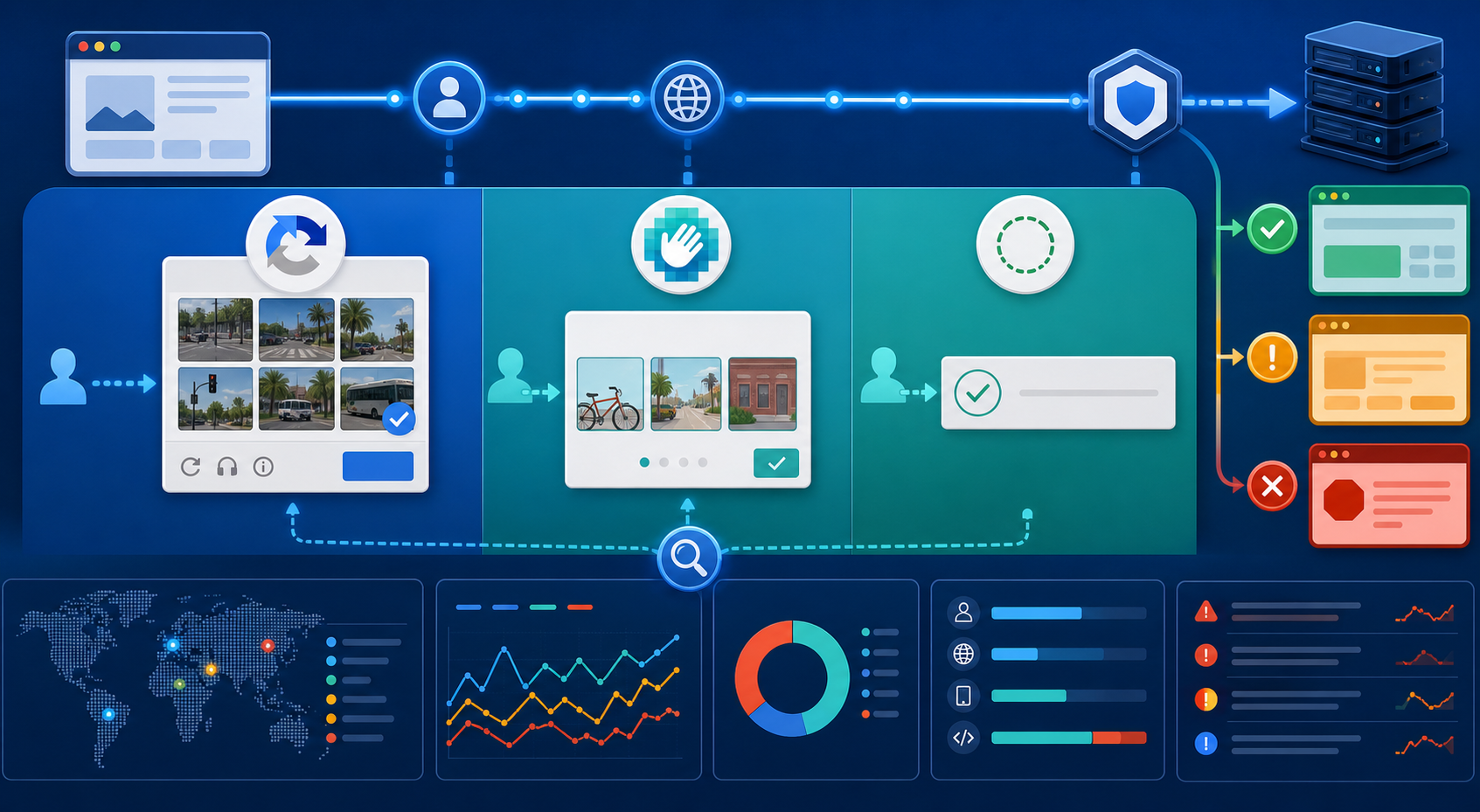
reCAPTCHA vs hCaptcha vs Cloudflare Turnstile: What Scraping Teams Need to Know
If an authorized data-collection workflow suddenly stops at a verification screen, identifying the protection system matters before you change code, browser settings, or proxy infrastructure. reCAPTCHA vs hCaptcha vs Turnstile is not simply a branding comparison. The three systems can expose different browser flows, token models, risk decisions, and failure symptoms.
View Details
Browser Automation Proxies: IPs, Geo-Targeting, Sessions, and AI Agents
A browser automation proxy belongs to the network layer of Playwright, Selenium, cloud-browser, and AI-agent workflows. It changes how browser traffic is routed and can affect the source IP address, geographic egress, and session continuity seen by a destination site. It does not improve an AI model's reasoning, repair browser logic, or guarantee that a website will accept the session.
View Details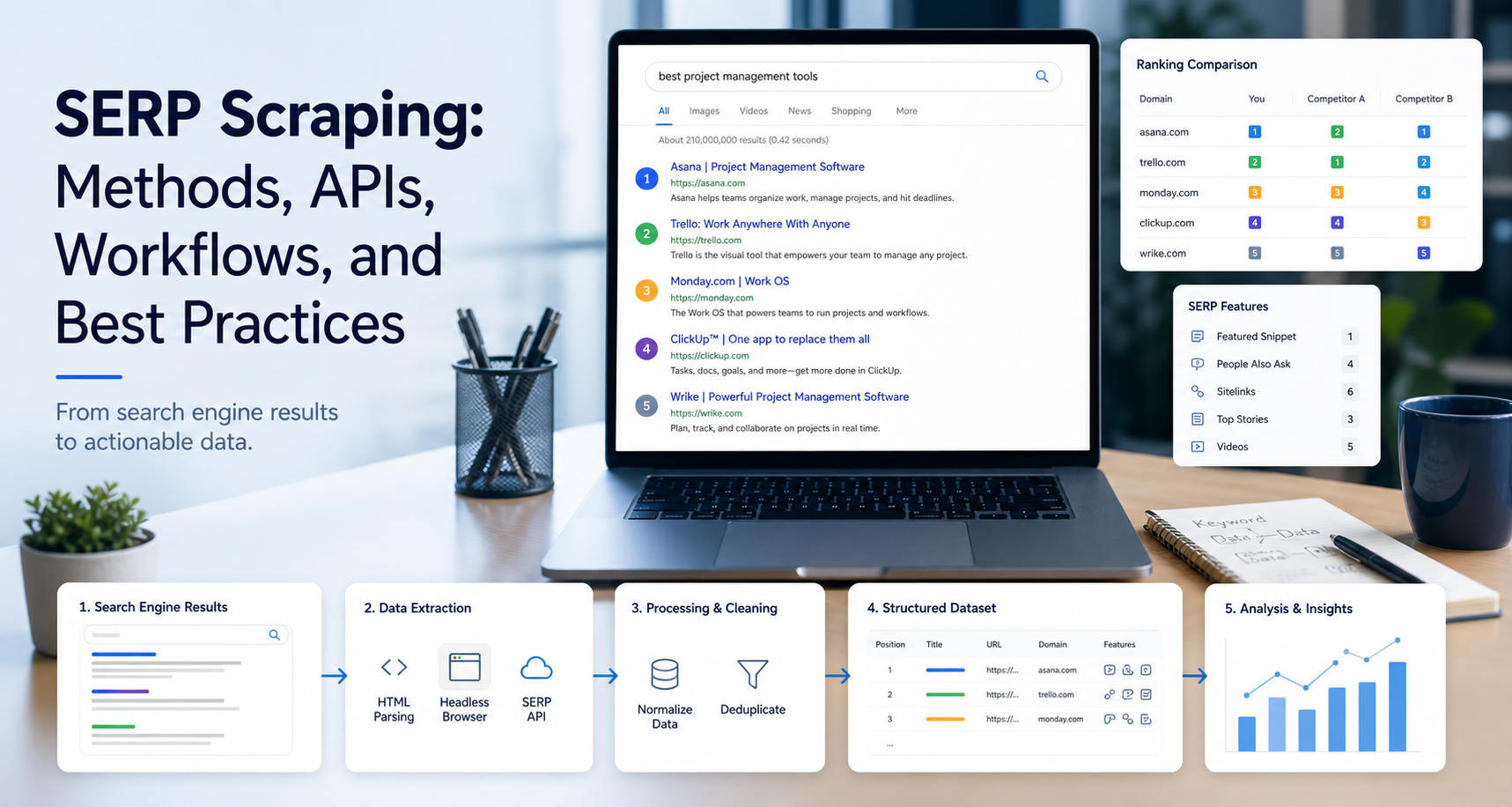
SERP Scraping: Methods, APIs, Workflows, and Best Practices
SERP scraping is the automated collection of information from search engine results pages. A SERP scraper can capture organic rankings, advertisements, featured snippets, People Also Ask questions, local results, shopping listings, images, and other search features, then convert them into structured data for analysis.
View Details
Ecommerce Web Scraping: How to Collect Reliable Product Data
Ecommerce web scraping is the automated collection of publicly accessible product information from online stores. Teams use it to gather prices, availability, variants, ratings, seller details, and catalog changes for legitimate tasks such as competitive research, assortment monitoring, brand protection, and data quality checks.
View Details