
Ecommerce Web Scraping: How to Collect Reliable Product Data
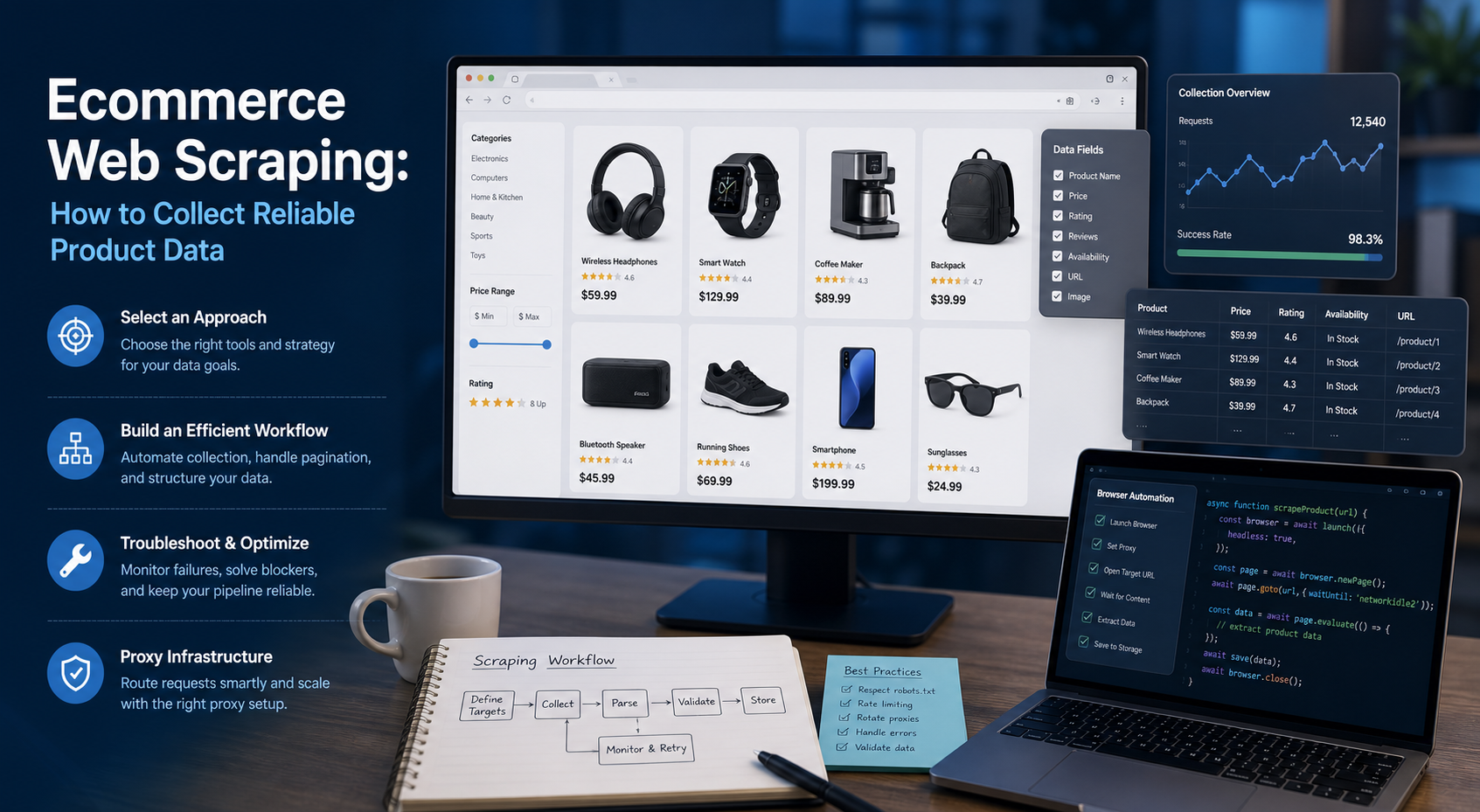
This guide explains how to select an approach, build an efficient collection workflow, troubleshoot failures, and decide where proxy infrastructure fits.
Ecommerce web scraping is the automated collection of publicly accessible product information from online stores. Teams use it to gather prices, availability, variants, ratings, seller details, and catalog changes for legitimate tasks such as competitive research, assortment monitoring, brand protection, and data quality checks.
The practical challenge is not simply downloading pages. A reliable system must choose the right source, extract the correct product state, distinguish variants and regions, limit unnecessary requests, and validate every record. An official API or licensed feed is usually preferable when it covers the required data. When it does not, teams can use HTTP extraction, browser automation, or a managed scraping service, subject to website terms, robots directives, access controls, privacy requirements, and applicable law.
What Is Ecommerce Web Scraping?
Ecommerce web scraping is the automated extraction of product and marketplace data from online storefronts into a structured format such as JSON, CSV, or a database table. A crawler discovers pages, a scraper retrieves and parses them, and a validation layer checks whether the resulting records are complete, current, and internally consistent.
It is not the same as copying an entire website. A well-scoped project collects only the fields and pages needed for an authorized business purpose. It also separates the target website, extraction logic, browser, network route, session state, and data-quality pipeline because a failure in one layer cannot always be fixed in another.
Common ecommerce data fields
A product-data schema may include:
- Product name, brand, category, description, and canonical URL
- SKU, GTIN, MPN, internal product ID, and seller ID
- List price, sale price, currency, shipping cost, and promotion state
- Variant attributes such as size, color, pack quantity, and material
- Stock status, estimated availability, and fulfillment method
- Rating, review count, review text, and review date
- Product images, specifications, breadcrumbs, and related products
- Collection timestamp, source location, locale, device context, and extraction version
Google's product structured-data documentation shows why product pages often expose machine-readable fields such as Product, Offer, price, availability, ratings, and variants. These fields can be useful extraction sources, but the visible page should still be checked because structured data may be missing, incomplete, or inconsistent with the rendered storefront. Google's product structured-data guidance explains the main product and offer properties.
For the LycheeIP implementation details behind this step, review LycheeIP proxy infrastructure.
For the LycheeIP implementation details behind this step, review rotating residential proxies.
For the LycheeIP implementation details behind this step, review static residential proxies.
For the official technical reference behind this point, see MDN HTTP overview.
For the official technical reference behind this point, see Playwright documentation.
What Is Ecommerce Web Scraping Used For?
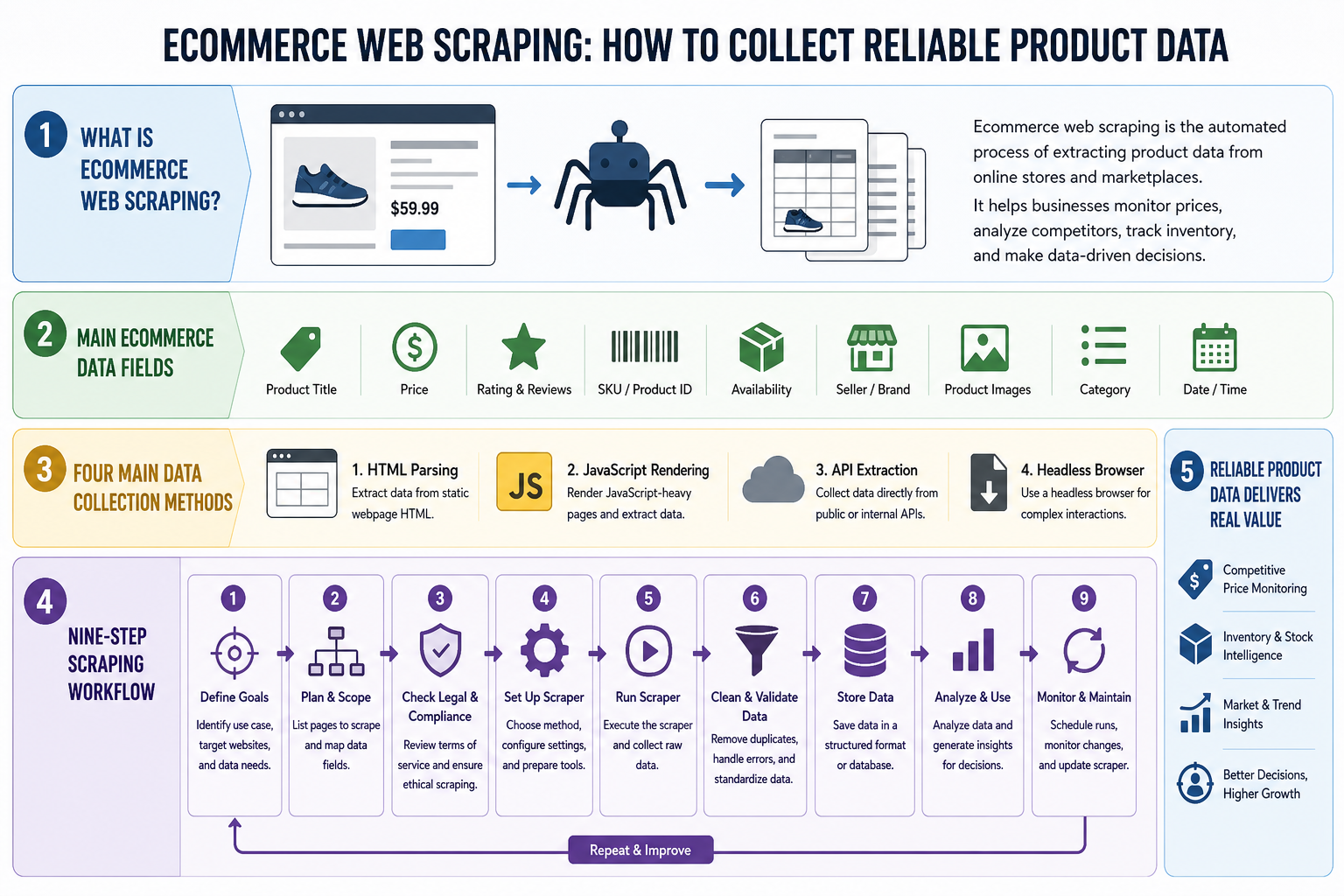
The most useful projects connect data collection to a specific decision instead of gathering everything available.
Price and promotion monitoring
Retailers and brands can track public list prices, sale prices, coupon language, shipping thresholds, and promotion periods. The dataset should preserve currency, region, membership state, and collection time so analysts do not compare prices shown under different conditions.
Assortment and availability monitoring
Teams can identify newly listed products, discontinued items, out-of-stock variants, category expansion, or changes in seller participation. Variant-level records are essential because a product can appear available while the size or color a customer wants is unavailable.
Catalog enrichment and matching
Distributors, marketplaces, and analytics teams can supplement permitted internal data with public specifications, identifiers, category labels, and images. Matching should use stable identifiers where possible and should not rely only on similar product titles.
Brand protection and channel research
Manufacturers can monitor public listings for unauthorized sellers, inaccurate product descriptions, old imagery, or advertised prices that require review. The collection system should preserve evidence such as the exact URL, timestamp, seller, region, and displayed offer context.
Review and market research
Public ratings and reviews can help teams identify recurring product complaints, feature requests, or positioning patterns. Review collection requires careful attention to privacy, licensing, duplication, sampling bias, and the difference between a review page's current state and the full customer population.
The Four Main Ecommerce Data Collection Methods
No single extraction method fits every store. Use the least complex source that reliably provides the required fields.
| Method | Best for | Main advantage | Main tradeoff | Typical maintenance |
|---|---|---|---|---|
| Official API, partner feed, or licensed dataset | Stores you own, approved integrations, stable commercial access | Structured data and clearer permission boundaries | Coverage, eligibility, cost, or rate limits may be restrictive | Low to medium |
| Direct HTTP extraction | Static or server-rendered product and category pages | Fast, inexpensive, and easy to test | Misses data rendered only after JavaScript or interaction | Medium |
| Browser automation | JavaScript-heavy pages, variant interaction, infinite scroll, or client-side requests | Reproduces a real browser execution environment | Higher compute cost and more operational complexity | Medium to high |
| Managed scraping API or platform | Teams that want rendering, retries, extraction, and infrastructure managed externally | Reduces internal browser and network operations | Less control and potentially higher usage cost | Medium |
Official platform interfaces should be considered first for stores you control or have permission to access. Shopify's Storefront API can return paginated product and variant data for approved storefront applications, while WooCommerce exposes public product information through its Store API. Review the applicable access scopes, authentication requirements, and platform terms before relying on either interface. See the Shopify Storefront Product documentation and the WooCommerce Store Products API.
A practical source-selection framework
Choose the collection route by answering five questions:
- Permission: Is there an approved API, feed, export, or data partnership?
- Completeness: Does the source include all required products, variants, prices, and locations?
- Rendering: Is the required data present in the initial response, structured data, or only after browser execution?
- Freshness: How quickly must changes appear in the downstream system?
- Maintenance: Can the team monitor schema changes, extraction failures, and source-policy updates?
A sensible escalation path is: approved API or feed, structured page data, direct HTML extraction, browser automation, then a managed service when operating the infrastructure is not the team's core competency.
For the LycheeIP implementation details behind this step, review AI-powered browser automation hub.
Ecommerce Web Scraping Architecture: Separate the Layers
A dependable system treats ecommerce data collection as a pipeline rather than a single script.
1. Discovery layer
This layer identifies product, category, seller, and review URLs. Sources can include XML sitemaps, category pagination, internal links, approved APIs, feeds, and previously known URLs.
Sitemaps can reduce unnecessary crawling by providing a list of important URLs, although they are only hints and may not contain every page. Google's sitemap documentation explains how sitemap files enumerate URLs and update information.
2. Retrieval layer
The retrieval layer obtains the raw response. It may use an HTTP client, a headless browser, a managed browser, or an approved API. It should record status codes, response time, final URL, content type, and retry history.
3. Browser and interaction layer
Use browser automation only when the required state depends on JavaScript, variant selection, scrolling, or user-interface interaction.
Playwright can observe HTTP and HTTPS requests made by a page, including fetch and XHR traffic, which helps teams determine whether a storefront loads product data through a structured request. See the Playwright network documentation.
Do not assume that discovering an internal request grants permission to use it. Authorization, terms, access controls, and data rights still apply.
4. Network and proxy layer
A proxy changes the network route, source IP, geography, and sometimes session routing. It does not repair broken selectors, missing fields, incorrect product matching, stale data, or flawed validation. It also does not guarantee that a website will accept a request.
5. Parsing and normalization layer
The parser converts HTML, JSON, JSON-LD, or API responses into a consistent schema. Normalization should standardize currency codes, decimal formats, units, stock states, timestamps, identifiers, and variant attributes without erasing the original source value.
6. Validation and storage layer
The final layer rejects or flags incomplete records, deduplicates products, preserves provenance, and writes accepted records to storage. It should keep the raw source or a reproducible snapshot where policy and storage rules permit.
How to Scrape an Ecommerce Website: A Nine-Step Workflow
1. Define the authorized business purpose
Document the target stores, required fields, collection frequency, intended users, retention period, and prohibited data.
Review website terms, robots directives, contractual restrictions, copyright, privacy obligations, and relevant laws. The Robots Exclusion Protocol lets website owners communicate crawler preferences, but the standard states that robots rules are not a form of access authorization. See RFC 9309.
2. Check for a better data source
Before building a scraper, look for an official API, merchant feed, affiliate interface, export, sitemap, licensed dataset, or direct data partnership. A stable authorized source may be more accurate and less expensive to maintain.
3. Define a product identity model
Choose the fields that identify the same product across time and stores. Prefer stable identifiers such as GTIN, MPN, SKU plus seller, or a platform product ID.
Keep variants separate from the parent product and store the source URL as evidence, not as the only identity key.
4. Build a small representative test set
Select pages that cover:
- Ordinary products
- Sale items
- Unavailable items
- Products with multiple variants
- Category pagination
- Different product categories
- Regional prices
- At least one known edge case
A scraper that works on ten nearly identical products has not yet proved it can handle the catalog.
5. Extract from the least brittle source
For each page, inspect sources in this order:
- Approved API or feed
- Embedded structured data such as JSON-LD
- Server-rendered HTML
- Page network responses that you are permitted to use
- Rendered DOM after required browser interaction
Do not trust a single field blindly. Compare the product name, identifier, price, currency, and availability across the selected source and the visible product state.
6. Normalize without losing provenance
Store both the normalized value and the source value.
For example, convert $1,299.00 to a decimal amount plus USD, but retain the original text and URL. Record the locale, region, timestamp, extraction method, parser version, and any session state that materially affects the result.
7. Use incremental collection instead of full recrawls
Maintain a catalog index containing:
- Known URLs
- Product IDs
- Last-seen timestamps
- Content hashes
- Last successful extraction times
- Last detected changes
- Current collection priority
Refresh frequently changing pages more often, revisit stable pages less often, and run a periodic full audit to discover missed or removed products.
For large catalogs, separate discovery from extraction. A discovery job can find new or changed URLs, while an extraction queue processes only pages that need attention. This is faster and more respectful than crawling every page whenever one user requests data.
8. Add rate control, retries, and stop conditions
Start with conservative concurrency. Slow down when latency rises, stop repeated retries on permanent errors, and respect server instructions.
An HTTP 429 Too Many Requests response means the request rate has exceeded a limit, and a Retry-After header can indicate when to try again. See MDN's 429 response guidance.
Frameworks can help automate polite rate adjustment. Scrapy's AutoThrottle extension changes delays in response to observed latency while respecting configured concurrency and delay limits.
9. Validate before scaling
Compare a sample of extracted records with the visible storefront. Test missing values, variant counts, price ranges, currency, availability, duplicates, and update behavior.
Scale by source and category only after the error rate and operational cost are understood.
How to Scrape Ecommerce Data Without Getting Blocked Responsibly
The goal should be to reduce unnecessary load and avoid invalid traffic patterns, not to defeat access controls.
- Prefer official APIs, feeds, and licensed sources.
- Read applicable terms and robots directives before collection.
- Avoid protected, private, account-only, checkout, or payment data without explicit authorization.
- Limit requests to the pages and fields required for the stated use case.
- Use conservative per-domain concurrency and adaptive delays.
- Cache successful responses and avoid repeated requests for unchanged content.
- Respect 429, Retry-After, and other clear server signals.
- Identify and stop loops caused by pagination, faceted navigation, or duplicate URLs.
- Do not treat a proxy, browser, or changed header as permission to continue after access has been denied.
- Create an escalation path for policy, privacy, security, and legal review.
A scraper can still be challenged even when the collection is legitimate. Websites may evaluate request rate, session consistency, IP reputation, geography, cookies, browser behavior, and account state.
The right response is not automatic escalation. First verify that the source permits the activity, the collection rate is proportionate, and a sanctioned source is not available.
Choosing Proxies for Ecommerce Data Collection
Proxy infrastructure is relevant when an authorized workflow needs geographic routing, distributed public-web collection, network isolation, or stable source IPs. Choose it only after confirming that the failure is genuinely at the network layer.
| Proxy approach | Suitable for | Main consideration |
|---|---|---|
| Datacenter proxies | High-throughput collection on less sensitive public pages, testing, and jobs where speed and stable infrastructure matter | Hosted IP ranges may be treated differently by some sites |
| Dynamic residential proxies | Authorized public-web collection across locations or workflows that need rotating network routes | Rotation can disrupt carts, cookies, and variant sessions if not configured carefully |
| Static residential proxies | Long-lived approved sessions or repeated checks that require a consistent regional IP | Higher stability does not remove account, policy, or browser requirements |
| No proxy | Small, permitted jobs from an accepted network where location and distribution are unnecessary | Often the simplest and easiest setup to debug |
LycheeIP provides dynamic residential proxies, static residential proxies, and static datacenter proxies.
Its current product pages describe HTTP, HTTPS, and SOCKS5 support across these categories, along with location and session options that vary by product. Verify current coverage, limits, pricing, and session behavior on the relevant product page before implementation.
How LycheeIP fits into the architecture
LycheeIP can support the network layer of a permitted ecommerce data collection system.
Dynamic residential routing may be relevant for location-based public product checks, static residential routing may suit approved stable-session workflows, and datacenter proxies may suit lower-sensitivity, throughput-oriented jobs.
The proxy should be configured only after the team has validated the crawler, selectors, data model, and session design. A proxy cannot correct a parser that selects the wrong price, combines variants, or stores stale records.
Ecommerce Data Quality: What to Validate
A successful HTTP response does not prove that the data is correct. Web data can vary over time, by location, by session, and by what the crawler discovered.
Research on web-scraped datasets has highlighted volatility, personalization, and incomplete population coverage as sources of sampling bias. See the paper Should We Trust Web-Scraped Data?.
Use this quality-control checklist.
Completeness
- Are all required product fields present?
- Were all category pages and pagination paths discovered?
- Are all product variants represented?
- Are products with no price or no stock state flagged?
- Were discontinued and redirected product URLs recorded?
Accuracy
- Does the extracted price match the visible offer for the same region and variant?
- Is the currency correct?
- Does the sale price include or exclude coupons, memberships, or quantity conditions?
- Does availability refer to the product, a variant, a seller, or a fulfillment location?
- Are shipping costs and taxes clearly distinguished from the product price?
Identity and deduplication
- Is the same SKU appearing under multiple URLs?
- Are parent products and variants stored separately?
- Are marketplace sellers distinguished?
- Can redirects, tracking parameters, and alternate category paths create duplicates?
- Are product matches based on stable identifiers rather than titles alone?
Freshness
- When was each field last verified?
- Are volatile fields refreshed more frequently than stable descriptions?
- Can the system detect a product that disappeared, changed URL, or returned after being unavailable?
- Can downstream users tell the difference between current, stale, and failed records?
Provenance
- Can an analyst trace each record to its source URL, timestamp, locale, parser version, and extraction method?
- Is the raw value retained beside the normalized value?
- Are manually corrected records clearly distinguished from automated output?
- Can the team reproduce how a disputed value was collected?
Common Ecommerce Scraping Failures and Fixes
| Symptom | Likely cause | First check | Recommended next step |
|---|---|---|---|
| Price is blank | Price loads through JavaScript, is variant-specific, or is absent from the selected element | Compare initial HTML, JSON-LD, network responses, and rendered page | Use the permitted structured source or browser interaction that matches the visible state |
| Wrong price is collected | Selector captured a crossed-out price, subscription price, member price, or another seller's offer | Inspect all price labels and offer conditions | Store price type, seller, currency, variant, and promotion context separately |
| Product appears in stock when variants are unavailable | Parent-level status was used for every variant | Open the variant matrix and compare each combination | Create one availability record per variant or explicit offer |
| Duplicate products appear | Multiple category paths, tracking parameters, canonical variants, or seller pages point to the same item | Compare stable product identifiers and canonical URLs | Deduplicate using product and seller keys, not title alone |
| Data becomes stale | Full recrawls are too slow or change detection is missing | Review last-seen and last-success timestamps | Add incremental queues, priority refresh rules, and periodic full audits |
| Frequent 429 responses | Concurrency or request frequency is too high | Check rate, retry loop, and Retry-After | Reduce concurrency, increase delays, cache responses, and pause the affected source |
| 403 or challenge page | Access restriction, policy rule, session issue, or network reputation | Confirm authorization, terms, path, cookies, and response body | Stop unauthorized paths, reduce scope, use an approved source, or investigate the correct network layer |
| Works locally but fails on a server | Browser dependencies, TLS, DNS, region, firewall, or runtime configuration differs | Compare browser versions, headers, network route, and environment variables | Reproduce with logging in a controlled environment and fix the actual mismatch |
| Extraction breaks after a site update | DOM, structured data, endpoint, or product model changed | Compare saved fixtures with the new response | Version parsers, add fallbacks, and alert on field-level failure rates |
| Review totals do not match | Pagination, hidden filters, locale, moderation, or duplicate review sources | Compare the visible count with collected pages | Record the review scope and avoid claiming complete coverage without evidence |
When Ecommerce Web Scraping Is Not the Right Approach
Do not build or continue a scraping workflow when:
- A reliable official API, export, or licensed feed already meets the need.
- The use case lacks authorization or conflicts with website terms or contractual obligations.
- The required data is private, protected, paywalled, account-only, or sensitive.
- The project depends on bypassing access controls, CAPTCHAs, payment controls, or account restrictions.
- The team cannot implement data validation, monitoring, retention controls, or incident response.
- The collection cost exceeds the value of the decision it supports.
- The source changes too often for the team to maintain a reliable parser.
- The desired conclusion requires a complete market sample that the crawler cannot establish.
- Legal or compliance review is required and has not been completed.
In those cases, negotiate access, purchase a licensed dataset, use a platform integration, narrow the research question, or obtain qualified legal advice.
Assumptions and Limitations
The results of ecommerce data collection can change based on:
- The target platform
- Page structure
- Region and currency
- Device and browser version
- Cookies and session history
- Account state
- Seller and fulfillment method
- Product variant
- Request rate and concurrency
- IP reputation
- Proxy type and session configuration
- Website policy or technical changes
A workflow that succeeds on one store may fail on another, and a workflow that succeeds today may require maintenance after a storefront update.
The recommendations in this guide apply to legitimate, authorized collection of public or permitted ecommerce information. They are not legal advice and do not guarantee access, completeness, freshness, or commercial results.
Use LycheeIP Proxies for Reliable Ecommerce Data Collection
Build the Smallest Reliable Collection System
A dependable ecommerce web scraping project begins with a narrow question, a defined schema, and the least complex authorized source.
Start with a representative sample, preserve product and variant context, collect incrementally, respect server signals, and validate the output before scaling.
When the network layer is the verified constraint, compare the proxy type against the project's geography, session continuity, throughput, and policy requirements. Review LycheeIP's proxy options and test the architecture on a small, permitted workload before expanding it.
Frequently Asked Questions
What is ecommerce web scraping?
Ecommerce web scraping is the automated extraction of product, price, inventory, seller, review, and catalog information from online storefronts. The output is converted into structured records that can support research, monitoring, matching, or analytics.
What data can be scraped from an ecommerce website?
Depending on what is publicly available and permitted, a collector may obtain product names, identifiers, prices, currencies, variants, availability, images, specifications, ratings, reviews, seller details, and category information. The project should collect only the fields needed for its authorized purpose.
Is ecommerce web scraping legal?
There is no universal answer. The outcome depends on the jurisdiction, data type, access method, website terms, contractual obligations, privacy rules, copyright, and whether technical access controls are involved. Review the specific use case with qualified counsel when legal interpretation matters.
Is there a specific scraper for ecommerce websites?
There are ecommerce-focused tools, managed APIs, visual scrapers, and platform-specific integrations, but no single scraper works reliably for every store. The right choice depends on permission, platform, rendering, catalog size, freshness needs, development capacity, and maintenance budget.
How do I scrape ecommerce data without getting blocked?
Use an approved source where possible, keep request rates conservative, limit collection to necessary pages, cache responses, respect robots directives and server signals, and stop when access is denied. Proxies and browsers should support authorized operations, not be treated as permission to bypass restrictions.
How can I scrape a large ecommerce catalog without crawling the whole site every time?
Separate discovery from extraction. Maintain a catalog index of URLs and product IDs, detect new or changed pages, refresh volatile products more often, and schedule periodic full audits instead of repeating a complete crawl for every request.
Do I need a browser such as Playwright for ecommerce scraping?
Use a browser when the required product state is generated by JavaScript or depends on interaction such as selecting variants or loading more results. Direct HTTP requests are usually simpler and less expensive when the needed data is already present in HTML, structured data, or an approved API.
Which proxy type is suitable for ecommerce web scraping?
Datacenter proxies may suit lower-sensitivity, high-throughput public pages, dynamic residential proxies may suit permitted geographic checks, and static residential proxies may suit approved workflows requiring a stable IP. The correct choice depends on the target, session model, geography, cost, and applicable policies. No proxy guarantees access. Embedded anchor text Destination Article section Reason Dynamic residential proxies LycheeIP Dynamic Residential Proxies Choosing Proxies Relevant to authorized location-based and rotating network routes Static residential proxies LycheeIP Static Residential Proxies Choosing Proxies Relevant to approved stable-session workflows Static datacenter proxies LycheeIP Static Datacenter Proxies Choosing Proxies Relevant to throughput-oriented, lower-sensitivity collection LycheeIP's proxy options LycheeIP Homepage Conclusion Calm next step for readers evaluating network-layer requirements Hyperlinked source Claim or guidance supported Source type Accessed RFC 9309 Robots Exclusion Protocol and the limitation that robots rules are not access authorization IETF standard July 23, 2026 Google product structured-data guidance Product and offer fields commonly exposed in structured data Official documentation July 23, 2026 Google sitemap documentation Sitemap discovery and its limitations Official documentation July 23, 2026 Shopify Storefront Product documentation Product, variant, and paginated catalog access through the Storefront API Official documentation July 23, 2026 WooCommerce Store Products API Public product information through WooCommerce Store API endpoints Official documentation July 23, 2026 Playwright network documentation Monitoring page requests, fetch calls, and XHR traffic Official documentation July 23, 2026 MDN 429 response guidance Meaning of HTTP 429 and Retry-After Technical reference July 23, 2026 Scrapy AutoThrottle extension Adaptive delays and concurrency-aware crawling Official documentation July 23, 2026 Should We Trust Web-Scraped Data? Volatility, personalization, and incomplete coverage as sources of sampling bias Research paper July 23, 2026
Related LycheeIP Guides and Resources

Recommended Articles
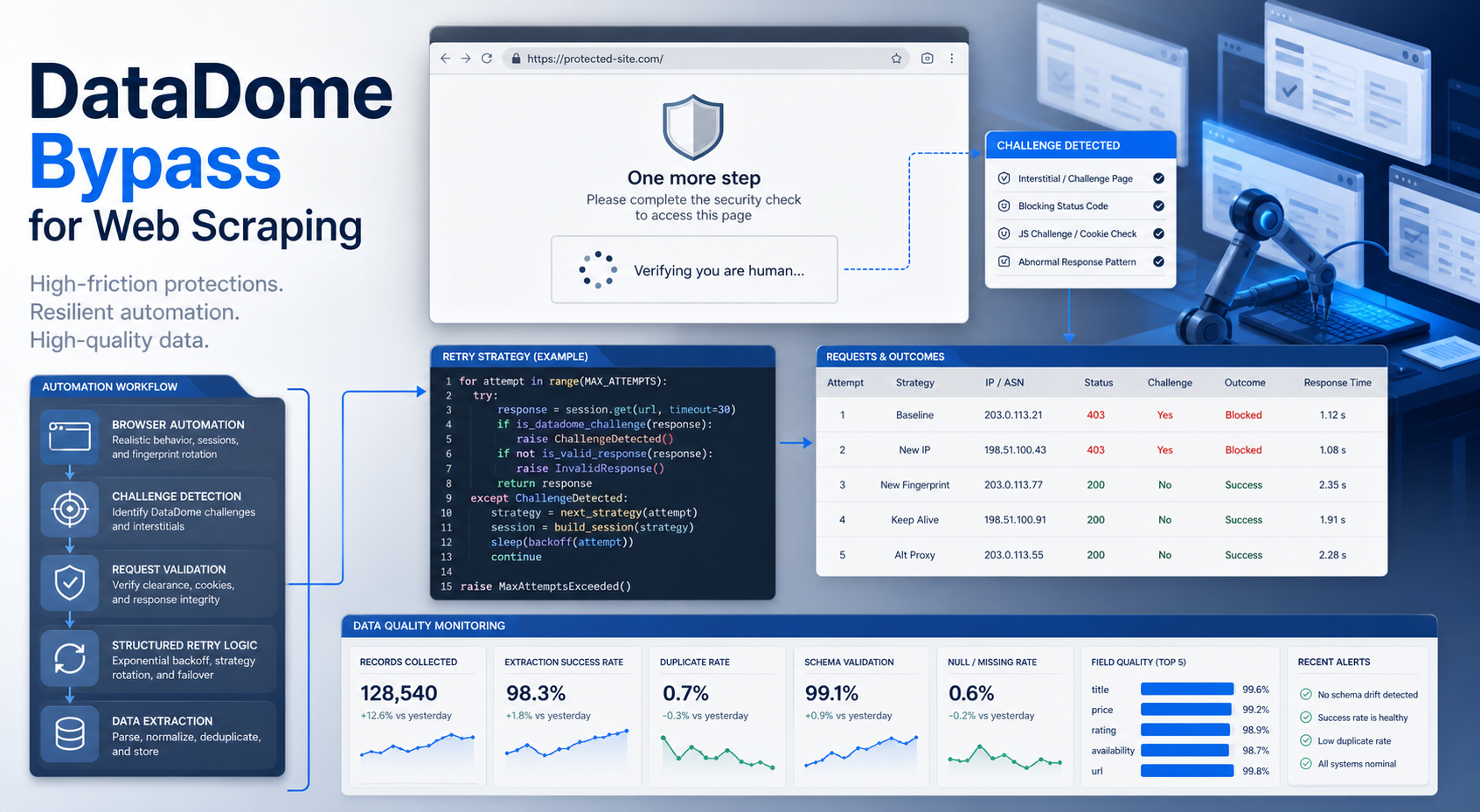
DataDome Bypass for Web Scraping
DataDome Bypass for Web Scraping
View Details
Web Scraping Rate Limiting: How to Handle 429s, Backoff, and Concurrency
Web scraping rate limiting is the engineering discipline of keeping an authorized collection workload inside a target service's acceptable request envelope. When that envelope is exceeded, a server may respond with HTTP 429 Too Many Requests, delay responses, or apply other controls.
View Details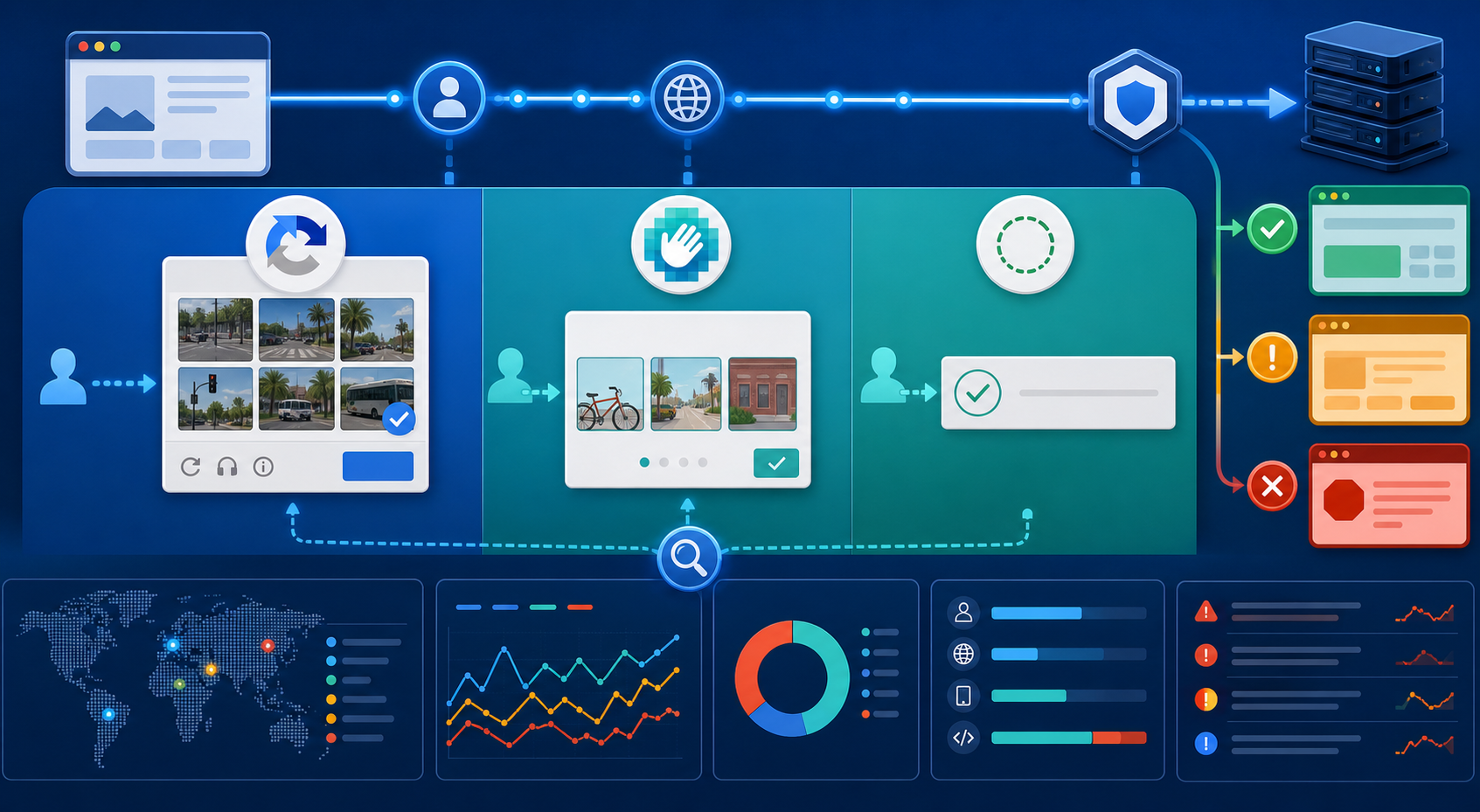
reCAPTCHA vs hCaptcha vs Cloudflare Turnstile: What Scraping Teams Need to Know
If an authorized data-collection workflow suddenly stops at a verification screen, identifying the protection system matters before you change code, browser settings, or proxy infrastructure. reCAPTCHA vs hCaptcha vs Turnstile is not simply a branding comparison. The three systems can expose different browser flows, token models, risk decisions, and failure symptoms.
View Details
Browser Automation Proxies: IPs, Geo-Targeting, Sessions, and AI Agents
A browser automation proxy belongs to the network layer of Playwright, Selenium, cloud-browser, and AI-agent workflows. It changes how browser traffic is routed and can affect the source IP address, geographic egress, and session continuity seen by a destination site. It does not improve an AI model's reasoning, repair browser logic, or guarantee that a website will accept the session.
View Details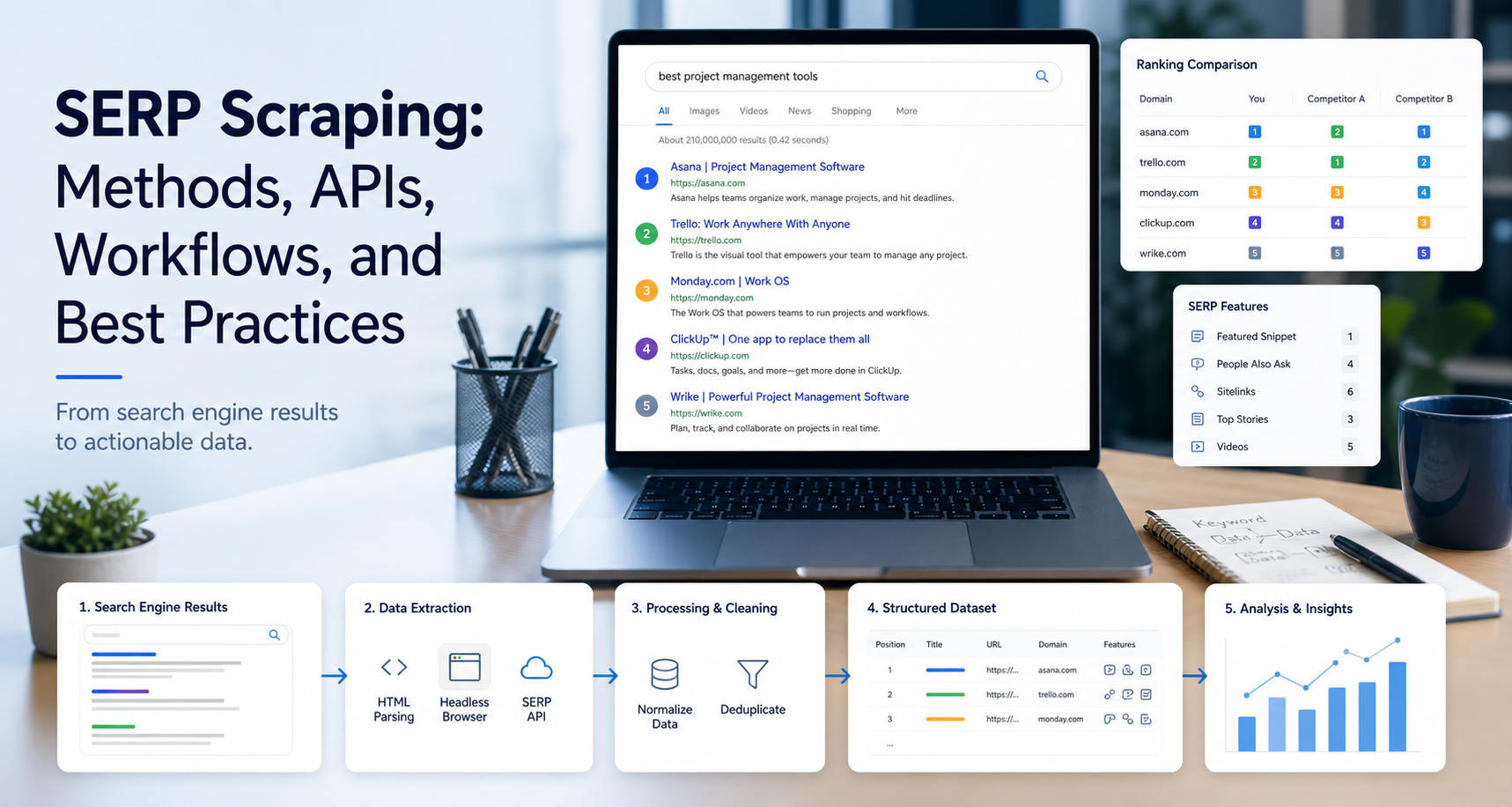
SERP Scraping: Methods, APIs, Workflows, and Best Practices
SERP scraping is the automated collection of information from search engine results pages. A SERP scraper can capture organic rankings, advertisements, featured snippets, People Also Ask questions, local results, shopping listings, images, and other search features, then convert them into structured data for analysis.
View Details