
Get Free Proxy Access in Any Country (2026)
You don't need to pay for a proxy to start testing and routing your web traffic internationally. Here's how to get reliable access worldwide. Whether you're a developer trying to QA localized applications, a data engineer collecting region-specific public data, or a technical operator running authorized security checks, understanding how proxy access works in 2026 is critical. While network restrictions and bot-detection systems have tightened globally, the tools available to navigate them legitimately have also evolved, and not all of them cost money.
This guide breaks down exactly how free proxy access works, what separates reliable infrastructure from risky setups, and how you can configure country-specific proxy access without spending a cent.
Start Reliable Global Routing
Free Residential Proxies vs. Free Web Proxies — What's Actually the Difference?
Before jumping into setup steps, it's worth understanding the underlying architecture. Not all free proxies are created equal, and the difference between a free web proxy and a free residential proxy is enormous in terms of speed, reliability, and security.
Free Web Proxies: Fast to Access, Slow to Deliver
Free web proxies are typically browser-based tools where you paste a URL and route your HTTP requests through their server. They require zero configuration, which makes them appealing at first glance.
However, the architectural limitations are significant:
- Speed throttling: Free web proxies share bandwidth among thousands of simultaneous users, causing severe network congestion.
- HTTPS limitations: Many of these tools struggle with modern TLS handshakes, frequently breaking page elements or refusing connections entirely.
- Cookie and session stripping: Web proxies often aggressively clear cookies, making it impossible to test authenticated sessions.
- Ad injection: A large percentage of these services inject unsolicited ads—or worse, malicious JavaScript—into your DOM.
- IP detection: Modern proxy servers and tunneling detection systems easily flag the datacenter IP ranges used by these services, rendering them useless for accurate geo-testing.
Free Residential Proxies: The More Legitimate Alternative
Residential proxies route your traffic through real consumer IP addresses—actual home internet connections assigned by local ISPs. When a target server receives your request, it appears to originate from a real user in a specific region, not a massive datacenter block.
This drastically reduces detection rates, making residential IPs ideal for legitimate QA testing and data collection. Because operating a residential proxy network is resource-intensive, providers usually charge a premium. However, developers can still access residential proxy bandwidth for free through trial programs, peer-to-peer sharing networks, and freemium proxy pools.
Key Comparison Summary
Free Web Proxies:
- Setup Required: None
- Speed: Slow
- Detection Risk: High
- HTTPS Support: Partial
- Country Selection: Limited
- Stability: Poor
Free Residential Proxies:
- Setup Required: Minimal
- Speed: Moderate to Fast
- Detection Risk: Low
- HTTPS Support: Full
- Country Selection: Wide
- Stability: Moderate
Step-by-Step Setup for Free Proxy Access Across Multiple Countries
Here are the most reliable methods available in 2026 for securing free proxy access internationally, along with setup instructions tailored for technical workflows.
Method 1: Use a Freemium Residential Proxy Provider's Trial
Several reputable proxy providers offer free trial bandwidth—typically between 100MB and 1GB—with no credit card required. This is the cleanest and safest method for developers conducting isolated tests.
Setup steps for a typical Freemium Tier (e.g., Webshare):
- Register a free account on the provider's platform using just an email address.
- Navigate to the dashboard's "Proxy List" section and filter by your target country.
- Copy the proxy IP, port, username, and password provided.
- Open your operating system or browser network settings (e.g., Chrome: Settings > System > Open proxy settings).
- Enter the credentials under manual proxy configuration.
- Verify the connection by sending a curl request or visiting an IP-lookup tool to confirm your localized testing environment is active.
Method 2: Peer-to-Peer Bandwidth Sharing Networks
Applications like Honeygain and PacketStream allow users to share unused internet bandwidth in exchange for credits, which can be redeemed for proxy access. These are fully legal services widely utilized by market research and data intelligence companies.
How to set up for proxy credits:
- Download the client application on your testing machine or mobile device.
- Create an account and let the service run securely in the background.
- Accumulate bandwidth credits over time.
- Redeem credits to access the provider's Content Delivery network, granting you residential IP access across dozens of global regions.
Method 3: Browser Extensions With Built-In Proxy Rotation
Several extensions provide free rotating proxy access directly within Chrome or Firefox. While some market themselves as VPNs, they function identically to a standard HTTP proxy at the browser level.
- Windscribe Browser Extension: The free tier includes up to 10GB/month and servers in over 10 countries.
- Hoxx VPN Proxy: A free extension offering granular country selection (US, UK, Germany, etc.).
- SetupVPN: Offers free proxy routing across 30+ countries (ad-supported).
Setup for browser extensions:
- Search for the extension in your browser's official web store and install it.
- Create a free user account.
- Click the extension icon and select a target country to simulate.
- Connect the extension—your browser DOM and network requests will now be routed through that region.
Method 4: Community Proxy Databases
Platforms like free-proxy-list.net and proxyscrape.com maintain live, community-driven databases of free proxy endpoints sorted by country, anonymity level, and protocol (HTTP, HTTPS, SOCKS4, SOCKS5).
How to use public lists manually:
- Visit a live proxy database.
- Filter by your target country and select an HTTPS or SOCKS5 endpoint. SOCKS5 is generally preferred due to its robust UDP/TCP support, defined under the RFC 1928 SOCKS5 specification.
- Copy the IP and Port combination.
- Inject these details into your automation script (e.g., Puppeteer or Selenium) or manual network settings.
- Pro Tip: Public proxies have notorious churn rates. Always build fallback logic into your scripts to rotate to the next available IP if the connection drops.
Start Reliable Global Routing
Risks of Using Free Proxies and How to Minimize Your Exposure
Free access always comes with tradeoffs. Technical operators must understand these risks before routing corporate or personal traffic through unknown servers.
Risk 1: Data Interception and Logging
When you use a free proxy, all your traffic passes through an intermediary server. If that server is operated by a malicious actor, your payload data, headers, and credentials could be intercepted.
- How to minimize this: Enforce strict HTTPS for all requests. End-to-end TLS encryption ensures that even a compromised proxy cannot read your packet payloads. Never authenticate into sensitive accounts or internal administration panels through a public free proxy.
Risk 2: Malware and Script Injection
Particularly common with free web proxies, operators may inject JavaScript payloads into the pages you visit.
- How to minimize this: Use ad-blocking and script-blocking extensions (like uBlock Origin) when testing manually. In automated headless environments, disable JavaScript execution if your specific testing parameters allow it.
Risk 3: IP Blacklisting and Account Bans
Public proxies, especially shared datacenter IPs, have high "abuse scores." Accessing platforms using these IPs can trigger CAPTCHAs, automated rate-limiting, or outright platform bans.
- How to minimize this: Use residential IPs for QA testing on aggressive bot-mitigation platforms. Always rotate endpoints frequently to avoid triggering rate limits.
Risk 4: Legal Considerations
Routing traffic through different jurisdictions can touch upon various legal gray areas. Gathering public data or running security checks must always be done ethically.
- How to minimize this: Ensure all data scraping and testing activities strictly comply with applicable laws (e.g., GDPR, CCPA) and the target website's Terms of Service. Obtain explicit authorization before running security probes against any network infrastructure.
Risk 5: Inconsistent Uptime
Free proxies die rapidly. A node that works perfectly at 9:00 AM may be completely unresponsive by 9:15 AM.
- How to minimize this: Treat public lists as temporary resources. Use tools like FoxyProxy or write robust retry-and-rotate logic in your code to automatically failover to backup proxies when timeouts occur.
LycheeIP (Developer-First Proxy Infrastructure)
While free and freemium proxy solutions are acceptable for casual, one-off testing, technical teams building scalable applications need robust reliability. LycheeIP is a developer-first proxy and data infrastructure provider designed to equip engineering, QA, and growth teams with high-performance global routing capabilities.
When a team needs to accurately verify international pricing models, perform continuous integration testing for localized UI flows, or conduct authorized security audits, relying on volatile free public pools simply isn't viable. These enterprise-level use cases demand stability. By integrating reliable data infrastructure directly into your automated pipelines, LycheeIP ensures accurate simulation of global user traffic with zero friction. For instance, testing a highly dynamic, region-specific checkout flow is best handled using dynamic IP routing, which constantly rotates end-nodes to simulate a distributed user base and prevent IP blocking. Conversely, tasks that require consistent identities—such as maintaining stable session states for secure QA environments—are optimally suited for high-speed datacenter proxies or dedicated static IPs. By migrating away from free lists, developers can focus entirely on shipping code rather than managing proxy uptime.
Final Thoughts
Free proxy access in 2026 is genuinely viable—if you deploy the right tools and understand the architectural tradeoffs. Legacy web proxies are largely obsolete and unreliable for modern development workflows. Instead, freemium residential proxy tiers, peer-to-peer bandwidth networks, and trusted browser extensions offer vastly superior performance with significantly lower risk profiles.
The golden rules remain unchanged: always enforce HTTPS, strictly compartmentalize your testing environments from sensitive login credentials, and treat public proxy lists as temporary utilities. With proper guardrails, testing localized content and gathering legitimate public data from virtually any country is highly achievable without a subscription.
Start Reliable Global Routing
Frequently Asked Questions
Q: What is the difference between a proxy and a VPN?
A: A proxy routes specific traffic (like HTTP requests from a browser or script) through an intermediary server, while a VPN encrypts and tunnels the entire device's network traffic at the OS level. Proxies are generally faster and preferred for programmatic testing, whereas VPNs offer broader, system-wide protection.
Q: Are free proxies safe to use in 2026?
A: Free proxies carry inherent risks, including potential data logging and script injection. However, you can mitigate these risks by using reputable freemium providers, strictly enforcing HTTPS connections, and ensuring you never transmit sensitive authentication tokens over unverified proxy nodes.
Q: Can I use a free proxy to bypass geo-blocks on streaming sites?
A: While end-users often attempt this, free datacenter proxies are almost universally blocked by major streaming platforms' anti-bot systems. For legitimate QA testing of streaming services, developers rely on high-quality residential networks that simulate real consumer devices without triggering automated defenses. Always comply with the platform's Terms of Service.
Q: What countries can I get free proxy access for?
A: Most public and freemium services offer extensive coverage in North America (US, Canada) and Europe (UK, Germany, France, Netherlands). Peer-to-peer networks often extend this to dozens of other regions, including APAC and LATAM, depending on node availability.
Q: Is using a proxy illegal?
A: In most jurisdictions, utilizing a proxy to route traffic or test localized content is entirely legal. However, the actions you perform over the proxy (e.g., unauthorized data extraction, bypassing security controls, violating site ToS) can carry legal consequences. Additionally, heavily censored regions may restrict proxy usage. Always consult local laws and operate ethically.
Q: Why do free proxy IPs stop working so quickly?
A: Public free proxies are hit by thousands of simultaneous requests. Websites quickly detect this abnormal traffic volume and rate-limit or ban the IP. Furthermore, the host servers often crash under the load. This high churn rate is why enterprise teams utilize dedicated infrastructure rather than public lists.
Q: What is a SOCKS5 proxy, and is it better than an HTTP proxy?
A: SOCKS5 is a versatile proxy protocol that operates at a lower network level, allowing it to handle any type of traffic (TCP and UDP), whereas HTTP proxies are strictly limited to web traffic. For complex testing scenarios, API integrations, or real-time data streaming, SOCKS5 is generally the superior option.
Q: How do I test if my proxy is correctly configured?
A: Execute a simple command-line request to an IP verification endpoint (e.g., via standard terminal commands) or visit a site like ipleak.net in your browser. If the returned IP and geographic location match your target proxy node instead of your local machine, your traffic is routing correctly.

Recommended Articles
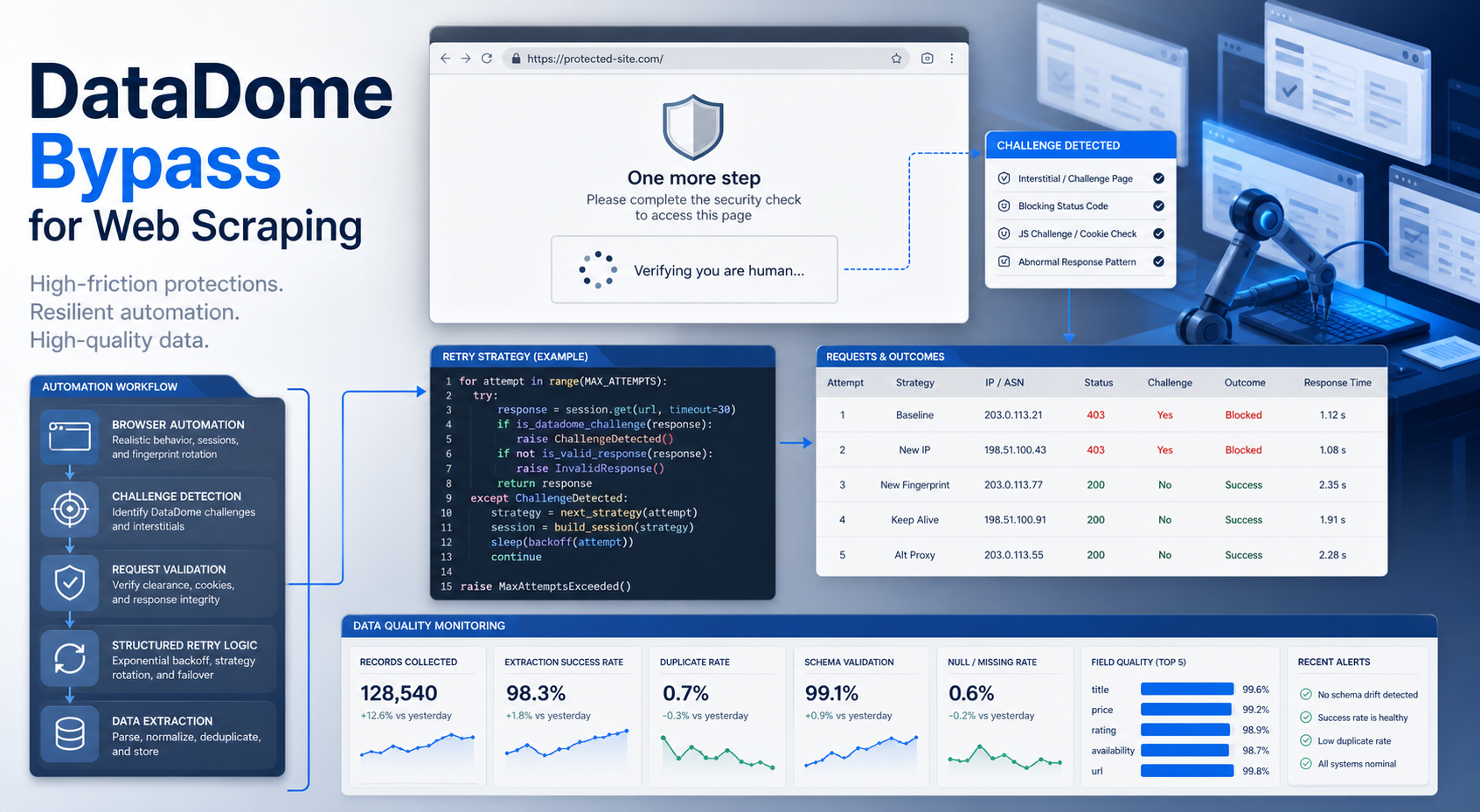
DataDome Bypass for Web Scraping
DataDome Bypass for Web Scraping
View Details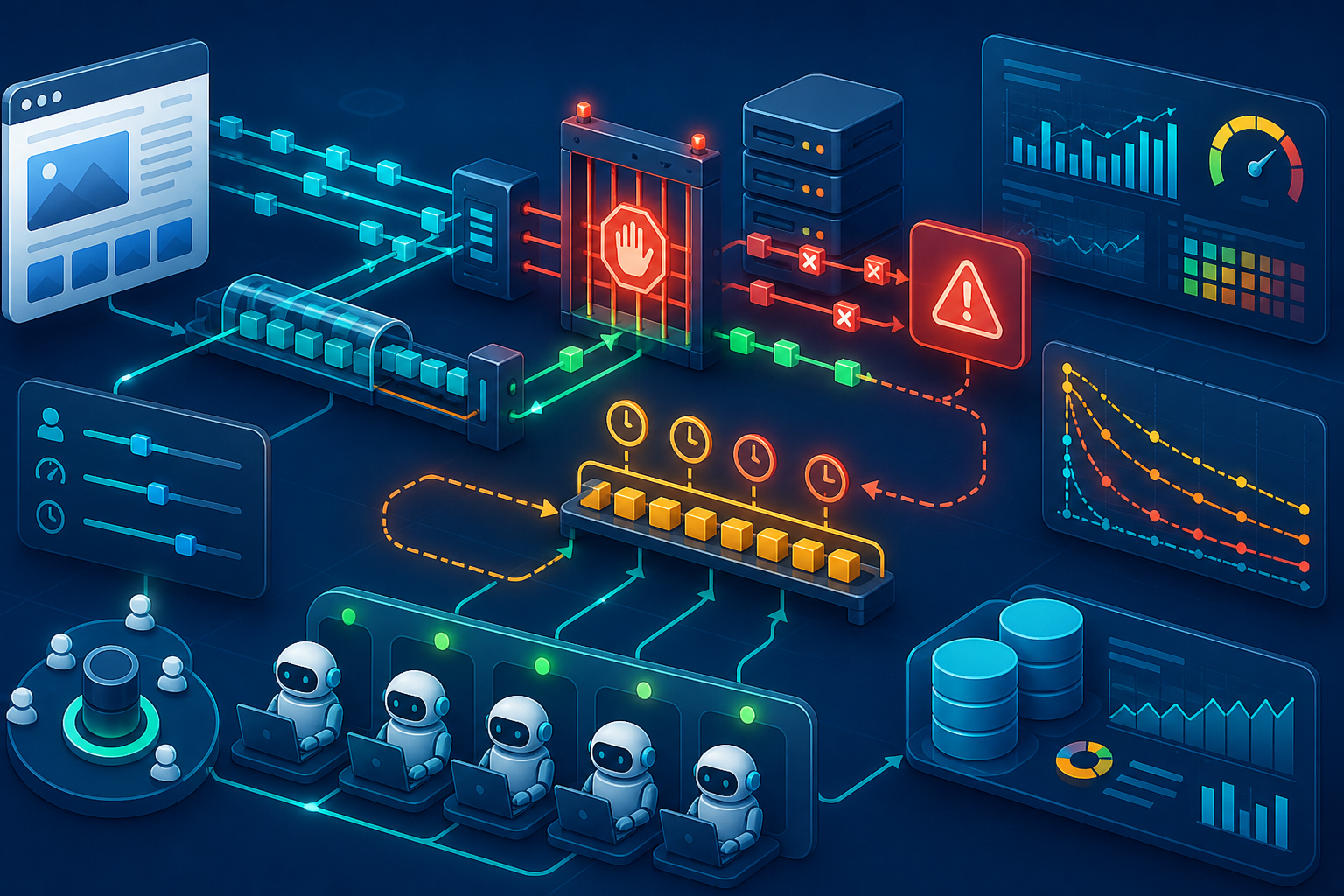
Web Scraping Rate Limiting: How to Handle 429s, Backoff, and Concurrency
Web scraping rate limiting is the engineering discipline of keeping an authorized collection workload inside a target service's acceptable request envelope. When that envelope is exceeded, a server may respond with HTTP 429 Too Many Requests, delay responses, or apply other controls.
View Details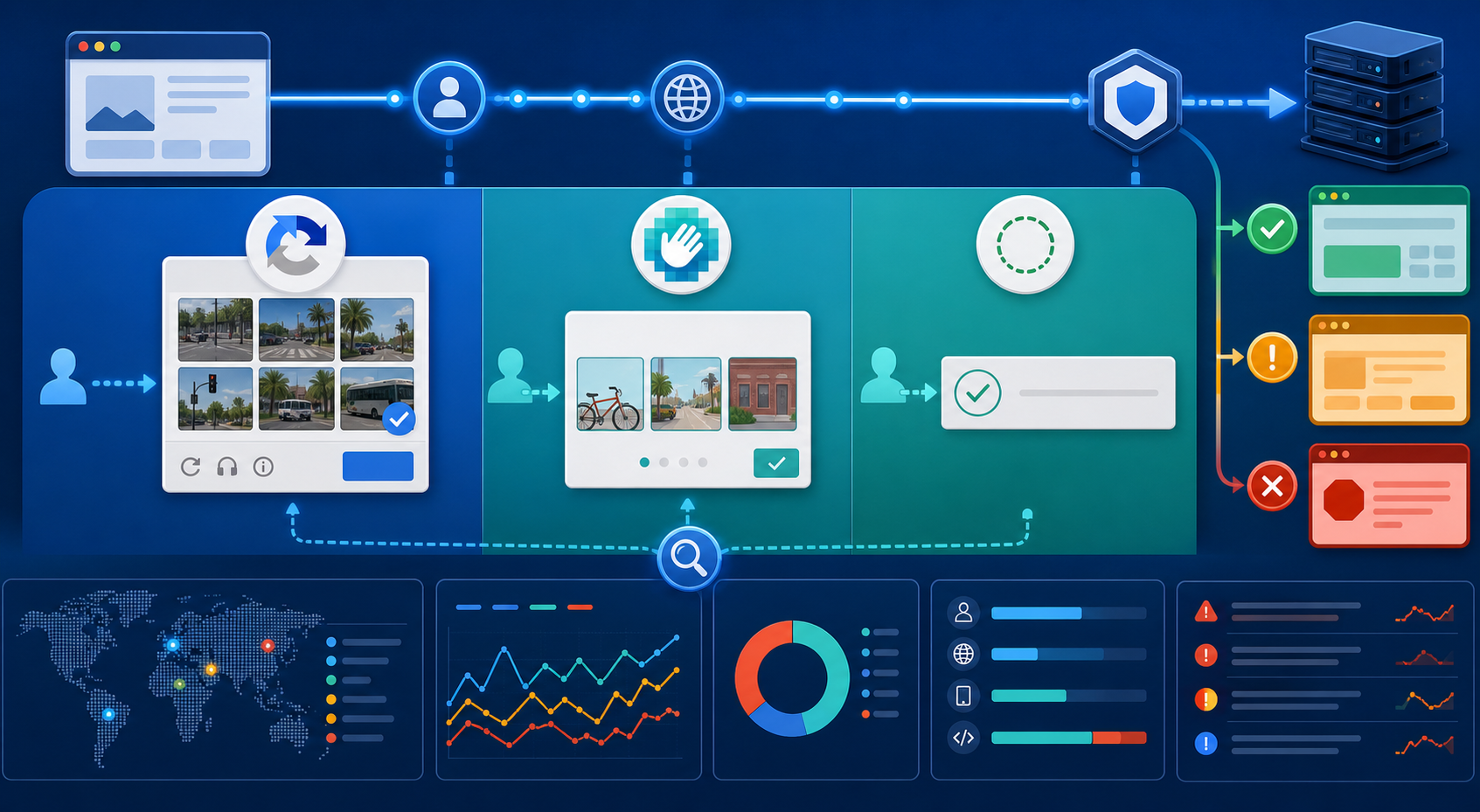
reCAPTCHA vs hCaptcha vs Cloudflare Turnstile: What Scraping Teams Need to Know
If an authorized data-collection workflow suddenly stops at a verification screen, identifying the protection system matters before you change code, browser settings, or proxy infrastructure. reCAPTCHA vs hCaptcha vs Turnstile is not simply a branding comparison. The three systems can expose different browser flows, token models, risk decisions, and failure symptoms.
View Details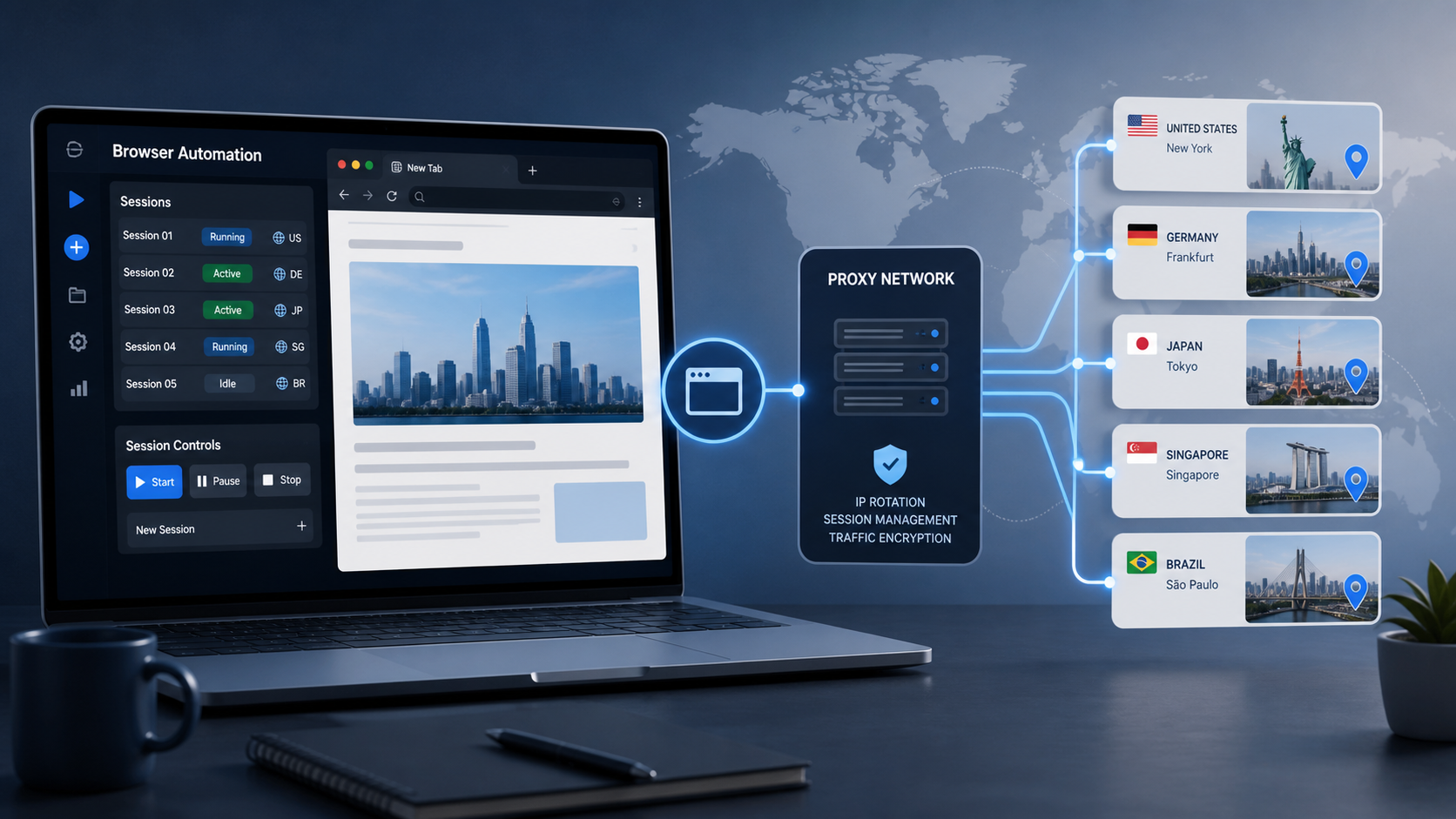
Browser Automation Proxies: IPs, Geo-Targeting, Sessions, and AI Agents
A browser automation proxy belongs to the network layer of Playwright, Selenium, cloud-browser, and AI-agent workflows. It changes how browser traffic is routed and can affect the source IP address, geographic egress, and session continuity seen by a destination site. It does not improve an AI model's reasoning, repair browser logic, or guarantee that a website will accept the session.
View Details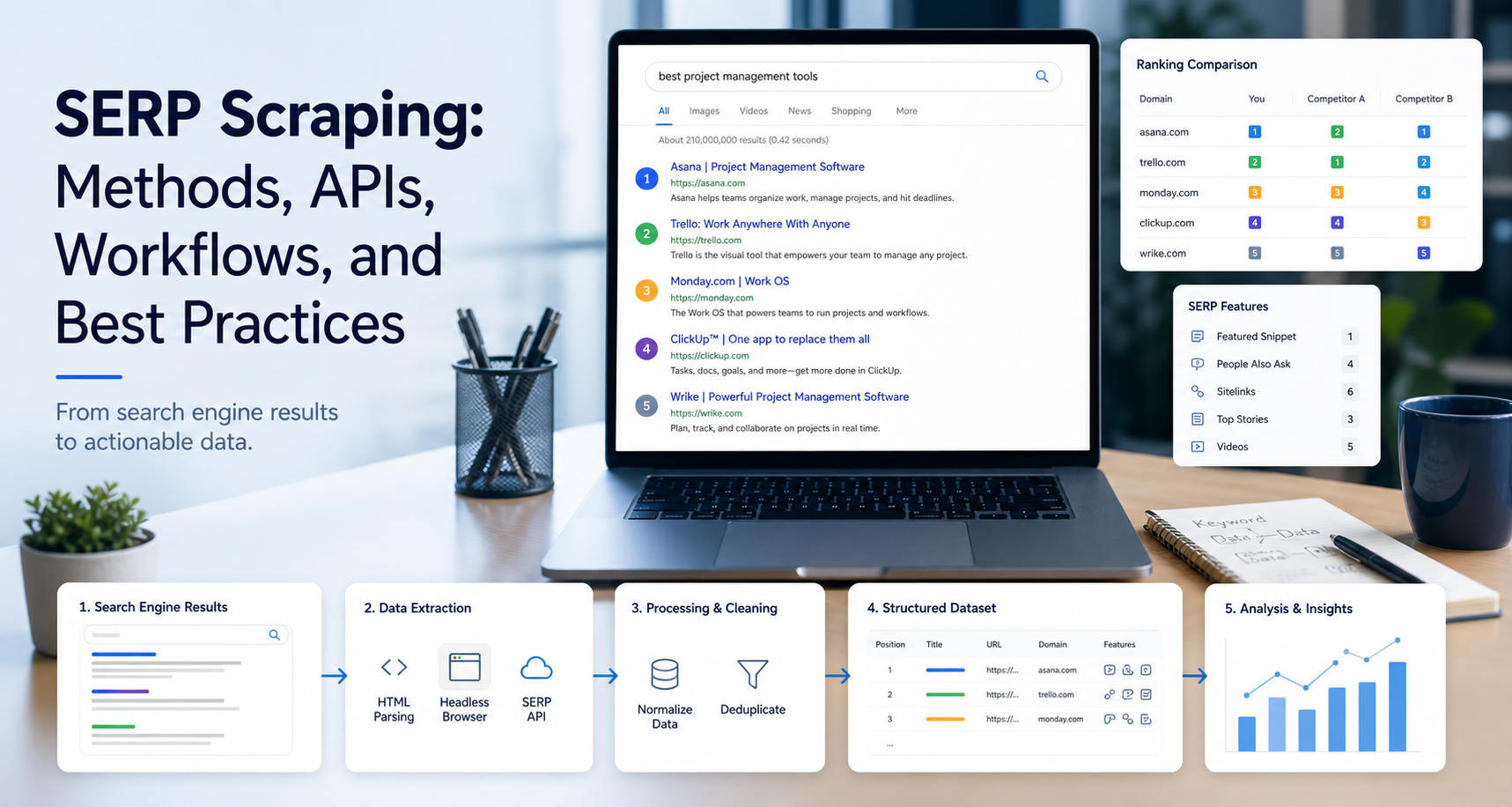
SERP Scraping: Methods, APIs, Workflows, and Best Practices
SERP scraping is the automated collection of information from search engine results pages. A SERP scraper can capture organic rankings, advertisements, featured snippets, People Also Ask questions, local results, shopping listings, images, and other search features, then convert them into structured data for analysis.
View Details