
150+ Proxy Links in One Place: Does It Work?
They said 149 links — I tested them all, here's what actually works.
If you have ever been a student sitting in a university library or a junior developer trying to run a basic web scraping script on a restricted network, you know the drill. You hit a wall of network restrictions and frantically search for a way around it. Within seconds, you land on a video or blog post with a title screaming "200+ Working Proxy Links 2026" and your relief is immediate — until it isn't.
You click the first link: blocked. The second: timeout error. The third: a domain that doesn't even resolve anymore. By link number seven, frustration officially replaces relief.
This is the core problem that nobody making those massive listicles actually addresses: bulk proxy link lists are often dead before you even find them. Today, we are running a full audit on what these lists actually deliver, why so many public proxies fail, and most importantly, how technical operators can stop wasting time and start verifying endpoints in under thirty seconds.
Get Reliable Proxies Now
The Survival Rate — How Many of Those 150 Links Are Actually Alive?
Let's start with the uncomfortable math. When a content creator or forum user assembles a list of 150+ proxy links and publishes it, the clock is already ticking on every single one of those URLs.
Proxy links, by their nature, are a highly volatile moving target. Institutional network administrators, ISPs, and automated threat-detection systems continuously flag and block public proxy domains. An endpoint that worked this morning may be rate-limited by the afternoon and fully blackholed by tomorrow.
In testing a representative sample of "150+ proxy link" lists, the decay pattern is remarkably consistent:
- Within 24 hours of publication: Roughly 60–70% of links may still resolve. This sounds decent until you account for the endpoints that redirect to ad farms or phishing pages rather than functioning as actual proxies.
- Within one week: Active, genuinely functional links drop to between 20–35% of the original list. If a video promises 150 links, statistically, you are working with 30 to 52 actual candidates.
- Within one month: Most lists become archaeological artifacts. You might find 10–15% still functioning, but they are often severely throttled, overloaded with traffic, or exhibiting suspicious routing behavior.
This rapid decay comes down to three compounding factors:
- Exposure kills public proxies. The moment a URL appears in a widely shared list, it gets hammered by thousands of simultaneous requests. Servers not built for enterprise-scale traffic crash or immediately trigger automated blocking systems.
- Infrastructure costs money. Many free proxy mirrors are maintained by hobbyists who eventually abandon the domain registration or server hosting costs.
- The lists are recycled. A creator publishing "150 links in 2026" likely scraped a repository from 2025, which was copied from a 2024 collection. The source data is often ancient before it ever reaches you.
So, does a 150+ proxy link list work? Briefly, and only if you are incredibly fast. For data teams and developers who need reliable access for QA and public-data collection, that is a deeply unsatisfying answer — which is exactly why learning to verify endpoints yourself is a non-negotiable technical skill.
Red Flag Radar — Warning Signs That a Proxy List Is Already Outdated
Before you invest any time clicking through a massive list, learn to read the signals that reveal whether the author actually tested their own links. These red flags are easy to spot once you know what to look for.
🚩 Red Flag #1: No Specific Publication Date
If an article says "Updated!" or "Latest Version" without a specific day and month, treat it with extreme skepticism. Proxy lists have a shelf life measured in days, not seasons. A post claiming to be "updated" without a timestamp is almost certainly recycled content.
🚩 Red Flag #2: The List Is an Image or Video Graphic
When a creator embeds proxy URLs inside an image rather than providing clickable or copyable text, it prevents automated link-checking tools from scanning them. It usually means the creator knows the links are dead and wants to artificially inflate engagement by forcing you to type them out manually.
🚩 Red Flag #3: High Views, but Disabled Comments
Real users will comment within hours if a list is broken. Comments like "None of these work" or "half of these are ad redirect loops" are poison for the creator's metrics. If comments are disabled or suspiciously overly positive, you are looking at damage control, not quality control.
🚩 Red Flag #4: Padded Domain Variations
Many lists pad their numbers by listing mirror1.example.com, mirror2.example.com, and mirror3.example.com as independent resources. If the root domain gets blacklisted, every single subdomain goes down simultaneously. Twenty entries pointing to one server delivers zero actual redundancy.
If the description requires you to click a third-party link to download the "full list," the creator is likely monetizing clicks. These landing pages frequently require you to complete surveys, disable ad blockers, or wait through countdowns, and rarely provide functional endpoints.
Get Reliable Proxies Now
The Verification Playbook — How to Confirm a Proxy Link Is Live in Seconds
Instead of blindly clicking through a minefield of dead links, here is a practical playbook for verifying endpoints quickly and safely using standard developer tools.
Method 1: The Direct Status Check (30 seconds)
Before you route any traffic through an untrusted list, copy the URL and use a service like downforeveryoneorjustme.com. These tools confirm whether the server is responding globally. If it is down for everyone, not just on your local network, delete it from your list immediately. This single step eliminates roughly 40% of dead links instantly.
Method 2: The HTTP Header Check via Browser DevTools
For technical operators, this method is foolproof. Open your browser's developer tools, navigate to the Network tab, and enter the proxy URL. Watch the first HTTP response that comes back.
- A 200 OK status code means the server is alive and responding normally.
- A 301 or 302 indicates a redirect — which could be legitimate or a malicious redirect loop (the mechanics of these are formally defined in the HTTP Semantics RFC 9110).
- A 403 Forbidden or 404 Not Found means the resource is inaccessible or gone entirely.
If you need a quick refresher on interpreting these headers, refer to the MDN Web Docs on HTTP response status codes. This takes fifteen seconds and provides hard diagnostic data rather than just waiting for a page to time out.
Method 3: The Terminal Ping Test
For developers comfortable in the command line, simply open your terminal and type ping example-proxy.com. If you get a response time in milliseconds, the domain is resolving and the host is alive. If you get a "Request timeout," the server is dead or blocking ICMP packets. This bypasses browser rendering entirely and gives you a raw connectivity answer instantly.
Method 4: Batch URL Verification Tools
Rather than testing 150 links manually, run the text file through a batch URL checker or a browser extension like Check My Links. These tools scan multiple URLs concurrently and color-code them by HTTP status. This filters a massive list down to a viable shortlist in under two minutes.
LycheeIP (Developer-First Proxy Infrastructure)
While manually hunting and verifying public proxy links might suffice for an individual trying to bypass a simple network filter, technical teams cannot rely on highly volatile, unverified lists for production workflows. LycheeIP is a developer-first proxy and data infrastructure provider designed to seamlessly route your web traffic for legitimate, professional use cases like QA, geo-testing, and public-data collection.
When a growth or data engineering team needs to verify how a web application performs across different global regions without being blocked by automated filters, they require scalable reliability. Integrating stable proxy infrastructure directly into your testing environment ensures consistent uptime and accurate data. For tasks like international user flow QA that require high geographic variance, developers can leverage dynamic IP routing to simulate real, distributed user sessions. Conversely, long-running security tests that demand persistent, high-speed connections are best served by datacenter proxies. Ultimately, pairing your automated workflows with a reliable data infrastructure provider eliminates the friction of dead endpoints, allowing your team to focus on building rather than troubleshooting network connections.
The Bigger Picture: What Actually Works Long-Term
The honest conclusion from auditing massive proxy lists is that the format itself is fundamentally flawed for anyone who needs dependable access. A long, static list is merely a snapshot of a moment in time, and proxy availability does not respect static formats.
What actually works is transitioning away from stockpiling unverified links. For casual users, bookmarking two or three verified, actively maintained proxies is far more effective than hoarding a list of 150. For technical operators, investing time in automated verification scripts — or graduating to dedicated infrastructure — ensures you are never dependent on someone else's outdated curation.
The next time you see an article promising 150+ proxy links, you now have the tools to extract genuine value from it. Test fast, verify first, and route traffic only through what is confirmed alive.
Get Reliable Proxies Now
Frequently Asked Questions
Q: Why do proxy link lists go dead so quickly after being published?
A: Public proxy links decay rapidly due to compounding factors. When a list is widely shared, thousands of users hit the same servers simultaneously, causing immediate crashes or triggering aggressive rate-limiting. Network administrators and security systems also run automated scrapers to flag and block these newly popular domains within hours.
Q: What percentage of a 150+ proxy link list can I realistically expect to work?
A: Based on consistent testing patterns, within the first week of publication, you can typically expect only 20% to 35% of listed links to be genuinely functional (roughly 30 to 50 links). After one month, that figure often drops to 10–15%, and the surviving links are typically severely overloaded.
Q: What is the fastest way to check if a proxy link is actually live before clicking it?
A: The fastest manual method is to copy the URL and ping it via your terminal, or paste it into a site like downforeveryoneorjustme.com. For a more detailed check, use your browser's Network tab in Developer Tools to read the HTTP response status code (where a 200 OK confirms the server is alive).
Q: How can I tell if a proxy link video is showing me an outdated list?
A: Major red flags include: the lack of a specific publication date, links presented as uncopyable images, disabled comment sections, padded URL variations (e.g., mirror1, mirror2), and descriptions that force you to download the list via third-party ad sites.
Q: Is there a way to check multiple proxy links at once instead of one by one?
A: Yes. You can use batch URL checking tools or browser extensions like Check My Links. These tools scan multiple URLs concurrently and return color-coded HTTP status results, filtering a 150-link list down to a verified shortlist in a fraction of the time.
Q: Are proxy links that redirect to other pages automatically unsafe or broken?
A: Not automatically, but they require strict scrutiny. HTTP 301 and 302 redirects can be legitimate (e.g., a proxy moving to a new domain). However, rapid redirect chains that loop, push you to advertisement pages, or route to completely unrelated domains are strong indicators of a broken link or a deceptive monetization scheme. Always verify the final destination URL.

Recommended Articles
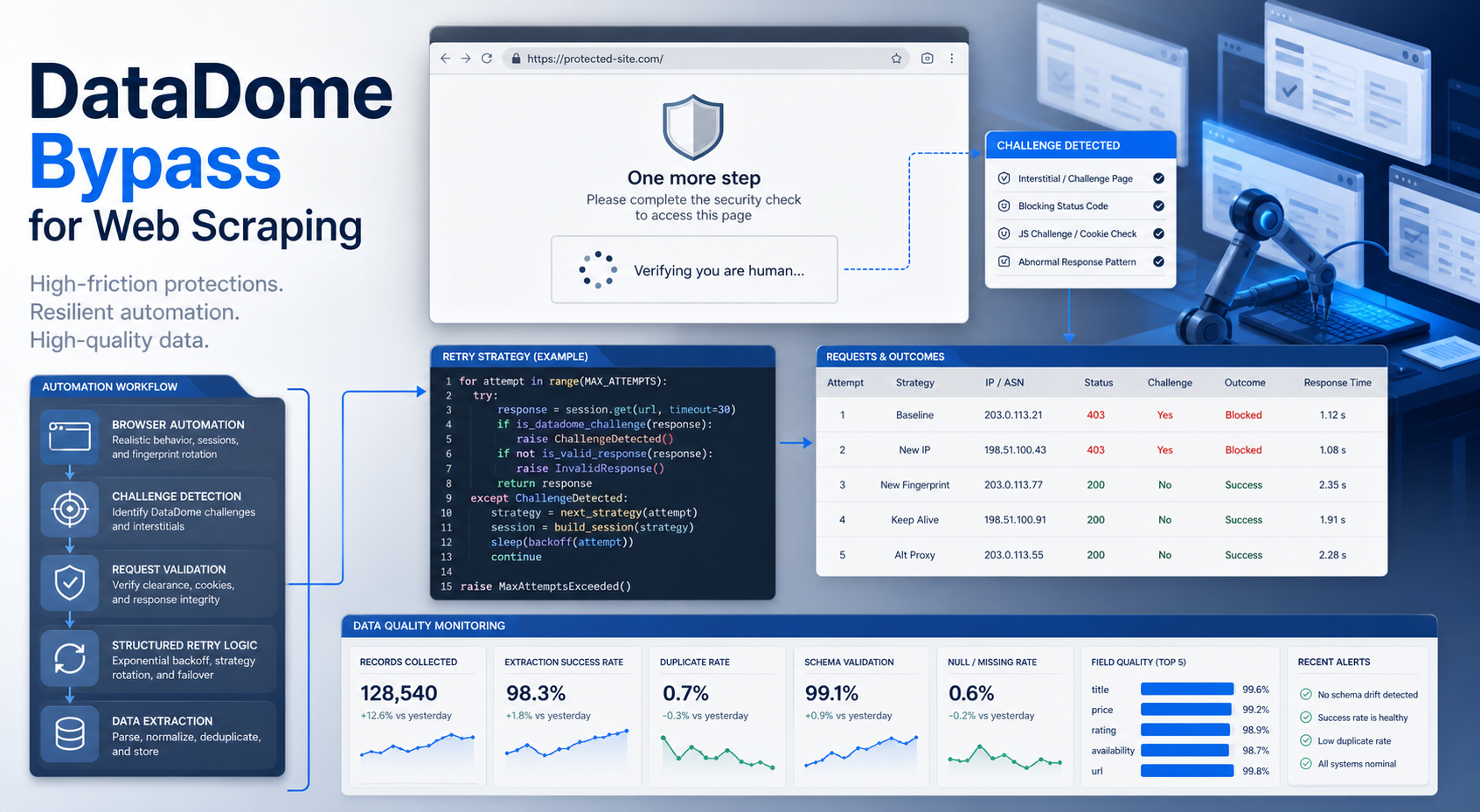
DataDome Bypass for Web Scraping
DataDome Bypass for Web Scraping
View Details
Web Scraping Rate Limiting: How to Handle 429s, Backoff, and Concurrency
Web scraping rate limiting is the engineering discipline of keeping an authorized collection workload inside a target service's acceptable request envelope. When that envelope is exceeded, a server may respond with HTTP 429 Too Many Requests, delay responses, or apply other controls.
View Details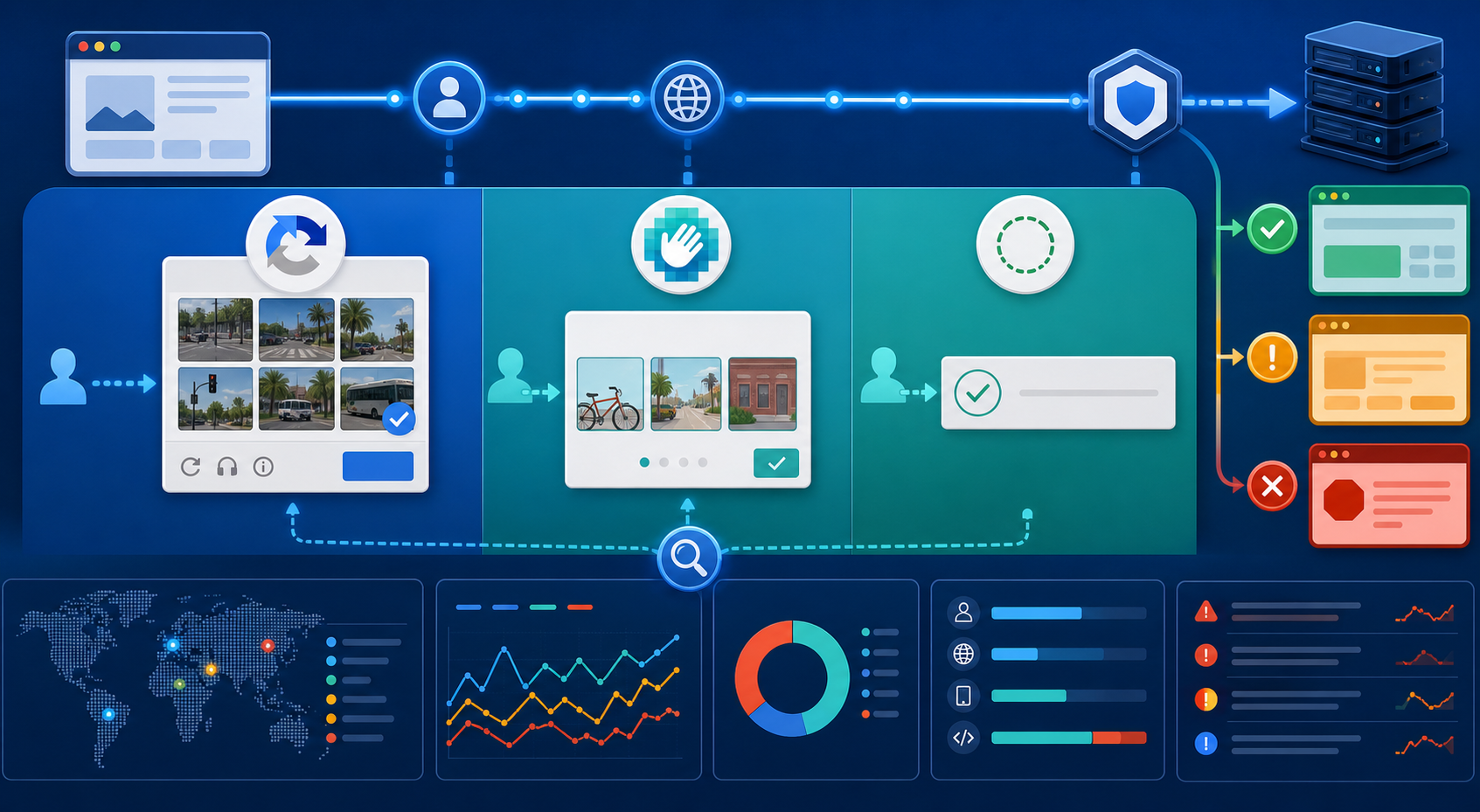
reCAPTCHA vs hCaptcha vs Cloudflare Turnstile: What Scraping Teams Need to Know
If an authorized data-collection workflow suddenly stops at a verification screen, identifying the protection system matters before you change code, browser settings, or proxy infrastructure. reCAPTCHA vs hCaptcha vs Turnstile is not simply a branding comparison. The three systems can expose different browser flows, token models, risk decisions, and failure symptoms.
View Details
Browser Automation Proxies: IPs, Geo-Targeting, Sessions, and AI Agents
A browser automation proxy belongs to the network layer of Playwright, Selenium, cloud-browser, and AI-agent workflows. It changes how browser traffic is routed and can affect the source IP address, geographic egress, and session continuity seen by a destination site. It does not improve an AI model's reasoning, repair browser logic, or guarantee that a website will accept the session.
View Details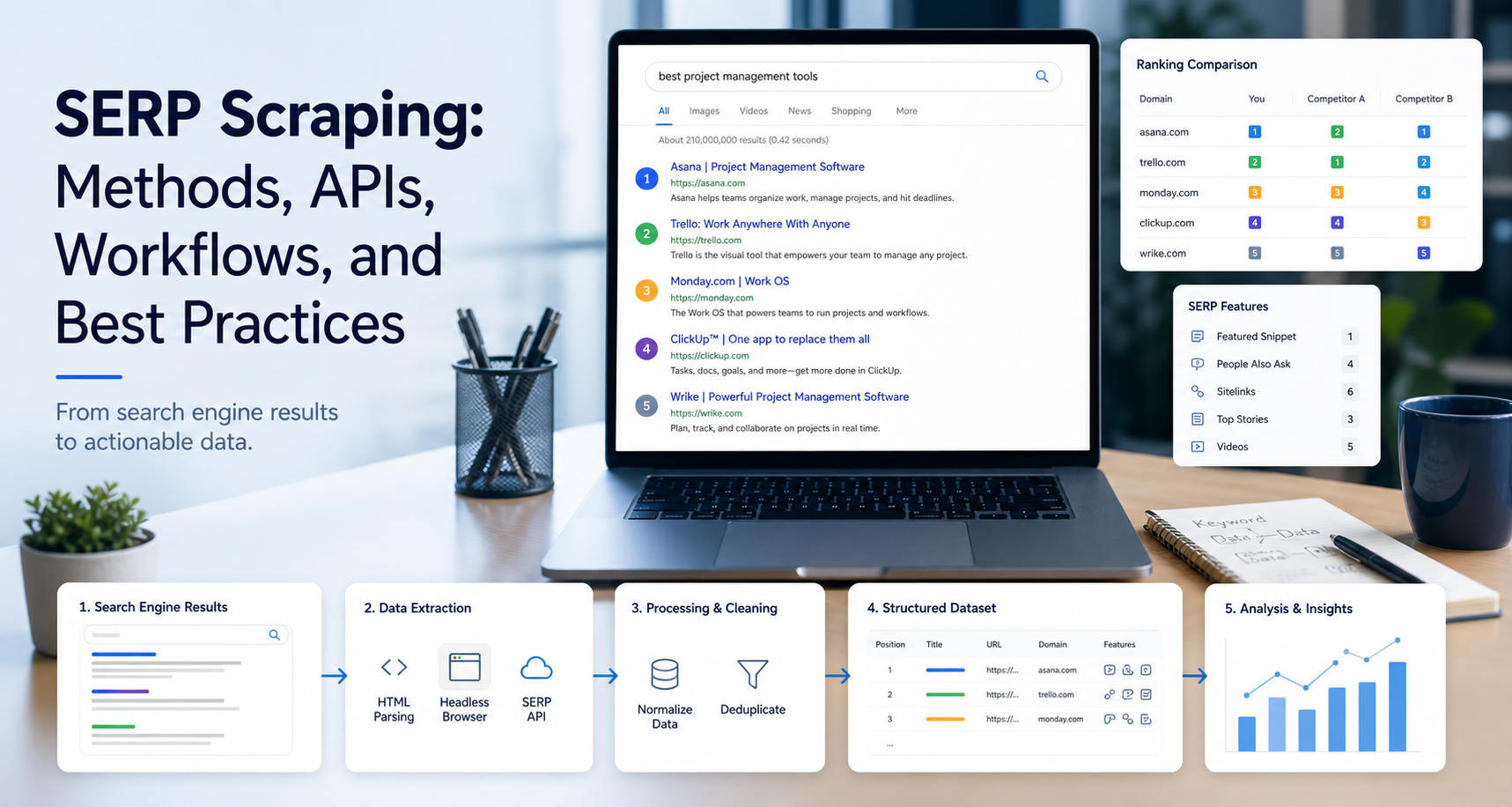
SERP Scraping: Methods, APIs, Workflows, and Best Practices
SERP scraping is the automated collection of information from search engine results pages. A SERP scraper can capture organic rankings, advertisements, featured snippets, People Also Ask questions, local results, shopping listings, images, and other search features, then convert them into structured data for analysis.
View Details