
Forward Proxy vs Reverse Proxy: Key Differences Explained
Both forward and reverse proxies act as intermediaries in network traffic, but they serve entirely different purposes. Understanding which one to use and why is essential for system design, security architecture, and practical network engineering.
Do you know the key distinctions between forward and reverse proxies? While both serve as intermediaries between clients and servers, their functions in network design are quite different. Understanding this distinction matters whether you are designing a scalable microservices architecture, setting up secure corporate internet access, preparing for a CompTIA Network+ exam, or deciding how to handle incoming traffic for a production web application.
The confusion is common. Many developers and system administrators use the terms interchangeably or have only a vague sense of which proxy type does what. In this guide, we will work through both proxy types using clear traffic flow patterns, real-world use cases, and implementation context so the difference becomes permanently clear.
What Is a Proxy Server?
Before comparing the two types, it helps to establish what a proxy server actually does. A proxy server is a system that sits between a client and a destination server, intercepting and forwarding requests on behalf of one of those parties. Rather than a client communicating directly with a target server, the request travels through the proxy first.
This middleman position gives the proxy the ability to inspect, modify, log, block, or route traffic depending on how it is configured. The key question is: which party does the proxy serve, and in which direction does it face? The answer to that question is what separates a forward proxy from a reverse proxy.
At a high level, proxies exist to solve three recurring infrastructure problems:
- Traffic control
- Security enforcement
- Performance optimization
Modern architectures often combine multiple proxy layers simultaneously. A single request might pass through a CDN reverse proxy, an internal API gateway, and outbound corporate forward proxies before reaching its final destination.
For a more general overview of proxy infrastructure concepts and deployment patterns, the LycheeIP homepage provides additional context around developer-focused proxy networking workflows.
Understand Proxy Differences Today
What Is a Forward Proxy?
A forward proxy sits in front of clients and acts on their behalf when making requests to the internet or external servers. When a client sends a request, it goes to the forward proxy first. The proxy then forwards the request to the destination server, receives the response, and passes it back to the client.
From the destination server's perspective, the request appears to originate from the proxy, not from the original client. This is the core function of IP address masking that forward proxies provide.
Forward proxies are commonly deployed in environments where administrators want visibility or control over outbound traffic. They are also widely used in automation workflows that require traffic routing through multiple IP addresses.
According to the Mozilla HTTP overview, proxies are an important part of how modern HTTP traffic is filtered, cached, secured, and routed across networks.
Forward Proxy Traffic Flow
The traffic path for a forward proxy looks like this:
Client → Forward Proxy → Internet / Destination Server → Forward Proxy → Client
The client is aware of the proxy and must be configured to route requests through it. The destination server only sees the proxy's IP address, not the client's real IP.
How Forward Proxies Mask Client IPs and Control User Access
One of the most important roles of a forward proxy is protecting and managing client identity. When users on a corporate network or a restricted environment send requests through a forward proxy, the following things happen:
- The client's real IP address is replaced by the proxy's IP at the destination server.
- The proxy can log outbound requests, giving administrators visibility into network usage patterns.
- The proxy can enforce access policies, blocking requests to specific domains or categories of content.
- Teams can centralize outbound security monitoring and compliance controls.
- Requests can appear to originate from different geographic regions depending on proxy placement.
This combination of IP masking and access control makes forward proxies a standard tool in enterprise environments, QA testing workflows, research networks, and managed internet access systems.
Forward Proxy Use Cases
Forward proxies are deployed across a wide range of scenarios:
- Corporate internet access control: Organizations route employee traffic through a forward proxy to enforce acceptable-use policies and reduce exposure to malicious domains.
- Privacy and anonymity: Users may route requests through a proxy to avoid exposing their origin IP address directly to destination services.
- Geo-testing and localization QA: Development and marketing teams validate how applications, ads, or search results behave in different regions.
- Caching for bandwidth savings: Frequently requested assets can be cached locally to reduce outbound bandwidth usage.
- Web scraping and public data collection: Developers use forward proxy infrastructure to distribute automated requests across multiple IP addresses during legitimate public-data collection workflows.
- Security testing: Authorized security teams use forward proxies to inspect and modify outbound traffic during penetration testing and debugging exercises.
When evaluating proxy strategies for automation workflows, teams often compare residential and datacenter IP routing options depending on reliability, speed, and detection sensitivity.
Common Forward Proxy Tools
Squid is one of the most widely used open-source forward proxy servers. It supports HTTP, HTTPS, FTP, and other protocols, and includes robust access control list (ACL) functionality for filtering and logging.
Other forward proxy implementations include:
- Browser-configured proxies
- System-level proxy routing
- Enterprise gateway appliances
- Managed proxy infrastructure services
For example, teams running high-volume automation workflows may use managed dynamic residential proxies to distribute outbound requests across rotating IP pools while maintaining operational flexibility.
What Is a Reverse Proxy?
A reverse proxy sits in front of servers rather than clients. It intercepts incoming requests from the internet or external clients before those requests reach the origin servers. From the client's perspective, the reverse proxy looks like the server. The actual backend servers are hidden behind it.
This is the guardian-at-the-gate model. External users never interact directly with your origin servers. All traffic passes through the reverse proxy, which decides how to handle it, where to route it, and what to do with the response.
Reverse proxies are foundational components in modern production infrastructure. Nearly every large-scale web platform uses them for traffic management, security enforcement, and application scaling.
Reverse Proxy Traffic Flow
The traffic path for a reverse proxy looks like this:
Client → Internet → Reverse Proxy → Backend Server(s) → Reverse Proxy → Client
The client does not know about the backend servers. It only communicates with the reverse proxy. The reverse proxy handles the connection to the appropriate backend server and returns the response.
Security Benefits of Reverse Proxies
Reverse proxies provide a significant security layer for production web architectures. Because clients never communicate directly with origin servers, backend infrastructure remains shielded from direct exposure.
Important security benefits include:
- IP address concealment: Backend server IPs remain hidden from public clients.
- DDoS mitigation: Malicious traffic can be filtered before reaching application servers.
- Web Application Firewall (WAF) enforcement: Requests can be inspected for attack signatures such as SQL injection and XSS attempts.
- SSL/TLS termination: Encryption handling can be centralized at the proxy layer.
- Authentication enforcement: Access policies can be applied before requests ever reach backend services.
The OWASP Web Security Testing Guide provides additional guidance on securing web-facing infrastructure and validating traffic handling layers.
Performance Benefits of Reverse Proxies
Beyond security, reverse proxies deliver important operational and performance advantages:
- Load balancing: Traffic is distributed across multiple backend servers.
- Caching: Static assets and API responses can be served without repeatedly hitting the application layer.
- Compression: Response payloads can be compressed before delivery to clients.
- Connection pooling: Backend connection overhead is reduced through persistent upstream connections.
- Traffic shaping: Reverse proxies can direct subsets of traffic to different application versions during staged deployments.
These capabilities are especially important in microservices architectures where many backend services must be coordinated efficiently.
Reverse Proxy Use Cases
Reverse proxies appear throughout modern production infrastructure:
- Web application gateways: NGINX and HAProxy commonly sit in front of production applications.
- Microservices API gateways: Requests are routed dynamically to internal services.
- CDN edge delivery: Providers like Cloudflare cache and accelerate traffic globally.
- SSL offloading: TLS management is centralized at the proxy layer.
- Canary and blue/green deployments: Reverse proxies direct traffic selectively during rollouts.
Reverse proxies also improve observability by centralizing request logging, request tracing, and traffic metrics collection.
Real-World Reverse Proxy Tools: NGINX and HAProxy
NGINX is one of the most widely used reverse proxy servers in production environments. It is heavily used for:
- Load balancing
- SSL/TLS termination
- API gateway routing
- Static asset serving
- Edge caching
HAProxy is another production-grade option known for high-performance load balancing and detailed health-checking functionality.
Cloudflare operates as a globally distributed reverse proxy platform. When DNS traffic is routed through Cloudflare, incoming requests are processed through Cloudflare's edge network before reaching the origin infrastructure.
The Cloudflare Learning Center explanation of reverse proxies provides a useful operational overview of how reverse proxies fit into internet-scale architectures.
Understand Proxy Differences Today
Forward Proxy vs Reverse Proxy: Side-by-Side Comparison
The core difference between forward and reverse proxies comes down to who the proxy represents.
A forward proxy represents the client.
A reverse proxy represents the server.
Several distinctions follow from that architectural difference:
- A forward proxy protects outbound client traffic.
- A reverse proxy protects inbound server traffic.
- A forward proxy hides client identity.
- A reverse proxy hides backend infrastructure.
- A forward proxy requires client configuration.
- A reverse proxy is transparent to end users.
In practice, this means developers usually interact with forward proxies intentionally, while reverse proxies are often invisible operational infrastructure running behind applications and domains.
The Clearest Way to Remember the Difference
The simplest mental model is direction and protection.
- A forward proxy faces outward on behalf of clients.
- A reverse proxy faces outward on behalf of servers.
Another practical way to remember the distinction:
- Forward proxies help clients reach the internet.
- Reverse proxies help the internet reach applications safely and efficiently.
If you are configuring a browser, automation script, or outbound routing policy, you are probably dealing with a forward proxy.
If you are configuring load balancing, TLS termination, or API routing, you are probably dealing with a reverse proxy.
Load Balancing: A Reverse Proxy Core Function
Load balancing is one of the primary reasons organizations deploy reverse proxies in production systems. When traffic volume exceeds the capacity of a single application server, requests must be distributed intelligently across multiple backend instances.
The reverse proxy handles this distribution using configurable routing algorithms.
Common load balancing strategies include:
- Round-robin: Requests are distributed sequentially across servers.
- Least connections: New traffic is sent to the least busy server.
- IP hash: Requests from the same client IP consistently reach the same backend instance.
- Weighted routing: Higher-capacity servers receive proportionally more traffic.
Load balancing also enables graceful failover handling. If a backend instance becomes unhealthy, the reverse proxy can stop routing traffic to it automatically.
Operationally, this becomes essential for:
- High-availability systems
- Horizontally scaled applications
- Kubernetes ingress traffic management
- Multi-region deployments
- Rolling infrastructure upgrades
SSL/TLS Termination at the Reverse Proxy
SSL/TLS termination is another core reverse proxy responsibility in production infrastructure.
When a client connects over HTTPS, the TLS handshake and encryption overhead consume compute resources. Instead of forcing every backend application instance to handle TLS independently, the reverse proxy can terminate encrypted traffic centrally.
The workflow typically looks like this:
- The client establishes an HTTPS connection with the reverse proxy.
- The reverse proxy decrypts the request.
- The proxy forwards the request internally to backend services.
- The response is re-encrypted before returning to the client.
This architecture simplifies:
- Certificate management
- Key rotation
- Operational consistency
- Backend application configuration
It also reduces duplicate cryptographic overhead across application nodes.
Teams implementing reverse proxy architectures often review the TLS guidance defined in the relevant IETF TLS RFC documentation to align deployments with current protocol standards.
Understand Proxy Differences Today
Forward Proxies in Web Scraping and Data Collection Workflows
Web scraping, automated data collection, and SERP monitoring are areas where forward proxy concepts become especially practical for developers and data teams.
When automated systems generate large numbers of requests, target services may enforce rate limits or IP-based throttling mechanisms. Routing requests through proxy infrastructure distributes outbound traffic across multiple IP addresses, helping teams avoid concentrating all requests from a single source.
Common proxy types used in these workflows include:
- Residential proxies
- Datacenter proxies
- Static residential proxies
- Rotating residential proxies
Each category has different operational tradeoffs involving speed, persistence, geographic distribution, and detection sensitivity.
For example:
- Datacenter proxies are often selected for high-throughput automation tasks where speed and scalability matter most.
- Static residential proxies are useful when teams need session persistence tied to a consistent residential IP identity.
Responsible usage matters. Teams should always:
- Respect robots.txt guidance where applicable
- Avoid overwhelming target infrastructure
- Review platform Terms of Service
- Ensure collection practices comply with applicable laws and contractual obligations
- Implement reasonable rate limiting and retry logic
Proxy infrastructure can improve routing flexibility, but it does not eliminate compliance responsibilities.
LycheeIP (Developer-First Proxy Infrastructure)
LycheeIP is a developer-focused proxy and data infrastructure provider that offers residential and datacenter proxy services for automation, testing, and public-data access workflows.
Teams typically consider infrastructure providers like LycheeIP when they need more operational control over outbound traffic routing, geographic testing coverage, session persistence, or scalable request distribution. This often applies to workflows involving QA testing, localization validation, SERP monitoring, public web data collection, ad verification, or distributed automation systems.
Depending on the workflow requirements, teams may evaluate:
- Dynamic residential proxy networks for rotating IP distribution
- Datacenter proxy infrastructure for high-speed request throughput
- Static residential proxy options for long-lived sessions and persistent identities
As with any proxy provider, teams should review acceptable-use policies carefully and ensure their workflows comply with applicable laws and the target platform's Terms of Service.
Can a System Use Both a Forward Proxy and a Reverse Proxy?
Yes. Many production environments use both proxy types simultaneously because they solve different infrastructure problems.
A common enterprise setup looks like this:
- Employees route outbound internet traffic through a forward proxy for access control and monitoring.
- Public-facing applications sit behind reverse proxies for load balancing and DDoS mitigation.
- Internal services communicate through API gateways functioning as reverse proxies.
- Automation systems use outbound proxy routing for testing or distributed request handling.
In cloud-native systems, reverse proxies often exist at multiple layers simultaneously:
- Edge CDN reverse proxies
- Kubernetes ingress controllers
- Internal service gateways
- Service mesh proxies
Meanwhile, forward proxies may still handle outbound client traffic, development environment routing, or automated network operations.
When to Use a Forward Proxy vs a Reverse Proxy
The decision is usually not either/or. The important question is which problem you are solving.
Choose a Forward Proxy When:
- You need outbound traffic control for clients or employees.
- You want to mask client IP addresses.
- You need content filtering or browsing policy enforcement.
- You are distributing automated outbound requests across multiple IP addresses.
- You need region-specific testing or localization validation.
- You want to cache external resources for bandwidth savings.
Choose a Reverse Proxy When:
- You need to protect backend servers from direct internet exposure.
- You are load balancing across multiple application instances.
- You want centralized SSL/TLS termination.
- You need DDoS mitigation or WAF inspection.
- You want edge caching for APIs or static assets.
- You need traffic routing between backend services.
- You are implementing canary deployments or staged rollouts.
A useful operational rule is this:
If the traffic problem originates from the client side, think forward proxy.
If the traffic problem originates from the server side, think reverse proxy.
Common Mistakes to Avoid
Several implementation mistakes appear repeatedly in proxy deployments.
Confusing Which Side the Proxy Protects
This is the most common conceptual error. Forward proxies protect clients. Reverse proxies protect servers.
Expecting a Forward Proxy to Load Balance Servers
Load balancing is fundamentally a reverse proxy responsibility because it distributes inbound traffic across backend systems.
Deploying Reverse Proxies Without Health Checks
Without active health monitoring, traffic may continue routing to failed backend instances.
Ignoring Internal Traffic Security
Even when TLS termination happens at the reverse proxy layer, internal traffic security still requires careful evaluation in sensitive environments.
Using Untrusted Public Proxies
Free public proxy lists introduce substantial operational and security risk. They may log traffic, inject content, or disappear unpredictably.
Overlooking Compliance Requirements
Proxy infrastructure changes routing behavior, but it does not override legal, contractual, or platform-specific restrictions on data usage or automation activities.
Forward Proxy vs Reverse Proxy in System Design Contexts
Both proxy types appear frequently in system design interviews and production architectures.
In a traditional three-tier web application:
- A reverse proxy receives inbound traffic.
- Application servers process requests internally.
- Databases remain isolated on internal networks.
In microservices architectures:
- API gateways act as reverse proxies.
- Requests are routed dynamically between services.
- Authentication and rate limiting are centralized.
In enterprise networks:
- Forward proxies regulate outbound employee traffic.
- Security teams enforce internet access policies centrally.
- Traffic logs support auditing and compliance workflows.
Cloud platforms also rely heavily on reverse proxy infrastructure. Managed load balancers in AWS, GCP, and Azure effectively function as reverse proxy systems that abstract away much of the operational complexity involved in traffic distribution and TLS management.
Conclusion
The difference between a forward proxy and a reverse proxy comes down to direction and purpose.
A forward proxy serves clients by managing outbound traffic, masking client identity, and controlling access to external resources.
A reverse proxy serves servers by protecting backend infrastructure, optimizing traffic distribution, and improving security and performance at the application edge.
Both play critical roles in modern infrastructure design. Forward proxies are commonly associated with outbound traffic control, automation workflows, and IP routing. Reverse proxies are foundational for load balancing, API gateways, caching, TLS termination, and production web security.
Understanding how these two proxy models differ helps developers, DevOps engineers, system administrators, and technical decision-makers build architectures that are more scalable, maintainable, and operationally predictable.
Understand Proxy Differences Today
Frequently Asked Questions:
1. What is the simplest way to explain the difference between a forward proxy and a reverse proxy?
A forward proxy sits in front of clients and sends requests on their behalf, hiding the client's identity from destination servers. A reverse proxy sits in front of servers and receives requests on their behalf, hiding the servers' identities from clients.
2. Does a client know it is using a forward proxy?
Yes. Forward proxies require explicit client configuration at the browser, operating system, or application level.
3. Does a client know it is connecting through a reverse proxy?
No. Reverse proxies are usually transparent to end users. Clients believe they are communicating directly with the destination server.
4. Can NGINX be used as both a forward proxy and a reverse proxy?
NGINX is primarily optimized as a reverse proxy and load balancer. While it can support limited forward proxy functionality, Squid is generally the more common forward proxy solution.
5. What is Squid Proxy and when is it used?
Squid is an open-source forward proxy server commonly used for outbound traffic filtering, access control, logging, and caching in enterprise environments.
6. What is load balancing and why does it require a reverse proxy?
Load balancing distributes incoming traffic across multiple backend servers. Because the routing happens on the server side, it requires a reverse proxy positioned in front of backend infrastructure.
7. What is SSL/TLS termination and why do reverse proxies handle it?
SSL/TLS termination centralizes HTTPS decryption at the proxy layer rather than at individual application servers. This simplifies certificate management and reduces backend overhead.
8. How does Cloudflare function as a reverse proxy?
Cloudflare receives inbound traffic before forwarding requests to origin servers. It provides caching, DDoS mitigation, WAF inspection, and TLS handling at the network edge.

Recommended Articles
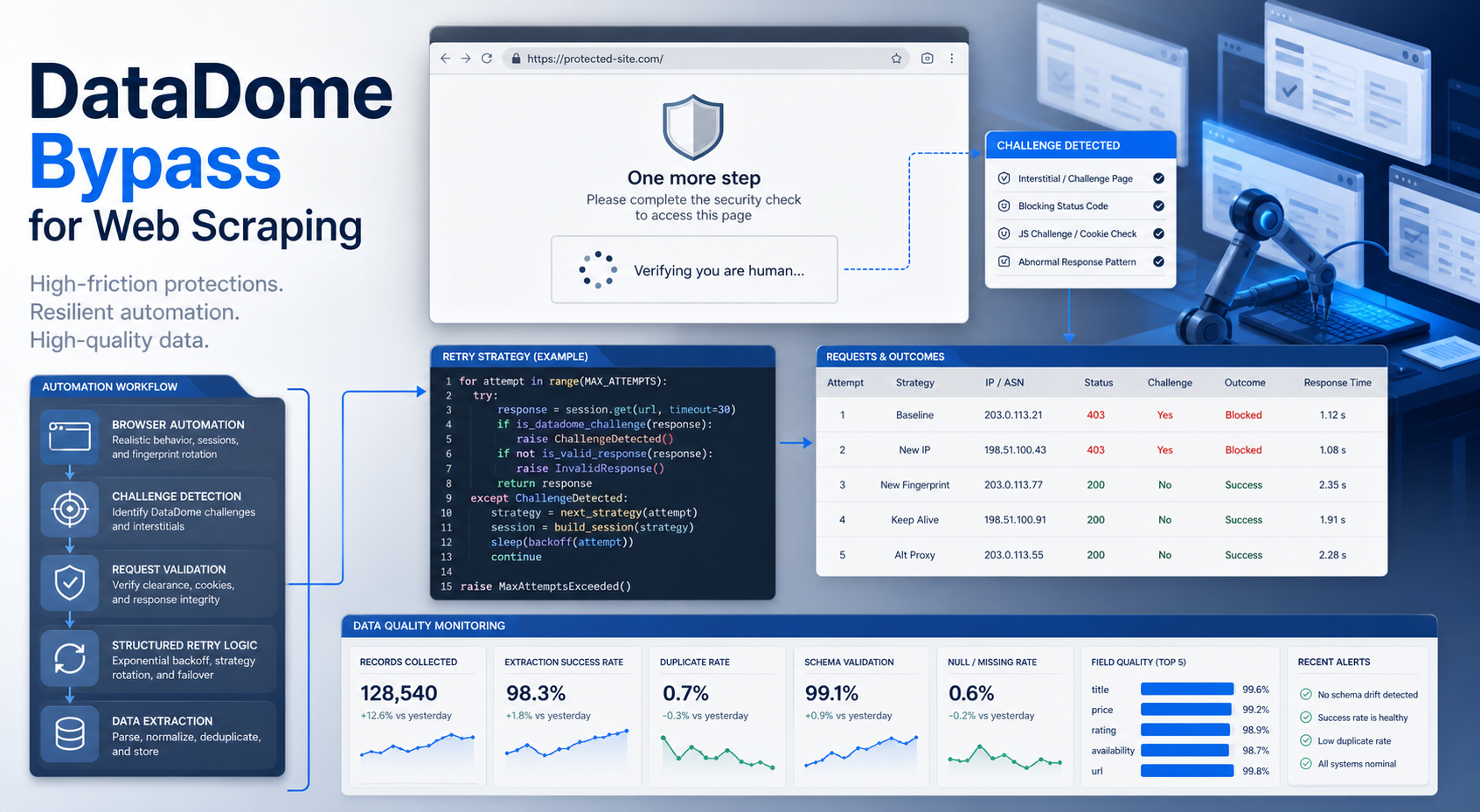
DataDome Bypass for Web Scraping
DataDome Bypass for Web Scraping
View Details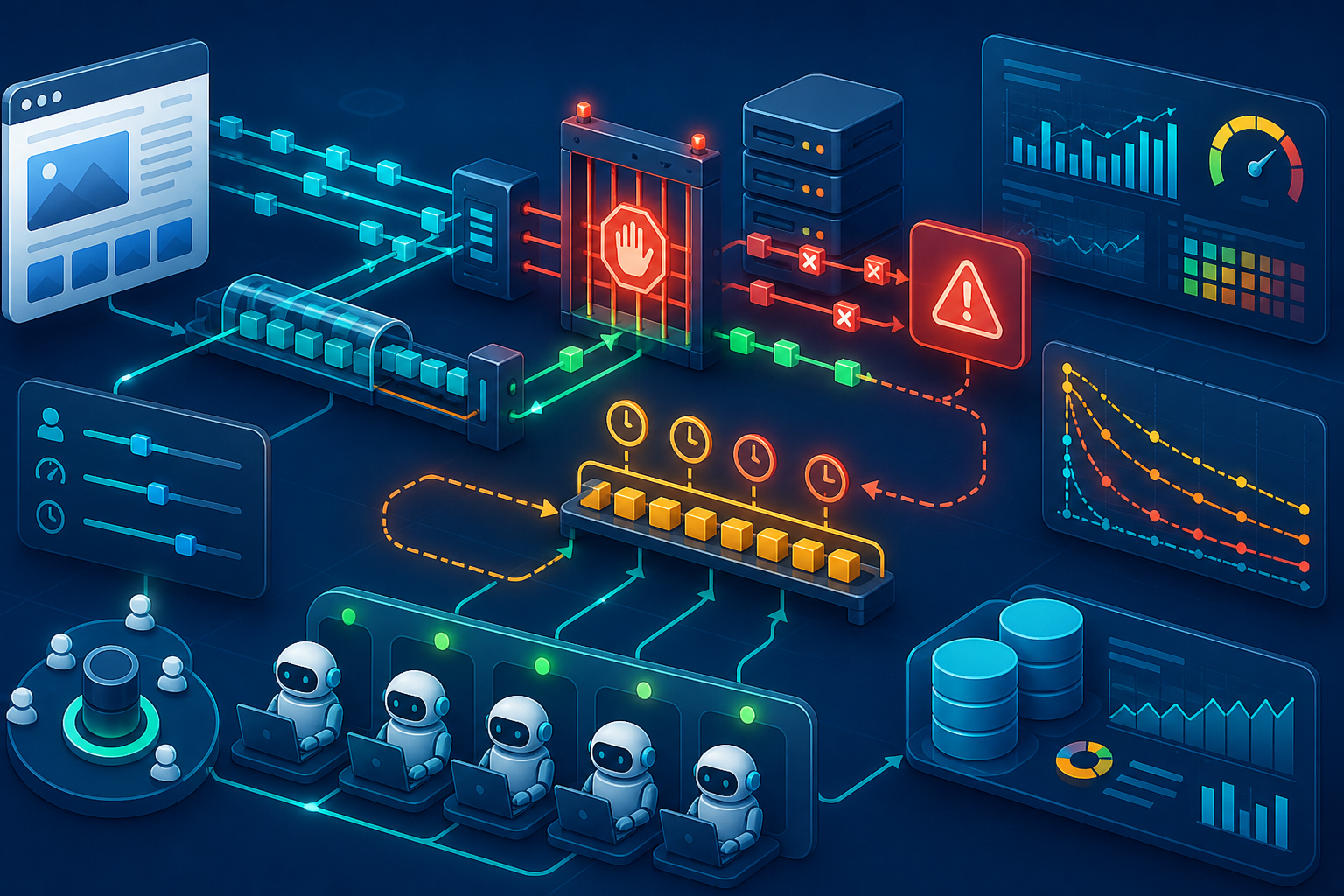
Web Scraping Rate Limiting: How to Handle 429s, Backoff, and Concurrency
Web scraping rate limiting is the engineering discipline of keeping an authorized collection workload inside a target service's acceptable request envelope. When that envelope is exceeded, a server may respond with HTTP 429 Too Many Requests, delay responses, or apply other controls.
View Details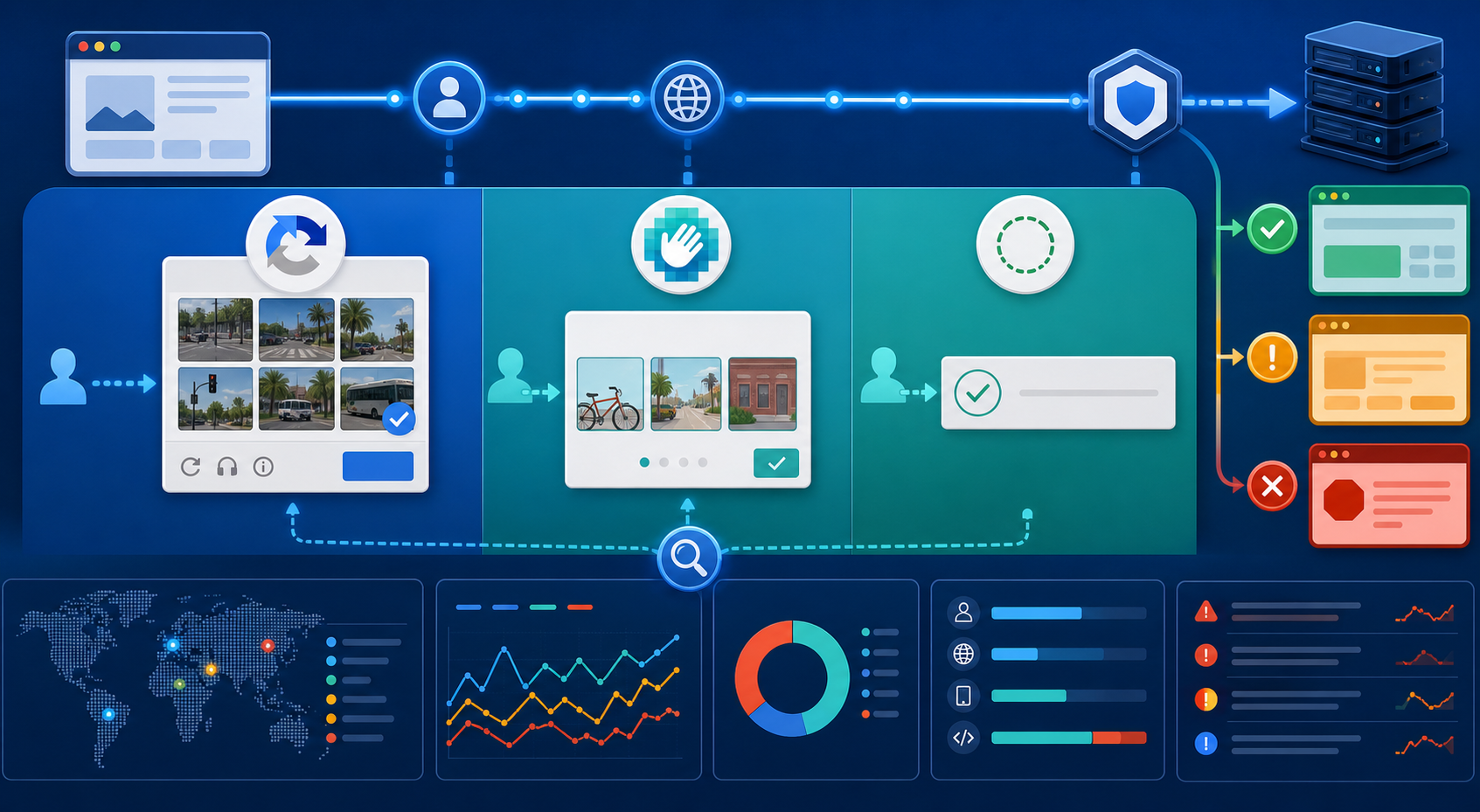
reCAPTCHA vs hCaptcha vs Cloudflare Turnstile: What Scraping Teams Need to Know
If an authorized data-collection workflow suddenly stops at a verification screen, identifying the protection system matters before you change code, browser settings, or proxy infrastructure. reCAPTCHA vs hCaptcha vs Turnstile is not simply a branding comparison. The three systems can expose different browser flows, token models, risk decisions, and failure symptoms.
View Details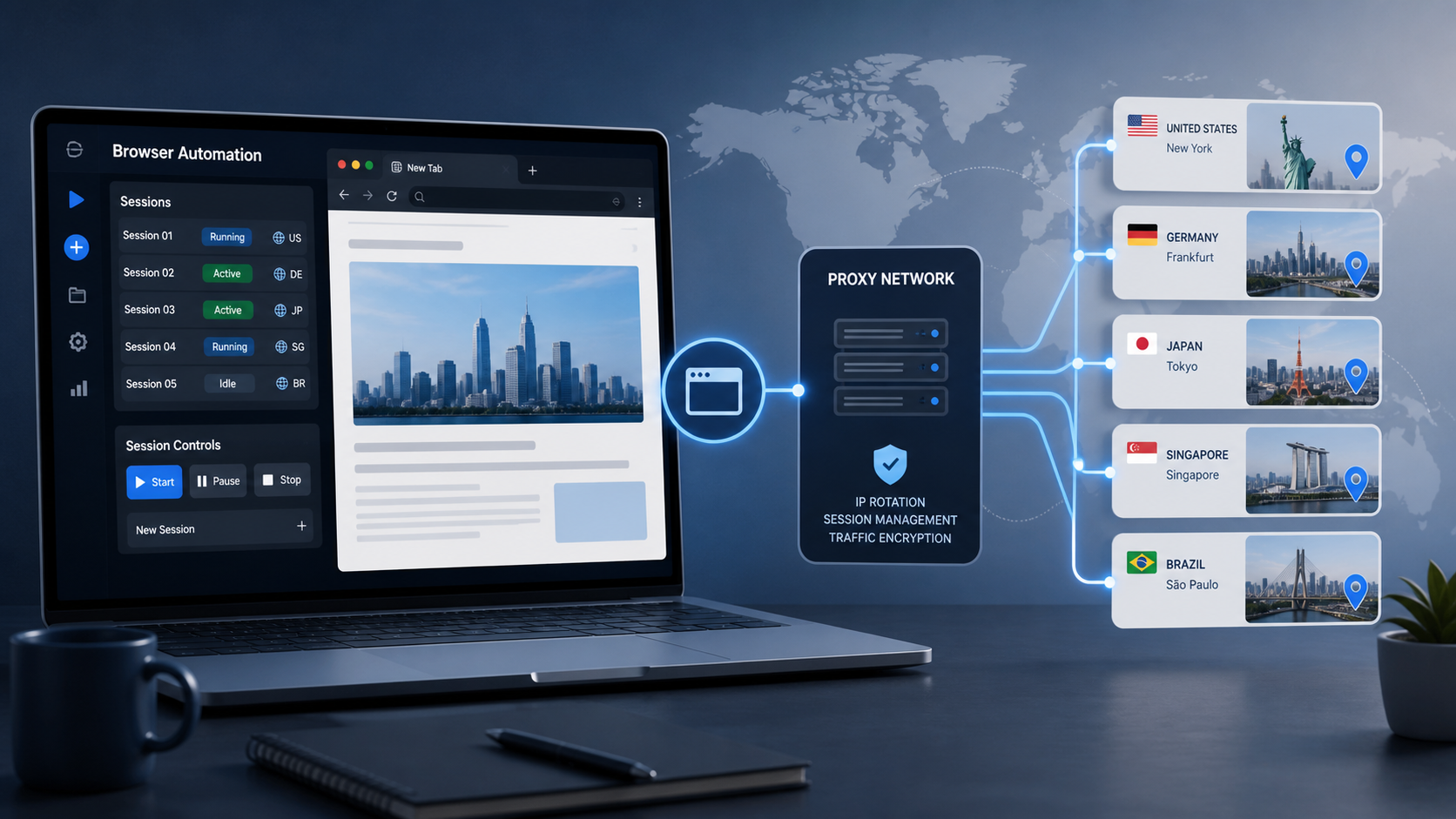
Browser Automation Proxies: IPs, Geo-Targeting, Sessions, and AI Agents
A browser automation proxy belongs to the network layer of Playwright, Selenium, cloud-browser, and AI-agent workflows. It changes how browser traffic is routed and can affect the source IP address, geographic egress, and session continuity seen by a destination site. It does not improve an AI model's reasoning, repair browser logic, or guarantee that a website will accept the session.
View Details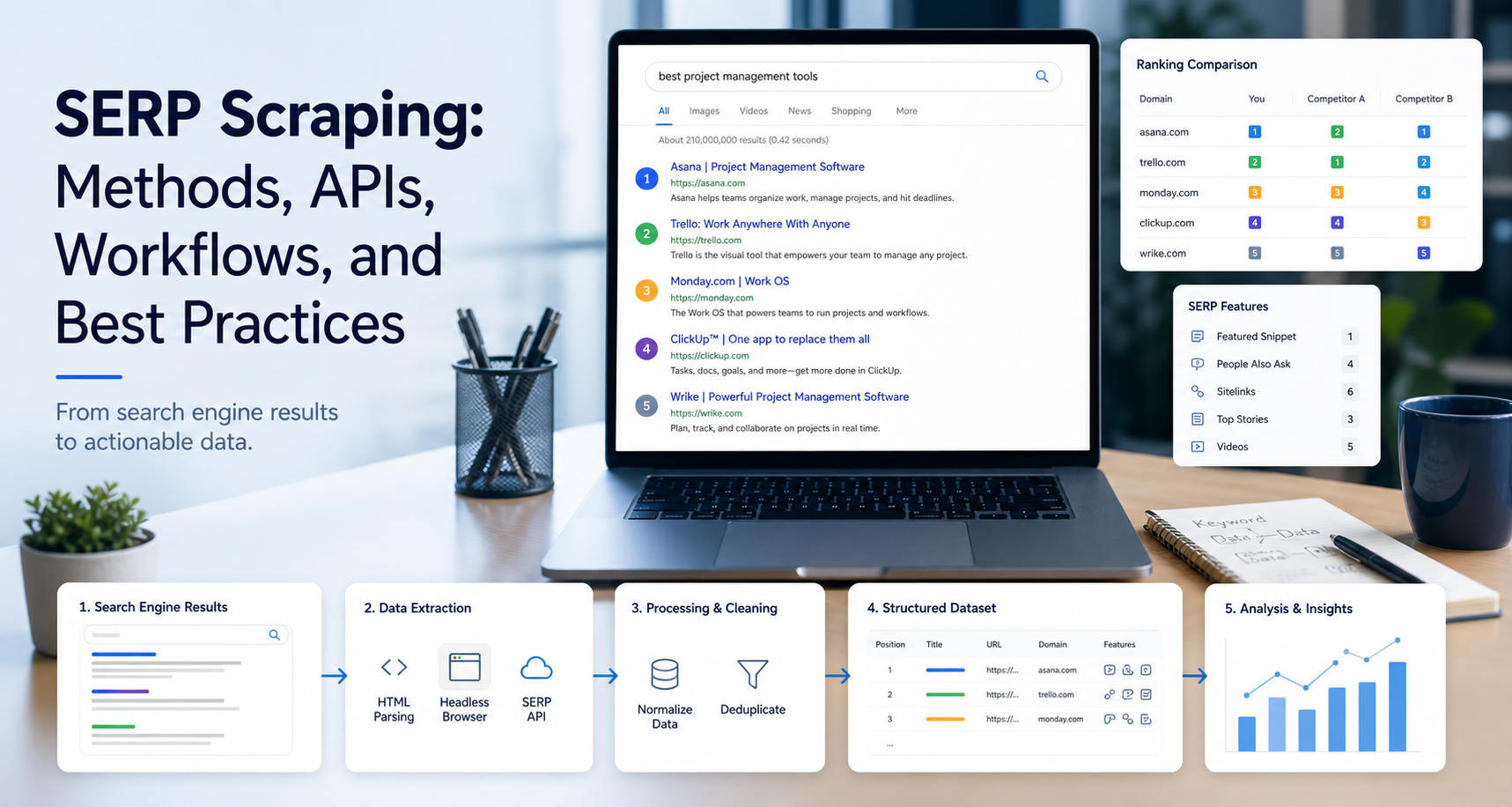
SERP Scraping: Methods, APIs, Workflows, and Best Practices
SERP scraping is the automated collection of information from search engine results pages. A SERP scraper can capture organic rankings, advertisements, featured snippets, People Also Ask questions, local results, shopping listings, images, and other search features, then convert them into structured data for analysis.
View Details