
Datacenter Proxies for SEO: Rank Tracking, SERP Checks, and Crawl Monitoring
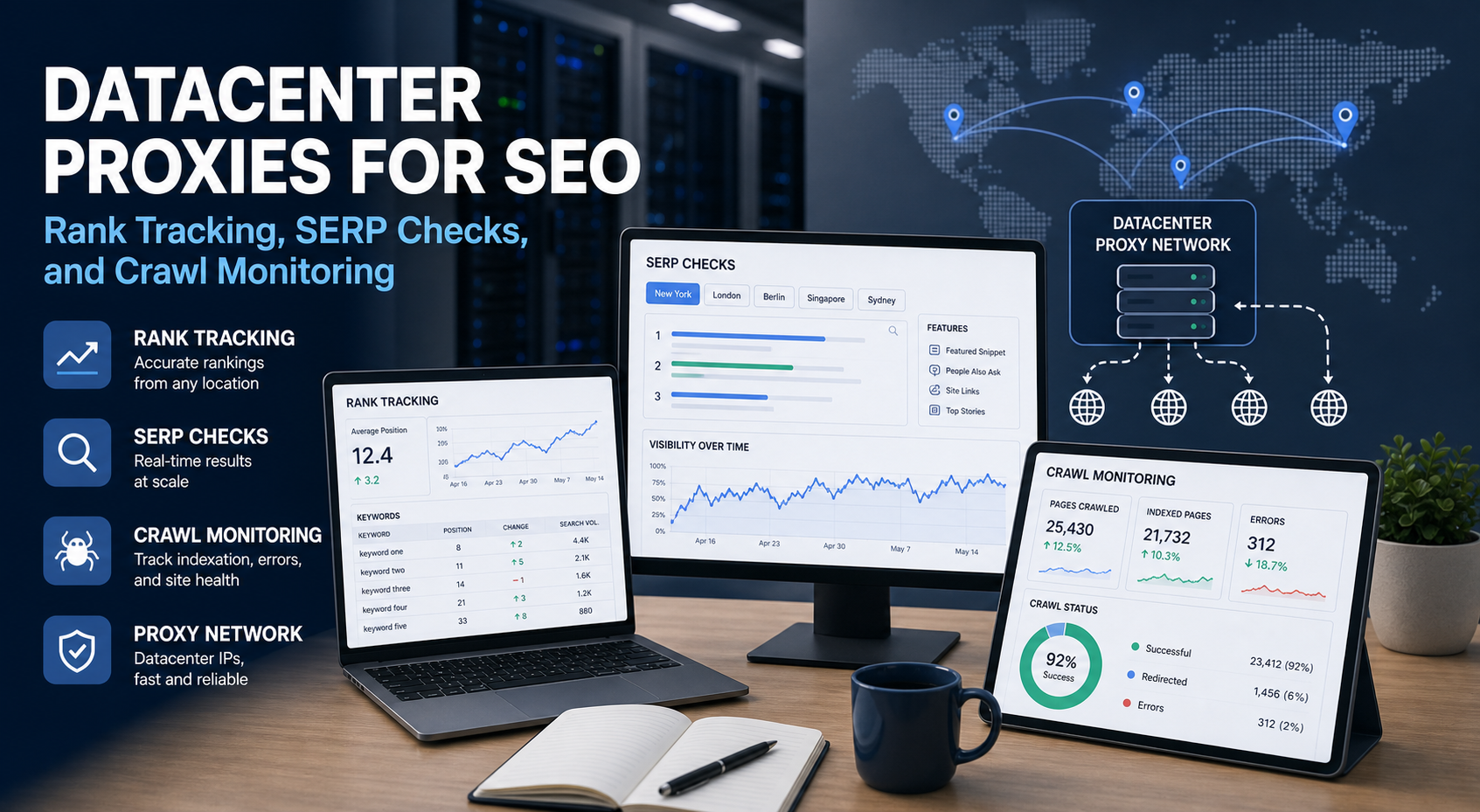
**Datacenter proxies for SEO** help teams collect search, crawl, and page-monitoring data without routing every request through one office, device, or server IP. They are useful for rank tracking, SERP checks, technical monitoring, competitor page checks, localized QA, and large-scale reporting workflows.
Datacenter proxies for SEO help teams collect search, crawl, and page-monitoring data without routing every request through one office, device, or server IP. They are useful for rank tracking, SERP checks, technical monitoring, competitor page checks, localized QA, and large-scale reporting workflows.
They are not a magic way to get perfect search results or bypass every restriction. SEO results can vary by location, language, device, personalization, and search context. A proxy can help you test from different network locations, but your process still needs clean settings, responsible request rates, and careful validation.
In this guide, you will learn:
- Where datacenter proxies fit into SEO workflows
- When SEO proxies are useful and when they are not
- How to use proxies for rank tracking and SERP checks
- How proxies support technical SEO monitoring
- What mistakes SEO teams should avoid
- How LycheeIP can fit into an SEO proxy stack
For the LycheeIP implementation details behind this step, review static residential proxies.
For the official technical reference behind this point, see MDN HTTP overview.
For the official technical reference behind this point, see Anthropic documentation.
What are datacenter proxies used for in SEO?
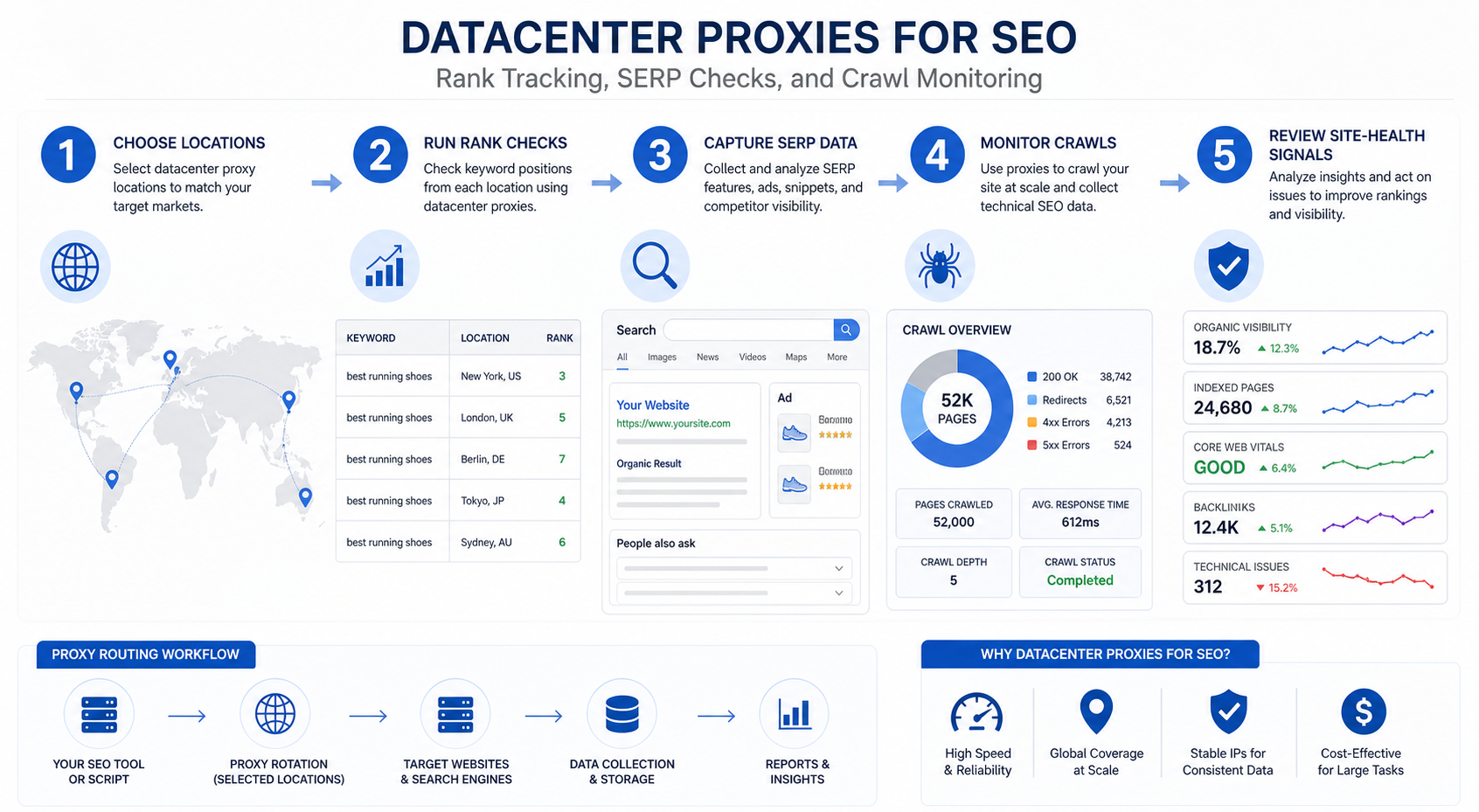
Datacenter proxies are used in SEO to route rank tracking, SERP monitoring, crawl testing, and page-checking requests through separate data center IPs.
For SEO teams, the goal is usually not anonymity for its own sake. The goal is cleaner data collection, controlled location testing, traffic separation, and repeatable monitoring.
For the LycheeIP implementation details behind this step, review LycheeIP proxy infrastructure.
Common SEO use cases include:
- SERP monitoring
- Rank tracking
- Crawl testing
- Competitor page checks
- Localized page QA
- Ad and landing page verification
- Technical monitoring
- Redirect checks
- Status code checks
- Page availability checks
- International SEO testing
For example, a technical SEO team may need to check how a website responds from different regions. A growth team may need to monitor competitor landing pages. An agency may need scheduled rank checks across many client markets. A proxy setup can help distribute those requests instead of sending everything from one IP.
Datacenter proxies are often attractive because they are fast, scalable, and cost-efficient compared with residential options. That makes them useful for repeatable, lower-risk SEO tasks where the target does not require strong residential trust.
Why do SEO teams use proxies?
SEO teams use proxies to distribute requests, test regional behavior, separate tool traffic, and support scheduled data collection.
Without proxies, repeated SEO checks may come from one office IP, cloud server, or tool environment. That can create several problems:
- One IP may hit request limits quickly
- Search results may reflect one location only
- Tool traffic may mix with normal browsing traffic
- Scheduled crawls may become harder to manage
- Regional issues may go unnoticed
- Competitor or SERP checks may produce inconsistent results
Proxies help SEO teams create cleaner test conditions. For example, an agency can run rank checks through US datacenter proxies for US-focused projects. A technical SEO team can compare how redirects, status codes, or hreflang behavior appear from different regions. A growth team can monitor landing pages without relying on a single network path.
However, proxies do not remove the need for caution. Search engines and websites have rules, rate limits, and anti-abuse systems. SEO teams should use proxies for responsible monitoring, QA, and research, not for aggressive scraping or policy-violating automation.
When are datacenter proxies enough for SEO?
Datacenter proxies are enough for SEO when the task is public, repeatable, low to moderate risk, and does not require strong residential trust.
They are often suitable for:
- Basic SERP checks
- Scheduled rank tracking
- Public page monitoring
- Technical SEO crawls
- Redirect testing
- Status code monitoring
- Competitor page availability checks
- Large-scale but low-risk checks
- Non-login workflows
- QA testing across locations
For example, if your team wants to monitor whether a competitor’s pricing page changed, a datacenter proxy may be enough. If you need to check whether your own site returns the right status code from a US location, datacenter proxies may work well. If you are collecting public SERP snapshots at a controlled pace, datacenter proxies can also be a practical starting point.
Datacenter proxies are especially useful when speed and cost control matter. They can handle many routine SEO checks without requiring the higher cost of residential or ISP proxies.
The key is to test them against your real workflow. If they produce usable results, there is no need to overpay for stronger proxy types.
When should SEO teams avoid datacenter proxies?
SEO teams should avoid datacenter proxies when the workflow requires strong trust signals, stable logged-in sessions, highly personalized results, or sensitive account-based actions.
Datacenter proxies may not be the right fit for:
- Highly personalized SERPs
- Aggressive bot detection environments
- Logged-in search or platform workflows
- Sensitive account-based tasks
- Workflows where residential trust is required
- Local checks that need realistic consumer network behavior
- Platforms that clearly restrict automated access
- Tasks where inconsistent results could mislead reporting
For example, if a search environment changes heavily based on device history, user profile, or personalized behavior, a datacenter proxy alone will not recreate a real user’s experience. If a target blocks hosting networks by default, datacenter proxies may produce many 403 errors or CAPTCHA pages.
In those cases, residential proxies, ISP proxies, official APIs, or manual validation may be more appropriate.
The best SEO workflow does not force datacenter proxies into every task. It uses them where they fit and adds stronger proxy types only where needed.
How do datacenter proxies support rank tracking?
Datacenter proxies support rank tracking by helping SEO teams collect search-result snapshots from controlled locations, devices, and schedules.
Rank tracking is not just about checking “where do we rank?” It is about measuring search visibility under defined conditions. Proxies can help make those conditions more consistent.
Location-specific checks
Location matters for many search results. A keyword searched from New York may not show the same results as the same keyword searched from Los Angeles.
US datacenter proxies can support location-focused checks for:
- National SEO tracking
- State-level comparisons
- Regional landing page QA
- Localized campaign monitoring
- Competitor visibility checks
SEO teams should still validate location settings carefully. Proxy location, search parameters, language settings, and device settings can all affect output.
Device and language testing
Search results can vary by device and language settings. Proxies are only one part of the setup.
For cleaner rank tracking, define:
- Desktop or mobile user agent
- Language settings
- Location settings
- Search parameters
- Cookie handling
- Personalization controls where possible
- Request frequency
This makes reports more consistent and reduces confusion when different tools show different rankings.
Scheduled SERP snapshots
SERP tracking proxies can help teams capture search-result pages at scheduled intervals.
This is useful for:
- Monitoring keyword volatility
- Tracking featured snippet changes
- Capturing competitor movement
- Watching paid and organic layout changes
- Checking whether new pages begin to appear
Scheduled snapshots should not run too aggressively. The goal is reliable monitoring, not excessive querying.
Competitor visibility monitoring
Datacenter proxies can help SEO teams monitor public competitor pages and SERP presence.
Use cases include:
- Checking if competitor pages are live
- Tracking title and meta changes
- Monitoring landing page redirects
- Reviewing SERP appearance
- Comparing visibility across regions
This should be done responsibly and within applicable site rules. Proxies support the workflow, but they do not replace ethical data collection practices.
How do proxies support technical SEO monitoring?
Proxies support technical SEO monitoring by showing how pages, redirects, headers, and content behave from different locations and network paths.
This can be useful for teams managing international websites, large content libraries, SaaS sites, ecommerce stores, or multi-region landing pages.
Common technical SEO checks include:
For example, an SEO team may discover that a page works from one region but redirects incorrectly from another. Or a multilingual site may show the wrong language version to users in a specific market. Proxies help uncover those differences before they affect reporting or user experience.
Still, proxy results should be validated. If a proxy shows an anomaly, confirm it with manual checks, server logs, analytics, or another controlled test.
How should SEO teams structure a proxy workflow?
SEO teams should structure proxy workflows by defining the SEO task first, then selecting proxy location, request rate, data capture rules, validation steps, and anomaly monitoring.
For the LycheeIP implementation details behind this step, review scaling lead scraping with n8n.
Use this workflow:
- Define the SEO task
Decide whether you are tracking ranks, checking status codes, monitoring pages, testing redirects, or reviewing localized content.
- Select proxy location
Choose the country or region that matches the market you want to test. For US campaigns, US datacenter proxies may be the first test layer.
- Set request rate
Use conservative request limits. Avoid aggressive bursts, repeated retries, or unnecessary page checks.
- Capture status, content, and SERP data
Store more than the ranking number. Capture status codes, timestamps, page titles, SERP features, target URLs, and content validation signals.
- Validate against manual checks
Compare a sample of proxy results with manual checks or trusted tools. This helps catch inaccurate, personalized, or blocked results.
- Store results consistently
Keep the same query settings, proxy region, device type, and schedule where possible. Consistency makes trend analysis more useful.
- Monitor anomalies
Watch for sudden ranking changes, high error rates, blocked requests, wrong-region pages, or missing SERP elements.
A proxy workflow should be repeatable. If the setup changes every time, your SEO data becomes harder to trust.
What mistakes do SEO teams make with proxies?
SEO teams make mistakes when they treat proxy output as absolute truth, ignore personalization, over-scrape search pages, or use one proxy type for every workflow.
Common mistakes include:
- Treating proxy results as perfect ranking truth
- Ignoring personalization, language, and device differences
- Running too many search checks too quickly
- Not checking localization settings
- Using datacenter proxies for targets that require residential trust
- Using residential proxies when datacenter proxies would be enough
- Forgetting compliance and platform rules
- Treating every 200 response as a successful result
- Not validating content quality
- Mixing tool traffic and reporting traffic without documentation
- Changing proxy locations between reports without noting it
The biggest SEO reporting mistake is overconfidence. A proxy can help you collect useful data, but search results are dynamic. Rankings vary by context. SERP layouts change. Local packs, ads, maps, videos, and other features can appear differently across users and devices.
Good SEO proxy workflows document the test conditions. They do not pretend the output represents every possible user.
Should SEO teams use datacenter, residential, or ISP proxies?
SEO teams should use datacenter proxies for scale and speed, residential proxies for sensitive localized checks, and ISP proxies for stable workflows that need stronger trust.
For the LycheeIP implementation details behind this step, review rotating residential proxies.
Here is a simple decision table:
A mixed stack is often the best option. Datacenter proxies handle high-volume SEO checks. Residential proxies handle sensitive location testing. ISP proxies support stable sessions where frequent IP changes create problems.
This approach prevents both underbuying and overbuying. You do not need the most expensive proxy type for every SEO task. You need the right proxy type for the job.
How does LycheeIP fit SEO proxy workflows?
LycheeIP can fit SEO proxy workflows as a provider to evaluate for datacenter speed, residential coverage, and static proxy needs depending on your task.
For SEO teams, a practical LycheeIP evaluation could look like this:
- Test datacenter proxies for rank checks, page monitoring, and technical crawling
- Test residential options for sensitive localized SERP checks
- Test static residential or ISP-style options for stable session workflows
- Compare success rate, latency, CAPTCHA rate, and wrong-region output
- Validate proxy results against manual checks
- Scale only after the workflow stays stable
LycheeIP should be tested against real SEO tasks, not just generic IP-check pages. If the goal is rank tracking, test actual queries. If the goal is crawl monitoring, test real URLs. If the goal is localized QA, test the exact region and language conditions your campaign needs.
For bandwidth-heavy SEO workflows, this page should link to your datacenter proxies unlimited bandwidth buyer guide. For setup validation, it should link to your proxy testing SOP. For failed requests and CAPTCHA issues, it should link to your troubleshooting guide on why datacenter proxies get blocked.
Improve SEO Data Collection with LycheeIP Datacenter Proxies
##
Frequently Asked Questions
Are datacenter proxies good for SEO?
Yes, datacenter proxies can be useful for SEO tasks such as rank tracking, SERP checks, crawl testing, page monitoring, and competitor research. They work best for public, repeatable, lower-risk workflows where speed and cost control matter.
What are SEO proxies?
SEO proxies are proxies used to route SEO-related tasks such as rank tracking, SERP monitoring, crawling, localized QA, and competitor page checks. They can be datacenter, residential, or ISP proxies depending on the workflow.
Can I use datacenter proxies for rank tracking?
Yes, datacenter proxies can support rank tracking when the search environment does not heavily block hosted IPs. For sensitive local results, residential or ISP proxies may produce more reliable location-aware checks.
What are SERP tracking proxies?
SERP tracking proxies are proxies used to collect search result pages from defined locations, devices, or schedules. They help SEO teams monitor rankings, SERP features, competitors, and search visibility changes.
Are US datacenter proxies useful for US SEO campaigns?
US datacenter proxies can be useful for checking US-focused rankings, landing pages, page availability, and regional behavior. They should still be tested because results can vary by location settings, device, language, and personalization.
Can proxies give perfectly accurate rankings?
No. Proxies can help create controlled test conditions, but rankings can still vary by personalization, device, language, location, time, and search features. SEO teams should use proxy data as a monitoring signal, not absolute truth.
Should SEO teams use residential proxies instead?
Residential proxies may be better for sensitive localized checks or targets that distrust data center IPs. Datacenter proxies are often better for faster, lower-cost, large-scale SEO monitoring.
How do proxies help with technical SEO?
Proxies help technical SEO teams test status codes, redirects, page availability, hreflang behavior, canonical consistency, and regional page differences. They are especially useful for multi-region websites and scheduled monitoring.
Can LycheeIP be used for SEO proxy workflows?
Yes, LycheeIP can be evaluated for SEO workflows such as SERP checks, crawl monitoring, page testing, and localized QA. The best approach is to test LycheeIP against your real SEO tasks before scaling.
What is the biggest mistake when using proxies for SEO?
The biggest mistake is treating proxy data as complete truth without validation. Always document proxy location, device settings, language settings, request rate, and manual checks so reports stay reliable.
Related LycheeIP Guides and Resources

Recommended Articles
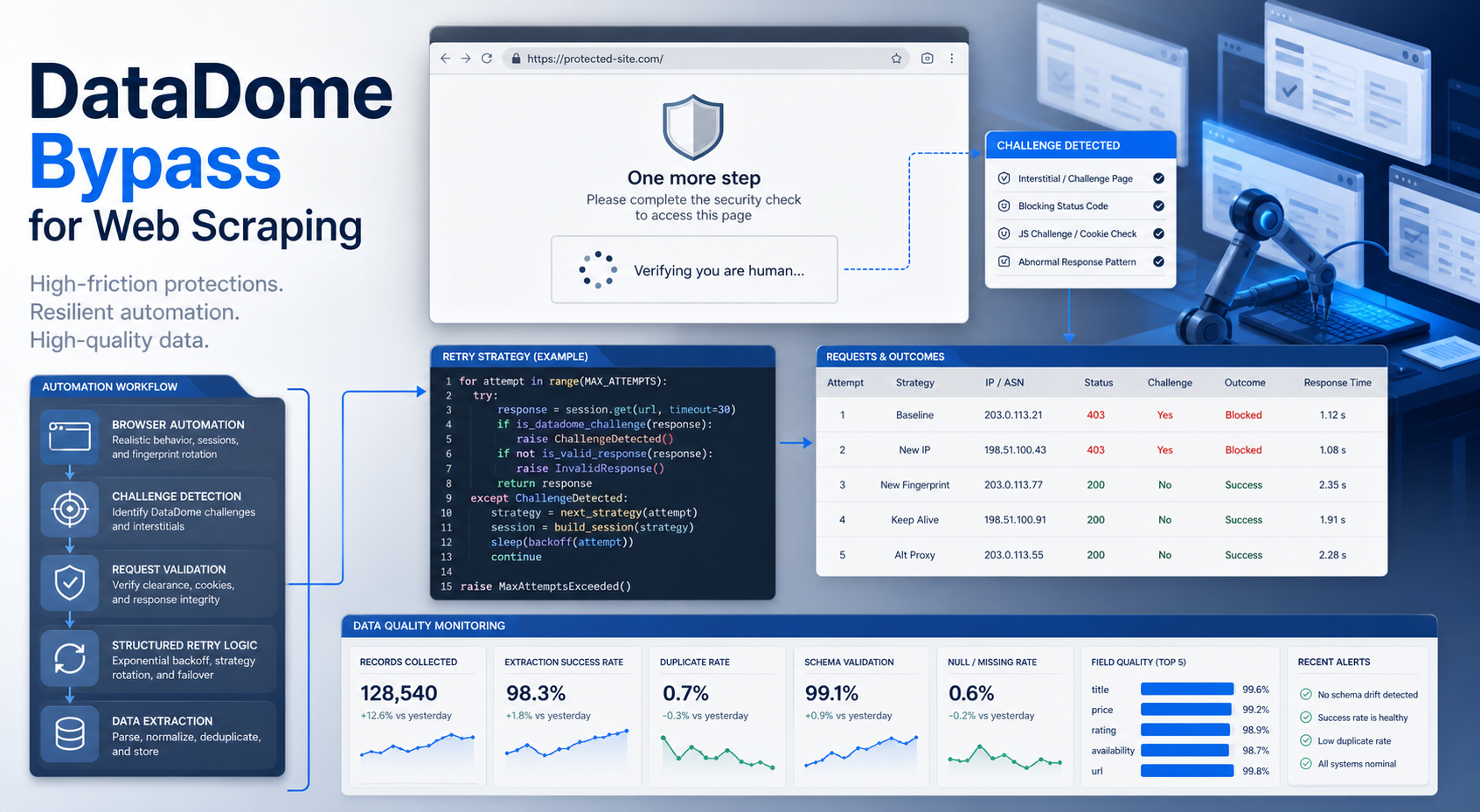
DataDome Bypass for Web Scraping
DataDome Bypass for Web Scraping
View Details
Web Scraping Rate Limiting: How to Handle 429s, Backoff, and Concurrency
Web scraping rate limiting is the engineering discipline of keeping an authorized collection workload inside a target service's acceptable request envelope. When that envelope is exceeded, a server may respond with HTTP 429 Too Many Requests, delay responses, or apply other controls.
View Details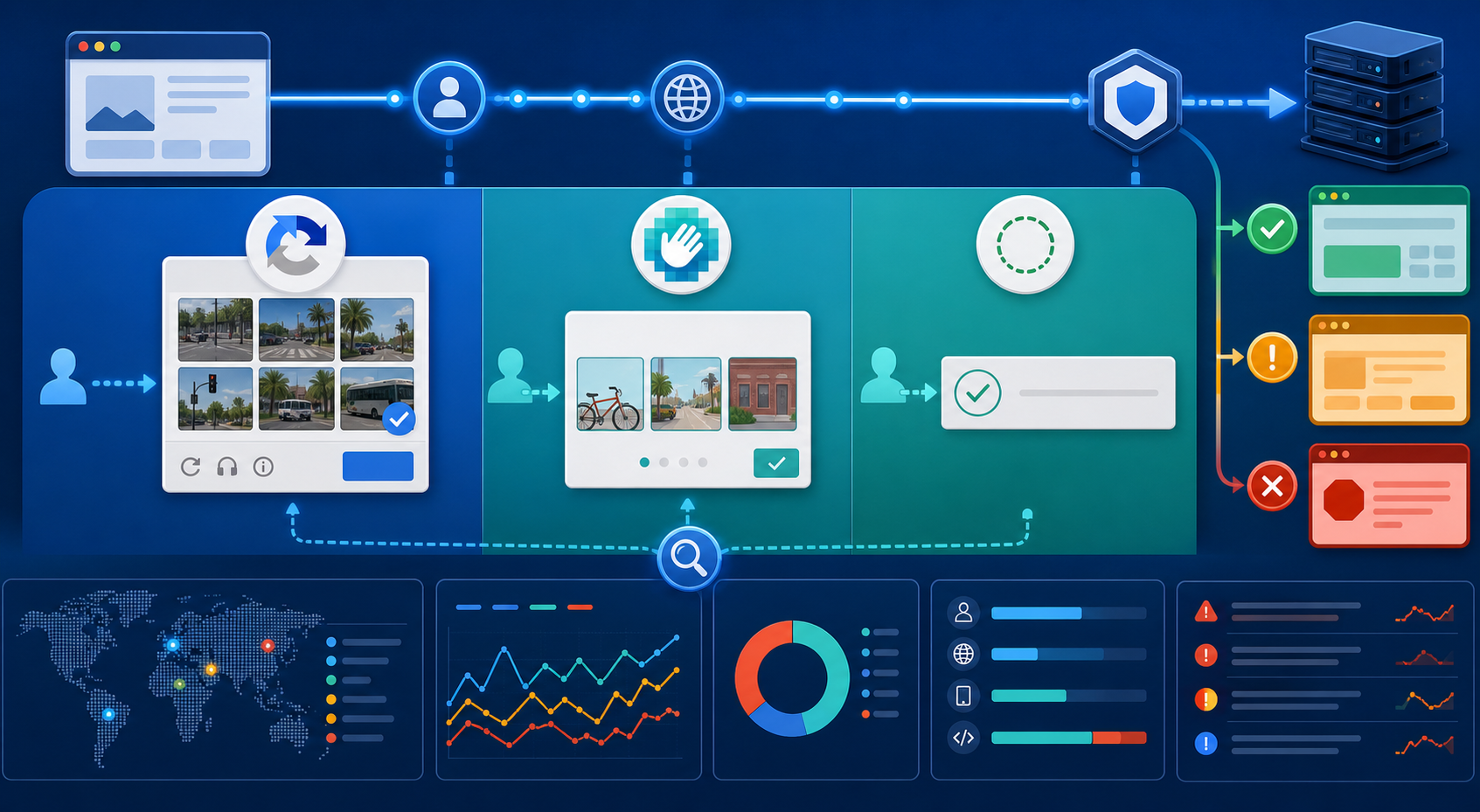
reCAPTCHA vs hCaptcha vs Cloudflare Turnstile: What Scraping Teams Need to Know
If an authorized data-collection workflow suddenly stops at a verification screen, identifying the protection system matters before you change code, browser settings, or proxy infrastructure. reCAPTCHA vs hCaptcha vs Turnstile is not simply a branding comparison. The three systems can expose different browser flows, token models, risk decisions, and failure symptoms.
View Details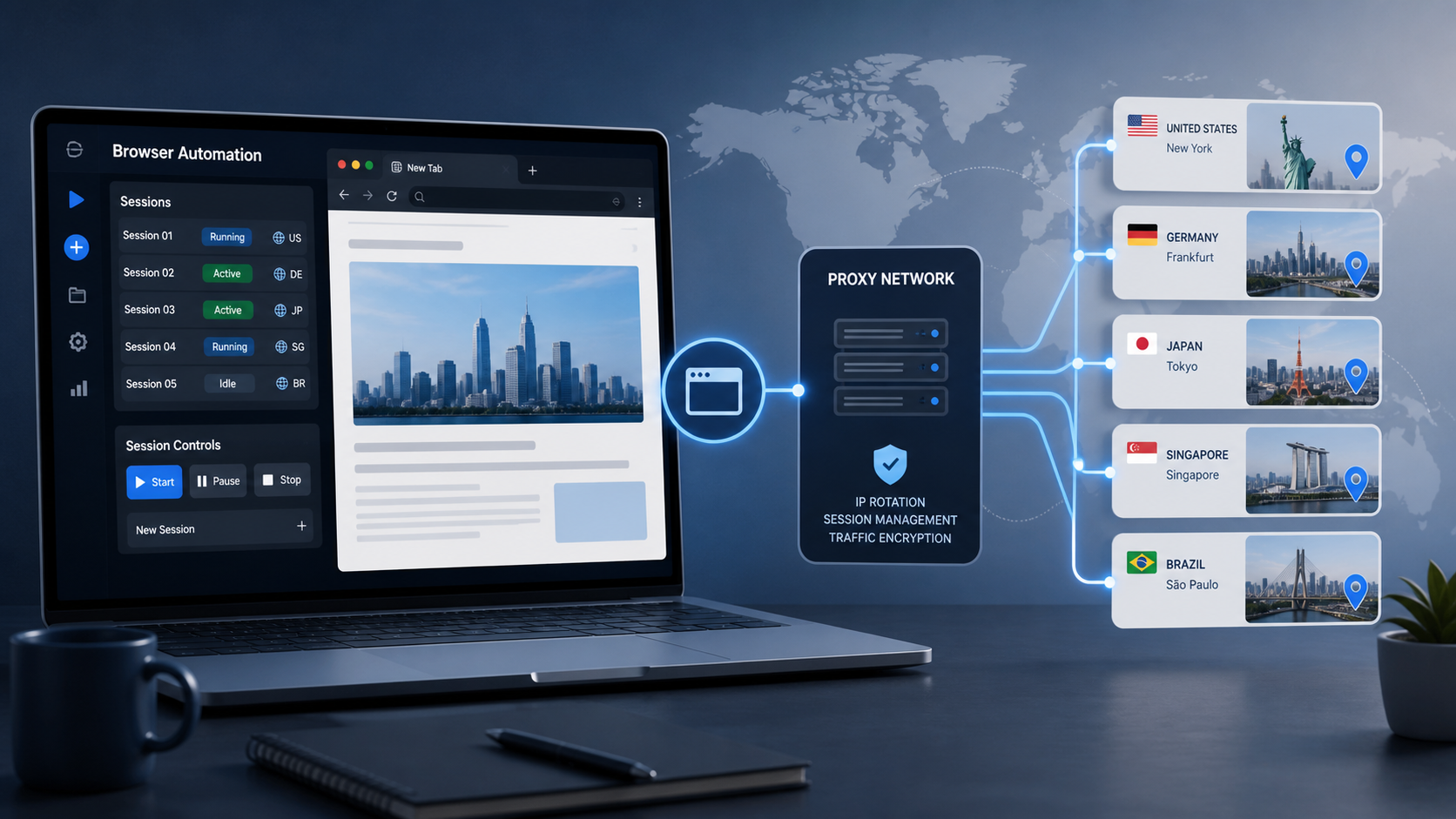
Browser Automation Proxies: IPs, Geo-Targeting, Sessions, and AI Agents
A browser automation proxy belongs to the network layer of Playwright, Selenium, cloud-browser, and AI-agent workflows. It changes how browser traffic is routed and can affect the source IP address, geographic egress, and session continuity seen by a destination site. It does not improve an AI model's reasoning, repair browser logic, or guarantee that a website will accept the session.
View Details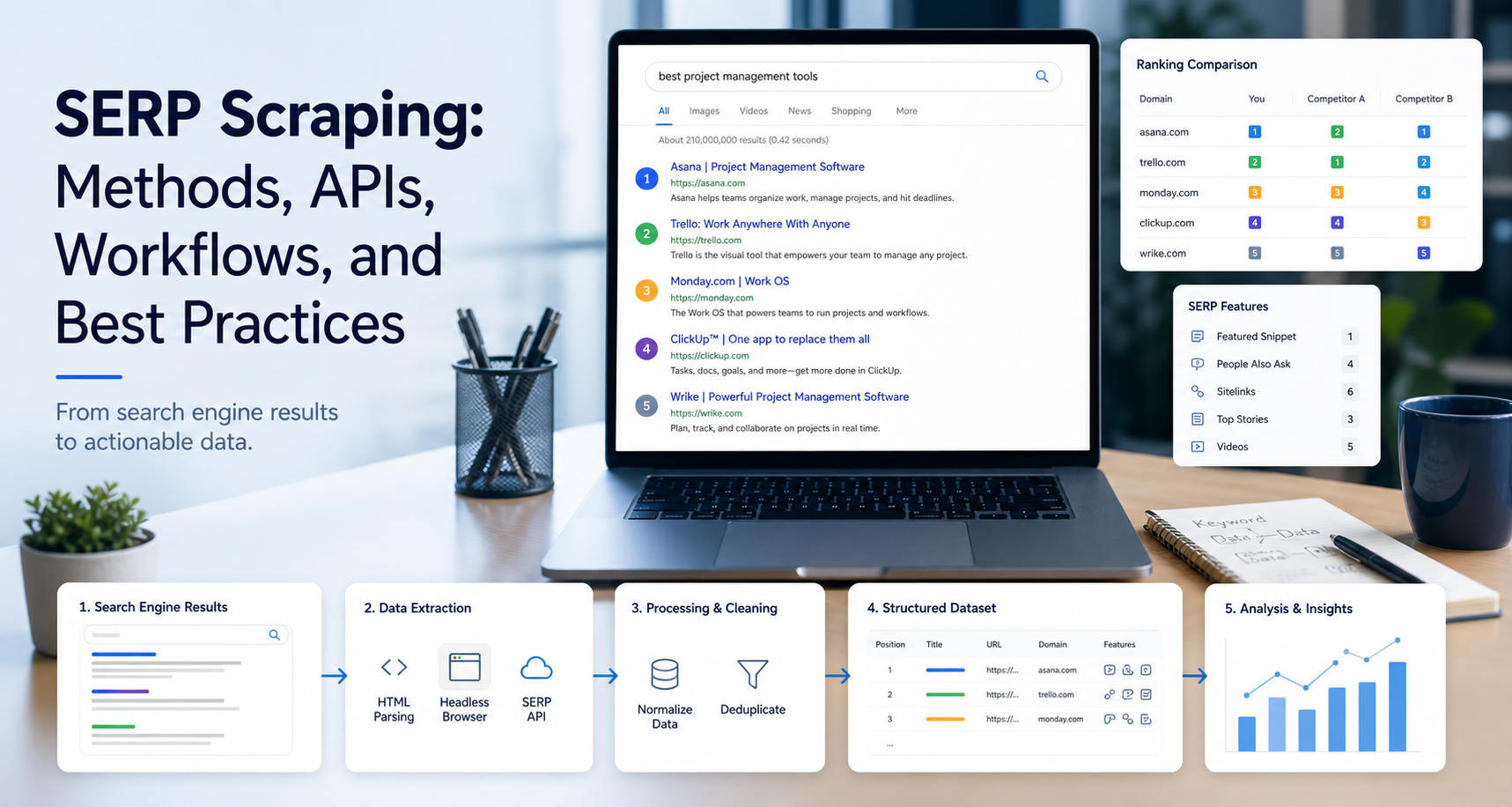
SERP Scraping: Methods, APIs, Workflows, and Best Practices
SERP scraping is the automated collection of information from search engine results pages. A SERP scraper can capture organic rankings, advertisements, featured snippets, People Also Ask questions, local results, shopping listings, images, and other search features, then convert them into structured data for analysis.
View Details