
Why We're Running Out of IP Addresses
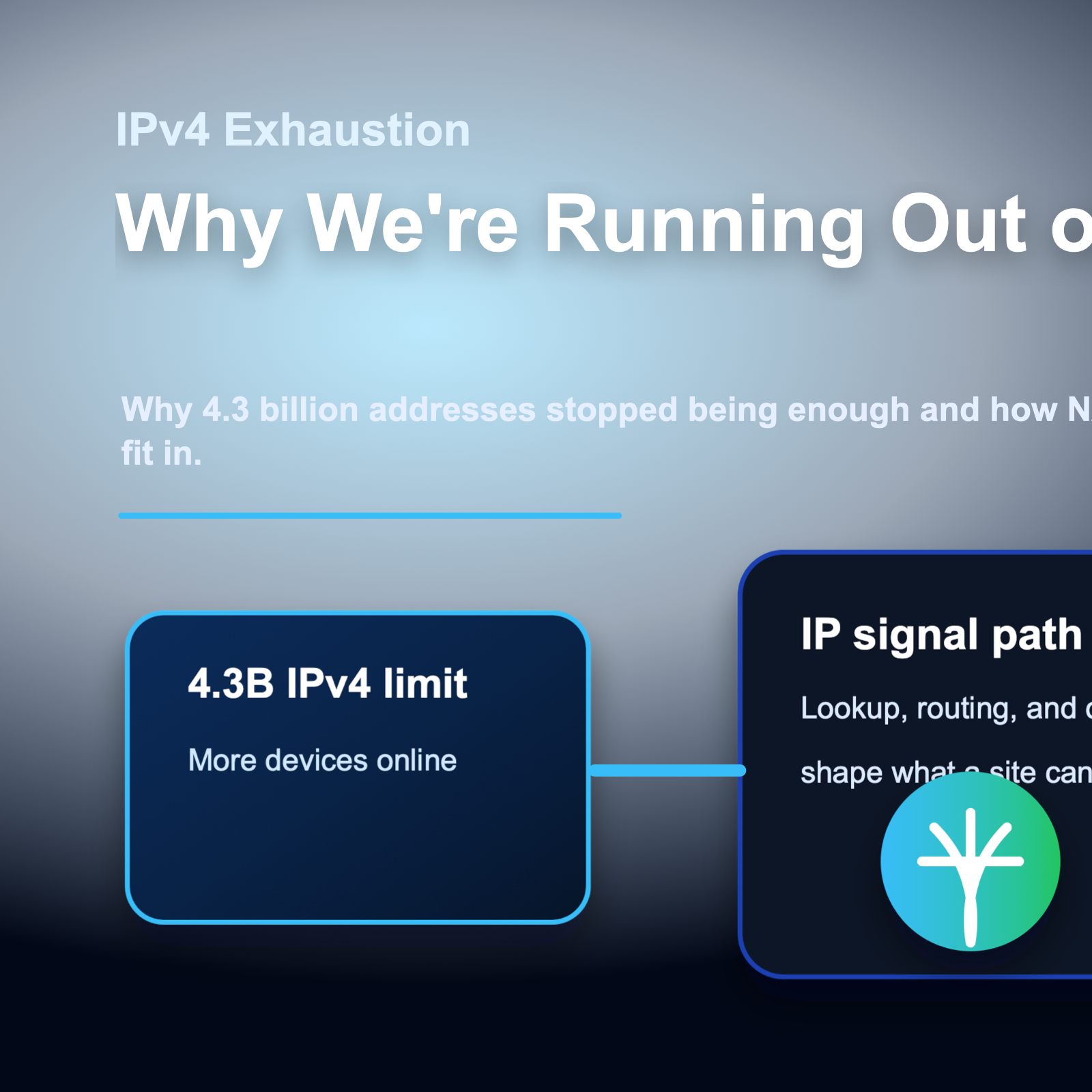
The internet is running out of addresses. Here's why that's a $50 billion problem.
For teams comparing privacy, geo-testing, and data collection workflows, the practical question is not only what an IP address reveals. It is also how clean routing, trusted proxy infrastructure, session control, and compliance practices shape the final result.
For official technical background, see IANA number resources, ARIN IPv4 resources, RFC 791 Internet Protocol, MDN X-Forwarded-For reference.
Every device that connects to the internet needs a unique identifier called an IP address. For decades, we've relied on IPv4, a protocol that provides approximately 4.3 billion possible addresses. That seemed like plenty in 1983 when the standard was finalized. But with the explosive growth of smartphones, IoT devices, connected cars, and cloud infrastructure, we've run into a hard limit. The internet is experiencing address exhaustion, and the shortage is driving up costs, complicating network infrastructure, and creating technical debt that affects everyone from individual developers to enterprise data teams.
This scarcity matters whether you're building web applications, managing proxy infrastructure for data collection, or simply trying to understand why IP resources have become expensive commodities. Understanding the technical reality behind IP address exhaustion helps explain why proxy providers charge what they do, why certain automation workflows face restrictions, and why the transition to a new addressing system has been both inevitable and frustratingly slow.
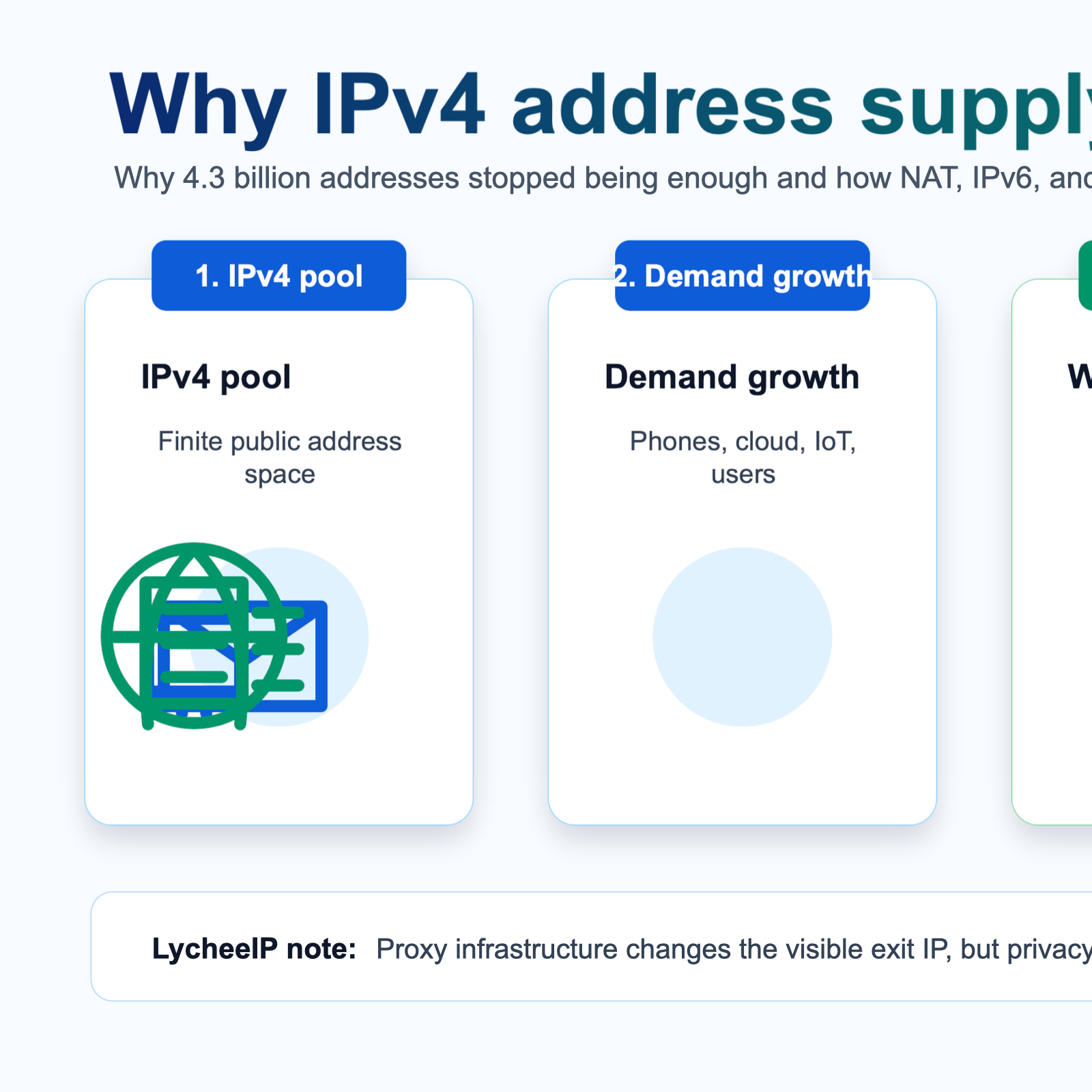
What Is IPv4 Exhaustion?
The scarcity drives up acquisition costs. Proxy providers must either:
- Purchase IPv4 blocks on the secondary market (where prices have risen from $5 per IP in 2014 to $50+ per IP in recent years)
- Build relationships with ISPs to access residential IP pools
- Invest in IPv6 infrastructure (though adoption remains limited)
- Use rotation and sharing techniques to maximize address utilization
These costs ultimately pass through to customers. Understanding IPv4 scarcity explains why proxy services price their offerings as they do and why IP resources are treated as valuable inventory.
Network Address Translation as a Temporary Solution
NAT has extended IPv4's lifespan by allowing multiple devices on a private network to share a single public IP address. Your home router likely uses NAT, giving each device in your house a private IP (like 192.168.1.x) while presenting a single public IP to the internet.
NAT works well for basic browsing but creates complications:
- Peer-to-peer applications struggle with connectivity
- Certain protocols require complex NAT traversal techniques
- End-to-end connectivity principles are violated
- Carrier-grade NAT introduces additional latency and complexity
- Troubleshooting network issues becomes harder
NAT is a workaround, not a solution. It buys time but doesn't solve the fundamental scarcity problem.
What IPv6 Is and Why Adoption Is Slow
IPv6 was designed specifically to solve IPv4 exhaustion. The protocol uses 128-bit addresses instead of 32-bit, creating an address space so large it's difficult to comprehend.
The Size of IPv6 Address Space
IPv6 provides approximately 340 undecillion addresses:
340,282,366,920,938,463,463,374,607,431,768,211,456
That's 340 trillion trillion trillion addresses, or roughly 670 million trillion addresses per square millimeter of Earth's surface. We will never run out of IPv6 addresses.
IPv6 addresses look different from IPv4. They're written in hexadecimal and separated by colons:
2001:0db8:85a3:0000:0000:8a2e:0370:7334
The protocol also includes improvements beyond just more addresses:
- Simplified header structure for faster routing
- Built-in security features (IPsec)
- Better support for mobile devices
- Automatic configuration capabilities
- Elimination of NAT requirements
Why Hasn't Everyone Switched?
If IPv6 solves the scarcity problem, why are we still dealing with IPv4 exhaustion decades after IPv6 was standardized in 1998?
The transition has been slow for several interconnected reasons:
Lack of Backward Compatibility
IPv6 and IPv4 are not directly compatible. They're separate protocols that can't communicate without translation mechanisms or dual-stack implementations. This creates a chicken-and-egg problem: content providers don't prioritize IPv6 if users can't reach them, and ISPs don't rush to deploy IPv6 if most content remains IPv4-only.
Infrastructure Investment Required
Upgrading to IPv6 requires investment across the entire internet stack:
- Routers and network hardware must support IPv6
- Operating systems and applications need IPv6 capability
- Network administrators require training
- Security policies must be updated
- Monitoring and management tools need adaptation
For large organizations with complex networks, the upgrade represents significant cost and risk.
The NAT Band-Aid Works Well Enough
NAT has proven effective at extending IPv4's life. For most users, NAT-based connectivity works fine for web browsing, streaming, and common applications. The pain of IPv4 scarcity is felt more by network operators and specialized use cases than by typical end users.
This reduces the urgency for consumer-facing organizations to prioritize IPv6.
Application and Service Compatibility
Many legacy applications, embedded systems, and network appliances are IPv4-only. Organizations with custom software, industrial control systems, or specialized equipment face substantial costs to update or replace these systems.
Security Concerns and Learning Curve
Network security teams must learn new approaches for IPv6. Firewall rules, intrusion detection systems, and security policies all need updates. Some organizations worry about introducing new vulnerabilities during the transition.
Current IPv6 Adoption Rates
Despite these challenges, IPv6 adoption has been growing:
- Global IPv6 adoption exceeded 40% in 2023 (measured by Google's user statistics)
- Some countries have much higher rates: India (70%+), United States (48%), Germany (60%)
- Major content providers (Google, Facebook, Netflix) support IPv6
- Mobile carriers have led adoption because new mobile networks are easier to build with IPv6 from the start
However, significant portions of the internet remain IPv4-only, and dual-stack operation (supporting both protocols simultaneously) is common.
How IP Scarcity Affects Proxy Infrastructure
For organizations that rely on proxy infrastructure for data collection, automation, or testing, IPv4 scarcity has direct operational and financial implications.
Proxy Types and IP Address Requirements
Different proxy approaches have different IP address needs:
Datacenter Proxies
These use IPv4 addresses from datacenter IP blocks. Providers must purchase or lease these addresses, and costs have risen substantially. datacenter proxies are cost-effective for high-volume operations but are more easily identified and blocked by sophisticated anti-bot systems.
Residential Proxies
These route traffic through real residential IP addresses provided by ISPs. The IP pool comes from consenting users or business relationships with ISPs. Residential IPs are harder to detect because they appear as legitimate home connections. IPv4 scarcity affects the underlying ISP allocation, potentially limiting pool growth.
Static Residential Proxies
These provide dedicated residential IPs that don't rotate. They're valuable for workflows requiring consistent identity but are limited by available residential IP inventory.
Rotating Proxies
These automatically change IP addresses for each request or at set intervals, maximizing the utility of a limited IP pool. Rotation helps work around scarcity by ensuring addresses are used efficiently.
Why This Matters for Web Scraping and Data Collection
Public data collection workflows often require accessing websites from multiple IP addresses to avoid rate limiting or blocks. When collecting SERP data, monitoring prices across e-commerce sites, or verifying ad placements, having access to diverse, clean IP addresses is essential.
IPv4 scarcity means:
- Proxy services must invest more in IP acquisition
- Prices for high-quality residential IPs increase
- IP rotation becomes more important for efficient utilization
- Organizations must carefully evaluate which workflows truly need proxies versus which can use direct connections
Services like LycheeIP provide proxy infrastructure that helps teams access the IP resources they need for legitimate data collection, geo-testing, and automation workflows. Understanding the underlying scarcity helps explain pricing models and the technical approaches providers use to deliver value.
IPv6 Proxies: A Growing Alternative
Some proxy providers have begun offering IPv6 proxy pools. These provide abundant address space at lower cost, but they're only useful when target websites support IPv6.
For data collection teams, this creates a decision point: IPv6 proxies work well for IPv6-enabled targets but can't replace IPv4 for the large portion of the web that remains IPv4-only.
Common Mistakes and Considerations When Managing IP Resources
Organizations working with IP addresses, whether for internal infrastructure or proxy-based workflows, should avoid several common pitfalls:
Underestimating IPv4 Costs
IPv4 addresses are no longer free resources. Budgeting for IP acquisition, whether purchasing address blocks or leasing proxy access, requires understanding market pricing. The cost per IP has increased significantly and will likely continue rising.
Ignoring IPv6 Readiness
Even if your current workflows are IPv4-focused, planning for IPv6 capability makes sense. Evaluate whether your applications, scraping tools, and automation frameworks can handle IPv6 addresses. Building IPv6 support now avoids more costly retrofitting later.
Using Proxies Without Clear Need
Not every workflow requires proxies. Unnecessary proxy use adds cost, complexity, and potential points of failure. Evaluate whether rate limiting, geo-restrictions, or anti-bot measures actually require IP rotation before investing in proxy infrastructure.
Overlooking IP Reputation
IP addresses carry reputation scores. Datacenter IPs are often flagged because they're associated with automated traffic. When choosing proxy infrastructure, consider not just IP quantity but also IP quality and reputation. Clean residential IPs typically provide better results for sensitive workflows.
Forgetting Responsible Use Practices
When using proxies for web scraping or data collection, always:
- Review and respect website terms of service
- Check robots.txt files for crawler guidance
- Implement rate limiting to avoid overloading target servers
- Focus on publicly available data
- Use proxies for legitimate purposes like testing, monitoring, research, and data collection
Failing to Plan for Dual-Stack
Organizations deploying new infrastructure should consider dual-stack networking (supporting both IPv4 and IPv6). This provides maximum compatibility while positioning for the future.
Conclusion
The internet's IPv4 address shortage is a real technical constraint with significant economic impact. The 4.3 billion address limit, once thought sufficient, has been overwhelmed by the explosive growth of connected devices. Smartphones, IoT, cloud infrastructure, and the need for proxy resources in data-driven workflows have all contributed to exhaustion.
IPv6 provides a long-term solution with virtually unlimited address space, but adoption has been slower than anticipated. The lack of backward compatibility, infrastructure investment requirements, and the effectiveness of NAT as a temporary measure have all slowed the transition.
For organizations working with proxy infrastructure, data collection, or automation, IPv4 scarcity translates to higher costs and the need for efficient IP management. Understanding this scarcity helps explain why proxy services charge what they do and emphasizes the importance of choosing infrastructure that uses IP resources wisely.
The internet will eventually complete the transition to IPv6, but that transition will take years or even decades. In the meantime, IPv4 addresses remain valuable, scarce resources that must be managed carefully. Whether you're evaluating proxy providers, building scraping infrastructure, or simply trying to understand internet architecture, recognizing the reality of IP scarcity provides important context for technical and business decisions.
Frequently Asked Questions
How many IPv4 addresses are left?
All IPv4 address blocks have been allocated by the central authority (IANA) to regional registries. Individual regional registries reached exhaustion between 2011 and 2015. New IPv4 addresses can only be obtained through the secondary market, reclamation of unused blocks, or waiting lists for returned addresses. Effectively, there are no new IPv4 addresses available through traditional allocation processes.
Why can't we just make more IPv4 addresses?
IPv4's 32-bit address structure is fundamentally limited to 4.3 billion addresses. This is a mathematical constraint built into the protocol's design. The only way to expand address space is to adopt IPv6, which uses 128-bit addresses. You can't add more IPv4 addresses without changing the protocol itself, which would break compatibility with existing internet infrastructure.
Will IPv6 completely replace IPv4?
Eventually, yes, but the timeline is measured in decades. Complete replacement requires every device, network, application, and service on the internet to support IPv6. As of 2023, adoption is around 40% globally. Many legacy systems will continue using IPv4 for years. The transition period involves dual-stack operation (supporting both protocols simultaneously) rather than a sudden switchover.
How much does an IPv4 address cost?
On the secondary market, IPv4 addresses typically sell for $50 or more per address as of 2024, up from around $5 per address in 2014. Prices vary based on block size, reputation, and geographic region. Organizations needing IPv4 addresses must either purchase blocks outright, lease addresses, or obtain proxy services that provide IP access as part of their offering.
Why do proxy services need so many IP addresses?
Proxy services provide IP addresses that customers route traffic through for web scraping, data collection, geo-testing, ad verification, and similar workflows. Different IP addresses help avoid rate limiting, distribute requests, access geo-restricted content, and appear as diverse users rather than automated systems. Quality proxy services maintain large IP pools to ensure customers have access to clean, diverse addresses.
What's the difference between residential and datacenter IPs in terms of availability?
Datacenter IPs come from IPv4 blocks allocated to hosting providers and datacenters. These must be purchased or leased in a scarce market. Residential IPs come from address pools allocated to internet service providers (ISPs) for home users. Residential proxy providers access these through business relationships or user participation. Both face scarcity constraints, but residential IPs are generally more valuable because they're harder to detect and block.
Can I use IPv6 proxies for web scraping?
You can use IPv6 proxies if the target website supports IPv6. Many major websites do support IPv6, but significant portions of the web remain IPv4-only. IPv6 proxies are more abundant and often less expensive, but they don't work for IPv4-only targets. Check whether your target sites support IPv6 before relying exclusively on IPv6 proxy infrastructure.
How does IP scarcity affect cloud computing costs?
Cloud providers charge for public IPv4 addresses because they're scarce resources. AWS, for example, charges for IPv4 addresses used by instances and load balancers. These costs reflect the underlying market price for IPv4 addresses. Organizations can reduce cloud costs by minimizing public IPv4 address use, sharing addresses through NAT, or adopting IPv6 where possible.
What are carrier-grade NAT (CGNAT) and why does it matter?
Carrier-grade NAT is when internet service providers use network address translation at their infrastructure level, sharing a single public IPv4 address across many customers. CGNAT extends IPv4 address life but creates problems for applications requiring inbound connections, reduces end-to-end connectivity, and complicates troubleshooting. Users behind CGNAT may experience issues with gaming, video calls, VPNs, and peer-to-peer applications.
Should businesses buy IPv4 addresses or lease proxy access?
The decision depends on your use case. Buying IPv4 address blocks makes sense if you need permanent, dedicated addresses for infrastructure you control and manage. It requires significant upfront investment ($50+ per IP) and ongoing management. Leasing proxy access makes sense for data collection, testing, or automation workflows where you need flexible, managed IP access without infrastructure responsibility. Proxy services handle the IP acquisition, reputation management, and rotation while you pay for access as needed.
Related LycheeIP Guides and Resources

Recommended Articles

AI Search API for AI Agents: How to Ground LLMs With Live Search Data
An AI search API gives an application or agent programmatic access to current search results. Its most useful role is discovery: the agent can find candidate sources, identify fresh information, and decide what to retrieve next instead of relying only on model memory.
View Details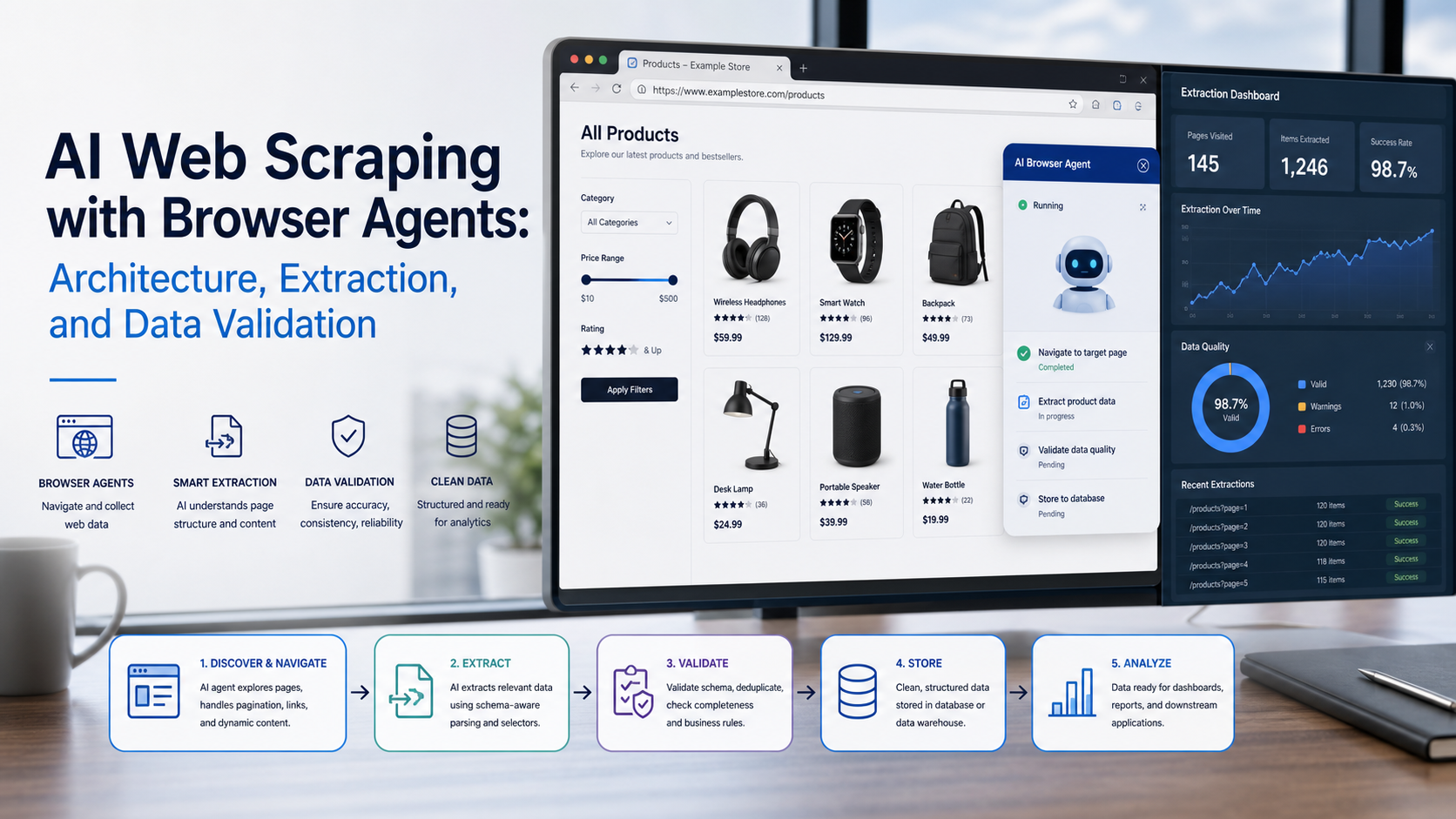
AI Web Scraping with Browser Agents: Architecture, Extraction, and Data Validation
AI web scraping uses AI to help discover, navigate, interpret, or extract information from websites. Browser agents are one implementation option when page interaction, rendering, or layout variation makes a simple scraper too brittle, but the agent should not become the entire data pipeline.
View Details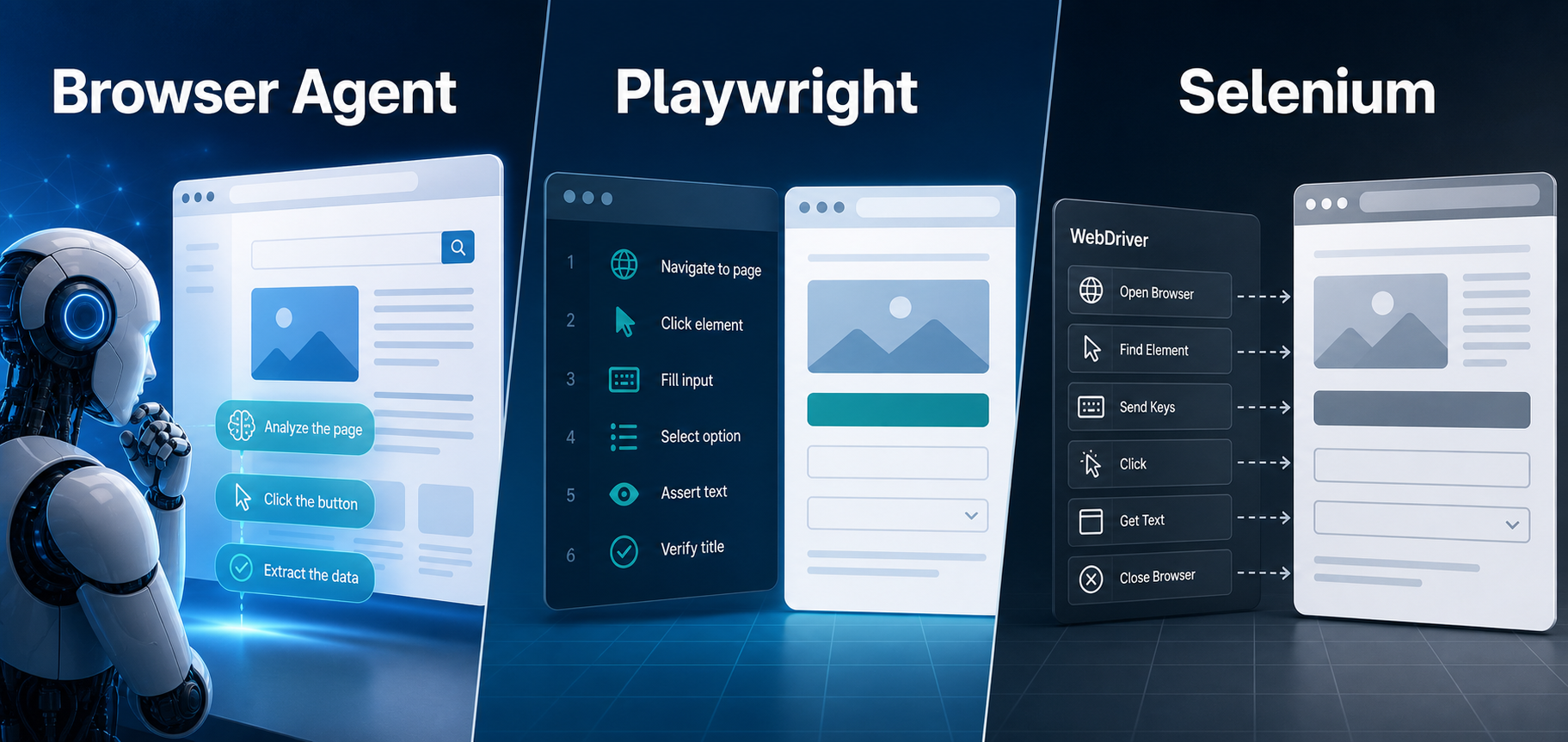
AI Browser Automation: Browser Agents vs Playwright vs Selenium
A browser agent interprets a goal and decides what browser action to take next. Playwright and Selenium can execute explicit, testable browser logic defined by developers. In 2026, however, Playwright also provides official MCP and agent-oriented workflows, so Playwright is no longer just the deterministic alternative to agentic automation. It can also serve as the browser-control layer inside an agent system.
View Details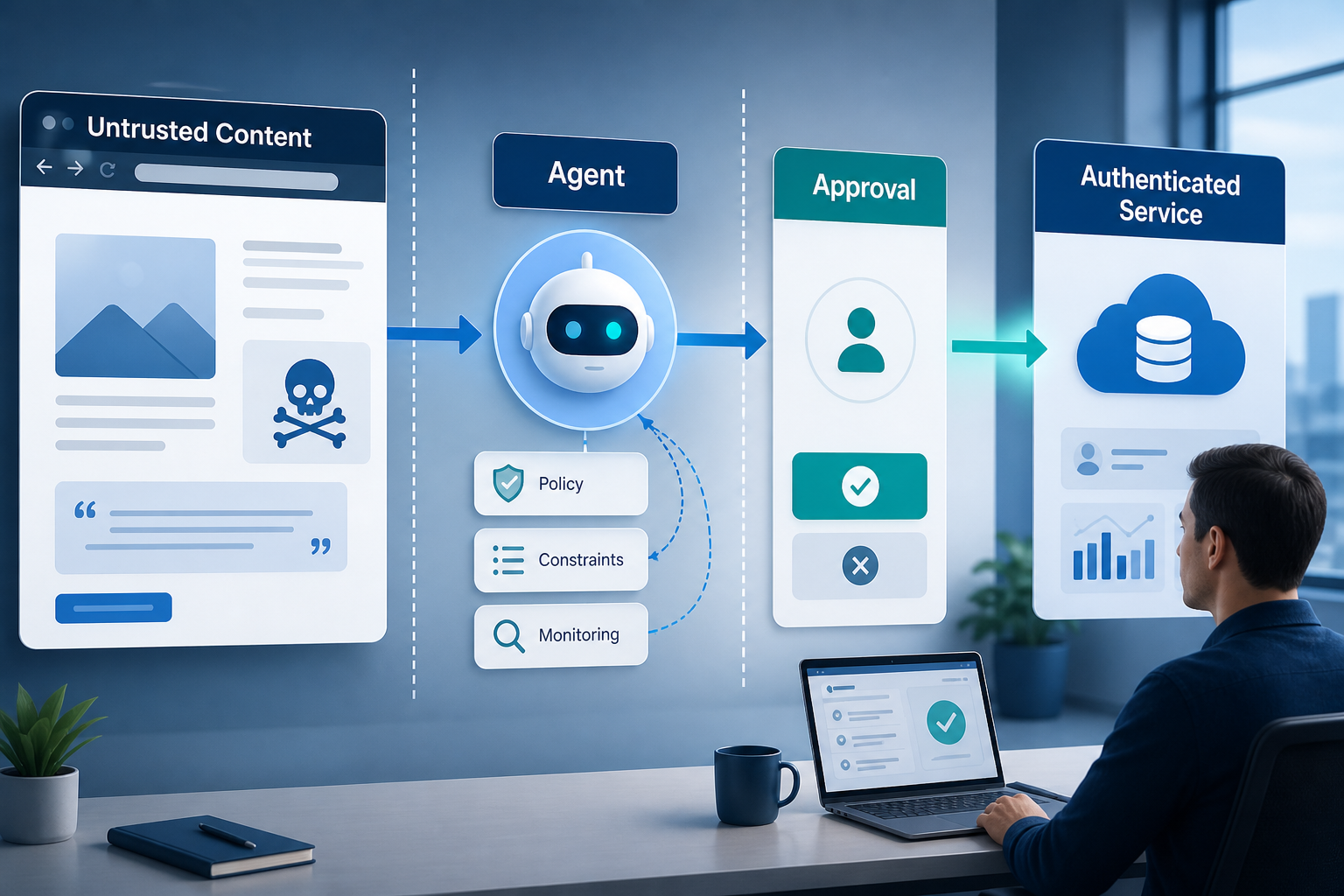
Agentic Browser Security: Prompt Injection, Permissions, and Safe Deployment
That combination creates risks that are different from ordinary browsing and traditional automation. The most important is indirect prompt injection, where hostile instructions hidden in web content attempt to redirect the agent away from the user's goal. Google describes indirect prompt injection as a primary new threat for agentic browsing and has introduced layered defenses that include origin constraints, independent action checks, threat detection, and user confirmation for sensitive actions. Google's Chrome security architecture is a useful reference for how browser-agent defenses are evolving.
View Details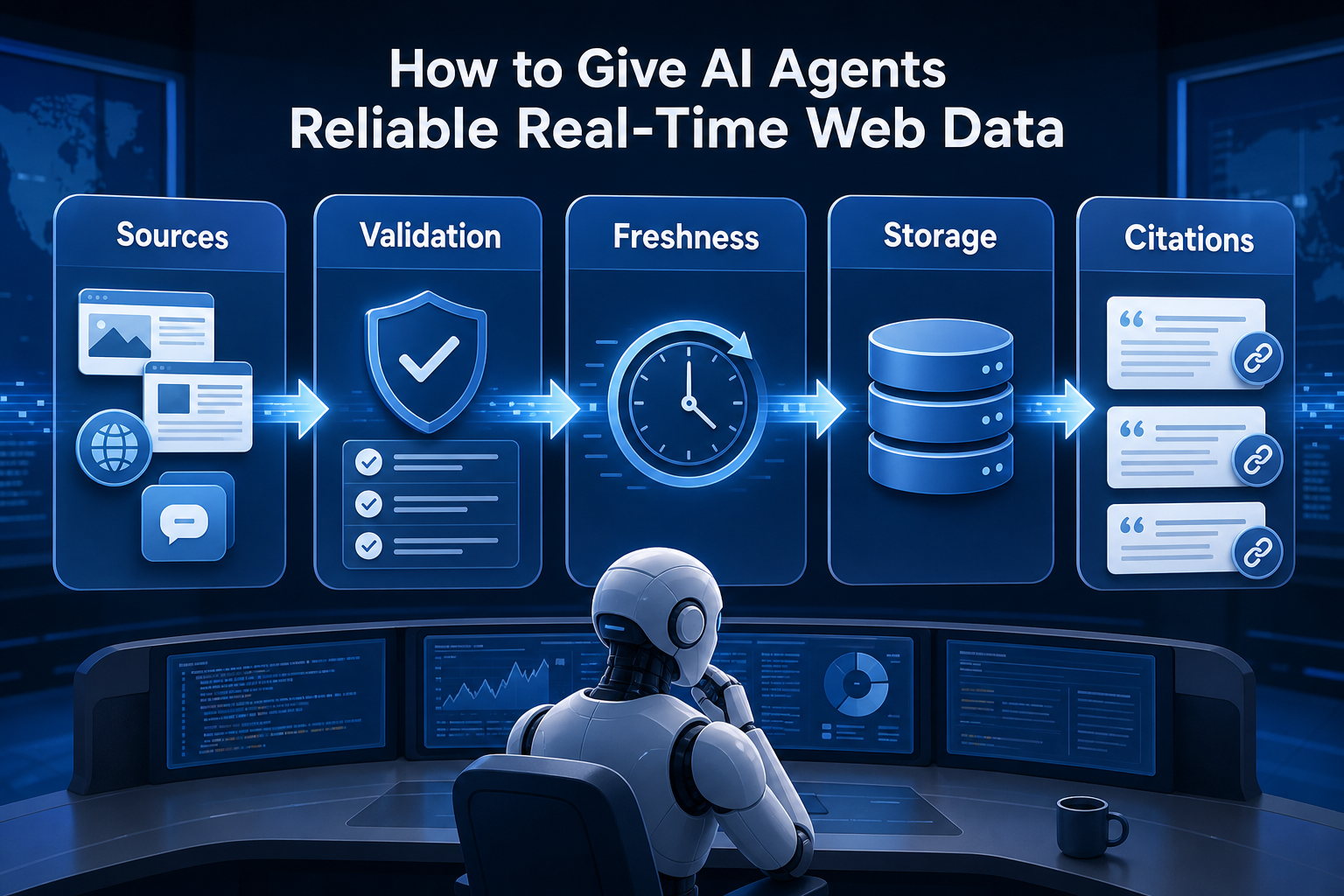
How to Give AI Agents Reliable Real-Time Web Data
A production-ready solution therefore needs more than a web scraper. It needs a web data layer that connects acquisition, validation, storage, retrieval, security, and observability. This guide explains how to design that layer.
View Details