
AI Search API for AI Agents: How to Ground LLMs With Live Search Data
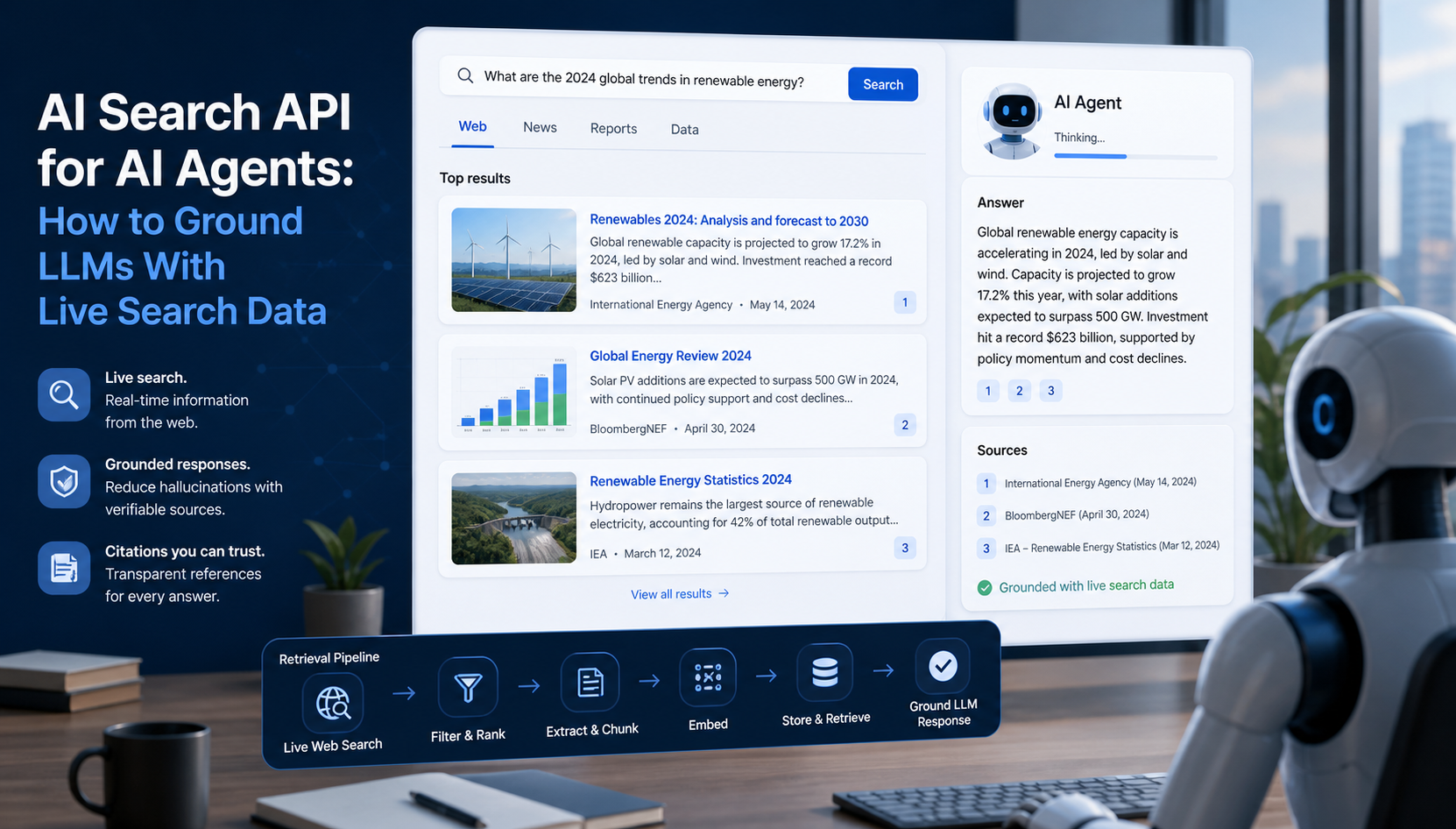
An AI search API gives an application or agent programmatic access to current search results. Its most useful role is discovery: the agent can find candidate sources, identify fresh information, and decide what to retrieve next instead of relying only on model memory.
The important limitation is that a search result is not the same thing as verified evidence. A reliable agent should separate search discovery from page retrieval, source evaluation, and final answer generation. This article explains that architecture and the controls needed to keep search-enabled agents useful, traceable, and cost-aware.
Where a Search API Fits in an AI Agent
The Model Context Protocol documentation describes MCP as an open standard for connecting AI applications to external systems, including tools such as search engines. The MCP tools specification further describes tools as model-controlled functions that can query APIs or other external systems.
A search API can be exposed to an agent through MCP, a native tool interface, an agent SDK, or your own function-calling layer. The interface changes, but the logical role is the same: search helps the agent discover possible sources.
For the LycheeIP implementation details behind this step, review LycheeIP proxy infrastructure.
For the LycheeIP implementation details behind this step, review AI-powered browser automation hub.
For the LycheeIP implementation details behind this step, review rotating residential proxies.
For the LycheeIP implementation details behind this step, review static residential proxies.
For the official technical reference behind this point, see Anthropic documentation.
For the official technical reference behind this point, see Gemini API documentation.
Search Discovery Is Not Ground Truth
Search snippets are compressed representations of pages. They may omit qualifiers, reflect a different page section than the one you need, or become stale relative to the underlying source. Search rank also measures visibility, not authority.
For claims that matter, the agent should use search results to identify candidate sources, then retrieve and inspect the underlying pages. This is especially important for current product capabilities, laws, prices, health information, financial information, research findings, and other time-sensitive or high-stakes topics.
The Search-to-Answer Architecture
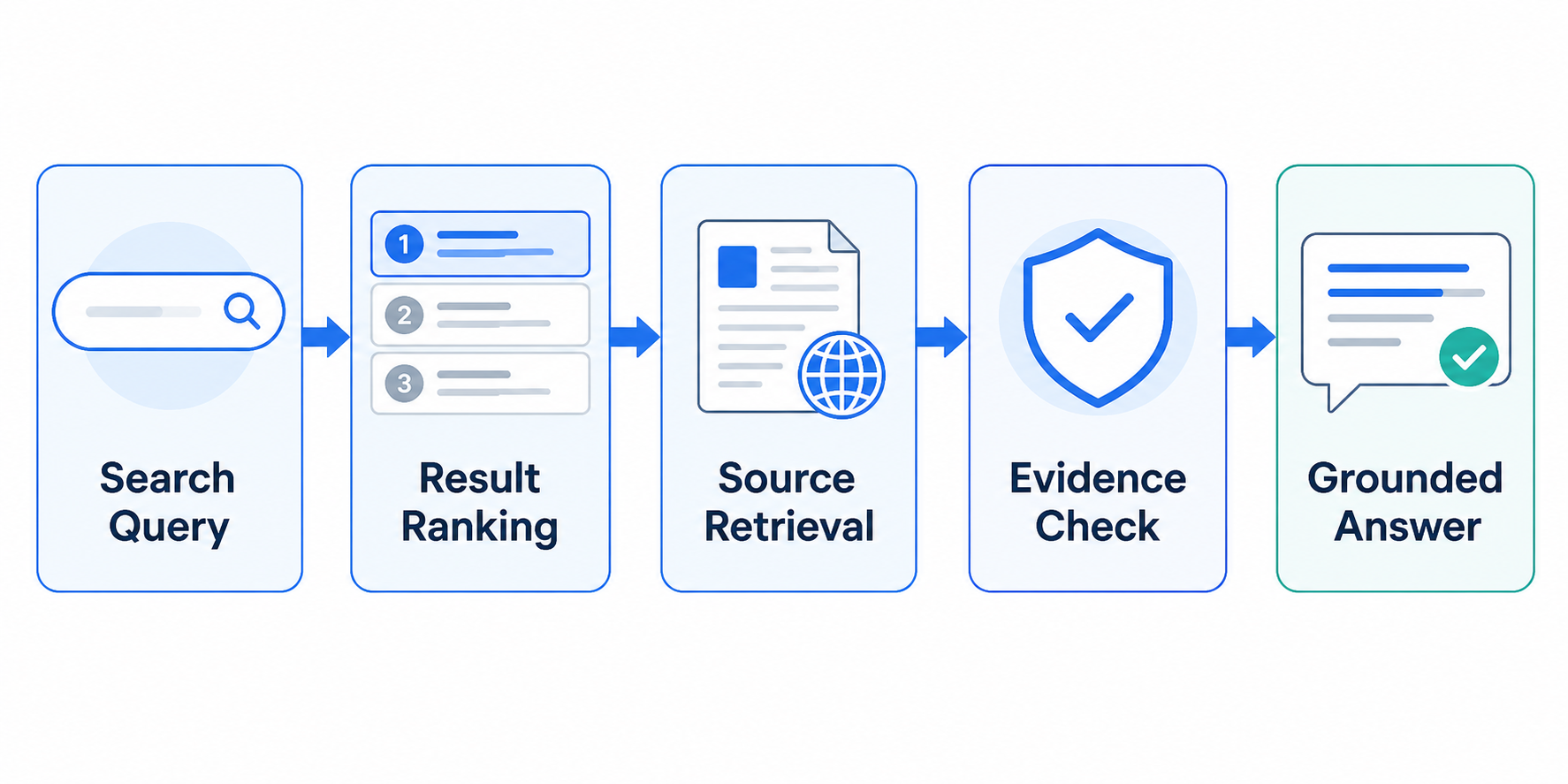
- Interpret the user’s task and decide whether fresh external information is needed.
- Generate one or more focused search queries.
- Send the query to the search API with required language, country, location, or freshness settings.
- Rank candidate sources by relevance and source quality.
- Retrieve the most relevant underlying pages.
- Extract evidence from those pages.
- Generate the answer using the retrieved evidence.
- Preserve source URLs, retrieval time, and query provenance for citations and auditing.
This sequence creates a useful boundary: the search API helps locate information, while the retrieval and reasoning layers determine whether the information actually supports the answer.
Which Search Fields Matter Most to an AI Agent
Query Planning for AI Search Agents
Use one query when the task is narrow
If the user asks for a specific current fact, one precise query may be enough to discover the authoritative source. Avoid generating five variants when one query can identify the needed documentation.
Use multiple queries when viewpoints or terminology differ
Complex research may require a broad discovery query followed by narrower verification queries. The second query should answer a specific evidence gap rather than simply restating the first query.
Use domain-restricted searches for known authorities
When the correct source type is known, constrain discovery to the relevant domain or source class. Product capabilities should usually be checked against official documentation. Regulations should be checked against the responsible authority. Research claims should be traced to the original paper or institution when possible.
How an Agent Should Select Sources
- Prefer the primary source when the question is about a named product, standard, regulation, organization, or research finding.
- Use recent sources for facts likely to change.
- Use more than one reliable source when the claim is disputed or consequential.
- Do not treat the highest-ranked result as automatically most trustworthy.
- Preserve the source URL even if the final response uses a synthesized summary.
AI Search API, Direct Retrieval, or Internal RAG?
Using Search APIs Through MCP
SerpApi’s current MCP integration exposes multi-engine search capabilities to MCP-compatible clients. Apify’s AI integration documentation likewise describes exposing Actors and storage to AI clients and agent frameworks, including through its MCP server.
MCP can reduce custom tool plumbing, but it does not remove the need for search budgets, source-quality rules, access controls, logging, and validation. A tool being callable by a model is not the same as the tool being safe or appropriate for every task.
Prevent Runaway Search Loops
Agents can waste time and money if they keep searching because they lack a clear stop condition. Build explicit limits into the workflow.
- maximum searches per task
- maximum pages retrieved per search
- duplicate-query detection
- maximum repeated results from the same domain
- freshness threshold for cached results
- stop when a primary source answers the question
- escalation when evidence remains insufficient
The goal is not to stop research early. It is to prevent repeated queries that add no new evidence.
Separate Search Failure From Reasoning Failure
When an agent produces a poor answer, identify the failing layer. Did the query fail to discover the right source? Did the retrieval step fail to open it? Did extraction miss the relevant passage? Or did the model misinterpret evidence that was successfully retrieved?
This distinction is essential for debugging because changing the search provider will not fix a reasoning error, and prompting changes will not fix a search integration that consistently returns the wrong locale.
Observability for Search-Enabled Agents
At minimum, log:
- user task or task identifier
- generated search queries
- search configuration such as country and language
- returned source URLs
- which sources the agent selected
- retrieval success or failure
- evidence used in the answer
- search and retrieval timestamps
- tool errors and retry decisions
These records help teams investigate unsupported answers, unexpected costs, and repeated search loops.
Where LycheeIP Fits in AI Search Workflows
If an AI agent calls a managed search API, that provider normally handles the search retrieval network layer. A separate proxy is not automatically required.
Proxy infrastructure becomes relevant when the agent or a supporting service operates its own authorized public-web collector, localization check, or browser workflow. The proxy controls network routing and location. It does not decide which sources are authoritative or whether the model interpreted evidence correctly.
LycheeIP dynamic residential proxies can support authorized, location-sensitive collection where rotating residential routes are relevant.
LycheeIP static residential proxies can support longer workflows that need a stable network identity.
LycheeIP datacenter proxies can fit permitted high-throughput retrieval when hosted IP infrastructure is acceptable.
Common Architecture Mistakes
- treating search snippets as complete evidence
- selecting sources by rank alone
- losing source URLs before generation
- letting the agent search indefinitely
- using stale cached results for fast-changing questions
- failing to distinguish search discovery from page retrieval
- generating an answer when retrieval failed
- giving the search tool broader access than the task requires
When an AI Agent Does Not Need a Search API
Do not add public search when the task can be answered from a fixed internal knowledge base, a known official API, a deterministic database lookup, or a curated set of documents. Extra search increases latency, cost, and uncertainty without automatically improving the answer.
Ground AI search workflows with LycheeIP proxy infrastructure
Final Takeaway
An AI search API is most valuable as a controlled discovery tool. Reliable agents search only when freshness or external evidence is needed, retrieve the underlying sources, preserve provenance, and stop when the evidence is sufficient.
Frequently Asked Questions
What is an AI search API?
An AI search API is a programmatic search service used by an AI application or agent to discover current external information. It typically returns structured search results that the agent can use to choose sources for further retrieval.
Can an LLM answer directly from SERP snippets?
It can, but that is often a weak verification strategy. Snippets are useful for discovery and relevance screening, while important claims should be checked against the underlying source.
What is the difference between search and RAG?
Public search discovers external sources. RAG usually retrieves from a known or indexed corpus. Many agent systems use both, with internal retrieval for trusted organizational knowledge and web search for fresh external information.
Does MCP replace a search API?
No. MCP is an interface standard that can expose a search API as a tool. The underlying search service still performs the search.
How do I control AI search costs?
Set query budgets, retrieval limits, duplicate-query checks, cache policies, and explicit stop conditions. Measure cost per successful task, not only cost per search call.
Do AI agents need proxies for web search?
Not when a managed search provider already handles retrieval. Proxies become relevant when you operate your own authorized collector and need network-layer control such as geography or session routing.
Related LycheeIP Guides and Resources

Recommended Articles
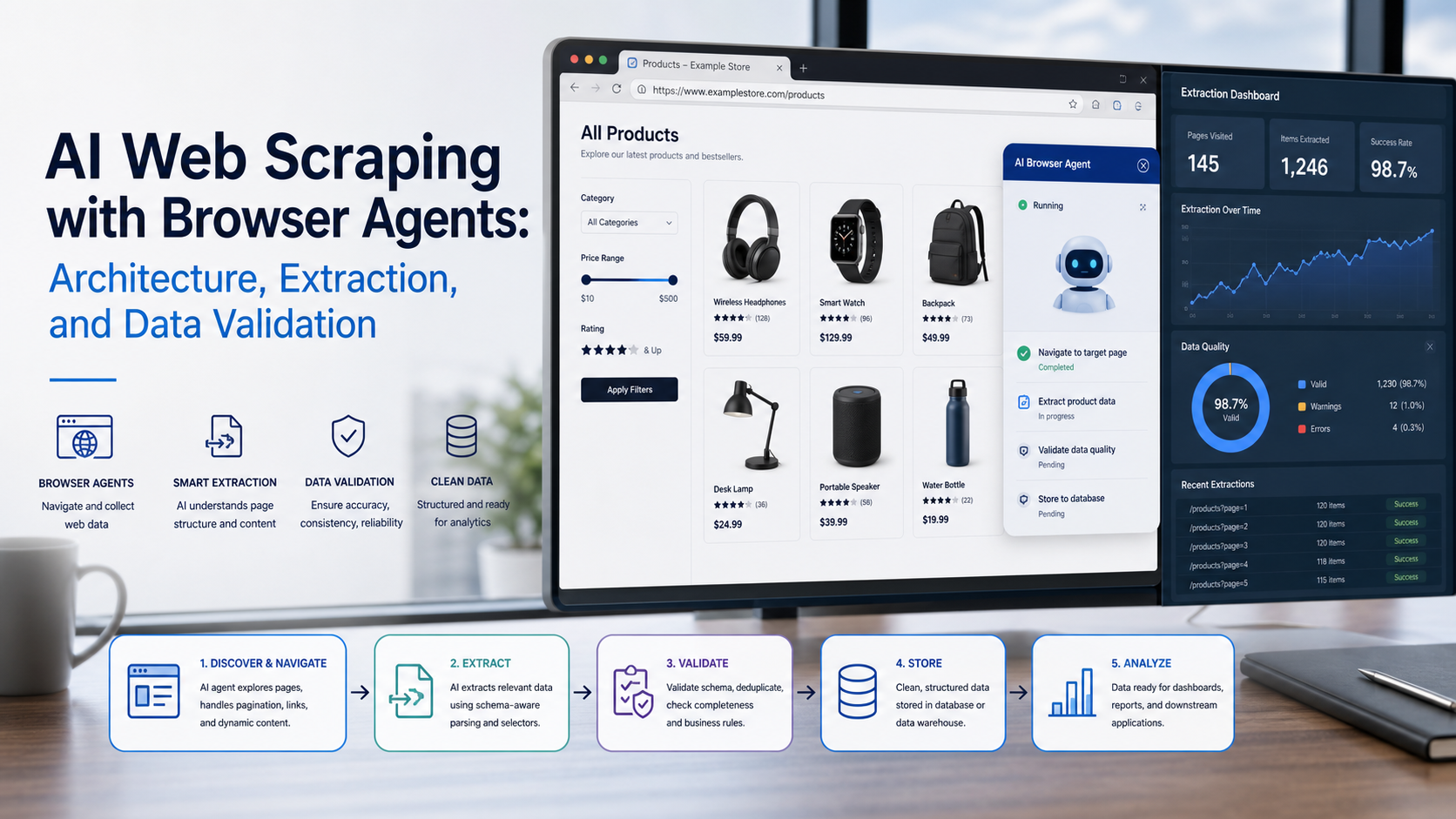
AI Web Scraping with Browser Agents: Architecture, Extraction, and Data Validation
AI web scraping uses AI to help discover, navigate, interpret, or extract information from websites. Browser agents are one implementation option when page interaction, rendering, or layout variation makes a simple scraper too brittle, but the agent should not become the entire data pipeline.
View Details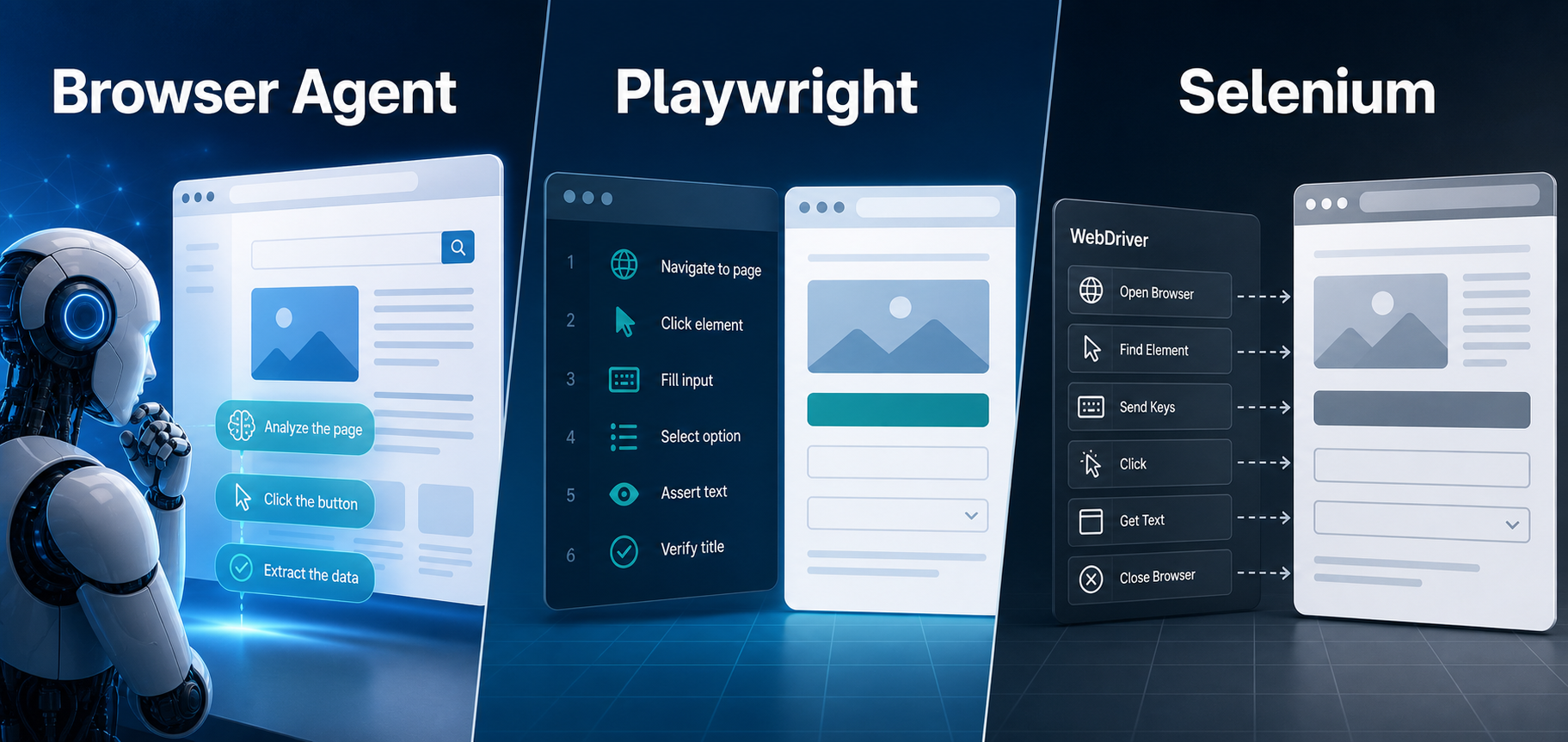
AI Browser Automation: Browser Agents vs Playwright vs Selenium
A browser agent interprets a goal and decides what browser action to take next. Playwright and Selenium can execute explicit, testable browser logic defined by developers. In 2026, however, Playwright also provides official MCP and agent-oriented workflows, so Playwright is no longer just the deterministic alternative to agentic automation. It can also serve as the browser-control layer inside an agent system.
View Details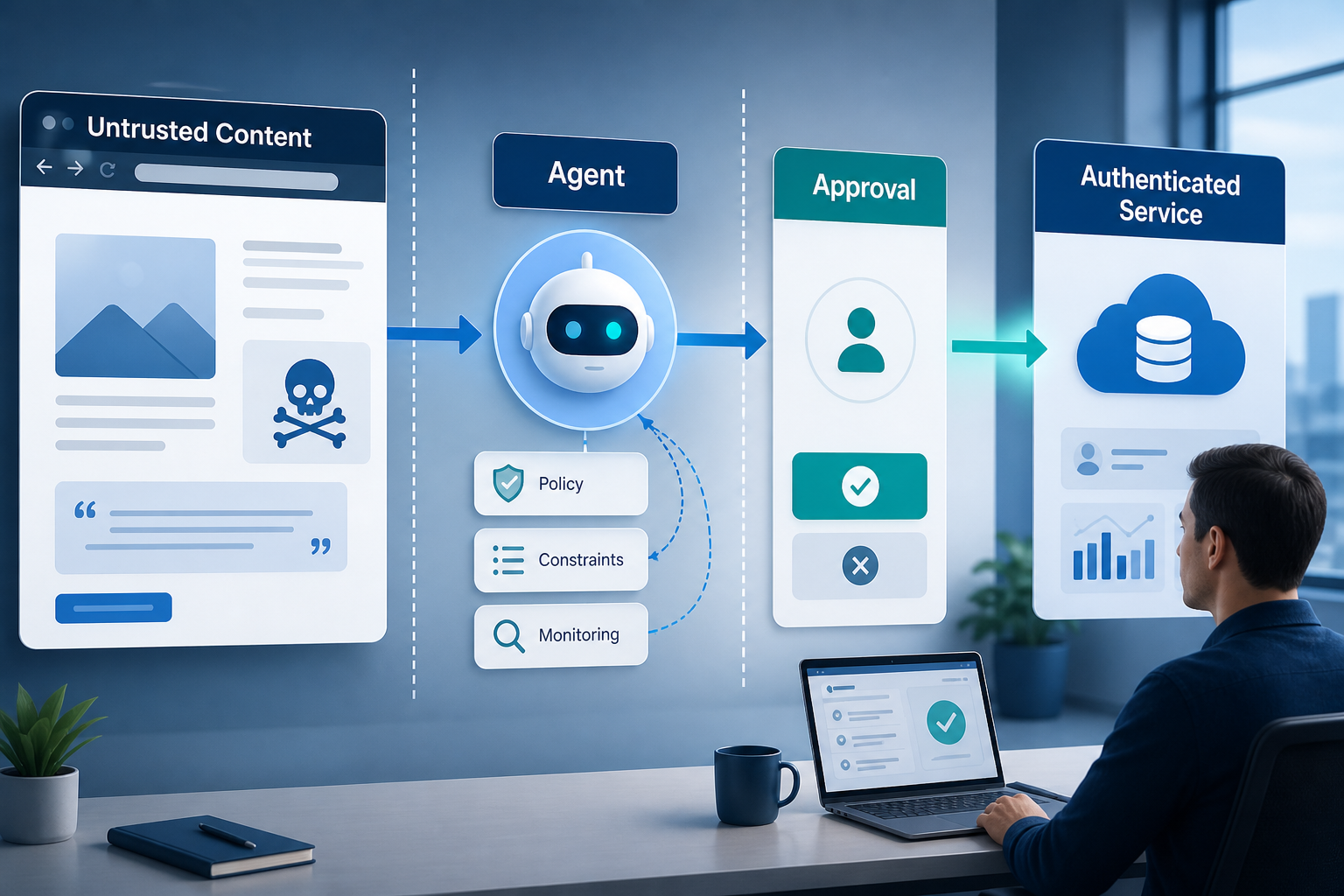
Agentic Browser Security: Prompt Injection, Permissions, and Safe Deployment
That combination creates risks that are different from ordinary browsing and traditional automation. The most important is indirect prompt injection, where hostile instructions hidden in web content attempt to redirect the agent away from the user's goal. Google describes indirect prompt injection as a primary new threat for agentic browsing and has introduced layered defenses that include origin constraints, independent action checks, threat detection, and user confirmation for sensitive actions. Google's Chrome security architecture is a useful reference for how browser-agent defenses are evolving.
View Details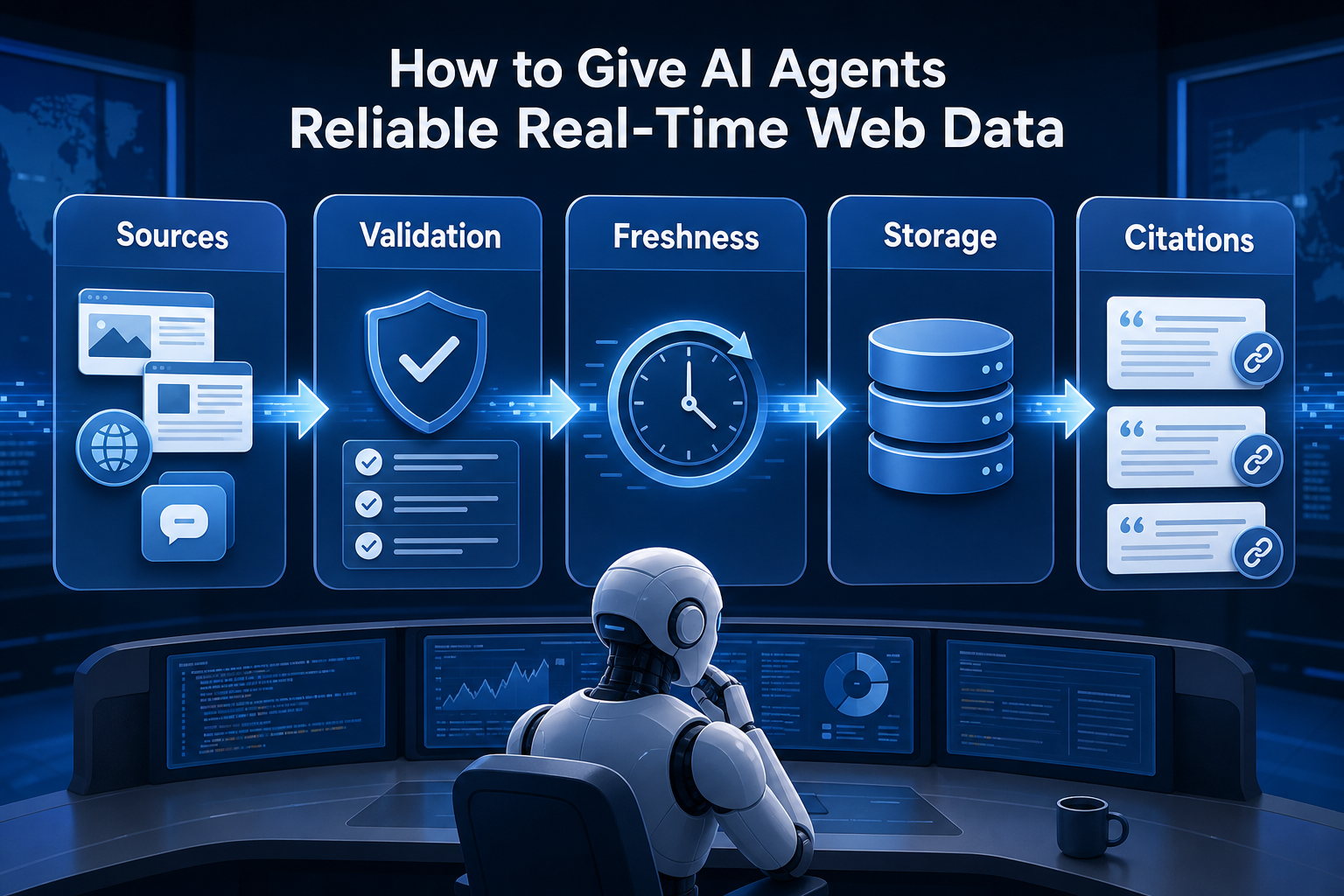
How to Give AI Agents Reliable Real-Time Web Data
A production-ready solution therefore needs more than a web scraper. It needs a web data layer that connects acquisition, validation, storage, retrieval, security, and observability. This guide explains how to design that layer.
View Details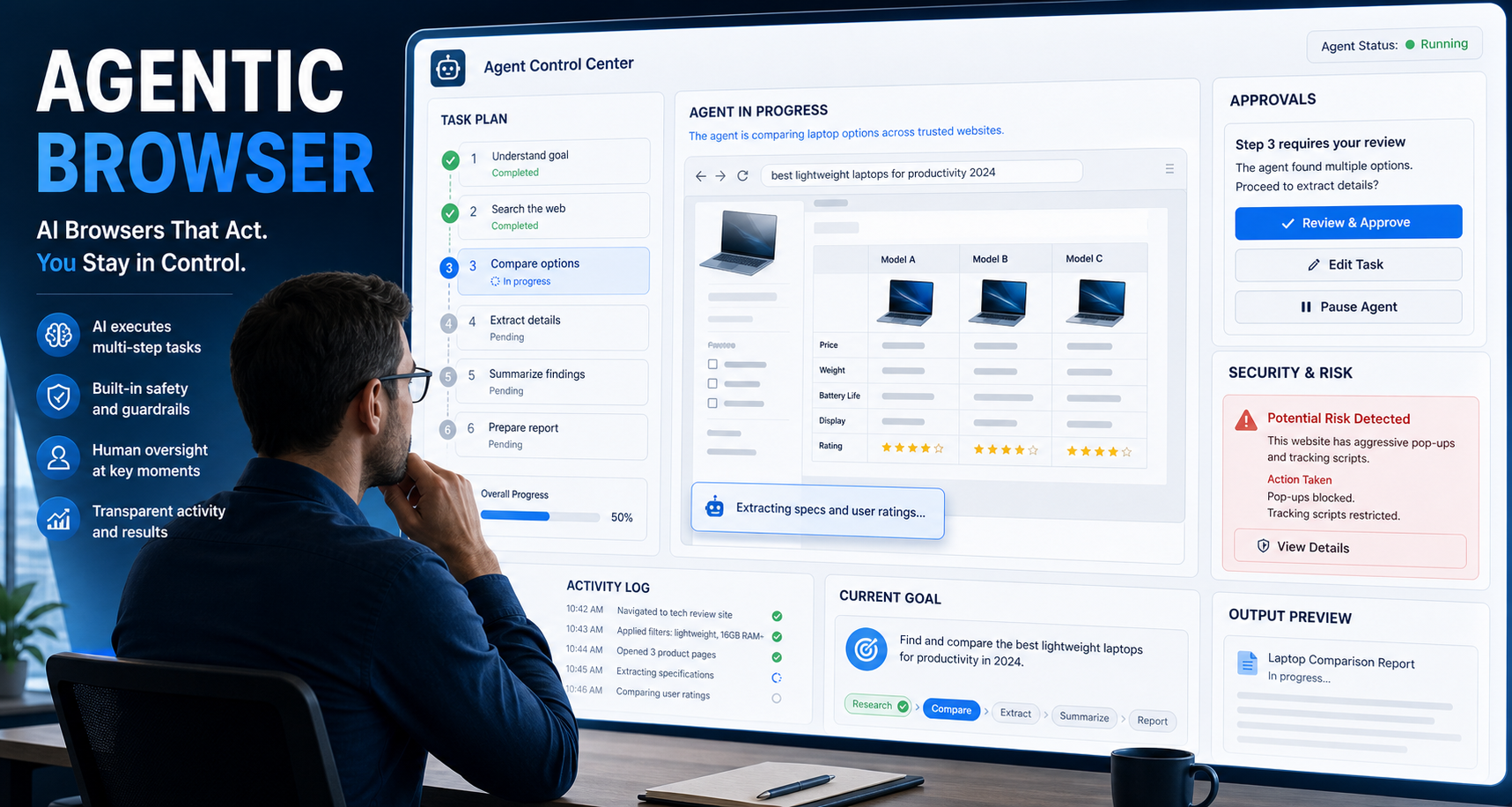
Agentic Browser: How AI Browsers Work, Where They Help, and What Can Go Wrong
An **agentic browser** is a web browser or browser-based system that uses an AI agent to interpret a goal, plan the necessary steps, navigate websites, and take actions on the user’s behalf. Instead of manually opening tabs, comparing information, clicking buttons, and filling in forms, the user describes the desired outcome and supervises the agent as it works.
View Details