
What Is cURL in 2026? Commands, API Requests, and Fixes
If you are asking what is cURL, the short answer is practical. cURL is a command-line tool that sends requests to a URL and shows you what comes back. It is one of the fastest ways to test endpoints, inspect headers, download files, and debug server behavior without opening a web browser.
Official documentation provides a standard cURL definition. It is a tool for transferring data from or to a server using URLs.
What you will get from this guide:
- A plain-English explanation of what is cURL and how it functions.
- A beginner-safe framework for building requests.
- Practical cURL command examples for daily use.
- A decision matrix for adjacent tools.
- A troubleshooting guide for common failures.
Scale requests with LycheeIP
What is cURL?
To fully answer what is cURL, you need to understand libcurl. Libcurl is the underlying transfer library that powers the cURL command and handles the actual network protocols. Because of libcurl, the tool supports far more than basic web traffic. It handles HTTP, HTTPS, FTP, IMAP, SMTP, MQTT, and WebSocket protocols depending on your specific build.
The easiest way to think about it is this. Your web browser makes requests for you behind the scenes, but cURL lets you make those exact requests manually and purposefully.
Why is cURL still relevant in 2026?
You might wonder what is cURL doing in modern development environments when graphical tools exist. It remains relevant because it sits very close to the network layer while staying easy to script. This makes it highly useful for teams that need to confirm what a server actually returns instead of guessing from a user interface.
Here is how different technical roles use it today:
- Scraping teams: Testing target responses and proxy behavior before writing complex Python code.
- Fintech ops: Validating secure API endpoints and authentication flows for payment gateways.
- Fraud and risk: Inspecting raw server headers to map suspicious backend infrastructure.
- Multi-account agencies: Verifying routing and IP localization rules quickly.
It is also the undisputed standard for cURL for Bash Scripts and automation. The official project keeps evolving, with version 8.19.0 bringing modern security updates that prove why keeping your terminal tools current matters.
How do you install and verify cURL?
The most reliable rule is to verify first and install second. Run curl --version to see whether the tool is already present and which build you are actually using.
On many Windows systems, cURL is already bundled. The official Windows build page also lists up-to-date binaries. On macOS and Linux, the tool is often installed by default. If not, macOS users typically use Homebrew (brew install curl), and Ubuntu users use APT (apt install curl).
One vital Windows detail to remember is that Command Prompt does not treat quoting the same way Unix shells do. Raw single-quoted JSON commonly fails in Windows cmd unless you move the JSON into a separate file or escape the characters differently.
How does cURL work under the hood?
At its core, a cURL command works by combining a target URL with specific request options. It then lets libcurl perform the transfer and return the response.
A useful beginner framework is the TRACE Framework:
- T (Target): Which URL am I calling?
- R (Request): Which method am I sending?
- A (Access): Which authentication and headers are required?
- C (Content): What body or parameters am I sending?
- E (Evidence): How will I inspect success or failure?
If you get this five-part structure right, understanding what is cURL capable of becomes much easier.
Which commands belong on a cURL commands cheat sheet?
Beginners do not need to memorize fifty different flags. They need a short cURL commands cheat sheet they can rely on.
- curl --version checks your installed version and supported protocols.
- curl -I https://example.com fetches the headers only.
- curl --verbose https://example.com shows exactly what was sent and received.
- curl --fail-with-body https://example.com forces HTTP failures to surface clearly while still showing the response content.
Scale requests with LycheeIP
How do you structure a cURL API request?
Building a reliable cURL API request requires a repeatable process. You must define the endpoint, method, headers, and body clearly.
When you need a basic cURL GET request, you simply call the URL.
curl https://api.example.com/data
For a standard cURL POST request, you use the -X POST flag alongside your data. Here are simple POST request examples using form data:
curl -X POST -d "user=admin" https://api.example.com/login
Modern APIs usually require a cURL JSON request. The --json flag is the friendliest starting point because it bundles the JSON payload with the correct Content-Type: application/json and Accept: application/json headers automatically.
curl --json '{"email":"user@example.com"}' https://api.example.com/users
If you need to update an existing resource, you will use a cURL PATCH request.
curl -X PATCH --json '{"status":"active"}' https://api.example.com/users/1
Almost all secure endpoints require cURL authentication and specific cURL headers. You add headers using the -H flag.
curl -H "Authorization: Bearer YOUR_TOKEN" https://api.example.com/protected
Which tool is better: cURL vs wget vs curl_cffi?
When learning what is cURL, you will inevitably compare it to other utilities. Use the tool that matches the specific job you are trying to accomplish.
Comparison/Table
| Tool | Best For | Tradeoffs |
| cURL | API testing, custom headers, JSON payloads, and detailed request debugging. | Requires explicit flags for following redirects; not built for recursive site downloading. |
| Wget | Straightforward file downloads, resuming broken transfers, and recursive directory retrieval. | Lacks the fine-grained API request control and modern JSON shortcuts found in cURL. |
| curl_cffi | Python workflows requiring libcurl bindings combined with browser-like TLS impersonation. | Overkill for simple shell-based diagnostics; requires Python environment setup. |
How do you fix common cURL errors?
Most failures fall into a few repeat patterns involving quoting mistakes, DNS problems, or TLS verification issues.
Troubleshooting
| Common Symptom | Likely Cause | How to Fix It |
| Could not resolve host | Typo, bad shell quoting, or a header fragment parsed incorrectly as a host. | Verify endpoint spelling and ensure single/double quotes are closed properly. |
| SSL certificate problem | Missing CA chain, corporate proxy interception, or local trust-store issue. | Check your local CA store or verify if a corporate firewall is modifying the certificate chain. |
| Empty reply from server | Server closed the connection abruptly, or a firewall blocked the packet. | Check upstream availability or run with --verbose to see exactly when the connection drops. |
| 401 or 403 Status Code | Wrong authentication, expired bearer token, or missing required headers. | Validate token freshness and ensure all required -H headers are present. |
| Wrong JSON behavior | Bad escaping, Windows cmd quoting rules, or missing content-type headers. | Use the --json flag instead of manual data flags, or move the payload to a separate file. |
How should you use cURL safely?
Keep the safe defaults turned on unless you have a specific, temporary reason to disable them. The --insecure flag skips certificate verification. The official man page explicitly warns that this makes the transfer insecure and can expose you to malicious server routing.
You should also avoid exposing secrets carelessly. Use the -K flag to read sensitive parameters from a file rather than placing clear-text passwords directly in your terminal command history. Finally, treat verbose logs as highly sensitive, as they often contain session cookies and authorization tokens.
When should you scale beyond a single cURL command?
Do not force a single cURL command into jobs better handled by a dedicated infrastructure stack. Skip it when you need full-site recursive mirroring, JavaScript rendering, or high-volume automated data collection.
If your next step is scaling protected HTTP collection, that is where a specialized proxy layer becomes relevant. Once you finish testing headers and endpoints locally, you can route your automated scripts through LycheeIP to ensure reliable delivery.
How LycheeIP fits into scaled requests:
- Developer-first simplicity: Usage and statistics are available in near real-time via a simple API.
- Clean IP pools: Dynamic residential proxies feature AI and algorithm multi-filtering with a scenario cooling period of more than six months.
- Reliable uptime: Backed by 99.98% network availability and 99.8% uptime specifically for dynamic residential proxies.
- High performance: Static datacenter proxies offer low latency under 50ms and high throughput exceeding 1Gbps.
- Clear access: Supports easy IP whitelisting for static residential plans.
What are the assumptions and limitations?
Before relying heavily on terminal requests, keep these constraints in mind:
- Option availability depends entirely on how the tool was built on your specific machine.
- Windows, macOS, and Linux terminal environments parse quotes and special characters differently.
- Server behavior can vary wildly based on user-agent strings, even when your syntax is technically perfect.
- Version details and CVE patches change over time, requiring you to verify official security pages periodically.
Scale requests with LycheeIP
Frequently Asked Questions:
1. What is cURL command?
The cURL command is a terminal utility used for sending network requests to a URL and receiving the response directly in your console. It is widely used for API testing, header inspection, and automated scripting.
2. What is cURL used for?
It is used for downloading resources, testing API endpoints, sending structured data, checking HTTP status codes, and securely handling authentication without needing a graphical web browser.
3. How do you use cURL for API requests?
You start by defining the target endpoint, then append the method, authentication tokens, and headers. For data submission, using the --json flag is the most efficient way to format a cURL API request.
4. What is cURL in Linux environments?
In Linux and UNIX-style systems, it is a standard command-line utility executed directly from the terminal emulator. While the core functionality remains identical across operating systems, shell quoting rules may differ slightly.
5. How do you fix common cURL errors?
The most frequent issues involve syntax errors and TLS certificate blocks. The best first step is to append the --verbose flag to your command to inspect the raw connection steps and identify exactly where the failure occurs.
6. Is cURL the same as Wget?
No. While they both transfer data, cURL vs wget comes down to intent. cURL is designed for flexible, granular request construction (like API calls), whereas Wget is optimized for reliable, automated file downloading.
7. When should I use curl_cffi?
You should transition to curl_cffi when you are working within a Python environment and require browser-like TLS impersonation to bypass advanced anti-bot protections during data scraping tasks.

Recommended Articles
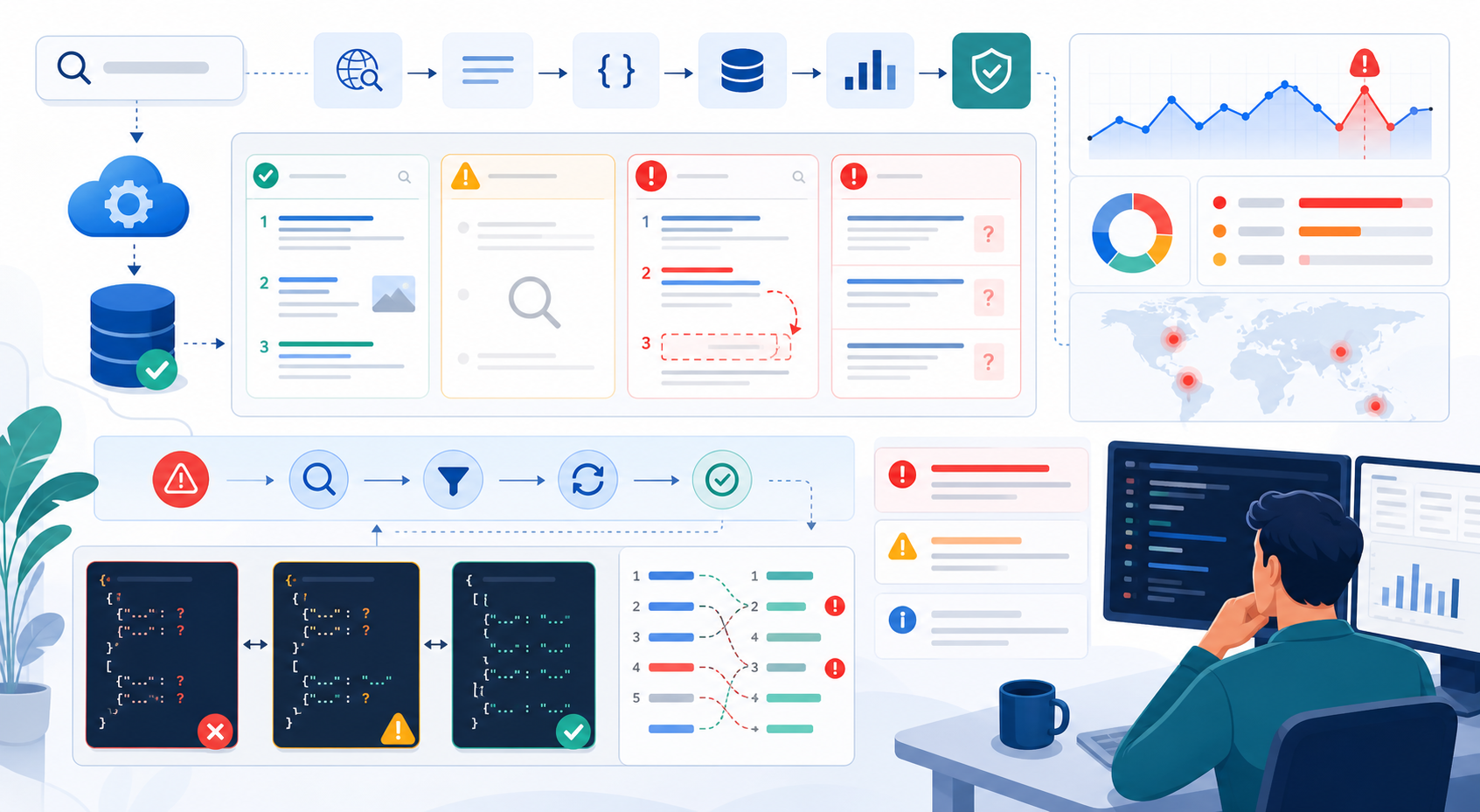
SERP API Troubleshooting: Fix Empty, Wrong, or Inconsistent Search Results
SERP API failures are not limited to obvious HTTP errors. A request can return successfully and still produce empty, incomplete, geographically wrong, duplicated, or misinterpreted search data. Production troubleshooting therefore has to separate transport problems from provider processing, SERP differences, and downstream parsing errors.
View Details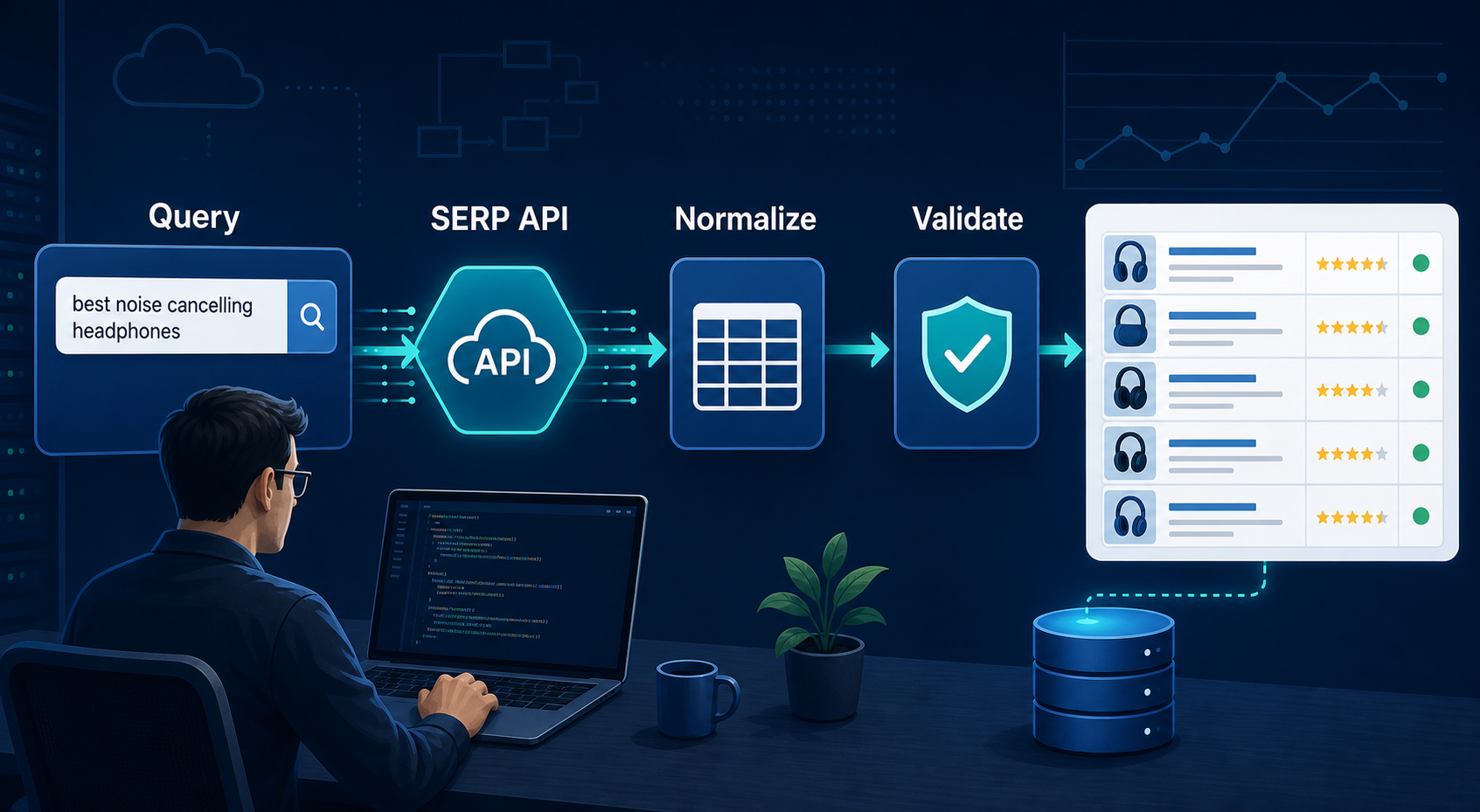
SERP API Python: How to Build a Reliable Search Data Pipeline
This guide shows a provider-neutral workflow for building that pipeline. It does not rank SERP API vendors. Instead, it focuses on the implementation choices that make a Python integration easier to operate, test, and migrate.
View Details
SERP Scraping API: How to Choose the Right Provider
Recommended Meta Description: Compare SERP scraping APIs by data coverage, localization, reliability, workflow fit, and cost structure, then choose and validate the right provider.
View Details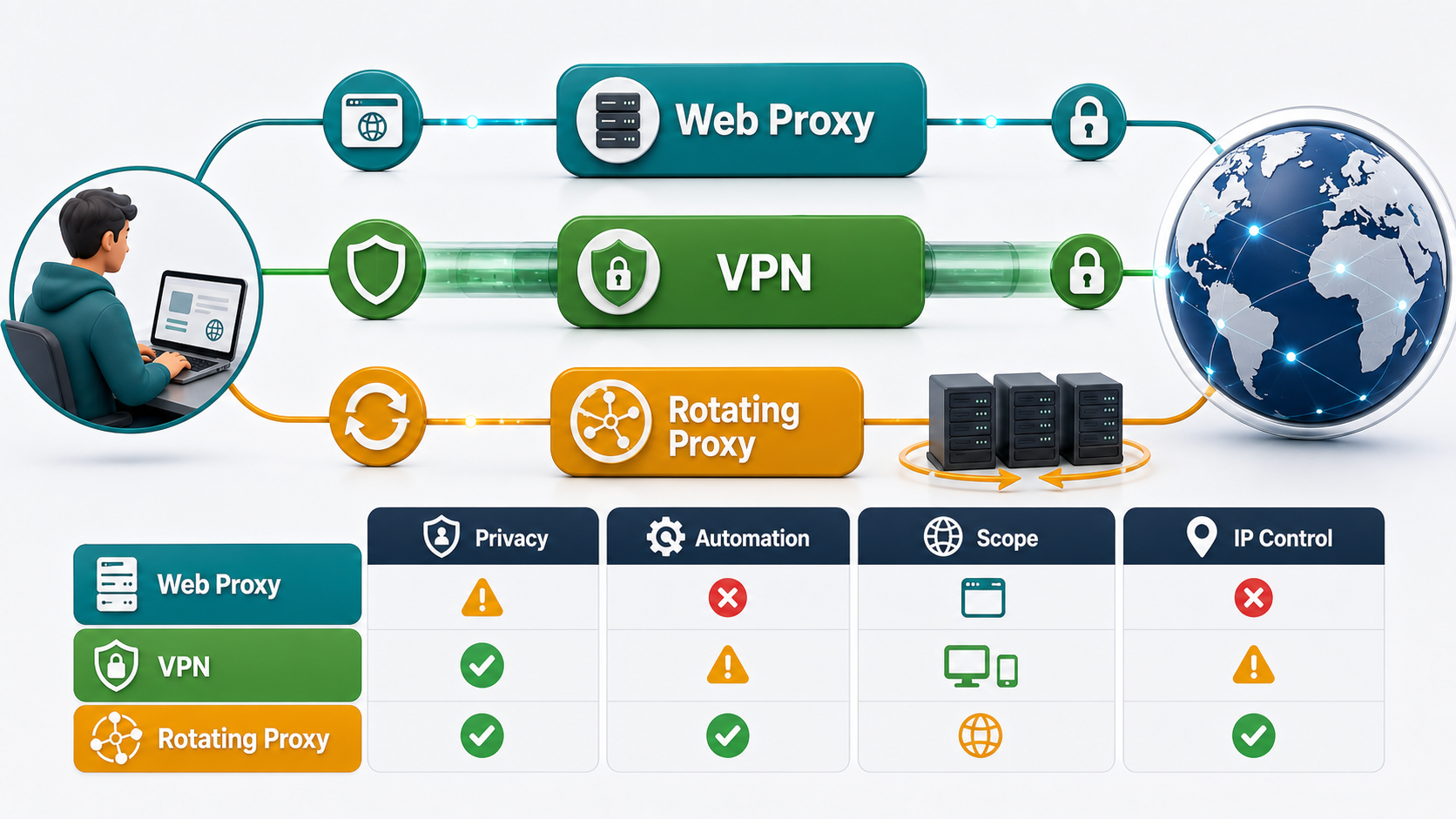
Free Web Proxy vs VPN vs Rotating Proxy: Which Should You Use?
Compare free web proxies, VPNs, rotating proxies, static proxies, and datacenter proxies by scope, encryption, IP control, automation, streaming, and account workflows.
View Details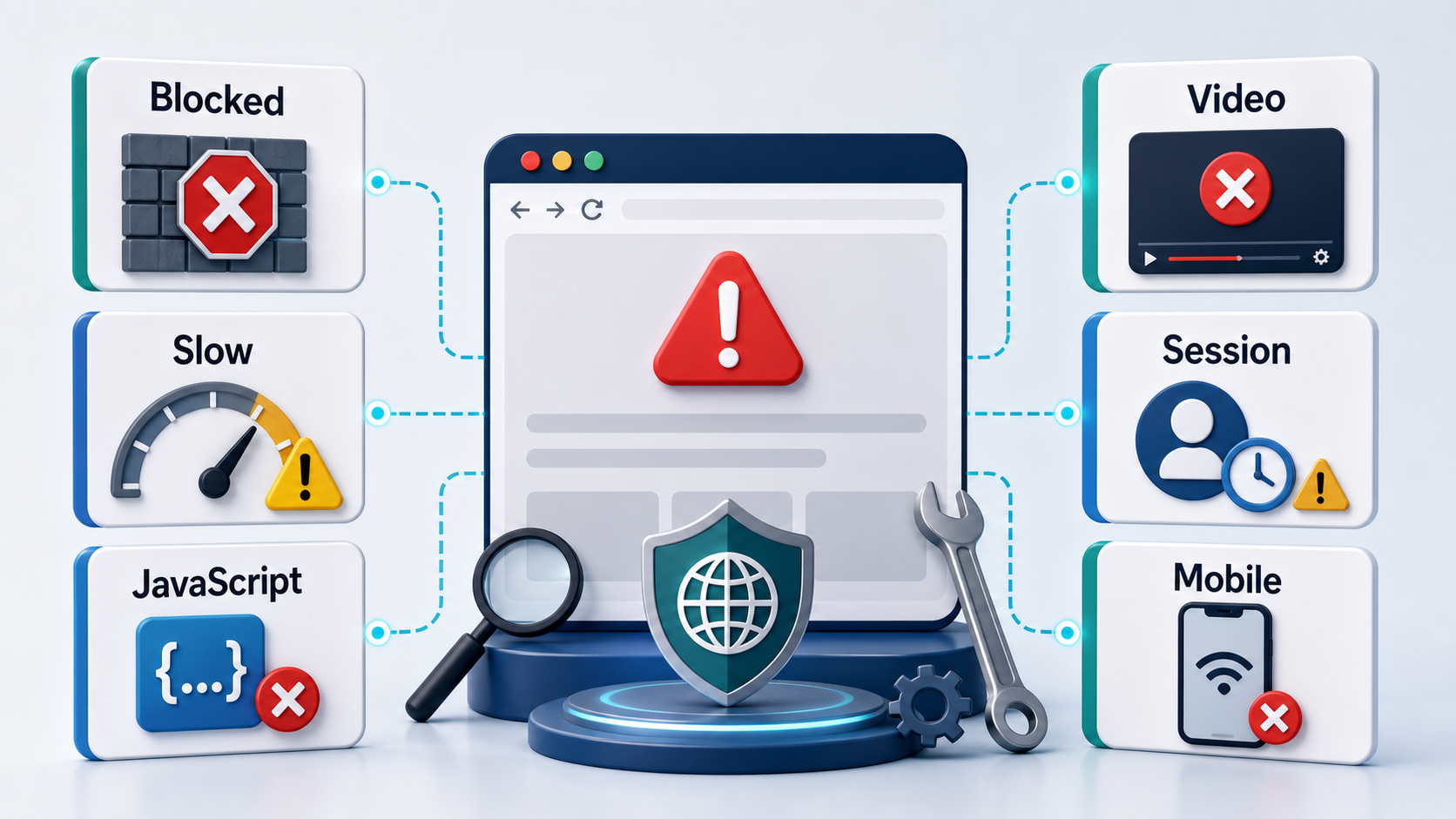
BlockAway Not Working? Fix Common Proxy, Video, and Access Problems
Troubleshoot BlockAway when pages are blocked, YouTube fails, JavaScript breaks, speed drops, sessions expire, or mobile access behaves differently.
View Details