
Synthetic Data vs Real Data for AI Training: What to Use When
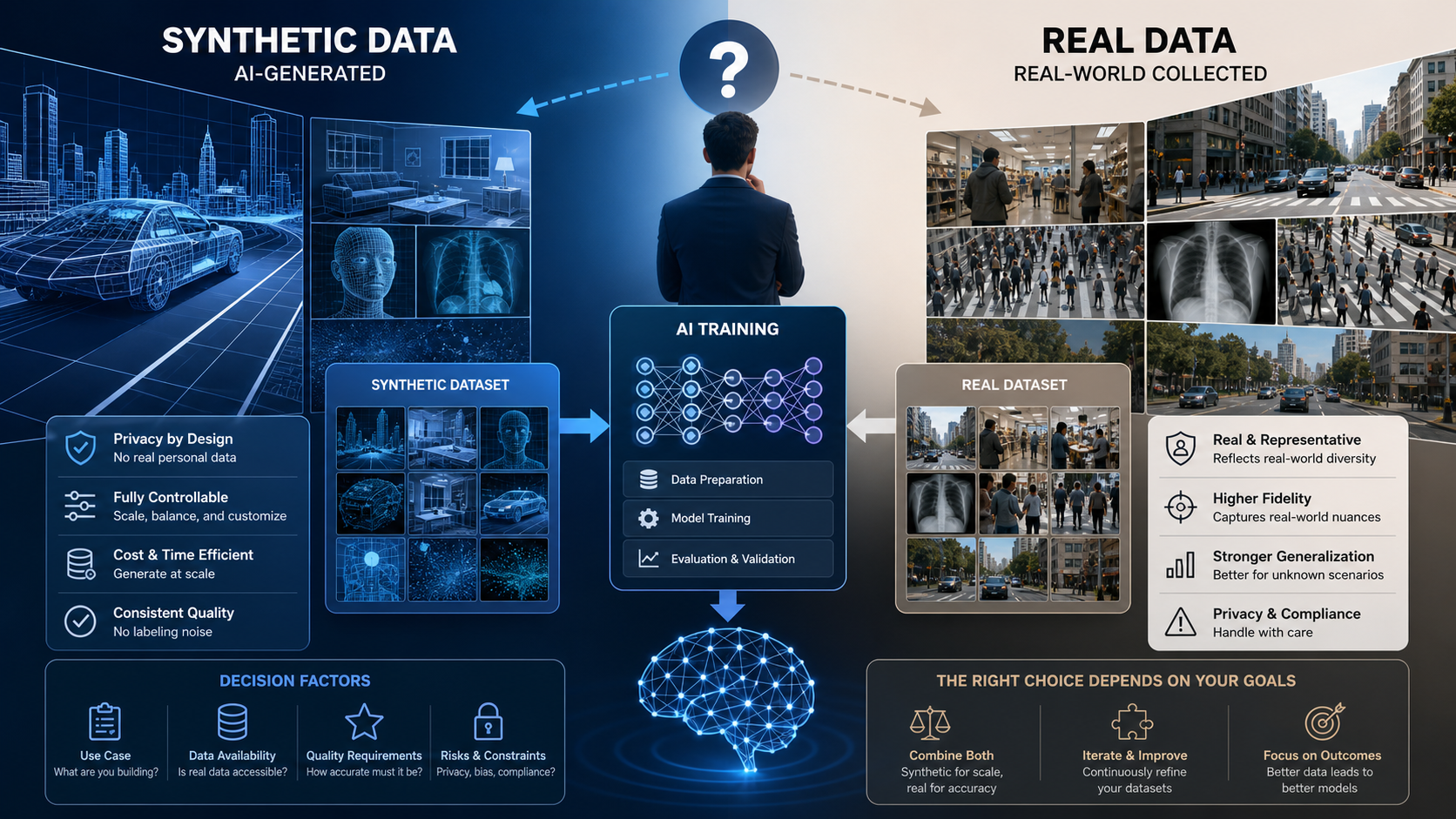
If you need the short answer first, here it is: real-world data and synthetic data are not rivals in the way most comparison articles suggest. Real data is still the reference point for realism, grounding, and trustworthy evaluation. Synthetic data becomes valuable when you need scale, edge-case coverage, safer sharing, or labels that would otherwise be too expensive or too slow to obtain. In practice, the strongest teams use both, but they do so at different stages and for different reasons, not because “hybrid” sounds balanced.
If you need the short answer first, here it is: real-world data and synthetic data are not rivals in the way most comparison articles suggest. Real data is still the reference point for realism, grounding, and trustworthy evaluation. Synthetic data becomes valuable when you need scale, edge-case coverage, safer sharing, or labels that would otherwise be too expensive or too slow to obtain. In practice, the strongest teams use both, but they do so at different stages and for different reasons, not because “hybrid” sounds balanced.
Why real data still anchors modern AI
The current AI stack was not built without web-scale real data. Common Crawl says it maintains more than 10 petabytes of crawl data collected since 2008 and publishes new crawls roughly monthly, each typically containing more than two billion web pages. OpenAI’s GPT-3 paper states that the majority of GPT-3’s training data was derived from raw Common Crawl after quality filtering, and Mozilla’s 2024 FAccT paper argues that Common Crawl has become a foundational building block for LLM development. That combination matters because it shows two things at once: web data remains central to frontier model pipelines, and the field still depends heavily on messy, heterogeneous, human-produced corpora.
That messiness is not just a nuisance. It is part of the value. Real data carries the ambiguity, inconsistency, missing context, humour, errors, and long-tail weirdness that models have to survive in production. If your model is going to face unpredictable user language, changing market content, niche documentation, or fresh public information, training and especially evaluation need contact with real-world distributions. Synthetic corpora can mimic patterns, but they only imitate the world through the lens of a generator or simulation.
Real data is also the safer choice for final validation. Synthetic training examples can help a model learn a behaviour, but they are weak as the sole yardstick for whether that behaviour will generalise. NIST’s Generative AI Profile warns that over-reliance on synthetic data can contribute to model collapse and reduced diversity in outputs. Recent survey work on LLM data contamination makes a related point from another angle: if your training and benchmarking loops are poorly controlled, you can end up measuring memorisation or overlap rather than real generalisation. For teams that care about whether a model works outside the lab, realism in evaluation is not optional.
There is one more reason real data keeps its value: freshness. Even if a base model is pretrained on a large historical corpus, many production systems still need current information for retrieval, grounding, or monitoring workflows. Synthetic data can improve behaviour. It cannot replace the need for up-to-date source material when the world itself is changing.
For the LycheeIP implementation details behind this step, review LycheeIP proxy infrastructure.
For the LycheeIP implementation details behind this step, review AI-powered browser automation hub.
For the LycheeIP implementation details behind this step, review datacenter proxies.
For the LycheeIP implementation details behind this step, review rotating residential proxies.
For the official technical reference behind this point, see OpenAI developer documentation.
For the official technical reference behind this point, see Anthropic documentation.
Where synthetic data genuinely helps
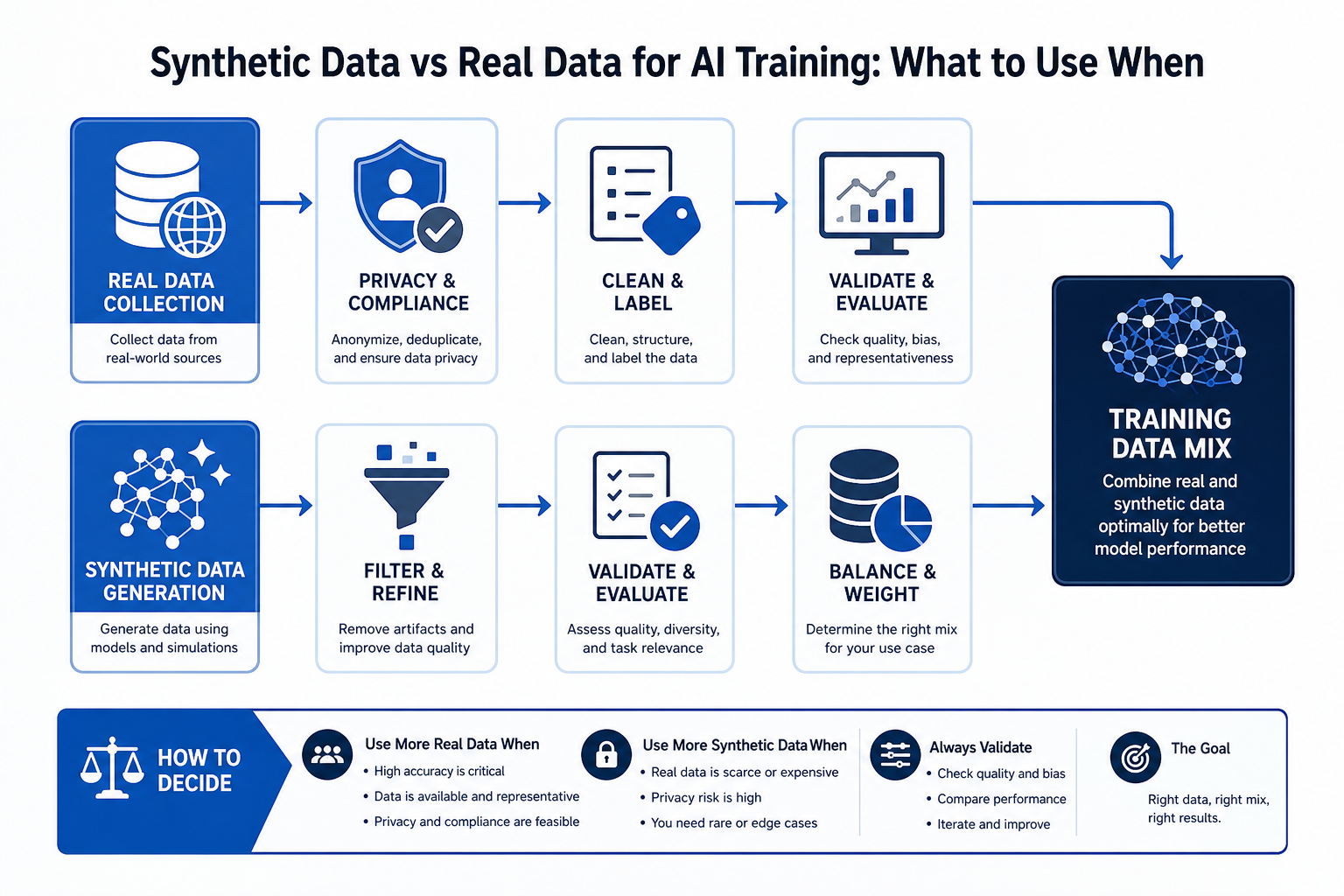
Synthetic data earns its place when reality is scarce, sensitive, imbalanced, or too expensive to label well. The European Data Protection Supervisor notes that synthetic data can help when training data is costly or subject to usage restrictions, and that it can support training and even pretraining. NIST’s privacy research pages similarly describe synthetic generation as learning the joint distribution of an original dataset and producing new examples with similar statistical properties, commonly using methods such as GANs and VAEs. In plain terms, synthetic data is useful when you need more controllable examples than the real world is willing to give you.
That is especially true in three situations.
The first is privacy-aware development. If a real dataset contains personal data, regulated information, or commercially sensitive records, synthetic versions can reduce direct exposure and make internal development safer. But this is exactly where many articles oversimplify the issue. Synthetic does not automatically mean anonymous. The EDPS explicitly says a privacy assurance assessment should be performed to ensure the resulting synthetic data is not still personal data. The ICO makes the same broader point in anonymisation guidance: identifiability is contextual, and simply removing obvious identifiers is not enough. In other words, synthetic data can reduce privacy risk, but it does not remove governance work.
The second is coverage of rare events. Fraud examples, safety failures, unusual customer intents, corner-case bugs, rare medical patterns, and unusual robotics states often do not appear often enough in real datasets to train robustly. Synthetic generation lets you oversample or construct those cases deliberately. That makes it powerful for augmentation, red-teaming, and safety training, provided you do not distort the real prior too far.
The third is simulation-heavy domains such as robotics, autonomous systems, industrial control, and some vision pipelines. Here the point is not simply privacy or scale. It is that collecting real-world data can be dangerous, expensive, or slow. But simulation brings its own constraint: the reality gap. Annual Reviews’ 2026 synthesis on robotics makes clear that simulated environments inevitably differ from real ones, and that this gap can limit deployment performance. So synthetic data is especially useful for learning behaviours early and cheaply, but it usually needs real-world correction later.
Why the argument keeps going wrong
The common mistake in this debate is asking which data type is “better” in the abstract. That question is too blunt.
A better question is: what job is the dataset doing?
If the job is broad pretraining, then scale and diversity matter enormously. If the job is domain adaptation, you may care more about task fit and label quality. If the job is benchmarking, you need independence and production realism. If the job is privacy-preserving internal development, governance may matter just as much as model quality. Once you separate those jobs, the trade-offs stop looking contradictory.
This also explains why simple pro-and-con tables often miss the real operational burden. Real data is not valuable merely because it is “authentic”. It is valuable if you can clean it, filter it, track provenance, reduce duplication, and keep it from contaminating your benchmarks. Synthetic data is not valuable merely because it is “cheap” or “safe”. It is valuable if you can control how it was generated, validate outputs, and confirm it improves performance on real inputs rather than only on synthetic ones.
A stronger way to combine them
For most teams, the best answer is not “use both everywhere”. It is “assign them different responsibilities”.
A practical hybrid pipeline often looks like this:
- Use real data to define the target distribution, establish baseline behaviour, and create holdout evaluation sets.
- Use synthetic data to expand sparse classes, generate edge cases, create instruction examples, or simulate expensive scenarios.
- Return to real data for fine-tuning checks, human review, and launch readiness.
- Keep fresh real data flowing into retrieval, monitoring, or retraining loops where the world changes faster than the model.
Notice what this does. It lets synthetic data improve coverage and efficiency without giving it the last word on whether the model is actually good. That is the part many teams miss.
This division of labour also reduces two serious risks. One is synthetic drift, where the model becomes too aligned to generated patterns and loses contact with real-world variation. The other is contaminated optimism, where flawed benchmark practices make progress look better than it is. NIST’s warning on model collapse and recent contamination surveys both support the same operational lesson: control what is generated, and protect what is held out for evaluation.
How to choose in practice
If you are deciding between synthetic and real data for a concrete project, ask these questions in order.
Is the target environment stable or fast-moving?
If your model must reflect current websites, current marketplace content, current regulations, or current user language, you need real and regularly refreshed data in the loop.
Is privacy a hard constraint?
If yes, synthetic data may help, but only with explicit privacy testing and documentation. “Generated” is not the same thing as “non-personal”.
Are the failures you care about common or rare?
If the critical cases are rare, synthetic augmentation is often one of the only efficient ways to get enough examples to train on them.
Are you training, or are you evaluating?
Synthetic data is far more defensible in augmentation than as the sole benchmark. For evaluation, stay as close as possible to production reality.
Can you explain where the data came from?
For real corpora, that means provenance, filtering, deduplication, and contamination control. For synthetic corpora, that means generator choice, prompts or simulation rules, validation checks, and privacy assessment.
Use LycheeIP Proxies for Reliable AI Data Collection
Will the model be deployed in a high-risk setting?
The higher the consequences of error, the less sensible it is to lean heavily on synthetic-only evidence. You want human review, real holdouts, and traceable data lineage.
Frequently Asked Questions
Is synthetic data going to replace real data?
Not in any complete sense. It is growing because it solves real problems around scarcity, labelling, and privacy, but current research and standards work still point to real-world data as essential for grounding and evaluation.
Is web data still useful for training foundation models?
Yes. Common Crawl remains one of the most important public corpora for large-scale model development, and major foundational work such as GPT-3 relied heavily on filtered Common Crawl data.
Does synthetic data solve privacy issues by default?
No. Regulators explicitly warn that synthetic outputs may still create identifiability risk and may require privacy assurance assessment.
When is synthetic data the strongest choice?
When real data is scarce, sensitive, expensive to label, or missing rare but important events. It is particularly strong for augmentation, simulation, and controlled task-specific generation.
What is the biggest mistake teams make with hybrid datasets?
They mix real and synthetic data without protecting a realistic holdout set, and then assume better training metrics mean better production generalisation. That is exactly where contamination and overfitting problems start. The real decision is not whether synthetic data beats real data. It is whether your data strategy matches the job your model has to do. Use real data to stay honest. Use synthetic data to fill the gaps reality leaves behind. If you separate those roles clearly, you get a better model and a much more defensible training pipeline.
Related LycheeIP Guides and Resources

Recommended Articles

AI Search API for AI Agents: How to Ground LLMs With Live Search Data
An AI search API gives an application or agent programmatic access to current search results. Its most useful role is discovery: the agent can find candidate sources, identify fresh information, and decide what to retrieve next instead of relying only on model memory.
View Details
AI Web Scraping with Browser Agents: Architecture, Extraction, and Data Validation
AI web scraping uses AI to help discover, navigate, interpret, or extract information from websites. Browser agents are one implementation option when page interaction, rendering, or layout variation makes a simple scraper too brittle, but the agent should not become the entire data pipeline.
View Details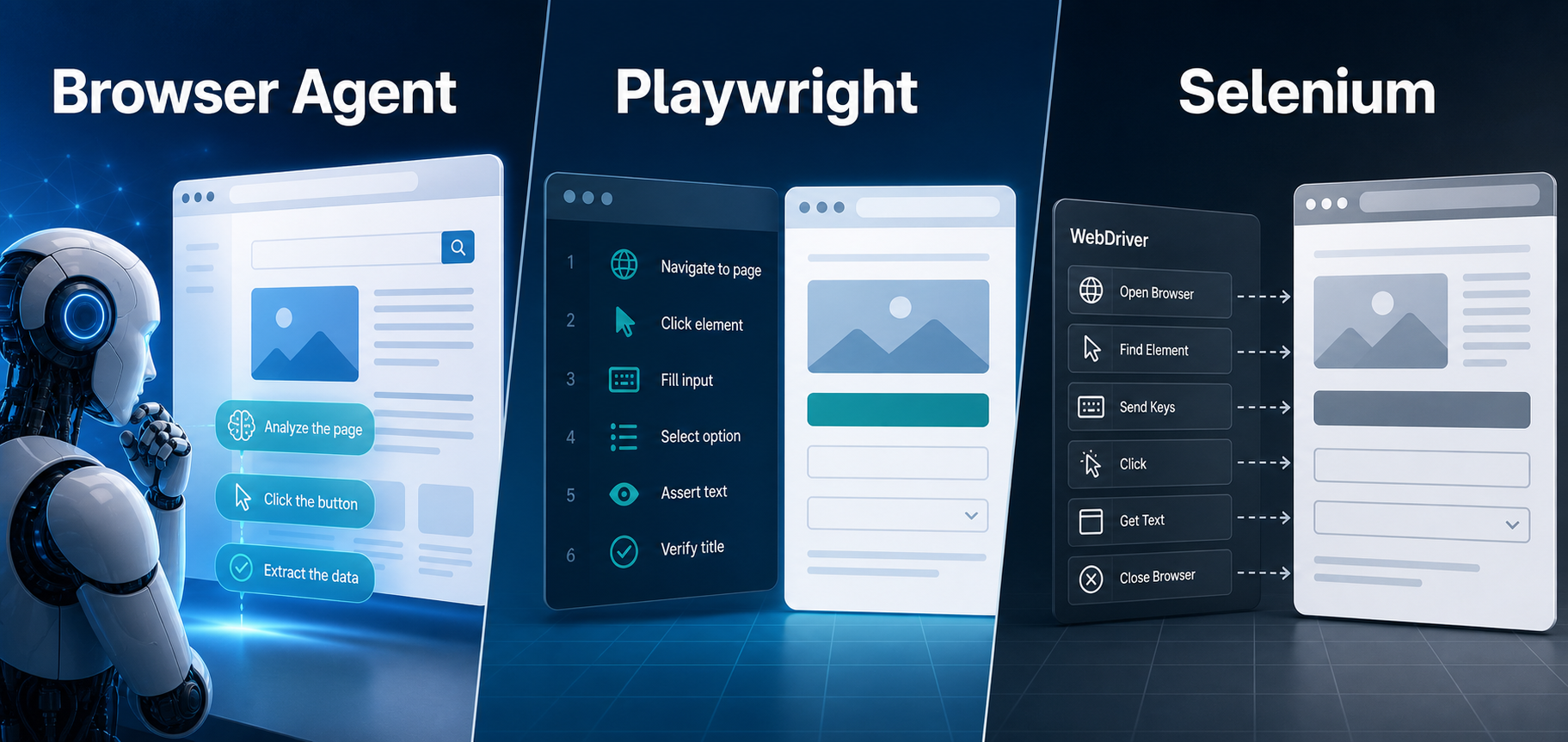
AI Browser Automation: Browser Agents vs Playwright vs Selenium
A browser agent interprets a goal and decides what browser action to take next. Playwright and Selenium can execute explicit, testable browser logic defined by developers. In 2026, however, Playwright also provides official MCP and agent-oriented workflows, so Playwright is no longer just the deterministic alternative to agentic automation. It can also serve as the browser-control layer inside an agent system.
View Details
Agentic Browser Security: Prompt Injection, Permissions, and Safe Deployment
That combination creates risks that are different from ordinary browsing and traditional automation. The most important is indirect prompt injection, where hostile instructions hidden in web content attempt to redirect the agent away from the user's goal. Google describes indirect prompt injection as a primary new threat for agentic browsing and has introduced layered defenses that include origin constraints, independent action checks, threat detection, and user confirmation for sensitive actions. Google's Chrome security architecture is a useful reference for how browser-agent defenses are evolving.
View Details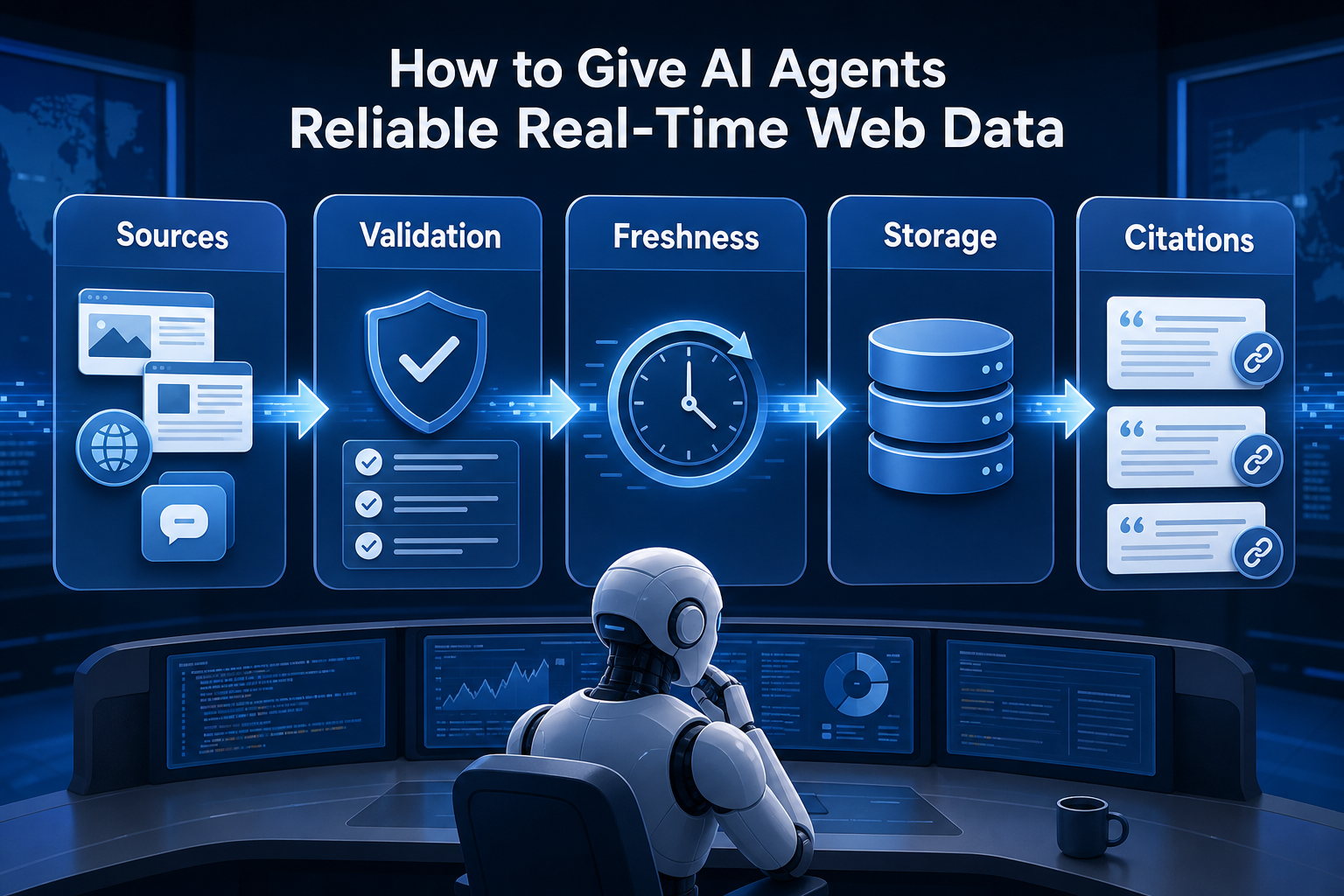
How to Give AI Agents Reliable Real-Time Web Data
A production-ready solution therefore needs more than a web scraper. It needs a web data layer that connects acquisition, validation, storage, retrieval, security, and observability. This guide explains how to design that layer.
View Details