
Starlink's Secret Space Surveillance System Exposed
Starlink is tracking 30 million objects daily, and deleting some from public view.
This revelation places SpaceX's satellite constellation at the center of an emerging debate about who controls information in Earth's orbit and what the public has a right to know. As private companies rapidly expand their reach beyond our atmosphere, the line between commercial communications infrastructure and a global surveillance apparatus grows increasingly blurred.
"Stargaze," Starlink's proprietary space tracking network, has quietly become one of the most sophisticated orbital monitoring systems on the planet. In many ways, it rivals, and occasionally exceeds, the capabilities of government agencies tasked with Space Domain Awareness (SDA).
The transparency concerns are straightforward: a private company operating thousands of satellites has developed tracking capabilities that detect objects invisible to public catalogs. Yet, it selectively shares this data with researchers, government partners, and the public. What gets shown, what gets hidden, and who ultimately decides?
Route global traffic with LycheeIP
When Private Industry Outpaces Government Surveillance
The Stargaze Advantage
Starlink's Stargaze system represents a fundamental shift in how humanity monitors near-Earth space. Unlike traditional ground-based radar and optical tracking systems, Stargaze leverages the distributed sensor network created by SpaceX's own constellation of over 5,000 satellites. Each satellite functions as both a communications node and a potential observation platform, creating a mesh network that provides near-continuous coverage of orbital space.
According to internal presentations leaked to space industry researchers, Stargaze processes approximately 30 million positional observations daily. This volume completely dwarfs the publicly available catalog maintained by the U.S. Space Force's 18th Space Defense Squadron, which tracks roughly 47,000 objects larger than 10 centimeters.
This massive discrepancy isn't simply about computing quantity, it reflects a fundamentally superior geometric detection capability.
Why Starlink Sees More
The technical advantages of an orbital monitoring network are substantial:
- Atmospheric Bypass: Traditional space surveillance relies on ground-based sensors that must peer through Earth's atmosphere, contend with weather conditions, and face geographic constraints that leave massive blind spots in coverage.
- In-Situ Monitoring: Starlink satellites operate within the environment they are monitoring. Orbital debris, defunct satellites, and active spacecraft pass through the constellation's operational altitudes constantly.
- Advanced Telemetry: Onboard sensors, originally designed to facilitate autonomous collision avoidance, can detect objects through radar cross-section analysis, optical tracking, and even the electromagnetic signatures of active satellites.
Dr. Moriba Jah, an astrodynamics professor at the University of Texas at Austin and a leading voice in space debris tracking, notes the significance: "When you have thousands of satellites in low Earth orbit, each equipped with sensors, you've essentially created a distributed surveillance network that has persistent coverage. Ground-based systems simply can't compete with that geometry."
The altitude advantage is also critical. Most Starlink satellites orbit between 340 and 550 kilometers, placing them directly in the heart of the most congested orbital zone. This positioning allows for the detection of debris and stealth objects that are simply too small or too faint for ground-based radar to reliably ping.
The Detection-to-Disclosure Gap
What Stargaze detects and what SpaceX publicly shares diverge significantly. The company regularly provides "conjunction alerts" to other satellite operators when close approaches are predicted, demonstrating their technical capability and operational awareness.
However, the underlying raw tracking data, which specific objects are being monitored, their precise orbital parameters, and the full extent of what Stargaze observes, remains highly proprietary.
This creates a severe information asymmetry. SpaceX knows exactly where competitors' satellites are with unprecedented precision. It can track highly classified national security assets, monitor space debris patterns, and potentially detect orbital activities that other global actors would prefer to keep quiet. The question of what happens to this data has moved from a theoretical privacy concern to an immediate operational reality.
The Vanishing Objects
Documented Disappearances
In March 2024, several independent satellite tracking enthusiasts noticed glaring anomalies in data shared through informal channels with SpaceX engineers. Objects that had appeared in earlier conjunction assessments simply vanished from subsequent reports, with zero explanation regarding deorbiting, collisions, or reclassification.
Marco Langbroek, a Dutch satellite tracker who has monitored classified military satellites for over two decades, documented 23 such cases between January and August 2024. "These weren't natural disappearances," he explains. "The orbital mechanics don't support deorbiting. The objects didn't decay; they were deliberately removed from the shared data sets."
The pattern becomes even more concerning when examining which objects disappeared. Analysis suggests a disproportionate number were located in orbital regimes heavily associated with national security satellites or experimental military spacecraft. Some matched the exact characteristics of previously unknown objects that amateur trackers had attempted to catalog independently.
The API Controversy
In June 2024, SpaceX quietly updated the Application Programming Interface (API) that external researchers used to access limited Stargaze data for academic purposes. The update included new, aggressive filtering parameters. According to documentation reviewed by space policy researchers, this update allowed the manual classification of objects as "excluded from public schema."
Dr. Tanya Harrison, a space scientist who has worked with commercial satellite operators, attempted to use the updated API for a debris tracking study. "Roughly 15% of the objects I could query in May were no longer accessible in July," she reports. "When I inquired about the discrepancy, I was told the data architecture had been 'optimized for partner needs.'"
The technical term "partner needs" appears repeatedly in communications between SpaceX and researchers. It is a corporate euphemism that conveniently obscures who requested the filtering and exactly why certain objects warrant exclusion from even limited, credentialed academic access.
Government Coordination or Corporate Discretion?
The most troubling question surrounding data removal is whether SpaceX acts unilaterally or strictly at the direction of government partners. The company maintains incredibly close, lucrative relationships with NASA, the Department of Defense, and various intelligence agencies—all of which have legitimate interests in controlling information about classified orbital assets.
Freedom of Information Act (FOIA) requests filed by space policy transparency advocates have yielded heavily redacted documents suggesting deep coordination. A November 2023 memo from the National Reconnaissance Office (NRO) to SpaceX includes the phrase "mutually agreed parameters for public catalog exclusions." The context and specifics, however, remain classified.
If government agencies are directing what data SpaceX withholds, it represents a massive outsourcing of information control to private contractors. If SpaceX makes these decisions independently based on commercial or strategic interests, it raises equally terrifying questions about corporate monopoly power in space governance.
Route global traffic with LycheeIP
The Implications of Private Space Surveillance
A New Information Monopoly
Starlink's surveillance capabilities create a modern monopoly, not of physical resources or manufacturing, but of situational awareness itself. Knowledge of orbital positions, trajectories, and activities translates directly into strategic, geopolitical advantage. Satellite operators who lack equivalent tracking capabilities must either blindly trust SpaceX's collision warnings without independent verification, or invest billions in building alternative sensing networks.
This dependency extends far beyond commercial competitors. Smaller nations launching their first satellites, academic institutions conducting climate research, and emerging space startups all operate within an information environment increasingly defined by what SpaceX chooses to reveal.
The historical parallel is early terrestrial telecommunications infrastructure. Just as nations recognized that private control of global communications networks required regulatory frameworks to ensure fair access, space surveillance now demands similar oversight. The difference is that orbital mechanics involve immediate national security dimensions that severely complicate straightforward regulatory approaches. For a deeper look at how international law governs space, refer to the United Nations Office for Outer Space Affairs (UNOOSA) treaties.
Privacy in the Public Domain
The concept of "privacy" in space seems paradoxical, orbital space is, by legal definition, a global commons. Yet, spacecraft operators have legitimate interests in controlling information about their assets' capabilities, maneuvers, and operational status:
- Commercial operators protect proprietary positioning data to maintain a competitive edge.
- Military operators depend on adversaries not knowing precise orbital parameters to protect national security.
Stargaze's comprehensive monitoring shatters these traditional information boundaries. If a private company can track spacecraft with greater precision than the operators themselves expect, what legal or ethical obligations does it have to protect that data? Should SpaceX notify a rival satellite operator when it tracks their assets?
These questions currently lack clear legal frameworks. The Outer Space Treaty of 1967 establishes baseline principles for space activities but drastically predates the current era of corporate mega-constellations and commercial surveillance capabilities.
The Transparency Paradox
Space safety advocates have long called for better tracking and data sharing to prevent collisions and manage the rapidly growing debris problem. The European Space Agency estimates over 36,000 objects larger than 10 centimeters orbit Earth, with millions of smaller fragments posing lethal collision risks. Improved tracking should be universally celebrated as a technological achievement.
Yet, Stargaze demonstrates the paradox of surveillance-dependent safety. Better tracking enables collision avoidance, but comprehensive monitoring also enables:
- Strategic military intelligence gathering.
- Aggressive commercial competitive analysis.
- Coercive information control.
The same system that warns operators of dangerous conjunctions can easily compile detailed intelligence on competitor activities.
LycheeIP (Developer-First Proxy Infrastructure)
As discussions surrounding global data visibility and tracking continue to escalate, whether in low Earth orbit or on the terrestrial web, maintaining control over how information is routed, accessed, and secured remains paramount for technical teams. LycheeIP is a developer-first proxy and data infrastructure platform designed to give engineering and growth teams total control over their localized network routing.
Just as satellite operators require precise telemetry to understand their orbital environment, developers require reliable data infrastructure to monitor global application performance, conduct localized QA testing, and verify geo-targeted content. By utilizing dynamic residential IPs, technical teams can simulate authentic user traffic across various regions to ensure their applications function correctly worldwide. For data teams requiring high-throughput stability for authorized public-data aggregation or security testing, LycheeIP's robust datacenter proxy networks provide the necessary speed and reliability. Integrating these tools empowers organizations to navigate complex digital environments securely and transparently, ensuring they retain control over their own operational visibility.
Regulatory Gaps and Potential Solutions
Current space regulations focus primarily on physical launch licensing, radio frequency coordination, and liability for physical damages. The Federal Communications Commission (FCC) licenses Starlink's communications activities, while the Federal Aviation Administration (FAA) oversees launch and reentry operations. But absolutely no agency has explicit authority to regulate what SpaceX's satellites observe, how that data is processed, or what disclosure obligations the company faces.
Several policy approaches have been proposed to close this gap:
- Mandatory Data Sharing Requirements: Some space policy experts advocate for regulations requiring satellite operators with tracking capabilities to share conjunction data with a neutral, international repository.
- Public-Private Partnerships: NASA and the Department of Defense have explored partnerships where companies like SpaceX contribute tracking data to government catalogs in exchange for access to complementary government sensor data.
- International Transparency Standards: The UN could develop specific guidelines for space surveillance data sharing, establishing baseline transparency expectations across all member states.
- Corporate Accountability Mechanisms: Advocacy organizations have called for SpaceX to publish mandatory transparency reports detailing exactly how many objects Stargaze tracks, what specific data is shared with government partners, and the criteria determining public disclosure.
Each approach faces severe implementation hurdles. Mandatory sharing requirements directly conflict with national security interests. International standards require a level of diplomatic consensus that is highly unlikely in the current geopolitical environment.
The Competitive Dimension
As other mega-constellations deploy, Amazon's Project Kuiper plans over 3,000 satellites, while Chinese operators pursue similar massive systems, the surveillance capabilities question will multiply exponentially. If each major constellation operator develops an equivalent tracking system with proprietary data policies, space domain awareness will fragment into competing, partial pictures of orbital reality.
Alternatively, if operators are forced to share tracking data through a common framework, the combined sensor network could provide unprecedented safety and sustainability benefits. The technical potential exists for a truly comprehensive, near-real-time map of Earth's entire orbital environment.
Route global traffic with LycheeIP
Conclusion: Watching the Watchers
Starlink's Stargaze system represents both a technological triumph and a terrifying governance challenge. The capability to track 30 million orbital observations daily could revolutionize space safety. However, that exact same capability concentrates immense strategic information in corporate hands with minimal public accountability.
The undeniable evidence of selective data removal—objects disappearing from shared catalogs, targeted API access restrictions, and undisclosed coordination with intelligence agencies—demonstrates that these transparency concerns aren't theoretical. The decisions about what orbital data becomes public are being made right now, by private actors, with long-term implications for global security.
The fundamental question isn't whether private companies should develop space surveillance capabilities. In a commercial space economy, such capabilities are inevitable. The question is what obligations come with that unprecedented power.
As satellites multiply and orbital space grows more fiercely contested, the infrastructure we build now will shape space activities for generations. If that infrastructure includes comprehensive surveillance systems with completely opaque disclosure policies, we risk creating an environment where corporate information asymmetry determines who can effectively operate in space.
Starlink's secret surveillance system is secret no longer. What remains to be seen is whether its exposure prompts the transparency standards that space governance urgently needs, or whether orbital monitoring becomes just another domain where private power operates beyond effective public oversight.
Route global traffic with LycheeIP
Frequently Asked Questions
Q: What is Starlink's Stargaze system?
A: Stargaze is SpaceX's proprietary space surveillance network. It utilizes the distributed sensor capabilities of Starlink's 5,000+ satellites to track objects in Earth orbit. It processes approximately 30 million positional observations daily, detecting satellites, debris, and other orbital objects with significantly greater coverage than traditional ground-based tracking systems.
Q: Why can Starlink track more objects than the U.S. Space Force?
A: Starlink's orbital positioning provides massive geometric and technical advantages. Because thousands of satellites are already located in low Earth orbit (340-550km altitude), they can continuously observe objects passing through that congested zone without dealing with atmospheric interference or ground-based radar coverage gaps.
Q: What evidence exists that SpaceX is removing data from public view?
A: Independent satellite trackers documented 23 specific cases where objects completely disappeared from shared datasets between January and August 2024, without orbital mechanics supporting natural orbital decay. Additionally, API access restrictions implemented in June 2024 made approximately 15% of previously queryable objects inaccessible to academic researchers.
Q: Is SpaceX legally required to share space tracking data?
A: No. There is currently no comprehensive legal framework that requires private satellite operators to share tracking data publicly. While SpaceX voluntarily provides conjunction warnings to other satellite operators to avoid collisions, the company has zero explicit regulatory obligation to disclose the full extent of what Stargaze observes. For more context on the complexities of sharing data across different jurisdictions, you can look at the principles outlined in the OECD Guidelines on the Protection of Privacy and Transborder Flows of Personal Data (though applied here to terrestrial data, similar frameworks are debated for space data).
Q: Could other satellite constellation operators develop similar surveillance capabilities?
A: Yes. Amazon's Project Kuiper and various Chinese mega-constellations will likely develop equivalent tracking systems as they deploy their own thousands of satellites. This will either fragment space domain awareness into competing proprietary systems or, if operators are forced to collaborate, create an unprecedented, comprehensive global monitoring network.

Recommended Articles

Best Real Estate Scrapers in 2026
Best Real Estate Scrapers in 2026
View Details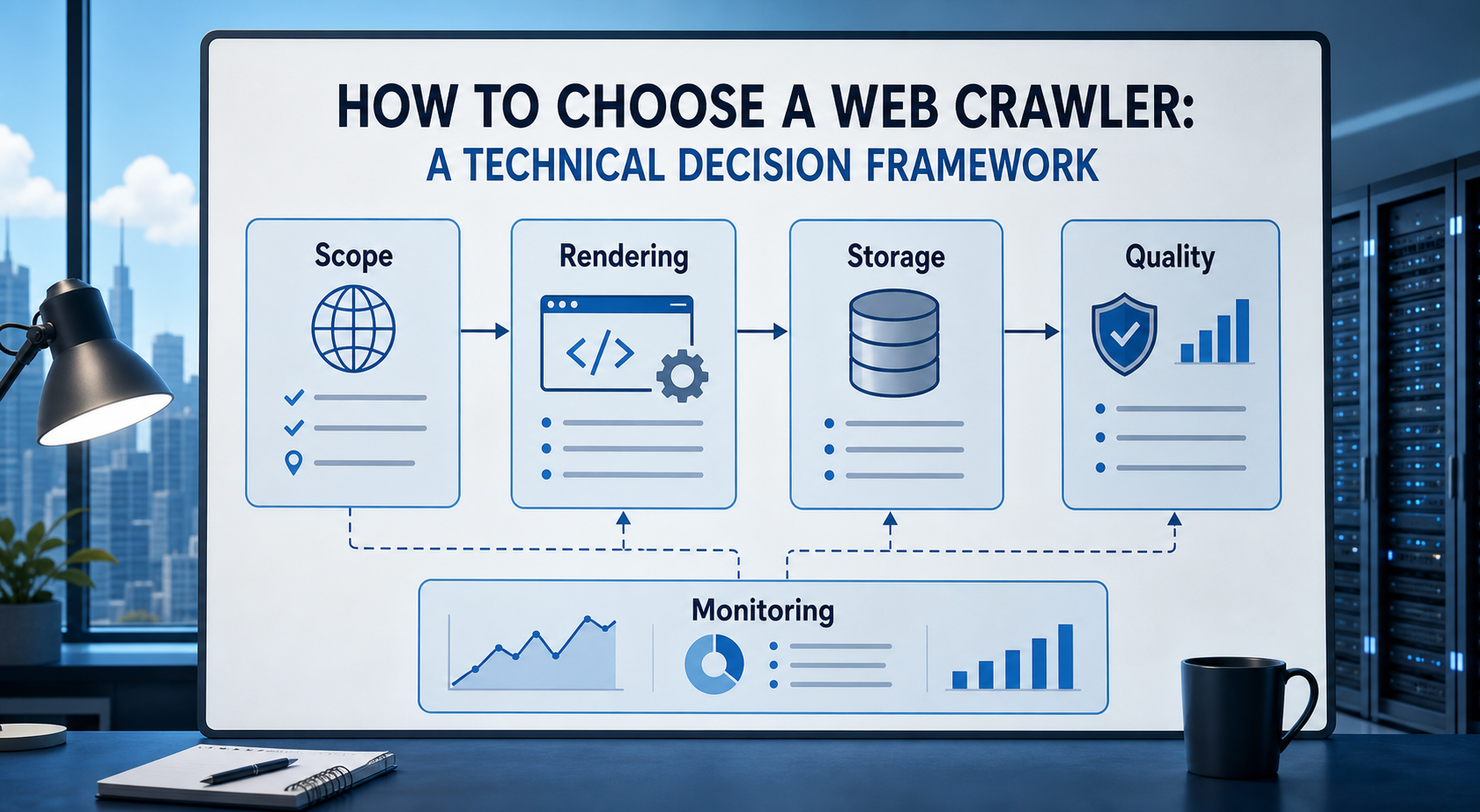
How to Choose a Web Crawler: A Technical Decision Framework
The wrong way to choose a web crawler is to begin with a list of products. The right starting point is the system you need to build. Before comparing tools, define:
View Details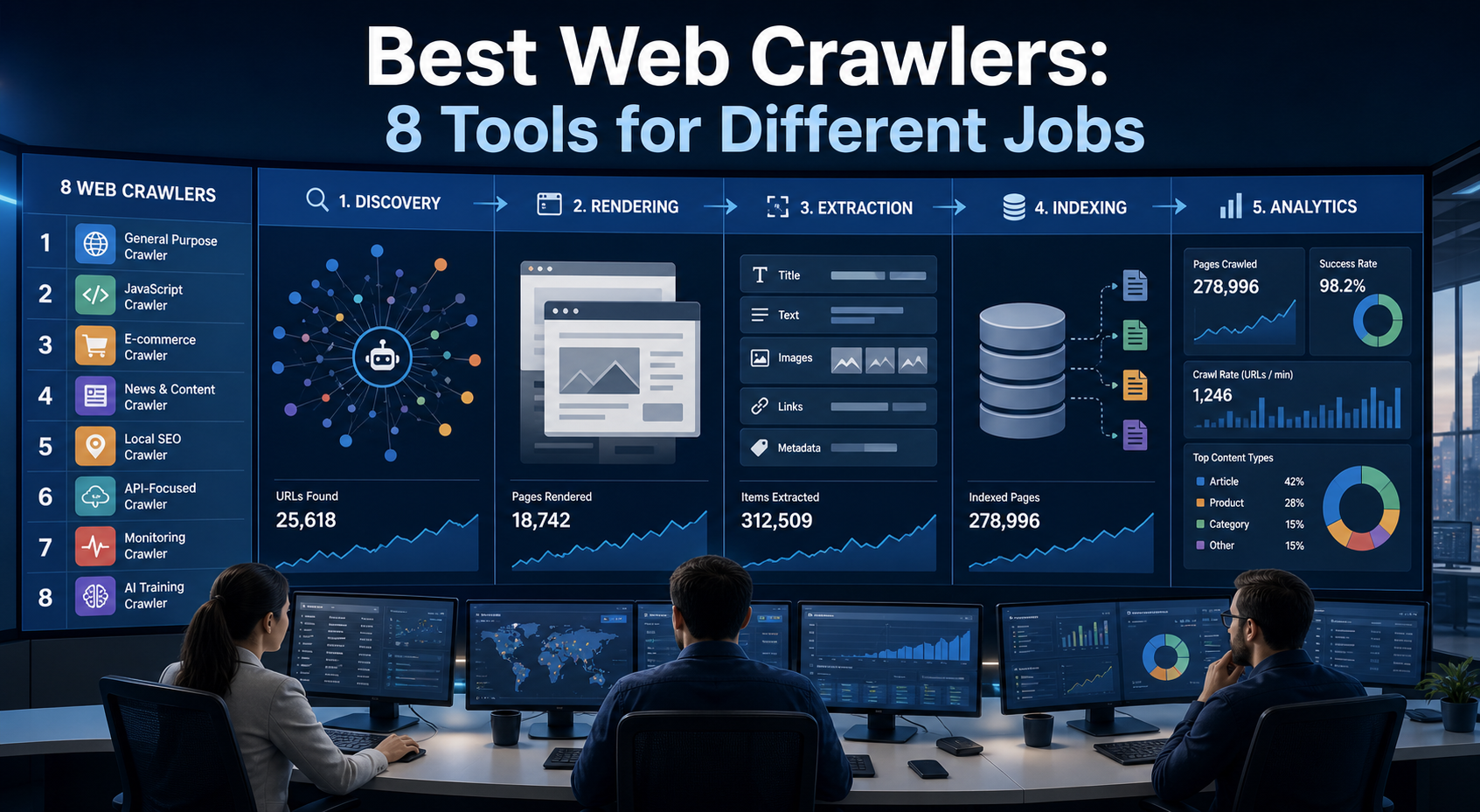
Best Web Crawlers: 8 Tools for Different Jobs
There is no single best web crawler for every project. A technical SEO audit, an AI knowledge pipeline, an internet archive, and a distributed search index may all involve crawling URLs, but they require different capabilities. The most useful way to compare web crawler tools is therefore to ask what job each one was designed to perform. This guide evaluates eight strong options across:
View Details
Web Scraping Ecommerce Websites With Python: A Practical Guide
Recommended meta title: Web Scraping Ecommerce Websites With Python: Guide Recommended meta description: Learn how to scrape ecommerce websites with Python using Requests, Beautiful Soup, Playwright, and Scrapy, with validation and scaling guidance. URL slug: /web-scraping-ecommerce-websites-python/
View Details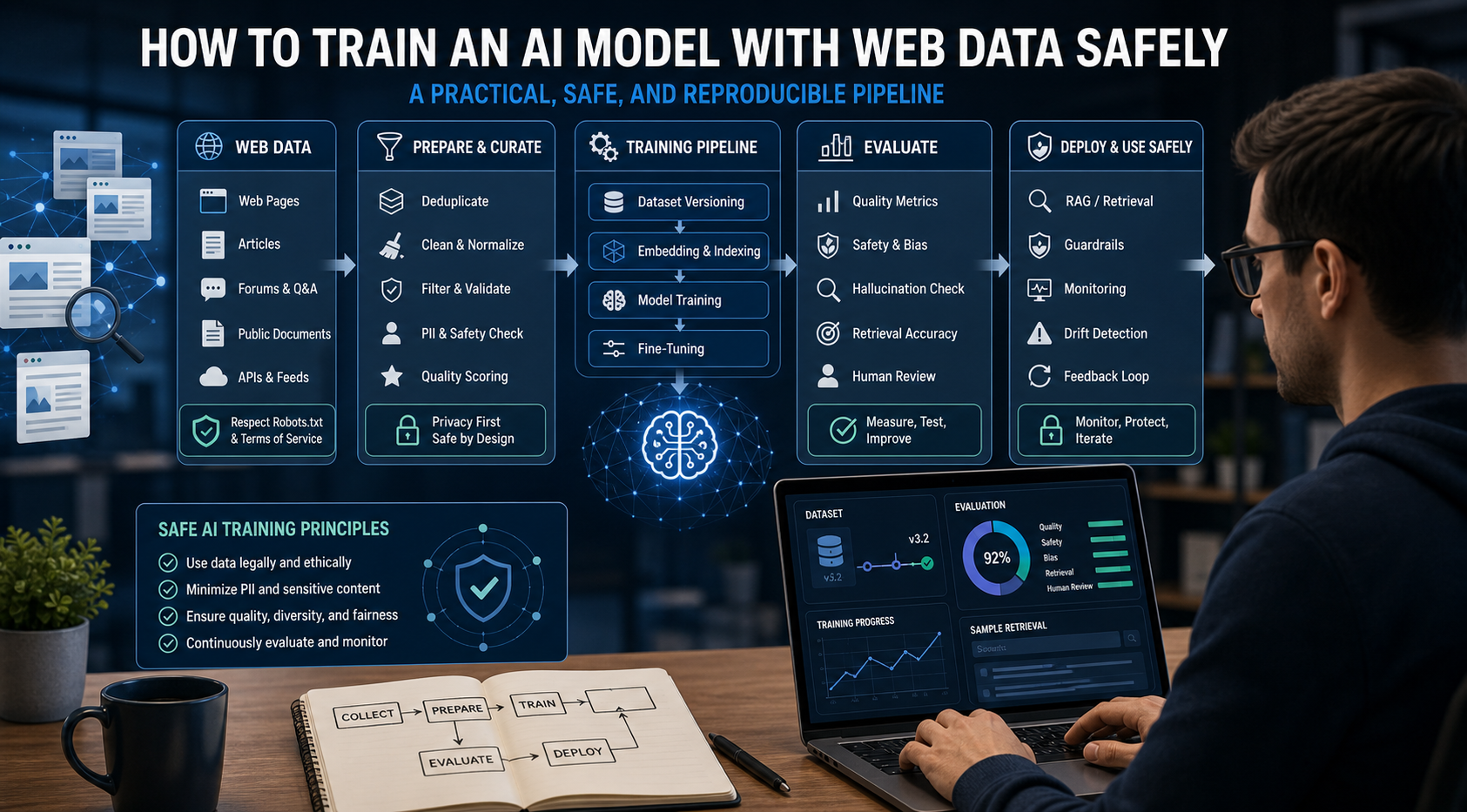
How to Train an AI Model With Web Data Safely
To train an AI model with web data, start by deciding whether you actually need training. Then collect representative sources, preserve provenance, remove duplicates and low-quality content, create leakage-resistant splits, build a baseline, fine-tune or train the appropriate model, and evaluate on real held-out examples before deployment.
View Details