
The Geopolitics of Starlink Access
Who decides which countries get Starlink access, and why it matters.
The question of who controls access to the internet has never been more politically charged. As SpaceX's Starlink constellation grows to encompass over 9,000 active satellites in low Earth orbit (LEO) as of early 2026, the company has emerged as a critical player in global communications infrastructure. It operates beyond the traditional boundaries of state control yet remains deeply entangled in geopolitical calculations.
The decisions about where Starlink operates, and under what conditions, reveal a new frontier in the struggle over technological sovereignty, digital censorship, and the politics of connectivity.
Route globally with LycheeIP
The Pressure Points of Satellite Diplomacy
Starlink's arrival on the global stage has created unprecedented tensions between corporate autonomy and government authority. Unlike traditional internet service providers (ISPs) that operate through ground-based infrastructure firmly within national jurisdictions, Starlink's satellite network presents a fundamental challenge to state control over information flows.
Governments worldwide have responded to this challenge with varying degrees of regulatory pressure:
- Licensing and Spectrum Leverage: At the most basic level, many countries require Starlink to obtain operating licenses before providing service, a regulatory checkpoint that gives states significant leverage. For instance, the Federal Communications Commission (FCC) Space Bureau strictly regulates US-based operators, while other nations use their own telecom frameworks to delay or shape entry. India, for example, heavily scrutinized Starlink's entry through complex security and spectrum allocation reviews well into 2026, reflecting broader anxieties about foreign control over critical communications and data sovereignty.
- Absolute Bans and Censorship: China and Russia have taken absolute stances, effectively banning Starlink operations within their borders. For authoritarian regimes that maintain extensive internet surveillance systems, Starlink represents an existential threat to information control. A satellite-based service that bypasses the "Great Firewall" or strict state-run ISPs undermines this censorship architecture entirely.
- Conditional Operations: Some governments have sought to impose conditions that effectively neutralize Starlink's advantages. Brazil's telecommunications regulator has required Starlink to comply with content-blocking orders—the exact same obligations imposed on traditional ISPs. Turkey has similarly demanded that Starlink establish a legal entity in the country and comply with extensive internet blocking regimes.
These regulatory pressures expose a fundamental tension: Starlink's technical architecture transcends physical borders, but its business operations remain deeply vulnerable to state coercion. SpaceX still relies on governments to approve radio spectrum, allow the import of ground equipment, and process local payments.
Strategic Calculations and the New Communications Battleground
The strategic implications of satellite internet control extend far beyond questions of market access and regulatory compliance. Control over communications infrastructure has always been a military and intelligence priority, but LEO satellite networks have introduced critical new variables into these calculations.
Three primary strategic shifts define this new battleground:
- 1. Unprecedented Communications Resilience: Traditional internet infrastructure depends on undersea cables, ground-based fiber networks, and centralized switching facilities—all of which can be physically severed or captured during conflicts. Satellite internet, by contrast, requires destroying or jamming thousands of distributed satellites. This resilience makes Starlink strategically valuable for military operations and highly disruptive during terrestrial network blackouts.
- 2. Information Asymmetries and Digital Resistance: In environments where governments restrict internet access, Starlink can theoretically enable journalists, and opposition movements to communicate freely. The 2022 Iranian protests brought these tensions into focus. As the government throttled the internet, activists smuggled Starlink terminals into the country to circumvent censorship. While empowering for democracy advocates, this raises thorny questions regarding digital intervention in sovereign nations.
- 3. New Forms of Technological Dependence: The concentration of satellite internet capabilities in the hands of a single private company creates severe technological dependence. Countries that rely on Starlink for critical communications are effectively outsourcing a strategic capability to a private American corporation subject to U.S. jurisdiction. This dependence becomes highly problematic if local and American corporate interests diverge.
The Dual-Use Dilemma
The Ukrainian conflict demonstrated this dynamic with unprecedented clarity. Starlink terminals provided crucial links for both civilian connectivity and military coordination (including drone operations and artillery targeting). If Starlink is used primarily for civilian communications, it enjoys protections under international humanitarian law. However, once integrated into military operations, it potentially becomes a legitimate military target, prompting adversaries to aggressively develop targeted anti-satellite (ASAT) capabilities.
Route globally with LycheeIP
Case Studies in Starlink's Geopolitical Decisions
Examining specific instances where Starlink has made consequential geopolitical decisions reveals the complex interplay of commercial, ethical, and political considerations shaping global access.
Ukraine: The Activist Phase
Starlink's Ukraine deployment represents its most activist geopolitical intervention. Within days of the 2022 Russian invasion, SpaceX rapidly activated service and shipped terminals. However, complications quickly arose. SpaceX later restricted Starlink access in certain areas, explicitly limiting its use for offensive military operations like drone strikes deep into Russian-held territory. This episode highlighted how operational control gives a private CEO leverage over the tactical execution of an international conflict.
Crimea and the Limits of Service
The status of Starlink access in Crimea became a flashpoint illustrating the political dimensions of service boundaries. SpaceX declined to activate Starlink in Crimea (occupied by Russia since 2014). When Ukrainian forces attempted to use Starlink-connected drones to attack naval assets in Crimea, they found the service unavailable. This limitation wasn't technical—it reflected a corporate political judgment about where it was willing to enable military operations.
Russia: The Hard Ban
Russia has taken aggressive steps to prevent Starlink operations, making possession of terminals illegal. Despite this, reports constantly emerge of Russian forces obtaining terminals through illicit third-party channels and deploying them on the front lines. This paradox highlights a key challenge: the satellite signal is borderless, but SpaceX must continuously play technological cat-and-mouse using geofencing to disable unauthorized gray-market terminals.
Middle East: Navigating Autocracy and Alignment
Starlink's uneven deployment across the Middle East reflects the region's complex political landscape. While available in Israel, it remains heavily restricted in most Gulf states. Even friendly, allied governments often perceive decentralized satellite internet as a threat to domestic telecom monopolies and internal information control priorities.
Taiwan: The Most Sensitive Flashpoint
No potential Starlink deployment carries more geopolitical weight than Taiwan. China's claims of sovereignty create extraordinary sensitivities. Starlink service in Taiwan would provide vital communications resilience in the event of a blockade or undersea cable sabotage—precisely the scenario Beijing fears. While Taiwan actively seeks to build its own LEO capabilities, the activation of an American-owned network over the island remains a delicate geopolitical standoff, with China actively researching methods to counter Starlink's capabilities.
LycheeIP (Developer-First Proxy Infrastructure)
Just as satellite networks like Starlink are redefining physical connectivity across borders, software engineering and data teams face their own geopolitical hurdles when navigating digital borders and regional network restrictions. LycheeIP is a developer-first proxy and data infrastructure provider designed to equip technical teams with reliable, global network routing.
For engineering teams conducting global QA, validating localized app deployments, or performing authorized public-data collection, relying on a single geographic node is insufficient. By integrating resilient dynamic residential IPs to simulate authentic localized user traffic, or leveraging high-throughput datacenter proxy networks for stable data aggregation, organizations can build highly robust digital operations. Whether you are navigating complex digital environments to verify geo-targeted content or ensuring your enterprise network remains resilient against regional blocks, comprehensive data infrastructure solutions like LycheeIP provide the technical foundation necessary for modern, borderless development. (Note: Always ensure your data collection and routing practices strictly comply with applicable local laws and target site Terms of Service.)
The Verdict: Technology, Power, and the Future of Connectivity
The geopolitics of Starlink access illuminates fundamental questions about power and technology in the 21st century. Who controls critical infrastructure when that infrastructure transcends traditional territorial boundaries? How do commercial interests interact with state security concerns?
Three stark conclusions emerge:
- Territorial Sovereignty Endures: The myth of perfectly borderless technology confronts the reality of state power. While satellites orbit above all nations equally, actual service activation depends on a matrix of regulatory approvals, payment gateways, and political permissions.
- The Privatization of Geopolitics: Private tech companies increasingly make decisions with profound public consequences. Operational control over satellite networks grants corporate executives influence over military conflicts and information flows that traditionally belonged exclusively to state actors.
- Outpacing Legal Frameworks: Satellite internet represents only the first wave of infrastructure that will challenge traditional notions of territorial control. The current corpus of international space law and treaties was largely drafted during the Cold War and is ill-equipped to handle commercial mega-constellations.
The decisions about who gets Starlink access, made in boardrooms and regulatory agencies, are ultimately decisions about power. As satellite constellations proliferate and competitors enter the market, these questions will only become more pressing. In this emerging landscape, access to connectivity is access to power.
Ready to Build Borderless Operations?
Don't let regional network restrictions bottleneck your engineering or QA pipelines. Explore LycheeIP's enterprise proxy solutions today and equip your development team with the resilient global infrastructure needed to test, deploy, and scale without limits.
Route globally with LycheeIP
Frequently Asked Questions
Q: Can Starlink operate in any country without government permission?
A: No. Despite its space-based technology, Starlink requires strict government approvals in each country where it operates. Countries control local radio spectrum licensing, ground station placements, and equipment imports, giving them total leverage over Starlink's ability to legally provide service within their borders.
Q: Why have countries like Russia and China banned Starlink?
A: Authoritarian governments ban Starlink primarily because it directly threatens their internet censorship and surveillance systems. Because satellite internet can bypass traditional telecommunications infrastructure (which these governments actively monitor and filter), these regimes view decentralized connectivity as an existential threat to their political control.
Q: How did Starlink become involved in the Ukraine conflict?
A: Following Russia's invasion in early 2022, traditional telecom infrastructure was targeted. SpaceX rapidly activated Starlink service in Ukraine to maintain civilian communications. However, Ukrainian military forces quickly integrated Starlink into offensive operations ranging from drone coordination to artillery targeting, effectively transforming a civilian ISP into a strategic military asset.
Q: Does Elon Musk personally control where Starlink operates?
A: As SpaceX's CEO and controlling shareholder, Musk holds significant influence over Starlink's operational decisions, including where service is activated (geofencing) and what tactical uses are permitted via Terms of Service. This concentration of authority means a single corporate entity makes decisions with major geopolitical consequences.
Q: What are the strategic implications of satellite internet for national security?
A: Satellite internet provides exceptional communications resilience that is incredibly difficult to disrupt compared to ground-based fiber infrastructure. It creates critical information asymmetries in authoritarian countries and establishes new forms of technological dependence. These factors make LEO satellite access a vital strategic consideration for both offensive and defensive military doctrines.

Recommended Articles

Best Real Estate Scrapers in 2026
Best Real Estate Scrapers in 2026
View Details
How to Choose a Web Crawler: A Technical Decision Framework
The wrong way to choose a web crawler is to begin with a list of products. The right starting point is the system you need to build. Before comparing tools, define:
View Details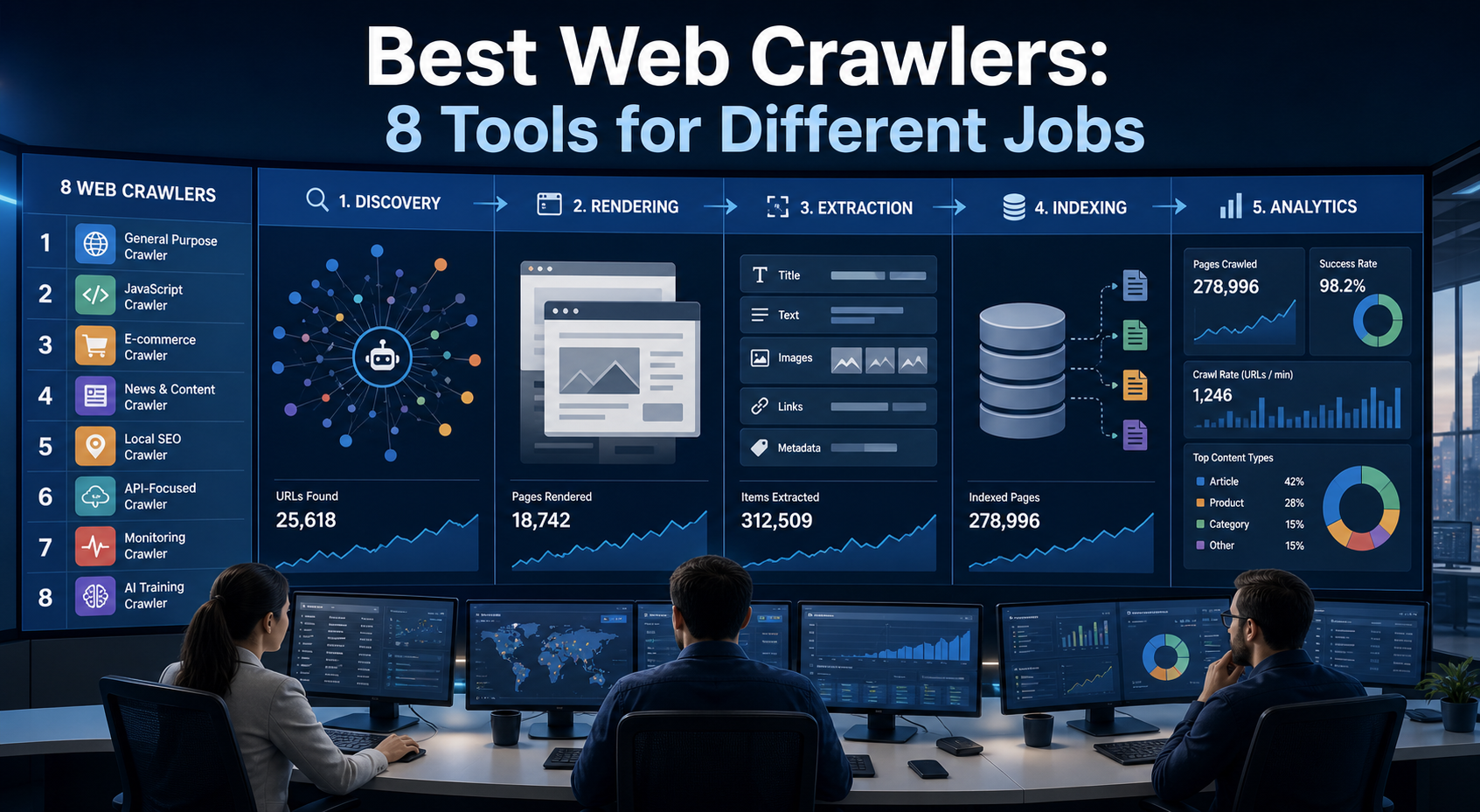
Best Web Crawlers: 8 Tools for Different Jobs
There is no single best web crawler for every project. A technical SEO audit, an AI knowledge pipeline, an internet archive, and a distributed search index may all involve crawling URLs, but they require different capabilities. The most useful way to compare web crawler tools is therefore to ask what job each one was designed to perform. This guide evaluates eight strong options across:
View Details
Web Scraping Ecommerce Websites With Python: A Practical Guide
Recommended meta title: Web Scraping Ecommerce Websites With Python: Guide Recommended meta description: Learn how to scrape ecommerce websites with Python using Requests, Beautiful Soup, Playwright, and Scrapy, with validation and scaling guidance. URL slug: /web-scraping-ecommerce-websites-python/
View Details
How to Train an AI Model With Web Data Safely
To train an AI model with web data, start by deciding whether you actually need training. Then collect representative sources, preserve provenance, remove duplicates and low-quality content, create leakage-resistant splits, build a baseline, fine-tune or train the appropriate model, and evaluate on real held-out examples before deployment.
View Details