
Starlink's Direct-to-Cell Tech Explained
Your regular smartphone connecting directly to a satellite in low Earth orbit? Here is the underlying technology and RF engineering that makes it possible.
For decades, satellite telecommunications required bulky, specialized hardware equipped with massive external antennas just to lock onto an orbiting signal. The idea that the existing iPhone or Android device in your pocket could communicate directly with a satellite—without hardware modifications, proprietary chips, or specialized apps—seemed to violate the laws of physics.
Yet, Starlink's Direct-to-Cell service is making exactly that a reality. For network engineers and developers, the confusion is completely understandable: how can a smartphone designed with a strict power budget to talk to a terrestrial tower a few miles away suddenly reach a satellite moving at 17,000 mph, 340 miles above the Earth?
The answer lies not in changing the smartphone, but in fundamentally reimagining the architecture of the satellite itself.
Turning Satellites Into Cell Towers
The Core Innovation: Space-Based Base Stations
Traditional satellite communications require the client device to do the heavy lifting with a powerful transmitter and a directional antenna. Your smartphone has neither; it is engineered to communicate with terrestrial cell towers using relatively weak, omnidirectional signals over short distances to conserve battery life.
Starlink's breakthrough is conceptually elegant but engineeringly brutal: instead of building special phones for satellites, they built special satellites that act as standard cell towers.
Each Direct-to-Cell Starlink satellite carries a payload that functions as an eNodeB (for 4G LTE) or a gNodeB (for 5G NR)—the exact same base station equipment that cellular carriers install on ground-based macro towers. The satellite literally presents itself to your phone as just another cell tower, utilizing standard cellular protocols that every modern mobile operating system already speaks.
Massive Antenna Arrays and Beamforming
The spatial engineering challenge is immense. A typical urban cell tower covers a radius of a few miles and serves hundreds of simultaneous users with sub-20ms latency. A satellite 340 miles up must cover thousands of square miles while actively compensating for its own orbital velocity, the curvature of the Earth, and the incredibly weak transmission power of a mobile phone.
Starlink's solution relies on massive phased-array antennas combined with advanced beamforming algorithms.
- Physical Scale: These Direct-to-Cell satellites deploy antenna systems far larger than standard Starlink internet satellites, with arrays measuring several square meters.
- Beam Steering: The phased array electronically steers extremely narrow, highly concentrated RF beams toward individual geographic cells, concentrating signal power exactly where it is needed without physically moving the antenna.
This beamforming serves dual purposes. First, it increases the effective signal strength received by the phone, overcoming the massive distance. Second, it allows for high-density spatial frequency reuse. Multiple beams can use the exact same frequency block simultaneously if they are pointing at geographically separated user clusters, exponentially multiplying the network's capacity.
Frequency Band Selection
Starlink partnered with major terrestrial carriers (like T-Mobile in the US) to utilize mid-band PCS (Personal Communications Service) spectrum—specifically, bands that the terrestrial carrier already legally owns. This strategic choice solves three critical problems:
- Regulatory Compliance: Satellites cannot legally broadcast on arbitrary frequencies. They require authorization to operate within licensed spectrum blocks to avoid interfering with ground communications.
- Hardware Compatibility: Mid-band frequencies (such as the 1900 MHz band) are natively supported by the baseband modems of virtually all modern smartphones.
- Propagation Characteristics: These specific frequencies offer a practical balance between geographic coverage area and the ability to penetrate atmospheric interference and light foliage.
Signal Power Mathematics
The fundamental physics of this connection are daunting due to the inverse-square law: signal strength decreases with the square of the distance from the source. A satellite at 340 miles is roughly 100 times farther from your phone than a standard cell tower 3 miles away. Consequently, the signal is approximately 10,000 times weaker by the time it reaches your device's internal antenna.
To close this massive link budget gap, Starlink relies on:
- High-Gain Receivers: Using the massive satellite array to "listen" with extreme sensitivity.
- Increased Transmit Power: Pushing the maximum allowable watts into the downlink signal without violating terrestrial interference regulations.
- Advanced Modulation: Utilizing highly robust error-correction coding schemes (like QPSK) that can maintain a link even when the Signal-to-Noise Ratio (SNR) is exceptionally poor.
Overcoming the Protocol Gap
The Timing Advance Problem
Standard cellular networking protocols assume the base station is stationary and geographically close. One of the most critical mechanisms is Timing Advance (TA)—a MAC-layer command that synchronizes transmissions from multiple phones so their packets arrive at the tower in perfectly aligned time slots, preventing data collisions.
In a terrestrial LTE network, a phone might be a few microseconds away from the tower. The network measures the round-trip time and instructs the phone exactly when to transmit.
With a satellite 340 miles up, the one-way signal propagation time at the speed of light is roughly 1.8 milliseconds. This completely blows past the standard timing budget of legacy cellular protocols. Worse, the satellite is moving at roughly 7.5 km/s relative to the ground, meaning the propagation delay is changing continuously.
To fix this, Starlink engineers had to modify the eNodeB software running on the satellite to dramatically extend the Timing Advance range and continuously recalculate parameters as the orbit shifts, all while remaining strictly compatible with the unmodified firmware running on the user's smartphone.
Doppler Shift Compensation
When a satellite races toward your phone at 7.5 km/s, the radio waves it transmits are compressed (blue-shifted) to slightly higher frequencies. As it passes and moves away, the waves are stretched (red-shifted) to lower frequencies.
At the 1.9 GHz frequencies Starlink utilizes, this Doppler shift can equate to variations of ±47 kHz. This is more than enough frequency drift to push the signal entirely outside the narrow channel bandwidth your smartphone's receiver is listening to.
- Downlink (Satellite to Phone): The satellite must pre-compensate for the Doppler shift, calculating the relative velocity to the target geographic cell and adjusting its transmission frequency dynamically so it arrives at the phone at the correct expected frequency.
- Uplink (Phone to Satellite): The satellite's massive receiver array must actively track and capture a wide range of drifting frequencies from thousands of phones across its footprint.
Handoff Mechanics
In terrestrial networks, a handoff occurs when you physically drive from one tower's coverage zone to another. In the Direct-to-Cell model, you stand perfectly still while the cell towers race across the sky above you.
A single satellite is only visible to a specific ground location for about 5 to 8 minutes. To prevent dropped packets, the network must orchestrate rapid, continuous handoffs:
- Predictive Routing: Using precise orbital mechanics (ephemeris data) to know exactly when a satellite will drop below the horizon.
- Pre-coordination: Preparing the next incoming satellite's beam and allocating the necessary channel resources before the transition occurs.
- Gateway Management: Ensuring the active data session remains seamless as the backend routing shifts between different ground-station gateways connected to the terrestrial internet.
Network Synchronization
To support global mobility, the 3GPP Non-Terrestrial Networks (NTN) standards dictate that these space-based nodes must maintain flawless timing synchronization. The entire constellation operates as a highly coordinated mesh, utilizing onboard atomic clocks and continuous ground-station calibration to ensure packets route properly despite relativistic effects.
The Hard Limits
Bandwidth Reality Check
The initial commercial rollout of Starlink Direct-to-Cell supports only SMS and text messaging. This is not a software limitation that will be quickly patched out—it is a hard boundary dictated by physics and spectrum economics.
A single satellite beam covers hundreds of square miles, potentially encompassing tens of thousands of users in an emergency scenario. The total bandwidth available is constrained by the strict spectrum allocation provided by partner carriers.
In these early deployments:
- Per-Beam Capacity: Estimated at 2 to 10 Mbps total.
- Per-User Bandwidth: Measured in mere kilobits per second (kbps).
This is perfectly sufficient for asynchronous SMS payloads, but completely inadequate for modern, data-hungry TCP connections like video streaming. Supporting widespread voice calls (VoLTE) and rich data requires launching thousands of additional, higher-capacity satellites.
Latency Constraints
While the physical speed-of-light round trip to a LEO satellite is roughly 3.6 milliseconds, that is only a fraction of the total network path.
A complete data round-trip looks like this:
- Phone to Satellite (Uplink).
- Satellite to Ground Gateway (Downlink).
- Ground Gateway to the public Internet/Carrier Core.
- And back through the same path.
Total system latency often ranges from 50 to 100+ milliseconds. While this is revolutionary compared to legacy GEO satellites (which suffer 600ms+ latency), it still introduces challenges for modern applications. Developers building apps that rely on rapid TCP handshakes or real-time UDP streams must account for these delays.
Capacity Scaling Issues
Because each beam serves a massive geographic area, capacity is strictly bottlenecked. In sparsely populated rural areas, or during a natural disaster where terrestrial towers are destroyed, this capacity is life-saving.
However, if deployed over a dense urban center, the system would instantly buckle under the connection requests. Direct-to-Cell is fundamentally designed to act as a fallback network—filling the rural coverage gaps of traditional carriers, not replacing city infrastructure.
Coverage Gaps and The Road Ahead
While the constellation orbits globally, the service requires regulatory approval from agencies like the FCC's Supplemental Coverage from Space (SCS) framework to broadcast legally over specific countries.
Furthermore, Direct-to-Cell requires direct line-of-sight to the sky. Unlike terrestrial low-band 5G, which can penetrate deep into concrete buildings, these satellite signals will be blocked by thick foliage, roofs, and urban canyons.
Despite these physical limits, Starlink's technology remains a monumental breakthrough. By migrating the immense complexity to the satellite and leaving the smartphone completely unchanged, SpaceX has forged a seamless compatibility layer between orbital infrastructure and billions of existing consumer devices.
LycheeIP (Developer-First Proxy Infrastructure)
LycheeIP is a developer-first proxy and data infrastructure platform that empowers engineering teams to reliably route, monitor, and scale their global network requests. As telecommunications providers increasingly adopt hybrid architectures—blending low-latency terrestrial 5G with higher-latency satellite fallbacks—developers must rigorously test how their applications behave under wildly shifting network conditions.
By utilizing LycheeIP's dynamic IP networks, QA and mobile engineering teams can simulate real-world user traffic transitioning across different global ISPs and geographic regions. This allows developers to test how their applications handle sudden latency spikes, connection drops, and IP handoffs without leaving their local testing environment. Furthermore, data teams requiring highly stable, uninterrupted throughput for continuous API monitoring or competitive intelligence gathering can leverage datacenter IP solutions to ensure their operations run smoothly. Integrating a robust developer-first proxy infrastructure ensures your testing pipelines remain as resilient and globally accessible as the hybrid networks your customers rely on every day.
Frequently Asked Questions
Q: Do I need to buy a special phone or a new SIM card to use Starlink Direct-to-Cell?
A: No. The service works natively with standard, existing LTE and 5G smartphones without any hardware or software modifications. However, your current mobile carrier must have an active partnership agreement with Starlink (such as T-Mobile in the US, Rogers in Canada, or Optus in Australia) to authenticate your device on the satellite network.
Q: Why is the service initially limited to just text messaging?
A: It is a strict limitation of bandwidth density. A single satellite beam must share a very limited slice of frequency spectrum among potentially thousands of users across a massive geographic footprint. Text messages (SMS) require tiny data payloads (bytes), making it mathematically feasible to serve many users simultaneously. Voice and broadband data require drastically more network capacity, which SpaceX will unlock as they launch denser constellations of upgraded satellites.
Q: How does my phone's weak signal reach a satellite 340 miles away if it sometimes struggles to reach a cell tower 3 miles away?
A: The heavy lifting is done entirely by the satellite, not your phone. The satellite is equipped with massive phased-array antennas that use beamforming to create extremely narrow, high-gain listening zones. This exponentially increases the satellite's reception sensitivity, allowing it to detect the weak, standard-power transmission from your everyday smartphone.
Q: Will Direct-to-Cell work indoors, in my basement, or in cities with tall skyscrapers?
A: Generally, no. The service requires a relatively clear line-of-sight to the open sky, similar to how a GPS receiver functions. Building materials (roofs, concrete), dense tree canopies, and tall urban buildings will block the faint satellite signal. It is explicitly designed as an outdoor fallback network for remote locations, wilderness areas, and maritime environments where standard cell towers simply do not exist.
Q: How is this technology different from legacy satellite phone services like Iridium?
A: Traditional satellite networks require users to purchase dedicated, expensive satellite phones featuring custom hardware, powerful transmitters, and thick external antennas. They operate on entirely different, proprietary protocols. Starlink flips this model upside down: it puts the complex cellular base station hardware directly onto the satellite. Because the satellite broadcasts standard LTE signals, your regular smartphone connects to it just as it would any normal terrestrial cell tower.

Recommended Articles

SERP API Troubleshooting: Fix Empty, Wrong, or Inconsistent Search Results
SERP API failures are not limited to obvious HTTP errors. A request can return successfully and still produce empty, incomplete, geographically wrong, duplicated, or misinterpreted search data. Production troubleshooting therefore has to separate transport problems from provider processing, SERP differences, and downstream parsing errors.
View Details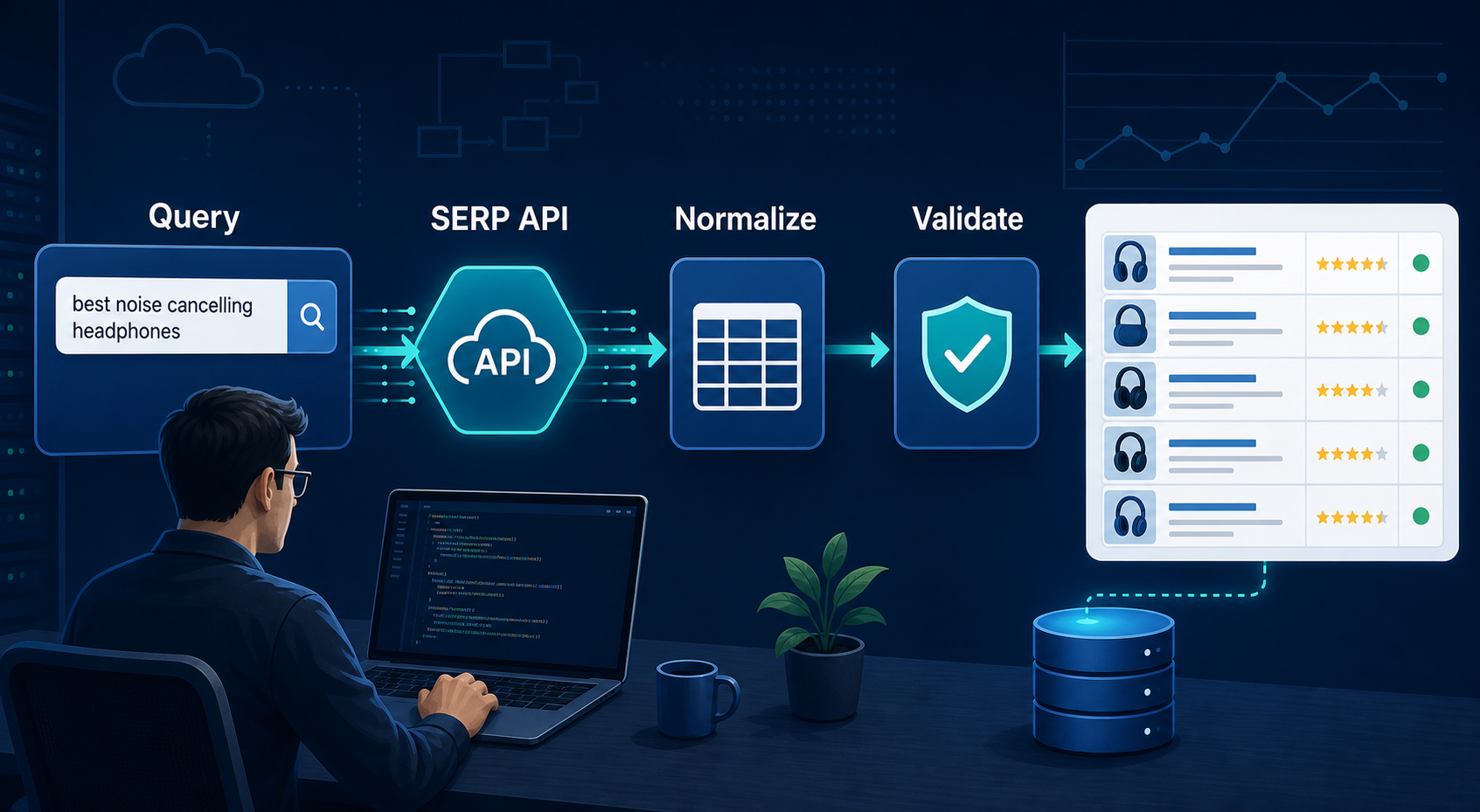
SERP API Python: How to Build a Reliable Search Data Pipeline
This guide shows a provider-neutral workflow for building that pipeline. It does not rank SERP API vendors. Instead, it focuses on the implementation choices that make a Python integration easier to operate, test, and migrate.
View Details
SERP Scraping API: How to Choose the Right Provider
Recommended Meta Description: Compare SERP scraping APIs by data coverage, localization, reliability, workflow fit, and cost structure, then choose and validate the right provider.
View Details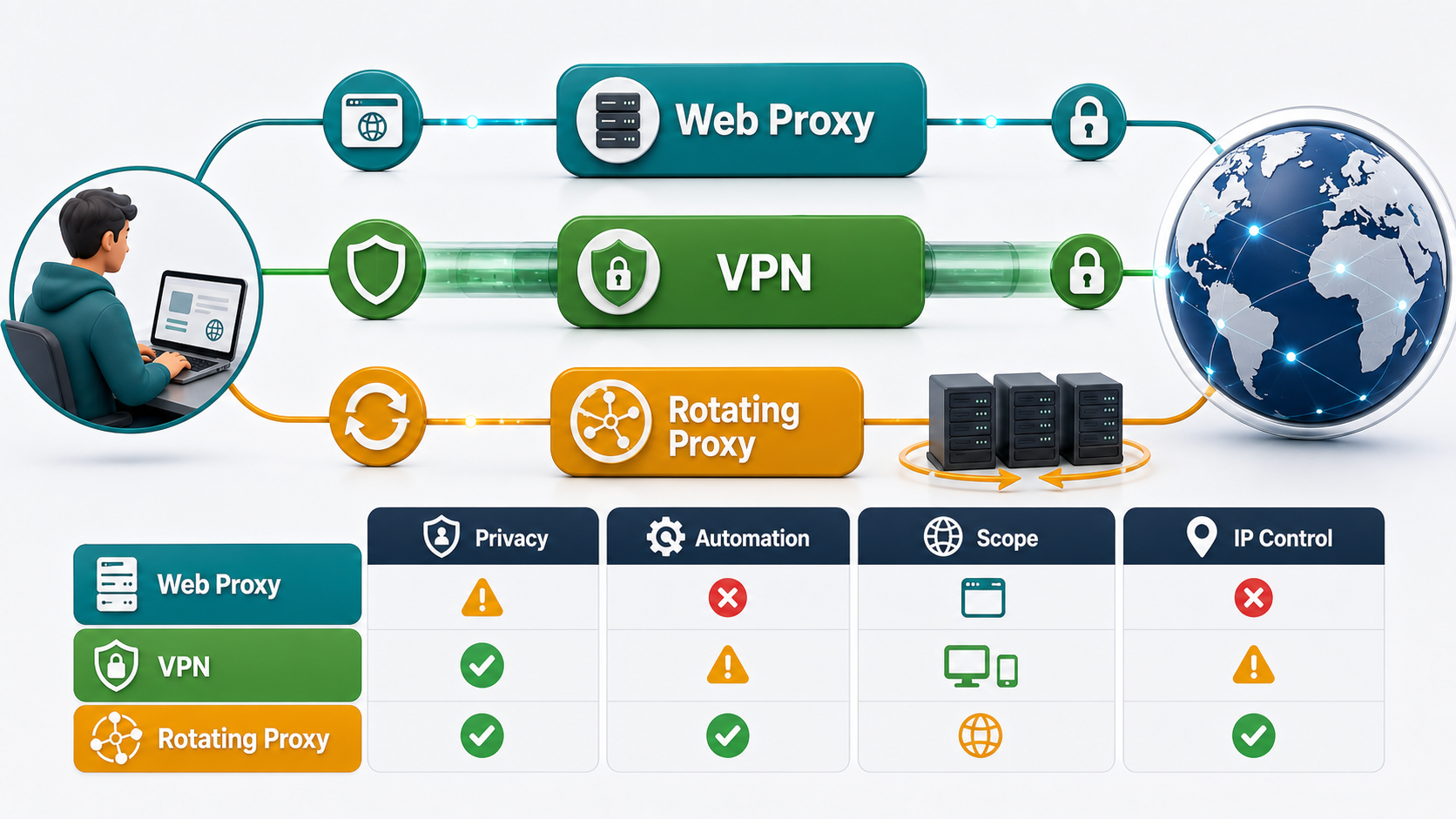
Free Web Proxy vs VPN vs Rotating Proxy: Which Should You Use?
Compare free web proxies, VPNs, rotating proxies, static proxies, and datacenter proxies by scope, encryption, IP control, automation, streaming, and account workflows.
View Details
BlockAway Not Working? Fix Common Proxy, Video, and Access Problems
Troubleshoot BlockAway when pages are blocked, YouTube fails, JavaScript breaks, speed drops, sessions expire, or mobile access behaves differently.
View Details