
Private Tech Platforms Now Control the Battlefield
When Elon Musk controls your military's communications, who really has the power?
This is no longer a hypothetical poly-sci question for defense planners—it is an urgent, terrifying strategic reality reshaping modern warfare. Across active conflict zones from Ukraine to the South China Sea, military forces increasingly depend on commercial technology platforms whose owners can unilaterally decide when, where, and how these systems operate.
The result is a fundamental shift in the architecture of military power: we are moving from government-owned, strategically air-gapped infrastructure to a fragile patchwork of private platforms governed by Terms of Service (ToS), corporate profit interests, and the personal philosophies of billionaire CEOs.
For centuries, absolute control over battlefield communications has been synonymous with military sovereignty. Governments built their own telegraph lines, encrypted radio networks, and multi-billion-dollar satellite constellations precisely because these capabilities were too critical to outsource. But the sheer economics and breakneck speed of commercial tech innovation have upended this calculus. Today's military commanders often find that Silicon Valley can deploy capabilities faster and cheaper than the Pentagon—but this convenience comes with hidden strings that fundamentally compromise operational autonomy.
Explore LycheeIP’s platform edge
When Terms of Service Override Military Strategy
The Ukraine conflict has crystallized this new reality in incredibly stark terms. When Russian forces invaded in February 2022, Ukraine's legacy military communications infrastructure was devastated within days via targeted kinetic strikes and advanced cyberattacks. Traditional military satellites were either unavailable, jammed, or inadequate for the highly distributed, mobile "shoot-and-scoot" warfare that Ukrainian forces needed to survive.
Enter Starlink: Elon Musk's SpaceX rapidly deployed thousands of commercial satellite terminals that instantly became the digital backbone of Ukrainian military communications, enabling everything from secure Zoom calls between commanders to real-time artillery targeting and drone operations.
On the surface, this looked like a triumph of public-private cooperation—a nimble tech company stepping in where bloated government bureaucracies moved too slowly. But the arrangement concealed a profound power asymmetry. While Ukrainian forces depended on Starlink for daily battlefield survival, SpaceX retained absolute, root-level control over when and how the service could be used.
The Billionaire Veto
This dynamic became dramatically clear in September 2022. Ukrainian forces attempted to use Starlink-enabled maritime drones to execute a surprise attack on the Russian naval fleet docked in Crimea. Elon Musk personally intervened to deny the satellite service expansion into Crimean waters, effectively vetoing a sovereign nation's military operation mid-execution.
His stated rationale—concern about SpaceX being seen as complicit in a "major act of war" and fearing a nuclear response—may have been understandable from a corporate risk perspective. However, it represented something historically unprecedented: an unelected private citizen making real-time strategic battlefield decisions that have traditionally been the sole constitutional purview of military commanders and elected officials.
The Structural Leverage Asymmetry
The leverage asymmetry here is deeply structural. Ukraine (and by extension, its NATO financial backers) became entirely dependent on a capability they do not own, cannot legally control, and whose End User License Agreement (EULA) was written for civilian RV owners, not active military operations.
Starlink's Acceptable Use Policy explicitly prohibits use for "offensive military actions." This restriction creates obvious, fatal tensions when the platform becomes integral to fighting a defensive war. Ukrainian commanders found themselves in the absurd, unprecedented position of coordinating life-or-death military operations around the contractual limitations of a California-based internet service provider.
This isn't just about one company or one conflict in Eastern Europe. It represents a category shift in how military capability is sourced. When the Pentagon buys an F-35 fighter jet, it owns the physical aircraft and controls its geographic deployment. When a military becomes dependent on Starlink, AWS, or Google Cloud, it is merely renting access to a platform whose owner retains a permanent kill-switch. The difference isn't merely contractual—it is constitutional.
The Expanding Landscape of Commercial Battlefield Dependencies
Starlink is merely the most visible, explosive example of a much broader infrastructure transformation. Across multiple domains, kinetic military operations now depend on commercial platforms whose corporate boards can enable or deny capabilities based on PR backlash, employee protests, or geopolitical calculation.
Cloud Infrastructure and Intelligence Operations
Modern military intelligence no longer runs on server racks in the basement of the Pentagon; it relies heavily on commercial cloud platforms—Amazon Web Services (AWS), Microsoft Azure, and Google Cloud—for infinite data storage, processing power, and AI-enabled targeting analysis. The Pentagon's Joint Warfighting Cloud Capability (JWCC) explicitly outsources critical, global defense computing to these commercial providers. These platforms process classified intelligence, train targeting algorithms, and support global command-and-control (C2) systems.
But what happens if a tech giant decides that a particular military operation violates their corporate ethics policies?
- In 2018, Google employees successfully pressured the company to withdraw from Project Maven, a Pentagon AI program for analyzing drone footage.
- Microsoft faced massive internal employee protests over its multi-billion-dollar IVAS (HoloLens) contract with the US Army.
While these companies ultimately maintained their defense relationships, the episodes revealed a glaring vulnerability: corporate culture and internal employee activism can constrain military capabilities in ways that would have been unthinkable during the Cold War.
Social Media as Intelligence and Information Warfare
Battlefield commanders now routinely utilize commercial social media platforms for Open-Source Intelligence (OSINT) gathering, troop coordination, and psychological information operations (PsyOps). Twitter/X, Facebook, Telegram, and TikTok have become integral to modern warfare.
Yet, these platforms' content moderation policies—applied inconsistently and often opaquely by AI algorithms—can directly impact military operations. During the Ukraine conflict, both Russian and Ukrainian forces relied heavily on Telegram for tactical coordination. The platform's vague policies on violent content and state-affiliated accounts created constant operational uncertainty. Social media companies have demonstrated a willingness to globally deplatform state actors they deem problematic. This immense power cuts both ways, potentially blinding both adversaries and allies overnight without warning.
Financial Infrastructure as a Weapon
Even military-adjacent financial operations depend entirely on commercial payment processors. PayPal, Visa, Mastercard, and SWIFT have all demonstrated the willingness—and the technical capability—to instantly sever services to entities they consider problematic, whether for government sanctions compliance or internal corporate policy reasons.
For military operations operating in "gray zones"—supporting proxy forces, funding covert intelligence operations, or sustaining supply lines in jurisdictions with complex sanctions regimes—dependence on commercial financial infrastructure creates massive choke points. If a corporation independently decides to cut off financial flows based on sudden reputational risk, military options instantly narrow.
Degradation and Reliability Questions
Beyond the outright denial of service, commercial platforms introduce reliability questions that military systems are not built to tolerate. Multiple reports during the Ukraine conflict suggested that Starlink service mysteriously degraded in highly contested areas or near front lines. Was this a technical limitation of the hardware, deliberate geofencing by SpaceX, or successful Russian electronic warfare (EW) jamming? The inherent opacity of commercial black-box systems makes it incredibly difficult for military planners to assess true reliability—a fatal problem when human lives depend on the connection.
LycheeIP (Developer-First Proxy Infrastructure)
As defense contractors and OSINT (Open-Source Intelligence) analysts increasingly rely on public commercial platforms to gather intelligence, monitor global sentiment, and track troop movements, their digital footprint becomes a critical vulnerability. Military intelligence teams cannot simply scrape global social media or access foreign cloud infrastructure using standard, identifiable government IP addresses without alerting adversaries or triggering automated commercial bans.
This is where a developer-first proxy infrastructure becomes a critical operational asset. By integrating dynamic IP networks, intelligence gatherers can safely and anonymously route their data collection scripts through millions of rotating global endpoints. This allows analysts to view the internet exactly as local citizens do in a conflict zone, bypassing regional censorship and preventing commercial platforms from geoblocking their intelligence gathering. Alternatively, when defense tech teams are building the high-speed backend infrastructure required to process this massive influx of raw OSINT data, datacenter IP solutions provide the dedicated, persistent bandwidth required to feed their AI models without interruption. Ultimately, operating safely in a commercialized digital battlespace requires masking your digital logistics, and LycheeIP provides the infrastructure to do exactly that.
Explore LycheeIP’s platform edge
Sovereignty, Strategy, and the Future of Military Infrastructure
The strategic implications of this commercial transformation extend far beyond tactical battlefield inconveniences. At stake is nothing less than true military sovereignty—the ability of a nation-state to conduct defense operations according to its own strategic imperatives, rather than constraints imposed by private Silicon Valley actors.
Regulatory Gaps and Legal Ambiguity
Existing legal frameworks for the government requisition of private assets in wartime—such as the US Defense Production Act—were designed for physical assets (like forcing a car factory to build tanks). They map incredibly poorly onto borderless cloud computing, satellite internet, and social media platforms that are simultaneously serving millions of civilian and military users across multiple sovereign nations.
- Can the U.S. government legally compel Amazon to provide AWS services for a kinetic military operation that Amazon executives publicly consider unethical?
- Can the government legally prevent SpaceX from providing Starlink access to geopolitical adversaries?
- The legal landscape is dangerously murky, and sophisticated adversaries are already learning to exploit these exact ambiguities.
The Taiwan Warning Sign
The potential scenario of a conflict over Taiwan looms large in defense planning and highlights this exact vulnerability.
If a kinetic conflict erupts in the South China Sea, will U.S. and allied forces be able to rely on commercial cloud infrastructure, satellites, and communications platforms—many of whose parent companies have tens of billions of dollars in manufacturing and retail business tied up in mainland China? Will corporate boards, facing massive financial pressure from shareholders with China exposure, guarantee service continuity to the US Military? Will employee activism at these tech companies constrain military options?
The dangerous assumption that Silicon Valley will always align perfectly with Pentagon priorities may not survive contact with complex, globalized geopolitical realities.
Strategic Responses and Alternatives
Defense establishments are finally beginning to grapple with these severe vulnerabilities, but clean solutions are elusive. Current options include:
- Government-Owned Alternatives: Building sovereign, classified satellite constellations and air-gapped cloud infrastructure removes commercial dependencies. However, it sacrifices the speed, AI innovation, and cost-efficiency of the private sector.
- Guaranteed Access Frameworks: Creating ironclad contractual arrangements that guarantee military access under specified conditions, backed by federal legislation. The challenge is actually enforcing these guarantees when corporate culture or reputational risk pushes a company toward non-compliance.
- Allied Infrastructure Sharing: NATO allies pooling resources to build shared, proprietary infrastructure that no single commercial entity controls.
None of these approaches fully resolves the underlying tension: commercial platforms currently provide vastly superior technological capabilities, but absolute dependence on them creates strategic vulnerabilities that adversaries can and will exploit.
The New Reality: Hybrid Public-Private Warfare
The era of purely government-controlled, sovereign military infrastructure is over. Economic realities, technological complexity, and the blistering pace of AI innovation have made commercial platforms totally indispensable to modern warfare. But this integration has occurred much faster than the development of the legal and governance frameworks required to manage it.
We now inhabit a fragile, hybrid space where battlefield effectiveness depends on platforms whose owners answer to Wall Street shareholders, vocal employees, and personal convictions rather than the traditional Chain of Command or democratic accountability.
What is urgently required is a new legal framework that acknowledges the reality of commercial dependence while establishing clear, unbreakable boundaries and guaranteed access provisions for critical infrastructure during military operations.
The current trajectory—absolute military dependence without strict governance frameworks—creates strategic vulnerabilities. The first step toward addressing this is acknowledging the power shift that has already occurred: in 21st-century warfare, the battlefield isn't just contested between nation-states. It is subject to the Terms of Service of platforms controlled by private citizens who may have very different ideas about when, where, and how their infrastructure should be used.
When Elon Musk controls your military's communications, the answer to "who really has the power?" is uncomfortably ambiguous—and that ambiguity itself is a massive strategic vulnerability.
Explore LycheeIP’s platform edge
Frequently Asked Questions
Q: Why does the military use commercial platforms like Starlink instead of their own military-owned satellite systems?
A: Commercial platforms offer vastly superior technological capabilities at a fraction of the cost, with incredibly fast deployment timelines. Building and maintaining dedicated, classified military satellite constellations requires enormous taxpayer investment and decade-long development cycles. Commercial companies deploy technology using economies of scale that government programs simply cannot match. However, this cost-efficiency comes with the severe tradeoff of reduced operational control.
Q: Can the government legally force private tech companies to provide services during wartime?
A: The legal framework is highly ambiguous and currently untested for modern digital platforms. Traditional authorities, like the Defense Production Act, allow the government to requisition physical goods, but it is unclear how these laws apply to global cloud computing or satellite internet. Compelling a platform to provide services raises complex constitutional questions about cross-border operations and whether companies can be legally forced to violate their own Terms of Service to support kinetic warfare.
Q: What exactly happened with Starlink in Ukraine and Crimea?
A: In 2022, Starlink became the critical communications infrastructure for Ukrainian forces after Russia destroyed their traditional systems. However, in September 2022, when Ukraine attempted to use Starlink-connected drones to attack Russian naval assets in Crimea, Elon Musk personally refused to enable the satellite service expansion into those specific areas. He cited concerns about SpaceX's complicity in military escalation. This incident proved that while a sovereign military depended on Starlink for operations, a private company retained ultimate veto power over how the service was used.
Q: How dependent is modern warfare on commercial technology platforms?
A: Extremely dependent. Modern military operations rely on commercial platforms across almost every domain: satellite communications (Starlink), cloud computing and AI targeting (AWS, Microsoft Azure, Google Cloud), OSINT gathering (Twitter/X, Telegram), and operational funding (commercial banking systems). This dependence has grown because commercial innovation drastically outpaces military R&D.
Q: What alternatives exist to commercial satellite communications for military use?
A: Alternatives are limited but include: (1) Rebuilding fully government-owned military satellite systems, which offer absolute control but at much higher costs and slower speeds; (2) Creating "Hybrid" public-private partnerships with strict legal guarantees for military access; or (3) Multi-vendor strategies that avoid dependence on any single commercial provider (e.g., using both Starlink and Amazon's Project Kuiper). However, any approach involving commercial vendors retains some vulnerability to corporate decision-making.

Recommended Articles

SERP API Troubleshooting: Fix Empty, Wrong, or Inconsistent Search Results
SERP API failures are not limited to obvious HTTP errors. A request can return successfully and still produce empty, incomplete, geographically wrong, duplicated, or misinterpreted search data. Production troubleshooting therefore has to separate transport problems from provider processing, SERP differences, and downstream parsing errors.
View Details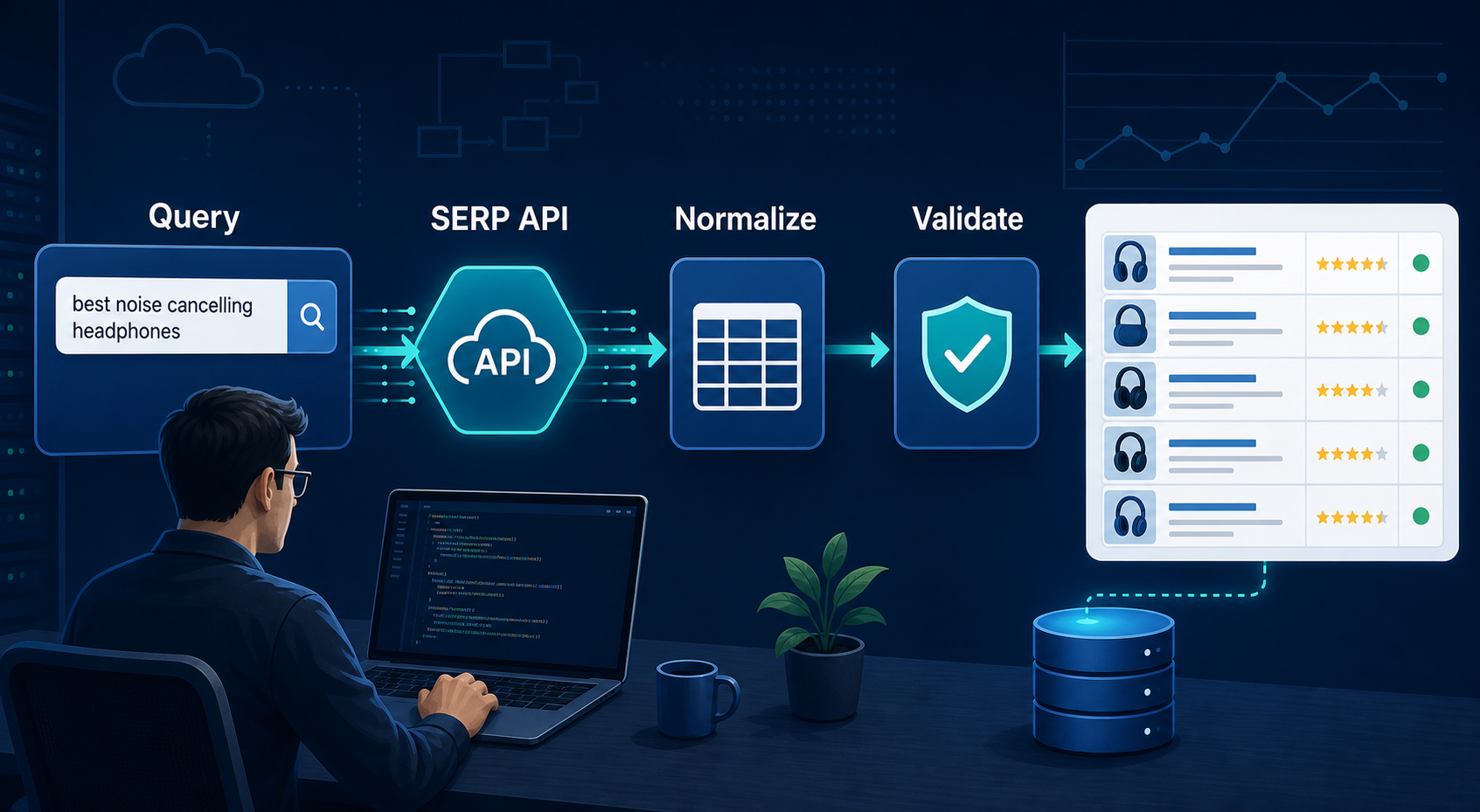
SERP API Python: How to Build a Reliable Search Data Pipeline
This guide shows a provider-neutral workflow for building that pipeline. It does not rank SERP API vendors. Instead, it focuses on the implementation choices that make a Python integration easier to operate, test, and migrate.
View Details
SERP Scraping API: How to Choose the Right Provider
Recommended Meta Description: Compare SERP scraping APIs by data coverage, localization, reliability, workflow fit, and cost structure, then choose and validate the right provider.
View Details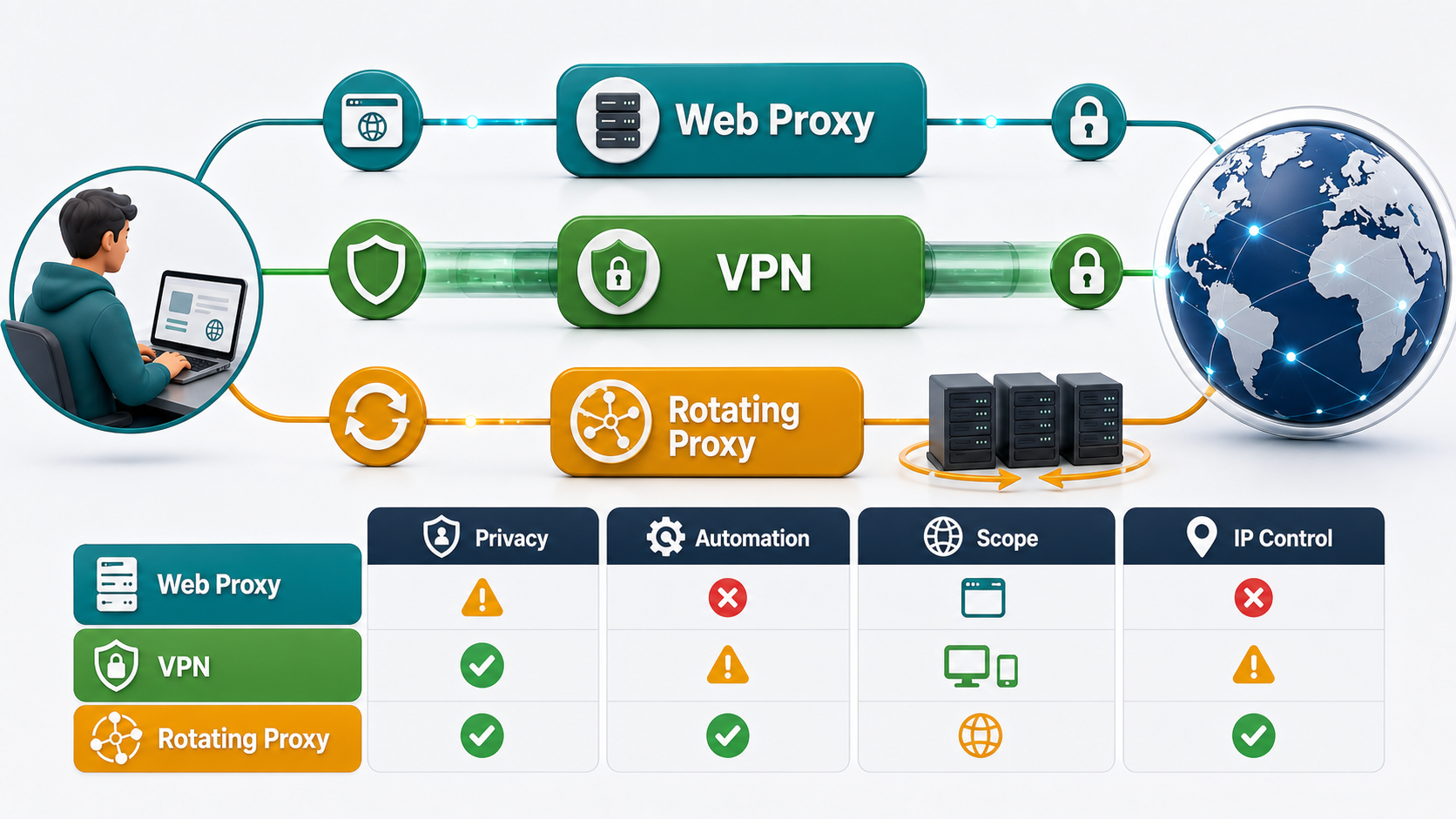
Free Web Proxy vs VPN vs Rotating Proxy: Which Should You Use?
Compare free web proxies, VPNs, rotating proxies, static proxies, and datacenter proxies by scope, encryption, IP control, automation, streaming, and account workflows.
View Details
BlockAway Not Working? Fix Common Proxy, Video, and Access Problems
Troubleshoot BlockAway when pages are blocked, YouTube fails, JavaScript breaks, speed drops, sessions expire, or mobile access behaves differently.
View Details