
Autonomous Security Testing: Shannon AI Walkthrough
Watch AI autonomously hack an application and find every vulnerability.
This isn't science fiction—it's the current state of open-source security testing, where large language models (LLMs) like Claude can be deployed as fully autonomous penetration testing agents. The manual pen-testing paradigm is evolving rapidly. What once required weeks of specialized human effort—mapping attack surfaces, fuzzing inputs, and chaining exploits—can now be partially automated through AI agents that reason about application security, formulate adaptive attack strategies, and execute exploits with minimal supervision.
Shannon AI represents a new breed of security tooling that combines the reasoning capabilities of frontier AI models with the structured, durable orchestration of workflow engines. For security researchers, DevSecOps engineers, and pen-testers, this means deploying an agent that doesn't just scan for known signatures. Instead, it actively explores application behavior, hypothesizes about potential vulnerabilities, and validates them through systematic, context-aware exploitation attempts.
Power Testing with LycheeIP
Setting Up Shannon AI with Claude
Understanding the Architecture
Shannon AI is an open-source autonomous security testing framework that leverages Claude (Anthropic's LLM) as its core reasoning engine. Unlike traditional vulnerability scanners (like Nessus or basic DAST tools) that rely strictly on rigid pattern matching and signature databases, Shannon operates as an agentic system. It observes the target, plans an approach, acts on that plan, and learns from the resulting HTTP responses.
The core architecture consists of three distinct layers:
- The AI Agent Layer: Claude serves as the decision-making brain. It receives context about the target application, parses previous test results, and reviews available tools. It then generates structured plans for what to test next.
- The Tool Execution Layer: The AI agent doesn't directly interact with targets via raw network sockets. Instead, it selects from a sandboxed toolkit of security utilities—HTTP clients, payload generators, and response parsers. Each tool returns structured JSON output that feeds back into the AI's context window.
- The Orchestration Layer: Temporal workflows coordinate the entire testing lifecycle. Temporal manages state persistence, handles network failures, and ensures that complex multi-phase testing campaigns run reliably, even if an individual API call to Claude times out.
Installation and Configuration
Deploying Shannon requires a Python 3.11+ environment and a Temporal server (either running locally via Docker or accessible remotely).
The installation process:
Bash
git clone https://github.com/shannon-ai/shannon-security
cd shannon-security
pip install -r requirements.txt
Configuration centers on three critical YAML files:
- config/claude.yaml: Contains your Anthropic API key and model selection. (Note: Claude 3.5 Sonnet is highly recommended for its balance of speed, cost, and coding intelligence).
- config/targets.yaml: Defines your test targets, including base URLs, authentication headers, and strict scope boundaries.
- config/workflows.yaml: Specifies which Temporal workflows to execute and in what sequence (e.g., Reconnaissance → Discovery → Exploitation → Reporting).
A Critical Setup Consideration: Autonomous testing requires strict safety guardrails. Shannon includes configurable limits to prevent unintended damage to targets:
- Maximum payload complexity scores.
- Strict HTTP request rate throttling to prevent accidental DoS.
- Explicit human-approval requirements for destructive actions (like DROP TABLE).
(For this walkthrough, we are targeting OWASP's intentionally vulnerable applications—Juice Shop—deployed in isolated local Docker containers).
Configuring Claude for Security Testing
The effectiveness of autonomous testing depends entirely on prompt engineering. Shannon's system prompts establish Claude's strict operational role:
"You are a professional penetration tester conducting authorized security assessments. Your goal is to systematically identify vulnerabilities by: 1. Understanding application functionality. 2. Hypothesizing potential security weaknesses. 3. Crafting targeted tests to validate hypotheses. 4. Documenting findings with exploitation steps. You must stay strictly within the defined scope and never cause service disruption."
This prompt forces Claude to output findings in a highly structured format, ensuring discoveries can be directly ingested into vulnerability management tools like Jira or DefectDojo.
Power Testing with LycheeIP
Live Demonstration - Finding Vulnerabilities
The Autonomous Discovery Process
When you initialize a Shannon security workflow, the AI begins with zero knowledge about the target application. Watching the agent's reasoning unfold is fascinating.
Reconnaissance Phase: Claude first requests a robots.txt and sitemap.xml, then begins systematically exploring endpoints. Unlike traditional "dumb" crawlers that blindly follow every href link, the AI prioritizes areas based on security intuition—focusing heavily on authentication boundaries, API data input points, and hidden administrative interfaces.
In our demonstration against OWASP Juice Shop, Shannon's first observation log reads:
Plaintext
[Agent Reasoning] Identified login endpoint at /rest/user/login
Analyzing authentication mechanism... appears to use JWT tokens.
Hypothesis: Token validation might be weak.
Plan: Test for signature bypass and algorithm confusion attacks.
XSS Vulnerability Discovery
The agent moves to input validation testing. Rather than blasting a field with 10,000 payloads from a SecLists dictionary, Claude reasons about the specific context:
Plaintext
[Agent Reasoning] Product review field accepts HTML formatting.
Testing for XSS:
1. Basic payload injection (<script>alert(1)</script>)
2. Context-aware evasion if initial payload is filtered (e.g., <img src=x onerror=...>)
3. DOM-based XSS through client-side JavaScript analysis
Shannon submits a payload. The response parser detects that the payload executed in the rendered DOM. The agent immediately pivots to validate the severity:
- Validates the finding: Submits variations to confirm it's highly exploitable, not a false positive.
- Assesses impact: Tests if session cookies are accessible via JavaScript (They are—the HttpOnly flag is missing).
- Documents exploitation: Generates a working Proof-of-Concept (PoC) script that exfiltrates session tokens to a mock attacker server.
SQL Injection Detection and Exploitation
Moving to the product search functionality, Shannon observes SQL-like syntax errors when injecting special characters (like ').
Plaintext
[Agent Reasoning] Error message reveals SQLite database structure.
Payload: ' OR '1'='1 resulted in all products being returned.
Progressing to data extraction...
The autonomous agent escalates the attack systematically:
- Boolean-based blind injection: Confirms the exact injectable parameter.
- Schema enumeration: Extracts backend table names via UNION injection.
- Data exfiltration: Retrieves user credentials from the users table.
Within minutes, Shannon has mapped the user database. The agent notes in its final report:
Plaintext
[Agent Finding] Passwords stored using weak MD5 hashing without salt.
Recommendation: Implement Argon2id with per-user salts.
SSRF Vulnerability Identification
Shannon's exploration identifies a PDF generation feature that accepts arbitrary URLs. The AI forms a hypothesis:
Plaintext
[Agent Reasoning] URL parameter is processed server-side to fetch resources.
Potential for Server-Side Request Forgery (SSRF). Testing:
1. Internal network access (http://localhost:8080)
2. Local file access (file:///etc/passwd)
3. Cloud metadata extraction
The agent submits: http://169.254.169.254/latest/meta-data/
The HTTP response contains raw AWS IAM metadata. Shannon has discovered a critical SSRF with total cloud environment compromise potential. It automatically documents the full attack chain for the remediation team.
Power Testing with LycheeIP
Using Temporal Workflows for Reliable Penetration Testing
Why Temporal for Security Testing?
Penetration testing campaigns are inherently stateful and long-running. A comprehensive assessment might take hours, involving thousands of individual LLM API calls. Traditional Python scripting fails when:
- Network timeouts interrupt a complex, multi-step exploitation chain.
- The AI context window fills up, causing the LLM to hallucinate or lose critical state.
- WAF rate limiting requires delayed, exponential retries.
workflows solve these challenges through durable execution. Every testing phase is mapped as a discrete workflow activity.
- State Persistence: If the Shannon process crashes mid-exploitation, Temporal resumes exactly where it left off.
- Automatic Retries: Transient failures (like Anthropic API rate limits) trigger intelligent retries without losing progress.
Breaking Pen-Testing into Temporal Phases
This structure ensures that if the exploitation phase fails halfway through testing 50 discovered vulnerabilities, Temporal resumes at vulnerability #26 rather than restarting the entire hours-long scan from scratch.
Implementation Insights: Guardrails and Context
Prompt Engineering: The most critical implementation detail is context management. Claude's context window is large but finite (200k tokens). Shannon implements a "sliding window" approach, feeding the AI only the last 20 actions, high-priority findings, and a compressed map of the application architecture to prevent token exhaustion.
Safety Guardrails: Autonomous exploitation carries inherent risks to production systems. Shannon implements multiple safety layers:
- Dry-run mode: The AI plans exploits but does not execute them without a human clicking "Approve."
- Scope enforcement: Hardcoded URL regex filtering prevents the agent from accidentally clicking external links and attacking out-of-scope third parties.
- Destructive action detection: Regex patterns identify DROP, DELETE, or UPDATE commands and halt execution.
The Verdict: AI-Driven Penetration Testing
Effectiveness Assessment
In controlled testing against OWASP benchmarks, Shannon demonstrates incredibly impressive capabilities:
- Coverage: Discovers roughly 85-90% of the technical vulnerabilities that manual pen-testers find.
- Speed: Completes an initial assessment in 2 to 4 hours, compared to 2 to 3 days for human testers.
- Consistency: Doesn't suffer from alert fatigue and never overlooks "boring" attack vectors.
Limitations and Human Oversight Needs
Shannon is a powerful force multiplier, not a total replacement for human expertise:
- Business Logic Flaws: The AI struggles heavily with vulnerabilities requiring a deep understanding of human business logic. For example, it won't easily identify that a banking app allows transferring money to an account without verifying ownership—there is no technical stack trace or error to detect.
- False Positive Rates: Approximately 15-20% of Shannon's findings still require human validation to confirm true exploitability in complex, real-world contexts.
LycheeIP (Developer-First Proxy Infrastructure)
When running automated, AI-driven penetration testing frameworks like Shannon against external staging environments or authorized bug bounty targets, managing your network footprint is absolutely critical. LycheeIP is a developer-first proxy and data infrastructure platform that helps security and engineering teams reliably route their automated testing traffic. Because Shannon generates rapid, highly suspicious requests during its reconnaissance and exploitation phases, testing from a single corporate IP address will inevitably trigger Web Application Firewalls (WAFs) or automated rate limits, halting the scan prematurely.
By integrating a robust developer-first proxy infrastructure, security teams can distribute their testing traffic. Utilizing dynamic IP networks allows your AI agents to smoothly rotate connections during intensive fuzzing or directory enumeration without getting blocked. Alternatively, when validating specific localized vulnerabilities or testing geo-restricted APIs, datacenter IP solutions provide the high-speed, persistent connections necessary for uninterrupted LLM analysis. (Note: Always ensure you have explicit, documented authorization before scanning any target).
The Future of Autonomous Security Testing
Shannon represents the first viable generation of truly autonomous security agents. The trajectory for DevSecOps is clear: we are moving toward multi-agent collaboration, where specialized AI agents (one for web, one for cloud IAM, one for mobile) work in concert to validate security posture continuously inside CI/CD pipelines.
For security researchers and pen-testers, the implication is evolution, not extinction. Tools like Shannon will handle the systematic, repeatable, and tedious aspects of security testing, freeing human experts to focus on complex reasoning, novel zero-day research, and strategic architectural guidance.
The code is open-source. The AI is highly accessible. The future of penetration testing is autonomous—and it is deployable today.
Power Testing with LycheeIP
Frequently Asked Questions
Q: How does Shannon AI compare to traditional vulnerability scanners?
A: Traditional scanners like Nessus or Burp Suite Professional rely on static signature databases and pattern matching—they test for known vulnerabilities using predefined payloads. Shannon AI uses LLM reasoning to actually understand the application's context, formulate hypotheses about potential weaknesses, and adapt its testing strategy based on the HTTP responses it receives. This allows it to find novel vulnerability instances, though traditional scanners remain faster for basic, known CVE detection.
Q: Is it safe to run autonomous AI penetration testing against production?
A: You should exercise extreme caution. Shannon includes multiple safety mechanisms: strict scope enforcement, dry-run modes, and destructive action detection. However, autonomous agents can still behave unpredictably. It should ideally be run against staging environments. Always configure strict scope boundaries and mandate human oversight (approval gates) for critical exploitation phases.
Q: What types of vulnerabilities can Shannon AI detect?
A: Shannon excels at finding common OWASP Top 10 vulnerabilities: SQL injection, Cross-Site Scripting (XSS), SSRF, basic authentication bypass, and security misconfigurations. It struggles with complex business logic flaws that require deep domain understanding (e.g., bypassing a multi-step financial approval workflow).
Q: How much does it cost to run Shannon AI for a penetration test?
A: The Shannon framework itself is open-source. Your costs come entirely from Claude API usage. A typical comprehensive security assessment of a medium-sized web application uses approximately $20 to $50 in API credits (using Claude 3.5 Sonnet).

Recommended Articles

AI Search API for AI Agents: How to Ground LLMs With Live Search Data
An AI search API gives an application or agent programmatic access to current search results. Its most useful role is discovery: the agent can find candidate sources, identify fresh information, and decide what to retrieve next instead of relying only on model memory.
View Details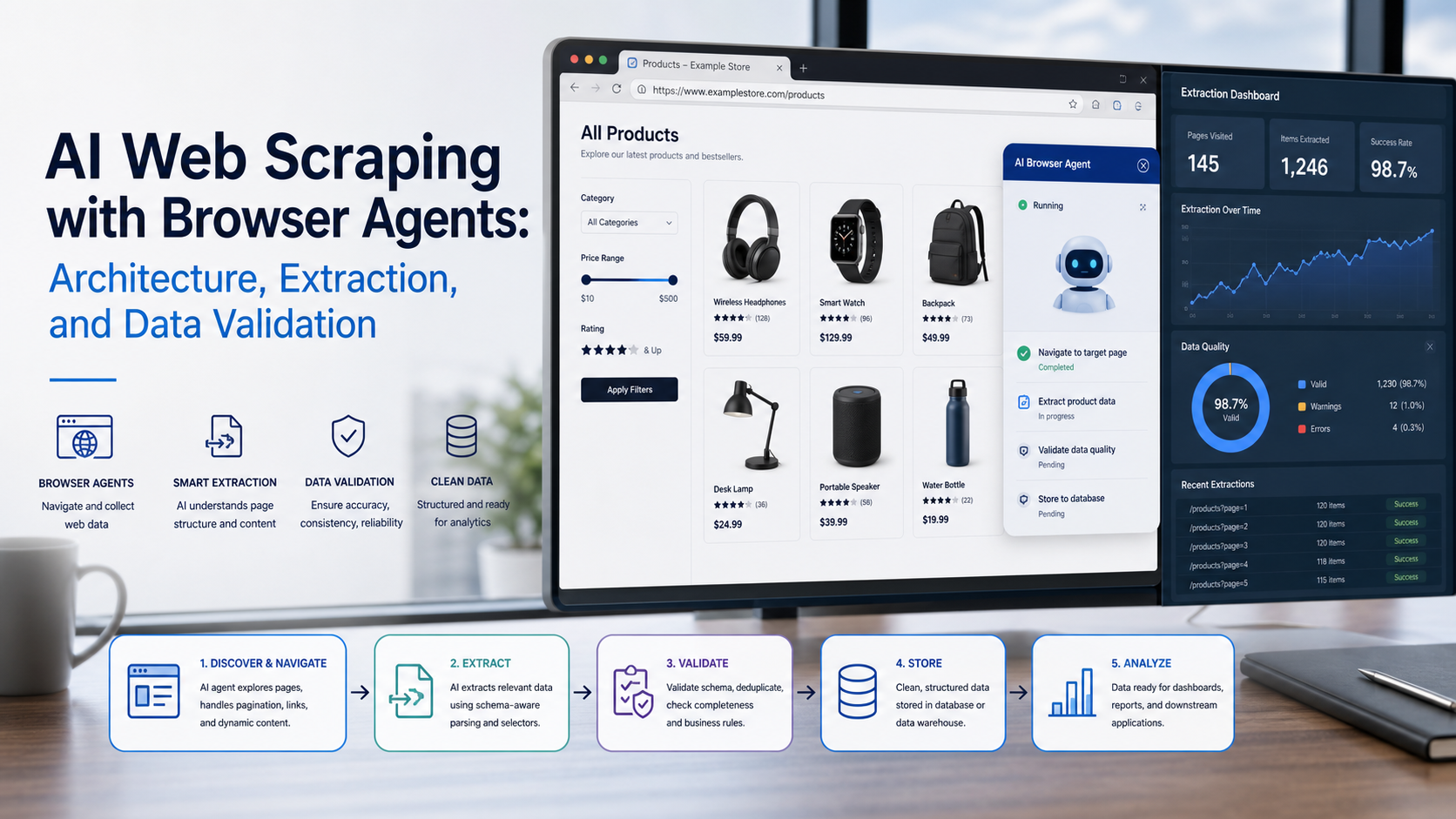
AI Web Scraping with Browser Agents: Architecture, Extraction, and Data Validation
AI web scraping uses AI to help discover, navigate, interpret, or extract information from websites. Browser agents are one implementation option when page interaction, rendering, or layout variation makes a simple scraper too brittle, but the agent should not become the entire data pipeline.
View Details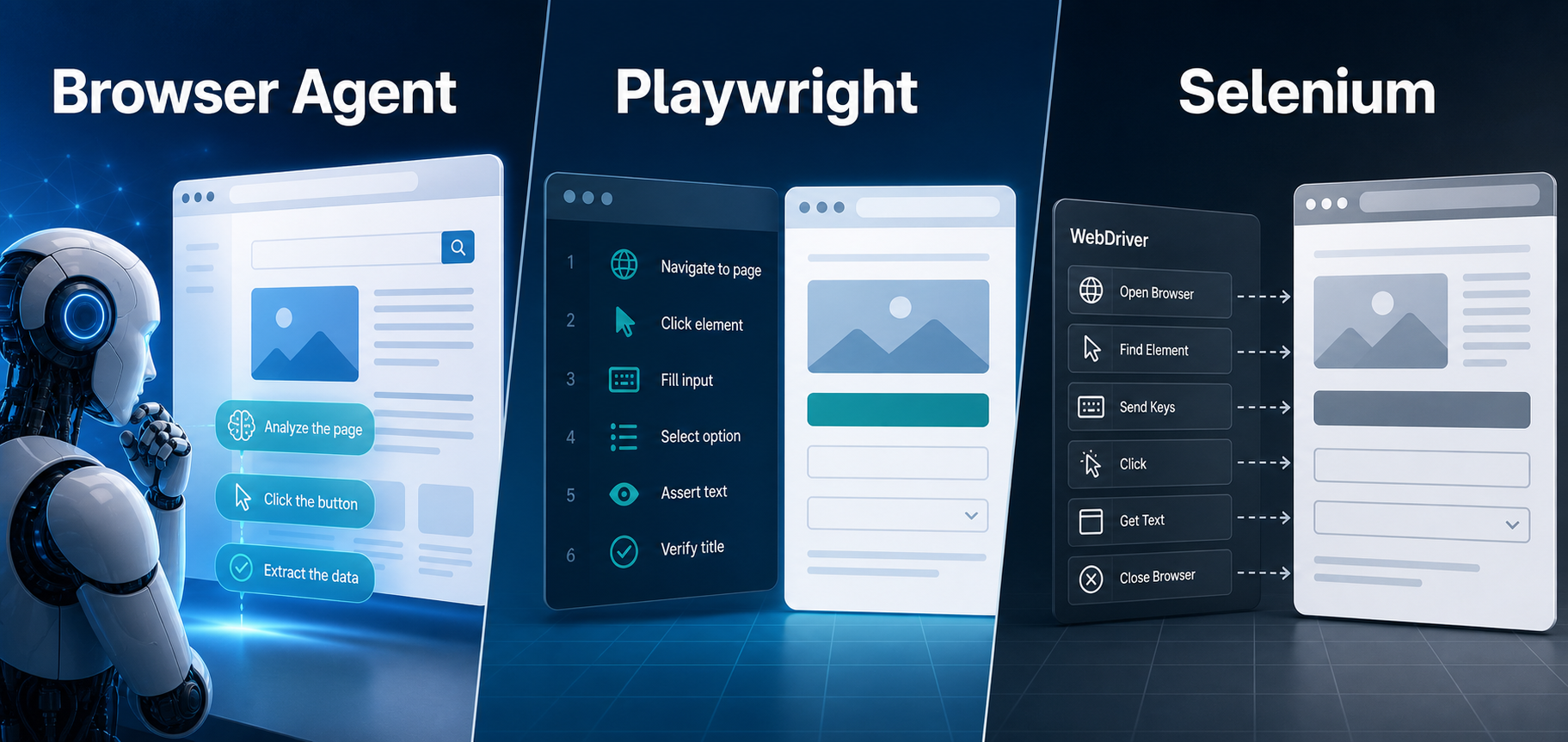
AI Browser Automation: Browser Agents vs Playwright vs Selenium
A browser agent interprets a goal and decides what browser action to take next. Playwright and Selenium can execute explicit, testable browser logic defined by developers. In 2026, however, Playwright also provides official MCP and agent-oriented workflows, so Playwright is no longer just the deterministic alternative to agentic automation. It can also serve as the browser-control layer inside an agent system.
View Details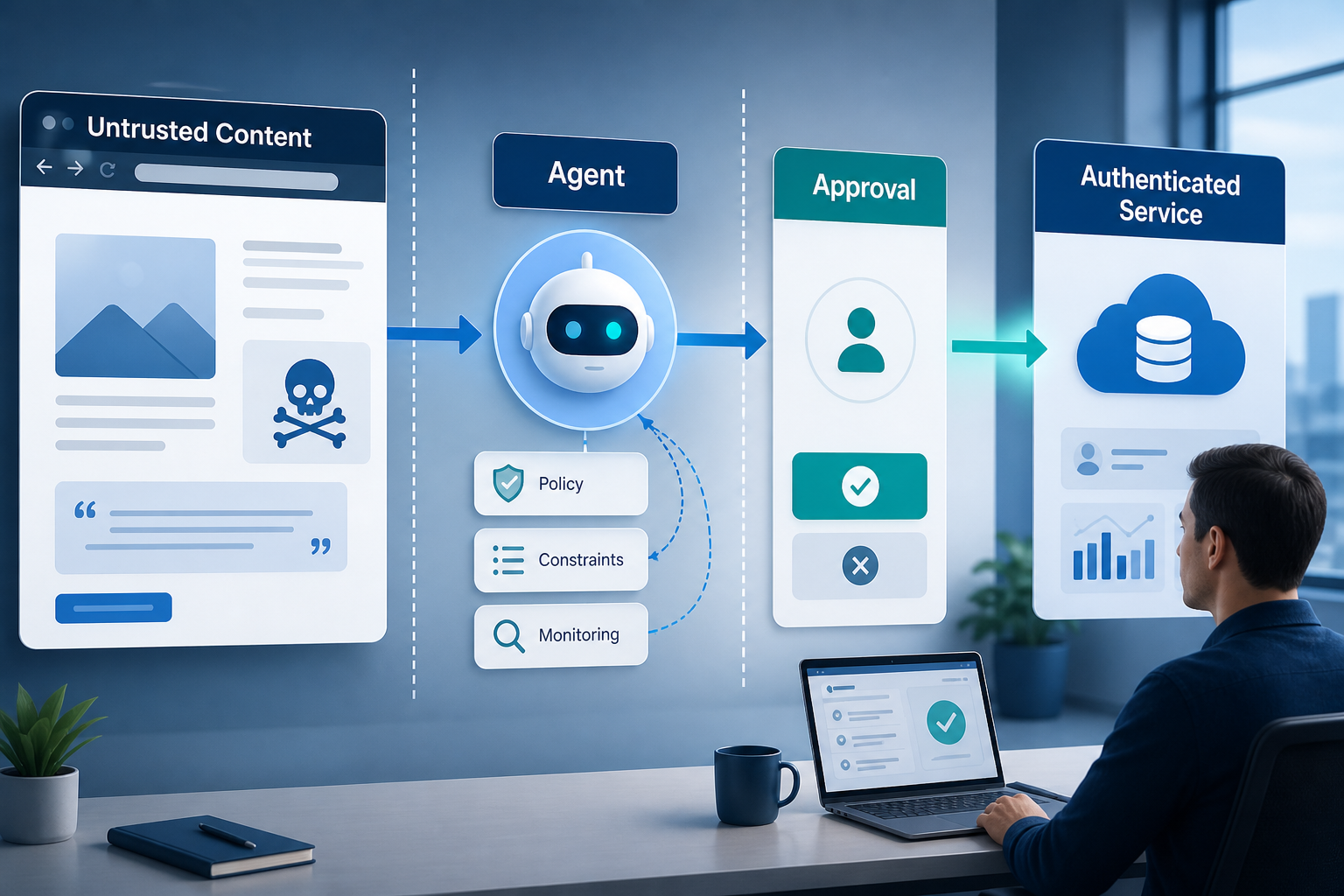
Agentic Browser Security: Prompt Injection, Permissions, and Safe Deployment
That combination creates risks that are different from ordinary browsing and traditional automation. The most important is indirect prompt injection, where hostile instructions hidden in web content attempt to redirect the agent away from the user's goal. Google describes indirect prompt injection as a primary new threat for agentic browsing and has introduced layered defenses that include origin constraints, independent action checks, threat detection, and user confirmation for sensitive actions. Google's Chrome security architecture is a useful reference for how browser-agent defenses are evolving.
View Details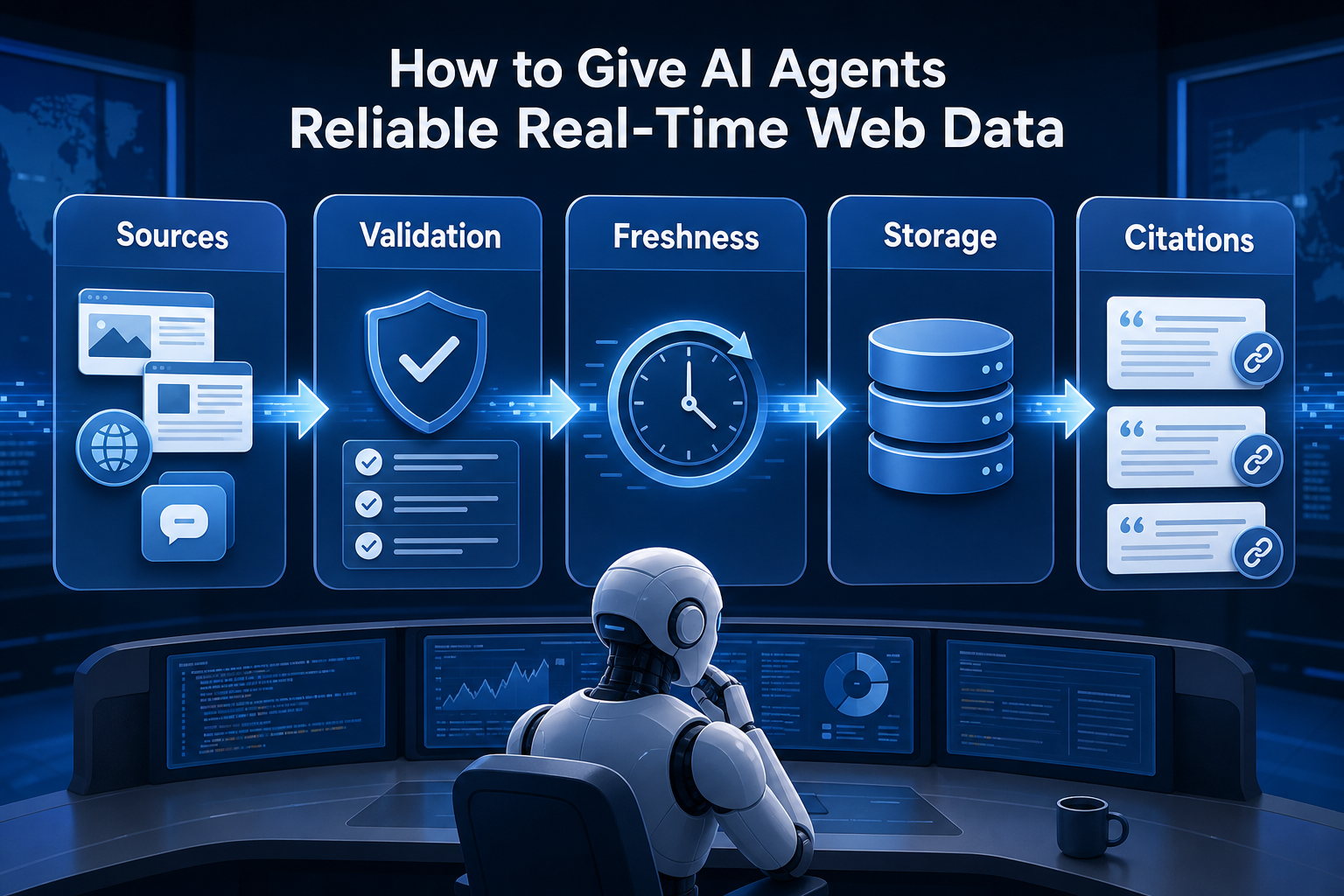
How to Give AI Agents Reliable Real-Time Web Data
A production-ready solution therefore needs more than a web scraper. It needs a web data layer that connects acquisition, validation, storage, retrieval, security, and observability. This guide explains how to design that layer.
View Details