
Automate Kali Linux pen testing with Claude AI's natural language.
Run Nmap scans with natural language commands. That's not science fiction, it's the current state of penetration testing automation using Claude AI integrated directly into Kali Linux environments.
For ethical hackers and security professionals, the traditional workflow involves memorizing dozens of command flags, syntax variations, and tool-specific parameters. What if you could simply tell your terminal, "Scan this target for web vulnerabilities and enumerate directories," and have the AI translate that intent into perfectly formatted, executable tooling?
This integration addresses a core challenge in modern penetration testing: balancing workflow efficiency with deep technical complexity. Even highly experienced pen testers expend valuable mental energy recalling the exact syntax for tools like Nmap, Gobuster, SQLmap, and Nikto. For junior security analysts, this syntax barrier creates an even steeper learning curve. By leveraging Claude AI through the Model Context Protocol (MCP), operators can maintain the granular power and precision of command-line tools while drastically reducing cognitive overhead.
Scale Authorized Testing with LycheeIP
Model Context Protocol for Security Automation
The Model Context Protocol (MCP) is an open standard that allows AI models like Claude to interact with external tools, databases, and local systems in a highly structured way. Unlike simple web-based chatbots that only generate text, MCP enables Claude to actively bridge the gap between conversation and execution. With MCP, Claude can:
- Execute terminal commands with proper syntax validation.
- Read and parse tool outputs (e.g., digesting complex Nmap XML or JSON results).
- Chain multiple security tools together in logical, automated sequences.
- Maintain session context across complex, multi-step security engagements.
For penetration testers, this means Claude functions as an intelligent automation layer that understands core security concepts, not just basic bash scripting.
How MCP Works in Kali Linux
The integration architecture typically involves four main components working in tandem:
- MCP Server: A local service running securely on your Kali machine that exposes controlled terminal access to Claude through secure APIs.
- Claude Desktop or API: The conversational AI interface where you input your natural language objectives.
- Tool Wrappers: Optional (but recommended) Python scripts that parse Claude's output and feed it to specific security tools with proper error handling.
- Result Parsers: Components that take the raw tool output, clean it up, and either present it in human-readable formats or feed it back to Claude for secondary analysis.
The beauty of this architecture is operational isolation. Claude doesn't need root, direct system access. The MCP server acts as a sandboxed intermediary, allowing you to explicitly whitelist exactly which commands can be executed—a critical requirement for maintaining strict security hygiene, even when automating workflows.
Security Considerations
Before diving into practical examples, responsible operators must understand the constraints and ethical boundaries of AI-assisted testing:
- Never run AI-suggested commands blindly: Especially on production systems. Always review the syntax.
- Verify Authorization: Ensure you have documented, explicit permission (e.g., a formal Statement of Work or active Bug Bounty scope) before probing any target.
- Use MCP's permission system: Whitelist only the specific, necessary tools for the engagement.
- Maintain Audit Trails: Log all AI interactions and generated commands for compliance reporting during penetration tests.
Claude can dramatically accelerate your workflows, but human oversight remains non-negotiable. Think of the AI as a tireless junior analyst, not a replacement for seasoned security judgment.
Natural Language to Terminal Command Translation
The real magic happens when Claude interprets your high-level security testing intent and generates highly context-appropriate commands. Let's break down exactly how this translation process works in practice.
Understanding Contextual Intent
When you tell Claude, "Scan the target for open ports and identify the services," the AI must instantly process several variables:
- Identify the primary tool: Nmap is the industry standard for port/service scanning.
- Select appropriate flags: -sV for service version detection, -sC for default safe scripts, and -p- for all ports (or -F for a fast scan).
- Consider stealth requirements: Should it use -sS (a stealthy SYN scan) or -sT (a full TCP connect)?
- Format output properly: -oN for normal output, or -oX for XML parsing.
A typical translation workflow looks like this:
Your input: "Perform a comprehensive port scan on 192.168.1.100 and identify running services"
Claude generates:
Bash
sudo nmap -sV -sC -p- -T4 -oN scan_results.txt 192.168.1.100
Explanation provided by Claude:
- -sV: Enables deep service version detection.
- -sC: Runs default NSE (Nmap Scripting Engine) scripts for additional enumeration.
- -p-: Instructs the tool to scan all 65,535 ports.
- -T4: Applies aggressive timing for faster results (assuming stealth isn't requested).
- -oN: Saves the raw results in a normal, readable text format.
Scale Authorized Testing with LycheeIP
Parameter Optimization Based on Scenario
Claude can dynamically adjust command parameters based on the situational context you provide:
Scenario 1: Stealth engagement"I need to scan this target without triggering IDS alerts"
Bash
sudo nmap -sS -T2 -f --randomize-hosts 192.168.1.0/24
(Uses a SYN stealth scan, very slow T2 timing, and fragmented packets to evade intrusion detection).
Scenario 2: Fast internal network assessment"Quick scan of the internal network for web servers"
Bash
sudo nmap -p 80,443,8080,8443 -T5 --open 192.168.1.0/24
(Targets only common web ports, uses max T5 timing, and filters to show only open ports).
Multi-Tool Workflows
Claude truly excels at chaining disparate tools together in logical, sequential workflows:
Request: "Find all web servers on this subnet, then enumerate directories on each one"
Claude's approach:
Bash
Step 1: Identify web servers

sudo nmap -p 80,443 --open -oG web_servers.txt 192.168.1.0/24

Step 2: Extract IPs with grep

grep "80/open" web_servers.txt | awk '{print $2}' > targets.txt

Step 3: Run Gobuster on each target

while read target; do
gobuster dir -u http://$target -w /usr/share/wordlists/dirb/common.txt -o gobuster_$target.txt
done < targets.txt
This multi-step automation would typically require writing a custom bash script from scratch. Claude generates it on the fly based purely on conversational input.
Practical Examples - Gobuster and Vulnerability Scanning
Let's dive into hands-on demonstrations of the most common penetration testing tasks you can automate today. (Note: Only execute these commands against authorized targets).
Example 1: Directory Enumeration with Gobuster
Natural Language Command:"Enumerate directories on example.com using a medium wordlist, and look for PHP files"
Claude Translation:
Bash
gobuster dir -u https://example.com -w /usr/share/wordlists/dirbuster/directory-list-2.3-medium.txt -x php -t 50 -o gobuster_results.txt
Parameters explained:
- -u: Designates the target URL.
- -w: Points to the wordlist path (Claude inherently knows common Kali Linux wordlist directory structures).
- -x php: Instructs Gobuster to specifically search for files with a .php extension.
- -t 50: Allocates 50 concurrent threads for maximum speed.
- -o: Defines the output file.
Advanced variation:"I found a /admin path. Enumerate that directory specifically, looking for backup files"
Bash
gobuster dir -u https://example.com/admin -w /usr/share/wordlists/dirbuster/directory-list-2.3-small.txt -x bak,old,backup,zip -t 30 --exclude-length 0
Notice how Claude automatically appends /admin to the base URL, intuitively adds relevant backup file extensions (.bak, .old, .zip), and uses --exclude-length 0 to filter out empty responses and reduce false positives.
Example 2: Vulnerability Scanning with Nikto
Natural Language Command:"Run a web vulnerability scan on the target and save results in HTML format"
Claude Translation:
Bash
nikto -h https://example.com -o nikto_report.html -Format html -Tuning 123456789abc
Parameters:
- -h: Specifies the host target.
- -o: Defines the output file name.
- -Format html: Requests a human-readable HTML report.
- -Tuning: Instructs Nikto to run all vulnerability categories (Claude already knows the proper tuning codes).
Example 3: SQL Injection Testing with SQLmap
Natural Language Command:"Test this login form for SQL injection vulnerabilities"
Claude's interactive approach:
Bash
Claude will ask for specifics:

- What's the target URL?

- POST or GET request?

- Any specific parameters to test?


After you provide: https://example.com/login.php with POST parameters

sqlmap -u "https://example.com/login.php" --data="username=test&password=test" --batch --level=3 --risk=2
Safety features Claude includes by default:
- --batch: Enables non-interactive mode for smooth automation.
- --level=3: Ensures thorough testing of payloads without being overly aggressive.
- --risk=2: Applies a moderate risk profile (purposely avoiding OR-based queries that might inadvertently damage backend database records).
Example 4: Network Reconnaissance Workflow
Natural Language Command:"I need to perform a full reconnaissance on 10.10.10.50 - ports, services, OS detection, and traceroute"
Claude generates a comprehensive Nmap command:
Bash
sudo nmap -sV -sC -O -A --traceroute -p- -T4 -oA full_recon_10.10.10.50 10.10.10.50
Output formats:
- -oA: Efficiently saves the results in all three formats (normal, XML, and grepable) using your specified prefix.
- -O: Enables OS detection.
- -A: Triggers an aggressive scan (bundling OS detection, version scanning, script scanning, and traceroute into one flag).
Example 5: Web Application Attack Surface Analysis
To align with frameworks like the OWASP Web Security Testing Guide, mapping the full attack surface is critical before launching exploits.
Natural Language Command:"Map out the entire attack surface of this web application - subdomains, directories, technologies used"
Claude creates a comprehensive mapping workflow:
Bash
Subdomain enumeration

sublist3r -d example.com -o subdomains.txt

Technology fingerprinting

whatweb https://example.com -v -a 3 | tee whatweb_results.txt

Directory enumeration on main domain

gobuster dir -u https://example.com -w /usr/share/wordlists/dirbuster/directory-list-2.3-medium.txt -x php,html,js -o dirs.txt

Spider the application for links

gau example.com | tee urls.txt
This orchestrated workflow saves hours of manual tool execution and ensures no foundational reconnaissance steps are forgotten.
Implementation Guide: Setting Up Claude with Kali Linux
Here is exactly how to implement this MCP setup in your own pen testing environment:
Prerequisites
- Kali Linux (2023.1 or later recommended).
- Claude API access or the Claude Desktop app.
- Python 3.9+ installed with pip.
- An active internet connection for processing API calls.
Step-by-Step Setup
1. Install MCP Server Dependencies
Bash
pip install mcp anthropic
git clone https://github.com/anthropics/anthropic-quickstarts
cd anthropic-quickstarts/mcp-server
2. Configure Security Boundaries
Create a strict configuration file named mcp_config.json:
JSON
{
"allowed_tools": [
"nmap",
"gobuster",
"nikto",
"sqlmap",
"whatweb",
"sublist3r"
],
"require_confirmation": true,
"log_all_commands": true,
"working_directory": "/home/kali/pentest/"
}
3. Launch the MCP Server
Bash
python3 mcp_server.py --config mcp_config.json
4. Connect Claude via API
Python
import anthropic

client = anthropic.Anthropic(api_key="your-api-key")

message = client.messages.create(
model="claude-3-5-sonnet-20241022",
max_tokens=1024,
tools=[...], # MCP tools configuration
messages=[{
"role": "user",
"content": "Scan 192.168.1.1 for open ports and services"
}]
)
5. Test the Integration Safely
Start with a non-intrusive, read-only command:
"Show me the syntax for a basic Nmap scan"
Claude should respond with proper command syntax without executing anything. Once confirmed working, escalate slightly:
"Scan localhost for open ports"
Always verify the "require confirmation" prompt triggers before execution.
Workflow Benefits and Limitations
Integrating AI into Kali Linux is powerful, but operators must understand both the pros and cons.
Advantages
- Reduced Cognitive Load: Focus your mental energy on deep analysis and attack strategy rather than rote syntax memorization.
- Knowledge Transfer: Junior testers learn rapidly by watching Claude generate expert-level commands accompanied by clear explanations.
- Consistency: Maintains highly standardized command patterns across your entire red team's engagements.
- Documentation: Conversational logs natively serve as a detailed, self-documenting audit trail of your testing methodology.
- Error Reduction: Claude proactively catches common human mistakes, like incompatible flag combinations or missing required parameters.
Limitations
- Requires Internet: API calls to Claude need external connectivity, which is a major concern for strictly air-gapped environments.
- Latency: There is a minor delay (typically 1–3 seconds) while Claude processes requests.
- Not a Substitute for Expertise: Claude can generate commands flawlessly, but it cannot creatively interpret complex results or make high-level strategic pivot decisions.
- Tool Version Differences: Claude's training data may occasionally lag behind the absolute latest tool updates pushed to the Kali repositories.
LycheeIP (Developer-First Proxy Infrastructure)
LycheeIP is a developer-first proxy and data infrastructure provider designed to help engineering and security teams reliably route their network traffic at scale. When teams automate their penetration testing workflows using AI integrations like Claude, sending thousands of automated Gobuster or Nikto requests from a single origin IP will rapidly trigger Web Application Firewalls (WAFs) or strict rate limits. Security operators conducting authorized external attack surface mapping can leverage a robust developer-first proxy infrastructure to responsibly distribute these automated requests. Utilizing dynamic IP networks prevents automated reconnaissance scripts from being prematurely blocked during heavy fuzzing sessions, while datacenter IP solutions offer the high-speed bandwidth required for continuous, API-driven interaction. Learn more about optimizing your team's authorized testing and data collection capabilities at LycheeIP.
Conclusion
Integrating Claude AI into Kali Linux penetration testing workflows represents a massive productivity multiplier, without forcing you to sacrifice control or operational security. By effortlessly translating natural language intent into precise terminal commands, Claude significantly lowers the barrier to entry for junior analysts while acting as a high-speed orchestrator for experienced professionals.
The Model Context Protocol provides the secure, sandboxed foundation necessary to bring AI into security-critical operations. As demonstrated with the Nmap, Gobuster, Nikto, and SQLmap examples, the practical applications span the entire penetration testing lifecycle, from initial reconnaissance to targeted exploitation.
Start with read-only commands and safe reconnaissance tools, gradually expanding to more aggressive testing configurations as you build confidence in the system. Always review generated commands, maintain strict audit logs, and remember that AI augments, but never replaces, human security expertise.
The future of penetration testing isn't about choosing between human intelligence and artificial intelligence, it's about combining both to work smarter, faster, and more effectively.
Scale Authorized Testing with LycheeIP
Frequently Asked Questions
Q: Is it safe to let AI execute commands on my Kali Linux system?
A: Safety depends entirely on your implementation. Using the Model Context Protocol with proper configuration—such as heavily whitelisted tools, mandatory command reviews before execution, and comprehensive logging—provides highly secure boundaries. Never grant Claude unrestricted terminal access, and always manually review commands before execution, especially on client networks or production systems.
Q: Does Claude need internet access to generate penetration testing commands?
A: Yes, if you are using Claude's API. The AI model processes natural language requests on Anthropic's cloud servers and returns the generated commands. For air-gapped or highly classified environments, this is a strict limitation. While some organizations attempt to use locally-hosted, open-source models as alternatives, they typically do not match Claude's command generation precision.
Q: Can Claude replace the need to learn penetration testing fundamentals?
A: Absolutely not. Claude accelerates workflow execution and dramatically reduces the need for syntax memorization, but it cannot replace a fundamental understanding of security concepts, threat modeling, payload interpretation, or strategic decision-making. Think of it as a force multiplier for existing skills. Junior analysts should still learn tools manually first to truly understand why Claude is generating a specific command.
Q: Which Kali Linux tools work best with Claude AI integration?
A: Command-line tools with clear syntax and standardized parameters perform best: Nmap, Gobuster, Nikto, SQLmap, Sublist3r, WhatWeb, and Masscan. Tools requiring heavy, continuous interactive input (like the Metasploit console) are less suitable for conversational AI automation. Generally, reconnaissance and enumeration tools show the highest productivity gains.
Q: How do I handle situations where Claude generates incorrect or dangerous commands?
A: Implement a mandatory command review phase before execution by setting "require_confirmation": true in the MCP server settings. If Claude generates an incorrect command, provide immediate conversational feedback—it will quickly learn the context and adjust the syntax. For inherently dangerous operations (like data deletion scripts or DoS attack tools), completely exclude those binaries from the MCP's allowed configuration list.

Recommended Articles

AI Search API for AI Agents: How to Ground LLMs With Live Search Data
An AI search API gives an application or agent programmatic access to current search results. Its most useful role is discovery: the agent can find candidate sources, identify fresh information, and decide what to retrieve next instead of relying only on model memory.
View Details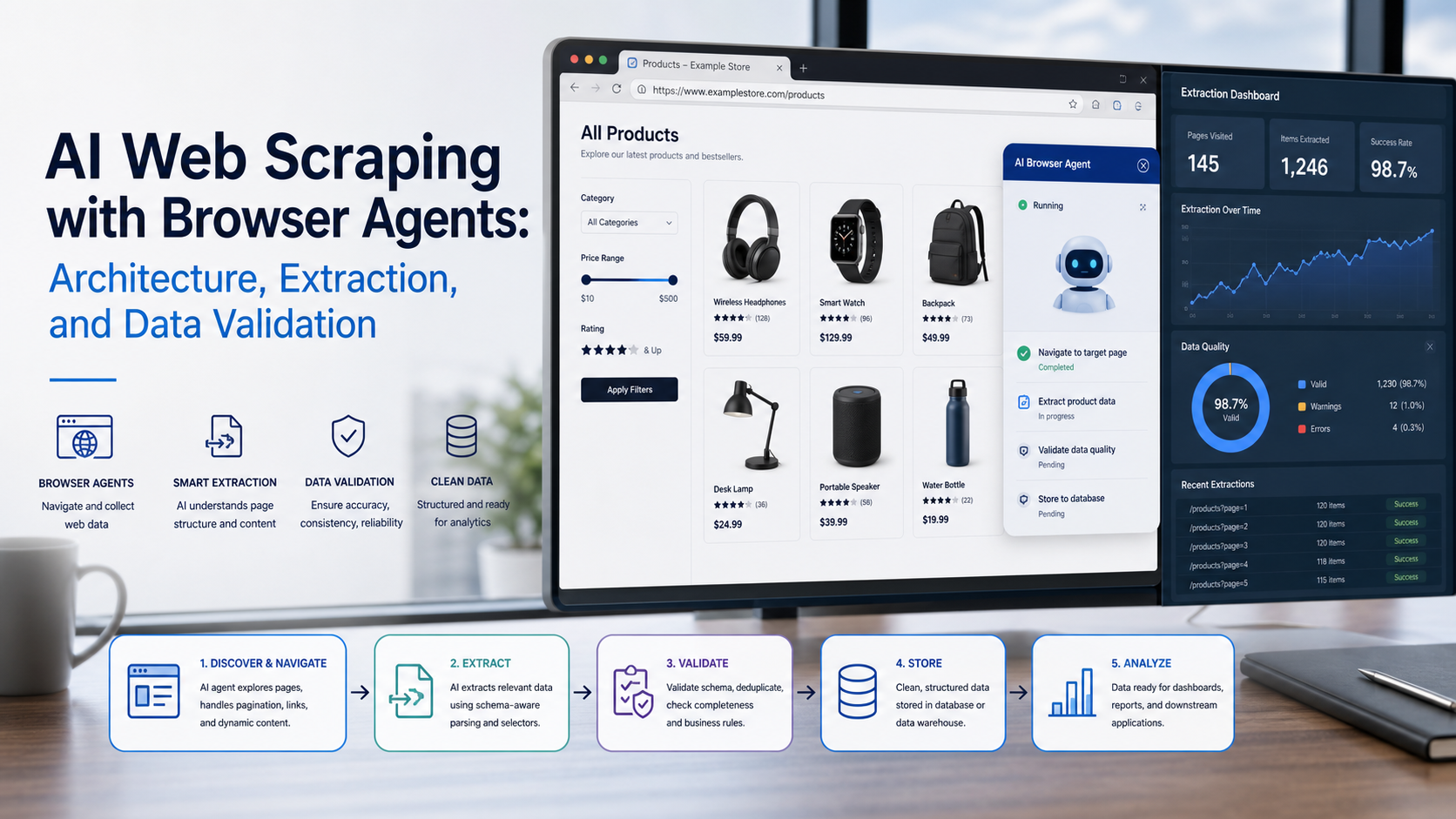
AI Web Scraping with Browser Agents: Architecture, Extraction, and Data Validation
AI web scraping uses AI to help discover, navigate, interpret, or extract information from websites. Browser agents are one implementation option when page interaction, rendering, or layout variation makes a simple scraper too brittle, but the agent should not become the entire data pipeline.
View Details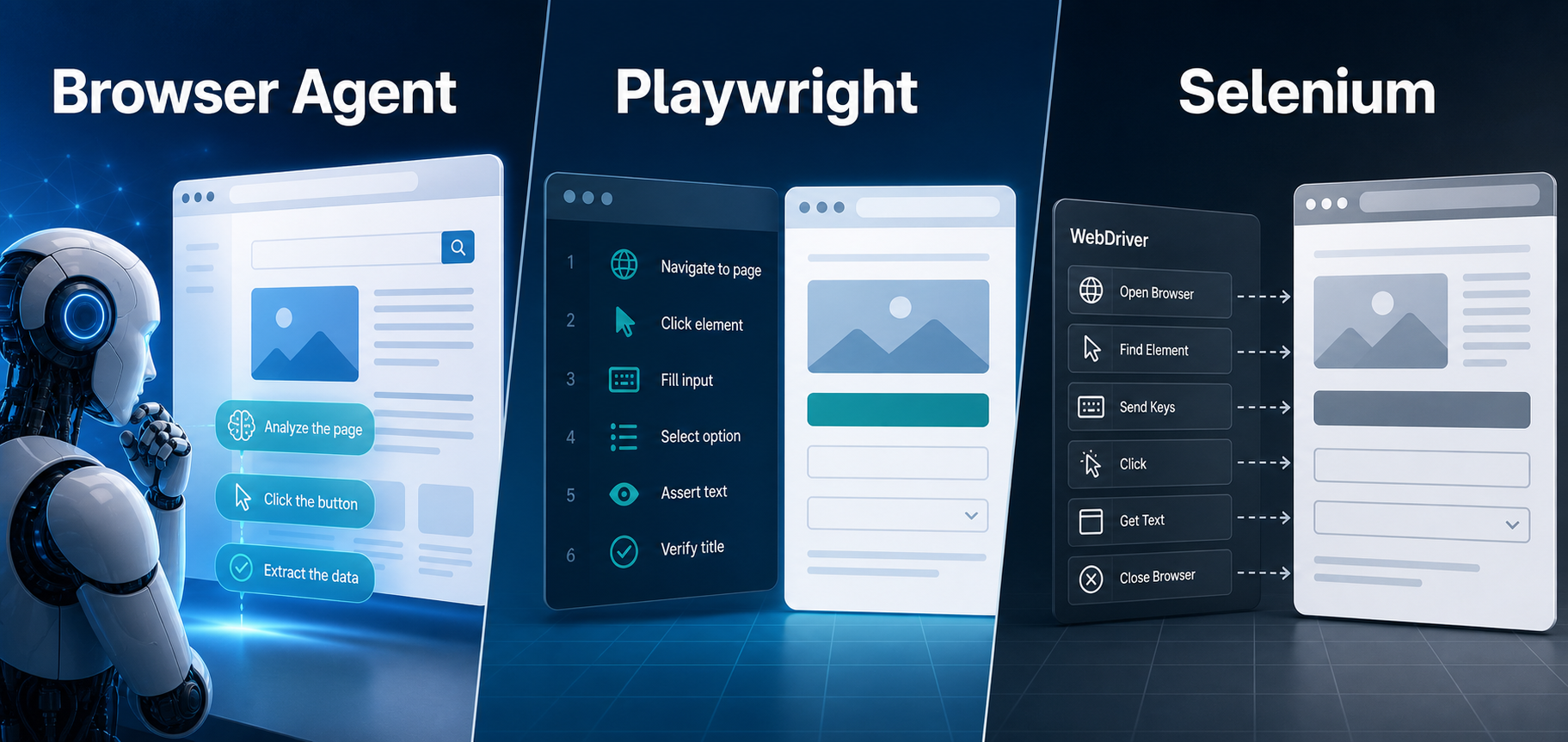
AI Browser Automation: Browser Agents vs Playwright vs Selenium
A browser agent interprets a goal and decides what browser action to take next. Playwright and Selenium can execute explicit, testable browser logic defined by developers. In 2026, however, Playwright also provides official MCP and agent-oriented workflows, so Playwright is no longer just the deterministic alternative to agentic automation. It can also serve as the browser-control layer inside an agent system.
View Details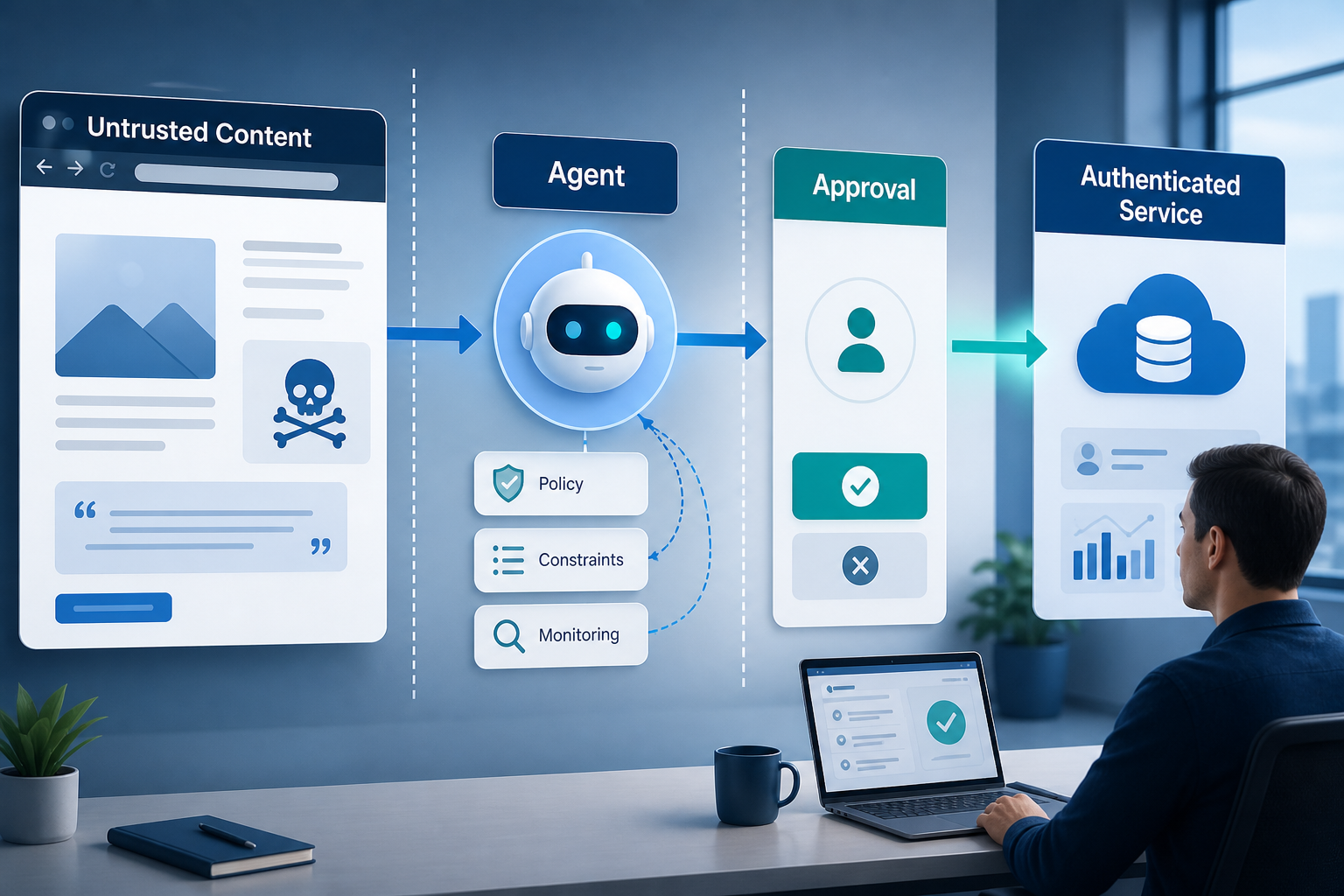
Agentic Browser Security: Prompt Injection, Permissions, and Safe Deployment
That combination creates risks that are different from ordinary browsing and traditional automation. The most important is indirect prompt injection, where hostile instructions hidden in web content attempt to redirect the agent away from the user's goal. Google describes indirect prompt injection as a primary new threat for agentic browsing and has introduced layered defenses that include origin constraints, independent action checks, threat detection, and user confirmation for sensitive actions. Google's Chrome security architecture is a useful reference for how browser-agent defenses are evolving.
View Details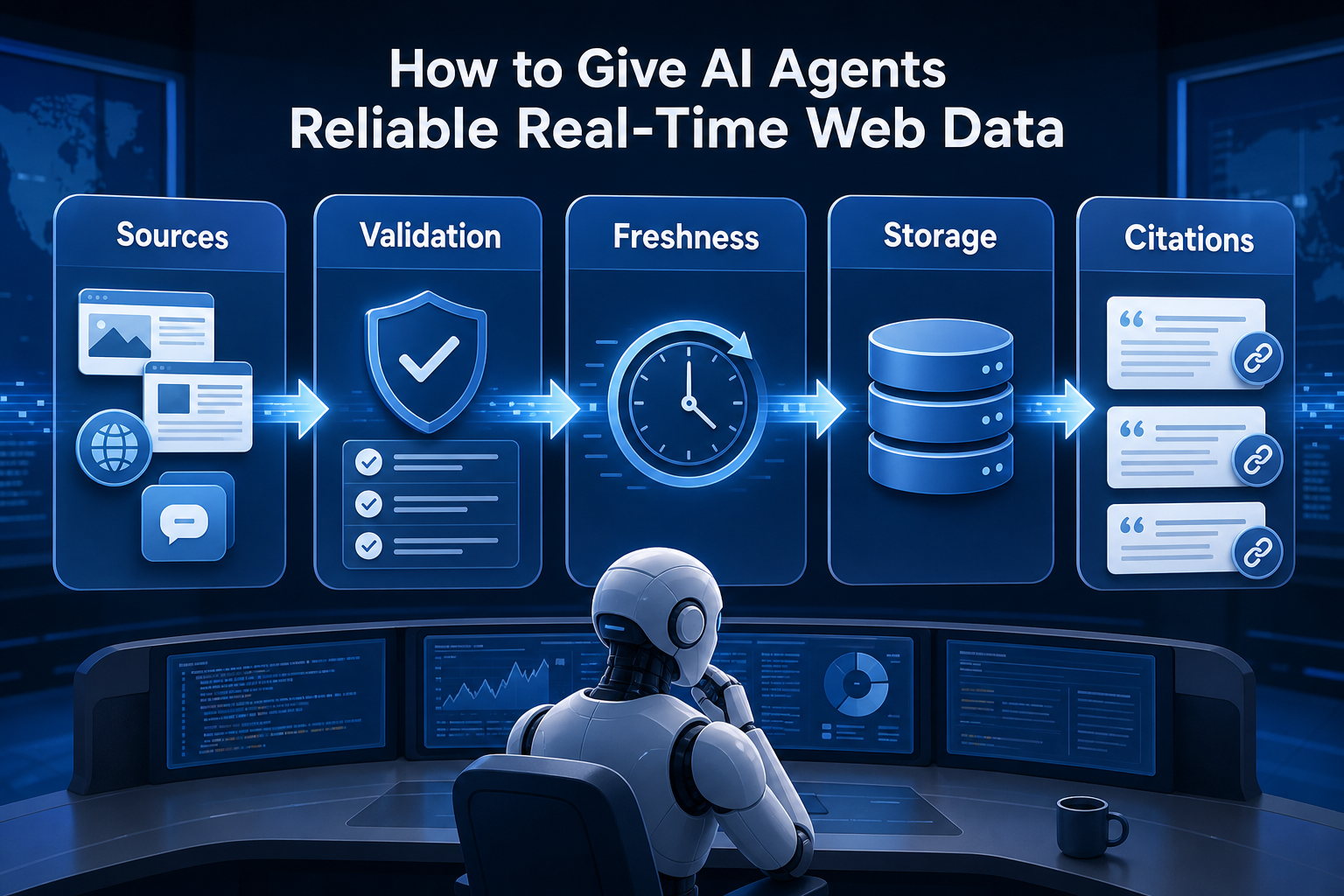
How to Give AI Agents Reliable Real-Time Web Data
A production-ready solution therefore needs more than a web scraper. It needs a web data layer that connects acquisition, validation, storage, retrieval, security, and observability. This guide explains how to design that layer.
View Details