
Self-Repairing Scrapers for Production Environments
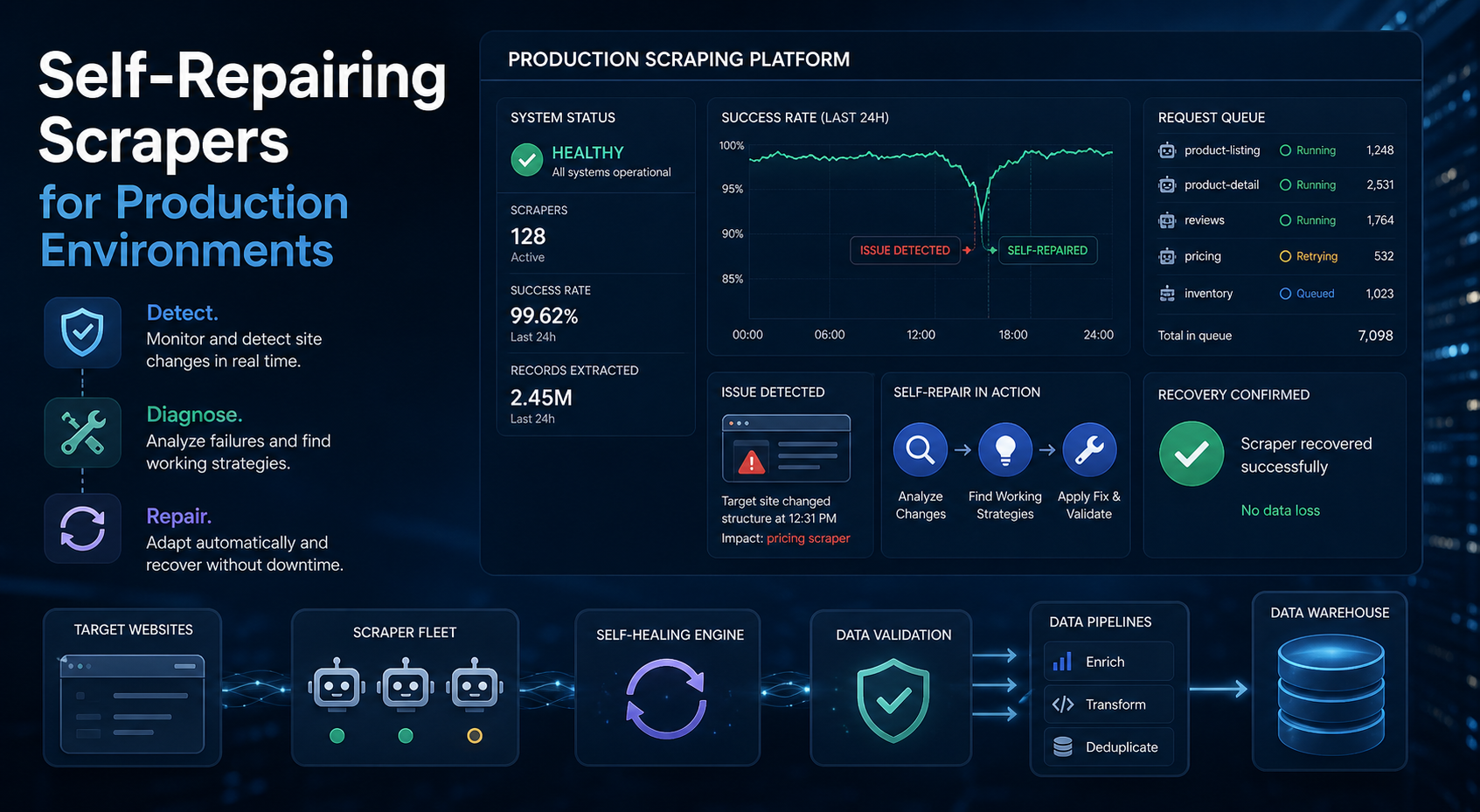
Self-Repairing Scrapers for Production Environments
Your scrapers break every deploy. This one repairs itself automatically.
Production scrapers are mission-critical infrastructure for thousands of engineering teams extracting public data for pricing intelligence, market research, SERP monitoring, and competitive analysis. Yet these systems fail constantly. A single CSS class change on a target site can break extraction logic across hundreds of endpoints. JavaScript refactors invalidate XPath queries. Page structure updates render entire parsing workflows useless.
The result is predictable: engineering teams spend more time fixing scrapers than building features. What should be reliable data pipelines become maintenance nightmares requiring constant intervention. The cost compounds when data gaps trigger downstream failures in pricing engines, inventory systems, and business intelligence dashboards.
How Self-Healing Parsers Detect and Fix Broken Selectors in Real-Time
The Selector Fragility Problem
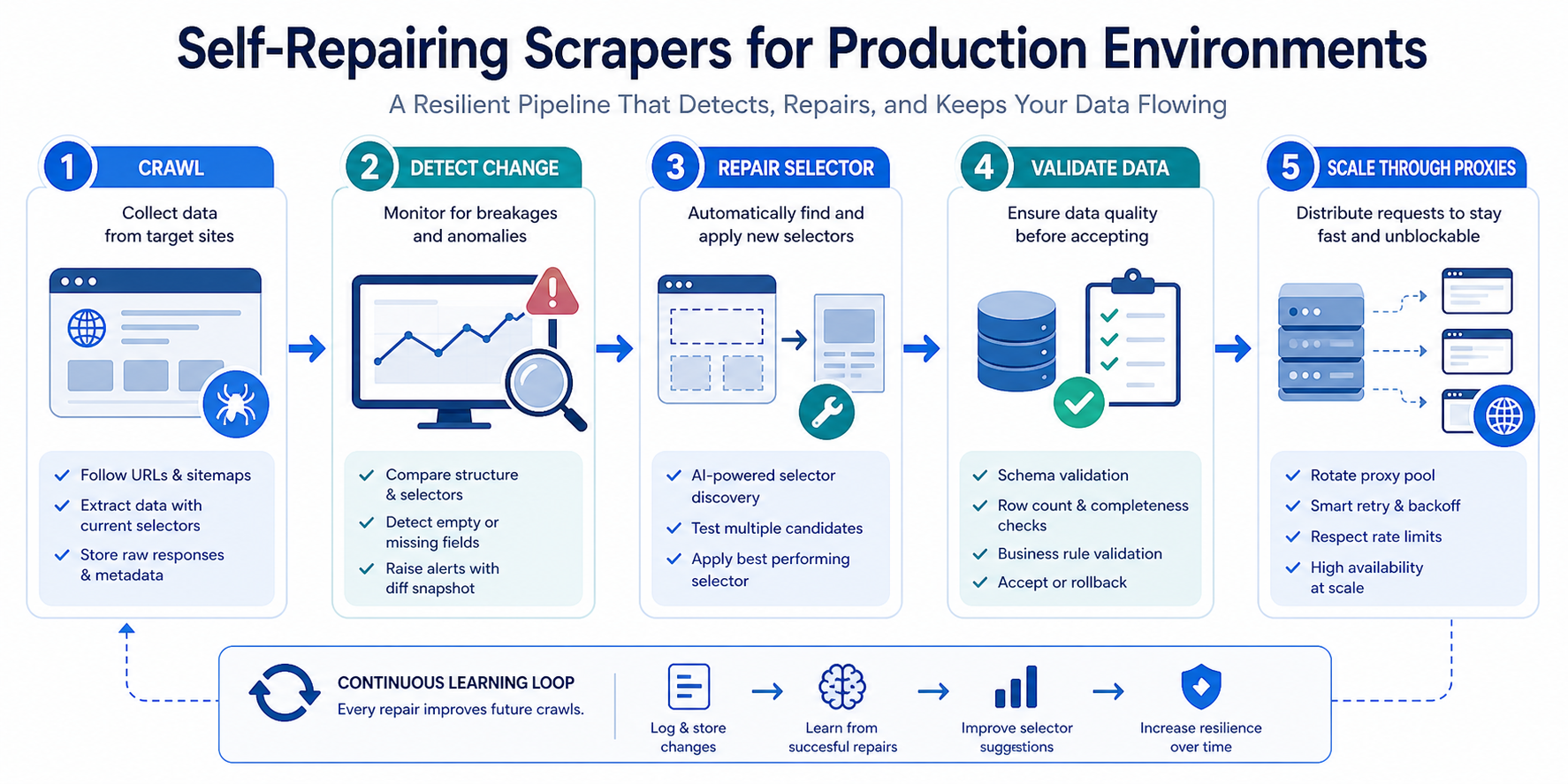
Traditional scrapers rely on brittle extraction logic. A typical parser targets specific DOM elements using CSS selectors or XPath expressions:
price = soup.select('.product-price-main')[0].text
title = soup.select('h1.product-title')[0].text
This approach fails immediately when sites update their HTML structure. Frontend teams routinely:
- Rename CSS classes during refactors
- Restructure DOM hierarchies for performance
- Change element types or nesting patterns
- Implement A/B tests with different markup
- Deploy regional variations with localized HTML
Each change breaks selectors that worked perfectly the day before. Engineering teams discover failures only after data gaps appear in production systems, sometimes hours or days after the breaking change.
Adaptive Selector Strategies
Self-healing parsers implement multiple extraction strategies simultaneously, validating results and switching methods when primary selectors fail.
Selector fallback chains define multiple paths to the same data:
FIELD_STRATEGIES = {
'price': [
{'css': '.product-price-main'},
{'css': '[data-testid="price"]'},
{'xpath': '//span[contains(@class, "price")]'},
{'regex': r'\$([0-9,\.]+)'},
]
}
The parser attempts each strategy in order, validating extracted values against expected patterns. If the primary selector returns empty results or invalid data, the system automatically tries the next approach without human intervention.
Semantic targeting identifies elements by purpose rather than structure. Instead of hardcoding class names, parsers analyze:
- Element context and surrounding text
- Attribute patterns common to specific data types
- Position relationships between elements
- Text content patterns and formatting
A price extractor might look for numeric text preceded by currency symbols, contained in elements near "Add to Cart" buttons, regardless of specific CSS classes.
Real-Time Validation and Repair
Self-healing systems validate extracted data against business logic rules:
- Price fields must contain numeric values within reasonable ranges
- Product titles should have minimum length thresholds
- Availability status must match known value sets
- Image URLs should return valid responses
When validation fails, the system triggers repair workflows:
- Selector diagnosis: The parser identifies which extraction strategy failed
- Alternative method testing: Fallback selectors are evaluated against the current page
- Pattern learning: Successful alternative methods are promoted for future requests
- Alert generation: Engineering teams receive notifications with context about what broke and what worked
For the LycheeIP implementation details behind this step, review AI-powered browser automation hub.
Machine Learning for Selector Adaptation
Advanced implementations use supervised learning to identify target elements. Training data consists of labeled examples showing correct extraction targets across page variations.
During execution, the model:
- Analyzes page structure as a DOM tree with node features
- Scores elements by likelihood of containing target data
- Extracts from highest-confidence nodes
- Updates confidence scores based on validation results
When sites change, the model adapts by recognizing similar patterns in new page structures. This approach is particularly effective for scraping many sites with similar content types, where patterns learned from one target generalize to others.
Fingerprinting and Change Detection
Self-healing scrapers maintain page fingerprints to detect structural changes before extraction fails completely. Fingerprints capture:
- Overall DOM structure and depth
- Element count distributions
- Critical path signatures from root to target elements
- Asset loading patterns and external resource dependencies
When fingerprints change beyond threshold values, the system triggers proactive validation and selector testing before deploying standard extraction logic. This early warning system prevents data gaps by identifying problems during test runs rather than production scraping.
Cloudflare Bypass and JavaScript Rendering for Protected Pages
Anti-Bot Protection Challenges
Self-healing selectors solve only half the production scraping problem. Many high-value targets implement sophisticated anti-bot systems that block scrapers entirely:
- Cloudflare Bot Management analyzes browser fingerprints, TLS characteristics, and request patterns
- PerimeterX uses behavioral analysis and device fingerprinting
- Akamai Bot Manager evaluates hundreds of signals to distinguish humans from bots
- Custom solutions implement CAPTCHAs, rate limiting, and IP reputation checks
These systems trigger before your parser even sees HTML. No amount of selector intelligence helps when requests return 403 errors or JavaScript challenge pages.
JavaScript Rendering Requirements
Modern sites depend heavily on client-side rendering. React, Vue, and Angular applications deliver minimal HTML, populating content through JavaScript execution. Traditional HTTP libraries see only skeleton markup:
The actual product data, prices, and availability information only appear after JavaScript executes, makes API calls, and updates the DOM. Scrapers must render pages in real browsers to access this content.
Headless Browser Integration
Production self-healing scrapers integrate headless browsers for JavaScript execution:
For the official technical reference behind this point, see Playwright documentation.
Playwright and Puppeteer provide programmatic browser control:
- Execute JavaScript and wait for dynamic content
- Interact with pages through clicks, scrolls, and form submissions
- Handle multiple browser contexts and sessions
- Take screenshots for debugging and validation
Headless browsers expose realistic browser fingerprints, making them harder for anti-bot systems to detect than raw HTTP requests.
Browser context management pools resources efficiently:
- Reuse browser instances across multiple scraping tasks
- Maintain separate cookie jars and local storage per target
- Rotate user agents and viewport configurations
- Clean up resources to prevent memory leaks during long-running operations
Stealth Techniques and Fingerprint Normalization
Headless browsers are still detectable through automation signals. Anti-bot systems check for:
- `navigator.webdriver` property set to true
- Missing or inconsistent browser plugin lists
- Chrome DevTools Protocol signatures
- WebGL renderer mismatches with claimed hardware
- Automation-specific JavaScript properties
For the LycheeIP implementation details behind this step, review LycheeIP proxy infrastructure.
Stealth plugins modify browser environments to remove these signals:
await page.evaluateOnNewDocument(() => {
delete navigator.__proto__.webdriver;
Object.defineProperty(navigator, 'plugins', {
get: () => [/ realistic plugin list /]
});
});
Production systems combine stealth techniques with residential proxy infrastructure to present realistic request profiles indistinguishable from genuine users.
Proxy Infrastructure for Scale and Stealth
Self-healing scrapers at scale require sophisticated proxy strategies. Sending thousands of requests from datacenter IPs triggers immediate blocks. Production architectures use:
Residential proxies route requests through real user devices:
- IPs associated with ISPs and residential networks
- Geographically distributed across target markets
- Lower detection rates than datacenter sources
- Essential for protected high-value targets
Rotating proxy pools prevent IP reputation issues:
- Distribute requests across thousands of exit IPs
- Implement request limits per IP to avoid rate limiting
- Maintain session persistence when required for multi-step workflows
- Handle geographic targeting for localized content
Static residential IPs support session-based scraping:
- Maintain consistent IPs for login workflows
- Support shopping cart and checkout testing
- Enable account-based data collection
- Reduce CAPTCHA frequency compared to rotating pools
LycheeIP provides proxy infrastructure designed specifically for these production scraping workflows, supporting residential, datacenter, and static residential options with geographic targeting capabilities across multiple markets.
For the LycheeIP implementation details behind this step, review rotating residential proxies.
For the LycheeIP implementation details behind this step, review static residential proxies.
For the official technical reference behind this point, see MDN HTTP overview.
CAPTCHA Handling and Human Verification
Even with perfect fingerprints and residential IPs, high-security targets occasionally present CAPTCHAs. Production systems need fallback strategies:
- CAPTCHA solving services integrate with 2Captcha, Anti-Captcha, or similar platforms
- Human verification queues route challenging requests to manual operators
- Request spacing and rate limiting reduce CAPTCHA frequency
- Session warmup performs browsing actions before critical extractions to build trust scores
The goal is minimizing CAPTCHA encounters through proper infrastructure rather than solving every challenge.
Spider Framework Architecture for Large-Scale Scraping Operations
From Scripts to Production Systems
Single-file scraper scripts become unmaintainable at scale. Production teams need frameworks that support:
- Hundreds or thousands of target sites
- Multiple data types and extraction patterns
- Distributed execution across worker pools
- Request queuing and prioritization
- Error handling and retry logic
- Monitoring and alerting infrastructure
- Data validation and quality assurance
Spider frameworks provide the architectural foundation for these requirements.
Scrapy and Distributed Crawling
Scrapy is the dominant Python framework for production web scraping. Its architecture separates concerns:
Spider classes define extraction logic:
class ProductSpider(scrapy.Spider):
name = 'product_spider'


def parse(self, response):
# Self-healing selector logic
for strategy in self.field_strategies['price']:
price = self.try_extract(response, strategy)
if self.validate_price(price):
break


yield {
'price': price,
'url': response.url,
'timestamp': datetime.now()
}
Middleware components handle cross-cutting concerns:
- Proxy rotation and session management
- User agent randomization
- Retry logic with exponential backoff
- Request throttling and politeness policies
- Custom header injection
Pipelines process and store extracted data:
- Validation against business rules
- Deduplication across scraping runs
- Database insertion or file export
- Data transformation and enrichment
Settings and configuration centralize operational parameters:
- Concurrent request limits
- Download delays and auto-throttling
- Memory usage constraints
- Logging and telemetry configuration
Distributed Task Queues
Scaling beyond single machines requires distributed architectures. Celery and similar task queues distribute scraping jobs across worker pools:
@celery.task
def scrape_product_page(url, spider_config):
spider = ProductSpider(spider_config)
return spider.scrape(url)
Workers pull tasks from message brokers like Redis or RabbitMQ, execute scraping logic, and return results. This architecture supports:
- Horizontal scaling by adding workers
- Task prioritization for time-sensitive data
- Retry policies for failed requests
- Result aggregation and batch processing
Request Scheduling and Politeness
Production scrapers must balance speed with responsible resource usage. Overwhelming targets with requests:
- Triggers anti-bot defenses
- Degrades site performance for legitimate users
- Violates terms of service
- Risks legal complications
Frameworks implement multiple throttling strategies:
Rate limiting restricts requests per time window:
- Concurrent request limits per domain
- Minimum delays between requests to the same host
- Backoff multipliers when errors increase
Auto-throttling adjusts rates based on target response:
- Monitors response times and error rates
- Reduces concurrency when targets slow down
- Increases throughput when sites respond quickly
Politeness configuration respects standard conventions:
- Parse and obey robots.txt directives where applicable
- Identify scrapers with accurate user agent strings
- Implement crawl delays specified by site operators
Monitoring and Observability
Production scraping systems require comprehensive observability:
Metrics and dashboards track operational health:
- Request success rates and error distributions
- Extraction success rates per field and site
- Proxy performance and IP rotation effectiveness
- Data freshness and pipeline delays
- Worker resource utilization and throughput
Alerting rules notify teams of issues:
- Extraction success rates dropping below thresholds
- Increasing 403/429 error rates indicating blocks
- Data validation failures suggesting selector breakage
- Queue depth indicating processing bottlenecks
Logging and debugging support troubleshooting:
- Structured logs with request context
- Failed request samples for analysis
- HTML snapshots of problematic pages
- Trace IDs linking requests through distributed systems
Data Quality and Validation
Self-healing scrapers must validate extracted data continuously:
Schema validation ensures structural correctness:
- Required fields present in all records
- Data types matching expectations
- Value constraints and enumeration checks
Business rule validation catches extraction errors:
- Prices within expected ranges for product categories
- Temporal consistency across scraping runs
- Relationship validation between related fields
- Duplicate detection and handling
Quality metrics quantify data reliability:
- Completeness scores per field and site
- Freshness measurements and update frequencies
- Error rates and failure modes
- Comparison against baseline patterns
Poor quality metrics trigger alerts and selector repair workflows before bad data reaches downstream consumers.
LycheeIP and Production Scraping Infrastructure
Self-healing scraper frameworks depend fundamentally on robust proxy infrastructure. Even the most adaptive parsing logic fails when requests are blocked at the network level.
Production teams running business-critical scrapers evaluate proxy providers on:
- IP pool diversity supporting geographic and ISP distribution requirements
- Session control for multi-step workflows and authenticated scraping
- Performance consistency maintaining low latency across high request volumes
- Reliability with high uptime and automatic failover
- Integration patterns supporting Scrapy middleware, Playwright proxies, and custom rotation logic
LycheeIP provides proxy infrastructure designed for these production scraping workflows. Teams building self-healing systems use LycheeIP's residential, datacenter, and static residential proxies to support:
- E-commerce product monitoring and pricing intelligence
- SERP tracking across geographic markets
- Public data collection for market research
- Ad verification and creative testing
- Availability monitoring and inventory tracking
The combination of adaptive parsing logic, anti-detection measures, and reliable proxy infrastructure creates resilient scraping systems that maintain data flow despite site changes and protection systems.
Common Mistakes and Considerations
Engineering teams implementing self-healing scrapers should avoid these common pitfalls:
Over-Engineering Extraction Logic
Building complex machine learning models for simple extraction tasks adds unnecessary overhead. Start with selector fallback chains and semantic targeting. ML-based approaches make sense when:
- Scraping hundreds of similar sites where patterns generalize
- Target sites change frequently with unpredictable structure
- Manual selector maintenance costs exceed model training investment
For smaller operations targeting a few sites, traditional methods with good fallback strategies are more practical.
Ignoring Responsible Scraping Practices
Self-healing capabilities don't eliminate responsibilities around ethical data collection:
- Review target site terms of service before large-scale scraping
- Implement appropriate rate limiting to avoid overloading sites
- Consider robots.txt guidance for public crawlers
- Use scraped data only for legitimate purposes like market research, pricing intelligence, and public data analysis
- Avoid scraping personal information or sensitive content
Proxy infrastructure and stealth techniques enable access, but responsible use remains essential.
Inadequate Error Handling
Self-healing parsers still fail in edge cases. Production systems need:
- Dead letter queues for repeatedly failed requests
- Human review workflows for ambiguous cases
- Graceful degradation when data quality drops
- Circuit breakers preventing cascading failures
Automatic healing reduces maintenance burden but doesn't eliminate it entirely.
Proxy Cost Optimization
Residential proxies are significantly more expensive than datacenter alternatives. Optimize costs by:
- Using datacenter proxies for low-security targets
- Implementing intelligent proxy selection based on site protection levels
- Caching responses to reduce redundant requests
- Consolidating data extraction to minimize total request volumes
Balancing cost and effectiveness requires understanding which targets truly require residential infrastructure.
Neglecting Data Pipeline Integration
Scraping is only valuable when data reaches downstream systems reliably. Plan for:
- Schema evolution as extraction logic adapts
- Data versioning and historical comparison
- Integration with existing ETL and data warehouse infrastructure
- Quality gates preventing bad data propagation
Self-healing scrapers generate evolving data patterns that require flexible downstream processing.
See LycheeIP Proxy Infrastructure for Production Scrapers
Conclusion
Production scrapers break constantly because the web is dynamic. Sites update structure, implement protection systems, and deploy variations that invalidate extraction logic. Traditional brittle parsers require constant engineering intervention, turning data collection into an endless maintenance cycle.
Self-healing scraper frameworks provide an alternative architecture. Adaptive selector strategies, real-time validation, and automatic repair workflows maintain extraction reliability despite site changes. Integration with headless browsers, stealth techniques, and residential proxy infrastructure enables access to protected, JavaScript-rendered content. Spider frameworks provide the operational foundation for scaling these systems across thousands of targets.
The result is resilient data pipelines that maintain flow with minimal intervention. Engineering teams spend less time fixing broken selectors and more time building products. Business-critical data workflows become reliable infrastructure rather than fragile scripts.
Implementing these systems requires investment in architecture, monitoring, and infrastructure. But for teams depending on scraped data for pricing, inventory, market intelligence, or competitive analysis, self-healing scrapers transform web data collection from a constant headache into dependable infrastructure.
Frequently Asked Questions
What makes a scraper "self-healing"?
A self-healing scraper automatically detects when extraction logic fails and adapts without manual intervention. This includes maintaining multiple selector strategies per field, validating extracted data against business rules, automatically switching to fallback methods when primary selectors break, and learning from successful adaptations to improve future extraction.
Do self-healing scrapers eliminate the need for maintenance?
No. Self-healing capabilities significantly reduce maintenance frequency and manual intervention, but don't eliminate it entirely. Edge cases, major site redesigns, and new anti-bot protections still require engineering attention. The goal is reducing routine maintenance from daily to occasional rather than achieving zero maintenance.
How do adaptive selectors differ from traditional CSS or XPath queries?
Traditional selectors rely on specific DOM structure that breaks when sites change. Adaptive approaches use multiple strategies simultaneously: selector fallback chains try alternatives when primary methods fail, semantic targeting identifies elements by purpose rather than class names, and validation confirms extracted values match expected patterns before accepting results.
What types of sites require residential proxies versus datacenter IPs?
High-value e-commerce sites, search engines, social media platforms, and any target with sophisticated anti-bot protection typically require residential proxies. Datacenter IPs work for smaller sites, B2B platforms, and targets without advanced bot detection. The key factor is whether the site actively blocks datacenter IP ranges and analyzes browser fingerprints.
Can self-healing scrapers bypass CAPTCHAs automatically?
Self-healing capabilities don't directly solve CAPTCHAs, but proper infrastructure reduces CAPTCHA frequency dramatically. Using residential proxies, realistic browser fingerprints, appropriate rate limiting, and session warmup minimizes challenges. When CAPTCHAs appear, systems integrate with solving services or route to human operators as fallbacks.
How do you validate that extracted data is correct after automatic healing?
Validation combines multiple strategies: schema checks ensure structural correctness, business rule validation confirms values are reasonable for the data type, temporal consistency analysis flags sudden changes across scraping runs, spot checking samples against live sites provides ground truth, and monitoring extraction success rates per field identifies degradation patterns.
What's the difference between self-healing selectors and machine learning extraction?
Self-healing selectors use rule-based fallback strategies and semantic targeting that developers define explicitly. Machine learning approaches train models to identify target elements based on labeled examples, learning patterns that generalize across sites. ML is more powerful for large-scale operations with many similar targets but adds complexity and training overhead.
How do you implement request throttling that respects both speed and politeness?
Production frameworks use multiple throttling layers: concurrent request limits per domain prevent overwhelming targets, minimum delays between requests to the same host space out traffic, auto-throttling monitors response times and adjusts rates dynamically, and backoff multipliers reduce aggression when error rates increase. The goal is maximizing throughput while staying below detection and overload thresholds.
What frameworks work best for building production self-healing scrapers?
Scrapy provides the most mature Python framework with middleware for proxies, retries, and throttling. Playwright or Puppeteer handle JavaScript rendering requirements. Celery or similar task queues enable distributed execution. The specific combination depends on scale, target complexity, and team expertise. Most production systems combine multiple tools into integrated architectures.
How much does proxy infrastructure cost for large-scale scraping operations?
Costs vary dramatically based on proxy type and volume. Datacenter proxies typically cost $1-3 per IP monthly. Residential proxies charge per gigabyte, ranging from $5-15/GB depending on targeting requirements and provider. Static residential IPs fall between these extremes. Large-scale operations spending thousands monthly on proxies are common for business-critical data collection. Optimization through intelligent proxy selection and request minimization significantly impacts economics.
Related LycheeIP Guides and Resources

Recommended Articles

AI Search API for AI Agents: How to Ground LLMs With Live Search Data
An AI search API gives an application or agent programmatic access to current search results. Its most useful role is discovery: the agent can find candidate sources, identify fresh information, and decide what to retrieve next instead of relying only on model memory.
View Details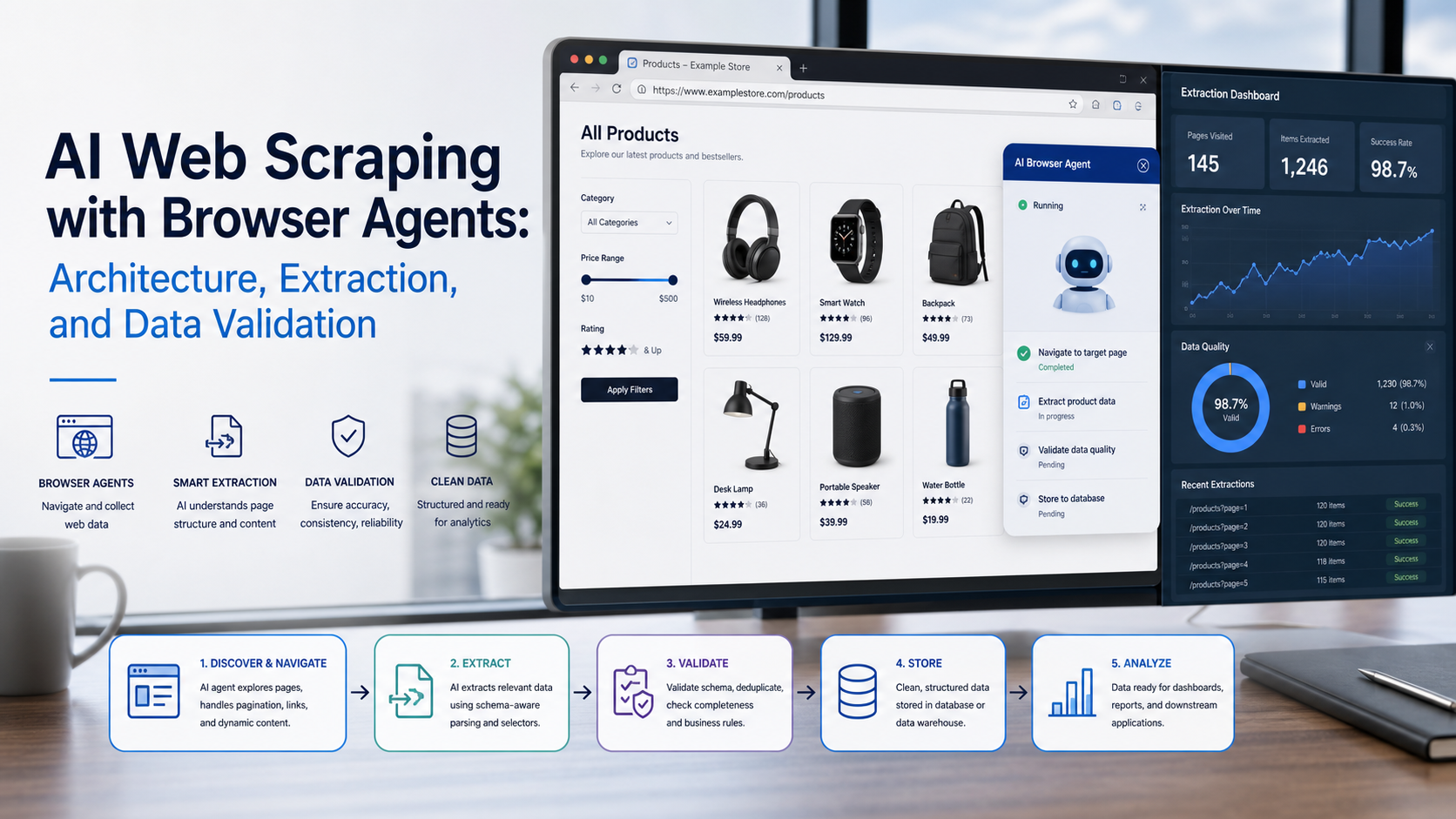
AI Web Scraping with Browser Agents: Architecture, Extraction, and Data Validation
AI web scraping uses AI to help discover, navigate, interpret, or extract information from websites. Browser agents are one implementation option when page interaction, rendering, or layout variation makes a simple scraper too brittle, but the agent should not become the entire data pipeline.
View Details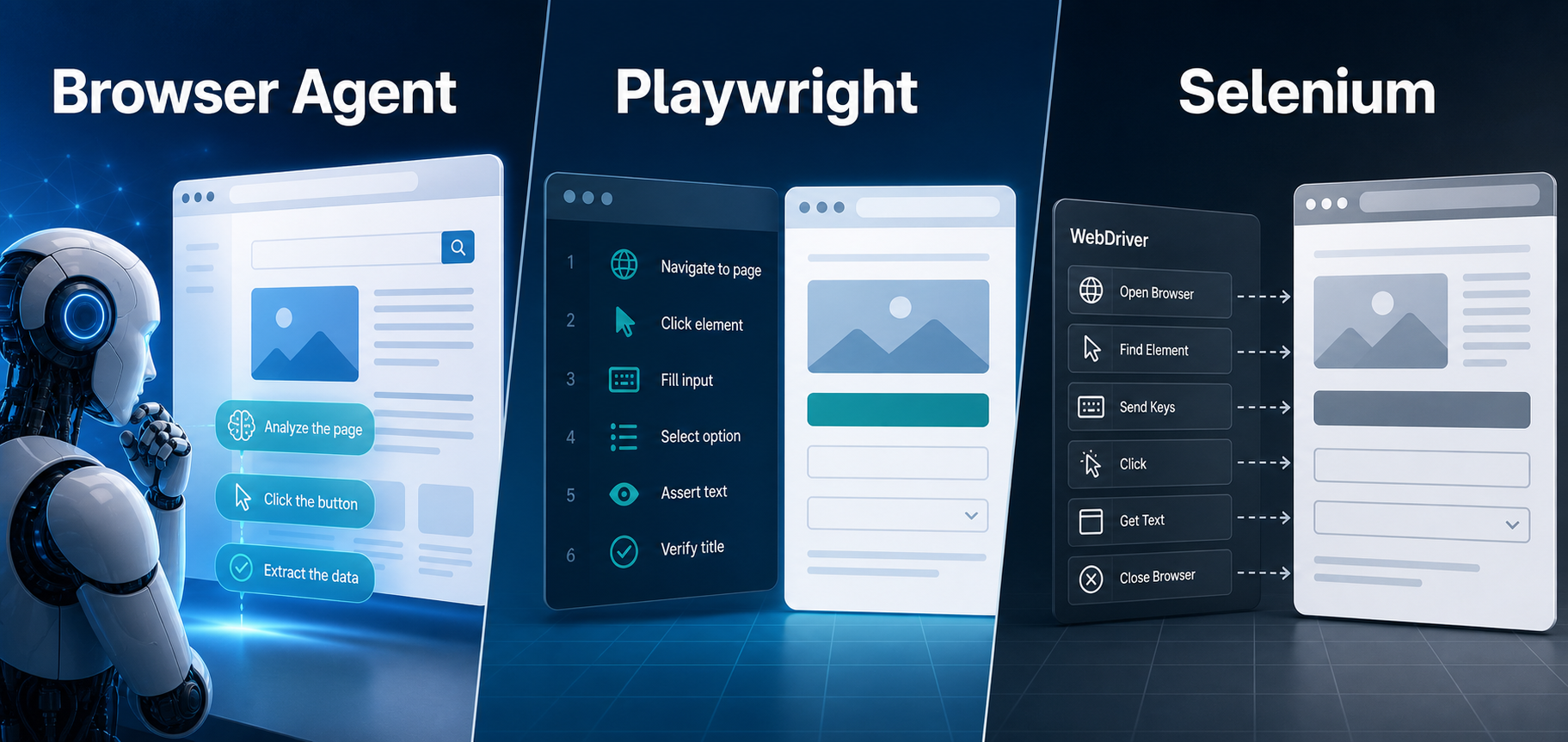
AI Browser Automation: Browser Agents vs Playwright vs Selenium
A browser agent interprets a goal and decides what browser action to take next. Playwright and Selenium can execute explicit, testable browser logic defined by developers. In 2026, however, Playwright also provides official MCP and agent-oriented workflows, so Playwright is no longer just the deterministic alternative to agentic automation. It can also serve as the browser-control layer inside an agent system.
View Details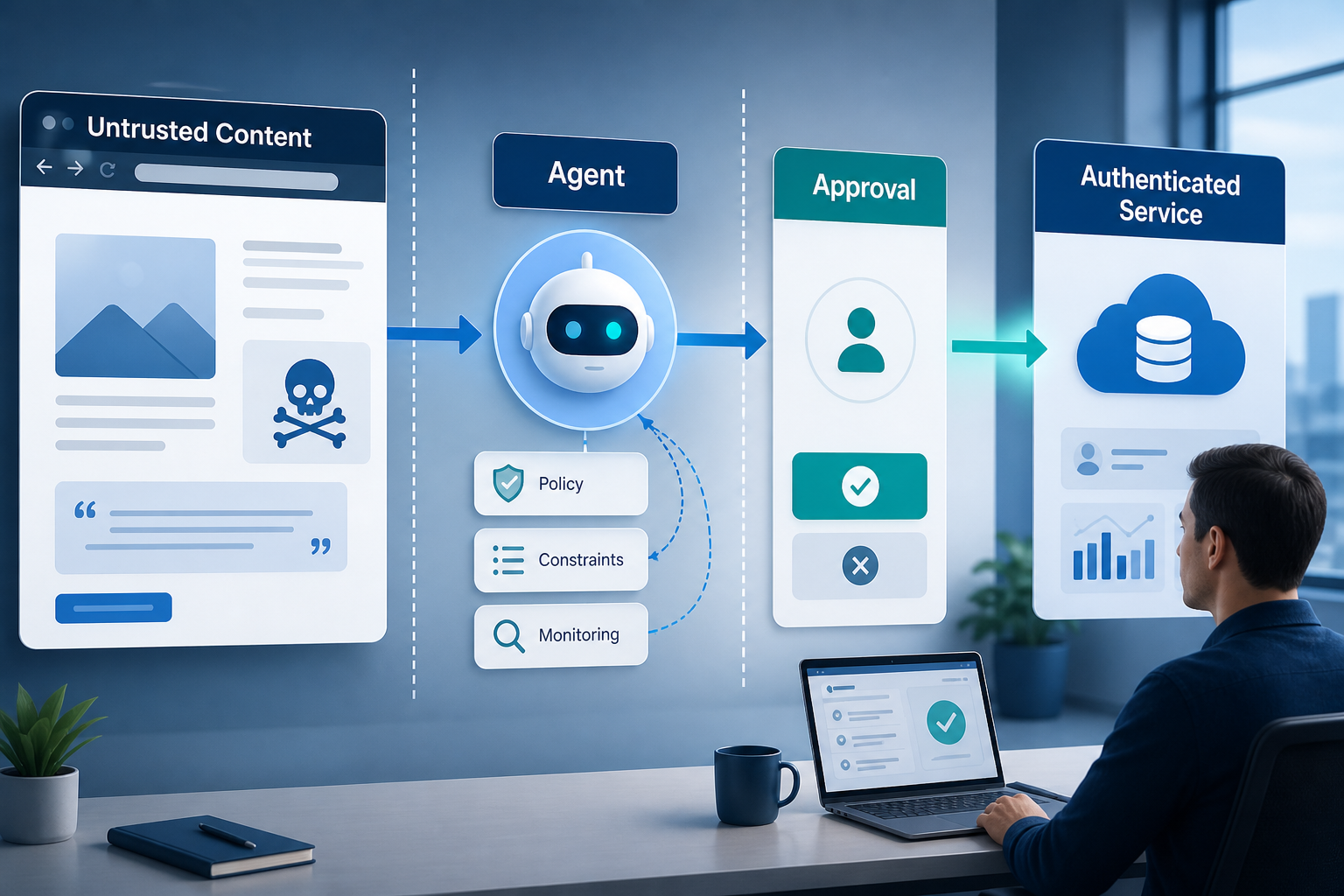
Agentic Browser Security: Prompt Injection, Permissions, and Safe Deployment
That combination creates risks that are different from ordinary browsing and traditional automation. The most important is indirect prompt injection, where hostile instructions hidden in web content attempt to redirect the agent away from the user's goal. Google describes indirect prompt injection as a primary new threat for agentic browsing and has introduced layered defenses that include origin constraints, independent action checks, threat detection, and user confirmation for sensitive actions. Google's Chrome security architecture is a useful reference for how browser-agent defenses are evolving.
View Details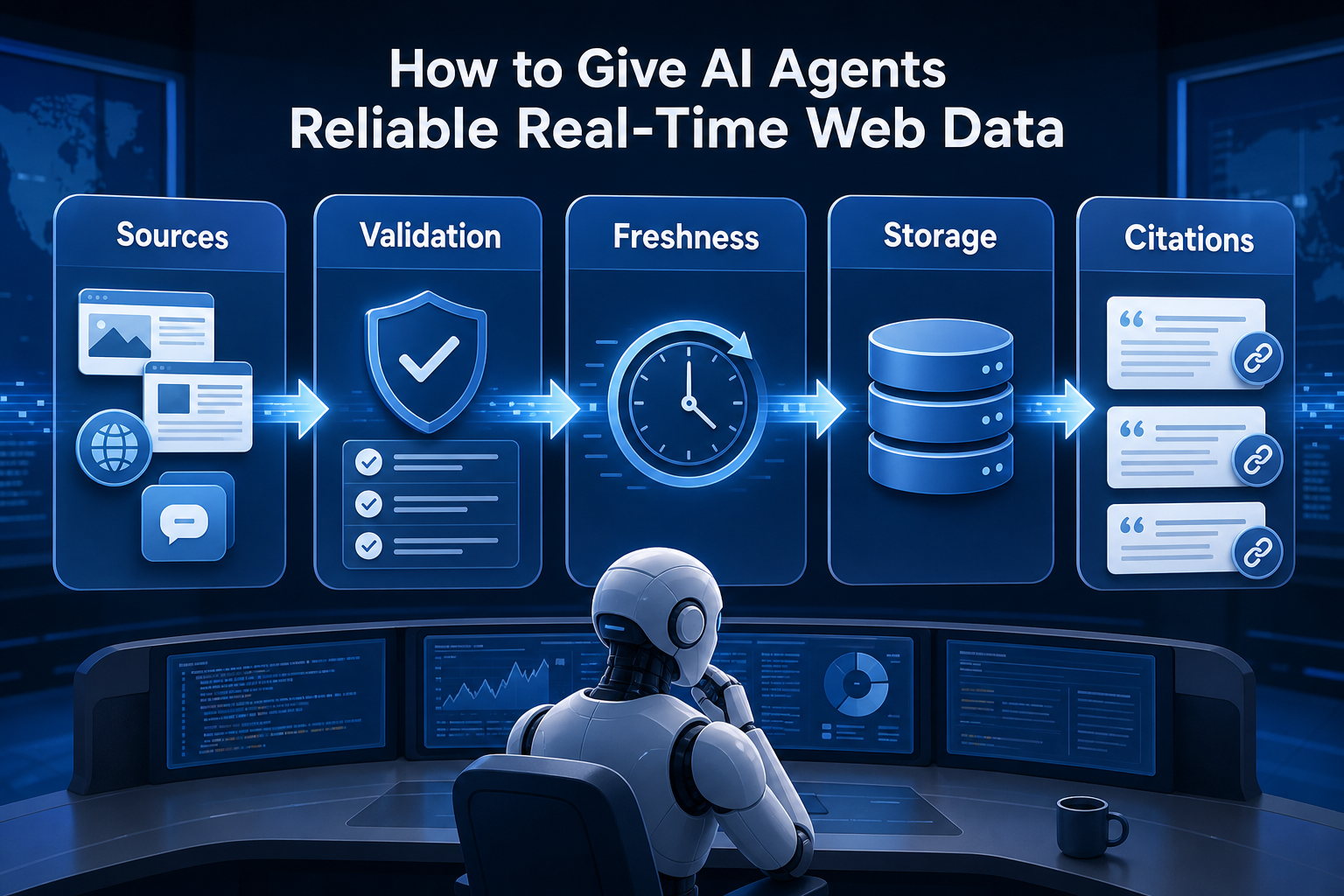
How to Give AI Agents Reliable Real-Time Web Data
A production-ready solution therefore needs more than a web scraper. It needs a web data layer that connects acquisition, validation, storage, retrieval, security, and observability. This guide explains how to design that layer.
View Details