
Self-Healing Web Scrapers That Never Break
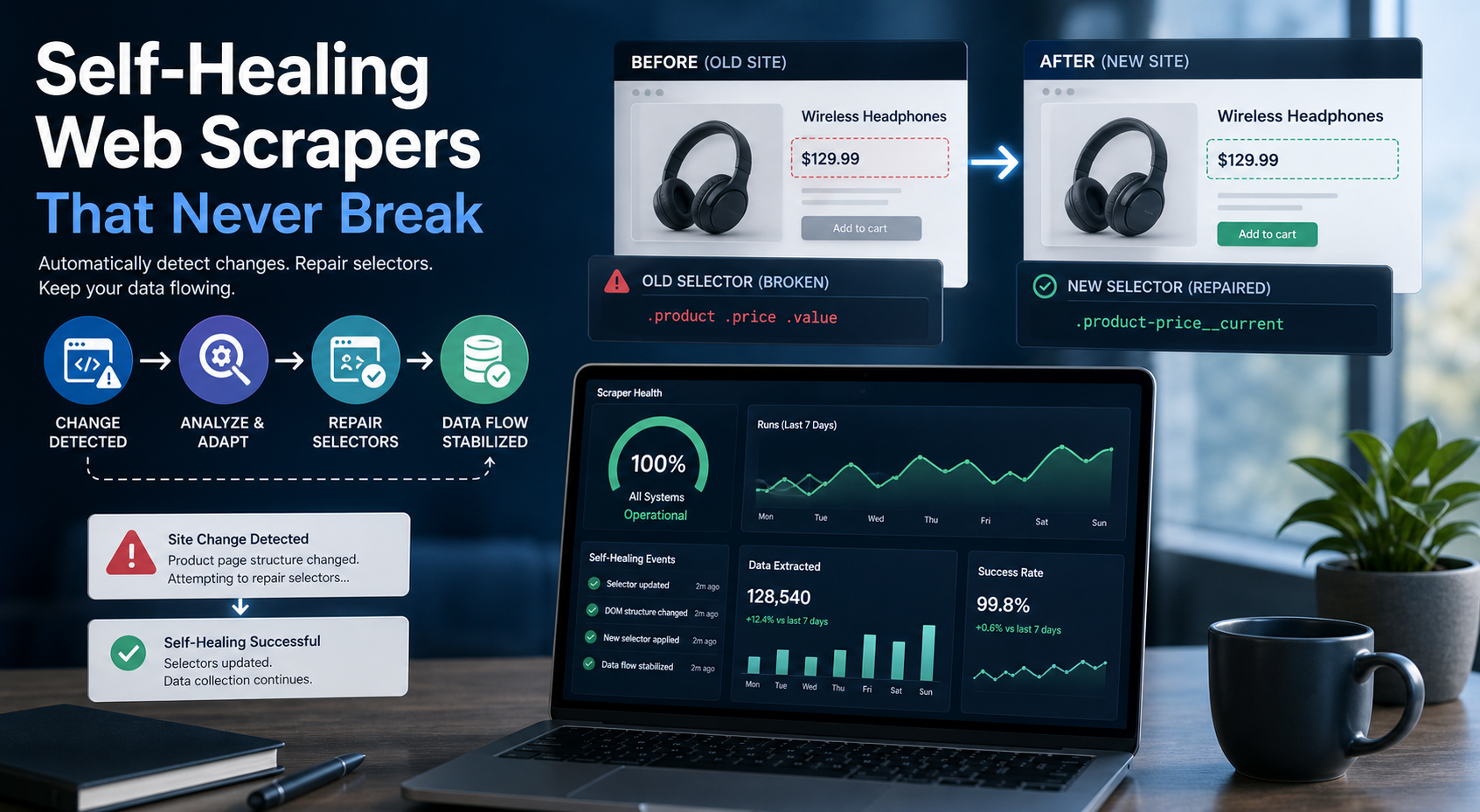
Your Scrapers Break Every Week. Here's One That Fixes Itself.
Web scrapers break constantly when websites change their structure. A single CSS class rename, a shuffled DOM hierarchy, or a new JavaScript framework can turn weeks of scraping work into useless code. Data engineers and Python developers know this pain intimately. You wake up to Slack alerts about failed pipelines, spend hours updating selectors, deploy fixes, and repeat the cycle when the next redesign drops.
This maintenance burden isn't just annoying. It's expensive. Every broken scraper means missing data, delayed reports, and engineering time spent on repetitive fixes instead of building new features. Traditional scrapers are brittle by design because they rely on exact HTML patterns that websites change without notice.
Self-healing scrapers solve this problem by adapting to structural changes automatically. Instead of breaking when a CSS selector fails, these systems use adaptive AI frameworks to identify alternative extraction patterns, repair broken selectors in real-time, and continue collecting data without manual intervention. The result is scraping infrastructure that requires dramatically less maintenance while remaining reliable through website updates.
How Scrapling's Self-Healing Parser Adapts to Website Changes Automatically
Traditional web scraping relies on rigid selectors. You inspect a page, identify the HTML element containing your target data, write a CSS selector or XPath expression, and extract content. This works until the website changes. When a developer renames a class from <code style="background:#f2f4f7;border:1px solid #d0d5dd;border-radius:5px;padding:1px 5px;color:#101828;">product-price</code> to <code style="background:#f2f4f7;border:1px solid #d0d5dd;border-radius:5px;padding:1px 5px;color:#101828;">price-container</code>, your scraper fails.
Self-healing parsers approach this differently. Instead of depending on a single extraction path, they maintain multiple strategies for identifying data and dynamically switch between them when the primary method fails.
The Adaptive Selection Framework
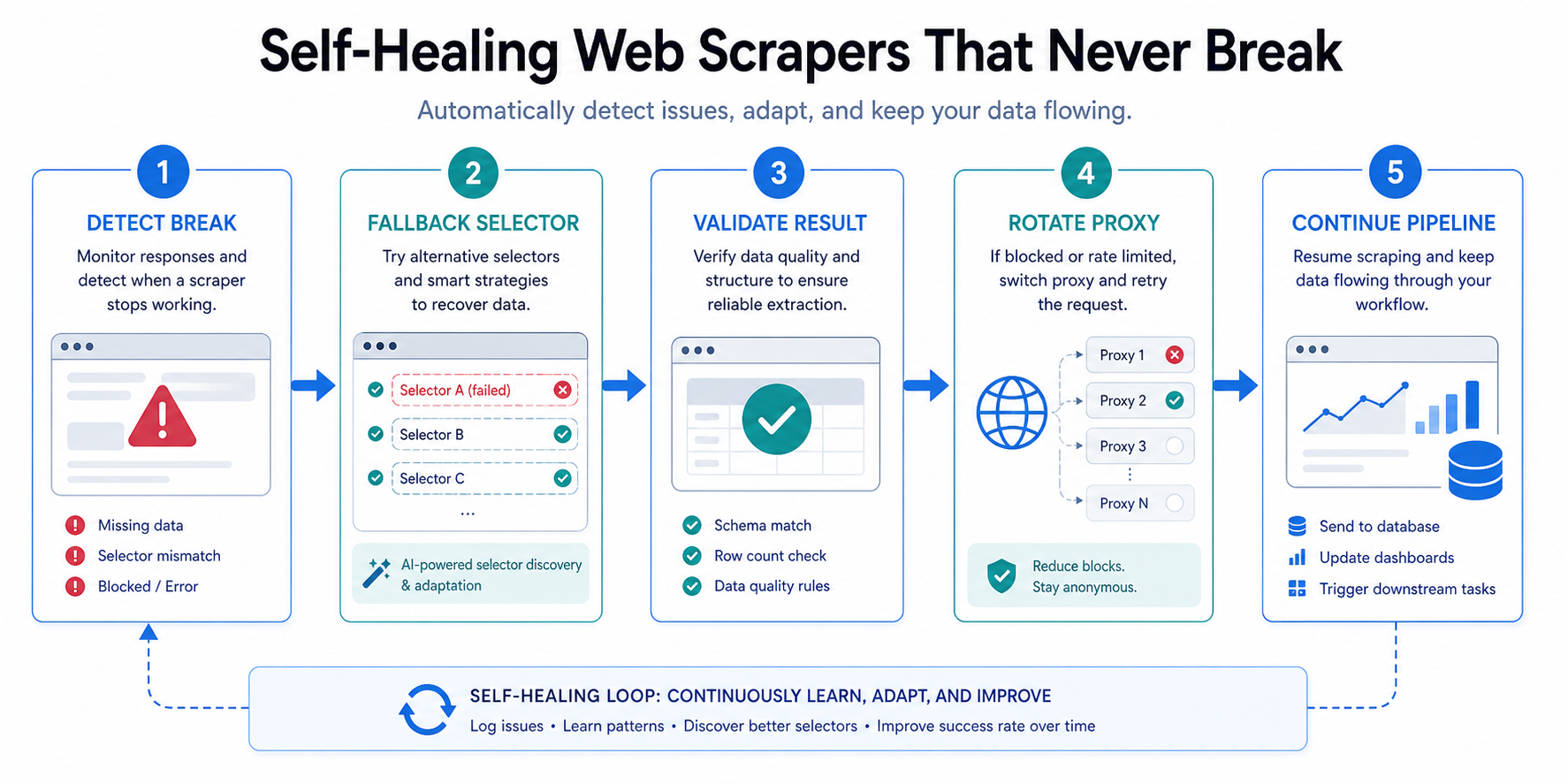
Scrapling's self-healing capability operates through a multi-layered selection system that combines:
Semantic Understanding: The parser analyzes page structure to understand content types rather than just matching patterns. It recognizes that certain data patterns indicate prices, titles, dates, or user reviews based on surrounding context, HTML semantics, and content format.
Fallback Hierarchies: When a primary selector fails, the system automatically tests alternative extraction methods ranked by reliability. These might include:
- Sibling element traversal
- Parent container patterns
- Text pattern matching within broader regions
- Structural position analysis (finding the third item in a list regardless of class names)
- Attribute-based selection when class names change but data attributes remain stable
Pattern Learning: The parser tracks which selection strategies succeed across scraping sessions. If a website consistently moves price data from a `<code style="background:#f2f4f7;border:1px solid #d0d5dd;border-radius:5px;padding:1px 5px;color:#101828;"> with class </code>price<code style="background:#f2f4f7;border:1px solid #d0d5dd;border-radius:5px;padding:1px 5px;color:#101828;"> to a </code> <code style="background:#f2f4f7;border:1px solid #d0d5dd;border-radius:5px;padding:1px 5px;color:#101828;"> with class </code>amount`, the system learns this pattern and prioritizes the working selector in future runs.
Automatic Selector Repair in Practice
For the LycheeIP implementation details behind this step, review AI-powered browser automation hub.
Consider a common e-commerce scraping scenario. Your initial selector targets product prices:
price = page.select('.product-card .price-display')When the website redesigns and changes <code style="background:#f2f4f7;border:1px solid #d0d5dd;border-radius:5px;padding:1px 5px;color:#101828;">.price-display</code> to <code style="background:#f2f4f7;border:1px solid #d0d5dd;border-radius:5px;padding:1px 5px;color:#101828;">.amount</code>, a traditional scraper breaks. A self-healing parser:
- Detects that the selector returns no results
- Analyzes the page structure for elements matching price patterns (currency symbols, decimal formatting, position near product titles)
- Tests alternative selectors based on structural similarity to the original element
- Identifies the new `.amount` class as the highest-probability match
- Extracts the data using the repaired selector
- Logs the selector change for developer review
This happens automatically during runtime without pipeline failure. The scraper continues collecting data while alerting developers to the structural change for validation.
For the official technical reference behind this point, see MDN HTTP overview.
Context-Aware Element Identification
The most sophisticated aspect of self-healing parsers is contextual understanding. Rather than treating every `` element identically, the parser considers:
- Position Relationships: Is this element always the third child of a product container?
- Content Patterns: Does this text match currency formatting?
- Sibling Context: Is this element consistently adjacent to a product image?
- Semantic HTML: Does this use schema.org markup or ARIA labels that provide stable identifiers?
This contextual approach means the parser can locate data even when class names, IDs, and structural hierarchy change, as long as the logical relationship between elements remains consistent.
Performance Considerations
Self-healing capability introduces computational overhead. The parser must:
- Analyze page structure more deeply than simple selector matching
- Test multiple extraction strategies when primary selectors fail
- Maintain state about successful patterns across sessions
Scrapling optimizes this by caching successful selector patterns and only triggering deep analysis when extraction fails. For stable websites where selectors work consistently, performance remains nearly identical to traditional scraping. The overhead appears only during adaptation events.
Integration with Existing Scraping Workflows
Self-healing parsers don't require rewriting existing scraping logic. Scrapling maintains compatibility with standard BeautifulSoup-style selector syntax while adding adaptive capabilities as a fallback layer. Developers can:
- Use familiar CSS selectors and XPath expressions
- Add semantic hints to guide the parser toward specific content types
- Configure fallback aggressiveness (how many alternative strategies to attempt)
- Review adaptation logs to validate that repairs match intended data
This approach allows gradual adoption. Teams can start with a few critical scrapers, validate the self-healing behavior, and expand to more complex pipelines after confirming accuracy.
Built-In Stealth Fetchers and Cloudflare Bypass for Blocked Scrapers
Website structure changes aren't the only scraper failure mode. Anti-bot systems block requests before your selectors ever run. Cloudflare, PerimeterX, DataDome, and similar services detect automated traffic and serve CAPTCHAs or block pages instead of content.
Scrapling addresses this with integrated stealth capabilities that handle request fingerprinting, JavaScript challenges, and bot detection without requiring separate anti-detection libraries or proxy configuration.
Stealth Fetcher Architecture
Traditional scraping separates concerns: you use <code style="background:#f2f4f7;border:1px solid #d0d5dd;border-radius:5px;padding:1px 5px;color:#101828;">requests</code> or <code style="background:#f2f4f7;border:1px solid #d0d5dd;border-radius:5px;padding:1px 5px;color:#101828;">httpx</code> to fetch HTML, then parse with BeautifulSoup. This creates detectable patterns:
- HTTP headers that don't match real browsers
- Missing JavaScript execution for challenge pages
- TCP/IP fingerprints that identify Python's request library
- TLS handshake patterns unique to urllib3
Scrapling's built-in fetcher handles all HTTP operations with browser-realistic fingerprints:
Header Normalization: Automatically generates header sets that match real Chrome, Firefox, or Safari browsers, including accept-language preferences, encoding headers, and cache directives in the correct order.
TLS Fingerprinting: Modifies the TLS handshake to match browser implementations rather than Python's SSL library, preventing TLS-based bot detection.
HTTP/2 Support: Uses HTTP/2 by default when servers support it, matching modern browser behavior rather than forcing HTTP/1.1.
Cloudflare Challenge Handling
Cloudflare's JavaScript challenges are a common blocking mechanism. The browser must execute JavaScript that computes a challenge response before accessing the actual page. Traditional scrapers fail here because they fetch HTML without executing JavaScript.
Scrapling's approach:
- Detects Cloudflare challenge pages automatically
- Executes the JavaScript challenge using a lightweight evaluation engine
- Submits the computed challenge response
- Retrieves the actual page content
- Returns the final HTML to your parser
This happens transparently. Your scraping code requests a URL and receives the final content without manual challenge handling:
from scrapling import Fetcher


fetcher = Fetcher()
response = fetcher.get('https://example.com/protected-page')
Response contains final content after automatic challenge bypass
Proxy Integration Patterns
Stealth fetchers work more effectively when combined with proper proxy infrastructure. Even with perfect fingerprinting, repeated requests from the same IP address trigger rate limiting and blocks.
Scrapling supports standard proxy configuration:
fetcher = Fetcher(proxy='http://username:password@proxy-server:port')For production scraping pipelines, this integration pattern works well:
Rotating Residential Proxies: Route requests through residential IPs that rotate automatically. This prevents IP-based blocking while maintaining browser-realistic fingerprints. Services like LycheeIP provide rotating residential proxy pools that integrate directly with Scrapling's fetcher, distributing requests across thousands of IP addresses to avoid rate limits.
Geographic Distribution: When scraping region-specific content, combine stealth fetchers with geo-targeted proxies. Scrapling passes proxy configuration through to all requests, allowing you to specify US, UK, or country-specific IPs for localized data collection.
Session Persistence: Some scraping workflows require maintaining sessions across multiple requests (login flows, shopping carts, multi-page forms). Scrapling's fetcher maintains cookies and session state automatically while allowing proxy rotation between distinct scraping sessions.
For the LycheeIP implementation details behind this step, review rotating residential proxies.
Rate Limiting and Respectful Scraping
Stealth capabilities enable access to protected content, but they don't eliminate the responsibility to scrape respectfully. Self-healing scrapers should include:
Request Throttling: Scrapling supports configurable delays between requests to avoid overwhelming target servers. Even with perfect bot evasion, aggressive scraping degrades website performance.
Robots.txt Respect: While stealth fetchers can bypass technical restrictions, checking robots.txt and honoring crawl-delay directives maintains ethical scraping practices.
Terms of Service Compliance: Anti-bot bypass should support legitimate use cases like public data collection, competitive research, price monitoring, and testing rather than violating explicit terms of service.
Proxy infrastructure providers like LycheeIP typically include usage policies that require customers to operate within legal boundaries and respect website terms when collecting public data.
Monitoring and Debugging Anti-Bot Interactions
When stealth fetchers encounter new blocking mechanisms, visibility into the interaction helps debugging:
- Log HTTP status codes and redirect chains
- Capture challenge page HTML for analysis when automatic bypass fails
- Monitor request timing to identify unusual delays that indicate challenges
- Track success rates across different proxy locations to identify geo-specific blocking
Scrapling provides logging hooks that integrate with standard Python logging, allowing teams to monitor anti-bot interactions alongside other application logs.
Dynamic JavaScript Rendering Without Manual Browser Configuration
Many modern websites render content entirely through JavaScript. The initial HTML contains minimal markup, and the actual data loads through API calls after the page loads. Traditional HTML scraping retrieves empty containers because the content doesn't exist in the initial response.
The standard solution is browser automation: launch a headless Chrome or Firefox instance, load the page, wait for JavaScript to execute, then extract the rendered content. Tools like Selenium, Playwright, and Puppeteer enable this but require:
- Installing and maintaining browser binaries
- Managing browser driver versions that match installed browsers
- Configuring headless mode, window sizes, and launch options
- Handling browser crashes and zombie processes
- Significantly higher memory and CPU usage compared to simple HTTP requests
Scrapling's JavaScript rendering capability eliminates this configuration overhead while providing dynamic content access.
For the official technical reference behind this point, see Playwright documentation.
Automatic Rendering Detection
Scrapling analyzes responses to determine whether JavaScript rendering is necessary:
Content Completeness Check: After fetching HTML, the parser looks for indicators that content should exist but doesn't (empty container elements with loading classes, API endpoint references in scripts, minimal text content).
Selective Rendering: Rather than rendering every page, the system only launches rendering for pages that need it. Static HTML pages process quickly through the standard parser. JavaScript-heavy pages trigger automatic rendering.
Lightweight Rendering Engine
Instead of launching full browser instances, Scrapling uses a lightweight JavaScript execution environment that:
- Evaluates page scripts without rendering UI elements
- Processes API calls and DOM manipulation
- Waits for network idle (no pending requests) before extraction
- Returns the final DOM state for parsing
This approach uses significantly less memory than headless browsers while providing access to JavaScript-rendered content.
Configuration-Free API
From the developer perspective, JavaScript rendering is transparent:
from scrapling import Fetcher


fetcher = Fetcher(auto_render=True)
response = fetcher.get('https://spa-website.com')
Response contains fully-rendered content


Parser extracts data from final DOM state
The `auto_render` flag enables automatic rendering detection. Scrapling handles:
- Determining when rendering is necessary
- Waiting for dynamic content to load
- Extracting the final HTML state
- Cleaning up rendering resources
No browser installation, driver management, or wait condition configuration required.
Wait Strategies for Dynamic Content
JavaScript rendering introduces timing complexity. Content may load immediately or after several seconds of API calls. Scrapling provides multiple wait strategies:
Network Idle: Wait until no network requests are pending (default behavior)
Element Visibility: Wait for specific elements to appear before extraction
Time-Based: Wait a fixed duration after page load
Custom Callbacks: Define JavaScript functions that return true when content is ready
These strategies ensure the parser accesses complete content rather than partial loading states.
Performance Trade-offs
JavaScript rendering is slower than static HTML fetching. Typical performance:
- Static HTML: 50-200ms per page
- JavaScript rendering: 1-3 seconds per page
For high-volume scraping, this matters. Optimize by:
Selective Rendering: Only render pages that require it. Use static fetching for content-heavy pages with minimal JavaScript.
Parallel Execution: Run multiple rendering instances concurrently. Scrapling supports async operation for parallel page processing.
Caching: For content that updates infrequently, cache rendered results and refresh periodically rather than rendering every request.
API Direct Access: When possible, identify the API endpoints that JavaScript calls and fetch data directly. This is faster than rendering but requires reverse-engineering the website's API.
Combining Rendering with Proxy Infrastructure
For the LycheeIP implementation details behind this step, review LycheeIP proxy infrastructure.
JavaScript-heavy websites often implement sophisticated bot detection that checks for:
- Browser API availability (WebGL, Canvas, Audio)
- Mouse movement and interaction patterns
- JavaScript execution timing consistency
Scrapling's rendering engine includes browser API emulation, but combining it with residential proxies further reduces detection risk. When scraping JavaScript-rendered content at scale:
- Use rotating proxies to distribute requests across IPs
- Add random delays between page loads to simulate human browsing
- Rotate user agents alongside proxy rotation
- Monitor for CAPTCHA pages that indicate detection
LycheeIP's residential proxy infrastructure integrates with Scrapling's rendering engine, allowing teams to scale JavaScript scraping while maintaining access to protected content.
Where LycheeIP Fits in Self-Healing Scraper Architecture
Self-healing scrapers solve selector breakage and JavaScript rendering, but they still need reliable network infrastructure to reach target websites at scale. Even with perfect adaptive parsing and stealth capabilities, scraping large volumes of data requires:
IP Rotation: Avoid rate limiting and IP blocks by distributing requests across multiple addresses
Geographic Distribution: Access region-specific content by routing requests through proxies in target countries
Session Management: Maintain consistent IPs for workflows that require session persistence while rotating for independent requests
LycheeIP provides proxy infrastructure that complements self-healing scraper capabilities:
Residential Proxy Integration
Residential proxies route requests through real user devices, making them appear as legitimate traffic rather than datacenter scraping. For self-healing scrapers processing large volumes:
- Rotating residential proxies prevent blocks even when individual request patterns are detected
- Country-specific targeting enables localized price monitoring and content access
- Automatic rotation works seamlessly with Scrapling's fetcher API
Datacenter Proxies for High-Speed Collection
When scraping public data from sources without aggressive anti-bot measures, datacenter proxies offer:
- Higher throughput than residential proxies (lower latency, higher bandwidth)
- Lower cost for high-volume collection
- Consistent performance for time-sensitive scraping
Combining self-healing parsers with datacenter proxy pools makes sense for:
- SERP monitoring where search engines allow automated access with proper throttling
- E-commerce price collection from APIs or sites with minimal bot protection
- Public database scraping where access restrictions are minimal
Static Residential Proxies for Account Workflows
Some scraping workflows require maintaining consistent IP addresses across sessions (account logins, shopping cart workflows, multi-step forms). Static residential IPs provide:
- Persistent addresses that don't change between requests
- Residential fingerprints that avoid datacenter IP detection
- Session state maintenance for complex workflows
When building self-healing scrapers for authenticated workflows, configure Scrapling's fetcher with static residential proxies to maintain session consistency while preserving browser-realistic fingerprints.
For the LycheeIP implementation details behind this step, review static residential proxies.
Proxy Configuration with Self-Healing Scrapers
Integrating proxy infrastructure with adaptive parsing frameworks requires:
Failure Handling: Distinguish between proxy failures (connection timeouts, proxy errors) and target website blocks. Self-healing parsers should retry with different proxies when network errors occur.
Geographic Consistency: When scraping localized content, maintain consistent proxy geography within a scraping session so the parser doesn't encounter different page versions.
Rotation Strategy: Balance between rotation frequency (higher privacy, lower block risk) and caching efficiency (stable IPs allow better caching).
Scrapling's fetcher accepts standard proxy configuration and automatically handles proxy errors through retries, but the overall rotation strategy depends on your proxy infrastructure setup.
Common Mistakes and Considerations
Self-healing scrapers reduce maintenance overhead, but they introduce new considerations:
Over-Trusting Automatic Repairs
Adaptive parsers sometimes misidentify data after structural changes. The self-healing capability might successfully extract text from a new location, but that text could be a related field rather than your intended target (extracting sale prices instead of regular prices, or product descriptions instead of titles).
Mitigation: Implement validation checks that verify extracted data matches expected formats and ranges. Log all selector repairs for manual review. Set up alerts when adaptation occurs so developers can validate changes.
Ignoring Performance Impact
Self-healing parsers with JavaScript rendering use significantly more resources than simple HTML scraping. Scaling to thousands of pages per hour requires:
- Adequate server resources for concurrent rendering
- Efficient proxy rotation to avoid bottlenecks
- Caching strategies for content that updates infrequently
- Monitoring to identify performance degradation
Mitigation: Profile your scraping pipeline to identify bottlenecks. Use JavaScript rendering selectively. Cache aggressively where appropriate. Scale horizontally with multiple scraper instances rather than vertically with larger single machines.
Treating Stealth as Permission
Anti-bot bypass capabilities enable access to protected content, but technical capability doesn't imply legal or ethical permission. Many websites explicitly prohibit scraping in their terms of service.
Mitigation: Review terms of service for target websites. Focus on legitimate use cases (public data collection, competitive research, price monitoring, testing). Implement rate limiting to avoid degrading website performance. Consider whether APIs or data partnerships provide better alternatives than scraping.
Proxy Misconfiguration
Improper proxy setup undermines stealth capabilities. Common errors:
- Using datacenter proxies for highly-protected websites (easily detected and blocked)
- Insufficient proxy rotation (same IP appears too frequently)
- Geographic mismatch (using US proxies for UK-specific content triggers access issues)
- Proxy timeout too short (interrupts JavaScript rendering before completion)
Mitigation: Match proxy type to target website protection level. Use residential proxies for anti-bot protected sites. Configure appropriate timeouts for JavaScript rendering. Monitor proxy success rates and block rates across different providers.
Insufficient Error Handling
Self-healing parsers handle selector failures, but your scraping pipeline must still handle:
- Network timeouts
- Proxy errors
- CAPTCHA pages that bypass fails to solve
- Temporary website outages
- Rate limit responses
Mitigation: Implement comprehensive error handling with appropriate retry logic. Distinguish between transient errors (retry) and persistent issues (alert developers). Log all failures with sufficient context for debugging.
Neglecting Responsible Scraping Practices
Even with self-healing capabilities and stealth features:
- Respect robots.txt when appropriate
- Implement request throttling to avoid overloading servers
- Use scraping for legitimate business purposes
- Maintain updated legal and ethical guidelines for your team
Mitigation: Build rate limiting into scraper configuration. Review robots.txt for guidance. Ensure your use case aligns with acceptable data collection practices. Consult legal counsel for industry-specific compliance requirements.
Explore LycheeIP Proxies for Resilient Scraping
Conclusion
Web scraper maintenance consumes significant engineering time because websites change constantly. Traditional scrapers break with every redesign, requiring manual selector updates and deployment cycles. This maintenance burden delays data collection and diverts development resources from higher-value work.
Self-healing scrapers eliminate most of this maintenance through adaptive parsing frameworks that automatically repair broken selectors. Scrapling's approach combines semantic content understanding, fallback selector hierarchies, and pattern learning to identify data even when HTML structure changes. Built-in stealth capabilities handle Cloudflare challenges and anti-bot systems without separate configuration. JavaScript rendering provides access to dynamic content without manual browser management.
For Python developers maintaining scraping pipelines, self-healing parsers reduce the selector breakage problem from a weekly maintenance task to an occasional validation check. The adaptive framework handles most structural changes automatically while alerting developers to significant modifications that require review.
Combining self-healing parsers with proper proxy infrastructure creates scraping systems that remain functional through both website changes and anti-bot measures. Residential proxy rotation prevents IP-based blocking, geographic targeting enables localized data access, and proper rate limiting maintains respectful scraping practices.
The result is data collection infrastructure that requires less maintenance, handles website evolution automatically, and scales reliably for production workflows. Self-healing scrapers don't eliminate scraping complexity entirely, but they solve the most time-consuming maintenance problem that fragile selector-based scraping creates.
Frequently Asked Questions
How accurate are self-healing scrapers compared to manually-written selectors?
Self-healing scrapers typically achieve 90-95% accuracy on initial adaptation events. When a website structure changes, the adaptive parser successfully identifies the correct new data location in most cases. However, complex layout changes or ambiguous content can cause misidentification. Best practice is treating self-healing as a reliability enhancement rather than perfect automation. Implement validation checks on extracted data and review adaptation logs to verify accuracy.
Can self-healing scrapers handle websites that completely redesign their layout?
Complete redesigns challenge self-healing capabilities more than incremental changes. If a website maintains similar semantic structure (prices still appear near product images, titles remain in heading elements), adaptive parsers usually succeed. However, fundamental content reorganization may require manual intervention. Self-healing scrapers fail gracefully with detailed logs about adaptation attempts, making debugging faster than traditional scrapers.
Do self-healing scrapers require more computational resources than traditional scraping?
Resource usage depends on adaptation frequency. For stable websites where selectors work consistently, overhead is minimal (typically under 5%). When adaptation occurs, processing time increases by 20-40% for affected pages. JavaScript rendering adds more significant overhead (2-5x compared to static HTML fetching), but this applies to any browser automation approach. The resource trade-off is worthwhile for reducing maintenance time.
How do self-healing scrapers integrate with existing data pipelines?
Scrapling maintains compatibility with standard Python scraping patterns, allowing gradual adoption. You can replace existing fetching and parsing logic while keeping data validation, storage, and scheduling components unchanged. The self-healing parser returns data in the same formats as BeautifulSoup or lxml, so downstream processing remains identical. Start by migrating high-maintenance scrapers and expand after validating accuracy.
What proxy types work best with self-healing scrapers for protected websites?
Residential rotating proxies provide the best combination of stealth and scale for anti-bot protected websites. They distribute requests across real user IPs, preventing detection even with high request volumes. For less-protected sites, datacenter proxies offer better performance and cost efficiency. Static residential proxies work well for account-based workflows requiring session persistence. The choice depends on target website protection level.
Are self-healing scrapers legal?
The technology itself is legal. Legality depends on what you scrape and how you use the data. Scraping public data for research, monitoring, or analysis is generally acceptable. Bypassing authentication, violating terms of service, or using data in unauthorized ways creates legal risk. Review target website terms, focus on publicly-accessible data, implement rate limiting, and consult legal counsel for your specific use case.
How often should I review self-healing scraper adaptations?
Initially, review all adaptation events to validate accuracy. After establishing confidence in the system, scale back to weekly or monthly reviews of adaptation logs. Implement automated validation that checks extracted data against expected formats and value ranges. Set up alerts for adaptation events that affect critical data fields. This balance provides oversight without requiring constant monitoring.
Can self-healing scrapers handle CAPTCHAs?
Scrapling's built-in capabilities handle JavaScript challenges (like Cloudflare's under-attack mode) but not interactive CAPTCHAs (image selection, reCAPTCHA v2). For sites with interactive CAPTCHAs, you need CAPTCHA solving services or alternative data access methods. The stealth fetcher and residential proxy combination reduces CAPTCHA frequency significantly by avoiding detection triggers.
What happens when self-healing adaptation fails completely?
When the parser cannot identify a reliable alternative selector, it returns empty results and logs detailed information about adaptation attempts. This prevents incorrect data extraction. The log includes tried selectors, page structure analysis, and potential candidate elements that didn't meet confidence thresholds. This information helps developers quickly identify the issue and implement manual fixes.
Do I still need proxies if I use a self-healing scraper with stealth capabilities?
Yes, for any significant scraping volume. Stealth capabilities handle browser fingerprinting and anti-bot challenges, but they don't prevent IP-based rate limiting. Websites track requests per IP address regardless of fingerprint quality. For small-scale scraping, stealth features alone may suffice. For production pipelines processing thousands of pages, combine self-healing parsers with proxy rotation to address both selector breakage and access blocking.
Related LycheeIP Guides and Resources

Recommended Articles

AI Search API for AI Agents: How to Ground LLMs With Live Search Data
An AI search API gives an application or agent programmatic access to current search results. Its most useful role is discovery: the agent can find candidate sources, identify fresh information, and decide what to retrieve next instead of relying only on model memory.
View Details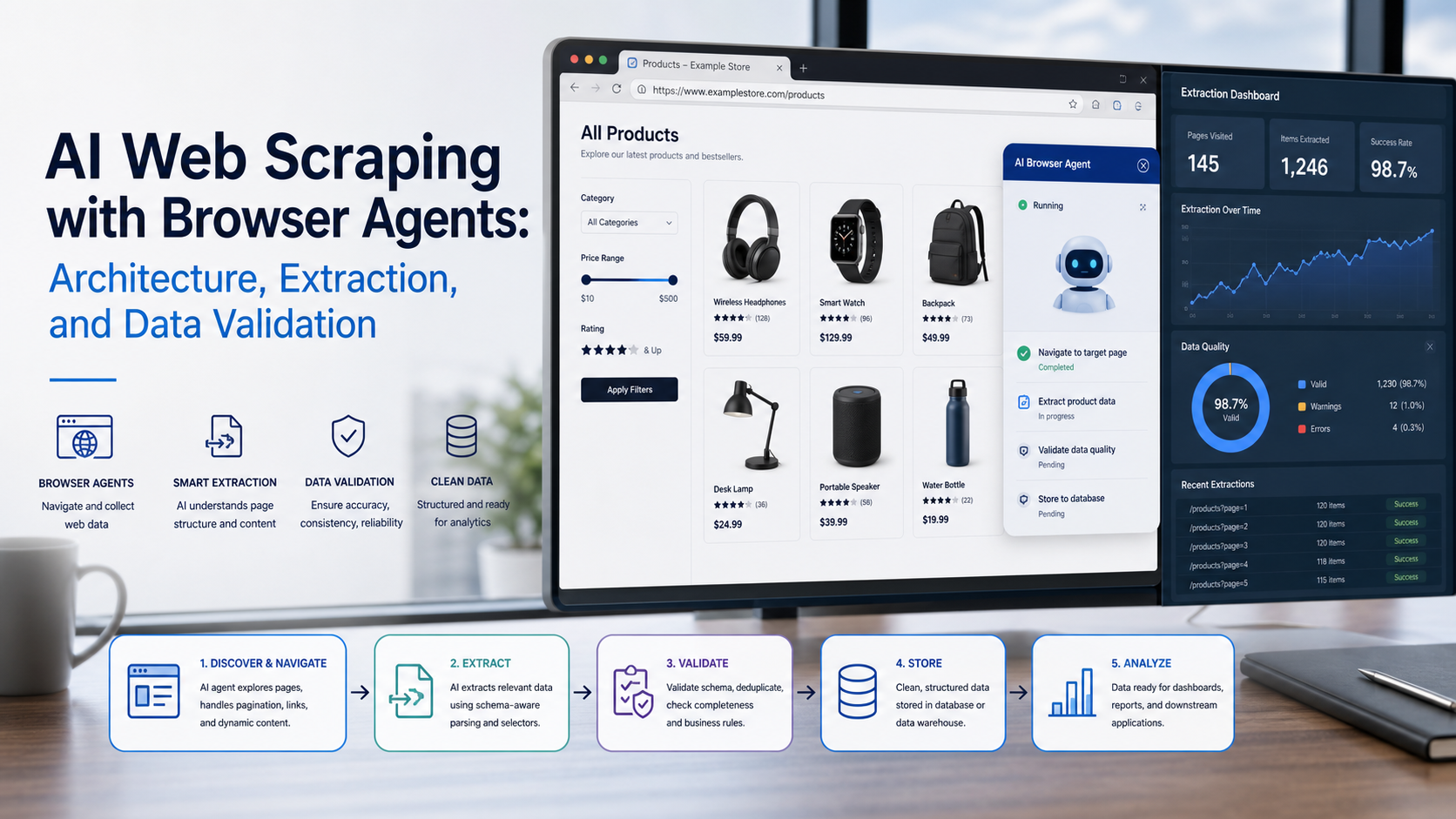
AI Web Scraping with Browser Agents: Architecture, Extraction, and Data Validation
AI web scraping uses AI to help discover, navigate, interpret, or extract information from websites. Browser agents are one implementation option when page interaction, rendering, or layout variation makes a simple scraper too brittle, but the agent should not become the entire data pipeline.
View Details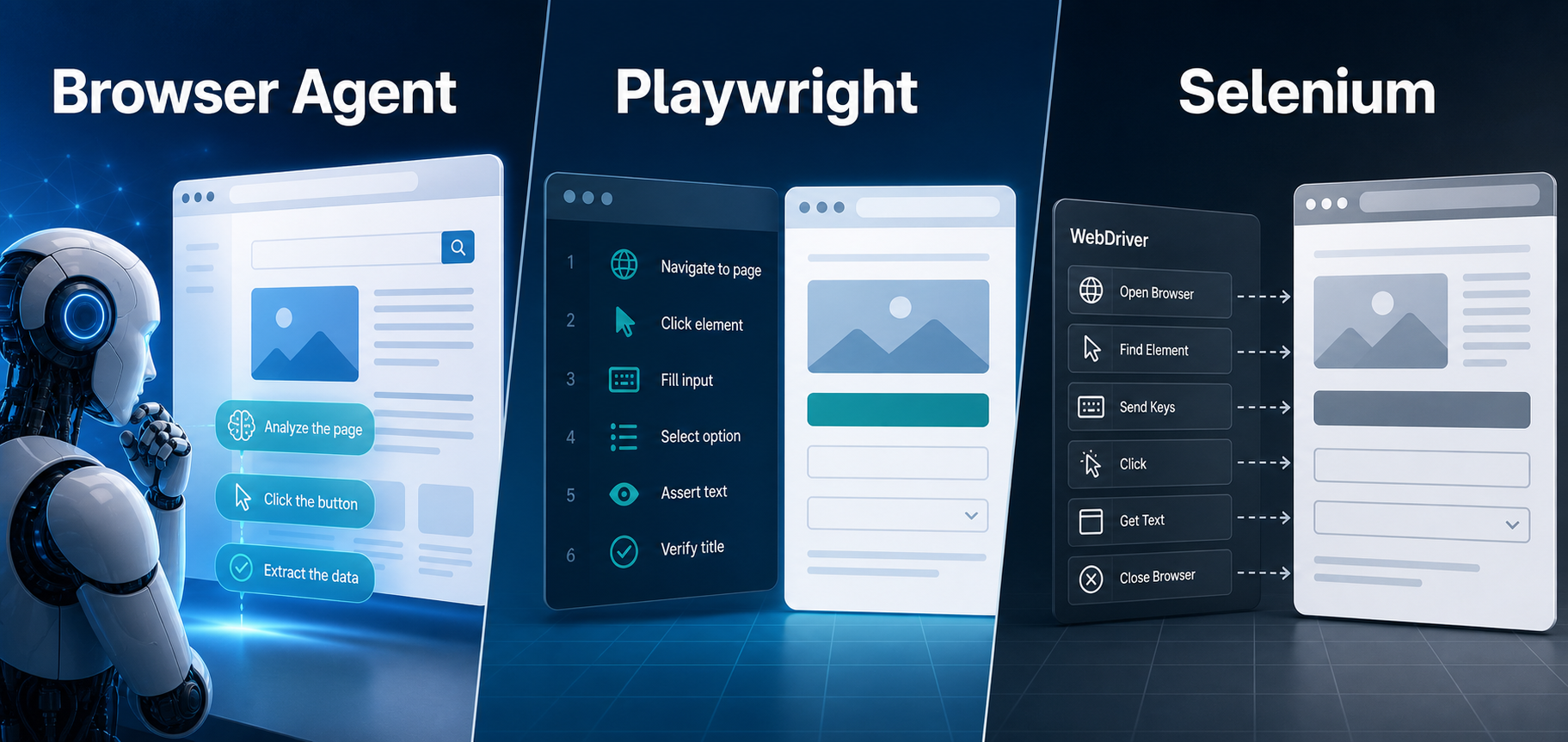
AI Browser Automation: Browser Agents vs Playwright vs Selenium
A browser agent interprets a goal and decides what browser action to take next. Playwright and Selenium can execute explicit, testable browser logic defined by developers. In 2026, however, Playwright also provides official MCP and agent-oriented workflows, so Playwright is no longer just the deterministic alternative to agentic automation. It can also serve as the browser-control layer inside an agent system.
View Details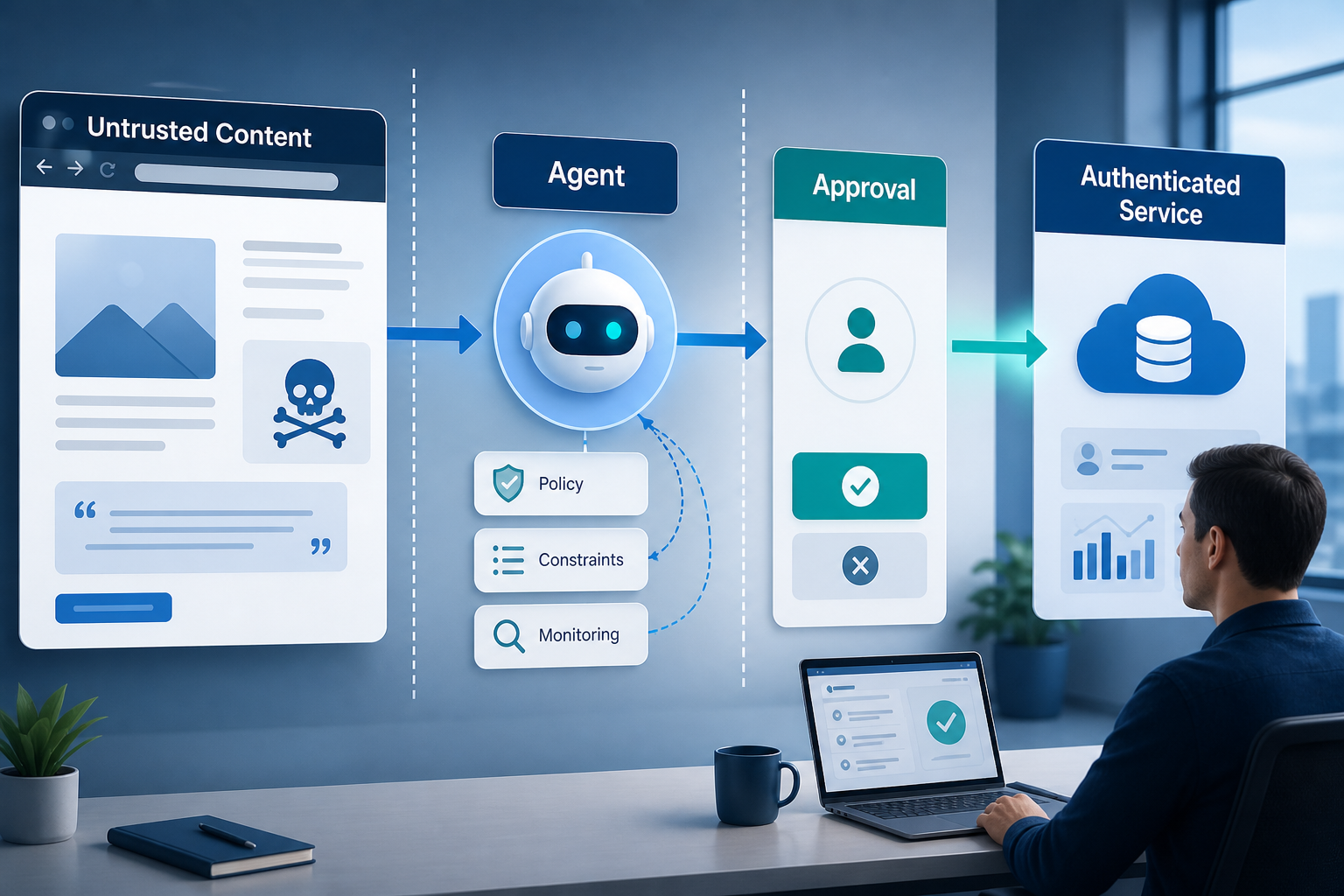
Agentic Browser Security: Prompt Injection, Permissions, and Safe Deployment
That combination creates risks that are different from ordinary browsing and traditional automation. The most important is indirect prompt injection, where hostile instructions hidden in web content attempt to redirect the agent away from the user's goal. Google describes indirect prompt injection as a primary new threat for agentic browsing and has introduced layered defenses that include origin constraints, independent action checks, threat detection, and user confirmation for sensitive actions. Google's Chrome security architecture is a useful reference for how browser-agent defenses are evolving.
View Details
How to Give AI Agents Reliable Real-Time Web Data
A production-ready solution therefore needs more than a web scraper. It needs a web data layer that connects acquisition, validation, storage, retrieval, security, and observability. This guide explains how to design that layer.
View Details