
Overseas Social Media Traffic Declining? These Reach-Limiting Triggers Are Often Overlooked
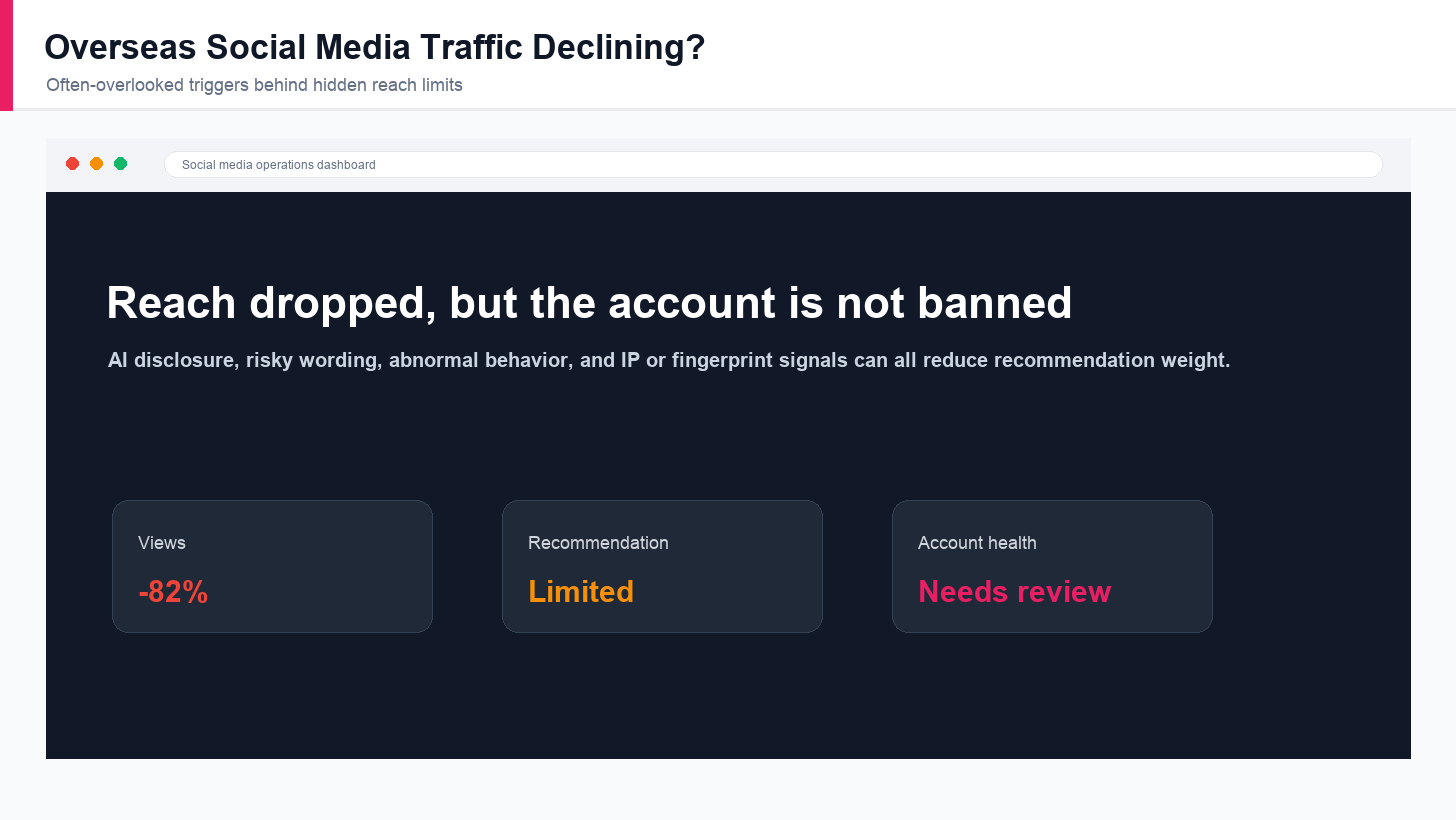
When overseas social media traffic drops sharply, the cause is not always a visible violation notice. Recommendation systems may quietly reduce distribution because of AI-content disclosure issues, risky wording, abnormal account behavior, or inconsistent account environment signals.
For overseas social media operators, the most frustrating problem is not always “no one likes the content.” It is when posts cannot enter the recommendation pool at all: follower count rises, but views collapse; no warning appears, yet multiple posts stay at single-digit exposure. This is the hidden reach-limiting state often described as traffic restriction or shadow limiting.
This guide summarizes the overlooked reach traps seen across Facebook, Instagram, TikTok, YouTube, and X, then gives practical checks for deciding whether an account has entered a low-weight state.
AI Content: Compliance Is Becoming a Hard Requirement
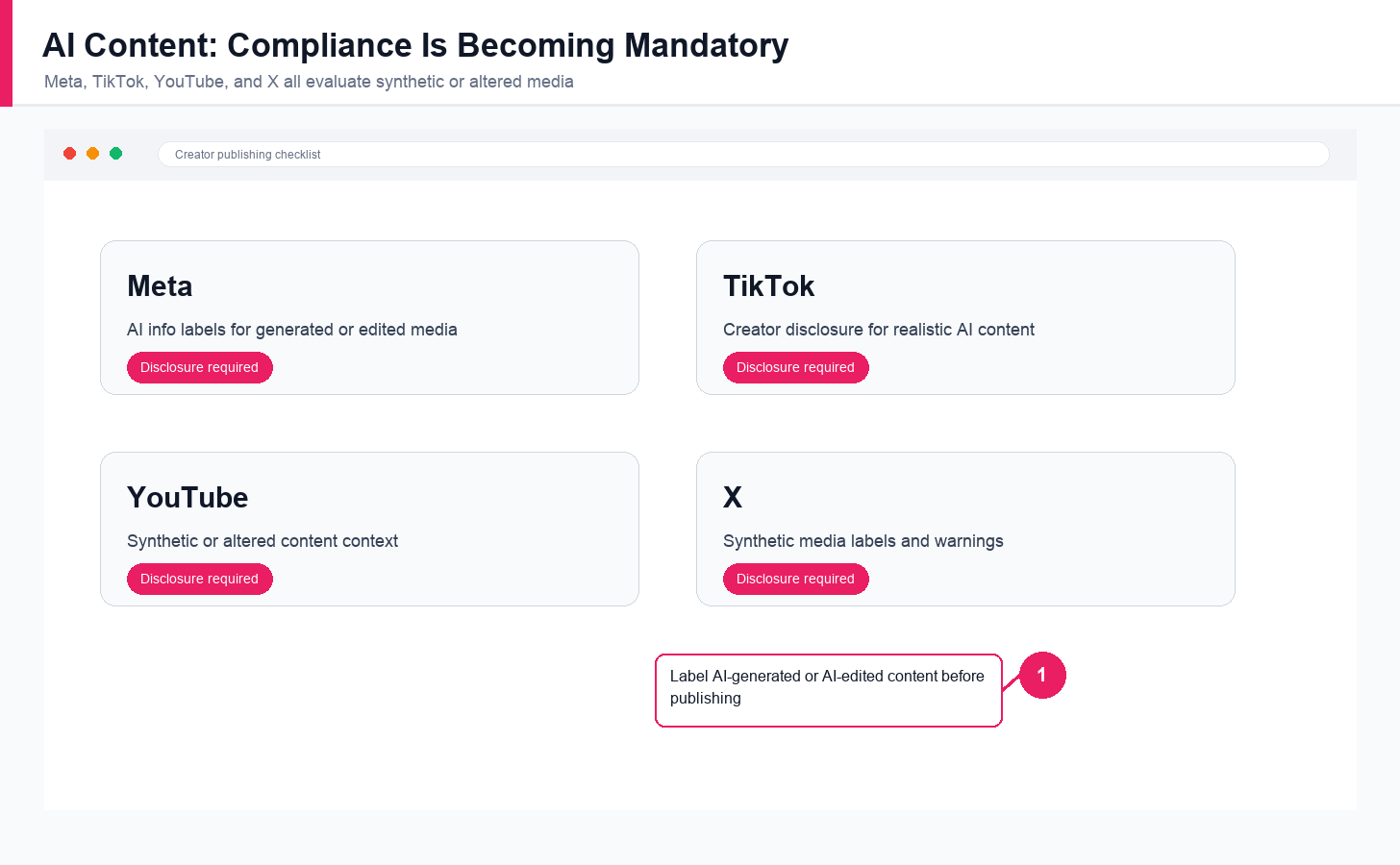
Algorithms are now much better at identifying generated, edited, or synthetic content. Using AI to mass-produce clips, lightly edit other people’s videos, or publish realistic synthetic media without disclosure can become a reach problem even when the content is not immediately removed.
Meta: Facebook, Instagram, and Threads
Meta explains that it labels AI-generated or AI-modified images, video, and audio with AI-related context when its systems detect relevant signals, and it encourages creators to disclose AI involvement. See Meta’s official explanation of labeling AI-generated content and manipulated media.
- Undisclosed AI content may receive less recommendation priority.
- Higher-risk synthetic content may receive additional labels or distribution limits.
- If AI content also violates misinformation, hate, impersonation, or safety policies, it can be removed or further restricted.
TikTok
TikTok has stated that creators should label realistic AI-generated content and that the platform can automatically label some AI-generated content through provenance signals. TikTok’s newsroom explains its work on AI transparency and automatic labeling.
- Avoid AI content that misleads viewers about real people, events, or authority sources.
- Do not use unauthorized personal likenesses or sensitive imagery.
- AI content still has to follow ordinary community rules.
YouTube and X
YouTube requires creators to disclose realistic altered or synthetic content in relevant cases; its official Creator Studio guidance explains the AI use disclosure setting. X also covers synthetic and manipulated media inside its authenticity and rules pages, warning that misleading media may be labeled or removed; see the X Rules.
Operational Advice
- Label AI-generated or AI-edited content when the platform requires it.
- Add meaningful human work: narration, editing, analysis, testing, commentary, or original perspective.
- Avoid using AI only to publish high-volume low-originality content. That pattern is increasingly easy for platforms to identify.
Keywords and Content Expression: The First Algorithmic Filter
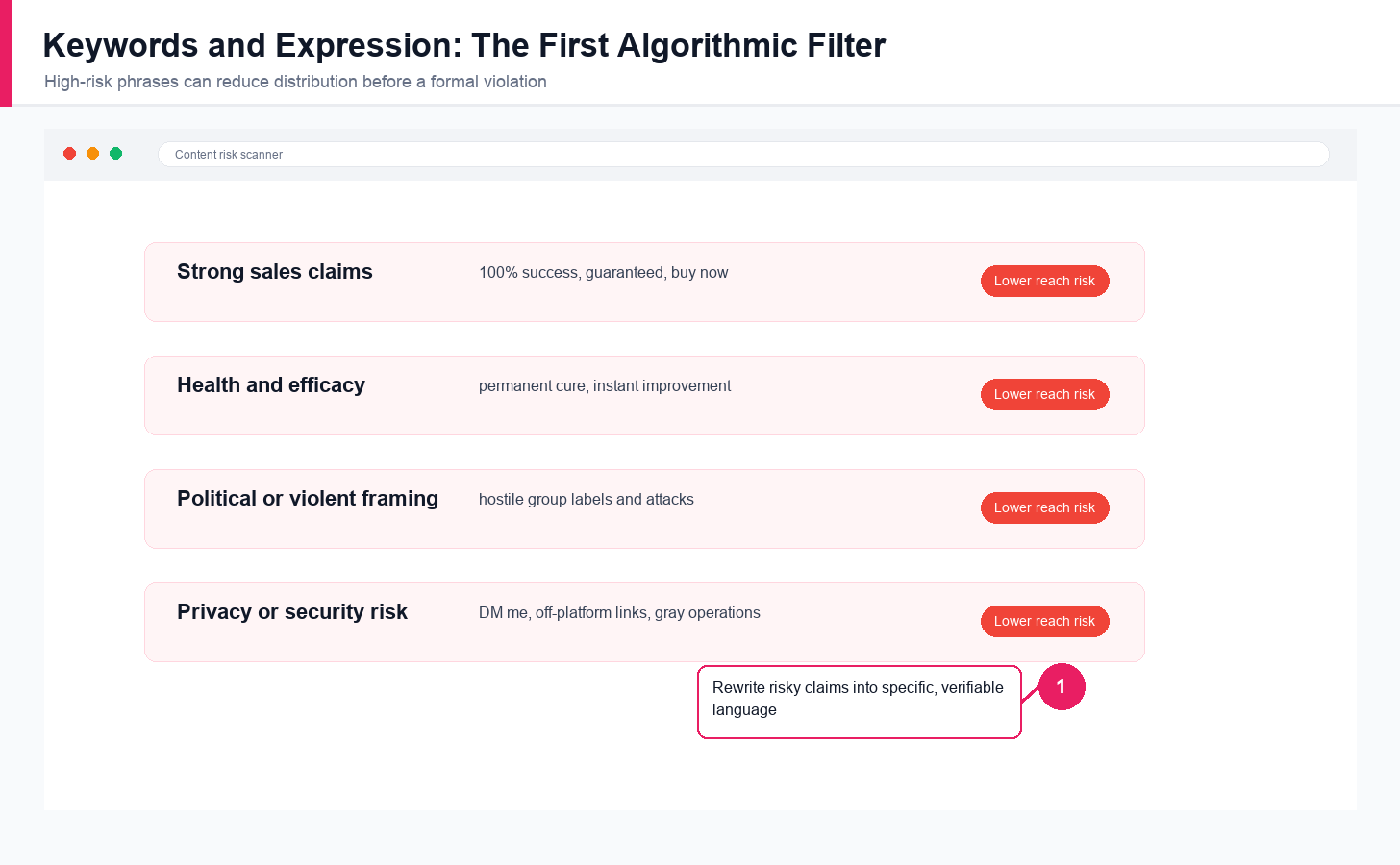
On overseas social platforms, reach limits are not decided only by formal violations. A post can release enough risk signals to be downranked before it is ever manually reviewed.
- Strong marketing and inducement language: absolute claims such as “100% success,” “guaranteed effective,” or “buy immediately” can look like low-quality promotional content.
- Health, medical, beauty, and efficacy claims: exaggerated outcomes such as “permanent results” or “instant improvement” are especially sensitive.
- Political, discriminatory, or violent framing: hostile group labels, polarized identity language, and aggressive claims are heavily monitored.
- Privacy and security risk language: prompts to move users off-platform, send private messages, or join unclear operations can compress recommendation reach.
Overlooked Hidden Reach-Limiting Triggers
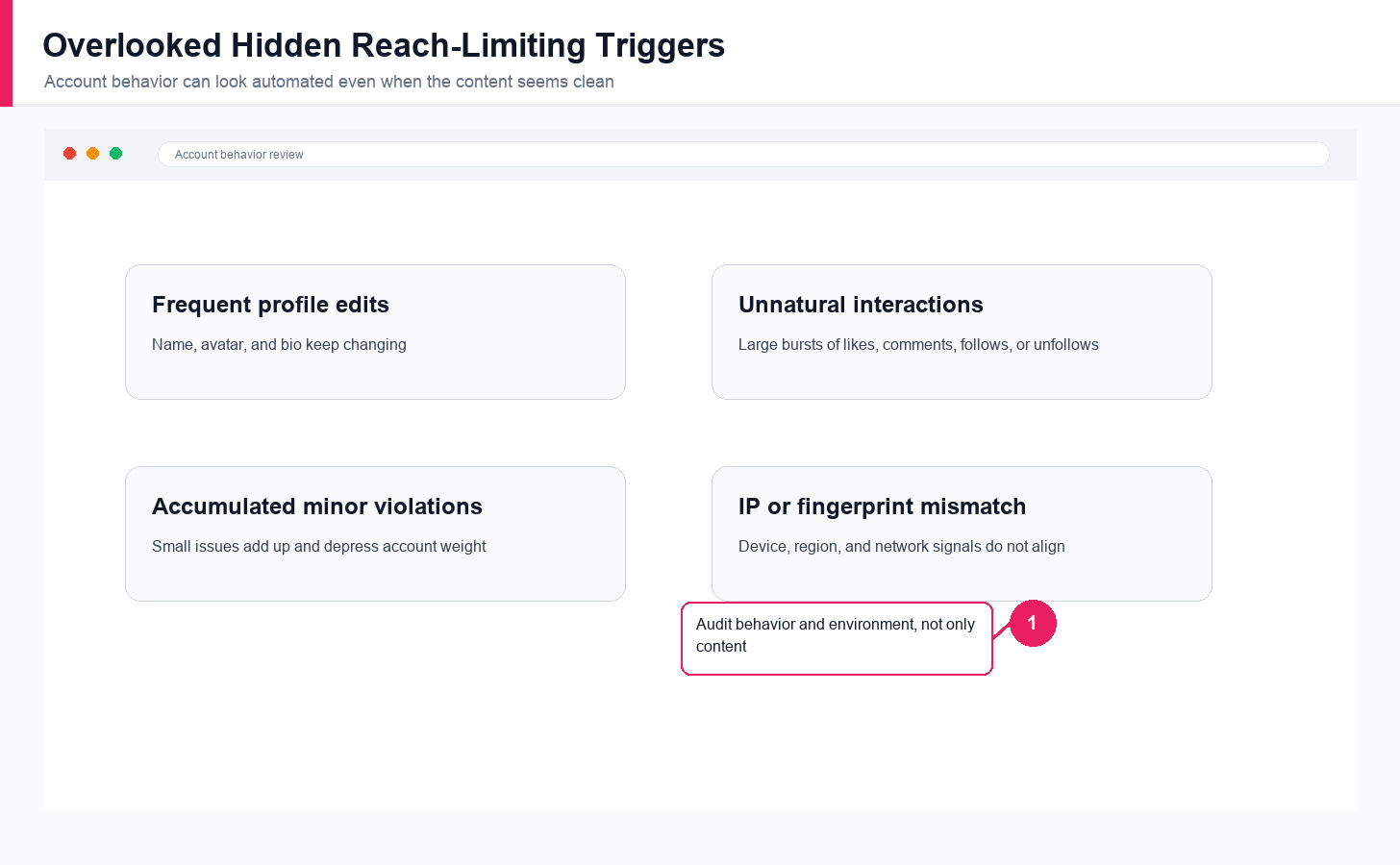
Account behavior often matters as much as the post itself. Many operators only review captions and videos, while the platform is also evaluating whether the account behaves like a stable real user.
- Frequent account information changes: repeated nickname, avatar, and bio changes can look unstable.
- Unnatural interactions: sudden bursts of likes, comments, follows, or unfollows can resemble automation.
- Accumulated minor violations: one small issue may not matter, but repeated small issues can lower account weight over time.
- Environment inconsistency: mismatched IP country, device fingerprint, timezone, language, and login pattern can weaken trust signals.
For multi-account operations, pair clean behavioral routines with stable account environments. LycheeIP guides on managing multiple Instagram accounts safely and residential proxy basics explain why network consistency matters.
How to Tell Whether an Account Is Being Reach-Limited
Use multiple signals instead of diagnosing one weak post in isolation. A single low-performing post can be normal; a pattern across several posts is more meaningful.
- Content metrics suddenly drop like a cliff.
- Follower count and view count become seriously mismatched.
- Several consecutive posts barely enter the recommendation pool.
- Older posts perform normally, while new posts stay weak for no clear content reason.
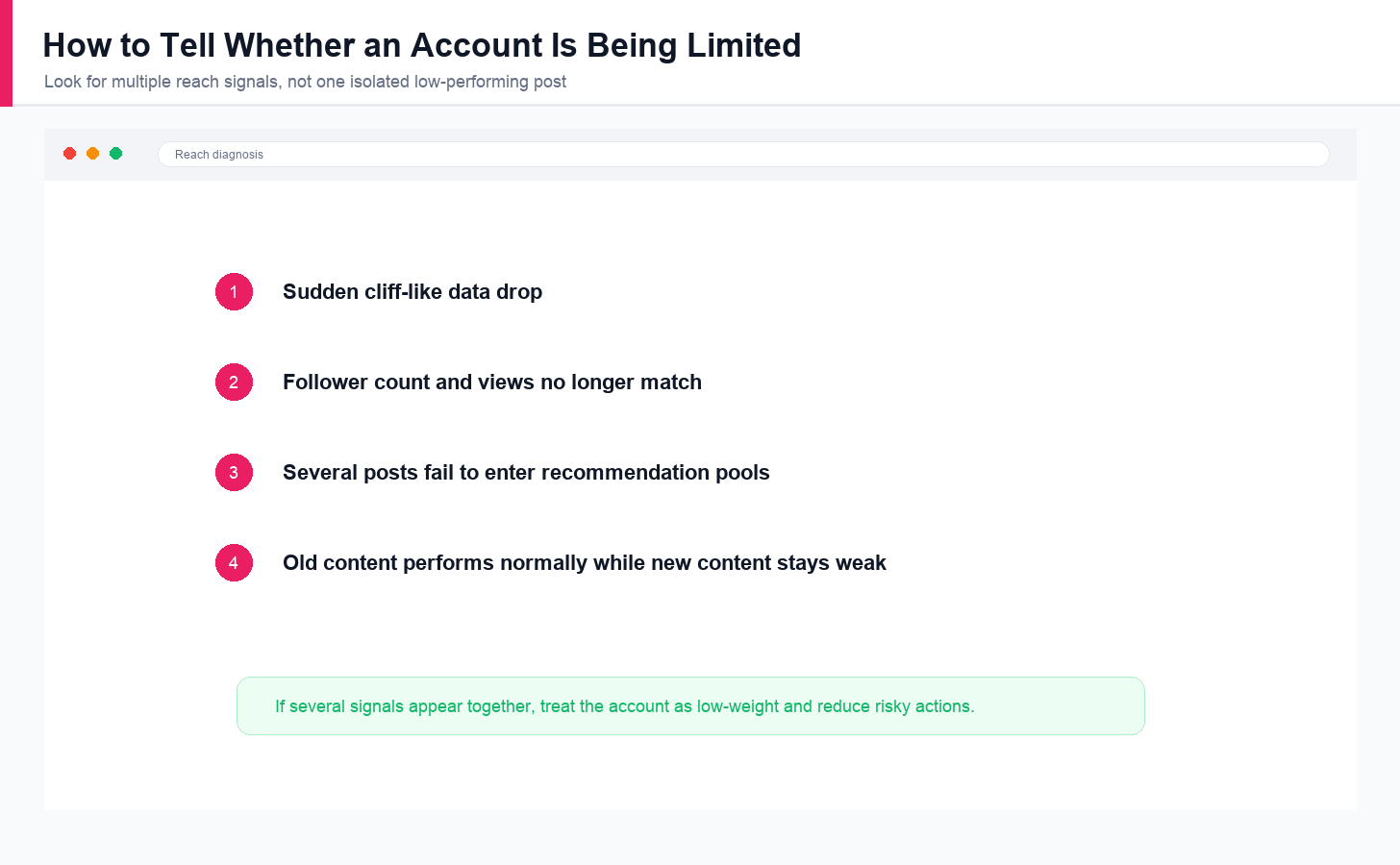
If several of these signals appear together, assume the account has entered a low-weight state. Reduce risky actions, stop mass posting, review content categories, check device and IP consistency, and rebuild normal account behavior gradually.
Summary
Overseas social media reach limits are not random. They are the combined result of platform rules, algorithmic risk scoring, content quality, account behavior, and environment trust signals. The most reliable path is to reduce high-risk operations, produce original value, label synthetic content when needed, and keep device and network signals consistent.
Do not let carefully warmed accounts fail because of IP association or fingerprint leakage. For legitimate overseas operations, LycheeIP residential proxies can be paired with fingerprint isolation and stable operating procedures to create a cleaner account environment.
Explore LycheeIP Residential Proxies
Frequently Asked Questions
Is every reach drop a shadowban?
No. Seasonality, poor content fit, weak hooks, audience fatigue, and posting time can also reduce performance. Treat it as reach limiting only when several account-level signals appear together.
Does AI content always reduce reach?
No. AI-assisted content can still perform if it is original, useful, compliant, and disclosed when required. Mass-produced, misleading, or unlabeled realistic AI content is the bigger risk.
Can proxies alone recover a limited account?
No. Proxies help with network consistency, but recovery also requires content cleanup, normal behavior, device hygiene, and time.
Related LycheeIP Articles
Related LycheeIP articles: Instagram proxy management, mobile and residential proxy use cases, residential proxies, anonymous proxy servers, mobile proxies, public versus private IP addresses, Apple proxy setup, V2rayN PC proxy setup, MoreLogin proxy setup, HubStudio proxy setup.

Recommended Articles
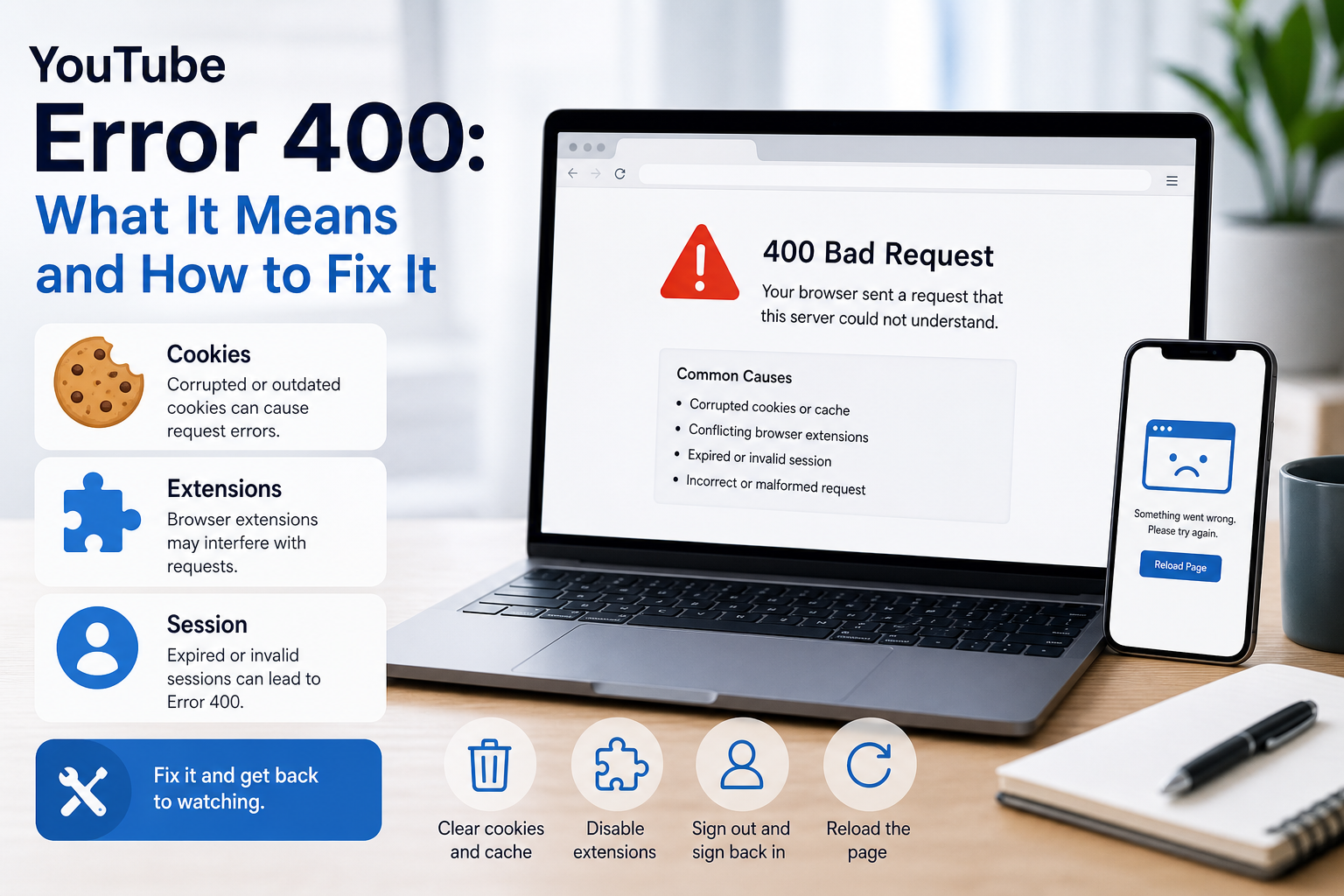
YouTube Error 400: What It Means and How to Fix It
In HTTP terminology, a 400 Bad Request is a client-error response. MDN explains that servers commonly return 400 when they consider the request malformed, incorrectly framed, or deceptively routed. The important troubleshooting clue is that repeating the exact same request without changing anything is expected to fail again.
View Details
How to Add a Server IP in Minecraft Step by Step
Learn exactly where to enter a Minecraft server IP in Java, Bedrock, and Pocket Edition, plus how to fix common connection errors, ports, and edition mismatches.
View Details
How to Find a Working Minecraft Server IP Fast
Stop wasting time on dead Minecraft server IPs. Learn how to verify live servers quickly, read status icons, check ports, and source updated server addresses.
View Details
Best 24/7 Online Minecraft Server IPs — No Downtime
Find reliable 24/7 Minecraft server IPs for Java and Bedrock, plus uptime checks, port basics, ping guidance, crossplay notes, and network stability tips.
View Details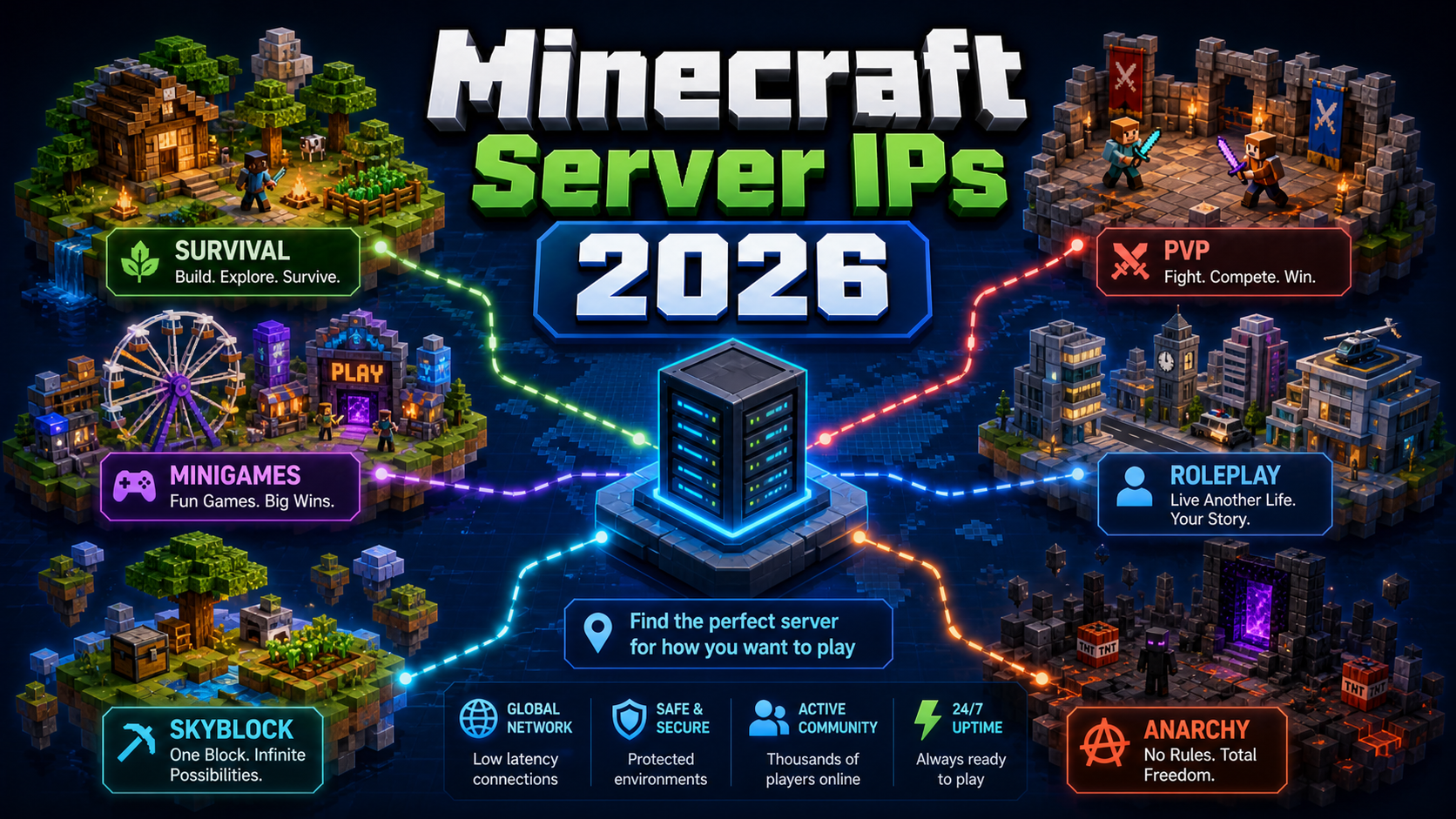
Minecraft Server IPs for Every Game Mode in 2026
Find Minecraft server IPs by game mode for 2026, including survival, PvP, minigames, roleplay, SkyBlock, anarchy, Java, Bedrock, crossplay, and pay-to-win notes.
View Details