
Best 24/7 Online Minecraft Server IPs — No Downtime
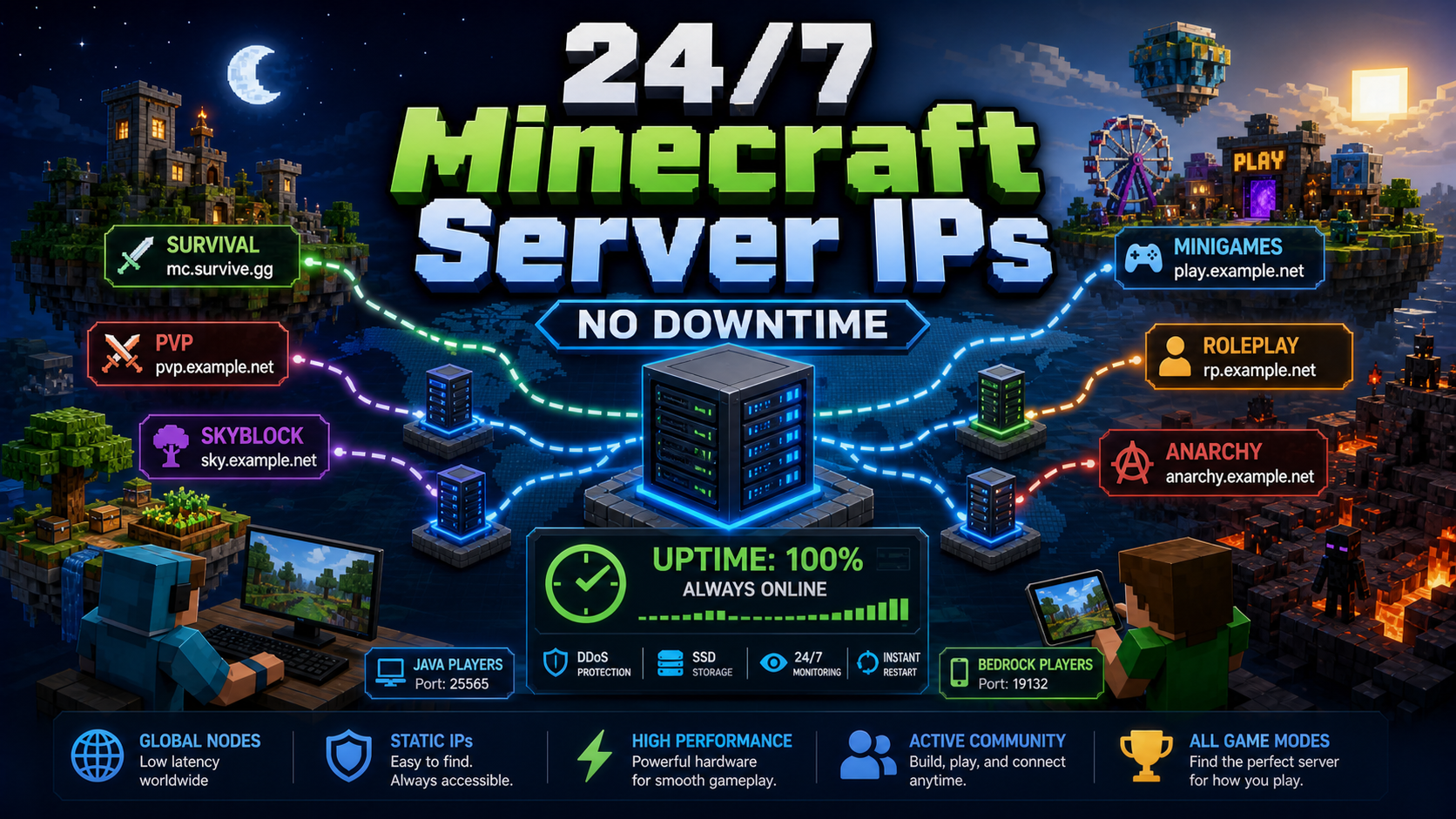
A Minecraft server can look perfect until it disappears at night, crashes during peak hours, or changes its address without warning. The best 24/7 server IPs are not just popular; they are stable, reachable, and backed by infrastructure that can survive real player traffic.
This guide explains why servers go offline, what 24/7 uptime really means, how to judge a server before committing to its IP, and which Java and Bedrock server addresses are worth testing when you want reliable access.
Why Minecraft Servers Go Offline
Most downtime comes from one of three places: weak hosting, unstable network routing, or poor server operations. A small home-hosted server might be fun for friends, but it can disappear when the owner turns off a PC, reboots a router, or loses power.
Budget shared hosting is more stable, but it can still struggle when too many servers compete for the same CPU, memory, disk, or bandwidth. Dedicated hosting and VPS setups are more reliable because they give the Minecraft server steadier resources and a more predictable network path.
Tier 1: Home-Hosted Servers
Home-hosted servers are the easiest to launch and the hardest to keep online. They depend on the owner’s home internet, power, router settings, and public IP. If that IP changes, the server address may stop working.
Tier 2: Budget Shared Hosting
Shared hosting is good for casual communities, but overload can cause lag, restarts, and connection failures. It is better than a laptop under a desk, but it is not always true 24/7 infrastructure.
Tier 3: Dedicated or VPS Hosting
The strongest public servers usually run on dedicated machines, VPS infrastructure, or managed game hosting with static addresses, DDoS protection, backups, and uptime monitoring.
What 24/7 Uptime Really Means
No public service can honestly promise zero downtime forever. Better wording is high availability: planned maintenance is rare, outages are short, and the server comes back quickly when something fails.
For Minecraft players, uptime has two parts. First, the server process must be online. Second, the address must remain reachable. A server can technically be running while players still cannot connect because DNS, firewall rules, ports, routing, or a changed IP broke the path.
That is why IP stability matters. A domain such as play.example.net should resolve to the right server, and the underlying IP should not jump unpredictably. Long-running communities usually rely on stable hosting and careful DNS management.
How to Check a Server Before Committing
Before you build a base, grind a ranking system, or bring a friend group into a new community, run a few quick checks.
- Prefer a domain name over a raw numeric IP because domains are easier for communities to keep stable.
- Look for evidence of professional hosting, public status pages, or uptime monitoring.
- Check whether the Discord, website, or forums are active.
- Search for how long the server has been operating.
- Join at peak time to test lag, queue length, TPS, and moderation quality.
Performance vs Uptime
A server can be online and still feel bad. Watch for TPS drops, rubber-banding, login delays, and overloaded hubs. Low downtime is only valuable if the server also plays smoothly.
Ping also matters. A reliable server in the wrong region may still feel slow. For server owners and technical teams, route quality is why distributed testing from different IP locations can be useful.
Java vs Bedrock Infrastructure
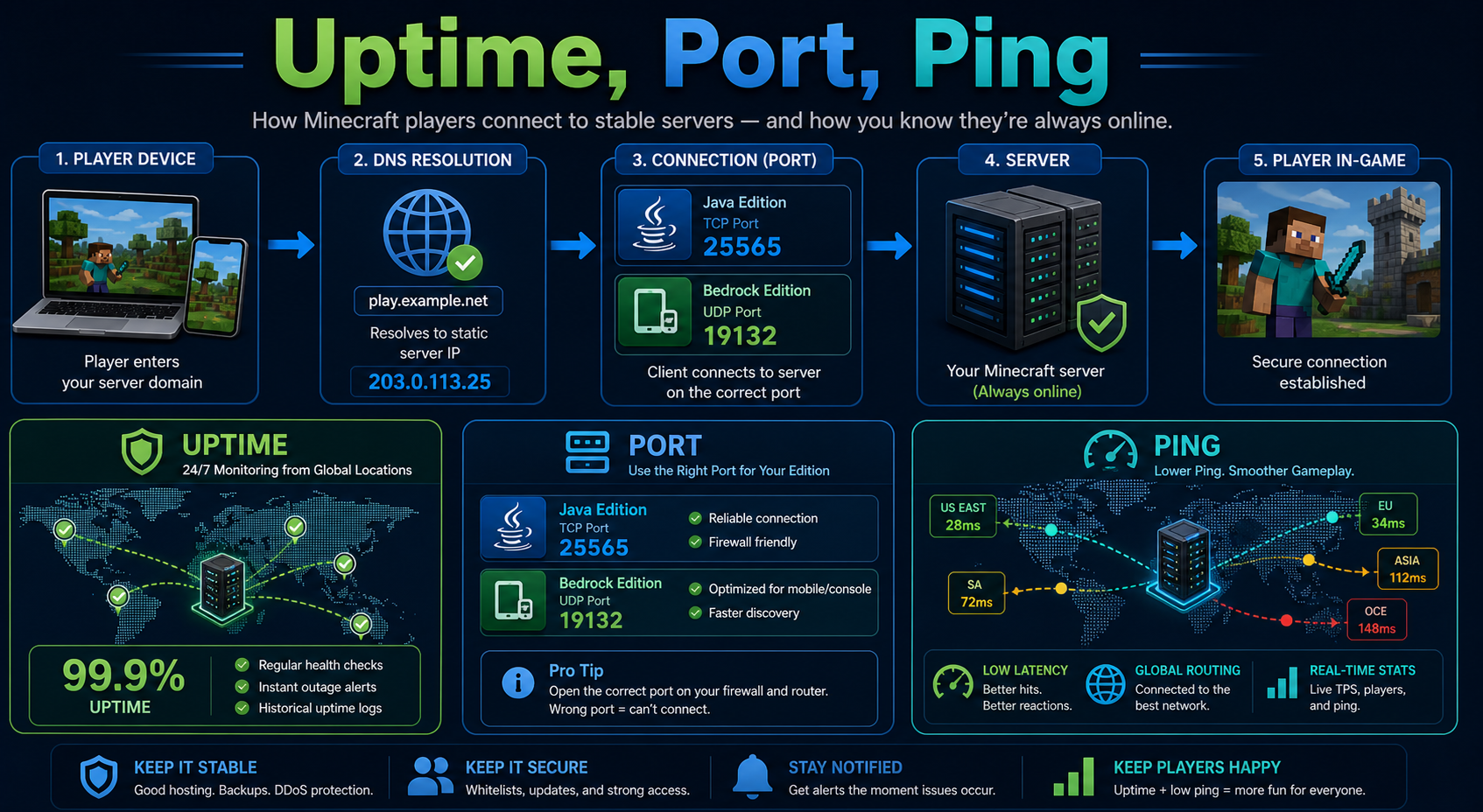
Java and Bedrock connect differently. Minecraft Help explains the basic flow for adding or directly entering a server in its official Java multiplayer server guide. Java servers usually use TCP port 25565. Bedrock servers commonly use UDP port 19132.
Crossplay and Geyser
Some networks support both editions through crossplay tooling. GeyserMC is one of the common bridges used to let Bedrock clients connect to Java servers, and the Geyser setup documentation explains how server operators configure that bridge.
| Edition | Default Port | Protocol | What to Check |
|---|---|---|---|
| Java Edition | 25565 | TCP | Server version, anticheat, PvP mechanics, and queue time |
| Bedrock Edition | 19132 | UDP | Correct port, platform support, and featured-server compatibility |
| Crossplay | Varies | Bridge-dependent | Geyser/Floodgate support, command limits, and mode compatibility |
Best 24/7 Java Server IPs to Try
| Server | IP | Best For | Stability Notes |
|---|---|---|---|
| Hypixel | play.hypixel.net | Minigames, SkyBlock, BedWars, SkyWars, Duels | Large infrastructure and high player volume |
| CubeCraft | play.cubecraft.net | Minigames and crossplay-friendly sessions | Long-running network with Java and Bedrock presence |
| PvP Land | pvp.land | Practice PvP and bot fights | Focused PvP environment |
| ComplexGaming | hub.mc-complex.com | Pixelmon, survival, factions, and mixed modes | Broad network with multiple game modes |
| EarthMC | play.earthmc.net | Towny, geopolitics, and long-term community play | Established niche community |
For Java, Hypixel remains the safest starting point if you want a huge active network. CubeCraft is useful when you want a more cross-platform-friendly ecosystem, while PvP Land is better for players focused on combat training.
Best 24/7 Bedrock Server IPs to Try
| Server | IP | Port | Best For |
|---|---|---|---|
| The Hive | geo.hivebedrock.network | 19132 | Bedrock minigames |
| CubeCraft Bedrock | mco.cubecraft.net | 19132 | Cross-platform-style minigames |
| Lifeboat | mco.lbsg.net | 19132 | Bedrock survival and minigames |
| Galaxite | play.galaxite.net | 19132 | Bedrock minigames |
| ComplexGaming Bedrock | bedrock.mc-complex.com | 19132 | Mixed modes where Bedrock support is available |
Bedrock players should always verify the port. A server address without the correct port can fail even when the network is online.
Cross-Platform Servers Worth Checking
| Server | Java IP | Bedrock IP or Port | Why It Matters |
|---|---|---|---|
| CubeCraft | play.cubecraft.net | mco.cubecraft.net | Strong option for mixed Java and Bedrock friend groups |
| ComplexGaming | hub.mc-complex.com | Check current Bedrock address | Broad mode selection with multi-edition support |
| EarthMC | play.earthmc.net | Check current Bedrock support | Roleplay and geopolitical gameplay |
| Geyser-enabled community servers | Varies | Usually 19132 | Useful when a Java server deliberately supports Bedrock clients |
Crossplay is convenient, but test the exact game mode you care about. Some features, menus, cosmetics, commands, or anticheat behavior may work differently for Bedrock clients.
Network Reliability Beyond Minecraft
Minecraft server selection is a useful reminder that connectivity depends on region, routing, IP reputation, ports, and stable infrastructure. Those same factors matter for business workflows that depend on public web access.
For legitimate technical work, LycheeIP can help teams test routes, monitor public access, and understand how services behave from different IP locations. Dynamic residential proxies are useful for distributed research, while static IPs help when a workflow needs a consistent identity over time.
If speed and scale matter more than long sessions, datacenter proxies can support fast checks. Teams can also start from the LycheeIP proxy dashboard and choose the IP type that best matches their monitoring or testing workflow.
Suggested Video: Java and Bedrock Crossplay
This short walkthrough is a helpful companion if you want to understand how Java and Bedrock crossplay can be configured with GeyserMC.
Common Mistakes When Choosing Long-Term Servers
Mistake 1: Trusting the Word “24/7” Without Testing
Some listings use 24/7 as a marketing label. Join at different times, check player activity, and watch whether the server restarts often.
Mistake 2: Ignoring IP Stability
If the address changes often, your friends may struggle to reconnect. Stable domains and static backend addresses are better for long-term communities.
Mistake 3: Mixing Up Java and Bedrock
A Java IP may not work on Bedrock. A Bedrock server may require a custom port. Always check the edition-specific connection details.
Mistake 4: Overlooking Ping and Region
A server that is always online can still feel laggy if it is hosted far away from you. Test ping during peak hours, not just when the network is quiet.
Mistake 5: Forgetting Security and Fairness
Avoid servers with suspicious launchers, unclear monetization, or aggressive pay-to-win systems. For business testing outside gaming, rotating residential IP access, stable static proxies, and high-speed datacenter proxy options should be used responsibly and within site terms.
Conclusion
The best 24/7 Minecraft server IP is not just the one with the biggest player count. It is the one that stays reachable, runs smoothly, uses the right edition and port, and supports the game mode you actually want to play.
Hypixel, CubeCraft, The Hive, PvP Land, ComplexGaming, Lifeboat, Galaxite, and EarthMC are practical starting points, but each has a different strength. Test the server, verify the address, and check how it behaves during busy hours before you commit.
For broader connectivity testing, LycheeIP gives teams flexible ways to evaluate public access through static proxy routes, dynamic proxy pools, and datacenter IP infrastructure.
Frequently Asked Questions
What does a 24/7 Minecraft server mean?
It means the server is intended to stay online around the clock, with minimal interruptions for maintenance, crashes, or network failures.
Can any Minecraft server truly have no downtime?
No public server can honestly guarantee zero downtime forever. The realistic goal is high availability, fast recovery, and stable routing.
What is the default Java Minecraft server port?
Java Edition usually uses TCP port 25565.
What is the default Bedrock Minecraft server port?
Bedrock Edition commonly uses UDP port 19132.
Why does a domain work better than a raw IP?
A domain can keep pointing players to the right backend even when server infrastructure changes. Raw IPs are harder for communities to manage long term.
Which 24/7 server is best for minigames?
Hypixel, CubeCraft, The Hive, and Galaxite are good starting points depending on whether you play Java or Bedrock.
Which server is best for PvP practice?
PvP Land and Minemen Club-style practice servers are good choices for focused combat training.
Can Bedrock players join Java servers?
Yes, but only when the server supports crossplay through tools such as Geyser or a dedicated Bedrock bridge.
How do I know if a server is stable?
Check uptime, community activity, restart frequency, ping during peak time, and whether the server has been around for a while.
Why does ping matter if the server is online?
A server can be available but still feel delayed. Ping affects hit registration, movement, combat, block updates, and overall smoothness.

Recommended Articles
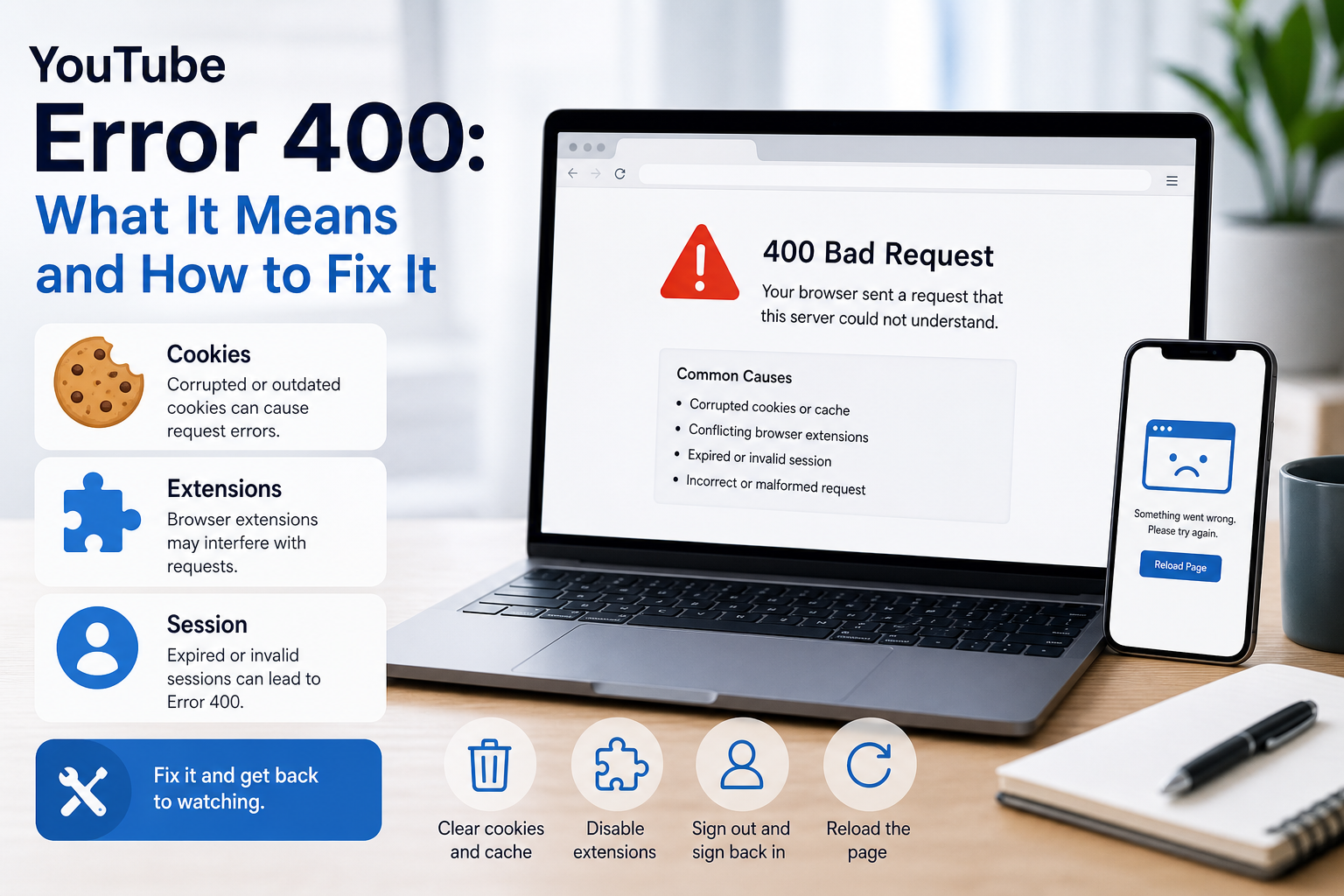
YouTube Error 400: What It Means and How to Fix It
In HTTP terminology, a 400 Bad Request is a client-error response. MDN explains that servers commonly return 400 when they consider the request malformed, incorrectly framed, or deceptively routed. The important troubleshooting clue is that repeating the exact same request without changing anything is expected to fail again.
View Details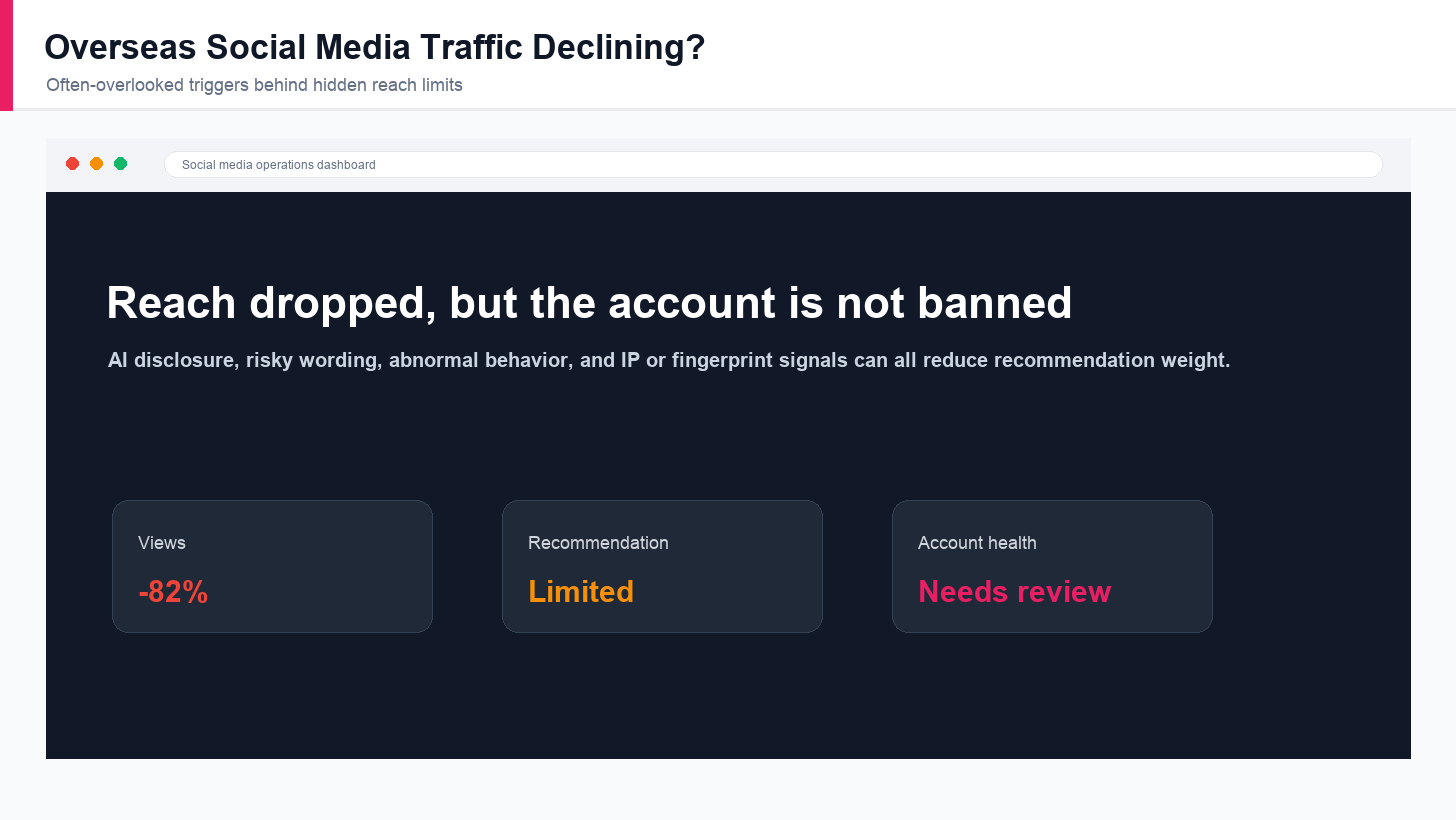
Overseas Social Media Traffic Declining? These Reach-Limiting Triggers Are Often Overlooked
A practical guide to overlooked overseas social media reach drops, covering AI content disclosure, risky wording, abnormal account behavior, hidden reach-limiting signals, and account environment checks.
View Details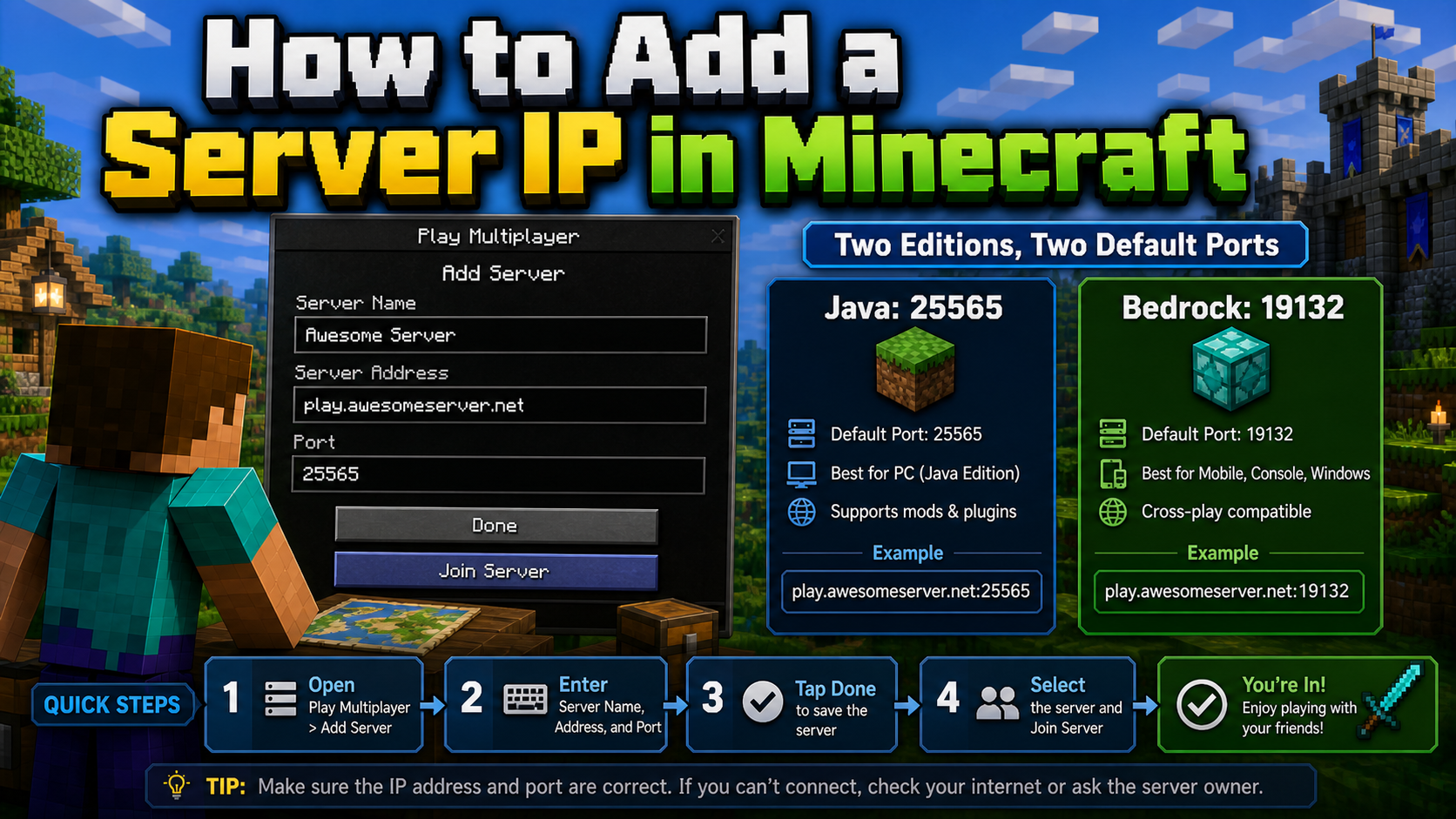
How to Add a Server IP in Minecraft Step by Step
Learn exactly where to enter a Minecraft server IP in Java, Bedrock, and Pocket Edition, plus how to fix common connection errors, ports, and edition mismatches.
View Details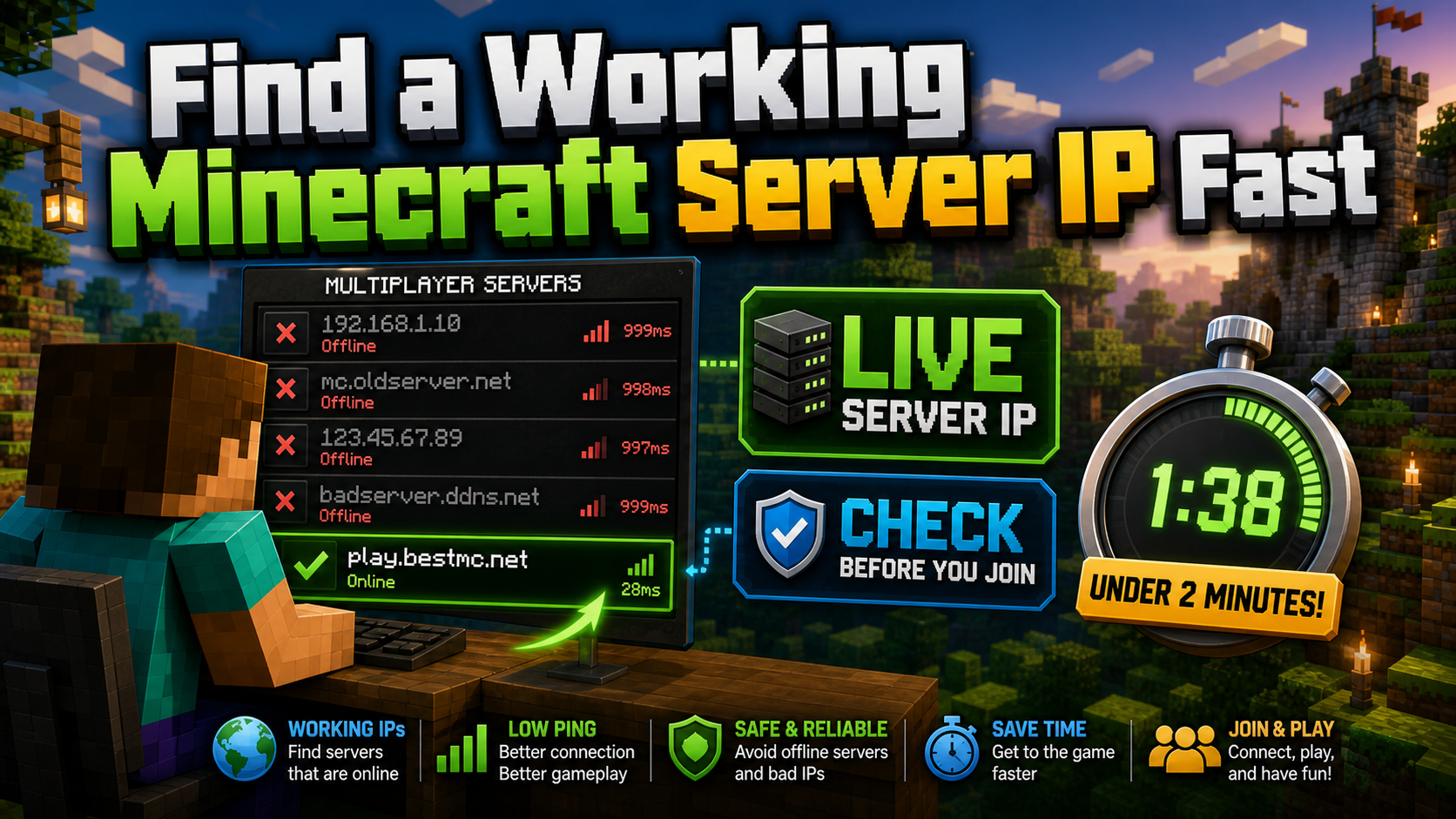
How to Find a Working Minecraft Server IP Fast
Stop wasting time on dead Minecraft server IPs. Learn how to verify live servers quickly, read status icons, check ports, and source updated server addresses.
View Details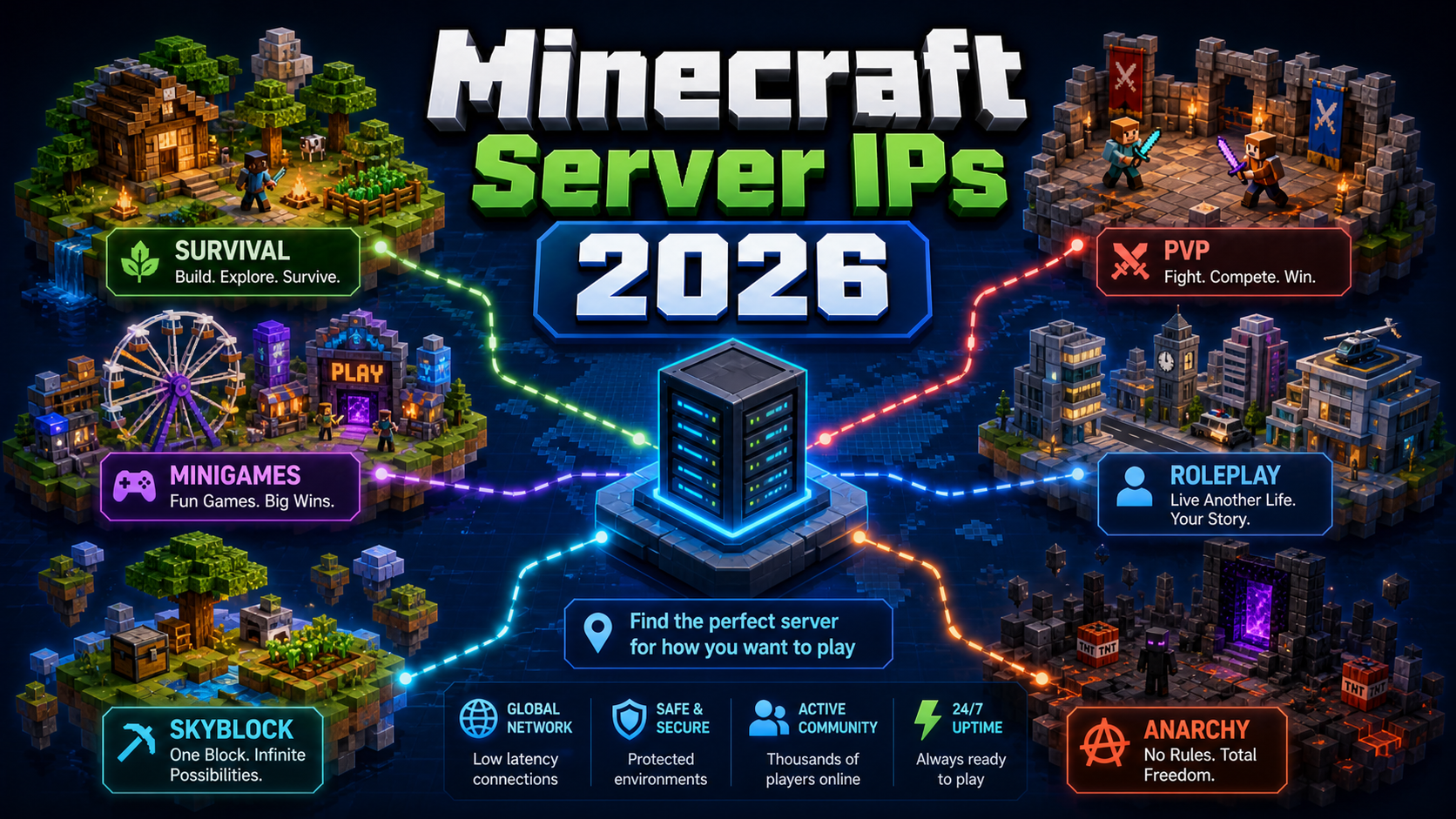
Minecraft Server IPs for Every Game Mode in 2026
Find Minecraft server IPs by game mode for 2026, including survival, PvP, minigames, roleplay, SkyBlock, anarchy, Java, Bedrock, crossplay, and pay-to-win notes.
View Details