
What Is the Difference Between Native ISP and Dual ISP?
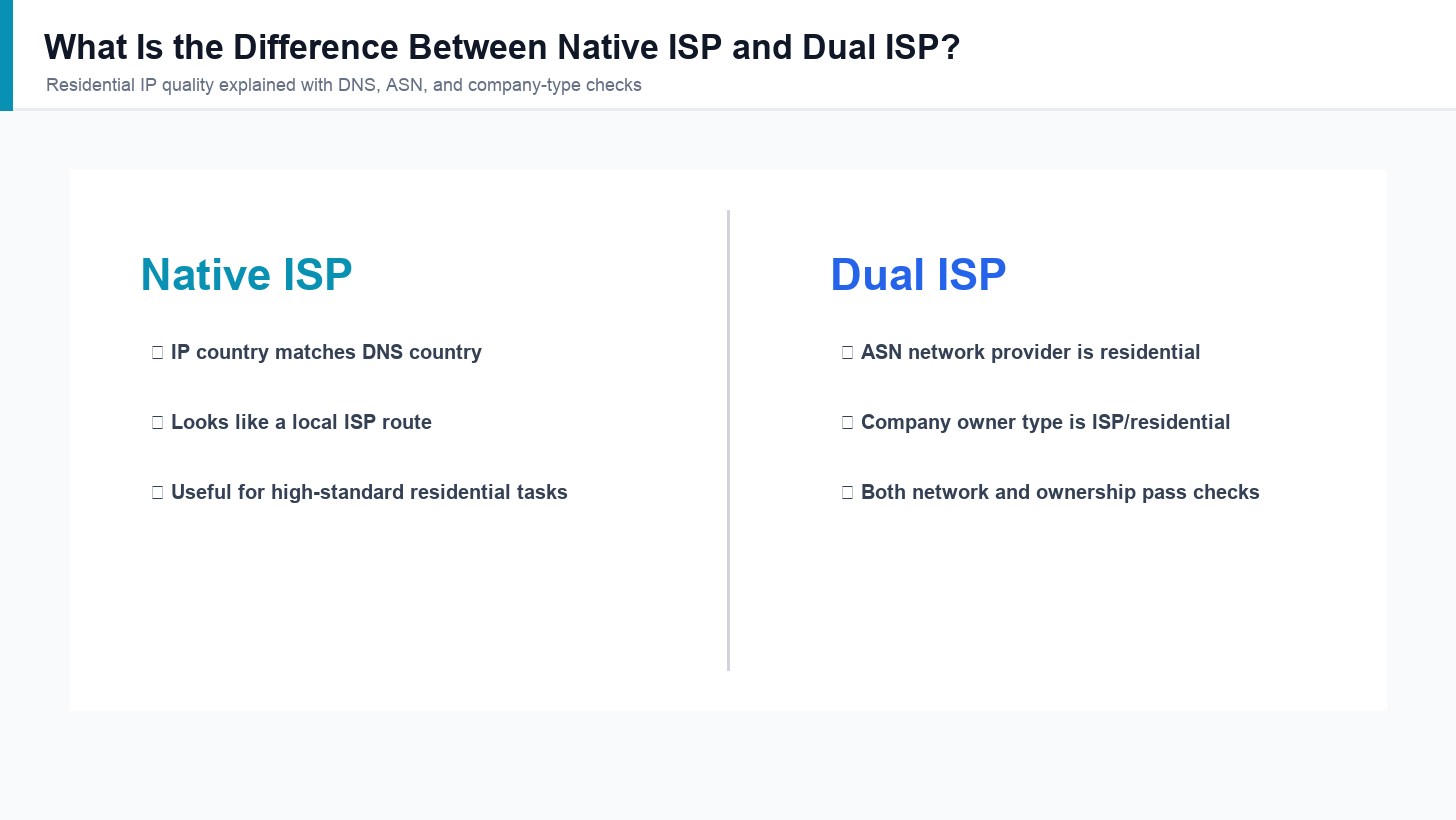
Native ISP and dual ISP are both used to describe high-quality residential proxy IP traits, but they focus on different checks. Native ISP usually emphasizes IP and DNS alignment, while dual ISP checks both the deployed network provider and the IP ownership type.
In high-standard proxy IP scenarios, the concepts of “native ISP” and “dual ISP” appear frequently. Understanding them helps teams evaluate whether an IP looks like real residential network access or whether it carries data-center or hosting traits that sensitive platforms may restrict.
Understanding Native ISP
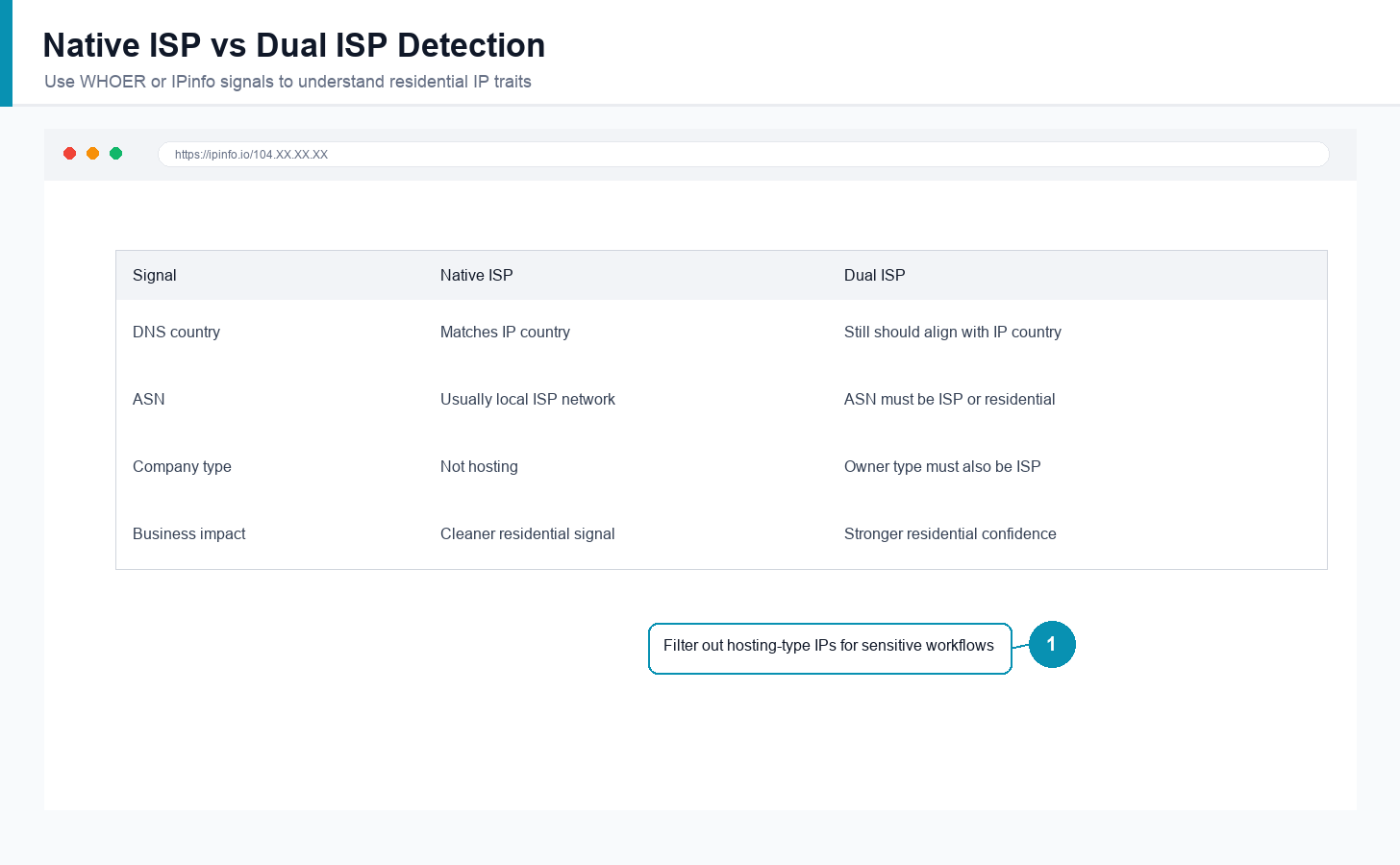
A native ISP IP, often called a native IP, is commonly evaluated by checking whether the IP address country and the DNS server country align. Tools such as WHOER or IPinfo can help inspect country, ASN, DNS, and organization signals.
If the IP country and DNS country match, the IP is often considered more naturally local. There are exceptions: in parts of Southeast Asia and Europe, local network infrastructure can be weaker, and DNS may be routed to a nearby country. For example, some Indonesian network environments may resolve DNS through Singapore.
LycheeIP states that its ISP resources are screened as pure native IP resources so customers can meet higher standards in workflows that care about IP authenticity and residential traits.
Understanding Dual ISP
Dual ISP means both the IP address registrant or owner and the deployed network service provider are identified as home-network or residential internet service providers. In other words, the ownership side and the actual network side both need residential ISP characteristics.
The simplest way to evaluate this is to inspect two attributes in tools such as WHOER or IPinfo:
- ASN: the autonomous system that represents the network provider actually announcing or deploying the IP.
- Company type: the nature of the organization that owns or registers the IP.
Only when both the ASN/network provider and the company type are clearly marked as ISP, residential, or similar home-network traits should the IP be treated as dual ISP.
Why IP Traits Matter for Business Workflows
IP traits can include residential ISP, business, education, hosting, and other categories. Server IPs from cloud platforms or data centers are often marked as hosting. Those IPs can be easier for sensitive workflows, such as social media, ecommerce, ad verification, and account operations, to identify and restrict.
LycheeIP static residential proxy resources are sourced from overseas carrier partnerships. During screening and cleaning, IPs that show hosting traits are filtered out, which helps preserve the appearance of real residential user attributes.
View LycheeIP Static Residential Proxies
Frequently Asked Questions
Is native ISP the same as dual ISP?
No. Native ISP usually focuses on local alignment signals such as IP country and DNS country. Dual ISP requires both the network provider and the IP ownership type to show residential ISP traits.
Can WHOER and IPinfo prove quality with 100% certainty?
No public lookup tool is perfect, but they are useful for screening. Treat them as practical signals and combine them with real workflow tests.
Why should hosting-type IPs be filtered out?
Hosting IPs are easier for platforms to associate with servers, automation, or data-center traffic. For sensitive tasks, residential ISP traits are generally more trusted.
Related LycheeIP Articles
Related LycheeIP articles: Instagram proxy management, mobile and residential proxy use cases, residential proxies, anonymous proxy servers, mobile proxies, public versus private IP addresses, Apple proxy setup, V2rayN PC proxy setup, MoreLogin proxy setup, HubStudio proxy setup.