
New Browser APIs You Need to Know in 2026
Browsers just shipped features that make half your frontend JavaScript libraries obsolete.
If that sentence made you sit up straighter, good—because it should. For years, frontend developers and technical operators have papered over the browser's limitations with thick layers of JavaScript: heavy grid libraries to handle complex layouts, utility functions to generate random design variance, polyfills for container-aware components, and custom renderers for search highlights.
In 2026, the browser is quietly dismantling that scaffolding piece by piece. The question isn't whether these native APIs are ready—they are. The question is whether your team is ready to use them.
This article breaks down the most impactful new browser-native features shipping in 2026, the legacy dependencies they replace, and how to seamlessly integrate them into your automated testing and deployment workflows today.
Run Global UI Tests
The Grid Lines API and Native Masonry — Goodbye, Masonry.js
Masonry layouts have been the white whale of CSS for over a decade. Pinterest-style grids, where items snap into the next available vertical slot rather than aligning to a strict row, have historically required JavaScript to calculate and reposition elements dynamically.
Libraries like Masonry.js, Isotope, and their React-specific wrappers became staples of the frontend toolkit precisely because CSS Grid couldn't natively handle this pattern without heavy scripting assistance. That changes with the Grid Lines API and the newly stabilized masonry value.
What the Grid Lines API Actually Does
The Grid Lines API exposes programmatic access to a grid container's computed line positions—both explicit and implicit. While this sounds like a debugging convenience, its real power lies in how it integrates with the browser's internal layout algorithms. By giving the layout engine the ability to resolve and communicate grid line positions natively, it opens the door to layout modes that previously required JavaScript simulation.
The native masonry layout mode builds directly on this capability. With a declaration as simple as:
CSS
.container {
  display: grid;
  grid-template-columns: repeat(auto-fill, minmax(250px, 1fr));
  grid-template-rows: masonry;
}
...you instantly achieve a fully native masonry layout. Items pack upward into available space automatically. There is no JavaScript, no layout recalculation on viewport resize, and no heavy third-party dependency to install.
What This Replaces
For most UI workflows, native CSS masonry directly obsoletes Masonry.js and Isotope for structural layout purposes. It also eliminates the painful workaround of using CSS columns for masonry approximations—a notorious hack that historically broke screen reader order and required complex media query gymnastics.
Beyond the bundle size win (Masonry.js alone is ~16KB minified), the performance story is undeniable. JavaScript-driven masonry triggers expensive reflows. Native CSS masonry is handled during the browser's own layout pass, delivering smoother initial renders and zero Cumulative Layout Shift (CLS) on load.
Practical Considerations
Browser support is expanding across Chromium, Firefox, and Safari in 2026. For progressive enhancement, wrapping your masonry styles in a @supports block is clean and effective:
CSS
@supports (grid-template-rows: masonry) {
  .container {
    grid-template-rows: masonry;
  }
}
By providing a standard column-based grid fallback for unsupported browsers, your layout degrades gracefully rather than breaking entirely.
CSS random() and Name-Only Container Queries — Killing the Boilerplate
If native masonry is the headline act, CSS random() and name-only container queries are the structural changes that will drastically alter your day-to-day workflow.
CSS random(): Controlled Randomness Without JavaScript
Generating visual variance—like slightly different rotation angles on cards, randomized animation delays, or organic-feeling stagger effects—has always required JavaScript to inject inline styles. It couples your styling logic to your scripting layer, muddying component architecture.
The experimental CSS random() function resolves this directly at the style level:
CSS
.card {
  transform: rotate(random(-3deg, 3deg));
  animation-delay: random(0s, 0.5s);
}
Key Benefits:
- Paint-Time Resolution: Values are resolved per-element at paint time and remain stable across repaints unless the element is explicitly re-inserted into the DOM.
- No Flickering: Because values do not recalculate on every render cycle, you eliminate the UI flickering bugs that plagued JavaScript randomness.
- Stepped Randomness: The function accepts an optional by parameter for stepped variance (e.g., locking randomness to increments of 5px).
Name-Only Container Queries: The End of Redundant Breakpoints
Container queries revolutionized responsive design, but they came with friction: to query a container, you had to establish a containment context (container-type), which forces size containment rules that don't always fit flexible component structures.
Name-only container queries remove that friction entirely:
CSS
.sidebar {
  container-name: sidebar;
  /* No container-type required */
}

@container sidebar style(--variant: compact) {
  .nav-item {
    padding: 4px 8px;
  }
}
By decoupling naming from size containment, frontend teams can dramatically reduce media query duplication in component libraries. You can now define a single contextual contract at the container level and let child components adapt dynamically.
Run Global UI Tests
Search-Text Styling and Canvas Integration — The Creative Frontier
The final two APIs are less about replacing libraries and more about expanding what's natively possible without reaching for a canvas renderer or a custom DOM engine.
The CSS Custom Highlight API for Search Text
Styling search result highlights has historically been brittle. Most implementations resort to injecting <span> elements into the DOM via JavaScript, which is prone to breaking across nested elements, performs poorly on large documents, and damages accessibility.
The CSS Custom Highlight API changes this paradigm entirely. You register a named highlight range in JavaScript, and style it cleanly in CSS:
JavaScript
const range = new Range();
range.setStart(textNode, 5);
range.setEnd(textNode, 20);

const highlight = new Highlight(range);
CSS.highlights.set('search-result', highlight);


CSS
::highlight(search-result) {
  background-color: #fef08a;
  color: #1c1917;
}
The highlight is rendered by the browser's native painting engine. This handles multi-line ranges, bidirectional text, and overlapping spans gracefully, eliminating an entire category of fragile DOM-wrapping code.
HTML Canvas Integration with the DOM
Historically, the <canvas> element existed in isolation. Drawing DOM elements onto a canvas required elaborate screenshot hacks. The emerging Canvas placeElement API aims to bridge this gap.
With ctx.placeElement(element, x, y), developers can render actual HTML/DOM elements as part of a canvas compositing operation.
- Data Visualization: Place real HTML tooltips natively inside WebGL chart canvas elements.
- Gaming UIs: Mix DOM-based HUD elements with canvas content without z-index conflicts.
- Creative Tooling: Composite design assets with live DOM components seamlessly.
While still evolving in its event-handling capabilities, this signals the end of the historical wall between the DOM tree and the Canvas rendering context.
LycheeIP (Developer-First Proxy Infrastructure)
As frontend teams deploy these cutting-edge browser APIs—such as custom highlights and highly complex native grid layouts—they face the challenge of testing how these interfaces perform across different regions and localized content. LycheeIP is a developer-first proxy and data infrastructure provider designed to seamlessly route your web traffic for global testing, QA, and secure data collection.
When your team needs to verify that a dynamic CSS masonry grid gracefully handles character-heavy translations in global markets, adjusting a local VPN isn't enough. By integrating reliable proxy infrastructure directly into your automated headless browser testing (like Playwright or Puppeteer), you ensure your UI renders flawlessly regardless of the user's location. For large-scale localized UI testing, leveraging dynamic IP routing allows your test suites to simulate real, distributed user sessions across multiple ISPs. Conversely, maintaining a stable CI/CD pipeline often requires high-speed datacenter proxies to prevent automated timeout errors during heavy visual regression tests. By pairing modern browser capabilities with a robust data infrastructure platform, engineering teams can confidently ship rich, native web experiences worldwide.
The Bigger Picture
What's notable about this batch of browser APIs is that they don't just add features—they return responsibility to the correct rendering layer. Layout logic and visual variance belong in CSS. Highlight rendering belongs in the browser paint engine. Canvas compositing belongs in a unified rendering model.
For years, JavaScript filled these gaps out of necessity. The ecosystem adapted, and bundle sizes ballooned. Now that the platform is catching up, the appropriate response isn't nostalgia for your current dependencies—it is a systematic audit of which ones you can finally retire.
The libraries did their job. The browser is ready to take over.
Run Global UI Tests
Frequently Asked Questions
Q: Is native CSS masonry layout production-ready in 2026?
A: Browser support is actively expanding across Chromium, Firefox, and Safari throughout 2026. The recommended best practice is to use @supports (grid-template-rows: masonry) to apply masonry styles progressively, providing a standard column-based grid as the fallback for older clients.
Q: Does CSS random() generate a new value every time the element repaints?
A: No—and that's by design. CSS random() values are resolved per-element at layout/paint time and remain stable across subsequent repaints. Values only re-randomize if the element is removed from and re-inserted into the DOM, preventing flickering.
Q: What's the difference between name-only container queries and standard container queries?
A: Standard container queries require container-type to be explicitly set, which activates size containment and can unexpectedly alter how the element participates in layout. Name-only container queries allow you to assign a container name without triggering size containment, enabling pure style-based queries.
Q: Can the CSS Custom Highlight API handle highlights that span across multiple HTML elements?
A: Yes. This is its primary technical advantage over the traditional approach of wrapping text in nested HTML tags. The API uses JavaScript Range objects that the browser's painting engine handles natively, meaning multi-element and multi-line spans are rendered flawlessly.
Q: Is the Canvas placeElement API ready for production use?
A: The Canvas placeElement API is still in early availability stages as of 2026, with known spec limitations around deep interaction event handling for placed elements. It is highly recommended for internal tools or progressive enhancement, but caution is advised for mission-critical user-facing interactive features.
Q: Do these new browser APIs mean I should immediately remove all my JavaScript layout libraries?
A: Not immediately, but now is the time to audit your package bundles. For greenfield projects, native browser APIs should be your default choice. For legacy applications, execute a staged migration using feature detection (@supports in CSS, capability checks in JS) to adopt native APIs progressively while maintaining backwards compatibility.

Recommended Articles
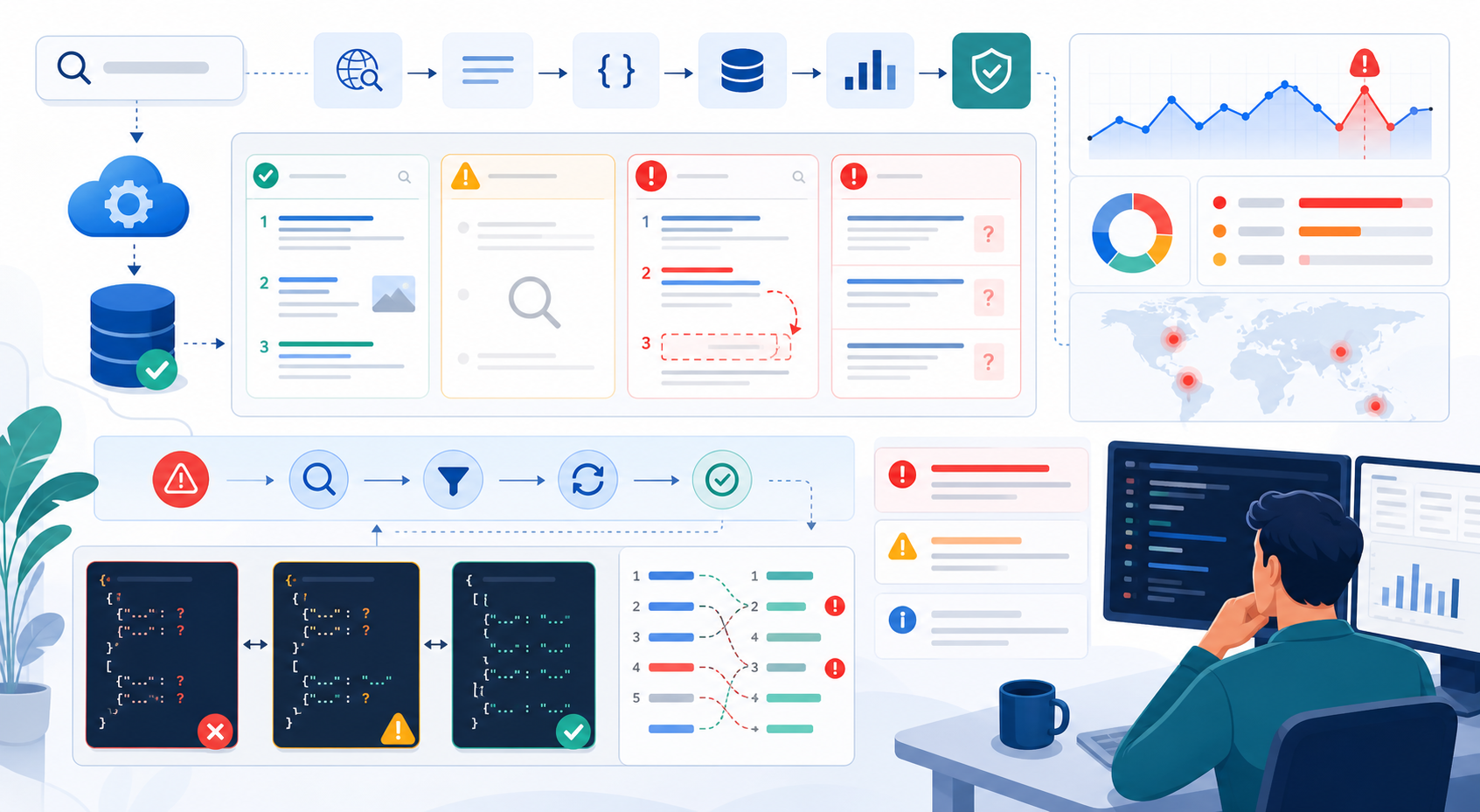
SERP API Troubleshooting: Fix Empty, Wrong, or Inconsistent Search Results
SERP API failures are not limited to obvious HTTP errors. A request can return successfully and still produce empty, incomplete, geographically wrong, duplicated, or misinterpreted search data. Production troubleshooting therefore has to separate transport problems from provider processing, SERP differences, and downstream parsing errors.
View Details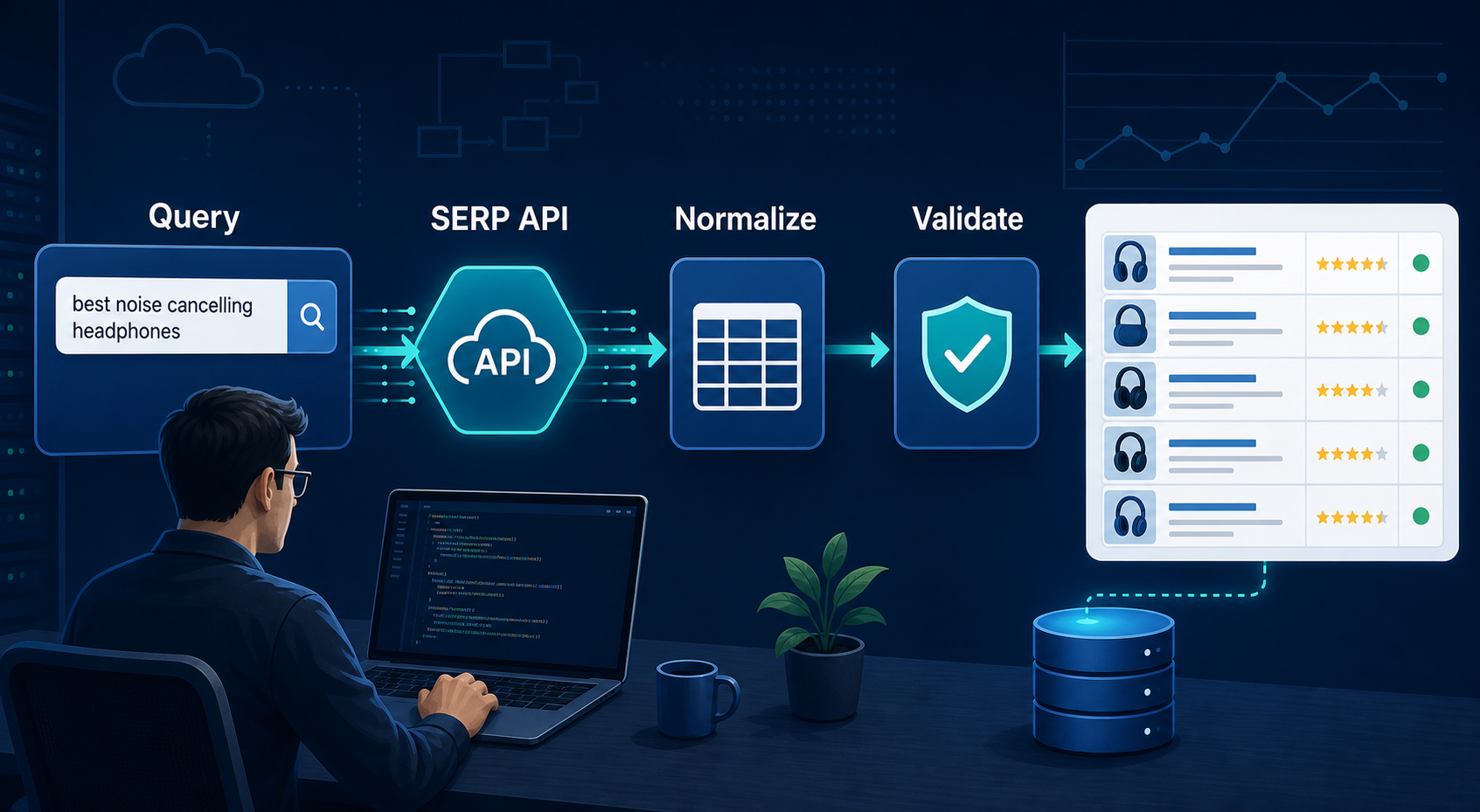
SERP API Python: How to Build a Reliable Search Data Pipeline
This guide shows a provider-neutral workflow for building that pipeline. It does not rank SERP API vendors. Instead, it focuses on the implementation choices that make a Python integration easier to operate, test, and migrate.
View Details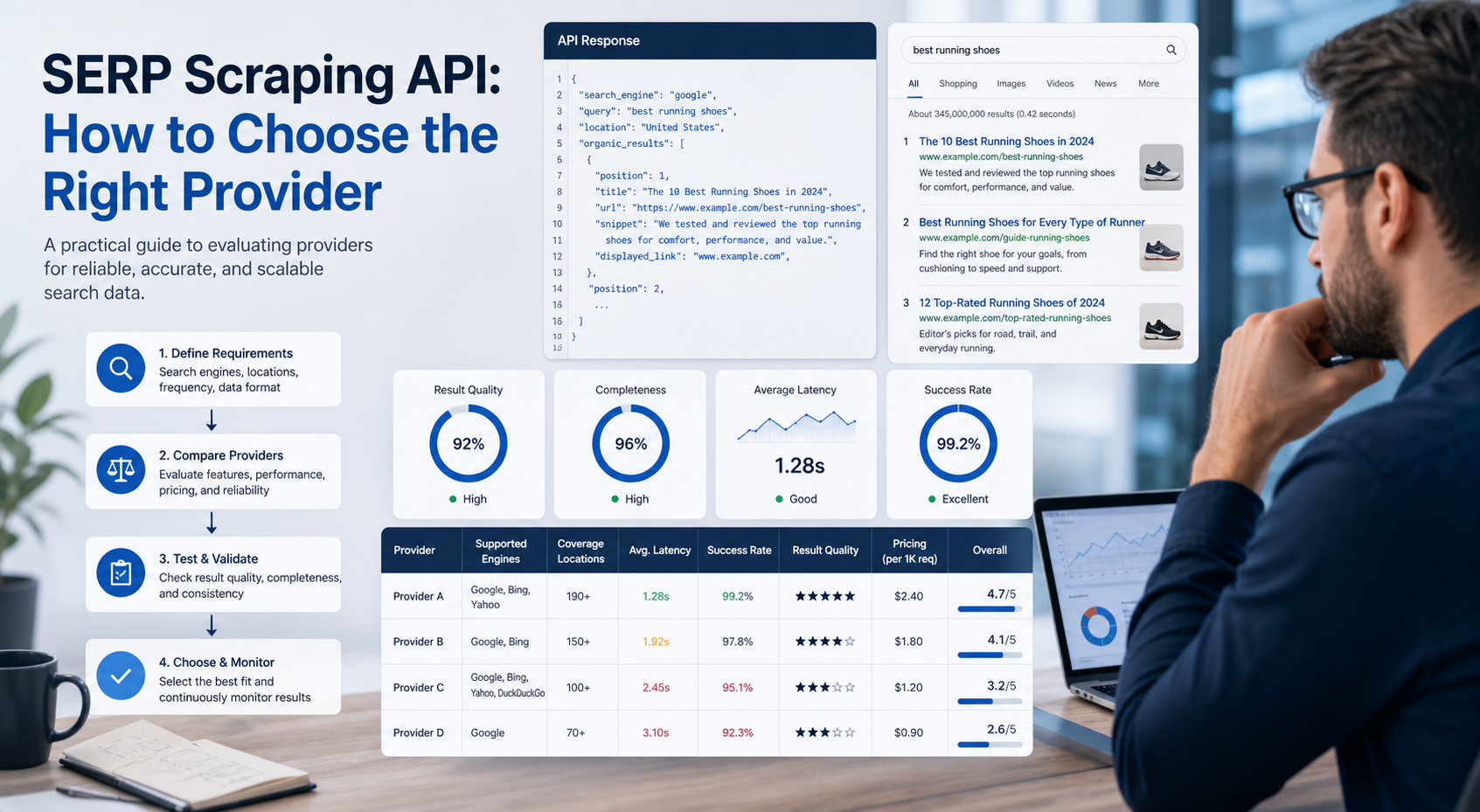
SERP Scraping API: How to Choose the Right Provider
Recommended Meta Description: Compare SERP scraping APIs by data coverage, localization, reliability, workflow fit, and cost structure, then choose and validate the right provider.
View Details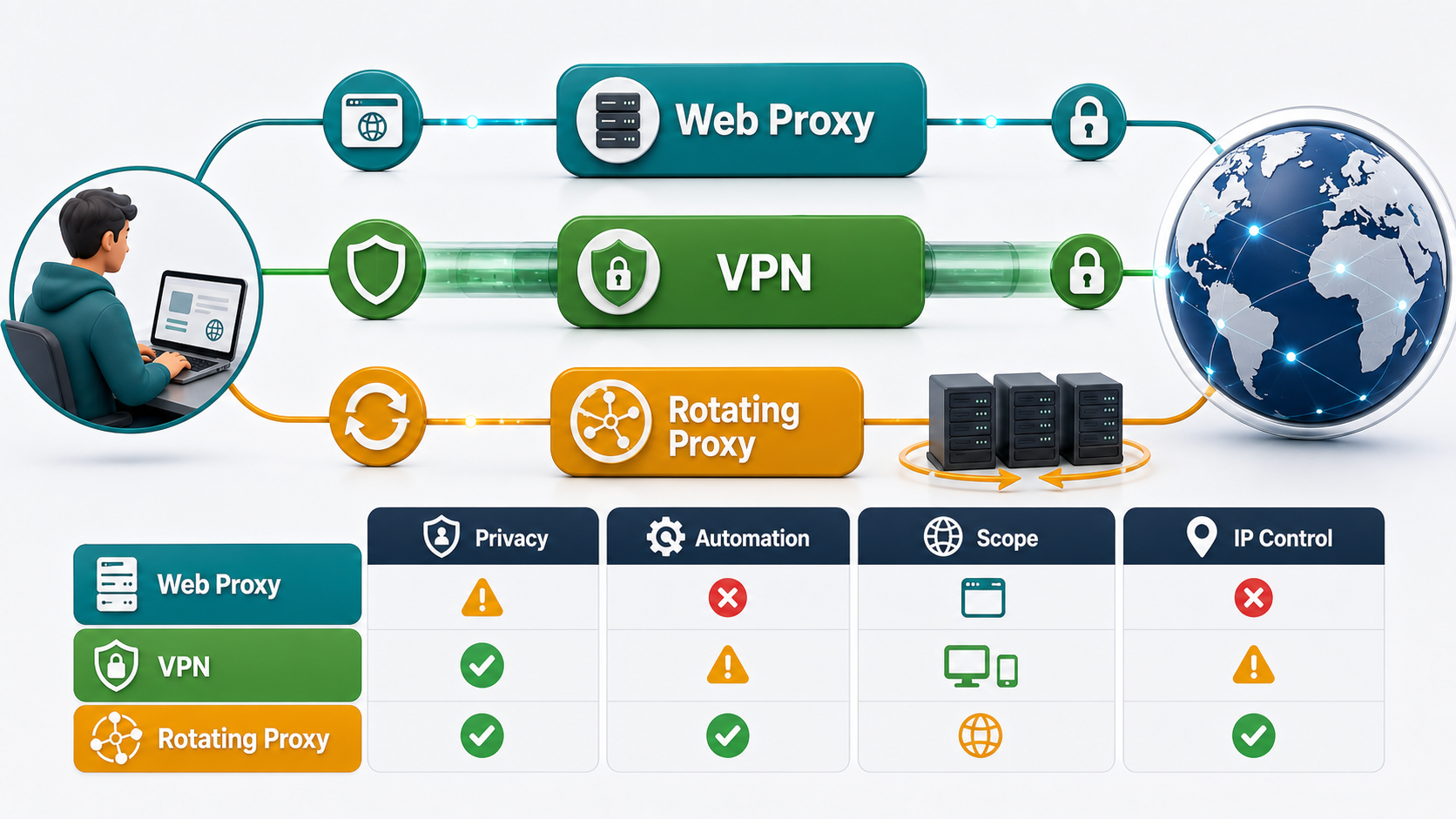
Free Web Proxy vs VPN vs Rotating Proxy: Which Should You Use?
Compare free web proxies, VPNs, rotating proxies, static proxies, and datacenter proxies by scope, encryption, IP control, automation, streaming, and account workflows.
View Details
BlockAway Not Working? Fix Common Proxy, Video, and Access Problems
Troubleshoot BlockAway when pages are blocked, YouTube fails, JavaScript breaks, speed drops, sessions expire, or mobile access behaves differently.
View Details