
Cheap Residential Proxies: Pricing, Providers, and Smarter Alternatives
Cheap Residential Proxies: Pricing, Providers, and Smarter Alternatives
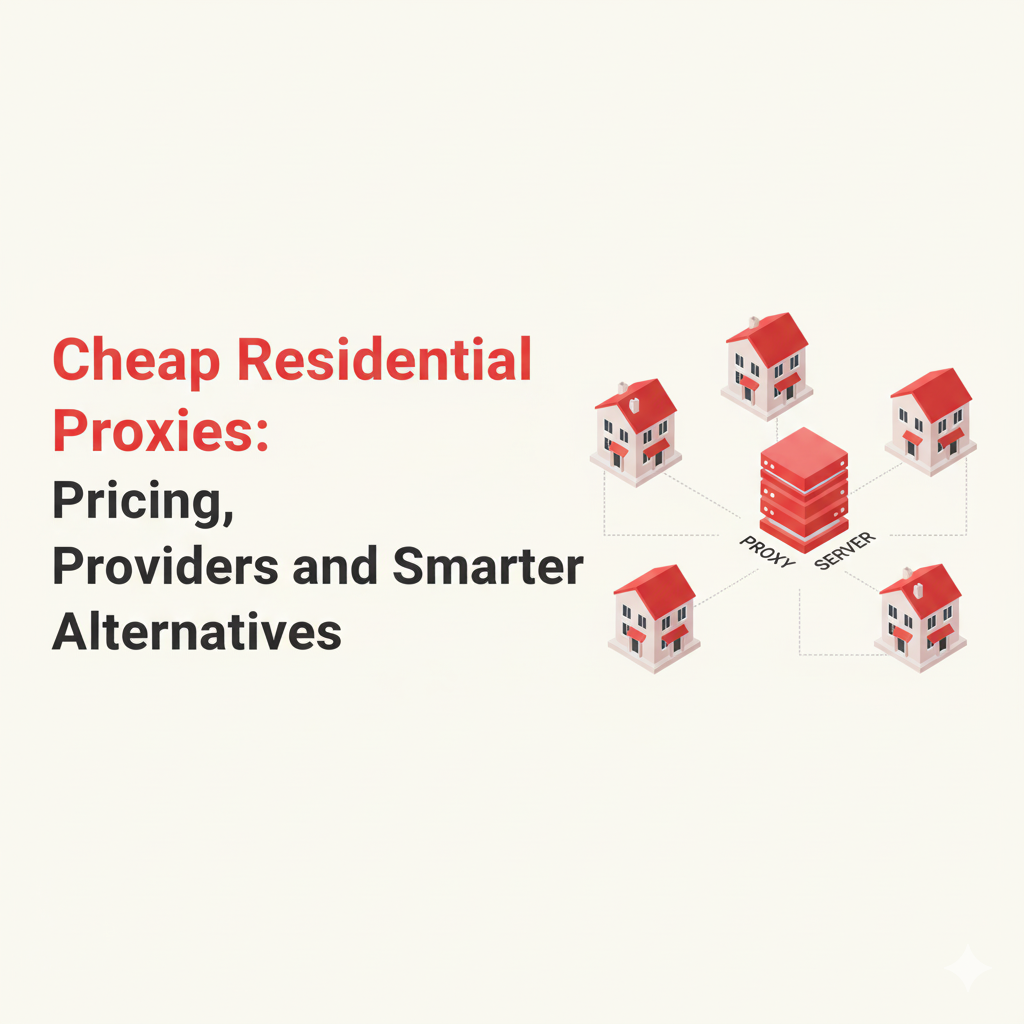
The search for cheap residential proxies is a common starting point for developers and businesses looking to access public web data without being blocked. These services promise the high trust signal of a real user's IP address at a lower price point. However, the word "cheap" is more complex than just the advertised price. The true cost of a proxy service is a function of its performance, reliability, and ethical standing.
This article offers a transparent analysis of the market for cheap residential proxies. We will compare real-world pricing from various residential proxy providers, explain when more affordable datacenter IPs are a smarter choice, and provide practical configuration tips to help you reduce your costs without sacrificing success rates.
Test LycheeIP's reliable network to find a cost-effective solution.
What are cheap residential proxies and who should use them first?
Cheap residential proxies are services that offer access to a network of residential proxies at a lower per-gigabyte or per-IP cost compared to premium enterprise providers. You should consider using them for projects where your target websites are sensitive to traffic from datacenter IPs or when you require the organic fingerprint of a real user's connection to gather accurate data.
What is a residential proxy and how does it differ from datacenter ips?
A residential proxy routes your internet traffic through an IP address assigned by an Internet Service Provider (ISP) to a real home device. In contrast, datacenter IPs are sourced from servers in commercial data centers. This distinction is critical because traffic from residential proxies is often indistinguishable from that of a regular user, making it much harder for websites to detect and block.
Why do targets flag datacenter ips more often?
Websites frequently flag datacenter IPs because their IP ranges are publicly registered to commercial hosting companies, not to consumer ISPs. Sophisticated anti-bot systems analyze an IP's Autonomous System Number (ASN), and an ASN belonging to a known data center is a strong indicator of automated traffic. Residential proxies, on the other hand, originate from a diverse range of consumer ISPs, allowing them to blend in with normal user activity.
Which cheap residential proxies are actually the most affordable today?
The most affordable proxy service is the one that delivers the highest success rate for the lowest cost, as failed requests still consume bandwidth and drive up your final bill. The following is a snapshot of public pricing from several popular residential proxy providers as of late 2025, based on their websites and independent industry reviews.
What do leading residential proxy providers charge?
This table provides a starting point for comparing options. Always verify current pricing and terms directly with the provider.
| Provider | Starting Price (per GB) | Key Consideration | Best For |
| PacketStream | $1.00 | Simple pay-as-you-go model. | Small tests and personal projects where performance variability is acceptable. |
| LycheeIP | Flexible Payment option | Flexible, low-commitment plans, and simple pay-as-you-go model. | Users who require a mix of proxy types without compromise on value even on a tight budget. |
| IPRoyal | ~$2.63 (with promos) | Flexible, low-commitment plans. | Small to medium workloads that need an easy entry point. |
| Proxy-Cheap | ~$4.99 (rotating) | Offers both rotating (per-GB) and static (per-IP) options. | Users who require a mix of proxy types on a tight budget. |
| Decodo | ~$1.50 (with promos) | A strong balance of price and mature features. | Budget-conscious teams that still need a stable toolset. |
| SOAX | ~$2.00 (at volume) | Very low per-GB rates on larger, multi-hundred GB plans. | High-volume data collection where bulk pricing is a key factor. |
| Oxylabs | ~$4.00 (with promos) | Enterprise-grade reliability, advanced tools, and strong support. | Teams that require SLAs and a premium data collection infrastructure. |
Independent review sites, such as Proxyway, regularly analyze these residential proxy providers, offering valuable third-party perspectives on performance and overall value.
Which coupons and trials change the effective rate?
Many residential proxy providers offer promotional coupons and free trials that can significantly reduce your initial cost. It is common to see introductory offers of 50% off or more for new customers. These deals are excellent for testing a service, but remember to factor in the standard renewal price when calculating the long-term cost of your residential proxies.
Test LycheeIP's reliable network to find a cost-effective solution.
Why might datacenter ips be a smarter first step for some tasks?
Datacenter IPs can be a smarter choice because they are significantly cheaper and faster than residential proxies, and many websites do not require the high trust signal of a residential IP. Before you invest in even the most cheap residential proxies, it is a best practice to test your target website with datacenter IPs first. You might find they are all you need.
When can datacenter ips pass without bans?
Datacenter IPs are often sufficient for collecting data from public sources that are not protected by aggressive anti-bot systems. This includes tasks like general SEO monitoring, crawling open-access academic journals, or accessing public government APIs. By using polite request rates and smart caching, datacenter IPs can be a very effective and cost-efficient solution.
Which workloads still require residential proxies?
Workloads that target sophisticated websites, particularly in e-commerce, travel, and social media, almost always require residential proxies. These sites invest heavily in bot detection and can easily identify and block traffic from datacenter IPs. For these use cases, the higher success rate of residential proxies justifies their higher cost.
How do pay-as-you-go and bulk plans compare on total cost?
Pay-as-you-go plans offer the most flexibility and are ideal for projects with variable or unpredictable data needs. Bulk plans, which require a larger upfront commitment, offer a much lower per-gigabyte rate and are more cost-effective for large, continuous data collection operations.
When does a bulk commit beat pay-as-you-go?
A bulk plan becomes more economical when your monthly data usage is consistently high, typically in the range of several hundred gigabytes or more. At this scale, the per-GB cost from many residential proxy providers can drop dramatically, making a bulk plan the clear financial winner for predictable, high-volume workloads.
How do retries and rotation waste bandwidth?
Inefficient data collection practices can significantly inflate your bandwidth consumption and drive up the cost of even the most cheap residential proxies. Every failed request due to a block still consumes data. Aggressive IP rotation, where you use a new IP for every single request, also adds overhead. Optimizing your code to handle retries intelligently and reuse sessions where possible can cut your data usage by 20-40%.
Which residential proxy providers fit common budgets and use cases?
The right provider depends on your project's scale, budget, and technical requirements.
Small personal projects
For small-scale tasks, a pay-as-you-go provider like PacketStream or a small, discounted plan from IPRoyal offers a low-cost entry point into using residential proxies.
Startup growth teams
Startups often find a good balance of price and performance with providers like Decodo. Their promotional offers and mature feature set provide a stable foundation without requiring a large enterprise budget.
Enterprise data pipelines
For large-scale, mission-critical data operations, providers like SOAX and Oxylabs are often preferred. They offer the lowest effective per-GB rates at high volumes, along with the support, SLAs, and advanced features that enterprise teams require from their residential proxy providers.
Test LycheeIP's reliable network to find a cost-effective solution.
How can you configure cheap residential proxies to spend less?
You can configure cheap residential proxies to be even more cost-effective by optimizing your data collection strategy and closely monitoring performance. The goal is to maximize your success rate while minimizing bandwidth consumption.
Rotation, sessions, headers, and caching
Minimize your data usage by reusing "sticky" sessions when a target site allows it, rather than rotating to a new IP for every request. Ensure your scripts request compressed content by using the correct headers (e.g., Accept-Encoding: gzip). Most importantly, cache your responses aggressively to avoid re-downloading the same data. A developer-first provider like LycheeIP provides simple, lightweight controls for managing session stickiness and rotation, allowing you to fine-tune your approach for maximum efficiency without wrestling with a complex "unlocker" application.
Health-checks and KPIs to watch
Monitor key performance indicators (KPIs) to understand the true cost and effectiveness of your setup. Track your success rate, average latency, and, most importantly, your cost per thousand successful requests. This data will help you identify the most cost-effective residential proxy providers and configurations for your specific targets.
When should you avoid cheap residential proxies on compliance grounds?
You should avoid using any proxy, including cheap residential proxies, to access websites that explicitly forbid automated access in their Terms of Service. It is also critical to ensure your provider uses an ethical sourcing model for its IP pool.
Terms of service and sensitive targets
Always review a website's robots.txt file and Terms of Service before beginning a data collection project. Never use residential proxies to bypass logins, access private information, or scrape copyrighted content. The most reputable residential proxy providers have strict acceptable use policies and will suspend users who violate them.
What visuals can help you make a better decision?
Visual aids can simplify the process of choosing the right proxy solution. A price ladder chart comparing the effective per-GB cost of different providers at various data volumes (e.g., 10 GB, 100 GB, 1 TB) can be very insightful. Additionally, a simple decision flowchart that guides a user to start with datacenter IPs and only escalate to residential proxies if they encounter blocks can save a lot of money. Finally, a mock KPI dashboard showing metrics like success rate and cost-per-success can highlight what to measure.
Test LycheeIP's reliable network to find a cost-effective solution.
Frequently Asked Questions:
1. What is a residential proxy?
A residential proxy is an intermediary server that uses an IP address assigned by an ISP to a real home device. This makes your web traffic appear as if it is coming from a regular user, which is useful for data collection on sensitive websites.
2. Are cheap residential proxies legal to use?
Using residential proxies is legal for legitimate purposes like collecting public web data. However, it becomes illegal if you use them to violate a website's Terms of Service, access private data, or engage in other illicit activities.
3. Why are residential proxies more expensive than datacenter IPs?
Residential proxies are more expensive because the IP addresses are more difficult and costly to acquire and maintain. They require a network of real users who have consented to share their IP, whereas datacenter IPs can be acquired in bulk from hosting companies.
4. How can I reduce the cost of using residential proxies?
You can reduce costs by optimizing your scraping code to minimize data usage. This includes using sticky sessions, caching responses, and only using residential proxies for websites that block cheaper datacenter IPs.
5. What should I look for in residential proxy providers?
Look for providers with transparent pricing, a clear and ethical IP sourcing policy, and high-quality customer support. The best residential proxy providers prioritize both performance and compliance.
6. Can I find good cheap residential proxies for a small project?
Yes, for small projects, look for providers that offer pay-as-you-go plans or small, affordable data packages. This allows you to get the benefits of residential proxies without a large upfront investment.

Recommended Articles
DataDome Bypass for Web Scraping
DataDome Bypass for Web Scraping
View Details
Web Scraping Rate Limiting: How to Handle 429s, Backoff, and Concurrency
Web scraping rate limiting is the engineering discipline of keeping an authorized collection workload inside a target service's acceptable request envelope. When that envelope is exceeded, a server may respond with HTTP 429 Too Many Requests, delay responses, or apply other controls.
View Details
reCAPTCHA vs hCaptcha vs Cloudflare Turnstile: What Scraping Teams Need to Know
If an authorized data-collection workflow suddenly stops at a verification screen, identifying the protection system matters before you change code, browser settings, or proxy infrastructure. reCAPTCHA vs hCaptcha vs Turnstile is not simply a branding comparison. The three systems can expose different browser flows, token models, risk decisions, and failure symptoms.
View Details
Browser Automation Proxies: IPs, Geo-Targeting, Sessions, and AI Agents
A browser automation proxy belongs to the network layer of Playwright, Selenium, cloud-browser, and AI-agent workflows. It changes how browser traffic is routed and can affect the source IP address, geographic egress, and session continuity seen by a destination site. It does not improve an AI model's reasoning, repair browser logic, or guarantee that a website will accept the session.
View Details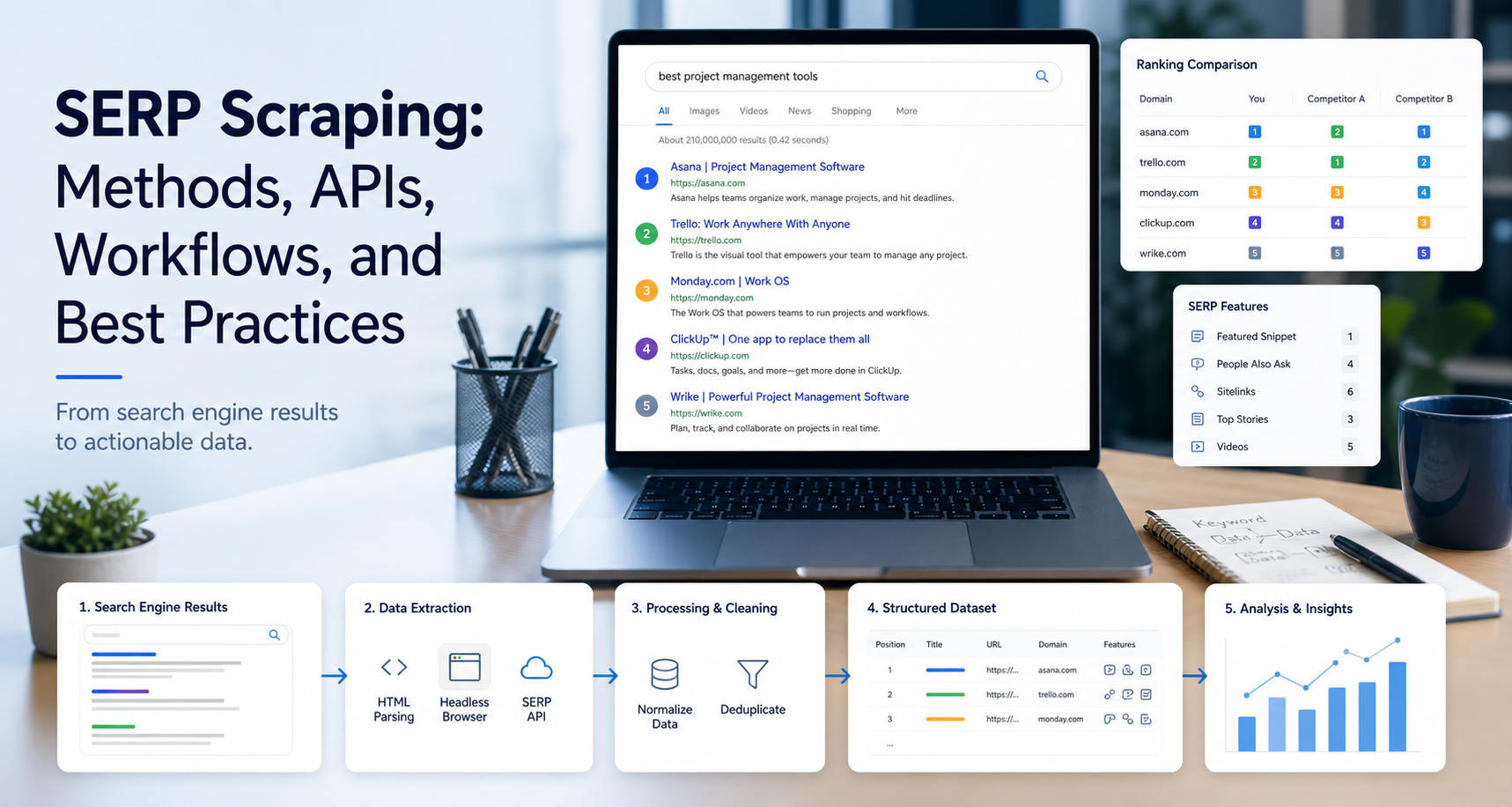
SERP Scraping: Methods, APIs, Workflows, and Best Practices
SERP scraping is the automated collection of information from search engine results pages. A SERP scraper can capture organic rankings, advertisements, featured snippets, People Also Ask questions, local results, shopping listings, images, and other search features, then convert them into structured data for analysis.
View Details