
AI for Automated Threat Hunting: Practical Guide
Your defense strategy is already behind if you're not using AI for threat hunting. While adversaries leverage sophisticated automation to probe defenses and exploit vulnerabilities at machine speed, many Security Operations Centers (SOCs) still rely heavily on manual processes and legacy signature-based detection that simply cannot keep pace.
The harsh reality? By the time traditional tools finally identify a threat and trigger an alert, attackers have often already achieved their objectives.
Zero-day exploits—vulnerabilities unknown to software vendors and undetectable by signature-based systems—represent one of the most formidable challenges in modern cybersecurity. These attacks bypass conventional defenses precisely because they exploit previously undocumented weaknesses. For SOC analysts, data engineering teams, and threat hunters, the question is no longer whether to implement AI-powered threat hunting, but how to do it effectively and what measurable results to expect.
Scale Threat Intel with LycheeIP
How AI Identifies Zero-Day Exploits Before Traditional Tools
Traditional security tools operate on a fundamental limitation: they can only detect what they've explicitly been programmed to recognize. Signature-based detection works by comparing network traffic, file hashes, and system behaviors against massive, static databases of known threats.
This approach fails catastrophically against zero-day exploits because, by definition, no signature exists yet. AI-powered threat hunting flips this paradigm entirely.
Behavioral Analysis Over Signature Matching
Machine learning models do not look for bad things; they learn what "normal" looks like. By analyzing system and network behavior to establish strict baselines, AI systems shift the question from "Does this match a known threat?" to "Does this deviate from expected behavior?" This subtle but critical shift creates a defensive posture capable of detecting entirely novel attack vectors. For example, an AI model trained on your network's typical authentication patterns can instantly flag anomalies such as:
- Unusual login times for specific service accounts.
- Geographic impossibilities (e.g., a user logging in from New York and Tokyo within ten minutes).
- Privilege escalation attempts that deviate from a user's historical patterns.
- Lateral movement that is inconsistent with legitimate business workflows.
These behavioral anomalies almost always signal the early reconnaissance and staging phases of a breach—precisely when intervention is most effective.
Anomaly Detection Through Machine Learning
Unsupervised learning algorithms excel at identifying mathematical outliers in massive, chaotic datasets. Security teams can deploy specific models tailored to their environment:
- Isolation Forests: Highly efficient at identifying anomalies in high-dimensional data (like network traffic flows), isolating rare events that warrant immediate human investigation.
- Autoencoders: Neural networks that learn to compress and reconstruct normal data. When presented with anomalous inputs (like a disguised malicious payload), the system's "reconstruction error" spikes, flagging the threat.
- Clustering Algorithms: These group similar baseline behaviors together, making statistical outliers—which often represent malicious activity—immediately visible on a dashboard.
The critical advantage: These models do not require prior knowledge of specific attack techniques. They capture zero-day exploits, rogue insider threats, and complex, multi-stage attack chains simply by recognizing that the activity does not belong.
Pattern Recognition in Network Traffic
Deep learning models, particularly Recurrent Neural Networks (RNNs) and Long Short-Term Memory (LSTM) networks, excel at identifying patterns in sequential, time-series data. When applied to deep packet inspection and network traffic analysis, these models can detect:
- Command-and-control (C2) beaconing patterns, even when the traffic is heavily encrypted or obfuscated.
- Data exfiltration attempts that are deliberately disguised as legitimate HTTPS traffic.
- "Low and slow" port scanning and reconnaissance activities that unfold over weeks to evade standard rate limiters.
- Polymorphic malware that constantly changes its file signature but maintains a recognizable behavioral execution pattern.
By analyzing packet timing, size distributions, and protocol sequences, AI identifies malicious intent even when the payload itself is unreadable.
User and Entity Behavior Analytics (UEBA)
UEBA systems apply machine learning directly to human activities, device behaviors, and access patterns. These platforms dynamically build risk scores based on context:
- Is a user accessing highly sensitive HR databases outside of normal working hours?
- Is a marketing endpoint suddenly initiating bulk data downloads from a restricted engineering repo?
- Are administrative credentials being utilized from an unusual subnet?
When an attacker compromises legitimate credentials—currently the most common initial access vector—UEBA flags the subtle behavioral differences between the actual employee and the malicious actor, even when all technical authentication indicators appear perfectly normal.
Scale Threat Intel with LycheeIP
Automating Threat Hunting Workflows with Machine Learning
Identifying potential threats is only half the battle. Modern enterprise SOCs are drowning in alerts—often generating tens of thousands of flags daily. This creates severe alert fatigue, practically guaranteeing that genuine threats will eventually slip through the cracks. AI doesn't just detect threats; it automates the heavy lifting of the entire hunting workflow.
ML-Powered Log Analysis and Correlation
Enterprise environments generate terabytes of log data daily across endpoints, firewalls, cloud services, and custom applications. Human analysts cannot possibly review this volume. Machine learning excels here by providing:
- Automated Log Parsing: Natural Language Processing (NLP) extracts meaningful fields from messy, unstructured logs, normalizing data across diverse, incompatible sources.
- Event Correlation: ML models identify hidden relationships between seemingly unrelated events. An isolated failed login is easily ignored; but when the AI correlates it with a subsequent privilege escalation attempt and anomalous database access, it becomes a high-priority incident.
- Temporal Pattern Analysis: Time-series analysis detects attack sequences that unfold over long timescales that would easily defeat manual human analysis.
Playbook Automation with AI Decision-Making
Security Orchestration, Automation, and Response (SOAR) platforms execute response playbooks, but historically, they require rigid "if-then" logic. AI-enhanced SOAR makes dynamic, context-aware decisions:
Example Automated Ransomware Response Playbook:
- AI detects ransomware encryption behavior on an endpoint.
- The SOAR platform instantly isolates the affected endpoint from the corporate network.
- The system captures a forensic snapshot of the machine's memory.
- Malicious processes are forcefully terminated.
- The system alerts the incident response team with a fully contextualized dossier.
Execution time: 4 seconds. Human intervention required: Zero.
Integration with Existing Security Stacks
AI threat hunting capabilities are designed to integrate with your existing security infrastructure, not necessarily replace it. Machine learning models plug directly into SIEM platforms like Splunk, IBM QRadar, or Microsoft Sentinel via API. This allows for incremental adoption—security teams can pilot AI enrichment capabilities without having to rip and replace their expensive, existing investments.
Real-World Success Metrics from AI-Powered Security Operations
Theory matters little without measurable business outcomes. Organizations implementing AI-powered threat hunting consistently report transformative improvements across their Key Performance Indicators (KPIs).
Time to Detection (TTD) Improvements
Traditional threat detection timelines are dangerously slow. Industry reports frequently indicate median detection times hovering around 21 days for sophisticated breaches. AI systems compress this timeline dramatically:
- Endpoint threats: Detected within minutes of initial payload execution.
- Lateral movement: Real-time identification as attackers attempt to pivot between internal servers.
- Data exfiltration: Immediate alerts triggered on anomalous outbound data transfers.
Case in point: A Fortune 500 financial services firm reported reducing their average TTD from 14 days down to just 3 hours after implementing AI-powered behavioral analytics across their endpoint estate.
Mean Time to Respond (MTTR) Reduction
Detection speed means nothing without a rapid response. AI automation accelerates response workflows exponentially:
- Manual Processes: 4 to 8 hours average MTTR (involving alert triage, manual log investigation, containment meetings, and execution).
- AI-Automated Workflows: 15 to 30 minutes average MTTR (automated triage and containment, with human oversight reserved only for critical business decisions).
ROI Calculations for AI Security Tools
Security investments face intense scrutiny from the board regarding Return on Investment (ROI). AI threat hunting platforms typically justify their costs through three main avenues:
- Breach Cost Avoidance: IBM's Cost of a Data Breach Report regularly places average breach costs well over $4 million. Preventing a single major breach justifies years of AI investment.
- Operational Efficiency: Automating 60% of Tier-1 SOC tasks allows a team to reallocate expensive analyst resources to higher-value proactive hunting and architecture hardening.
- Compliance Benefits: Demonstrating advanced, automated threat detection capabilities satisfies strict auditor requirements for frameworks like PCI-DSS, HIPAA, and SOC 2.
LycheeIP (Developer-First Proxy Infrastructure)
As security teams build and train their own AI threat detection models, they must constantly feed those models with vast amounts of external data. Whether your data engineering team is actively scraping the dark web for emerging threat intelligence, probing global infrastructure to map adversary Command and Control (C2) nodes, or conducting authorized, large-scale external attack surface management (EASM), robust network routing is required. LycheeIP is a developer-first proxy and data infrastructure platform that ensures your automated security operations run smoothly without getting blocked by external firewalls.
When your threat intelligence scripts need to gather data from heavily guarded forums or geo-restricted regions, utilizing dynamic IP networks allows your automated scrapers to smoothly rotate connections and avoid rate-limiting. Conversely, if your AI models require massive, continuous ingestion of external telemetry or need to maintain highly stable connections to off-site SIEM clusters, LycheeIP's datacenter IP solutions provide the dedicated bandwidth and persistence required. Integrating a reliable developer-first proxy infrastructure ensures your AI models always have the raw, unobstructed data they need to stay accurate and effective.
The Path Forward for Security Operations
The threat landscape is evolving exponentially, attack sophistication, volume, and speed are all trending aggressively upward. Human-scale defensive operations simply cannot match this machine-driven pace. AI-powered automated threat hunting isn't a luxury; it is rapidly becoming table stakes for effective enterprise cybersecurity.
For SOC analysts and technical operators, the implementation path is clear:
- Pilot in a Contained Scope: Start with a specific, measurable use case (e.g., endpoint anomaly detection or UEBA for remote workers).
- Build Solid Data Foundations: AI is only as good as its data. Ensure your log aggregation and normalization pipelines are pristine before deploying models.
- Integrate Incrementally: Layer AI capabilities via API onto your existing SIEM/SOAR infrastructure.
- Measure Relentlessly: Track TTD, MTTR, and false-positive rates to prove value to leadership.
The adversaries are already using AI to automate their attacks. Your defenses must do the same. The organizations that embrace intelligent, automated threat hunting today will be the ones still standing when tomorrow's inevitable zero-day exploits emerge.
Scale Threat Intel with LycheeIP
Frequently Asked Questions
Q: How does AI detect zero-day exploits if there's no signature to match?
A: AI abandons signature matching entirely in favor of behavioral analysis and anomaly detection. Machine learning models establish strict mathematical baselines of what "normal" system and network behavior looks like. When a zero-day exploit executes, it invariably causes the system to behave abnormally (e.g., unexpected memory allocation, unusual outbound network traffic). The AI flags this deviation, allowing it to catch novel threats without needing prior knowledge of the specific exploit.
Q: What's the typical implementation timeline for AI threat hunting capabilities?
A: Most enterprise organizations follow a 90 to 120-day implementation path. This breaks down into 30-45 days for data infrastructure preparation (ensuring logs are clean and accessible), 30-60 days for baseline establishment (allowing the models to observe and learn "normal" network behavior), and 30+ days for final tuning and API integration with existing SOAR workflows.
Q: Do we need data scientists on our security team to implement AI threat hunting?
A: Not necessarily. While having data scientists is helpful for building proprietary models, most modern AI security platforms are designed specifically for security analysts. They come with pre-built models, automated tuning, and explainable AI (XAI) outputs. Many organizations also successfully partner with Managed Detection and Response (MDR) providers to gain AI capabilities without building in-house data science teams.
Q: How do AI threat hunting tools integrate with existing SIEM and SOAR platforms?
A: Most modern AI security tools utilize API-first architectures. They consume raw log data from your existing SIEM (like Splunk or Azure Sentinel), run their behavioral analytics, and then feed high-confidence, enriched alerts back into your SOAR platform to trigger automated response playbooks. This allows for seamless, incremental adoption.
Q: What ROI should we expect from AI-powered threat hunting implementations?
A: Organizations typically see a 70-85% reduction in false-positive alerts, effectively curing analyst alert fatigue. Furthermore, they see a 60-90% faster Mean Time to Respond (MTTR). The financial ROI is primarily realized through breach cost avoidance, massive operational efficiency gains (by automating repetitive Tier-1 triage tasks), and streamlined compliance reporting.

Recommended Articles
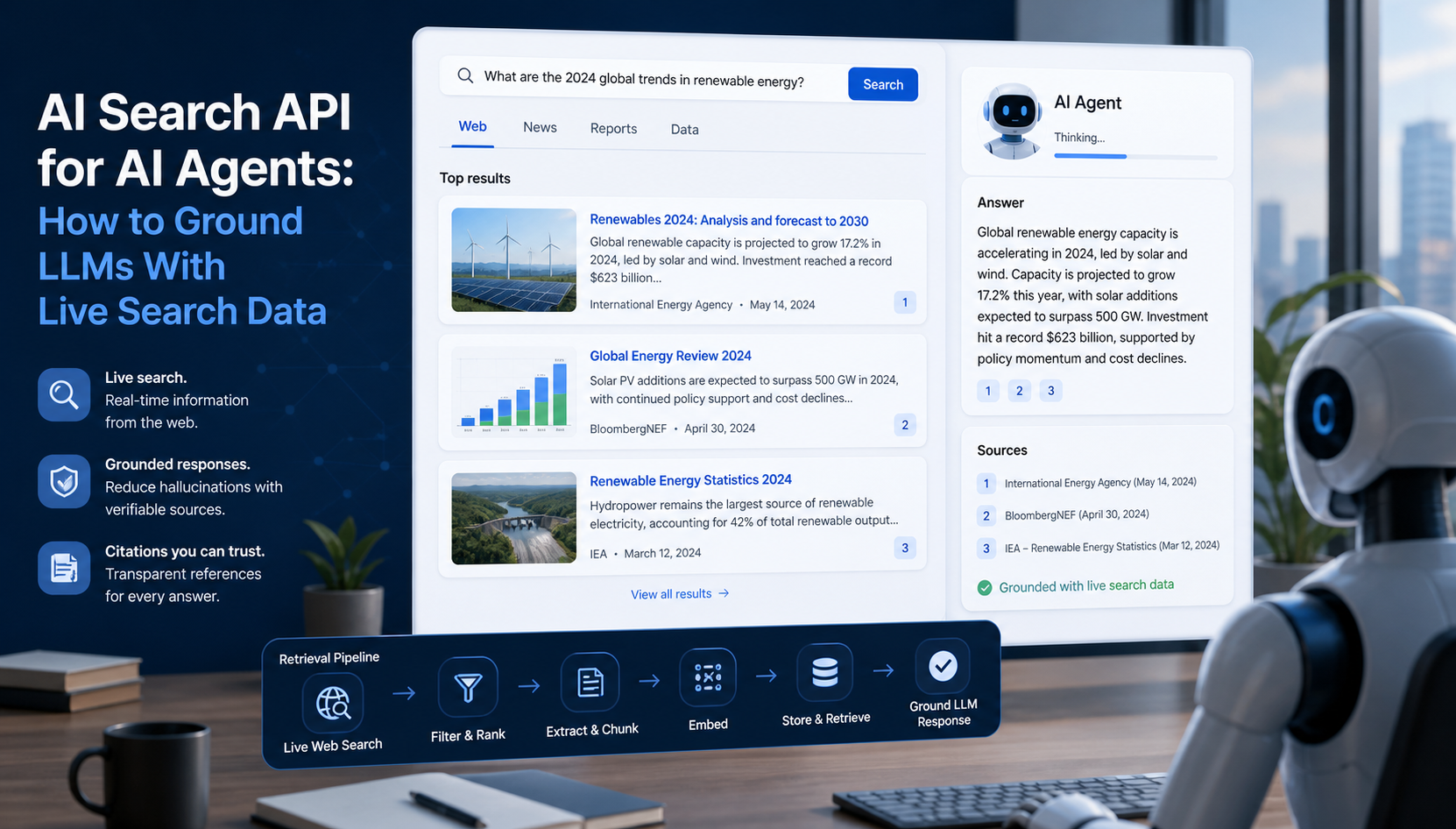
AI Search API for AI Agents: How to Ground LLMs With Live Search Data
An AI search API gives an application or agent programmatic access to current search results. Its most useful role is discovery: the agent can find candidate sources, identify fresh information, and decide what to retrieve next instead of relying only on model memory.
View Details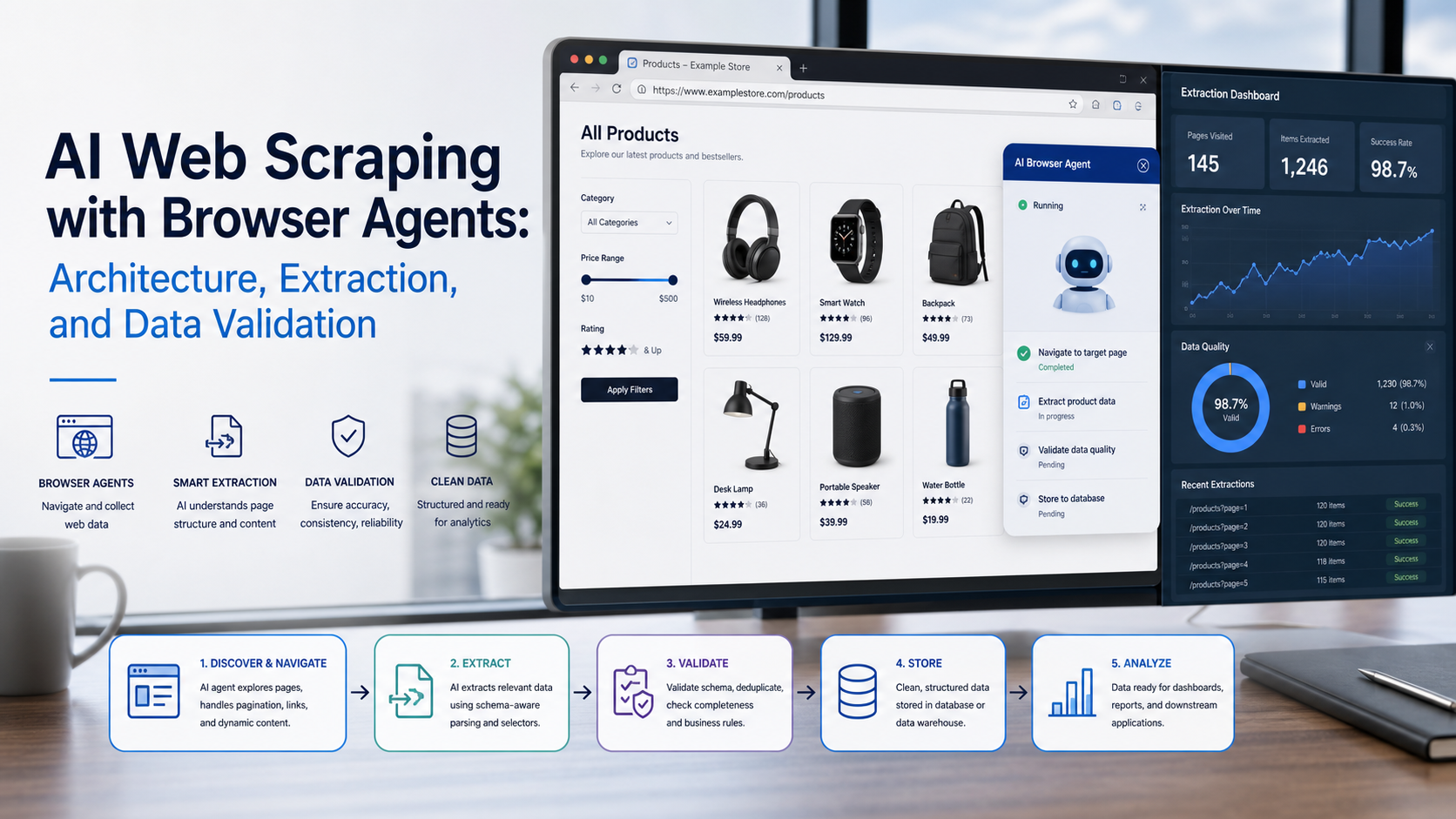
AI Web Scraping with Browser Agents: Architecture, Extraction, and Data Validation
AI web scraping uses AI to help discover, navigate, interpret, or extract information from websites. Browser agents are one implementation option when page interaction, rendering, or layout variation makes a simple scraper too brittle, but the agent should not become the entire data pipeline.
View Details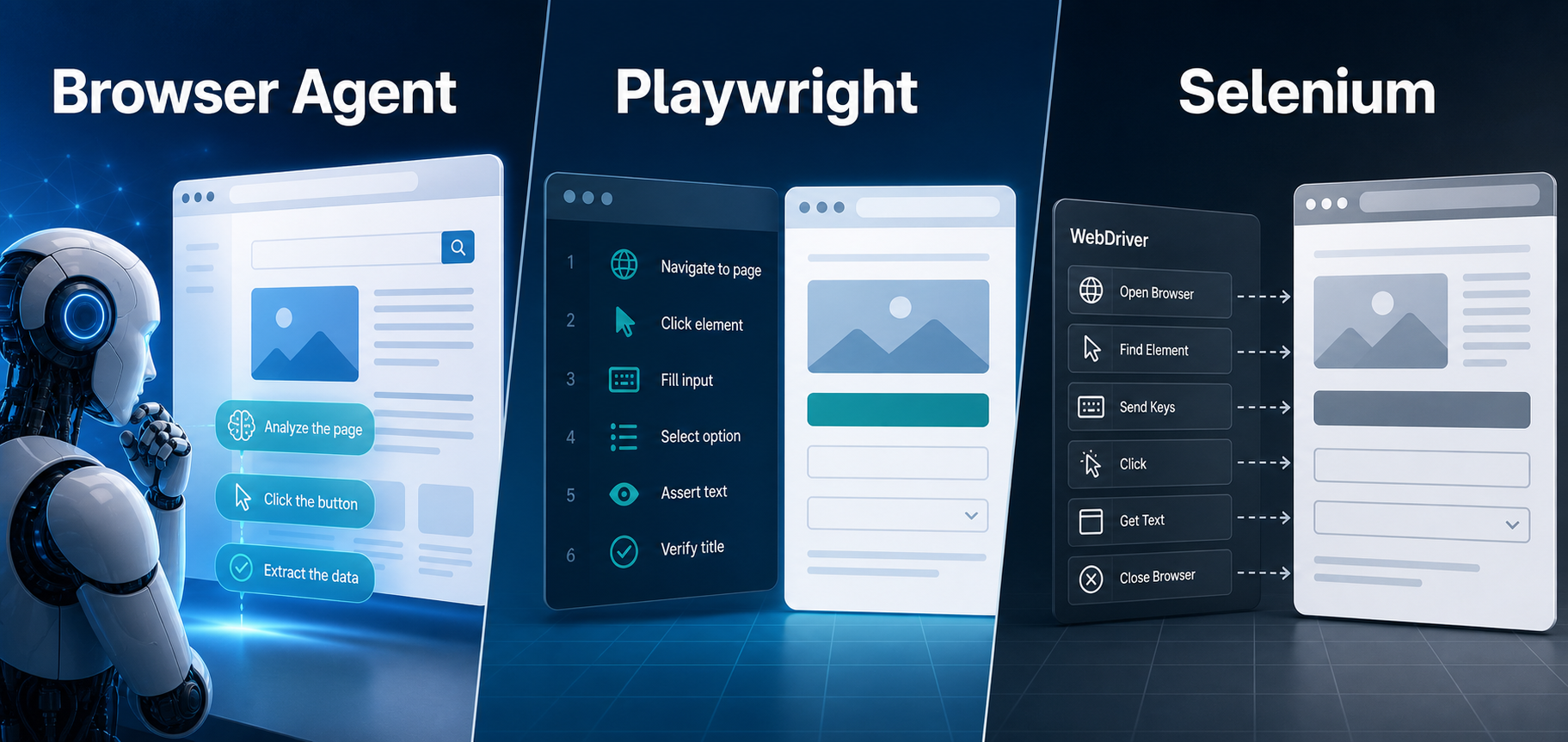
AI Browser Automation: Browser Agents vs Playwright vs Selenium
A browser agent interprets a goal and decides what browser action to take next. Playwright and Selenium can execute explicit, testable browser logic defined by developers. In 2026, however, Playwright also provides official MCP and agent-oriented workflows, so Playwright is no longer just the deterministic alternative to agentic automation. It can also serve as the browser-control layer inside an agent system.
View Details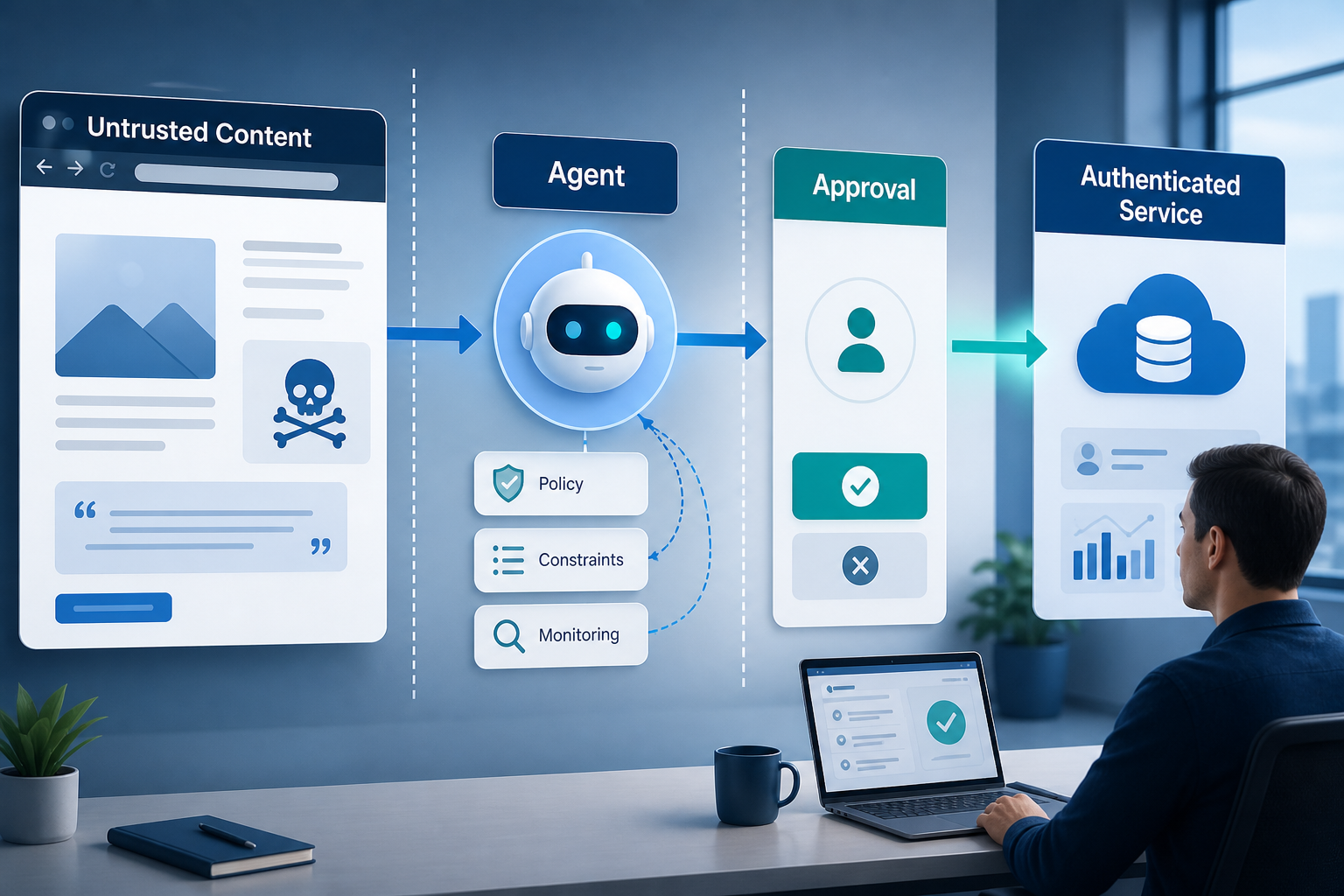
Agentic Browser Security: Prompt Injection, Permissions, and Safe Deployment
That combination creates risks that are different from ordinary browsing and traditional automation. The most important is indirect prompt injection, where hostile instructions hidden in web content attempt to redirect the agent away from the user's goal. Google describes indirect prompt injection as a primary new threat for agentic browsing and has introduced layered defenses that include origin constraints, independent action checks, threat detection, and user confirmation for sensitive actions. Google's Chrome security architecture is a useful reference for how browser-agent defenses are evolving.
View Details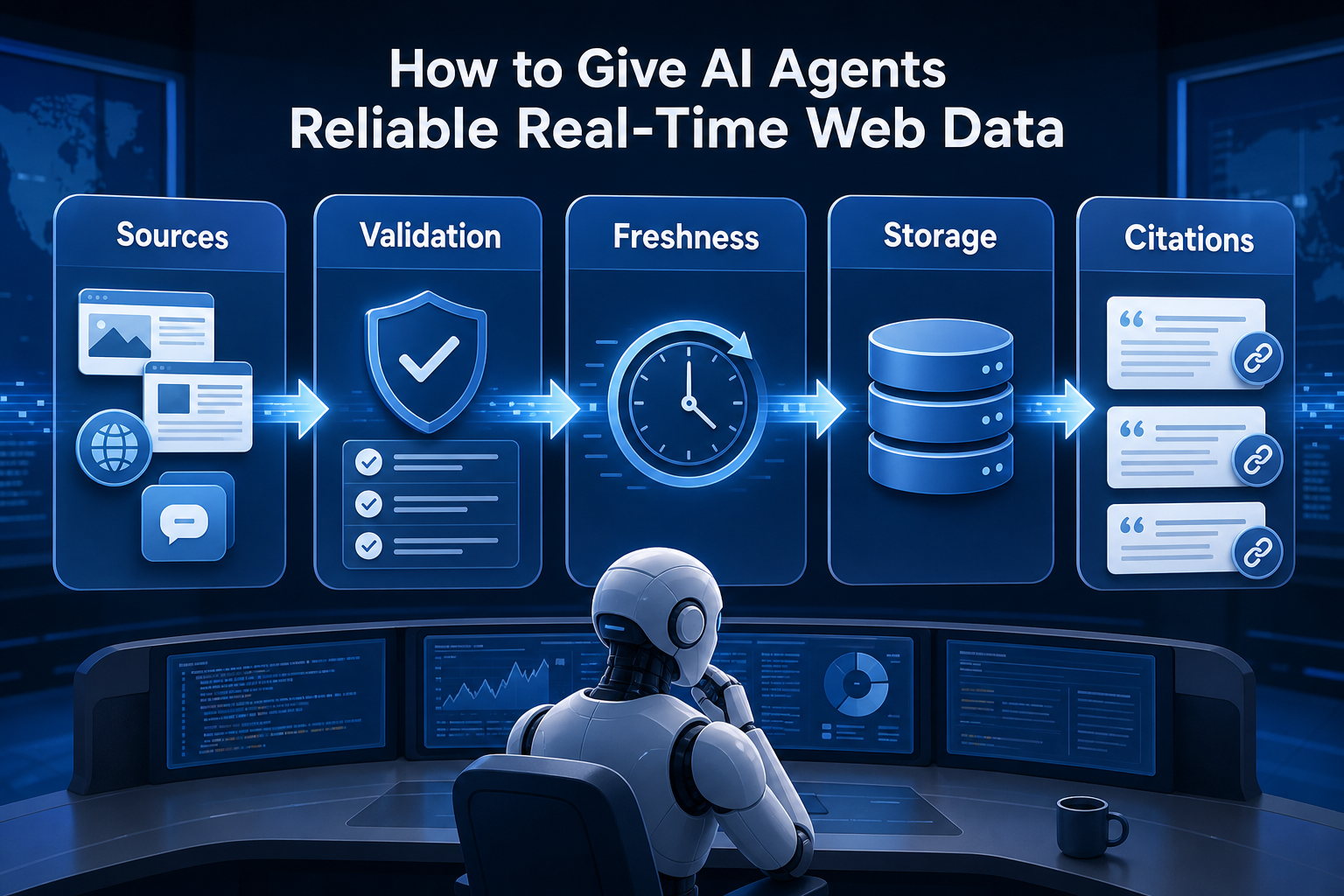
How to Give AI Agents Reliable Real-Time Web Data
A production-ready solution therefore needs more than a web scraper. It needs a web data layer that connects acquisition, validation, storage, retrieval, security, and observability. This guide explains how to design that layer.
View Details