
AI Data Collection: How to Build Reliable Data Pipelines for Modern AI Systems
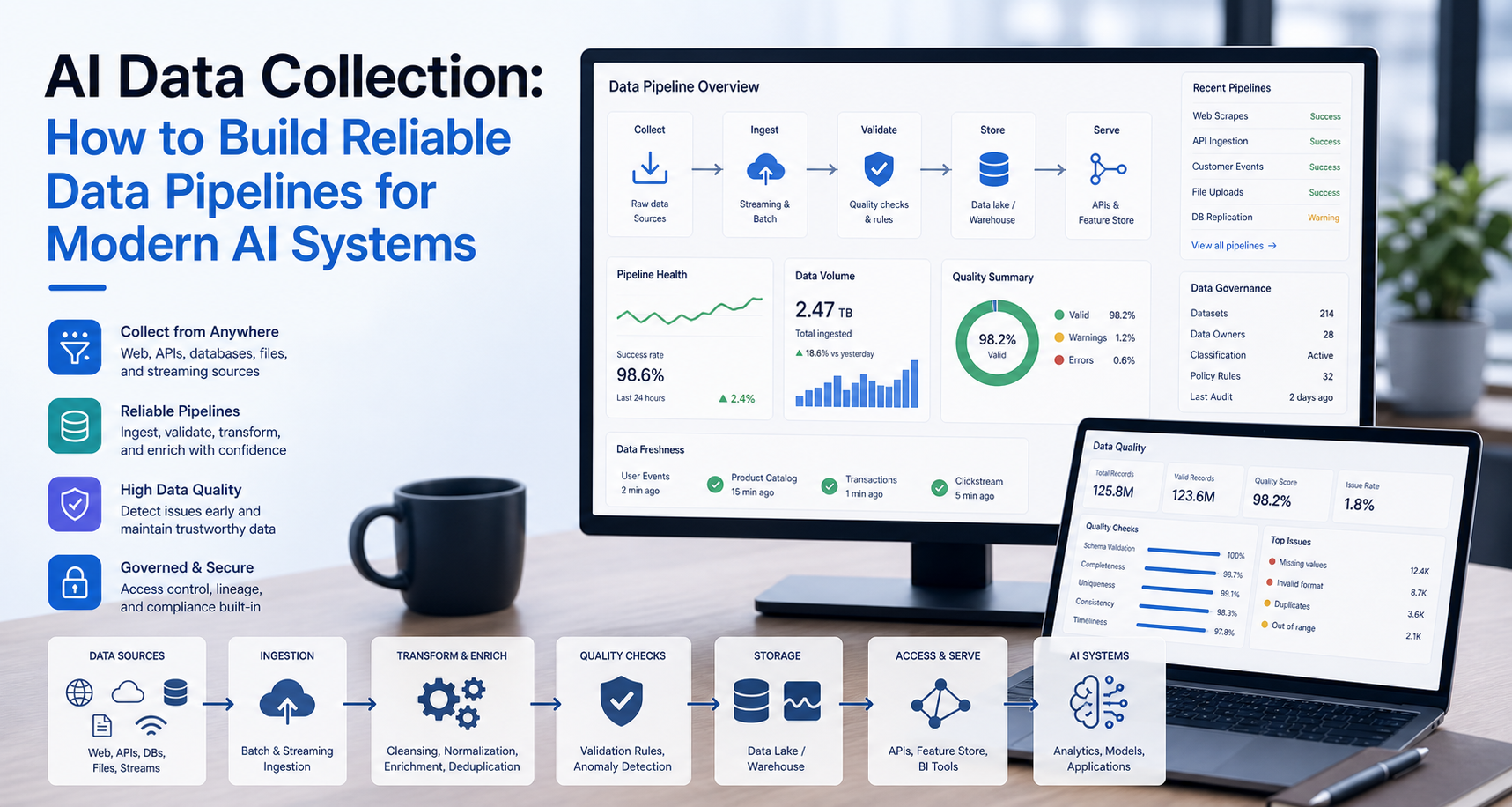
AI systems do not become useful simply because the model is powerful. They become useful when the data behind them is relevant, accurate, diverse, fresh, and properly governed.
AI systems do not become useful simply because the model is powerful. They become useful when the data behind them is relevant, accurate, diverse, fresh, and properly governed.
That is why AI data collection has become one of the most important parts of modern AI development. Whether a team is building a recommendation engine, training a computer vision model, improving a chatbot, powering a RAG system, monitoring competitors, or creating an AI agent that needs live web context, the quality of the data pipeline often determines the quality of the final output.
AI data collection is the process of sourcing, gathering, organizing, cleaning, validating, and preparing data so it can be used by machine learning models, large language models, retrieval systems, analytics engines, and automated decision systems.
What Is AI Data Collection?
AI data collection is the structured process of gathering information for artificial intelligence systems.
This information may be used to:
- Train machine learning models
- Fine-tune large language models
- Power retrieval-augmented generation systems
- Build search and recommendation engines
- Evaluate model performance
- Monitor market trends
- Feed AI agents with real-time context
- Improve personalization systems
- Detect fraud, risk, or anomalies
- Support business intelligence workflows
In simple terms, AI data collection is how teams give AI systems the examples, signals, facts, patterns, and context they need to perform a task.
A product recommendation model needs user behavior and product metadata. A pricing intelligence tool needs current product prices across the market. A sentiment analysis model needs text data. A visual recognition model needs labeled images. A RAG chatbot needs clean, retrievable knowledge sources.
Without reliable data, even an advanced AI model may produce weak, biased, outdated, or misleading results.
For the official technical reference behind this point, see Playwright documentation.
Why AI Data Collection Matters
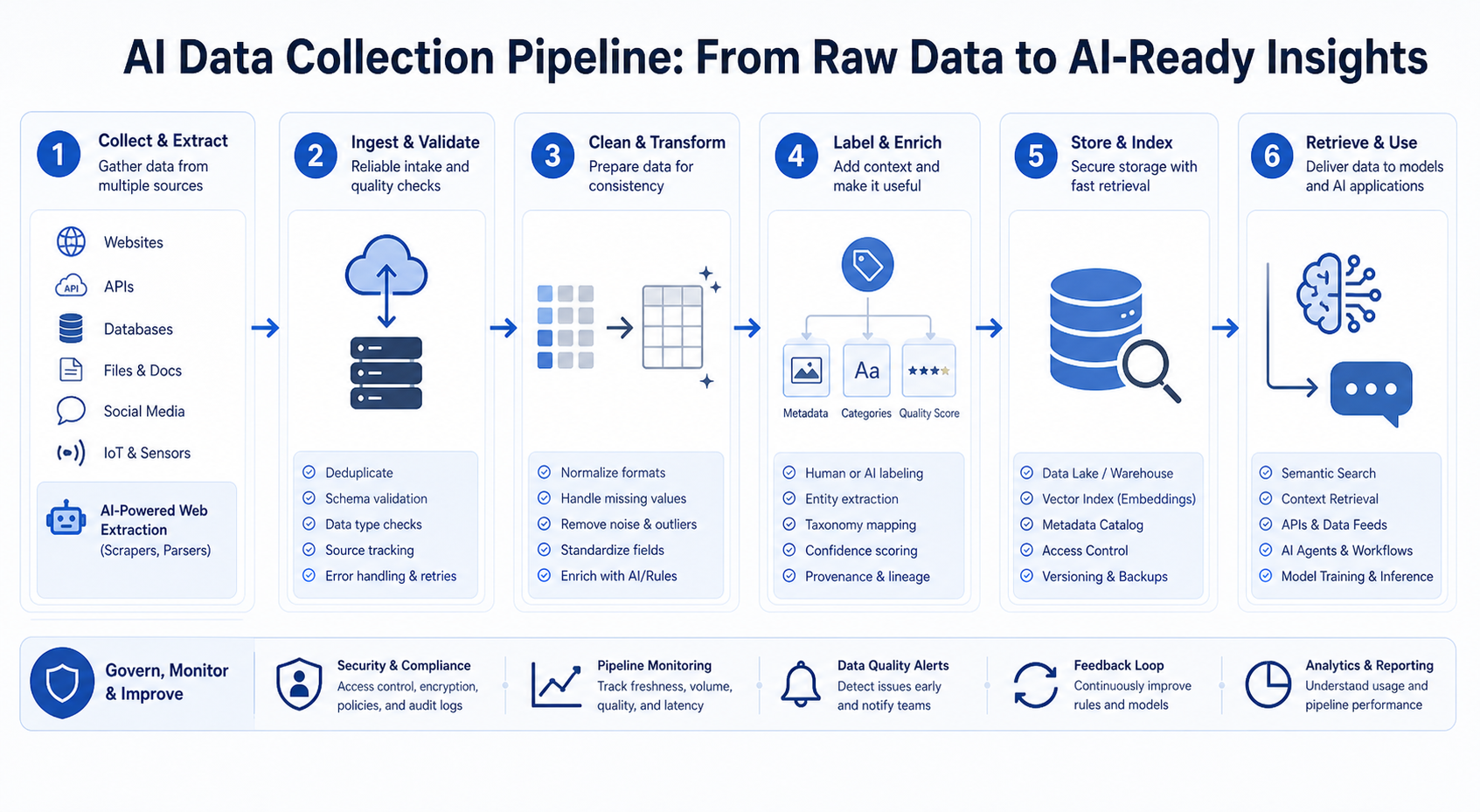
AI models learn from patterns. If the data is incomplete, outdated, biased, duplicated, mislabeled, or irrelevant, the model can inherit those problems.
Poor data collection can lead to:
- Inaccurate predictions
- Hallucinated or unsupported responses
- Biased model behavior
- Weak personalization
- Bad recommendations
- Broken automation
- Compliance risks
- Poor user trust
- Expensive retraining cycles
Strong data collection helps AI teams build systems that are more reliable, explainable, and useful in real-world conditions.
This is especially important for production AI. A demo can work with a small sample dataset. A real AI product needs repeatable data pipelines, quality checks, documentation, security controls, and continuous updates.
Main Types of Data Used in AI
AI systems can use several types of data. The best data type depends on the model, task, and business goal.
Structured Data
Structured data is organized in a clear format, usually rows and columns.
Examples include:
- Databases
- Spreadsheets
- Product catalogs
- Transaction records
- CRM data
- Inventory tables
- Financial records
- Pricing tables
Structured data is easier to query, clean, and validate because every field has a predictable format.
For example, an e-commerce AI model may use structured fields such as product name, category, price, stock status, rating, and review count.
Semi-Structured Data
Semi-structured data has some organization, but it does not always fit neatly into rows and columns.
Examples include:
- JSON
- XML
- HTML
- Log files
- Metadata
- API responses
- Email headers
- Webpage markup
Semi-structured data is common in web scraping, APIs, search results, and application logs.
For AI teams, semi-structured data is valuable because it often contains both machine-readable fields and rich contextual information.
Unstructured Data
Unstructured data does not follow a fixed format.
Examples include:
- Articles
- Social media posts
- Reviews
- Images
- Videos
- Audio files
- PDFs
- Support tickets
- Forum discussions
- Chat transcripts
Unstructured data is harder to process, but it is often where the richest AI training signals are found.
Large language models, sentiment analysis systems, image classifiers, speech models, and multimodal AI systems rely heavily on unstructured data.
Common AI Data Collection Methods
There is no single best way to collect data for AI. Most serious AI projects combine multiple methods.
1. Internal Business Data
Internal data is information a company already owns or generates.
This can include:
- Customer support tickets
- Product usage logs
- Sales records
- CRM data
- Website analytics
- App activity
- Survey responses
- Internal documentation
- Knowledge base content
Internal data is useful because it is specific to the business. It can help train AI systems that understand company products, customers, processes, and workflows.
However, internal data must be handled carefully. If it contains personal, financial, medical, or sensitive business information, teams need strong access controls, anonymization, privacy reviews, and retention policies.
2. Public Web Data
Public web data is information available on publicly accessible websites.
This may include:
- Product listings
- Prices
- Reviews
- News articles
- Job postings
- Real estate listings
- Public directories
- Search results
- Forum posts
- Public company information
- Public documentation
Public web data is useful for AI because it is broad, fresh, and market-facing. It can help AI systems understand current language, products, pricing, trends, competitors, and user behavior.
For many AI workflows, public web data is not a one-time collection activity. It needs to be refreshed regularly because the web changes constantly.
3. APIs
APIs provide structured access to data from platforms, tools, databases, or third-party providers.
APIs are often cleaner than scraping because they return data in predictable formats such as JSON. They may also include authentication, usage limits, documentation, and clear licensing terms.
APIs are useful for:
- Search data
- Weather data
- Financial data
- Product data
- Social platform data
- Internal system data
- SaaS integrations
- Location data
The limitation is that APIs may not provide all the data a team needs. They may also be expensive, rate-limited, incomplete, or restricted by platform policies.
4. Licensed Datasets
Licensed datasets are purchased or obtained from providers with defined usage rights.
These datasets may include:
- Text datasets
- Image datasets
- Video datasets
- Speech datasets
- Market datasets
- Search datasets
- Industry-specific datasets
Licensed datasets are useful when teams need cleaner data, predictable rights, and faster setup.
The tradeoff is cost and flexibility. A licensed dataset may not cover the exact niche, region, freshness level, or format the AI project needs.
5. User-Generated Data
User-generated data comes from people interacting with a product or system.
Examples include:
- Ratings
- Reviews
- Comments
- Uploaded images
- Search queries
- Feedback forms
- Chat messages
- Click behavior
- Preference selections
This type of data is powerful for personalization, recommendations, and product improvement.
However, it also creates serious privacy responsibilities. Teams should collect only what is necessary, explain how the data is used, protect it properly, and comply with applicable laws.
6. Synthetic Data
Synthetic data is artificially generated data designed to resemble real-world data.
It can be useful when:
- Real data is scarce
- Sensitive data cannot be used directly
- Edge cases need to be simulated
- Teams need more labeled examples
- Testing requires controlled scenarios
Synthetic data can reduce some collection challenges, but it is not automatically reliable. If synthetic data does not reflect real-world variation, it can make models perform well in testing but poorly in production.
AI Data Collection for RAG Systems
Retrieval-augmented generation, or RAG, is one of the most common AI use cases for data collection.
A RAG system retrieves relevant information from a knowledge base before generating an answer. This allows AI applications to respond using specific, up-to-date, or company-owned information instead of relying only on the model’s training data.
RAG data sources may include:
- Company documentation
- Help center articles
- Product pages
- Blog posts
- PDFs
- Knowledge bases
- Public webpages
- Research reports
- Internal policies
- Customer support content
For RAG, data collection is not just about gathering content. The content must also be cleaned, chunked, embedded, stored, retrieved, and updated.
A strong RAG data pipeline should answer these questions:
- Which sources are approved?
- How often should the data refresh?
- What content should be excluded?
- How should pages be chunked?
- How will duplicate content be handled?
- How will outdated information be removed?
- How will source attribution be preserved?
- How will retrieval accuracy be tested?
The goal is not just to collect data. The goal is to make the data retrievable, trustworthy, and useful at answer time.
AI Data Collection for Model Training
Training data is used to teach a model patterns from examples.
Depending on the model, training data may include:
- Text
- Images
- Audio
- Video
- Labels
- Annotations
- Metadata
- Structured records
- User interactions
For training, data quality is critical. A model trained on messy, biased, duplicated, or mislabeled data can produce unreliable results.
Training data should be evaluated for:
- Relevance
- Coverage
- Accuracy
- Diversity
- Label quality
- Format consistency
- Duplicates
- Bias
- Source reliability
- Legal usability
The NIST AI Risk Management Framework encourages organizations to manage AI risks across the AI lifecycle, which makes data governance and risk review important parts of AI development, not afterthoughts.
AI Data Collection for AI Agents
AI agents need data differently from traditional models.
A model may be trained once and updated periodically. An AI agent often needs fresh context while it works.
For example, an AI agent may need to:
- Search the web
- Compare current product prices
- Read documentation
- Monitor competitors
- Track news changes
- Check public listings
- Extract information from pages
- Summarize newly published content
- Trigger actions based on fresh data
This makes live data access important.
For agentic workflows, AI data collection may involve:
- Search result data
- Webpage extraction
- Browser automation
- API calls
- Internal database access
- Knowledge base retrieval
- Real-time monitoring
- Event-based triggers
The challenge is reliability. Agents need data that is current, clean, and available when the task runs. If the data source fails, blocks requests, changes layout, or returns inconsistent information, the agent’s output can fail.
That is where strong web data infrastructure becomes important.
For the LycheeIP implementation details behind this step, review LycheeIP proxy infrastructure.
For the LycheeIP implementation details behind this step, review AI-powered browser automation hub.
Where Web Scraping Fits Into AI Data Collection
Web scraping is the process of extracting information from websites using automated tools.
For AI teams, web scraping is useful because it can collect data that is:
- Fresh
- Publicly available
- Market-specific
- Competitor-facing
- Region-specific
- Product-specific
- Continuously changing
- Not available through a clean API
AI teams may use web scraping for:
- Product intelligence
- Price monitoring
- Search result tracking
- Market research
- Review analysis
- News monitoring
- Real estate data
- Job market analysis
- Brand monitoring
- RAG source updates
- AI search visibility tracking
However, web scraping must be done responsibly. Teams should review website terms, robots.txt, copyright issues, privacy obligations, and applicable laws before collecting data.
For the LycheeIP implementation details behind this step, review rotating residential proxies.
For the LycheeIP implementation details behind this step, review scaling lead scraping with n8n.
For the official technical reference behind this point, see MDN HTTP overview.
The AI Data Collection Pipeline
A reliable AI data pipeline usually has several stages.
1. Define the Data Goal
Before collecting anything, define the purpose.
Ask:
- What AI system will use this data?
- What decision or output will the data support?
- What fields are needed?
- How fresh must the data be?
- What level of accuracy is required?
- What sources are allowed?
- What data should not be collected?
This step prevents teams from collecting large volumes of unnecessary data.
2. Identify Data Sources
Next, choose the sources.
Possible sources include:
- Internal databases
- Public websites
- APIs
- Licensed datasets
- Search results
- Documents
- User interactions
- Third-party feeds
A good source should be relevant, accessible, reliable, and legally usable.
3. Collect the Data
Collection may happen through APIs, scraping tools, file imports, data connectors, forms, logs, or manual annotation workflows.
For web data, teams may use:
- Python scripts
- Scrapy
- Playwright
- Browser automation
- Web scraper APIs
- Proxy infrastructure
- Scheduled crawlers
- Data extraction pipelines
The collection method should match the source complexity. A static webpage may only need a simple scraper. A JavaScript-heavy site may require browser automation. A large-scale monitoring project may require proxies, retries, and distributed crawling.
4. Clean and Normalize the Data
Raw data is rarely ready for AI.
Cleaning may include:
- Removing duplicates
- Fixing broken characters
- Standardizing dates
- Normalizing prices
- Removing HTML clutter
- Extracting plain text
- Filtering irrelevant content
- Detecting missing fields
- Converting formats
- Removing boilerplate text
For AI systems, clean data improves retrieval, training, evaluation, and downstream automation.
5. Label or Annotate the Data
Some AI systems need labeled examples.
Labels may include:
- Sentiment
- Category
- Topic
- Entity type
- Image object labels
- Relevance score
- Intent classification
- Quality rating
- Safety rating
Label quality matters. Poor labels can damage model performance even when the underlying data is good.
6. Validate the Dataset
Validation checks whether the data is accurate, complete, and fit for purpose.
A validation process may check:
- Duplicate rate
- Missing fields
- Invalid values
- Outdated records
- Broken URLs
- Language mismatch
- Low-quality sources
- Incorrect labels
- Bias or coverage gaps
- Format inconsistency
Validation should happen before data enters training, retrieval, analytics, or production AI workflows.
7. Store and Govern the Data
AI datasets need secure storage and clear governance.
Governance should define:
- Who can access the data
- Where the data came from
- What rights apply to it
- How long it can be stored
- How it should be updated
- How errors are corrected
- How sensitive information is handled
- How datasets are versioned
Data lineage is especially important. If a model behaves badly or a RAG answer cites outdated content, the team should be able to trace the problem back to the source.
8. Refresh and Monitor the Data
AI data collection is not always a one-time task.
Many AI systems need fresh data because markets, websites, prices, policies, competitors, and user behavior change.
Monitoring should track:
- Source availability
- Scraper success rate
- Data freshness
- Schema changes
- Blocked requests
- Duplicate spikes
- Missing fields
- Retrieval quality
- Model performance shifts
A data pipeline that worked last month may fail today if a website changes layout or an API changes response format.
Data Quality Checklist for AI Teams
Before using collected data, review it against this checklist:
- Is the data relevant to the AI task?
- Is the source allowed and documented?
- Is the data recent enough?
- Are duplicates removed?
- Are fields consistent?
- Are labels accurate?
- Are missing values handled?
- Are outliers reviewed?
- Is personal data minimized or protected?
- Is the dataset diverse enough?
- Are known biases documented?
- Can the team trace each record to its source?
- Is the data stored securely?
- Is there a refresh schedule?
- Is there a process for removing outdated data?
For AI, data quality is not only a technical issue. It is a product, compliance, and trust issue.
Compliance and Ethics in AI Data Collection
Responsible AI data collection requires more than technical access.
Teams should consider:
- Website terms of service
- Robots.txt guidance
- Copyright restrictions
- Privacy laws
- Consent requirements
- Personal data handling
- Sensitive data exclusions
- Data retention limits
- Security controls
- Internal approval workflows
If personal data is involved, teams must be especially careful. GDPR Article 5 includes principles such as lawfulness, fairness, transparency, purpose limitation, data minimization, accuracy, storage limitation, integrity, confidentiality, and accountability.
A practical rule is simple: do not collect data just because you can. Collect data because it is necessary, permitted, documented, and useful for a clearly defined purpose.
The Role of Proxies in AI Data Collection
Proxies help route web requests through different IP addresses and locations.
For AI data collection, proxies can support:
- Geo-specific data collection
- Large-scale public web data gathering
- More stable crawling
- Reduced disruption from IP-based rate limits
- Testing localized search results
- Collecting region-specific pricing or availability
- Separating development and production traffic
- Running distributed data pipelines
Different proxy types support different use cases.
Datacenter proxies are usually fast and cost-efficient. They can work well for less restrictive targets and high-volume data collection where speed matters.
Residential proxies route traffic through real residential IPs. They are useful when teams need location diversity, more natural request patterns, or access to websites that treat datacenter traffic more aggressively.
ISP proxies combine some benefits of datacenter and residential proxies. They are often used when teams need stable IPs with strong reliability.
Mobile proxies are useful for mobile-specific experiences, app testing, localized mobile content, and cases where mobile carrier context matters.
The right proxy choice depends on the source, scale, target region, budget, and reliability requirements.
LycheeIP (Developer-First Proxy Infrastructure)
LycheeIP helps AI, scraping, and data teams build more reliable public web data pipelines with developer-first proxy infrastructure.
For AI data collection, LycheeIP can support workflows such as:
- Web scraping for AI datasets
- RAG source refresh pipelines
- AI agent web data access
- Search result monitoring
- E-commerce intelligence
- Competitor tracking
- Localized data collection
- Public web data extraction
- Browser automation at scale
A typical AI data collection workflow with LycheeIP may look like this:
- Define the AI use case and required data.
- Identify public sources that are allowed and relevant.
- Build or configure the scraper.
- Choose the right proxy type for the target.
- Run small tests before scaling.
- Monitor success rate, latency, and data quality.
- Validate the collected data.
- Store the data with source and timestamp metadata.
- Refresh the dataset on a defined schedule.
- Review compliance and governance regularly.
LycheeIP does not replace data governance, compliance review, or dataset validation. Instead, it supports the infrastructure layer that helps AI teams collect public web data more reliably.
AI Data Collection Challenges
AI data collection often sounds simple at the planning stage, but real-world pipelines can be difficult.
Common challenges include:
Source Changes
Websites change layouts, APIs change fields, and pages move. A scraper or connector that works today may break tomorrow.
Data Drift
Data can become outdated or less representative over time. AI systems that depend on stale data may produce weaker results.
Duplicate Content
Duplicate records can distort training, search, analytics, and evaluation.
Poor Labels
A dataset with inaccurate labels can damage model quality even if the data volume is large.
Bias and Coverage Gaps
If the data overrepresents one region, language, user group, or source type, the AI system may perform poorly for underrepresented cases.
Compliance Risk
Collecting data without clear rights, purpose, or privacy controls can create legal and reputational problems.
Infrastructure Failures
Rate limits, timeouts, blocked requests, unstable proxies, and dynamic websites can interrupt collection.
Cost Control
Large-scale data collection can become expensive if teams collect unnecessary data, use the wrong infrastructure, or fail to deduplicate efficiently.
Best Practices for AI Data Collection
Use these principles to build a stronger data collection process.
Start With the Use Case
Do not begin by collecting everything. Begin with the AI task.
Define what the model, RAG system, or agent needs to do. Then collect only the data required to support that task.
Document Every Source
Keep records of where each dataset came from, when it was collected, what permissions or rules apply, and how it can be used.
Prefer Fresh Data Where Freshness Matters
For search, pricing, product availability, news, listings, and AI agents, freshness can be critical. Set refresh intervals based on how quickly the source changes.
Build Quality Checks Into the Pipeline
Do not wait until the model performs badly before checking data quality.
Add validation steps for duplicates, missing fields, invalid formats, broken records, and source errors.
Use the Right Collection Method
Do not use browser automation if a clean API is available. Do not use a complex crawler if a simple static scraper works. Do not use one proxy type for every target.
Match the method to the source.
Minimize Personal Data
Collect only what is necessary. Avoid sensitive data unless you have a clear legal basis, strong safeguards, and a real need.
Monitor Continuously
Track source failures, layout changes, data drift, and output quality. AI data collection should be treated as an ongoing system, not a one-time export.
Keep Humans in the Loop
Human review is important for sensitive use cases, label quality, bias review, compliance decisions, and high-impact AI systems.
AI Data Collection Mistakes to Avoid
Avoid these common mistakes:
- Collecting data without a clear use case
- Assuming more data automatically means better AI
- Ignoring data rights and privacy rules
- Training on unvalidated scraped data
- Forgetting to remove duplicates
- Using stale data for real-time AI workflows
- Mixing trusted and untrusted sources without labels
- Ignoring regional or language coverage gaps
- Failing to document source lineage
- Scaling scraping before testing stability
- Using proxies to bypass rules instead of improving reliability
- Treating compliance as something to fix later
A good AI data strategy is intentional. It balances usefulness, quality, cost, compliance, and infrastructure.
AI Data Collection for Different Business Use Cases
E-Commerce AI
E-commerce teams may collect product titles, prices, availability, reviews, ratings, descriptions, images, and category data.
This can support:
- Dynamic pricing
- Product matching
- Market intelligence
- Recommendation systems
- Review analysis
- Catalog enrichment
SEO and AI Search Visibility
SEO and GEO teams may collect search results, AI-generated responses, cited sources, competitor mentions, ranking pages, and query patterns.
This can support:
- AI search visibility research
- SERP tracking
- Competitor analysis
- Content gap discovery
- Brand monitoring
- Prompt/query intelligence
Financial and Risk AI
Fintech and risk teams may collect public market data, company information, regulatory updates, news, job postings, public filings, and signals from trusted sources.
This can support:
- Risk monitoring
- Fraud detection
- Market intelligence
- Compliance workflows
- Entity monitoring
Real Estate AI
Real estate teams may collect listings, prices, locations, amenities, property descriptions, agent information, and market trends.
This can support:
- Price prediction
- Market analysis
- Lead generation
- Property recommendations
- Location intelligence
Customer Support AI
Support teams may collect internal tickets, help center articles, chat logs, product documentation, and resolved cases.
This can support:
- AI support bots
- Ticket routing
- Knowledge base search
- Intent classification
- Customer sentiment analysis
How to Choose an AI Data Collection Strategy
A strong strategy depends on five questions.
First, what is the AI use case?
A RAG chatbot, pricing monitor, recommendation engine, and image classifier all need different data.
Second, how fresh does the data need to be?
Static training data may be updated occasionally. AI agents and market intelligence systems may need daily, hourly, or real-time updates.
Third, what sources are allowed?
Some data can be collected from internal systems, some through APIs, some from public websites, and some only through licensed datasets.
Fourth, what quality level is required?
A low-risk research prototype may tolerate imperfect data. A production system that affects customers needs stronger validation.
Fifth, what governance is required?
Sensitive, regulated, or business-critical AI systems need stricter controls, documentation, and review.
Build AI Data Pipelines on LycheeIP Infrastructure
Final Thoughts
AI data collection is the foundation of useful AI.
Models, agents, and RAG systems all depend on the quality of the data they receive. If the data is relevant, fresh, diverse, clean, and properly governed, the AI system has a stronger chance of producing reliable outputs. If the data is weak, stale, biased, or poorly documented, the AI system will struggle no matter how advanced the model is.
For teams collecting public web data, infrastructure matters. Scrapers need stable access, source-aware routing, retries, monitoring, and responsible scaling. Proxies can support that infrastructure layer when used properly.
LycheeIP gives AI and data teams developer-first proxy infrastructure for building more reliable public web data pipelines. Combined with clear governance, quality checks, and responsible data practices, it can help teams move from messy collection experiments to production-ready AI data workflows.
Frequently Asked Questions
What is AI data collection?
AI data collection is the process of gathering, organizing, cleaning, and preparing data for artificial intelligence systems such as machine learning models, large language models, RAG systems, and AI agents.
Why is data collection important for AI?
AI systems depend on data to learn patterns, retrieve facts, make predictions, and generate useful outputs. Poor data can lead to inaccurate, biased, outdated, or unreliable AI behavior.
What types of data are used in AI?
AI systems use structured data, semi-structured data, and unstructured data. Examples include databases, spreadsheets, JSON, HTML, text, images, videos, audio, reviews, and documents.
What are the main AI data collection methods?
Common methods include internal data collection, public web data scraping, APIs, licensed datasets, user-generated data, and synthetic data.
Is web scraping useful for AI data collection?
Yes. Web scraping is useful when AI teams need public web data such as product listings, prices, reviews, search results, news, job postings, or market intelligence. It should be done responsibly and with proper compliance review.
Do AI teams need proxies for data collection?
Not always. Small projects may not need proxies. Proxies become useful when teams need scale, geo-targeted data, more stable access, or distributed public web data collection.
What is the difference between training data and RAG data?
Training data is used to teach or fine-tune a model. RAG data is stored in a retrievable knowledge base and used at answer time to provide fresh or specific context.
How do you improve AI data quality?
Improve AI data quality by removing duplicates, validating fields, checking labels, monitoring freshness, documenting sources, handling missing values, and reviewing bias or coverage gaps.
What are the biggest risks in AI data collection?
Major risks include poor data quality, outdated sources, bias, privacy violations, copyright issues, weak governance, source instability, and collecting more data than necessary.
How does LycheeIP help with AI data collection?
LycheeIP supports the infrastructure side of AI data collection by providing proxy solutions for public web data workflows, including scraping, RAG source refreshes, AI agent data access, search monitoring, and localized data collection.
Related LycheeIP Guides and Resources

Recommended Articles
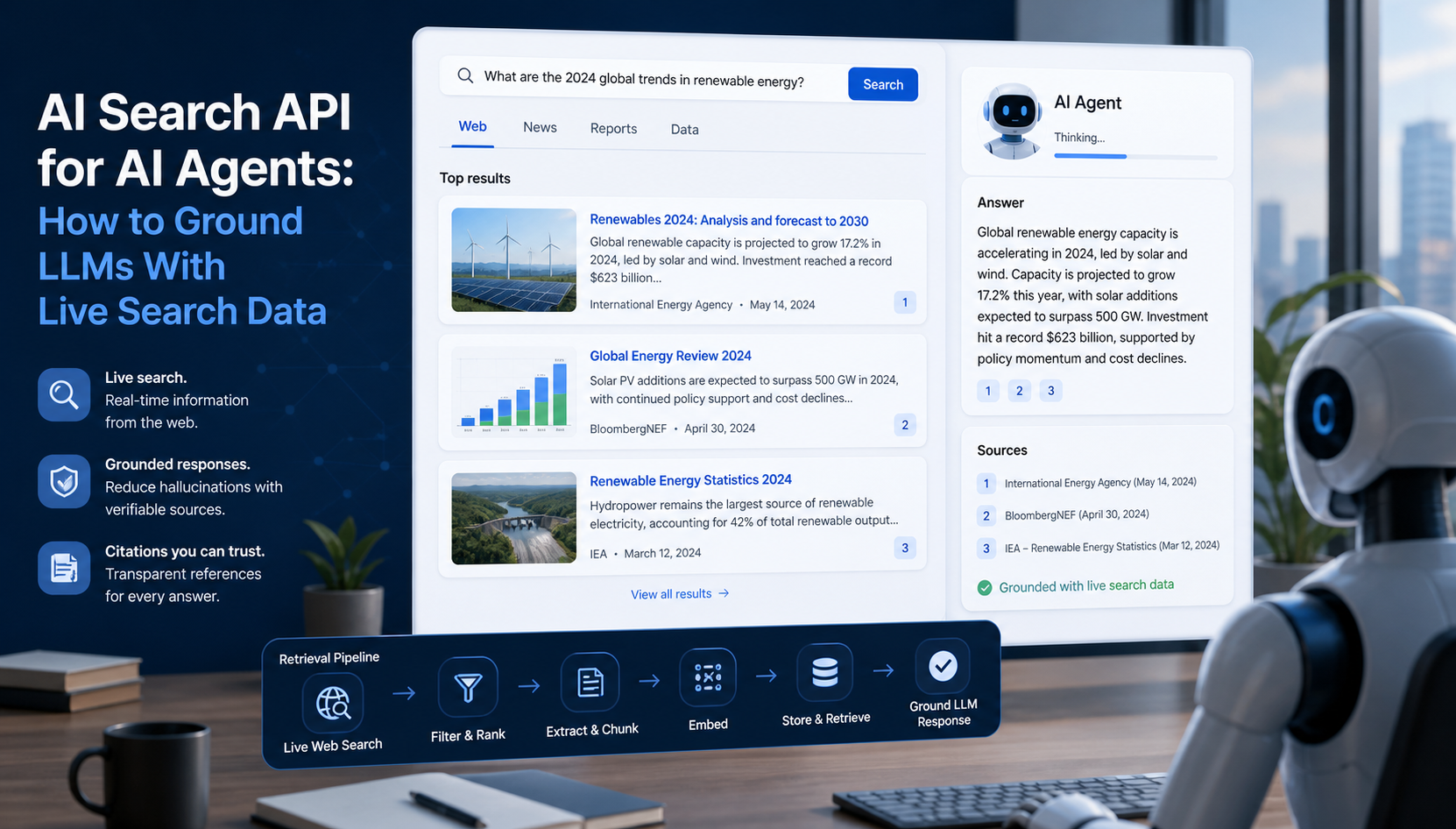
AI Search API for AI Agents: How to Ground LLMs With Live Search Data
An AI search API gives an application or agent programmatic access to current search results. Its most useful role is discovery: the agent can find candidate sources, identify fresh information, and decide what to retrieve next instead of relying only on model memory.
View Details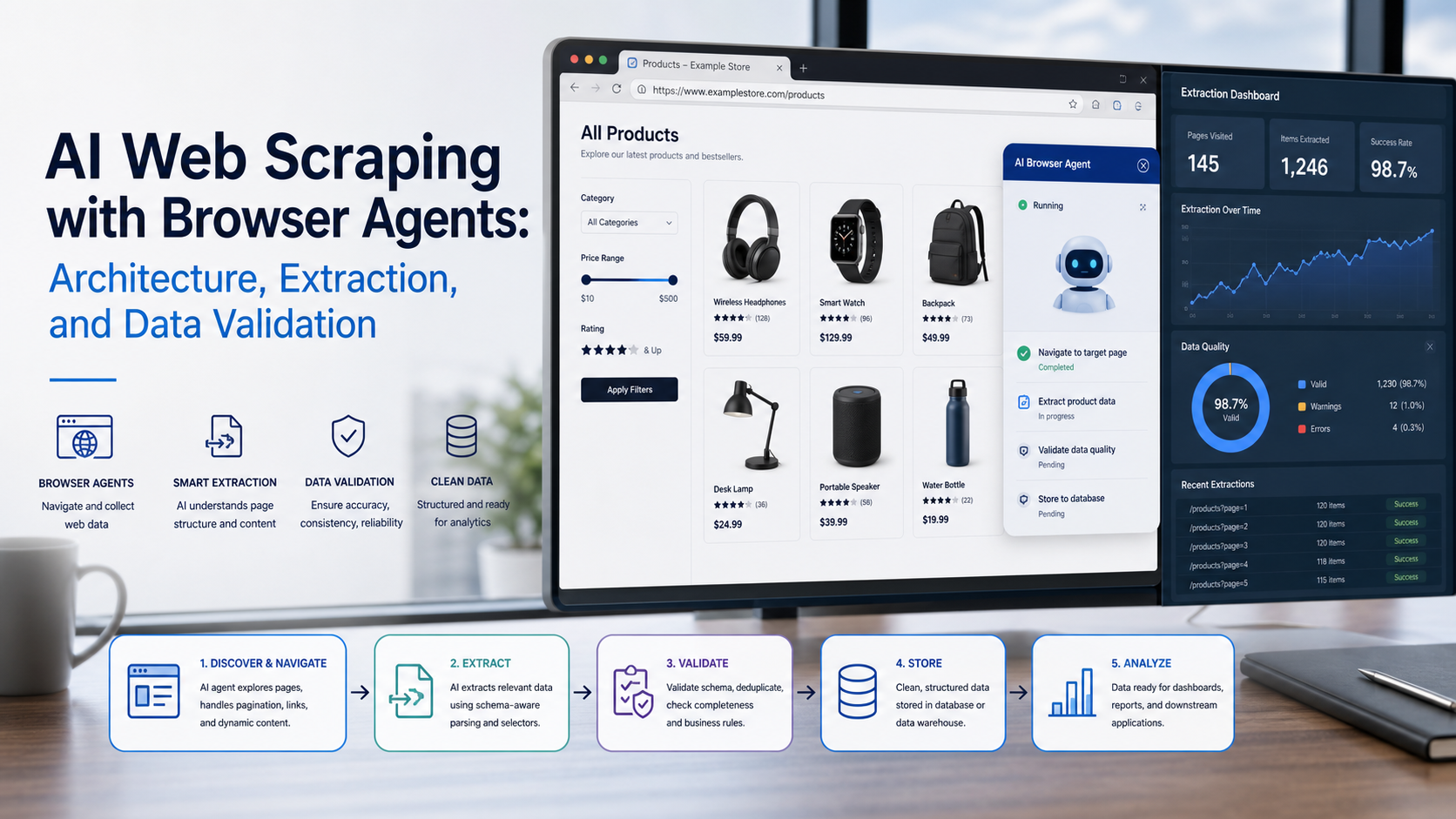
AI Web Scraping with Browser Agents: Architecture, Extraction, and Data Validation
AI web scraping uses AI to help discover, navigate, interpret, or extract information from websites. Browser agents are one implementation option when page interaction, rendering, or layout variation makes a simple scraper too brittle, but the agent should not become the entire data pipeline.
View Details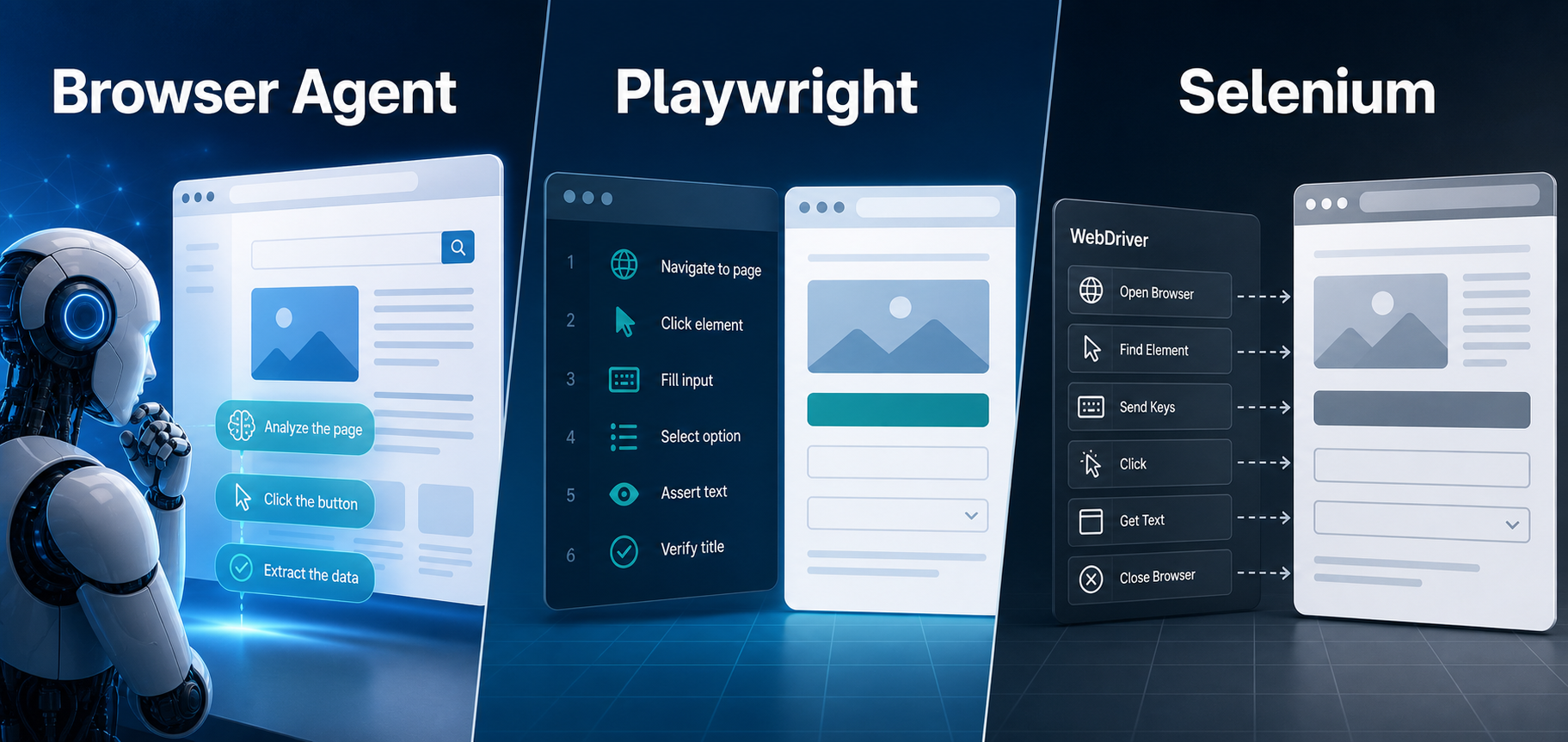
AI Browser Automation: Browser Agents vs Playwright vs Selenium
A browser agent interprets a goal and decides what browser action to take next. Playwright and Selenium can execute explicit, testable browser logic defined by developers. In 2026, however, Playwright also provides official MCP and agent-oriented workflows, so Playwright is no longer just the deterministic alternative to agentic automation. It can also serve as the browser-control layer inside an agent system.
View Details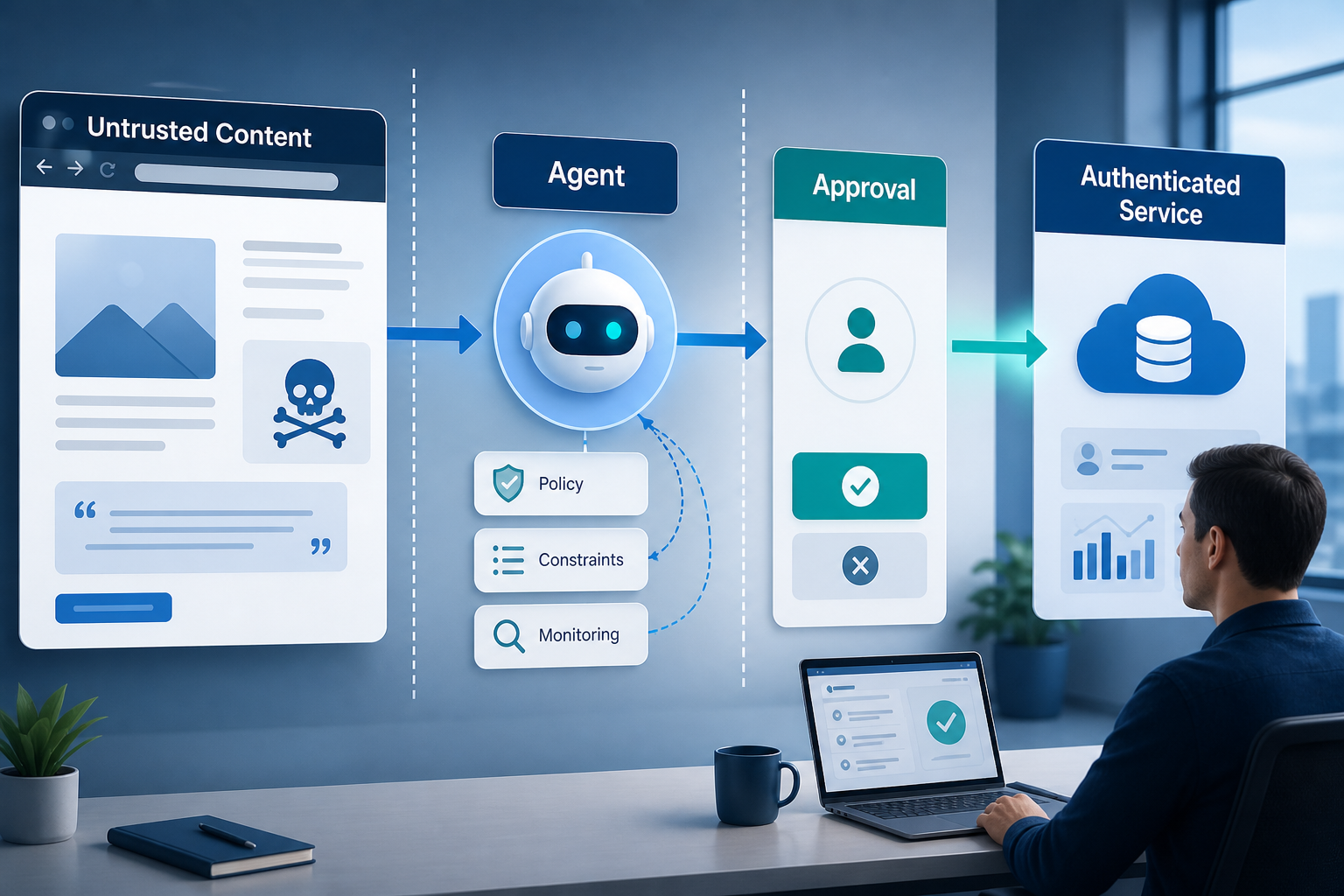
Agentic Browser Security: Prompt Injection, Permissions, and Safe Deployment
That combination creates risks that are different from ordinary browsing and traditional automation. The most important is indirect prompt injection, where hostile instructions hidden in web content attempt to redirect the agent away from the user's goal. Google describes indirect prompt injection as a primary new threat for agentic browsing and has introduced layered defenses that include origin constraints, independent action checks, threat detection, and user confirmation for sensitive actions. Google's Chrome security architecture is a useful reference for how browser-agent defenses are evolving.
View Details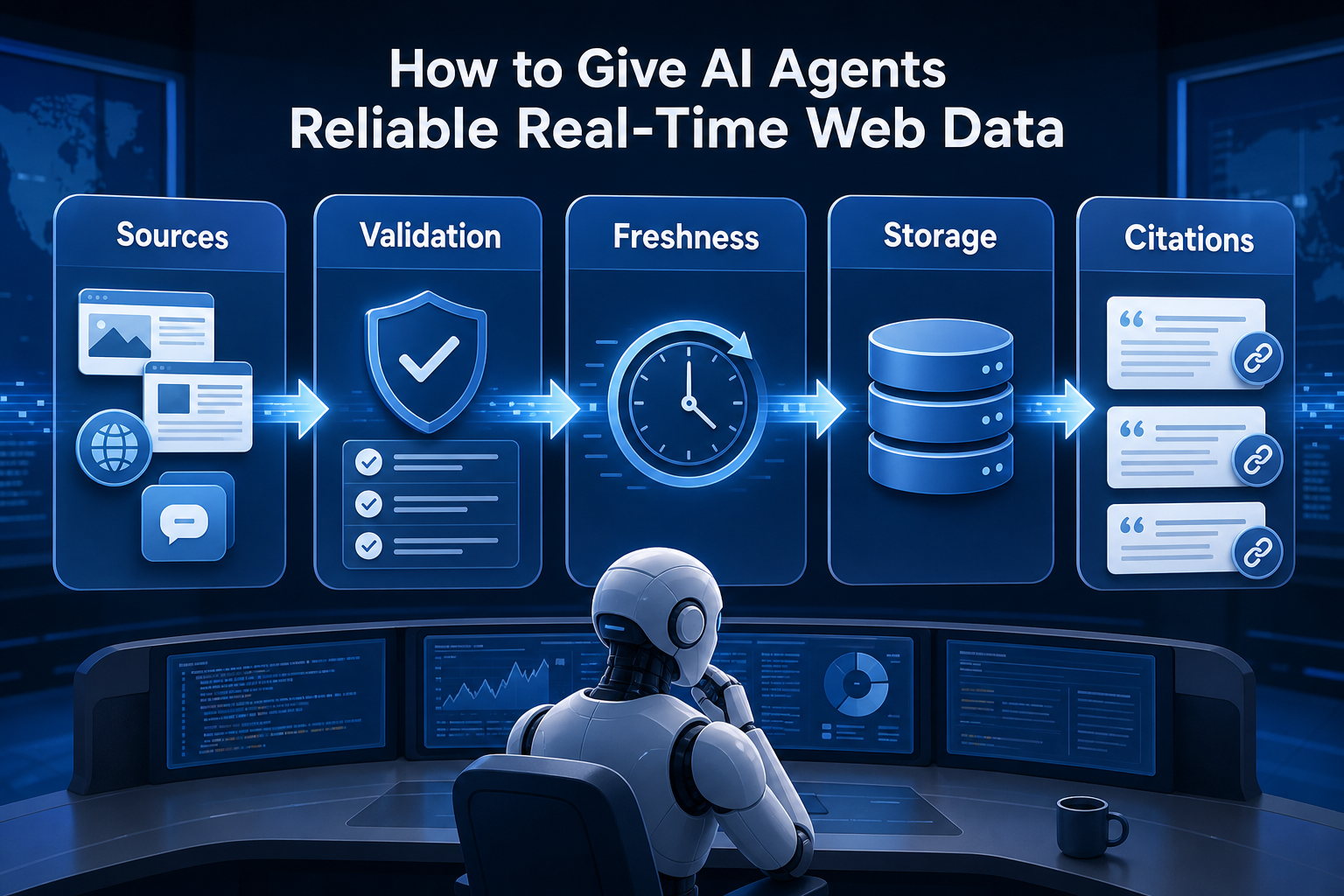
How to Give AI Agents Reliable Real-Time Web Data
A production-ready solution therefore needs more than a web scraper. It needs a web data layer that connects acquisition, validation, storage, retrieval, security, and observability. This guide explains how to design that layer.
View Details