
Advanced Python Web Scraping: Production Patterns
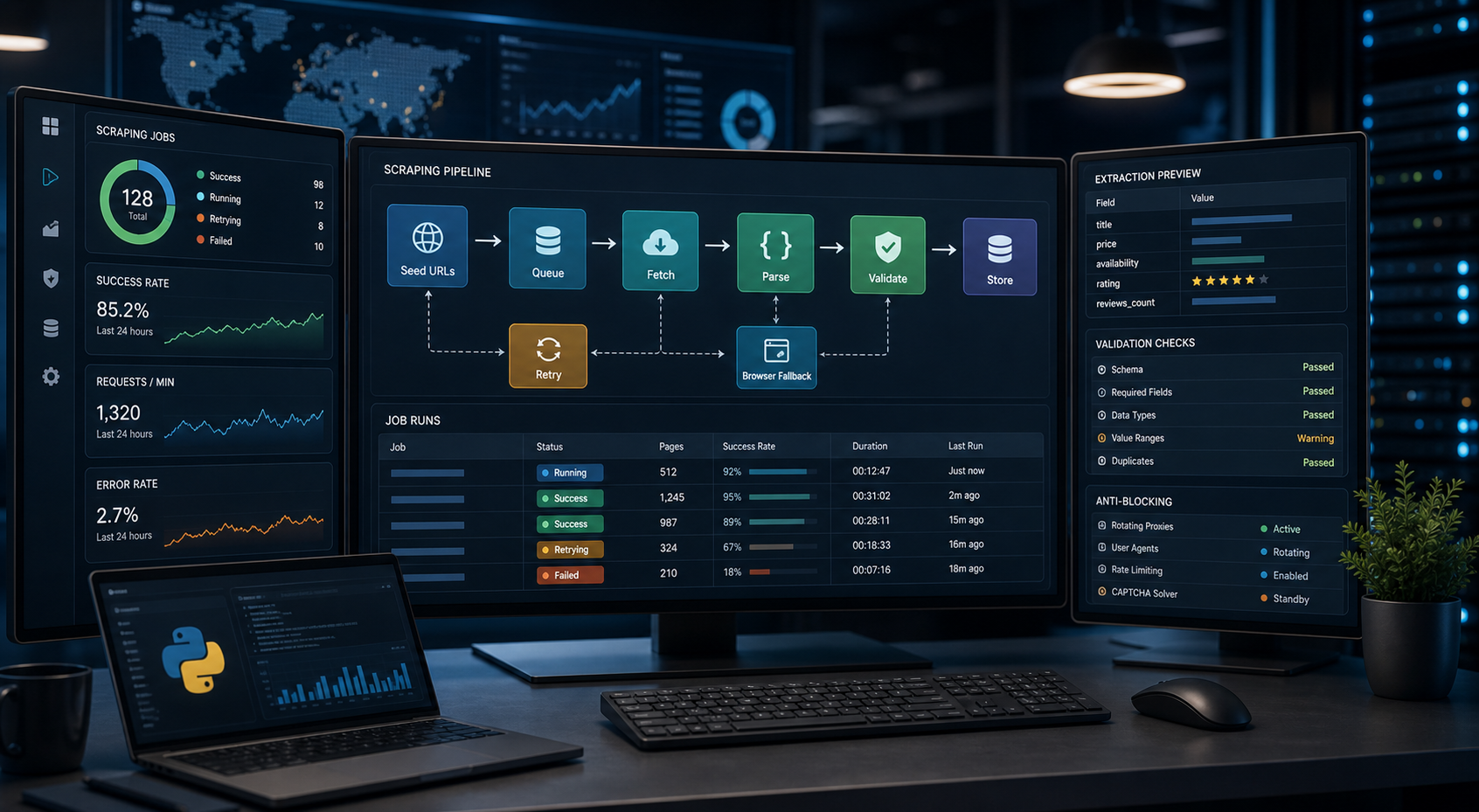
Build reliable Python web scraping pipelines with async fetching, browser fallbacks, validation, retries, state, monitoring, and safer scaling patterns.
Build reliable Python web scraping pipelines with async fetching, browser fallbacks, validation, retries, state, monitoring, and safer scaling patterns.
advanced-python-web-scraping
Advanced Python web scraping is less about adding more libraries and more about designing a reliable data pipeline. Learn how to separate fetching, parsing, validation, storage, and monitoring so crawlers can scale without silently producing bad data.
For the official technical reference behind this point, see MDN HTTP overview.
Full Article
Advanced Python Web Scraping: Production Patterns for Reliable Data Pipelines
Advanced Python web scraping begins when a script must keep working after the happy-path demo.
A production crawler has to deal with slow responses, redirects, pagination state, JavaScript-rendered content, duplicate URLs, malformed records, schema changes, restarts, and target-side capacity limits. At that point, the main engineering problem is not "How do I parse this div?" It is "How do I build a collection pipeline that can fail, recover, and prove the data is still correct?"
For the LycheeIP implementation details behind this step, review LycheeIP proxy infrastructure.
For the LycheeIP implementation details behind this step, review rotating residential proxies.
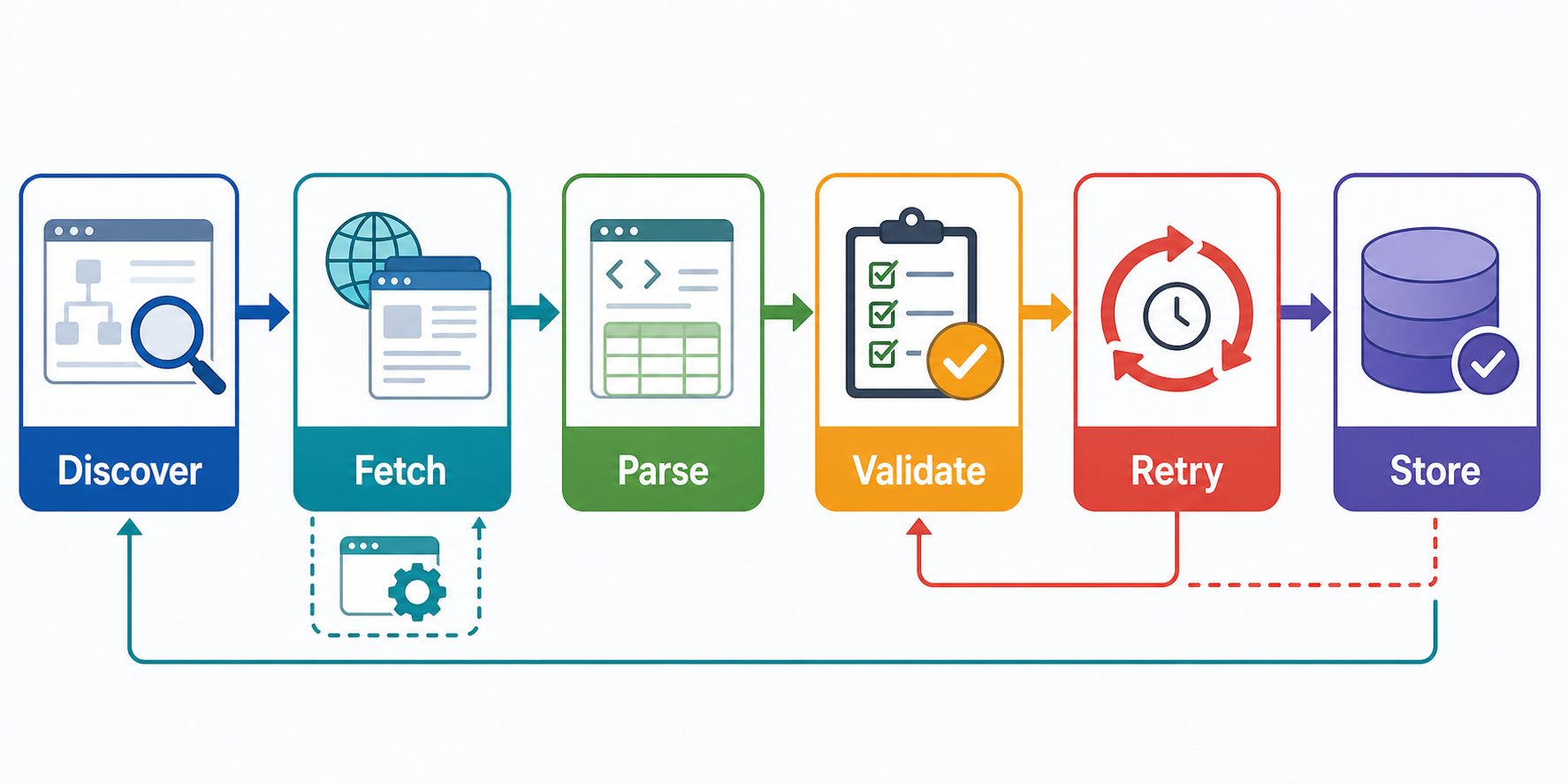
A strong architecture separates seven concerns:
Discovery Fetching or rendering Raw response retention Parsing Validation and normalization Storage and deduplication Monitoring and control
This guide shows how those parts fit together in Python and where async HTTP, browser automation, Scrapy, queues, and validation rules belong.
Start With a Source Strategy, Not a Library
Choose the source before the Python package.
If the required fields are in server-returned HTML, use a normal HTTP client and parser. If the site uses numbered pages or cursors, add durable pagination state. If JavaScript creates the required page state, a browser may be needed. If a permitted structured JSON response or official API contains the same data, structured parsing may be clearer than extracting presentation text.
Authenticated systems require a separate review of authorization, contract terms, credential handling, and data sensitivity.
Do not use a headless browser by default. The first architectural decision should be: what is the simplest permitted source that reliably contains the data?
The Production Scraping Pipeline
A maintainable Python scraper can be visualized as a sequence of boundaries:
URL frontier -> fetcher -> raw store -> parser -> validator -> normalizer -> record store
A scheduler and monitoring layer sit around the pipeline.
Each boundary has a purpose.
The URL frontier decides what should be visited and prevents accidental duplication.
The fetcher owns network behavior, including timeouts, connection limits, redirect policy, and response metadata.
The raw store preserves the source used for extraction when retention is appropriate.
The parser converts HTML or JSON into candidate records.
The validator rejects records that violate the expected schema.
The normalizer standardizes dates, currencies, text, and identifiers.
The record store writes accepted data with stable keys and deduplication rules.
When these responsibilities are mixed into one large function, every failure becomes harder to diagnose. A database error may trigger a network retry. A selector change may look like a successful request with zero products. A browser timeout may leave pagination state half updated.
Separation makes failure specific.
Use Async I/O for Network Concurrency, Not Unlimited Requests
Fetching many independent URLs is an I/O-bound workload, so asynchronous HTTP can improve throughput. Python's async ecosystem lets one process make progress on other requests while some connections are waiting for network activity.
But async does not mean "send everything at once."
HTTPX provides an asynchronous client, connection-pool limits, and configurable timeouts. Those controls matter because an unbounded gather() over thousands of URLs can exhaust sockets, memory, proxy capacity, or the target service.
A safer pattern is bounded concurrency:
import asyncio
from dataclasses import dataclass

import httpx

@dataclass
class FetchResult:
    url: str
    status\_code: int
    body: str

async def fetch(
    client: httpx.AsyncClient,
    semaphore: asyncio.Semaphore,
    url: str,
) \-\> FetchResult:
    async with semaphore:
        response \= await client.get(url)
        response.raise\_for\_status()
        return FetchResult(
            url=str(response.url),
            status\_code=response.status\_code,
            body=response.text,
        )

async def main(urls: list\[str\]) \-\> list\[FetchResult\]:
    timeout \= httpx.Timeout(20.0, connect=10.0)
    limits \= httpx.Limits(
        max\_connections=20,
        max\_keepalive\_connections=10,
    )
    semaphore \= asyncio.Semaphore(8)

    async with httpx.AsyncClient(
        timeout=timeout,
        limits=limits,
        follow\_redirects=True,
    ) as client:
        return await asyncio.gather(
            \*(fetch(client, semaphore, url) for url in urls)
        )

if \_\_name\_\_ \== "\_\_main\_\_":
    results \= asyncio.run(
        main(
            \[
                "https://example.com/page/1",
                "https://example.com/page/2",
            \]
        )
    )
    print(results)
The numbers in this example are not universal tuning recommendations. Concurrency should be chosen from the target's permitted access pattern, server behavior, response latency, your infrastructure, and any contractual limits.
Measure before increasing concurrency.
A useful operational rule is to control at least three things separately:
Maximum open connections Maximum concurrent work per host Request pacing or crawl delay
Global concurrency alone is not enough when one worker visits multiple domains.
Design Retries Around Failure Categories
"Retry three times" is not a production retry policy.
Different failures mean different things.
Connection failures and transient timeouts may succeed on a later attempt.
A 500 or 503 may be temporary, but repeated errors should reduce pressure rather than increase it.
A 429 is a rate signal. Respect Retry-After when present and lower request pressure.
A 404 is usually not fixed by immediate repetition.
A 401 or 403 may indicate missing authorization or an access rule. Do not treat it as a cue to disguise the client or cycle identities until access succeeds.
Parser failures are not network failures. Refetching the same unchanged response ten times will not repair a broken selector.
Database write failures may require transaction or storage retries without refetching the page.
Classify errors before deciding whether to retry.
Use exponential backoff with a maximum delay for eligible transient failures. Add jitter when many workers may retry at the same time. Cap total attempts and place exhausted jobs in a dead-letter or review queue with enough context to reproduce the failure.
Most importantly, make work idempotent. A retried page should not create duplicate records or advance a cursor twice.
Browser Automation Should Be a Controlled Fallback
For dynamic sites, browser automation can be appropriate. Playwright can monitor page network traffic and performs auto-waiting checks for many element actions.
That does not mean a browser should sit in front of every URL.
For the LycheeIP implementation details behind this step, review AI-powered browser automation hub.
For the official technical reference behind this point, see Playwright documentation.
A practical source hierarchy is:
- Direct HTTP response
- Permitted structured response used by the web application
- Browser rendering for page states that genuinely require JavaScript
This "HTTP first, browser when needed" design reduces compute cost and operational complexity.
When using Playwright, wait for a condition related to the data you need. Avoid fixed sleeps such as time.sleep(5) whenever a deterministic page or network condition is available.
Examples of meaningful conditions include:
a result container becomes available a specific response completes a next-page control becomes enabled the expected number of records is present a documented loading indicator disappears
A fixed five-second sleep is simultaneously too slow on a fast page and too short on a slow one.
Inspect Data Flow Only Within Your Access Rights
Browser network tools can help developers understand how a page loads data, but a frontend request is not automatically an unrestricted public API.
Before automating an internal endpoint, check whether collection is permitted, whether authentication is involved, whether the data is personal or sensitive, and whether an official API or export route exists. Technical discoverability is not the same as authorization.
Decouple Fetching From Parsing
One of the highest-value production patterns is to save the response before parsing, when storage, privacy, and retention rules allow it.
For each fetch, consider retaining:
requested URL final URL after redirects retrieval timestamp HTTP status content type selected response headers body hash raw HTML or JSON object location fetcher version
Then send a reference to that source object into the parsing stage.
This provides several advantages.
If a parser breaks, you can test the new extraction logic against previously collected source instead of making another network request.
If you add a new field, you may be able to reprocess retained source.
If a data-quality metric changes, you can compare source documents from before and after the change.
If the same URL returns identical content, a body hash can support change detection or duplicate analysis.
Raw source can also contain sensitive information. Apply access controls, encryption, retention periods, and deletion rules. "Save everything forever" is not a default architecture.
Treat Parsing as a Versioned Transformation
A parser should be a deterministic transformation as far as practical:
source document \+ parser version \-\> candidate records
Keep parsing functions independent from network calls.
For example:
from dataclasses import dataclass

from lxml import html

@dataclass
class Product:
    product\_id: str
    name: str
    price\_text: str

def parse\_products(page\_html: str) \-\> list\[Product\]:
    tree \= html.fromstring(page\_html)
    products: list\[Product\] \= \[\]

    for node in tree.xpath("//article\[@data-product-id\]"):
        product\_id \= node.xpath("string(./@data-product-id)").strip()
        name \= " ".join(
            node.xpath("string(.//h2)").split()
        )
        price\_text \= " ".join(
            node.xpath(
                "string(.//\*\[@data-field='price'\])"
            ).split()
        )

        products.append(
            Product(
                product\_id=product\_id,
                name=name,
                price\_text=price\_text,
            )
        )

    return products
The parser should not decide that "$1,299.00" equals a particular integer currency value. Put that logic in a normalization stage where currency, locale, decimal rules, and missing-value policy are explicit.
Validation Is More Important Than a Successful HTTP Status
A 200 response only says the server returned a successful HTTP response. It does not prove your data is correct.
A robust scraping pipeline validates at several levels.
Document-level validation
Did you receive the expected content type? Is the body suspiciously small or unexpectedly huge? Does the document contain the expected page landmark? Is the page actually an error message rendered with status 200?
Record-level validation
Are required identifiers present? Is a price parseable under the expected locale? Is the date within a reasonable range? Does a URL resolve to an allowed domain? Does an enumerated field contain a known value?
Batch-level validation
How many records were extracted? What percentage of required fields are missing? How many identifiers are duplicated? How different is volume from the recent baseline? Did the distribution of categories or states change abruptly?
Do not automatically accept a batch just because the parser returned a list.
Quarantine questionable output. It is usually cheaper to delay a bad batch than to discover weeks later that a selector filled your price column with shipping labels.
Build Stable Keys and Deduplication Rules
Deduplicate by entity identity, not by the exact text of a row. Prefer a legitimate stable source identifier or a documented composite key such as source + productid or source + canonicalurl.
Keep entity identity separate from observation identity. A product may have one stable key but many price observations over time. Overwriting the entity row on every crawl can destroy useful history.
Pagination and Crawl State Need Checkpoints
Pagination looks simple until a process restarts in the middle of a million-page job.
For numbered pages, store the last completed unit of work only after downstream processing succeeds.
For cursor pagination, persist the cursor together with the job state and source version.
For discovery crawls, keep the frontier and visited-state durable enough for the required restart behavior.
Scrapy supports pausing and resuming crawls through a job directory that can persist scheduled requests, the duplicate filter, and spider state. That is a useful example of treating crawl state as first-class infrastructure rather than an in-memory set.
The checkpoint boundary matters.
If you mark page 500 complete immediately after fetching it and the database write later fails, a restart may skip the page.
A safer state transition is:
queued \-\> fetched \-\> parsed \-\> validated \-\> committed
Only then is the unit complete.
Scrapy, Async HTTP, or a Custom Queue: How to Choose
Use a focused async HTTP application when:
the crawl has a narrow purpose the data source is mostly HTTP or JSON the team wants explicit application-level control the queue and storage requirements are simple
Use Scrapy when:
you need a mature crawling framework request scheduling and duplicate filtering matter you want middleware and item pipelines you need pause and resume behavior multiple spiders share crawling conventions
Use browser automation when:
the required page state genuinely depends on browser execution or interaction
Use an external queue and distributed workers when:
the workload exceeds one process or host jobs must be independently retried you need horizontal worker scaling backpressure and dead-letter handling matter different stages have different resource profiles
Do not distribute a scraper merely because the word "scale" appears in the requirements. A single well-bounded process may be easier to operate and fast enough.
Observability: Monitor Data Quality, Not Just Uptime
A crawler can run successfully every night and still be broken for a month.
Track infrastructure metrics such as:
request latency status-code rates timeout rates retry counts queue depth worker utilization browser crashes
Also track extraction metrics:
documents parsed records per document required-field missing rate selector match counts duplicate-key rate validation failures quarantined batches schema-version distribution
The second group often detects real scraping failures earlier.
Alert on trends and thresholds that reflect the dataset. A sudden 95 percent drop in records is obvious. A price field that moves from 0.2 percent missing to 8 percent missing can be just as important.
Create a regression fixture from every meaningful parser incident. Over time, the fixture suite becomes a history of the page structures your pipeline claims to support.
Rate Control Is Part of Reliability
Aggressive crawling is not a synonym for advanced crawling.
Rate limits protect the source service, your network path, and your own pipeline. A sudden increase in failures can be a signal to reduce pressure.
Scrapy's AutoThrottle documentation describes an approach that adjusts delays using observed latency while respecting configured concurrency and delay limits. Whether you use Scrapy or a custom client, the principle is useful: make crawl pressure observable and controllable.
Also check the site's published crawling instructions. RFC 9309 standardizes the Robots Exclusion Protocol for service owners to express crawler access rules. The RFC also makes clear that robots.txt rules are not access authorization.
Respect robots.txt where it applies to your crawler, but do not mistake "allowed by robots.txt" for legal permission to collect or process any data on the page.
Security, Privacy, and Legal Review Belong in the Design
At production scale, a scraping system can become a data-governance system.
Before collection, document:
the purpose of the dataset the categories of data collected the legal or contractual basis for the activity access restrictions retention period deletion process credential handling downstream users and systems
Avoid collecting personal data merely because it is technically visible. For projects subject to the GDPR, Article 5 includes purpose limitation, data minimisation, storage limitation, and integrity and confidentiality among the principles relating to personal-data processing.
This is not a substitute for legal advice. Jurisdiction, source, authentication, contractual terms, copyright, database rights, and the intended use can materially change the risk.
Build the review into the project before the crawler has accumulated terabytes of data.
Scale Python Data Collection with LycheeIP Proxies
A Practical Production Checklist
Before increasing crawl volume, confirm that you can answer these questions:
Can each job be retried without creating duplicate output? Are timeouts and connection limits explicit? Can request pressure be reduced quickly? Do you distinguish transient network failures from parser failures? Can a crawl resume after a restart? Do you save enough permitted source context to reproduce extraction bugs? Are required fields validated? Can bad batches be quarantined? Do you track field-level missing rates and record volume? Are credentials isolated and protected? Are retention and deletion rules defined? Have crawling instructions, terms, data sensitivity, and applicable legal obligations been reviewed?
If several answers are no, more concurrency will amplify uncertainty rather than solve the system's problems.
For the LycheeIP implementation details behind this step, review datacenter proxies.
Frequently Asked Questions
What is advanced web scraping in Python?
Advanced web scraping is the engineering of reliable collection pipelines for dynamic, high-volume, or long-running data tasks. It includes concurrency control, state, retries, validation, deduplication, monitoring, and recovery, not only HTML parsing.
Is asyncio always faster for web scraping?
No. Async I/O can improve throughput for network-bound work, but performance depends on latency, connection limits, server capacity, parser cost, and storage. Unbounded concurrency can make a scraper slower or less reliable.
When should I use Playwright instead of HTTPX?
Use Playwright when the required data or page state genuinely depends on browser execution or interaction. Use an HTTP client when the needed data is already available through a permitted direct response. A browser should be an intentional dependency, not a default.
Should I save raw HTML from every crawl?
It can be valuable for debugging and reprocessing, but retention should be based on purpose, storage cost, privacy, security, and legal requirements. Save only what your project is allowed to retain and define a deletion policy.
How do I detect a scraper that is silently broken?
Track data-quality metrics such as records per page, selector match counts, missing required fields, duplicate identifiers, validation failures, and distribution changes. A 200 response is not a data-quality check.
Is Scrapy better than a custom async scraper?
It depends on the workload. Scrapy provides mature scheduling, duplicate filtering, middleware, pipelines, and resumable job support. A small async application may be simpler for a narrow HTTP or JSON collection task. Conclusion Production Python scraping is a systems problem. The reliable pattern is to identify the simplest permitted data source, bound concurrency, classify retries, checkpoint state, separate fetching from parsing, validate every important field, quarantine suspicious output, and monitor the dataset as carefully as the workers. A fast scraper that silently writes incorrect records is not advanced. A pipeline that can explain what it fetched, which parser processed it, why a record was accepted, and how to recover after failure is much closer to production quality.
Related LycheeIP Guides and Resources

Recommended Articles

Best Real Estate Scrapers in 2026
Best Real Estate Scrapers in 2026
View Details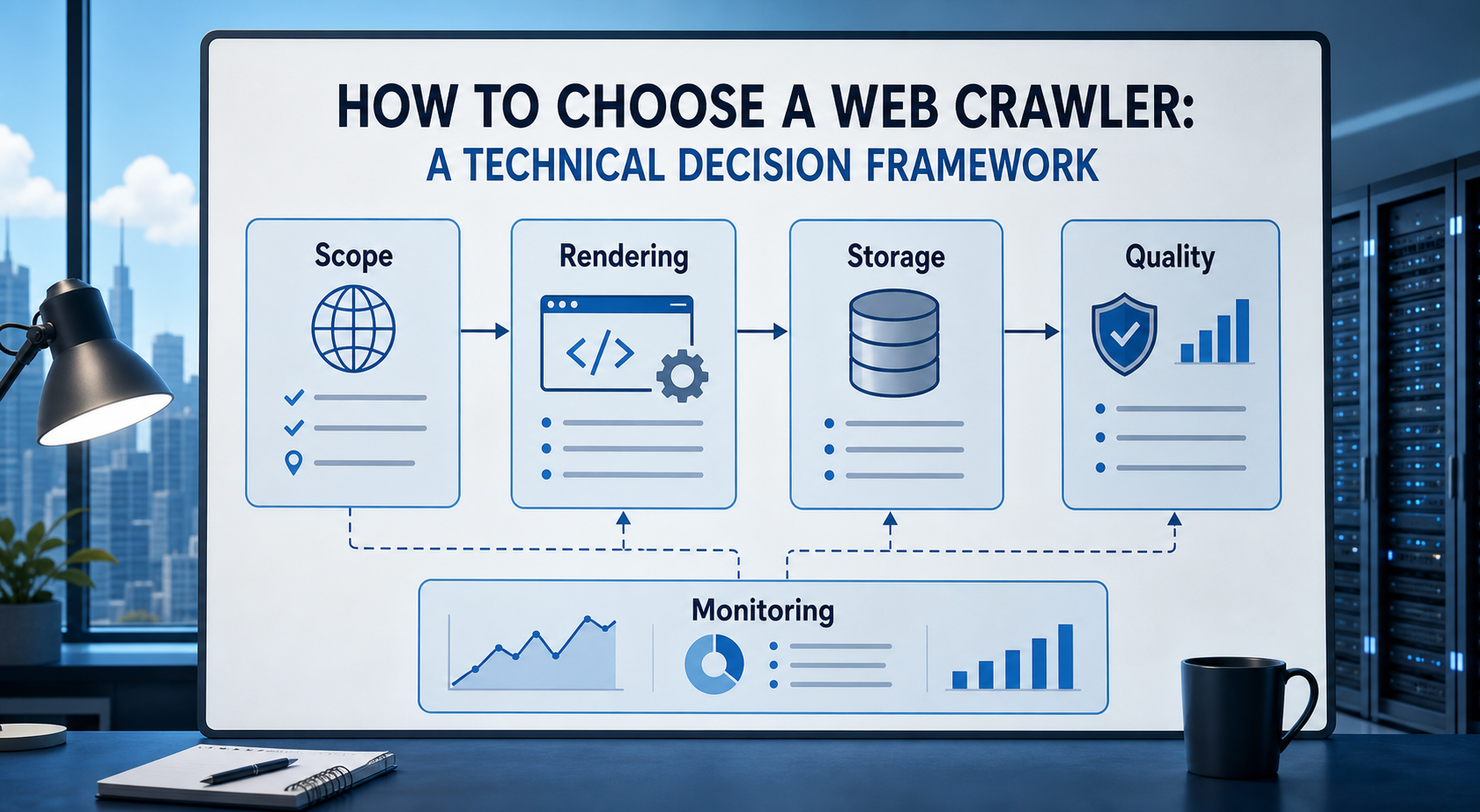
How to Choose a Web Crawler: A Technical Decision Framework
The wrong way to choose a web crawler is to begin with a list of products. The right starting point is the system you need to build. Before comparing tools, define:
View Details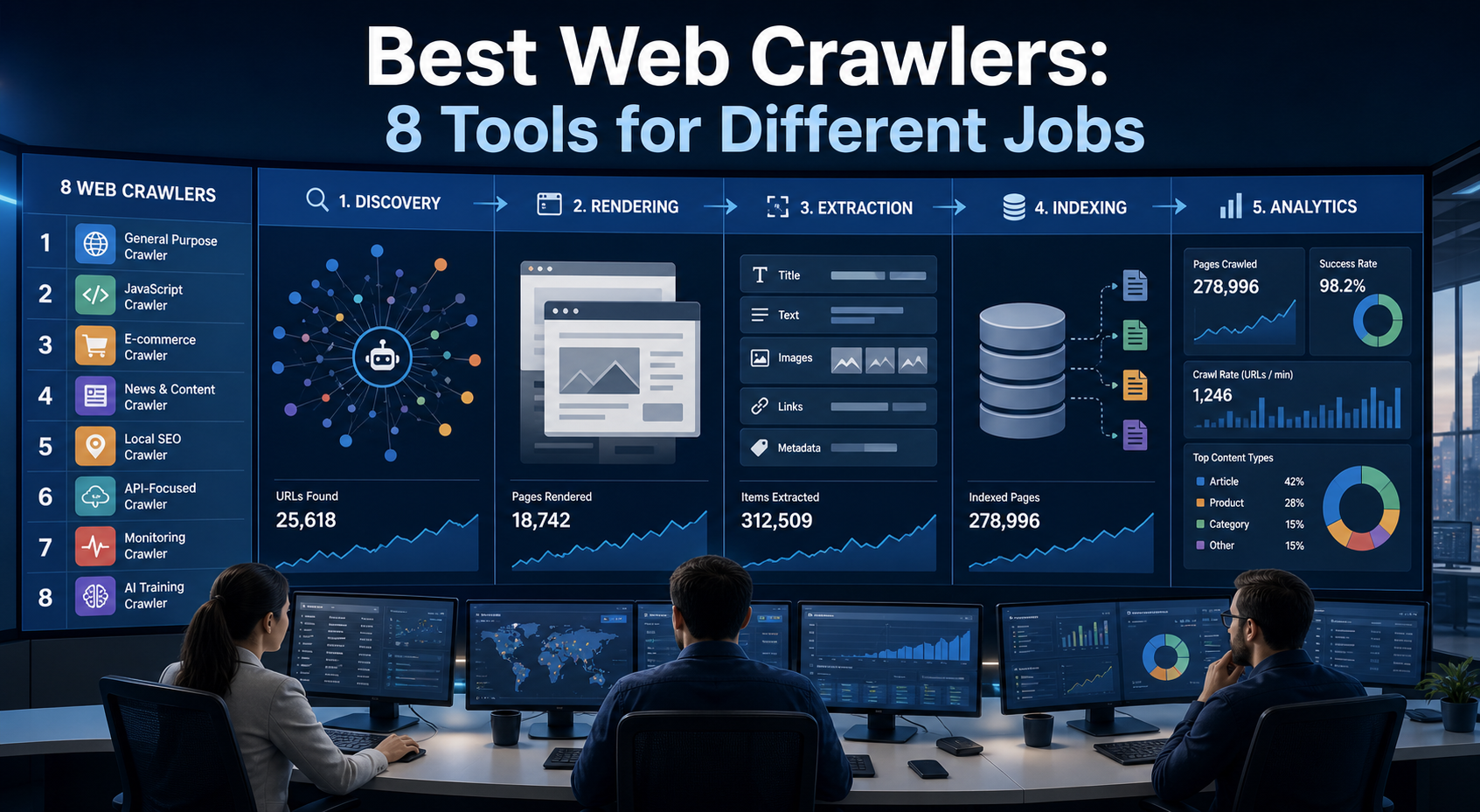
Best Web Crawlers: 8 Tools for Different Jobs
There is no single best web crawler for every project. A technical SEO audit, an AI knowledge pipeline, an internet archive, and a distributed search index may all involve crawling URLs, but they require different capabilities. The most useful way to compare web crawler tools is therefore to ask what job each one was designed to perform. This guide evaluates eight strong options across:
View Details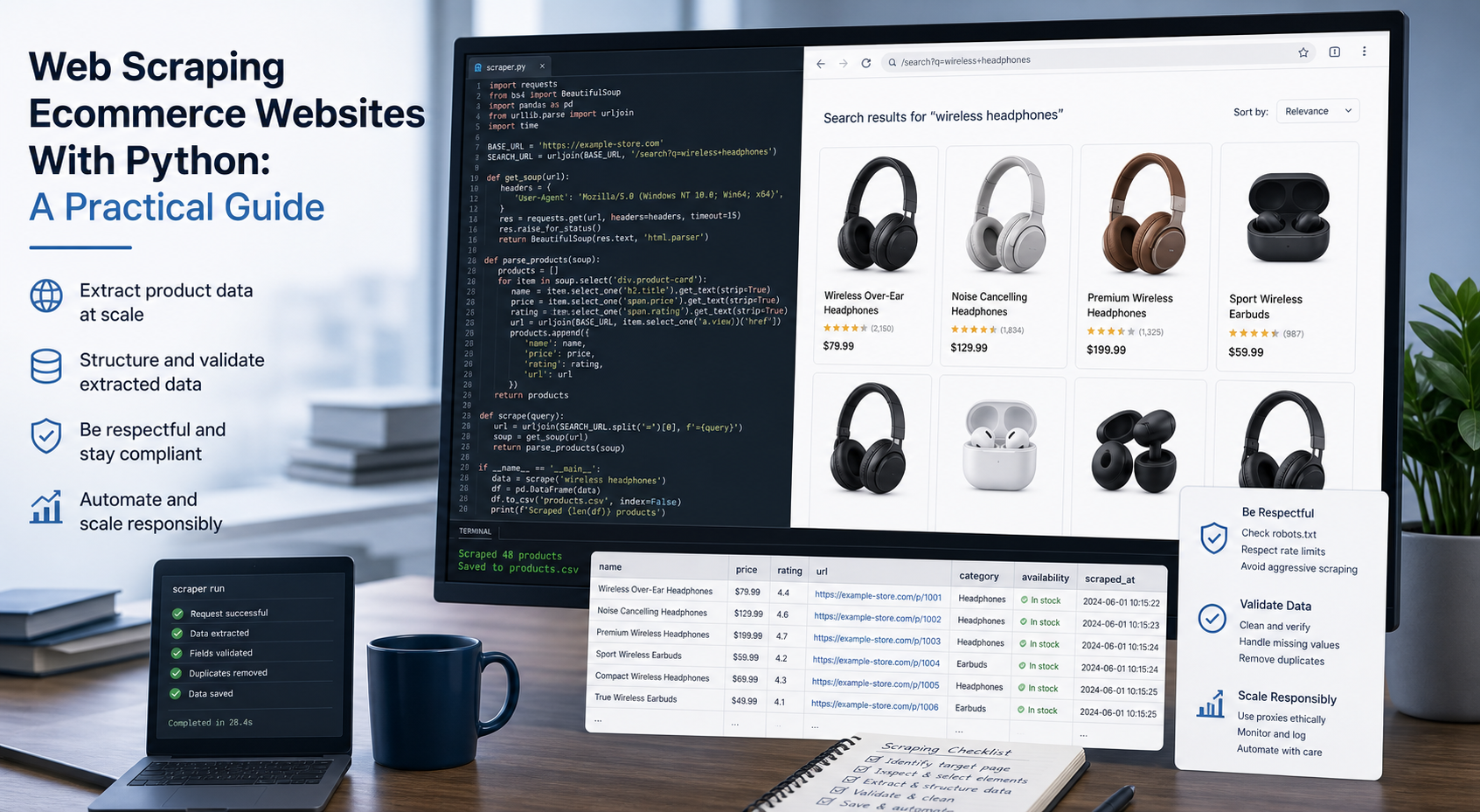
Web Scraping Ecommerce Websites With Python: A Practical Guide
Recommended meta title: Web Scraping Ecommerce Websites With Python: Guide Recommended meta description: Learn how to scrape ecommerce websites with Python using Requests, Beautiful Soup, Playwright, and Scrapy, with validation and scaling guidance. URL slug: /web-scraping-ecommerce-websites-python/
View Details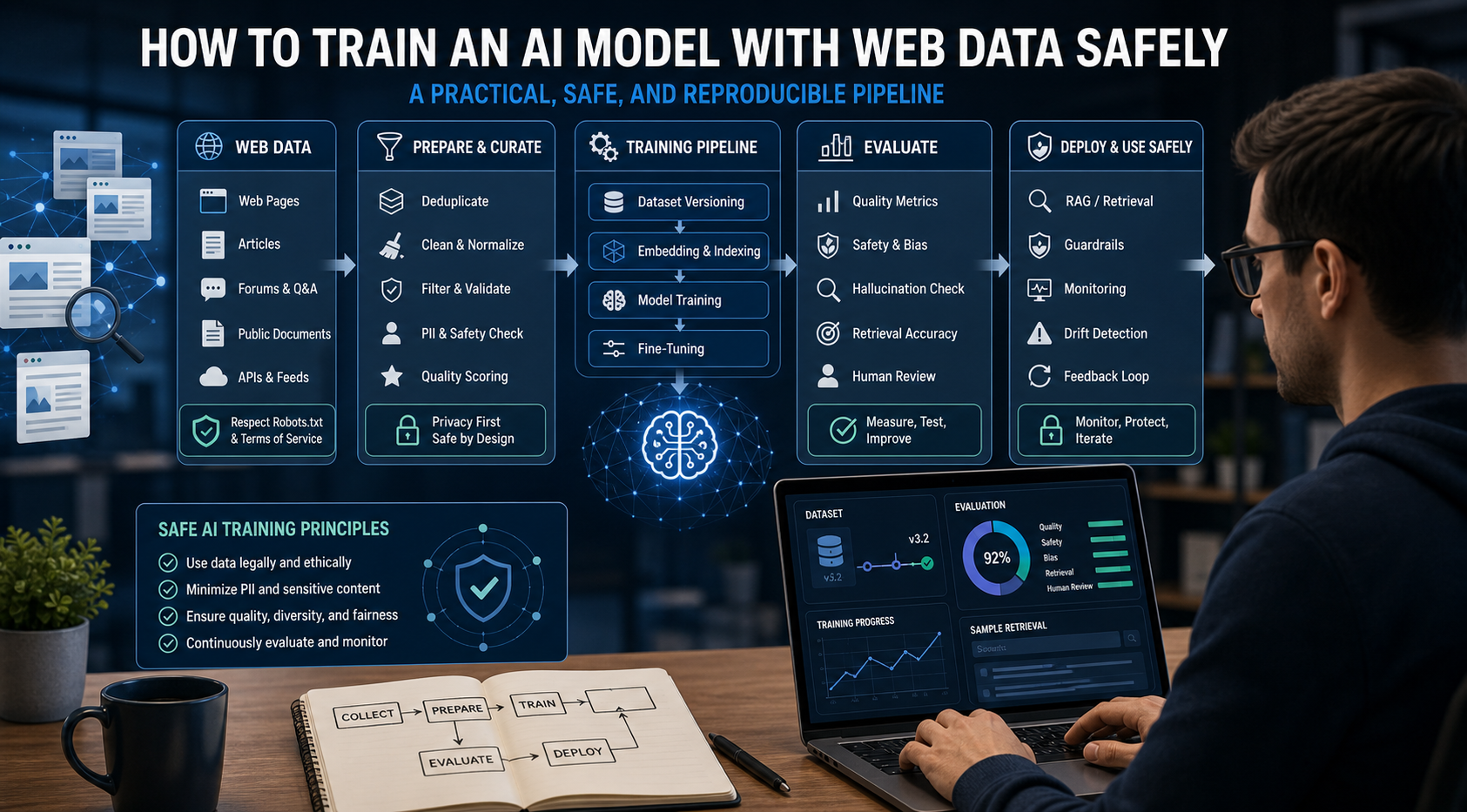
How to Train an AI Model With Web Data Safely
To train an AI model with web data, start by deciding whether you actually need training. Then collect representative sources, preserve provenance, remove duplicates and low-quality content, create leakage-resistant splits, build a baseline, fine-tune or train the appropriate model, and evaluate on real held-out examples before deployment.
View Details