
WireGuard VPN Guide: Setup, Stealth (QUIC), and Configuration
WireGuard VPN Guide: Setup, Stealth (QUIC), and Configuration
If you are searching for wireguard, you are likely looking for one of two things: the official software to secure your device, or a way to build a private tunnel that actually works on restrictive networks.
This guide covers both. We will walk through the standard setup, explain the modern "stealth" trend using QUIC/MASQUE, and clarify how to host your own node effectively.
Legal Note: Always use VPN tools in compliance with local laws, employer policies, and service terms of service.
Check out LycheeIP’s proxy network
What is WireGuard and why is it replacing older VPNs?
WireGuard is a modern, high-performance VPN protocol designed to be simpler and faster than IPSec or OpenVPN. It creates an encrypted tunnel between "peers" using state-of-the-art cryptography (like ChaCha20 for encryption and Curve25519 for key exchange).
It has become the industry standard for three reasons:
- Codebase size: WireGuard consists of roughly 4,000 lines of code, compared to 100,000+ for OpenVPN. This makes it significantly easier to audit for security vulnerabilities.
- Speed: It runs inside the Linux kernel, offering lower latency and higher throughput.
- Roam-capability: It handles network changes (switching from Wi-Fi to LTE) without dropping the connection.
How to download WireGuard and choose the right client
Because WireGuard is an open-source protocol, many apps support it. However, for security, you should strictly use official or verified distribution channels.
Use this checklist to find the right client:
- Windows / macOS: Download the official installer from the WireGuard website.
- Android / iOS: Install the official app from the Google Play Store or Apple App Store.
- Linux (Ubuntu/Debian): Install via the package manager (apt, yum, etc.).
- Router (OpenWRT/pfSense): Most modern router firmwares now have native support packages.
Warning: Avoid "Free VPN" sites offering custom installers. Always configure the raw client yourself or use a trusted commercial provider.
How to set up a self-hosted WireGuard server on Ubuntu
Setting up your own server gives you full control over your data. You can deploy this on any standard Linux VPS.
Step-by-step configuration (Copy-Paste)
Here is the minimal path to get a tunnel running on Ubuntu 20.04/22.04:
- Install the tools:
- Bash
sudo apt update && sudo apt install wireguard
3.
4.
5. Generate keys:
6. Bash
wg genkey | tee privatekey | wg pubkey > publickey
7.
8. Note: Never share your private key.
9. Create the configuration file (/etc/wireguard/wg0.conf):
10. Ini, TOML
[Interface]
PrivateKey = <Insert Server Private Key>
Address = 10.0.0.1/24
ListenPort = 51820
[Peer]
PublicKey = <Insert Client Public Key>
AllowedIPs = 10.0.0.2/32
11.
12.
13. Start the interface:
14. Bash
sudo wg-quick up wg0
15.
16.
Check out LycheeIP’s proxy network
The AllowedIPs setting confuses many new users. It acts as both a routing table and a firewall.
- On the Server: AllowedIPs = 10.0.0.2/32 means "only accept traffic from this specific client IP."
- On the Client: AllowedIPs = 0.0.0.0/0 means "route ALL my internet traffic through the VPN." If you only want to access the server's local network (Split Tunnel), you might use AllowedIPs = 192.168.1.0/24.
WireGuard is fast because it typically uses UDP (User Datagram Protocol). However, this makes it easy to fingerprint. Restrictive corporate firewalls or ISPs often block UDP on non-standard ports or identify the protocol's packet headers.
The UDP problem
If your network blocks UDP, a standard WireGuard connection will fail to handshake. The client will show "Active," but no data will pass.
QUIC and MASQUE obfuscation explained
To bypass these blocks, the industry is moving toward "Stealth WireGuard." This isn't a different protocol, but a way of wrapping the packets.
- QUIC: A transport layer protocol used by HTTP/3. It runs over UDP but mimics web traffic patterns.
- MASQUE: A standard (RFC 9298) that allows proxying IP packets over HTTP/3.
By wrapping WireGuard inside a QUIC/MASQUE tunnel, your VPN traffic looks like standard HTTPS web browsing to a firewall. While this requires more complex setup (often involving tools like gst-proxy or specialized provider clients), it is currently the most effective way to defeat DPI (Deep Packet Inspection).
When to use WireGuard vs. OpenVPN vs. Tailscale
Do not choose a protocol based on fandom. Choose based on your infrastructure needs.
| Feature | WireGuard | OpenVPN | Tailscale |
| Speed | Excellent (Kernel-level) | Moderate (Userspace) | Good (WireGuard-based) |
| Setup Difficulty | Low (Simple config) | High (Certificates/PKI) | Zero (Auth-based) |
| Obfuscation | None natively (needs plugins) | TCP Mode available | DERP relays available |
| Best For... | Site-to-Site, Personal VPN | Legacy Systems, TCP requirements | Mesh networks, Team Access |
Check out LycheeIP’s proxy network
Choosing a VPS for WireGuard: The BandwagonHost Example
You need a hosting provider that understands network tunnels. BandwagonHost is frequently cited in WireGuard discussions because of its focus on KVM (Kernel-based Virtual Machine) and self-management.
Key VPS requirements for VPN hosting
Whether you use BandwagonHost, DigitalOcean, or Vultr, ensure your plan includes:
- Tun/Tap Support: Required for creating network interfaces. Most KVM VPSs have this; OpenVZ containers often do not.
- Clean IP Reputation: If the VPS IP is blacklisted, your VPN won't help you access banking or streaming sites.
- Multiple Locations: To reduce latency, host the server physically close to your location or your target destination.
- Control Panel: Features like Bandwagon’s KiwiVM allow you to restart the server if the network stack freezes, which is vital for remote management.
Troubleshooting your WireGuard connection
If your tunnel is up but internet access is down, check these common failure points:
- The "Silent Failure": WireGuard uses UDP, so it doesn't confirm connections like TCP. If keys don't match, it simply drops packets silently.
- Key Mismatch: Ensure the Server's Public Key is in the Client's config, and vice versa.
- Firewall Rules: Open UDP port 51820 on your cloud provider's firewall (AWS Security Groups, ufw, etc.).
- IP Forwarding: On Linux servers, you must enable packet forwarding in sysctl.conf (net.ipv4.ip_forward=1).
Outbound Strategy: Where LycheeIP fits into your infrastructure
A self-hosted WireGuard server is excellent for securing inbound access to your tools or protecting your personal browsing. However, it provides only one static IP address. This is often insufficient for data collection, scraping, or managing multiple accounts.
How LycheeIP Fits:
- Inbound vs. Outbound: Use WireGuard to securely connect your team to your scraping server. Use LycheeIP to route that server's requests out to the internet.
- Scale: While your VPN has one IP, LycheeIP offers access to millions of dynamic residential IPs with >6 month cooling periods.
- Protocol Compatibility: LycheeIP supports HTTP/S and SOCKS5, which can easily be chained with your infrastructure for seamless rotation.
Conclusion
WireGuard has effectively replaced legacy protocols for most use cases due to its speed and simplicity. Whether you are downloading the official client for personal privacy or configuring a stealth QUIC tunnel for a hostile network environment, the key is proper configuration.
Start by setting up a basic interface, verify your handshakes, and then layer on obfuscation or high-quality proxies like LycheeIP as your needs scale.
Comparison / Decision Table
Method vs. When to Use
| Method | Best For | Tradeoffs |
| Official WireGuard Client | 90% of users; Personal privacy; Mobile use | No built-in obfuscation; easily blocked by strict firewalls. |
| Self-Hosted (VPS) | Tech-savvy users; Accessing home networks | Requires Linux knowledge; you are responsible for security updates. |
| Tailscale / Headscale | Teams; Connecting multiple devices easily | Relies on 3rd party coordination server (unless self-hosted Headscale). |
| Stealth (QUIC/MASQUE) | Users in restrictive countries/networks | Higher latency due to encapsulation; complex setup. |
Troubleshooting Guide
- Symptom: Client says "Active" but no internet.
- Likely Cause: Handshake failure.
- Fix: Check if the Endpoint IP is correct and if the keys match exactly. Remember: Use Server Public Key in the Client Config.
- Symptom: Can access server, but not the internet.
- Likely Cause: IP Forwarding disabled.
- Fix: Run sysctl -w net.ipv4.ip_forward=1 on the server.
- Symptom: Connection works for a while, then stalls.
- Likely Cause: MTU issues or UDP throttling.
- Fix: Lower the MTU in the config (try 1280) or switch to a TCP-based obfuscation method if UDP is being throttled.
Check out LycheeIP’s proxy network
Frequently Asked Questions:
1. Is WireGuard safe to use?
Yes. WireGuard uses modern, verified cryptography (ChaCha20, Poly1305) and has a much smaller attack surface than older protocols, making it easier to audit and secure.
2. Does WireGuard work over TCP?
Not natively. It is designed exclusively for UDP to maximize speed. To use it over TCP, you must wrap it in a tunnel (like Websockets or Shadowsocks), which reduces performance.
3. What is the difference between WireGuard and OpenVPN?
WireGuard is faster, leaner, and modern but has fewer configuration options. OpenVPN is older, slower, and heavier, but offers native TCP support and vast legacy compatibility.
4. Can I use WireGuard for web scraping?
You can use it to secure your scraping server, but a single VPN IP will get blocked quickly by target sites. For scraping, you should route traffic through a provider like LycheeIP to rotate residential addresses.
5. How do I fix the "Handshake did not complete" error?
This usually means the UDP packets aren't reaching the server. Check your VPS firewall (Security Groups/UFW) to ensure the ListenPort (default 51820) is open for UDP traffic.
6. Is WireGuard free?
Yes, the protocol and the official software clients are 100% free and open source. You only pay for the VPS or service hosting the connection.

Recommended Articles

SERP API Troubleshooting: Fix Empty, Wrong, or Inconsistent Search Results
SERP API failures are not limited to obvious HTTP errors. A request can return successfully and still produce empty, incomplete, geographically wrong, duplicated, or misinterpreted search data. Production troubleshooting therefore has to separate transport problems from provider processing, SERP differences, and downstream parsing errors.
View Details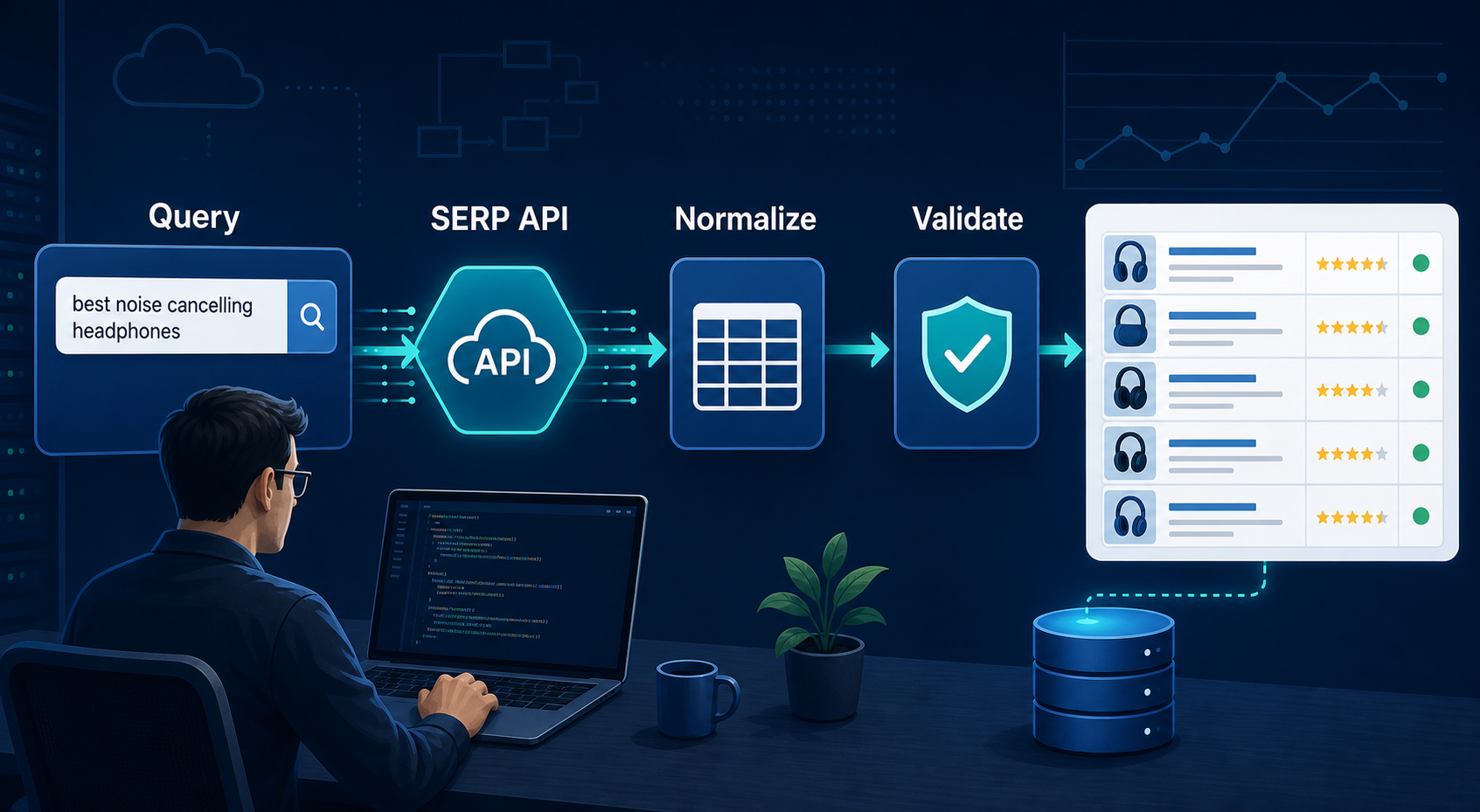
SERP API Python: How to Build a Reliable Search Data Pipeline
This guide shows a provider-neutral workflow for building that pipeline. It does not rank SERP API vendors. Instead, it focuses on the implementation choices that make a Python integration easier to operate, test, and migrate.
View Details
SERP Scraping API: How to Choose the Right Provider
Recommended Meta Description: Compare SERP scraping APIs by data coverage, localization, reliability, workflow fit, and cost structure, then choose and validate the right provider.
View Details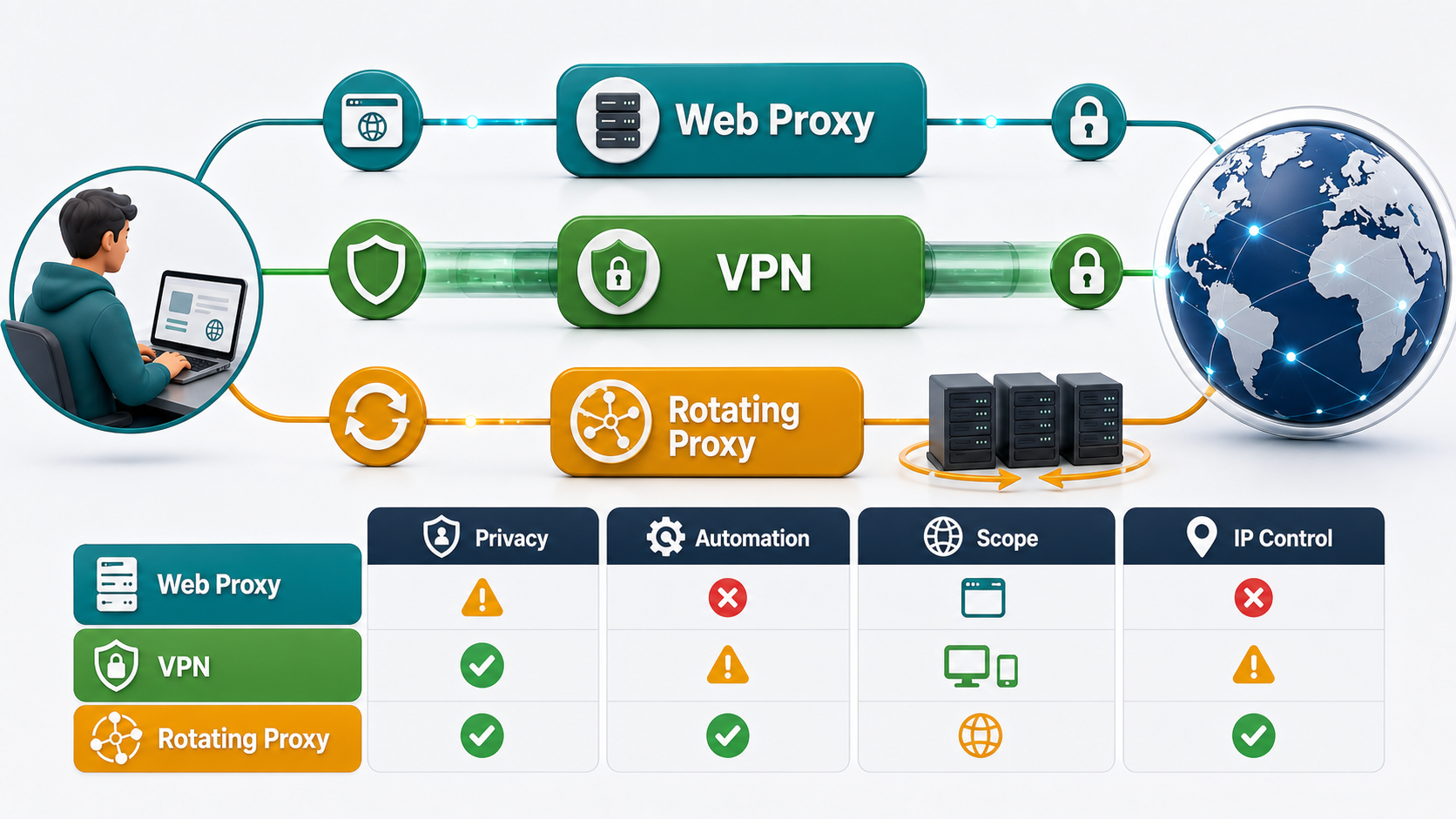
Free Web Proxy vs VPN vs Rotating Proxy: Which Should You Use?
Compare free web proxies, VPNs, rotating proxies, static proxies, and datacenter proxies by scope, encryption, IP control, automation, streaming, and account workflows.
View Details
BlockAway Not Working? Fix Common Proxy, Video, and Access Problems
Troubleshoot BlockAway when pages are blocked, YouTube fails, JavaScript breaks, speed drops, sessions expire, or mobile access behaves differently.
View Details