
The Real Reason We Haven't Fully Switched to IPv6
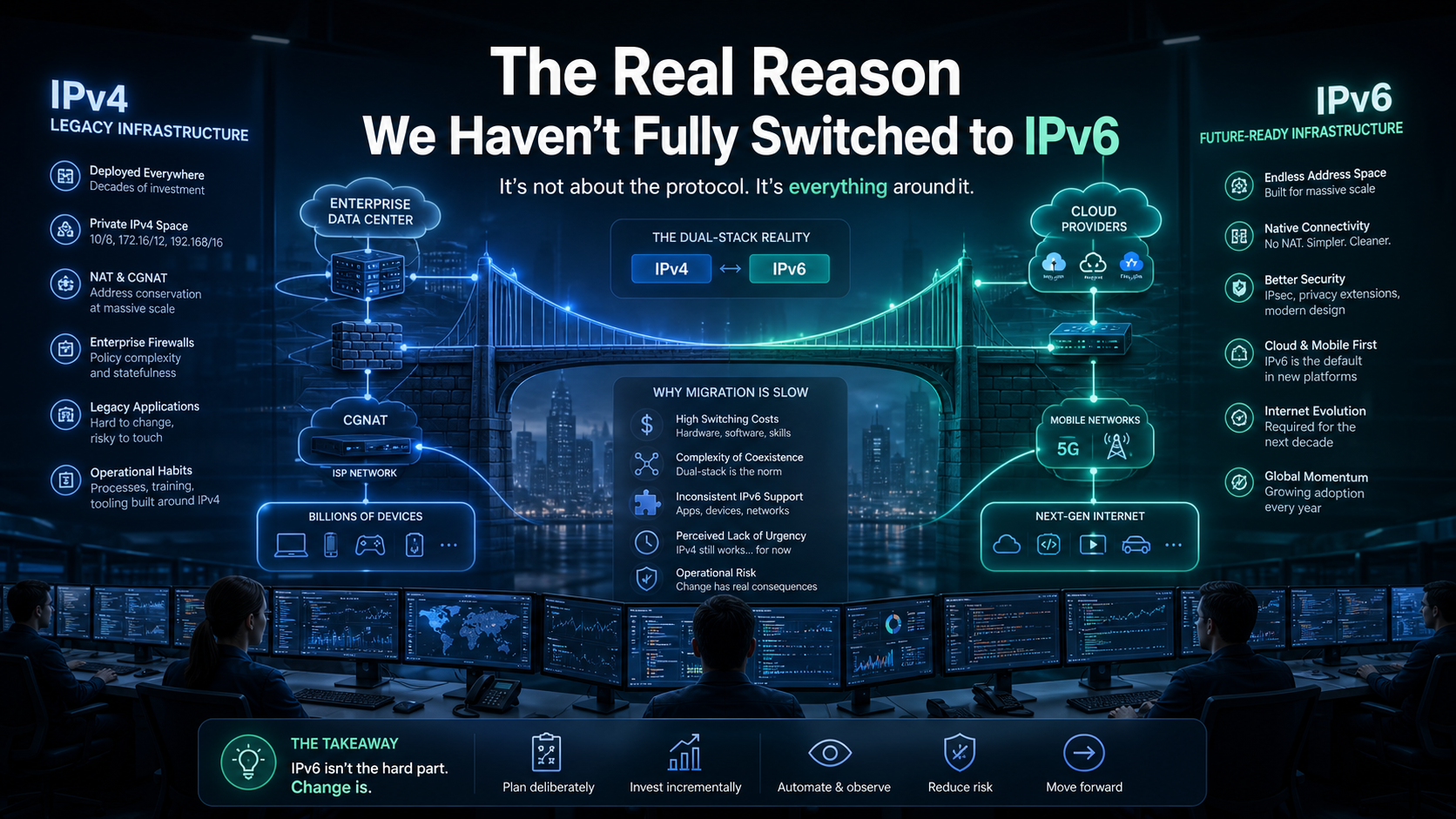
IPv6 was finalized in 1998. It's 2026. We're still using IPv4. Here's the uncomfortable truth.
The internet was supposed to run out of IPv4 addresses years ago. In a technical sense, it did. The Internet Assigned Numbers Authority (IANA) exhausted its central pool of IPv4 addresses in 2011. Regional registries followed shortly after. And yet, the world did not grind to a halt. New services kept launching. New devices kept connecting. The web kept growing.
That paradox sits at the heart of why IPv6 adoption has stalled. The problem IPv6 was designed to solve never fully materialized in the way engineers feared, and the workarounds that emerged in its place have proven stubborn enough to delay a complete transition by decades.
This article explains what's actually blocking IPv6 adoption, why dual-stack infrastructure creates more friction than most organizations want to admit, and what the realistic path forward looks like for enterprises, ISPs, and developers building infrastructure today.
The Legacy Problem Nobody Wants to Talk About
A Network Built on Infrastructure That Predates IPv6
IPv6 requires end-to-end support. Every router, firewall, load balancer, operating system, application, and network appliance in a path needs to understand it. That sounds straightforward until you audit a real enterprise network or a mid-sized ISP and start counting the devices that were deployed before IPv6 support was stable.
Many enterprise networks still run hardware from the mid-2000s. Replacing it is expensive, disruptive, and hard to justify when the existing infrastructure continues to work. A firewall that was purchased in 2007 may have received firmware updates through 2015 and then been left in place because it processed traffic reliably and no business case emerged to swap it out.
The same logic applies to embedded systems. Industrial control systems, smart meters, healthcare devices, point-of-sale terminals, and building management systems often run on hardware with fixed firmware and no path to IPv6 support. These devices are not negligence. They reflect the economic reality that purpose-built hardware has lifecycles measured in decades, not product cycles.
ISP Infrastructure Is Not as Ready as Headline Numbers Suggest
National and global statistics on IPv6 adoption can look optimistic. Some major mobile carriers have pushed IPv6 deployment aggressively because new mobile devices support it and assigning IPv4 addresses to millions of smartphones is operationally expensive. That pulls the headline adoption number upward.
But aggregate adoption percentages obscure enormous variation. A mobile carrier reporting 70 percent IPv6 traffic tells you very little about whether a regional ISP in a secondary market has upgraded its core routing hardware, trained its support staff, or reworked its address allocation processes. Many mid-tier and smaller ISPs have made limited investments in IPv6 because their customers have not demanded it and their existing infrastructure handles current load.
The result is a fragmented deployment landscape where IPv6 works well in some corridors and poorly or not at all in others.
The Embedded and Industrial Edge
This is the layer of the problem that gets the least attention in general technology coverage. Industrial automation, logistics networks, and critical infrastructure rely on devices that were not designed with protocol flexibility in mind. Updating them requires vendor support, often physical access, and in some cases full system replacement.
For organizations operating at that layer, IPv6 is not a configuration change. It's a capital project with a multi-year timeline and a cost that competes directly with other operational priorities.
The Dual-Stack Problem Nobody Wants to Pay For
What Dual-Stack Actually Means in Practice
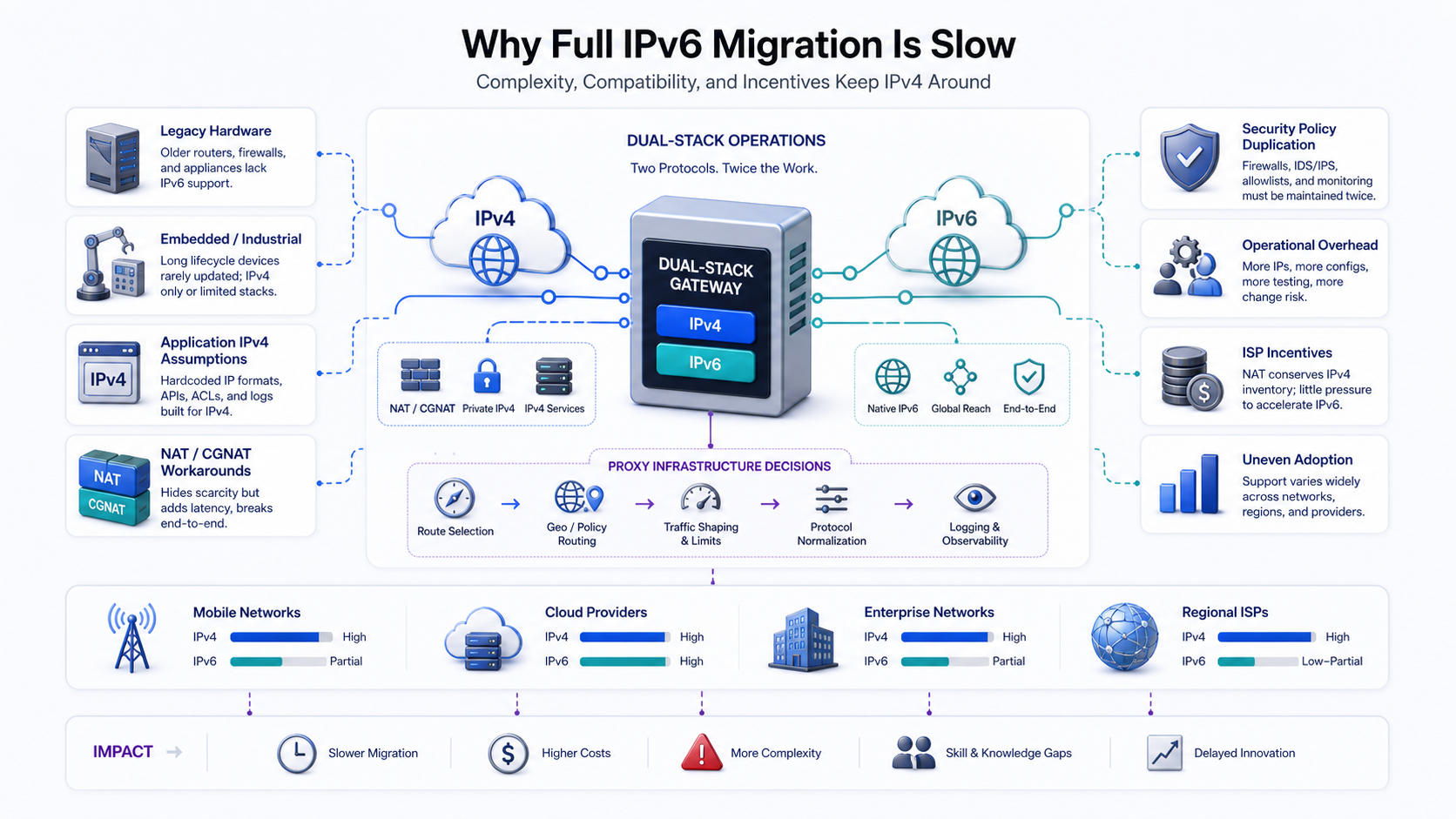
Dual-stack operation means running both IPv4 and IPv6 on the same network simultaneously. Every device needs two addresses. Routing tables double in complexity. Security policies need to be written and audited for both protocol stacks. Monitoring tools need to track both. Support staff need to understand both.
This is not a trivial overhead. Organizations that have gone through dual-stack deployments consistently report that the operational complexity is higher than anticipated, particularly around security. IPv6 introduces new attack surfaces. Misconfigured IPv6 stacks on networks that were designed primarily for IPv4 have historically been a source of security incidents because IPv6 traffic was not being inspected with the same rigor as IPv4 traffic.
The Cost Structure Does Not Favor Transition
Consider what an organization actually has to fund to run dual-stack properly:
- Hardware upgrades for any equipment that lacks IPv6 support
- Software updates and licensing for firewalls, intrusion detection systems, and network management platforms
- Staff training so that network engineers and security teams are equally confident in both protocol environments
- Audit and testing cycles to verify that IPv6 paths are as secure and monitored as IPv4 paths
- Application layer changes for any internal systems that use hardcoded IPv4 addresses or rely on IPv4-specific behavior
None of these costs are offset by immediate revenue. IPv6 adoption does not, by itself, make an organization's products faster, cheaper, or more competitive in most markets. The business case is almost entirely defensive: prepare for a future in which IPv4 becomes less reliable or more expensive to use.
Application Layer Assumptions Are Deeply Embedded
Many applications assume IPv4 in ways that are not immediately visible. Internal services that reference 192.168.x.x or 10.x.x.x addresses in configuration files. APIs that parse IP addresses as 32-bit integers. Logging systems that store addresses in formats designed for IPv4. Security tools that correlate activity using IPv4 address blocks.
Rewriting those assumptions takes time and introduces regression risk. For organizations running large application portfolios, the scope of that work can extend the dual-stack transition timeline by years.
A Comparison of Transition Models
| Approach | Complexity | Cost | Risk | Timeline |
|---|---|---|---|---|
| Full IPv6 migration | Very high | Very high | High during cutover | 3 to 10 years |
| Dual-stack operation | High | High ongoing | Moderate if managed well | Indefinite |
| IPv4-only with NAT | Low | Low ongoing | Low in short term | Already in place |
| IPv6-only (new infrastructure) | Moderate | Moderate upfront | Low for greenfield | Immediate for new builds |
The table makes the problem visible. For any organization with existing infrastructure, dual-stack is the only realistic intermediate step, and it is expensive enough that many organizations avoid committing to it fully.
Proxy Infrastructure and the IPv4/IPv6 Divide
For teams building automated data collection workflows, geo-testing pipelines, or scraping infrastructure, the IPv4/IPv6 transition has practical implications. Most proxy infrastructure today is IPv4-based because the majority of commercial websites, APIs, and data sources are reachable over IPv4. A residential proxy pool built primarily on IPv6 addresses may reach some targets but will fail on others that have not completed their server-side IPv6 deployment.
Providers like LycheeIP, which offer proxy IP infrastructure for scraping, public data collection, geo-testing, and automation workflows, operate in this environment. The proxy layer effectively abstracts the addressing complexity for the client, but the underlying routing decisions about which addresses to use and which protocol to route through remain operationally relevant. Teams evaluating proxy infrastructure for production workflows should verify whether their target sites are fully reachable over IPv6 before committing to IPv6-heavy proxy configurations.
Explore LycheeIP Proxy Infrastructure
The Business Incentive Problem
NAT Made IPv4 Viable Indefinitely
Network Address Translation (NAT) was originally a temporary measure. The idea was to let multiple devices share a single public IPv4 address while the industry completed its transition to IPv6. The transition did not complete. NAT did not go away. Instead, it became deeply embedded in network architecture at every level from home routers to carrier-grade NAT systems deployed by ISPs.
Carrier-grade NAT (CGNAT) lets an ISP serve thousands of customers from a small block of public IPv4 addresses. From the customer's perspective, connectivity works. From the ISP's perspective, the capital investment required to deploy CGNAT is far lower than the investment required to run a parallel IPv6 infrastructure. The business math is not complicated.
The Incentive Structure Is Misaligned
The organizations that would bear the cost of IPv6 transition are not the same organizations that would capture most of the benefit. ISPs would pay to upgrade their infrastructure. Enterprises would pay to retrain staff and rebuild applications. But the benefits of a fully IPv6 internet, primarily the removal of NAT complexity and the restoration of true end-to-end connectivity, are distributed across all users and developers, not concentrated in the organizations doing the work.
This is a coordination problem as much as a technical one. Individual organizations have weak incentives to move unless their peers and partners move at the same time. Because movement has been uneven, the incentive to wait and let others bear the transition cost first has persisted for nearly three decades.
Where Real Progress Is Happening
IPv6 adoption is not completely stalled. There are areas where the incentive structure does favor transition:
- Mobile networks: Assigning unique IPv4 addresses to hundreds of millions of smartphones is expensive. Mobile operators have strong incentives to run IPv6 natively and have done so at scale in several major markets.
- Hyperscale cloud providers: AWS, Google Cloud, and Azure all support IPv6. New infrastructure built on these platforms can be IPv6-native from the start.
- Content delivery networks: Major CDNs have added IPv6 support, which means that the edge layer of the internet is more IPv6-capable than the origin layer.
- Consumer devices: Modern operating systems and consumer routers support IPv6 well. The client side of the internet is largely ready.
The gap is in the middle: enterprise internal networks, mid-tier ISPs, legacy application stacks, and embedded systems.
What the Realistic Timeline Looks Like
A complete transition away from IPv4 is unlikely to happen through a planned cutover. What is more likely is a gradual hollowing out of IPv4 dependency as new infrastructure is built IPv6-first and legacy systems are replaced through normal hardware and software lifecycle processes.
For developers building new systems today, the practical advice is to design for IPv6 from the start and maintain IPv4 compatibility through dual-stack during the transition period. For organizations managing legacy infrastructure, the realistic goal is reducing IPv4 dependency over time rather than eliminating it on a fixed schedule.
LycheeIP Context: What This Means for Proxy Infrastructure and Data Workflows
For teams running proxy-dependent workflows, the IPv4/IPv6 divide is not abstract. It shows up in practical ways:
- Target site reachability: Many websites still resolve primarily or exclusively over IPv4. An IPv6 proxy address may not reach every target.
- IP reputation and detection logic: Anti-bot systems and fraud detection layers are largely calibrated against IPv4 address space. IPv6 address blocks are less well-catalogued in commercial threat intelligence databases, which creates different detection dynamics.
- Geo-targeting accuracy: IPv6 geolocation databases are less mature than IPv4 equivalents. This can affect the precision of geo-testing workflows that rely on IP-based location signals.
- Routing control: Developers who need fine-grained control over which addresses appear in outbound requests should understand whether their proxy provider routes over IPv4, IPv6, or both, and whether that routing is configurable per session.
LycheeIP provides proxy IP infrastructure for teams working on scraping, public data collection, geo-testing, automation, and e-commerce research workflows. Understanding the protocol layer of proxy infrastructure is relevant when evaluating whether a proxy configuration will reliably reach your target systems.
As always, any scraping or automated data collection workflow should respect the terms of service of target websites, review robots.txt where applicable, and avoid sending request volumes that would disrupt normal site operation.
Explore LycheeIP Proxy Infrastructure
IPv6 from scratch: the very basics of IPv6 explained
Common Mistakes and Considerations
Assuming IPv6 Deployment Is Uniform
Aggregate adoption statistics are misleading. IPv6 availability varies significantly by geography, ISP, and network type. Validate reachability for your specific use case rather than relying on global averages.
Treating Dual-Stack as a Permanent Solution
Dual-stack is a transition tool, not a destination. Organizations that deploy dual-stack and then fail to drive down IPv4 dependency over time end up carrying the operational cost of both protocols indefinitely.
Ignoring IPv6 Security Configuration
Adding IPv6 to a network without auditing the security configuration for the IPv6 stack is a documented source of vulnerabilities. IPv6 traffic must be inspected and filtered with the same rigor as IPv4 traffic.
Hardcoding IPv4 Addresses in Applications
Applications that hardcode IPv4 addresses or make protocol-specific assumptions will require code changes during any IPv6 transition. Auditing for this early reduces the scope of rework later.
Overlooking DNS Configuration
IPv6 connectivity requires correct AAAA record configuration. Applications that resolve hostnames to IPv4 addresses only will not use IPv6 paths even when the network supports them.
Underestimating Staff Training Requirements
IPv6 has a different addressing model, different header structure, and different neighbor discovery mechanisms compared to IPv4. Engineers comfortable with IPv4 networking will need deliberate training before they can manage IPv6 infrastructure confidently.
Conclusion
IPv6 is technically superior to IPv4 in almost every dimension that matters for a growing internet. It has more address space, cleaner routing, better support for modern connectivity patterns, and no dependency on NAT. None of that has been enough to drive complete adoption in nearly three decades.
The blockers are not primarily technical. They are economic and organizational. Legacy hardware with long replacement cycles, the operational cost of dual-stack, deeply embedded IPv4 assumptions in application code, and a business incentive structure that does not reward early movers have collectively kept IPv4 viable long past its theoretical expiration date.
NAT has been the critical enabler of that persistence. By making IPv4 address exhaustion manageable without forcing protocol change, CGNAT removed the most powerful forcing function for IPv6 adoption.
Progress is real but uneven. New infrastructure built today on cloud platforms and mobile networks increasingly runs IPv6. The legacy middle layer, enterprise networks, mid-tier ISPs, and embedded systems, will take longer, and the transition will happen through attrition rather than planned cutover.
For developers and network engineers making infrastructure decisions today, the practical path is IPv6-first design for new systems with dual-stack support maintained during the transition window. For organizations evaluating proxy infrastructure or data collection workflows, understanding the protocol layer of the infrastructure you rely on remains relevant for diagnosing reachability issues, managing detection risk, and ensuring geo-testing accuracy.
IPv4 is not going away on any near-term timeline. But the trajectory is clear, and building against it rather than with it is a form of technical debt that compounds over time.
Frequently Asked Questions
Why hasn't IPv6 fully replaced IPv4 despite being available since 1998?
The main blockers are economic and organizational rather than technical. Legacy hardware, the cost of dual-stack operation, IPv4-specific assumptions embedded in applications, and weak business incentives have all slowed adoption. NAT has kept IPv4 functional enough that organizations have limited pressure to change.
What is dual-stack and why is it expensive?
Dual-stack means running both IPv4 and IPv6 simultaneously on the same network. Every device needs two addresses, routing tables double in complexity, security policies must cover both stacks, and staff need training in both protocols. These costs are ongoing and difficult to offset with immediate business value.
What is carrier-grade NAT and how does it affect IPv6 adoption?
Carrier-grade NAT (CGNAT) allows ISPs to serve large numbers of customers from a small pool of public IPv4 addresses. It removes the immediate pain of IPv4 address exhaustion for ISPs at a much lower cost than deploying IPv6 infrastructure, which weakens the incentive to transition.
Which parts of the internet have made the most progress on IPv6?
Mobile networks, hyperscale cloud providers, major CDNs, and consumer devices are the most advanced. The biggest gaps remain in enterprise internal networks, mid-tier ISPs, legacy application stacks, and embedded or industrial systems.
Does IPv6 matter for web scraping and proxy workflows?
Yes. Many target websites still resolve primarily over IPv4, so IPv6 proxy addresses may not reach every target. IPv6 geolocation databases are also less mature, which can affect geo-testing accuracy. Teams should verify target site IPv6 reachability before relying on IPv6-heavy proxy configurations.
Is IPv4 going to run out completely and force a switch to IPv6?
The central IPv4 address pool was exhausted in 2011, but workarounds like CGNAT have prevented a hard cutover. A complete forced switch is unlikely. The transition will happen gradually as new infrastructure is built IPv6-first and legacy systems are replaced through normal lifecycle processes.
What security risks come with adding IPv6 to an existing network?
IPv6 introduces new attack surfaces and has different neighbor discovery mechanisms compared to IPv4. Networks that add IPv6 without auditing the security configuration of the IPv6 stack risk leaving traffic uninspected. IPv6 filtering and monitoring must be treated with the same rigor as IPv4.
Should new infrastructure be built for IPv6 or IPv4 today?
New infrastructure should be designed IPv6-first with dual-stack support maintained for compatibility during the transition period. Building IPv4-only systems today creates technical debt that will require rework as IPv4 becomes less central to network design.
How does IPv6 affect IP geolocation accuracy?
IPv6 geolocation databases are generally less mature and less precise than IPv4 equivalents because IPv6 deployment is less consistent and less well-catalogued in commercial threat intelligence and geolocation services. This is relevant for any workflow that depends on IP-based location signals, including geo-testing and ad verification.
What should developers check before relying on IPv6 in production workflows?
Verify that target systems and APIs are reachable over IPv6, check that DNS AAAA records are correctly configured, audit application code for hardcoded IPv4 addresses, confirm that security and monitoring tools cover IPv6 traffic, and ensure that any proxy or routing infrastructure used supports IPv6 for the relevant destinations.

Recommended Articles

AI Search API for AI Agents: How to Ground LLMs With Live Search Data
An AI search API gives an application or agent programmatic access to current search results. Its most useful role is discovery: the agent can find candidate sources, identify fresh information, and decide what to retrieve next instead of relying only on model memory.
View Details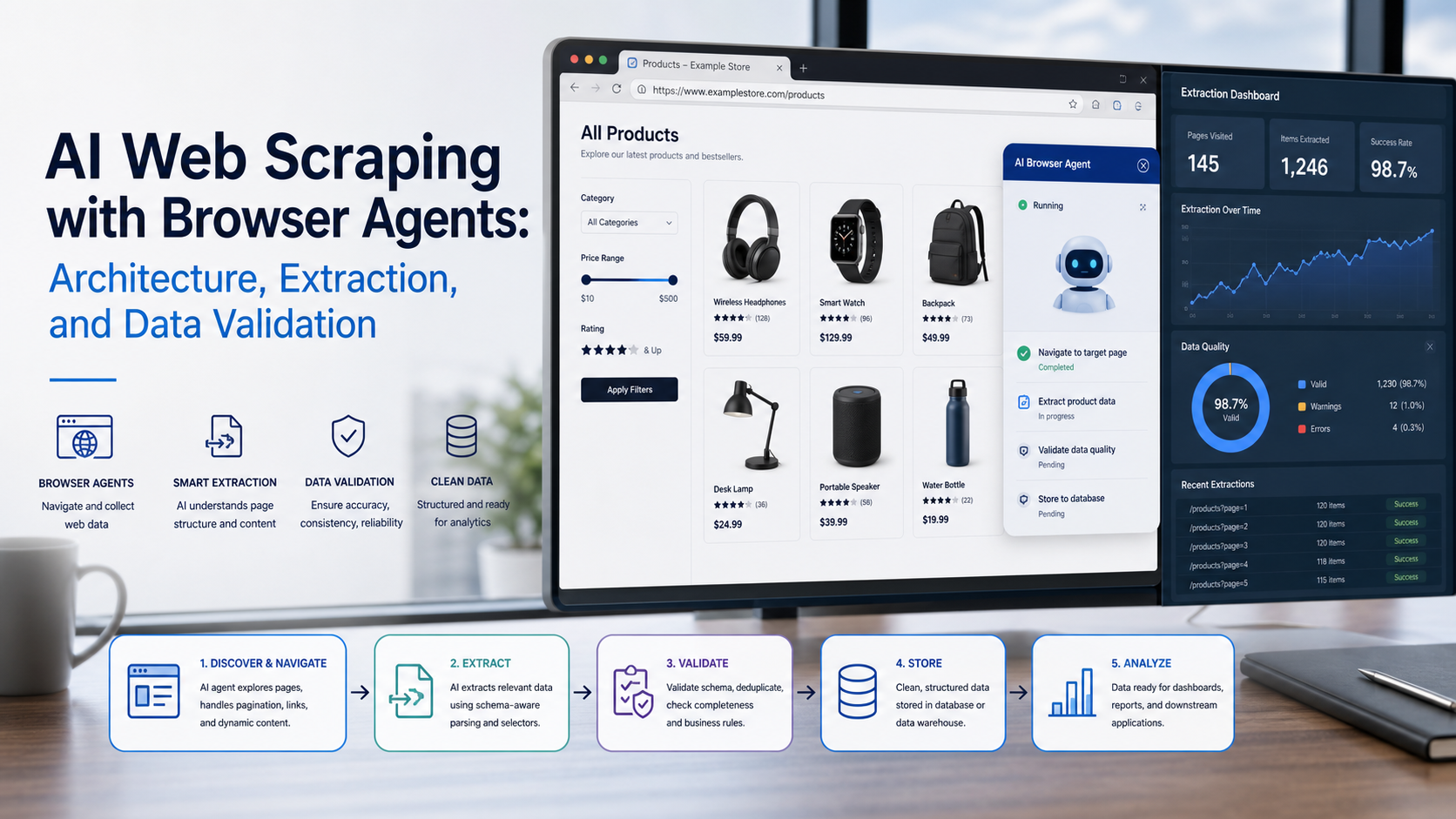
AI Web Scraping with Browser Agents: Architecture, Extraction, and Data Validation
AI web scraping uses AI to help discover, navigate, interpret, or extract information from websites. Browser agents are one implementation option when page interaction, rendering, or layout variation makes a simple scraper too brittle, but the agent should not become the entire data pipeline.
View Details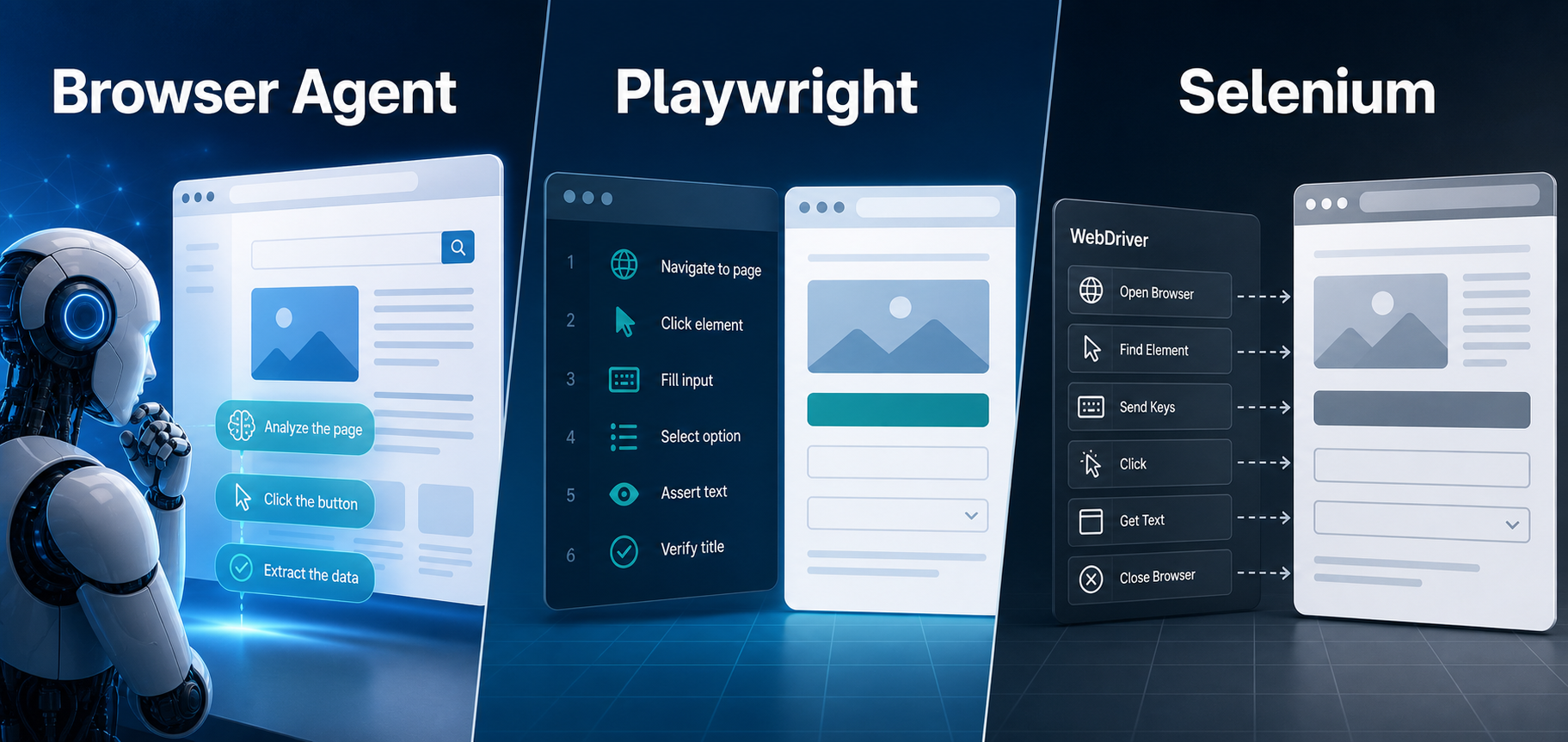
AI Browser Automation: Browser Agents vs Playwright vs Selenium
A browser agent interprets a goal and decides what browser action to take next. Playwright and Selenium can execute explicit, testable browser logic defined by developers. In 2026, however, Playwright also provides official MCP and agent-oriented workflows, so Playwright is no longer just the deterministic alternative to agentic automation. It can also serve as the browser-control layer inside an agent system.
View Details
Agentic Browser Security: Prompt Injection, Permissions, and Safe Deployment
That combination creates risks that are different from ordinary browsing and traditional automation. The most important is indirect prompt injection, where hostile instructions hidden in web content attempt to redirect the agent away from the user's goal. Google describes indirect prompt injection as a primary new threat for agentic browsing and has introduced layered defenses that include origin constraints, independent action checks, threat detection, and user confirmation for sensitive actions. Google's Chrome security architecture is a useful reference for how browser-agent defenses are evolving.
View Details
How to Give AI Agents Reliable Real-Time Web Data
A production-ready solution therefore needs more than a web scraper. It needs a web data layer that connects acquisition, validation, storage, retrieval, security, and observability. This guide explains how to design that layer.
View Details