
IPv8 Explained: Why Longer Addresses Aren't the Fix
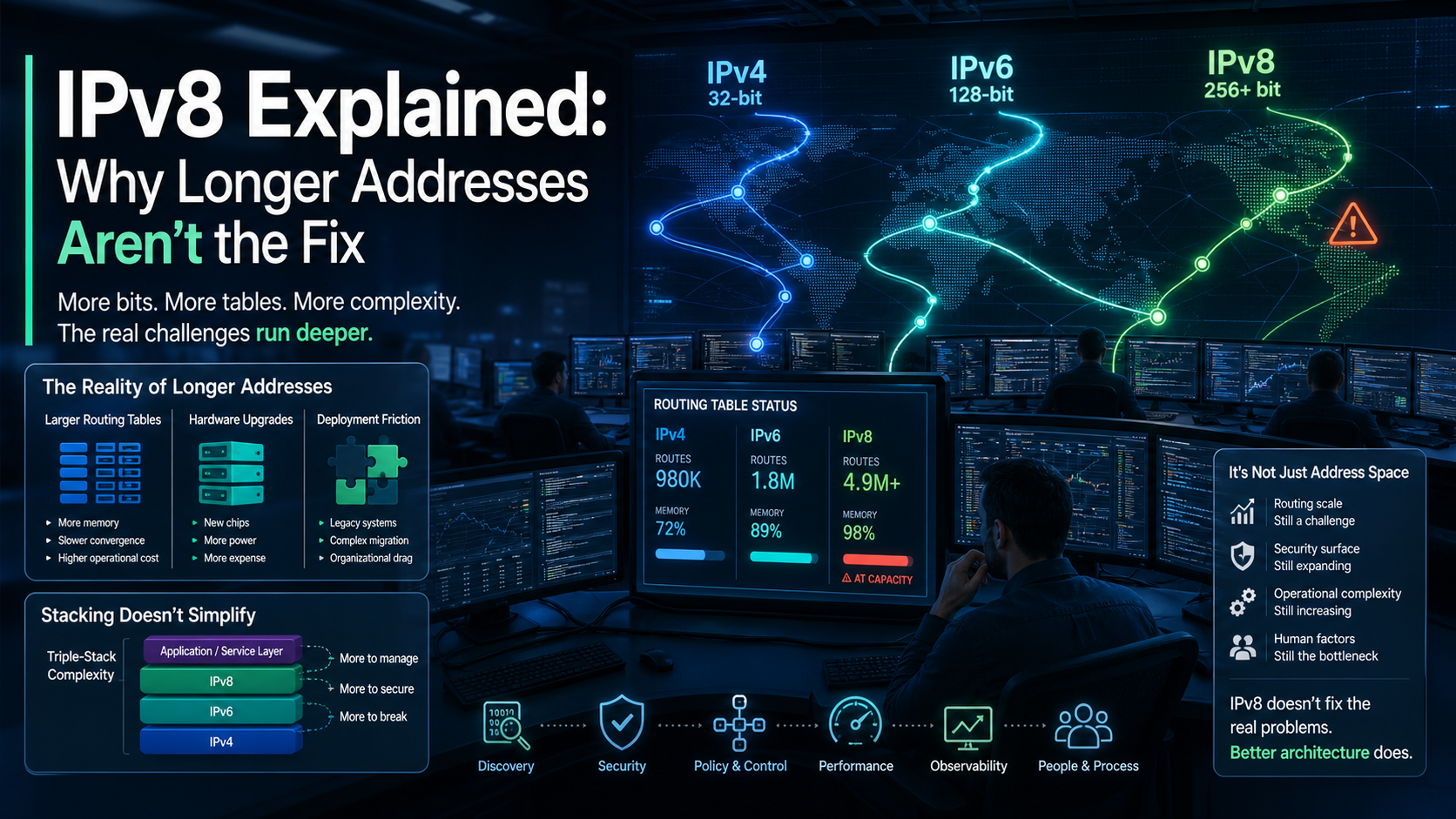
Someone submitted a plan to the IETF to create IPv8. The internet went wild. Here's why it's a terrible idea.
The proposal spread fast because it tapped into a real frustration. IPv4 addresses ran out. IPv6 adoption has been painfully slow. So when someone suggests a clean-slate solution with even longer addresses, it sounds like progress. It isn't.
The core misconception driving the excitement is this: people assume the IP address shortage is primarily a math problem. Make the address space bigger, problem solved. But that's not how networking works in practice. Address length is one small variable in a much larger, messier equation involving routing tables, hardware investment, software compatibility, ISP cooperation, and years of migration effort.
This article breaks down why IPv8 proposals miss the point, what the actual barriers to IP infrastructure evolution look like, and why the real story is about deployment friction, not digit count.
The IETF Draft Process Is Open - That's a Feature, Not a Proof of Quality
What the IETF Actually Is
The Internet Engineering Task Force is the standards body that develops and maintains the technical specifications underpinning the internet. It publishes documents called RFCs — Requests for Comments — which define protocols like TCP, DNS, HTTP, and yes, both IPv4 and IPv6.
The IETF operates on a principle of rough consensus and running code. Ideas don't get accepted because someone submitted a document. They get accepted because the engineering community reviews them, tests them, debates them, and ultimately finds that the protocol works correctly and solves a real problem better than existing alternatives.
Anyone Can Submit a Draft
Here's the part the viral coverage missed: submitting an Internet-Draft to the IETF costs nothing and requires no credentials. The submission system is intentionally open. This is a good thing. Open access means good ideas from anywhere in the world can get a hearing.
But open submission is not the same as endorsement. The IETF publishes thousands of drafts that never become standards. Many expire without comment. Some get discussed and rejected. A small number go through working group review, interoperability testing, and eventually become RFCs.
A draft titled something like "IPv8" appearing in the IETF document archive doesn't mean the IETF is working on IPv8. It means someone filed a document. That distinction matters enormously.
Why the Internet Got Excited Anyway
The proposal went viral because it offered a simple narrative: IPv4 is broken, IPv6 is complicated, here comes IPv8 to fix everything with bigger numbers. That narrative is emotionally satisfying. It's also technically shallow.
The IP address exhaustion problem is real. IANA exhausted its IPv4 pool in 2011. Regional registries followed. The response to that exhaustion has been a messy combination of NAT (Network Address Translation), CGNAT (Carrier-Grade NAT), IPv6 rollout, and proxy infrastructure. None of those solutions are elegant. So people want something cleaner.
But wanting a cleaner solution and having one are different things. The question isn't whether more address space would be abstractly useful. The question is whether proposing a new IP version solves any problem that IPv6 doesn't already address, and whether the cost of another transition is remotely justifiable.
Why Longer Addresses Don't Fix the Real Problems
IPv6 Already Has More Addresses Than Anyone Can Use
IPv6 uses 128-bit addresses. That gives you approximately 340 undecillion unique addresses. Written out, that's 340 followed by 36 zeros.
To put that in concrete terms: you could assign billions of IPv6 addresses to every atom on the surface of the Earth and still have addresses left over. The address space problem is not just solved by IPv6 — it is solved so completely that no foreseeable growth in connected devices, IoT sensors, or network infrastructure could exhaust it.
So what exactly would IPv8 add? More bits? The math is already incomprehensible. The address space is not the bottleneck.
The Real Problems Are Operational, Not Mathematical
The reason IPv6 adoption took decades and still isn't complete isn't because the addresses are too short or the spec is wrong. It's because transitioning the global internet to a new protocol is one of the most operationally complex things the industry has ever attempted.
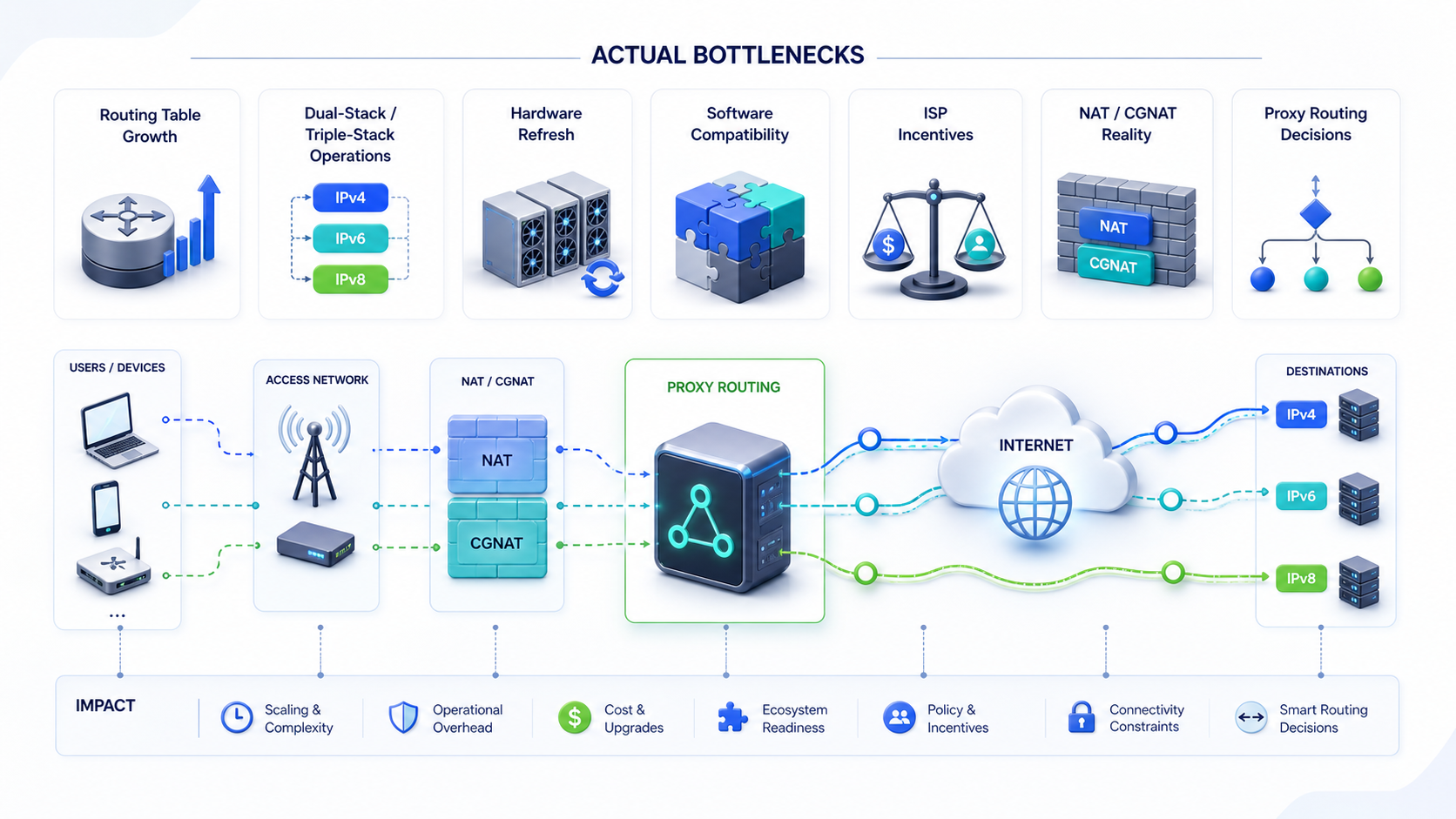
Here are the actual barriers:
Routing table complexity
Every router on the internet maintains a routing table — a map of which networks are reachable through which paths. Adding a new protocol means every router needs to understand it. That's firmware updates, hardware upgrades, and configuration changes across millions of devices operated by thousands of different organizations.
Dual-stack overhead
During the transition from IPv4 to IPv6, networks run both protocols simultaneously. This is called dual-stack operation. It doubles the complexity of network management, increases the attack surface, and requires operators to maintain expertise in two parallel systems. An IPv8 transition would mean triple-stack: IPv4, IPv6, and IPv8. That's not a solution. That's an operational nightmare.
Hardware and software compatibility
Network hardware — routers, switches, firewalls, load balancers — is expensive and long-lived. Enterprise data centers often run hardware that's a decade old. ISPs operate infrastructure that was engineered before IPv6 was widely deployed. Asking the industry to replace or update all of that for a third protocol standard, when IPv6 already solves the address space problem, has no realistic business case.
Software stack rewrites
Every operating system, network library, firewall rule set, load balancer configuration, and application that handles IP addresses would need updates. The IPv4-to-IPv6 transition required changes to Linux, Windows, macOS, BSD, every major programming language's network libraries, and countless enterprise applications. That work is still ongoing after 20+ years. Starting over with IPv8 would reset that clock.
ISP and carrier adoption incentives
ISPs don't upgrade infrastructure unless there's a business reason to do so. IPv6 adoption accelerated only when major content providers like Google and Facebook enabled it by default, and when mobile carriers found it operationally cheaper than CGNAT at scale. There is no equivalent forcing function for IPv8.
NAT and CGNAT: The Workarounds That Stuck
Because IPv6 adoption was slow, the industry built workarounds. NAT allows many devices behind a single public IPv4 address to share that address using port mapping. CGNAT scales that same concept to entire carrier networks, allowing an ISP to serve thousands of customers from a small pool of public IPv4 addresses.
These solutions are imperfect. CGNAT breaks certain peer-to-peer protocols, complicates abuse tracking, and creates latency in some edge cases. But they work well enough that many ISPs have little urgency to push IPv6 to all customers.
For proxy infrastructure operators and web scraping workflows, this matters directly. The reason residential IP pools exist at all is partly a consequence of IPv4 scarcity and the economics of address allocation. Proxy providers aggregate access to IP addresses that would otherwise be fragmented across CGNAT environments. That infrastructure serves legitimate use cases: geo-testing, ad verification, public data collection, localization research, and SERP monitoring.
Adding IPv8 doesn't change any of this dynamic. It adds a third protocol that nothing supports, solves a problem that IPv6 already handles, and creates years of new compatibility friction.
What Would Actually Need to Change for IPv8 to Be Viable
For a hypothetical IPv8 to be worth pursuing, it would need to do something IPv6 cannot. Let's stress-test that:
| Problem | IPv6 Status | IPv8 Would Add |
|---|---|---|
| Address exhaustion | Solved (128-bit space) | Nothing meaningful |
| Routing efficiency | Improved vs IPv4 | Not addressed in proposals |
| Security at protocol level | IPsec integration in spec | Not improved |
| Mobility support | Better than IPv4 | Not improved |
| Transition complexity | Already painful | Made significantly worse |
| Industry adoption | Decades of momentum | Reset to zero |
There is no column where IPv8 wins. The proposal adds transition cost without adding capability.
IPv6 Already Solved the Math - Deployment Is the Actual Problem
The Deployment Gap Is the Real Story
IPv6 was standardized in 1998. As of the mid-2020s, global IPv6 adoption is still not universal. Many enterprise networks, ISPs in developing regions, and legacy infrastructure stacks remain IPv4-only or dual-stack with IPv4 as primary.
That's a 25-year deployment gap. The reasons are well understood:
- Legacy hardware with no IPv6 support that's still in service
- IT teams with limited bandwidth to manage protocol transitions
- Internal applications that were never updated for IPv6
- Network monitoring tools that lag in IPv6 support
- Security teams that are more comfortable with IPv4 firewall rules
None of these problems are solved by proposing a new protocol. They are infrastructure, organizational, and economic problems. The solution is completing IPv6 deployment, not adding a fourth Internet Protocol version to the stack.
What Good IPv6 Adoption Actually Looks Like
Organizations and ISPs that have successfully deployed IPv6 share a few common practices:
- Dual-stack deployment with IPv6 preferred for new traffic
- Gradual hardware refresh cycles that prioritize IPv6-capable equipment
- Developer tooling that defaults to IPv6-compatible socket handling
- DNS infrastructure that serves both A (IPv4) and AAAA (IPv6) records
- Network monitoring updated to treat IPv6 as a first-class concern
This is not glamorous. It doesn't generate viral IETF draft submissions. But it's the work that actually moves the internet forward.
For Proxy Infrastructure, IPv6 Matters in Specific Ways
In proxy infrastructure, IP version is a real operational consideration. Most web servers now support both IPv4 and IPv6. However, many anti-bot and rate-limiting systems treat IPv6 ranges differently than IPv4 ranges, in part because IPv6 addresses are cheaper to cycle through given the vast address space.
For teams running web scraping workflows, public data collection, geo-testing, or ad verification, the practical question is not "when will IPv8 arrive" but rather "which IP version and which address type best fits this specific workflow."
Residential proxies are generally IPv4 because home ISP assignments have historically been IPv4. Datacenter proxies exist in both versions. IPv6 datacenter proxies are often cheaper per IP but may be flagged more aggressively by some target systems.
Proxy infrastructure providers like LycheeIP operate within this IPv4/IPv6 reality, offering address pools that reflect how the actual internet is allocated and how target systems respond. Understanding IP version behavior is a practical workflow consideration, not an abstract protocol debate.
Explore LycheeIP Proxy Infrastructure
How This Connects to Proxy Infrastructure Decisions
The IPv8 conversation is mostly theoretical, but it surfaces a question that proxy infrastructure users face practically: how does IP addressing affect the reliability of scraping, automation, and data collection workflows?
Here's what actually matters in that context:
IP version and detection
Some platforms treat IPv6 ranges with more suspicion because large blocks of IPv6 addresses are trivially obtained from hosting providers. If you're running geo-testing or ad verification workflows, IPv4 residential addresses typically produce more consistent results.
Address rotation and session control
Whether you're using IPv4 or IPv6, the key operational factor is control over when and how addresses rotate. Static residential proxies give you a stable address for session-dependent workflows like account management. Rotating proxies are better suited for large-scale public data collection where each request benefits from a fresh address.
Geographic precision
IP geolocation databases map both IPv4 and IPv6 addresses to locations, but IPv4 databases are more mature and granular. For localization testing and SERP monitoring, IPv4 residential addresses in specific cities tend to produce more predictable geolocation results.
These are concrete workflow decisions. They're unaffected by whether someone files an IPv8 draft with the IETF.
IPv6 from scratch: the very basics of IPv6 explained
Common Mistakes When Thinking About IP Infrastructure
Confusing address space with deployment readiness
Having a large address space doesn't mean the infrastructure to route and manage those addresses exists. IPv6 proved this. The math was done in the 1990s. The deployment took decades.
Assuming new standards replace old ones quickly
Protocol transitions on the internet are measured in decades, not years. IPv4 is still dominant in many environments despite IPv6 being available for 25+ years. IPv8, if it ever existed, would face the same inertia.
Treating IP version as the only factor in proxy selection
When evaluating proxy infrastructure for scraping or automation, IP version is one variable. Pool quality, rotation behavior, geographic coverage, session handling, and how the provider sources addresses all matter as much or more.
Ignoring responsible use requirements
Regardless of IP version or proxy type, teams running automated data collection workflows should respect website terms of service, review robots.txt files where applicable, avoid overwhelming target servers with excessive request rates, and use proxies only for legitimate purposes such as public data collection, localization testing, competitive research, and ad verification.
Over-indexing on viral tech proposals
IETF drafts are filed constantly. The vast majority never become standards. Evaluating your infrastructure decisions based on proposals that have no working group support, no reference implementations, and no adoption pathway is a poor use of planning resources.
Conclusion
The IPv8 proposal spread because it offered a simple answer to a real problem. But the IP address shortage was solved mathematically by IPv6 in 1998. The 128-bit address space is effectively inexhaustible. More bits won't fix anything.
The actual challenge is deployment: getting the industry to complete the IPv6 transition that's been underway for 25 years. That requires hardware upgrades, software updates, ISP incentives, and organizational willingness to work through compatibility issues. None of that is solved by proposing yet another protocol version.
For engineers and teams working with proxy infrastructure, web scraping, automation, or public data collection, the IPv4/IPv6 question is already a live operational concern. Understanding how IP version affects geolocation accuracy, detection behavior, and session reliability is a practical skill. Waiting for IPv8 is not a strategy.
The internet's addressing problems are real. The solutions already exist. The work is in deploying them.
Frequently Asked Questions
What is IPv8 and why did it trend online?
IPv8 refers to a concept for a new Internet Protocol version with longer addresses, proposed via an IETF draft submission. It trended because it appeared to offer a simple fix to IP address scarcity, but the proposal misunderstands the actual barriers to IP infrastructure evolution.
Does submitting a draft to the IETF mean it will become a standard?
No. The IETF draft submission process is open to anyone. A submitted draft has no guaranteed path to becoming an RFC or standard. Most drafts expire without action. Acceptance requires working group support, technical review, and demonstrated interoperability.
Why isn't IPv6 already universally deployed if it was standardized in 1998?
IPv6 deployment requires hardware upgrades, software updates across operating systems and applications, ISP infrastructure changes, and organizational investment. Legacy hardware, limited IT resources, and insufficient business urgency have all slowed adoption. The transition is ongoing but incomplete.
Would IPv8 actually provide more addresses than IPv6?
IPv6 already provides approximately 340 undecillion addresses, which is far beyond any foreseeable demand. Adding more bits in a hypothetical IPv8 would not solve any real-world addressing problem that IPv6 doesn't already handle mathematically.
What problems would an IPv8 transition actually create?
It would require running three protocols simultaneously (IPv4, IPv6, IPv8), forcing hardware and software updates across the entire internet for a third time, resetting decades of IPv6 deployment momentum, and providing no capability that IPv6 doesn't already offer.
How does IP version affect proxy infrastructure and web scraping workflows?
IPv4 residential addresses are generally more trusted by anti-bot systems and have more mature geolocation data. IPv6 datacenter addresses are cheaper but may face more aggressive filtering on some platforms. The right choice depends on the specific workflow, target system behavior, and session requirements.
What is CGNAT and why does it matter for IP addressing?
Carrier-Grade NAT allows ISPs to share a small pool of public IPv4 addresses across thousands of customers using port mapping. It extends the lifespan of IPv4 but introduces complications for peer-to-peer protocols and abuse tracking. It's one reason IPv4 exhaustion hasn't forced faster IPv6 adoption.
Are residential proxies IPv4 or IPv6?
Most residential proxy pools are IPv4, because home ISP assignments have historically used IPv4. IPv6 residential addresses exist but are less common in proxy pools. For workflows requiring consistent geolocation or session behavior, IPv4 residential addresses tend to produce more reliable results.
What should proxy users focus on instead of waiting for new IP protocols?
Focus on practical factors like IP version compatibility with your target systems, rotation behavior, session control, geographic coverage, and provider sourcing practices. These have direct impact on workflow reliability. Protocol speculation has no practical value for current operations.
What responsible use practices apply when using proxies for data collection?
Teams should review and respect website terms of service, check robots.txt files where applicable, avoid sending request volumes that could overload target servers, and limit proxy use to legitimate purposes such as public data collection, geo-testing, ad verification, localization research, and competitive monitoring.

Recommended Articles

AI Search API for AI Agents: How to Ground LLMs With Live Search Data
An AI search API gives an application or agent programmatic access to current search results. Its most useful role is discovery: the agent can find candidate sources, identify fresh information, and decide what to retrieve next instead of relying only on model memory.
View Details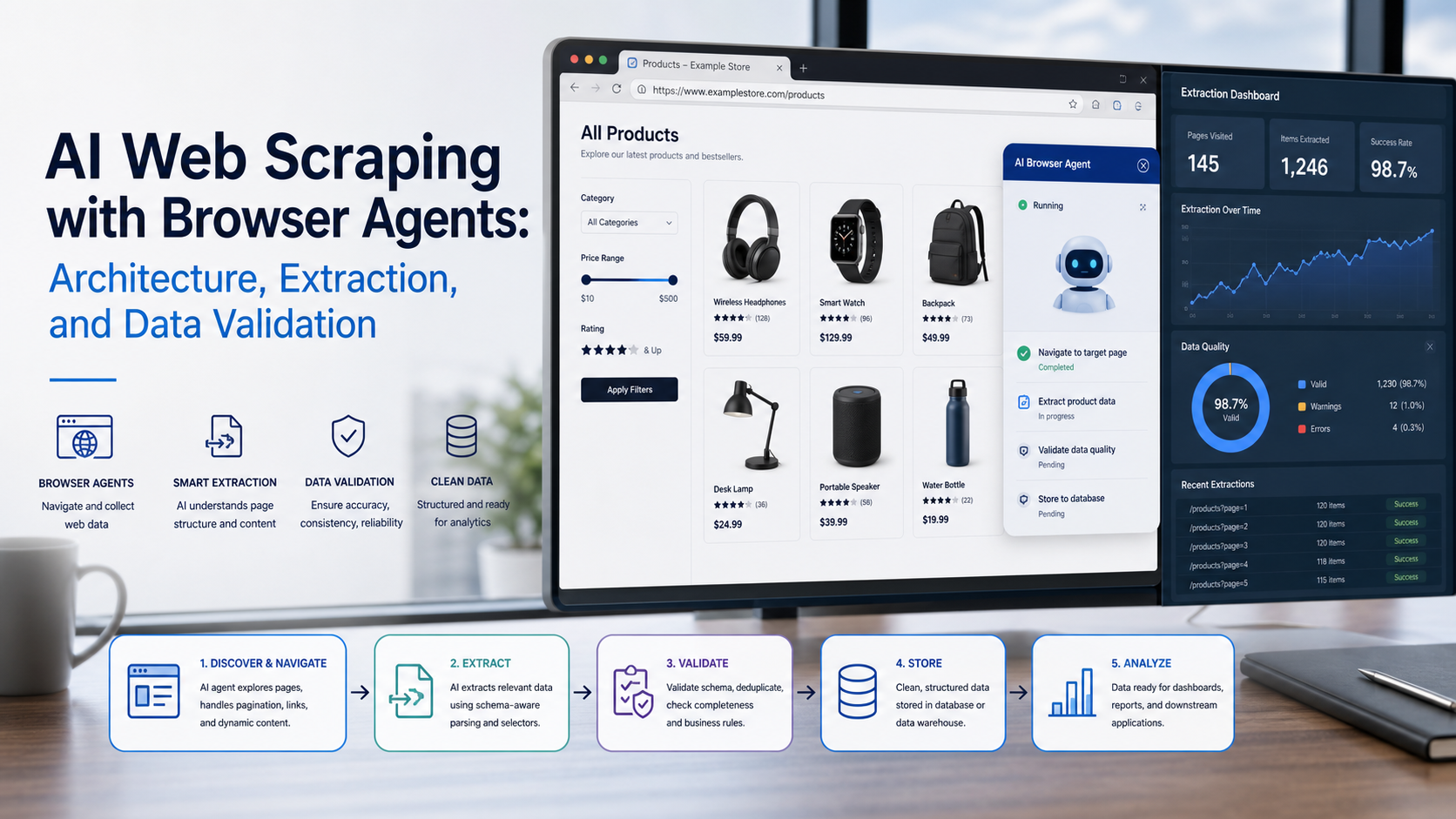
AI Web Scraping with Browser Agents: Architecture, Extraction, and Data Validation
AI web scraping uses AI to help discover, navigate, interpret, or extract information from websites. Browser agents are one implementation option when page interaction, rendering, or layout variation makes a simple scraper too brittle, but the agent should not become the entire data pipeline.
View Details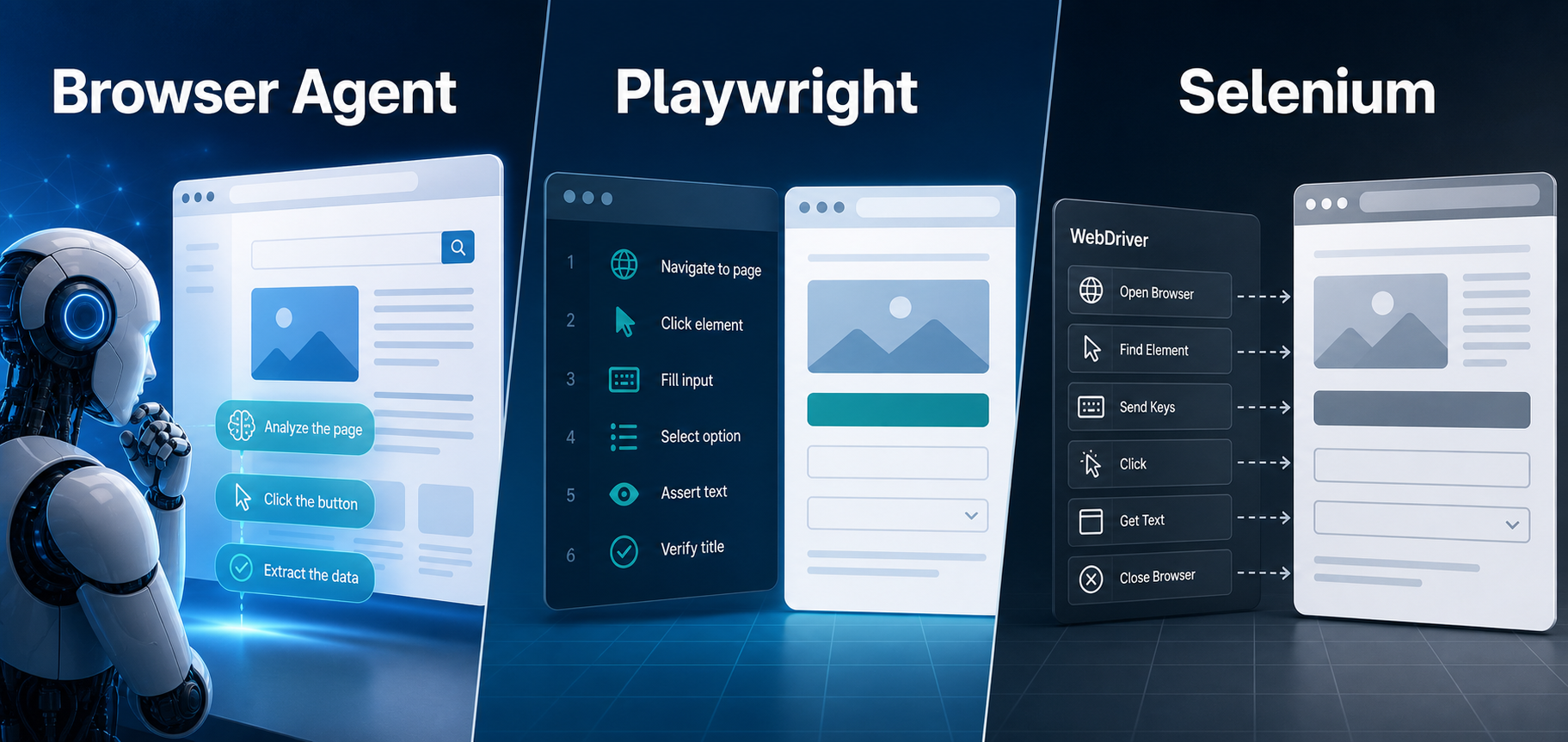
AI Browser Automation: Browser Agents vs Playwright vs Selenium
A browser agent interprets a goal and decides what browser action to take next. Playwright and Selenium can execute explicit, testable browser logic defined by developers. In 2026, however, Playwright also provides official MCP and agent-oriented workflows, so Playwright is no longer just the deterministic alternative to agentic automation. It can also serve as the browser-control layer inside an agent system.
View Details
Agentic Browser Security: Prompt Injection, Permissions, and Safe Deployment
That combination creates risks that are different from ordinary browsing and traditional automation. The most important is indirect prompt injection, where hostile instructions hidden in web content attempt to redirect the agent away from the user's goal. Google describes indirect prompt injection as a primary new threat for agentic browsing and has introduced layered defenses that include origin constraints, independent action checks, threat detection, and user confirmation for sensitive actions. Google's Chrome security architecture is a useful reference for how browser-agent defenses are evolving.
View Details
How to Give AI Agents Reliable Real-Time Web Data
A production-ready solution therefore needs more than a web scraper. It needs a web data layer that connects acquisition, validation, storage, retrieval, security, and observability. This guide explains how to design that layer.
View Details