
The Hidden Business of Buying and Selling IP Addresses
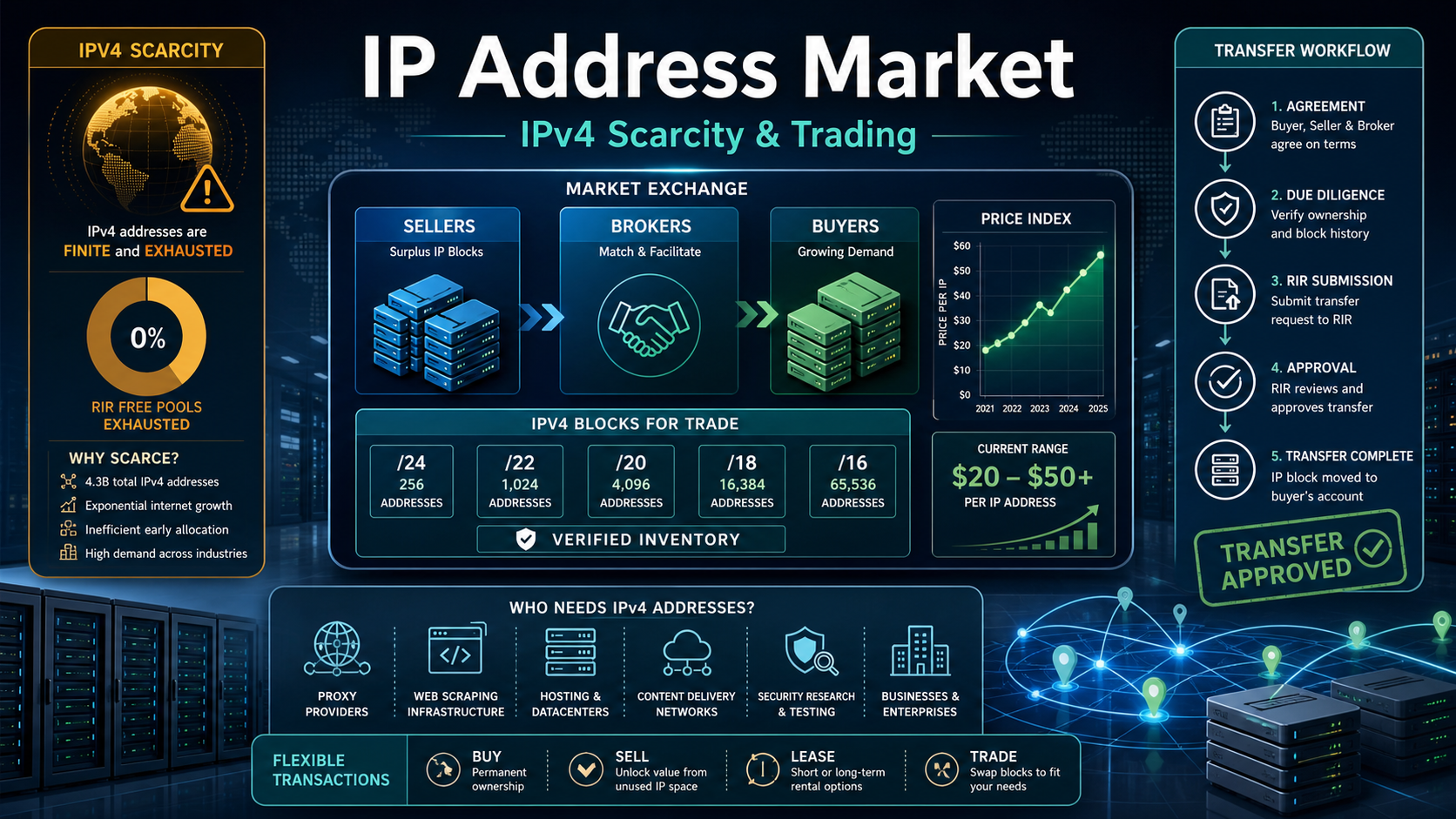
Did you know IP addresses are traded like real estate? Some sell for thousands of dollars. As IPv4 addresses have become increasingly scarce, a sophisticated secondary market has emerged where companies buy, sell, and lease these digital assets at prices that would surprise most internet users. A single IPv4 address can cost anywhere from $20 to $50 or more, and large blocks containing thousands of addresses change hands in deals worth hundreds of thousands of dollars. This market exists because we've run out of new IPv4 addresses to allocate, yet demand continues to grow as more businesses need dedicated IPs for infrastructure, proxies, hosting, scraping operations, and network services.
This article was prepared for practitioners who care about routing quality, operational reliability, and the real-world tradeoffs behind IP privacy, cloud security, email verification, and automation workflows.
For official technical background, see IANA number resources, ARIN IPv4 resources, RFC 791 Internet Protocol, MDN X-Forwarded-For reference.
The Hidden Business of Buying and Selling IP Addresses
For tech entrepreneurs launching data collection platforms, network administrators managing expanding infrastructure, and business owners evaluating proxy solutions or hosting requirements, understanding IP address economics has become essential. The scarcity of IPv4 addresses directly impacts operational costs, infrastructure decisions, and the viability of certain business models that depend on large IP pools.
Why IPv4 Addresses Are Finite and Running Out
The IPv4 addressing system was designed in the early 1980s and uses 32-bit addresses, which creates approximately 4.3 billion unique address possibilities. At the time, this seemed more than sufficient for what was then a small academic and military network. However, the explosive growth of the internet, the proliferation of connected devices, and the inefficient initial distribution of address blocks led to exhaustion far sooner than anticipated.
The Timeline of IPv4 Depletion
The Internet Assigned Numbers Authority (IANA) distributed the last remaining IPv4 address blocks to the five Regional Internet Registries (RIRs) in February 2011. Since then, each regional registry has managed its remaining inventory according to different policies:
- RIPE NCC (Europe, Middle East, Central Asia) reached full depletion in November 2019
- ARIN (North America) depleted its free pool in September 2015
- APNIC (Asia-Pacific) entered its final allocation phase in April 2011
- LACNIC (Latin America and Caribbean) exhausted its pool in June 2014
- AFRINIC (Africa) continues to have limited availability under strict allocation policies
Once regional registries could no longer issue new addresses freely, they implemented waiting lists, stricter justification requirements, and smaller allocation sizes. Organizations that need IPv4 addresses today face three options: join lengthy waiting lists with uncertain timelines, transition entirely to IPv6, or purchase addresses on the secondary market.
Why Companies Still Need IPv4 Addresses
Despite IPv6 offering a virtually unlimited address space with its 128-bit addressing scheme (providing approximately 340 undecillion addresses), IPv4 remains essential for several reasons:
Universal compatibility: Not all internet infrastructure supports IPv6. Many websites, services, and networks remain IPv4-only, creating compatibility requirements that force businesses to maintain IPv4 connectivity.
Legacy systems: Older hardware, software, and network equipment may not support IPv6 without expensive upgrades or replacements.
Dual-stack requirements: Even organizations transitioning to IPv6 typically maintain both protocols during the transition period, which can span years or even decades.
Business operations: Certain use cases specifically require IPv4 addresses, including proxy services, web scraping infrastructure, dedicated hosting environments, content delivery networks, and security testing platforms.
Client requirements: Many enterprise customers, particularly in regulated industries or with legacy infrastructure, explicitly require IPv4 connectivity for service delivery.
For businesses operating proxy infrastructure, residential proxy networks, or datacenter proxy pools, IPv4 addresses remain the primary currency. Web scraping operations, ad verification platforms, and e-commerce research tools typically require diverse IPv4 address pools to avoid detection, distribute requests, and access geo-restricted content.
How the IP Address Resale Market Works and Pricing
The IPv4 address transfer market operates as a structured but somewhat opaque marketplace where address blocks change hands through broker-facilitated transactions, direct sales, and lease arrangements. Unlike traditional commodities, IP addresses come with regulatory oversight, transfer approval processes, and ongoing maintenance obligations.
Explore LycheeIP Proxy Infrastructure
Market Structure and Transaction Process
IP address sales follow a formalized process managed by Regional Internet Registries:
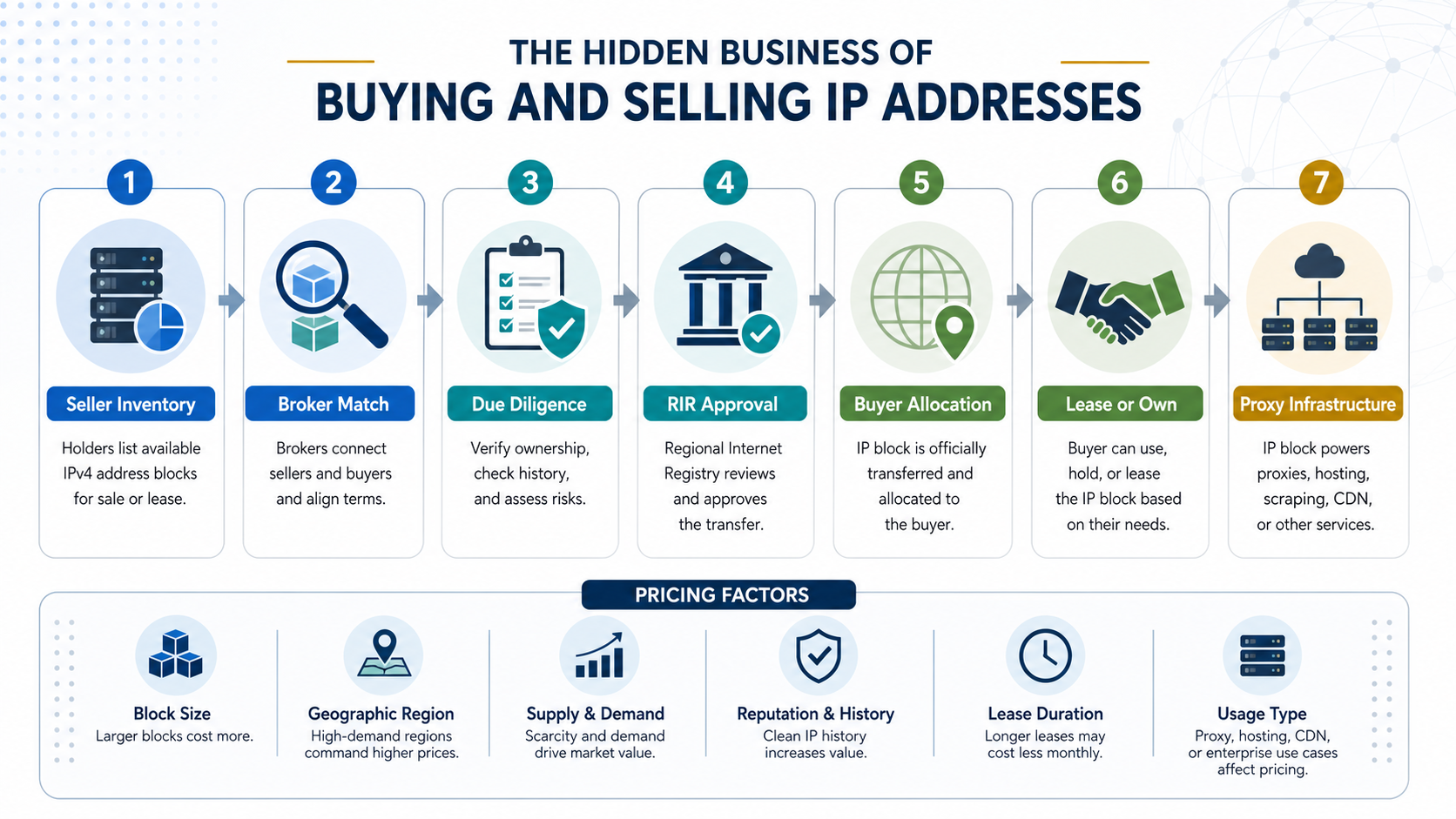
Listing and discovery: Sellers list address blocks through brokers, marketplaces, or direct outreach. Buyers search for available blocks matching their size requirements and budget.
Due diligence: Buyers must verify the address block's history, reputation, and blacklist status. Address blocks previously used for spam, malicious activity, or abuse may carry reputation damage that affects their utility.
Transfer approval: Both parties submit transfer requests to the relevant RIR. The buyer must demonstrate need justification according to registry policies, proving they will use the addresses for legitimate infrastructure purposes.
Registry updates: Once approved, the RIR updates WHOIS records, reverse DNS delegation, and routing registries to reflect the new ownership.
Why IPv4 Scarcity Still Matters
Payment and closing: Financial transactions typically occur through escrow services or upon transfer completion, with brokers taking commissions ranging from 5% to 15% of the transaction value.
Pricing Dynamics and Market Rates
IPv4 address pricing has evolved significantly since the secondary market emerged in the early 2010s. Prices reflect supply scarcity, demand intensity, regional availability, and block size:
Historical price trends: In 2014, IPv4 addresses traded for approximately $6 to $8 per address. By 2018, prices had risen to $15 to $20. In 2023 and 2024, typical market rates range from $35 to $50 per address, with some premium transactions exceeding $55.
Block size premiums: Larger contiguous blocks (slash-16 or slash-17 allocations containing 65,536 or 32,768 addresses respectively) often command higher per-address prices due to their routing efficiency and prestige value. Smaller blocks may trade at lower per-unit prices but can be harder to find buyers for.
Regional variations: Address scarcity varies by region. The Asia-Pacific region generally shows higher demand and prices due to rapid internet growth and earlier depletion. North American and European markets show strong demand from cloud providers, hosting companies, and infrastructure operators.
Reputation impact: Clean address blocks with no history of blacklisting, spam, or abuse carry premium value. Blocks from reputable organizations or previously used for legitimate enterprise purposes may sell for 10% to 30% above market rates. Conversely, tainted address space may be discounted or unsaleable.
Leasing as an Alternative
IPv4 address leasing has emerged as a parallel market serving organizations with temporary needs or insufficient capital for outright purchases:
Monthly lease rates: Addresses typically lease for $0.50 to $2.00 per IP per month depending on quantity, lease term, and provider. Annual contracts often offer discounted rates.
Advantages: Lower upfront costs, flexibility to scale up or down, no transfer approval delays, and no long-term commitment. Organizations testing new infrastructure or running time-limited projects often prefer leasing.
Disadvantages: Higher long-term costs compared to ownership, dependency on the lessor's continued operation, potential for rate increases upon renewal, and less control over address reputation management.
Use cases: proxy infrastructure providers, web scraping operations, temporary hosting expansions, seasonal traffic spikes, and testing environments frequently use leased IP addresses rather than purchasing blocks.
What Companies Are Buying and Renting IP Addresses
The IPv4 address market serves diverse buyers with different motivations, use cases, and acquisition strategies. Understanding the buyer landscape reveals how different industries value IP addresses and approach infrastructure decisions.
Cloud and Hosting Providers
Hyperscale cloud providers (Amazon Web Services, Microsoft Azure, Google Cloud) and traditional hosting companies represent the largest category of IPv4 buyers. These organizations acquire massive address blocks to support:
- Virtual machine instances requiring public IP addresses
- Load balancers and network gateways
- Customer-facing services and APIs
- Elastic infrastructure that scales dynamically
Cloud providers have purchased millions of IPv4 addresses, sometimes acquiring entire slash-8 blocks (16.7 million addresses) in single transactions worth hundreds of millions of dollars. These purchases ensure they can continue offering IPv4 connectivity as a standard feature rather than an expensive premium option.
Proxy Infrastructure and Data Collection Companies
Organizations providing proxy services, web scraping infrastructure, and public data collection platforms need large, diverse IP pools to:
Distribute requests: Rotating IP addresses prevents rate limiting, blocks, and bot detection when collecting public data from websites.
Enable geo-testing: Different IP addresses appear to originate from different geographic locations, allowing businesses to verify localized content, pricing, and user experiences.
Provide residential proxy alternatives: While residential proxy networks use actual consumer devices, datacenter proxy pools built on purchased IP addresses offer faster speeds and more predictable performance for certain scraping and automation workflows.
Support ad verification: Advertisers and brands use diverse IP addresses to verify their ads display correctly across different locations and contexts without triggering fraud detection systems.
Facilitate e-commerce research: Retailers and brands monitor competitor pricing, inventory, and product listings across regions using distributed IP infrastructure.
Proxy providers may own thousands of IP addresses across multiple autonomous systems (ASNs) and data centers to deliver geographic diversity and avoid network-level blocking. The investment in purchased IP blocks contributes significantly to infrastructure costs but provides more control than leasing arrangements.
Telecommunications and ISPs
Internet service providers and mobile carriers continue acquiring IPv4 addresses to support:
- New customer connections in IPv4-dependent markets
- Network equipment and infrastructure
- Business customer requirements for static IPs
- Maintaining service quality during IPv6 transition
Telecommunications companies often purchase addresses in large blocks and implement carrier-grade NAT (network address translation) to extend their IPv4 capacity while gradually migrating toward IPv6.
Enterprise Organizations
Large enterprises in financial services, healthcare, manufacturing, and retail purchase smaller IPv4 blocks for:
- Data center expansions and infrastructure growth
- Multi-site connectivity and WAN optimization
- Compliance requirements specifying IPv4 addressing
- Legacy application support
- Avoiding the complexity of IPv6 migration during critical operations periods
Enterprises typically purchase blocks ranging from slash-24 (256 addresses) to slash-20 (4,096 addresses) depending on their infrastructure scale.
The IPv6 Alternative and Dual-Stack Reality
IPv6 adoption continues growing, with major cloud providers, content delivery networks, and internet services offering full IPv6 support. However, complete transition remains years away:
Current IPv6 adoption: As of 2024, approximately 35% to 40% of internet users access services via IPv6, with significant regional variation. India, the United States, Germany, and Malaysia show adoption rates exceeding 50%, while many countries remain below 20%.
Transition challenges: Organizations face costs associated with equipment upgrades, staff training, application testing, and security policy updates. Many businesses choose to delay IPv6 adoption until absolutely necessary.
Dual-stack operations: Most organizations implementing IPv6 maintain dual-stack networks supporting both protocols simultaneously. This approach requires maintaining IPv4 addressing even as IPv6 capacity grows.
For proxy infrastructure specifically, IPv6 adoption faces additional barriers. Many target websites and services remain IPv4-only, making IPv6-only proxy infrastructure insufficient for comprehensive web scraping, public data collection, or geo-testing operations.
LycheeIP and the Proxy Infrastructure Market
The economics of IP address scarcity directly impact organizations building or using proxy infrastructure for web scraping, automation, public data collection, and testing workflows. Proxy providers must balance the capital costs of purchasing IP addresses against the operational flexibility of leasing, while considering the performance and reputation requirements of their target use cases.
LycheeIP provides proxy infrastructure solutions that address these economic realities through datacenter proxies, static residential proxies, and rotating proxy options. For teams evaluating proxy infrastructure for scraping operations, ad verification, e-commerce research, or geo-testing, understanding the underlying IP economics helps contextualize pricing, performance tradeoffs, and provider capabilities.
Organizations choosing between building their own proxy infrastructure and using providers like LycheeIP should consider the hidden costs of IP address acquisition, reputation management, network diversity, and ongoing maintenance. The capital investment required to purchase and maintain clean IP blocks, combined with the technical expertise needed to operate proxy infrastructure efficiently, often makes third-party proxy services more economical than in-house solutions.
When using proxy infrastructure for legitimate workflows such as public data collection, SERP monitoring, or localization testing, always respect website terms of service, review robots.txt guidelines where applicable, and implement rate limiting to avoid overloading target websites.
Common Mistakes and Considerations in IP Address Acquisition
Businesses entering the IP address market or evaluating proxy infrastructure should avoid several common pitfalls:
Neglecting Reputation Due Diligence
Purchasing IPv4 addresses without thoroughly checking blacklist status, spam history, and reputation can create immediate operational problems. Tainted IP addresses may be blocked by major websites, email providers, or security services, rendering them useless for intended purposes. Always check addresses against:
- Major blacklist databases (Spamhaus, SORBS, SpamCop)
- Historical WHOIS records to identify previous owners
- Reputation scoring services that track abuse history
- Sample testing against target websites or services
Underestimating Transfer Complexity
The IPv4 transfer process involves regulatory approval, documentation requirements, and waiting periods that can extend for weeks or months. Organizations needing immediate address availability should plan acquisitions well in advance or consider leasing arrangements that activate more quickly.
Ignoring Geographic Routing Considerations
IP addresses maintain associations with geographic locations based on their registration and routing announcements. For proxy infrastructure, web scraping, or geo-testing use cases, verify that purchased addresses will route correctly from your intended data center locations and appear in target geographic regions.
Overlooking Maintenance Obligations
IP address ownership carries ongoing responsibilities including maintaining accurate WHOIS records, responding to abuse complaints, managing reverse DNS, and paying annual registry fees. These operational burdens require dedicated staff time and processes.
Failing to Model Long-Term Economics
While leasing appears cheaper initially, organizations with permanent IP address needs often find purchasing more economical over multi-year periods. Calculate the breakeven point where cumulative lease costs exceed purchase prices plus maintenance to make informed acquisition decisions.
Conclusion
The hidden business of buying and selling IP addresses reflects the fundamental scarcity economics of internet infrastructure. IPv4 exhaustion has transformed addresses from freely available resources into traded assets worth billions of dollars collectively. For tech entrepreneurs, network administrators, and business owners, this market reality shapes infrastructure costs, operational decisions, and strategic planning.
Companies need IPv4 addresses to maintain compatibility, serve customers, and deliver services in an internet ecosystem that remains heavily dependent on the protocol despite IPv6's availability. The secondary market provides liquidity and flexibility through both purchase and lease options, though at significant cost compared to the era of free allocation.
For organizations evaluating proxy infrastructure for web scraping, automation, public data collection, or testing workflows, understanding IP address economics provides context for provider pricing, capability differences, and build-versus-buy decisions. Whether purchasing addresses directly, leasing infrastructure, or partnering with providers like LycheeIP, the underlying scarcity of IPv4 addresses remains a fundamental constraint shaping the proxy infrastructure landscape.
As IPv6 adoption gradually progresses, dual-stack requirements will persist for years, sustaining IPv4 address demand and market activity. The companies successfully navigating this landscape will be those that balance immediate operational needs against long-term transition planning, make informed acquisition decisions based on reputation and routing considerations, and choose infrastructure approaches aligned with their specific use cases and scale requirements.
Frequently Asked Questions
How much does an IPv4 address cost in 2024?
IPv4 addresses typically sell for $35 to $50 each on the secondary market, with prices varying based on block size, reputation, and regional demand. Larger contiguous blocks may command premium pricing, while addresses with clean histories and no blacklist issues are worth more than those with reputation problems. Leasing options range from $0.50 to $2.00 per IP per month.
Why can't we just use IPv6 instead of buying IPv4 addresses?
While IPv6 offers virtually unlimited addresses, approximately 60% to 65% of internet services and users remain IPv4-only as of 2024. Many legacy systems, enterprise networks, and websites do not support IPv6, creating compatibility requirements that force businesses to maintain IPv4 connectivity. For proxy infrastructure and web scraping operations, IPv4 remains essential because many target websites only respond to IPv4 requests.
How do I check if IPv4 addresses have a bad reputation before buying?
Check addresses against major blacklist databases including Spamhaus, SORBS, SpamCop, and Barracuda. Review historical WHOIS records to identify previous owners and usage patterns. Use reputation scoring services and conduct sample testing by accessing major websites, email providers, and services relevant to your intended use case. Reputable IP address brokers should provide reputation reports as part of due diligence.
Can individuals buy IPv4 addresses or only companies?
IPv4 address purchases typically require registration with a Regional Internet Registry (RIR) as an organization with documented need justification. Individuals can technically acquire addresses by registering as a business entity and demonstrating legitimate infrastructure requirements. However, the administrative overhead, annual fees, and transfer approval process make individual purchases uncommon unless for business purposes.
Is leasing IPv4 addresses better than buying them?
Leasing offers lower upfront costs, faster deployment, and flexibility for temporary or scaling needs, making it ideal for testing, seasonal projects, or uncertain long-term requirements. Buying provides better long-term economics for permanent needs, more control over address reputation, and asset value that may appreciate. Calculate the breakeven point based on your expected usage duration, typically ranging from 18 to 36 months depending on lease rates and purchase prices.
Why do proxy providers need so many IP addresses?
proxy infrastructure requires diverse IP addresses to distribute web scraping requests across different IPs, avoid rate limiting and blocks, enable geo-testing from multiple apparent locations, prevent bot detection systems from identifying patterns, and serve multiple customers simultaneously without IP overlap. Larger, more diverse IP pools improve proxy service quality, reliability, and the range of supported use cases.
What happens to IPv4 address prices as IPv6 adoption grows?
IPv4 address prices will likely remain elevated or continue increasing in the medium term despite IPv6 growth, because dual-stack requirements persist and backward compatibility needs continue. Eventually, as IPv6 adoption approaches universal coverage (likely a decade or more away), IPv4 address values may decline. However, the transition timeline remains uncertain, and scarcity continues driving current market dynamics.
Are there restrictions on what you can do with purchased IPv4 addresses?
IPv4 addresses must be used for legitimate infrastructure purposes and cannot be hoarded without utilization. Regional Internet Registries require periodic confirmation of usage and may reclaim addresses not actively deployed. Address owners must maintain accurate WHOIS records, respond to abuse complaints, and comply with registry policies. Using addresses for illegal activities, spam, or large-scale abuse can result in blacklisting, registry sanctions, or reclamation.
How long does it take to complete an IPv4 address purchase?
The IPv4 transfer process typically takes 2 to 8 weeks from agreement to completion, depending on the Regional Internet Registry, documentation completeness, and transfer approval queue. ARIN transfers in North America often process within 2 to 4 weeks, while RIPE NCC transfers in Europe may take 4 to 6 weeks. Expedited processing is generally not available, so plan acquisitions well ahead of infrastructure deployment timelines.
Do I need technical expertise to buy and manage IPv4 addresses?
Purchasing IPv4 addresses requires understanding of networking concepts, routing protocols, and registry procedures, but brokers can guide non-technical buyers through the process. However, operating and maintaining purchased addresses demands technical expertise in network configuration, BGP routing, reverse DNS management, and abuse handling. Organizations lacking this expertise should consider using managed services, proxy providers, or hiring network administrators rather than purchasing addresses directly.
Related LycheeIP Guides and Resources
- LycheeIP proxy infrastructure
- Static residential proxies
- Rotating residential proxies
- Datacenter proxies
- Cold email outreach after n8n scraping
- Auto-fill spreadsheets using AI agent web scraping
- LinkedIn lead scraping automation with n8n
- No-code AI agent web scraping
- Scale lead scraping to 100K+ with n8n
- Residential proxy guide
- Mobile proxy guide

Recommended Articles

AI Search API for AI Agents: How to Ground LLMs With Live Search Data
An AI search API gives an application or agent programmatic access to current search results. Its most useful role is discovery: the agent can find candidate sources, identify fresh information, and decide what to retrieve next instead of relying only on model memory.
View Details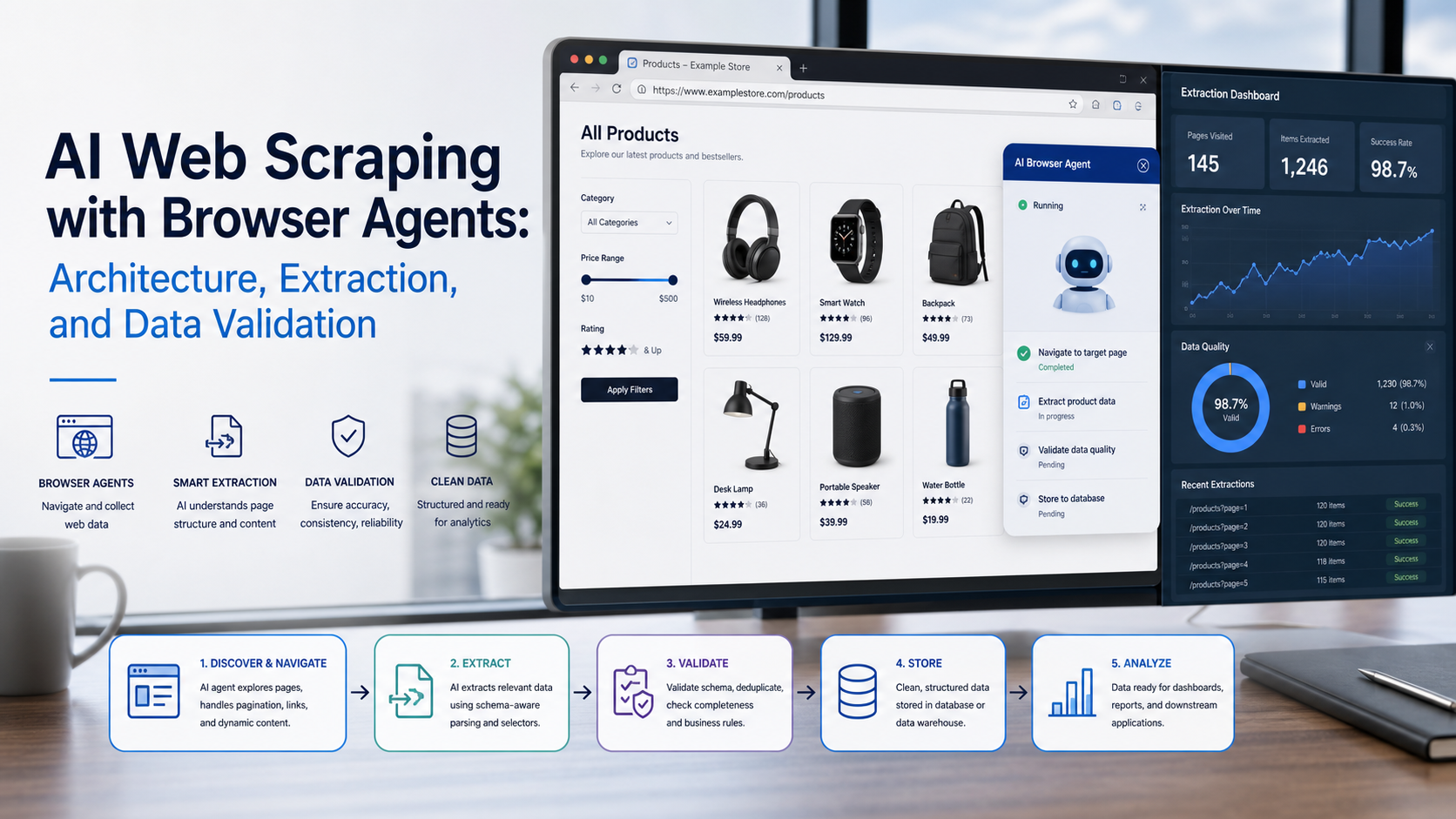
AI Web Scraping with Browser Agents: Architecture, Extraction, and Data Validation
AI web scraping uses AI to help discover, navigate, interpret, or extract information from websites. Browser agents are one implementation option when page interaction, rendering, or layout variation makes a simple scraper too brittle, but the agent should not become the entire data pipeline.
View Details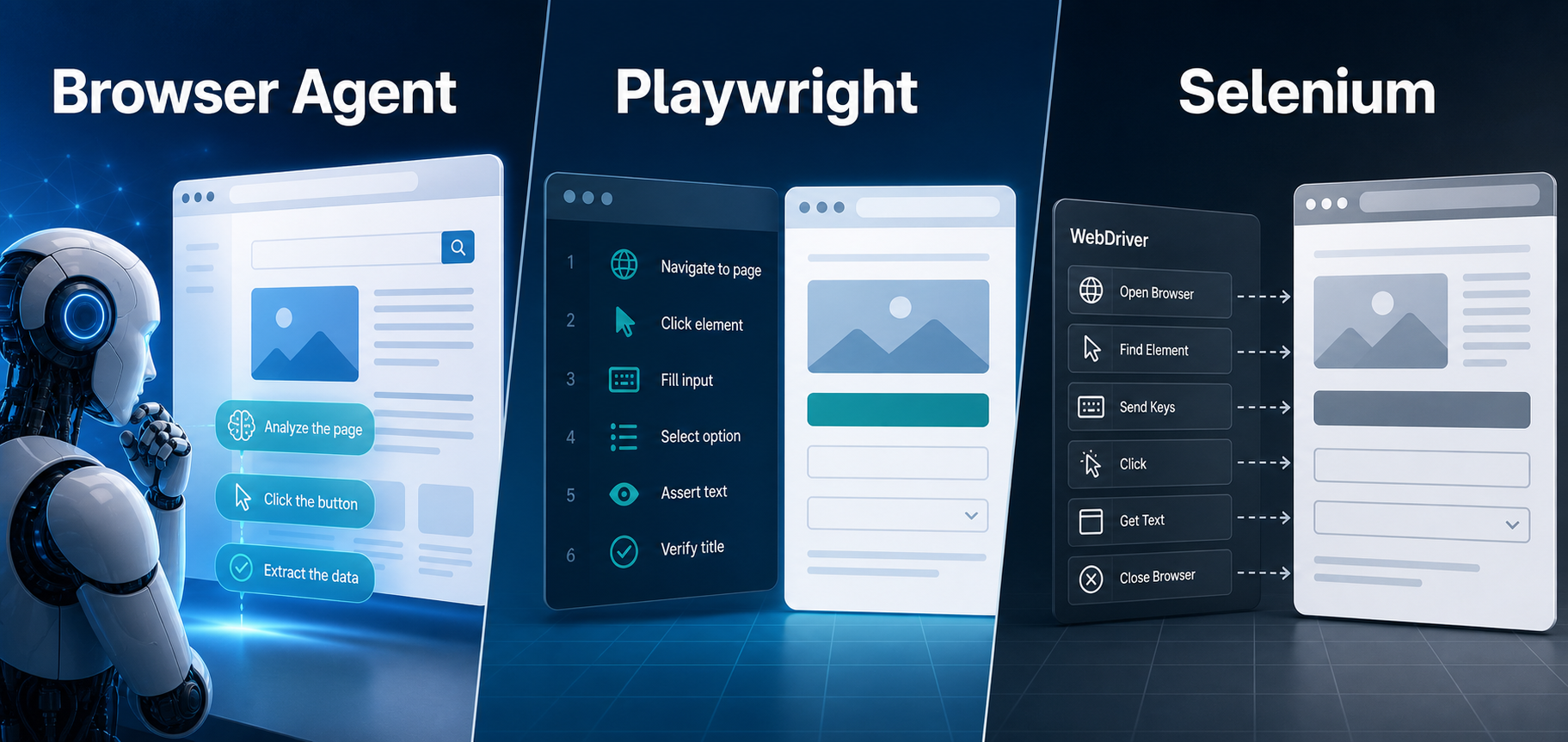
AI Browser Automation: Browser Agents vs Playwright vs Selenium
A browser agent interprets a goal and decides what browser action to take next. Playwright and Selenium can execute explicit, testable browser logic defined by developers. In 2026, however, Playwright also provides official MCP and agent-oriented workflows, so Playwright is no longer just the deterministic alternative to agentic automation. It can also serve as the browser-control layer inside an agent system.
View Details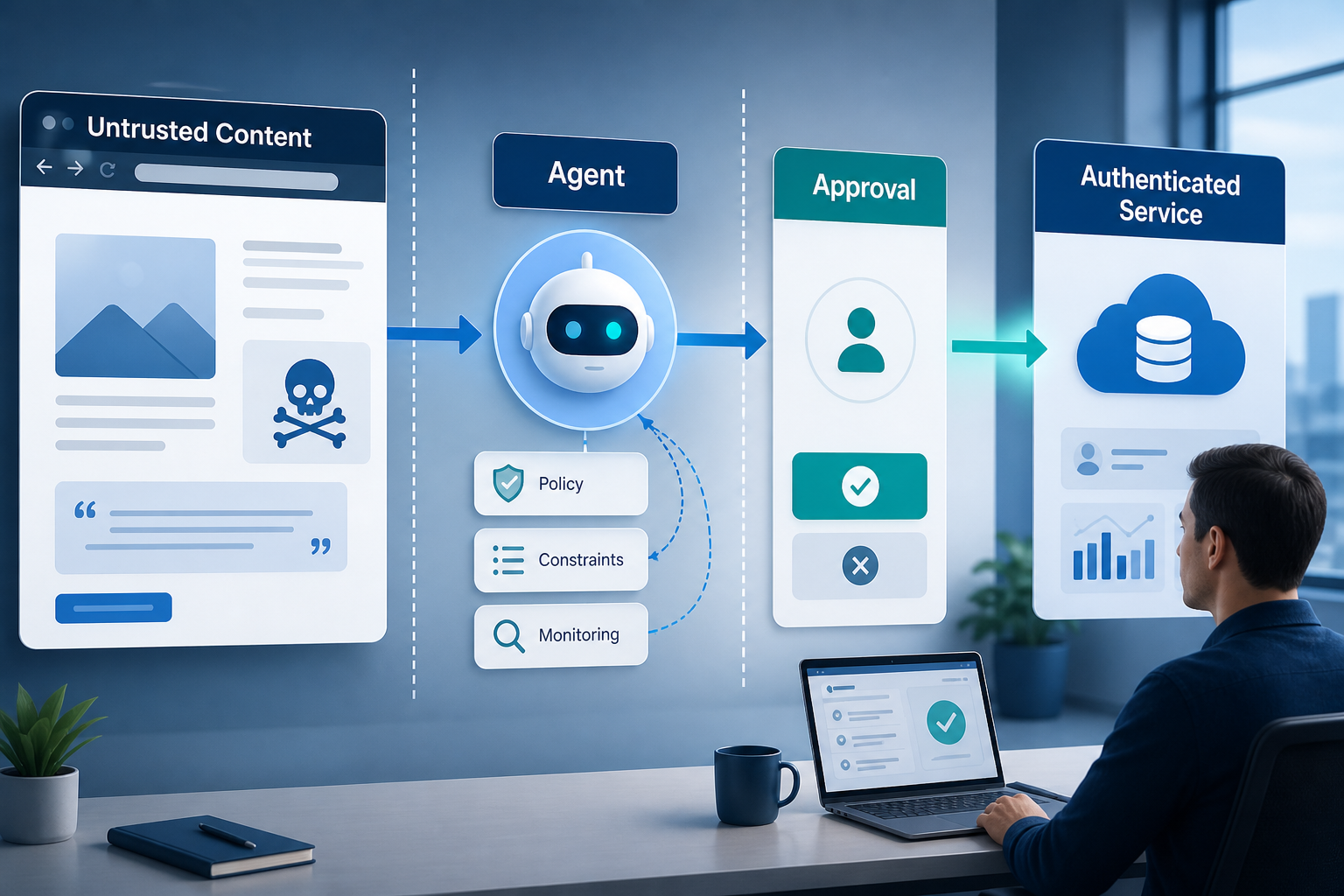
Agentic Browser Security: Prompt Injection, Permissions, and Safe Deployment
That combination creates risks that are different from ordinary browsing and traditional automation. The most important is indirect prompt injection, where hostile instructions hidden in web content attempt to redirect the agent away from the user's goal. Google describes indirect prompt injection as a primary new threat for agentic browsing and has introduced layered defenses that include origin constraints, independent action checks, threat detection, and user confirmation for sensitive actions. Google's Chrome security architecture is a useful reference for how browser-agent defenses are evolving.
View Details
How to Give AI Agents Reliable Real-Time Web Data
A production-ready solution therefore needs more than a web scraper. It needs a web data layer that connects acquisition, validation, storage, retrieval, security, and observability. This guide explains how to design that layer.
View Details