
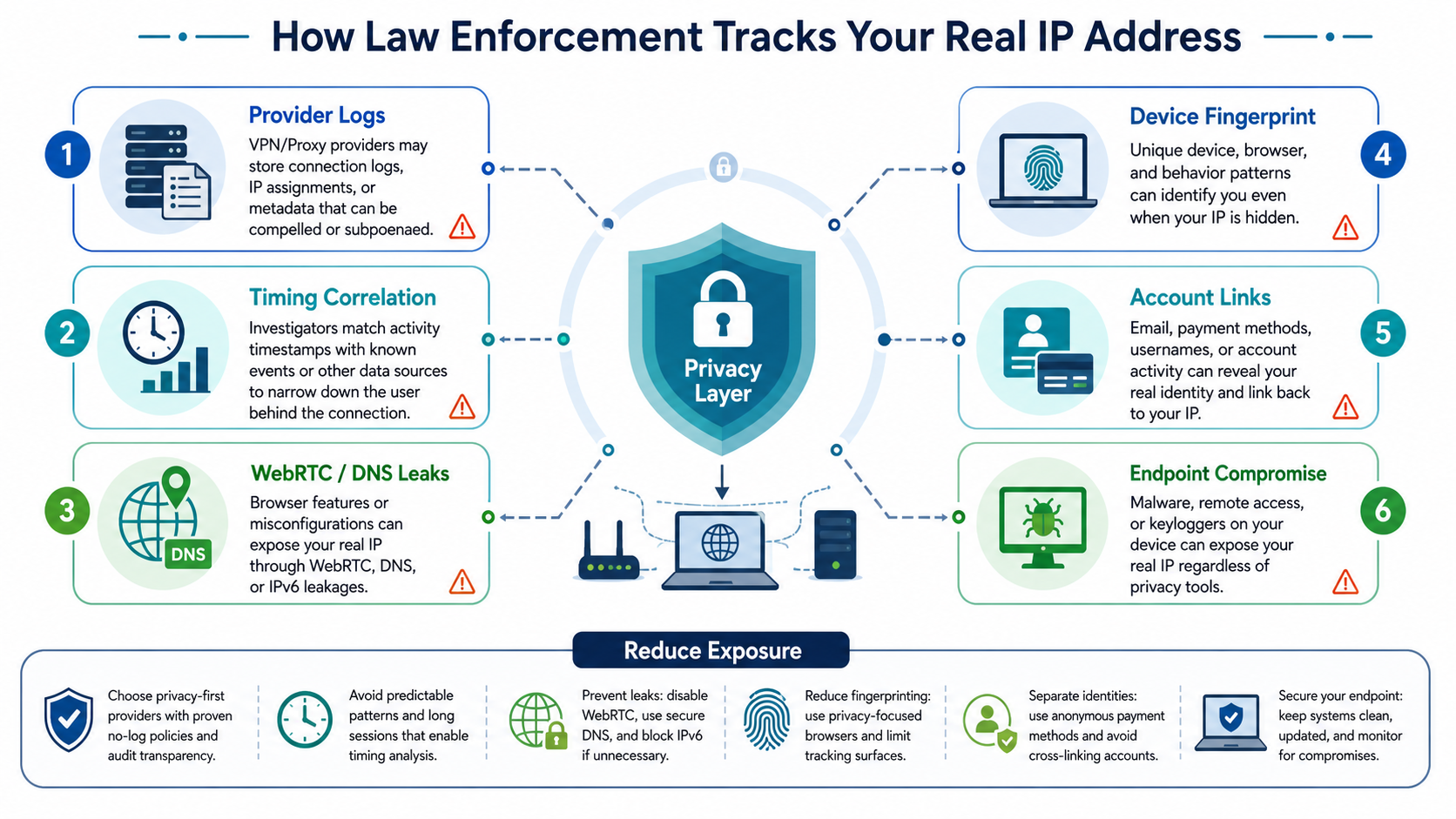
How Law Enforcement Tracks Your Real IP Address
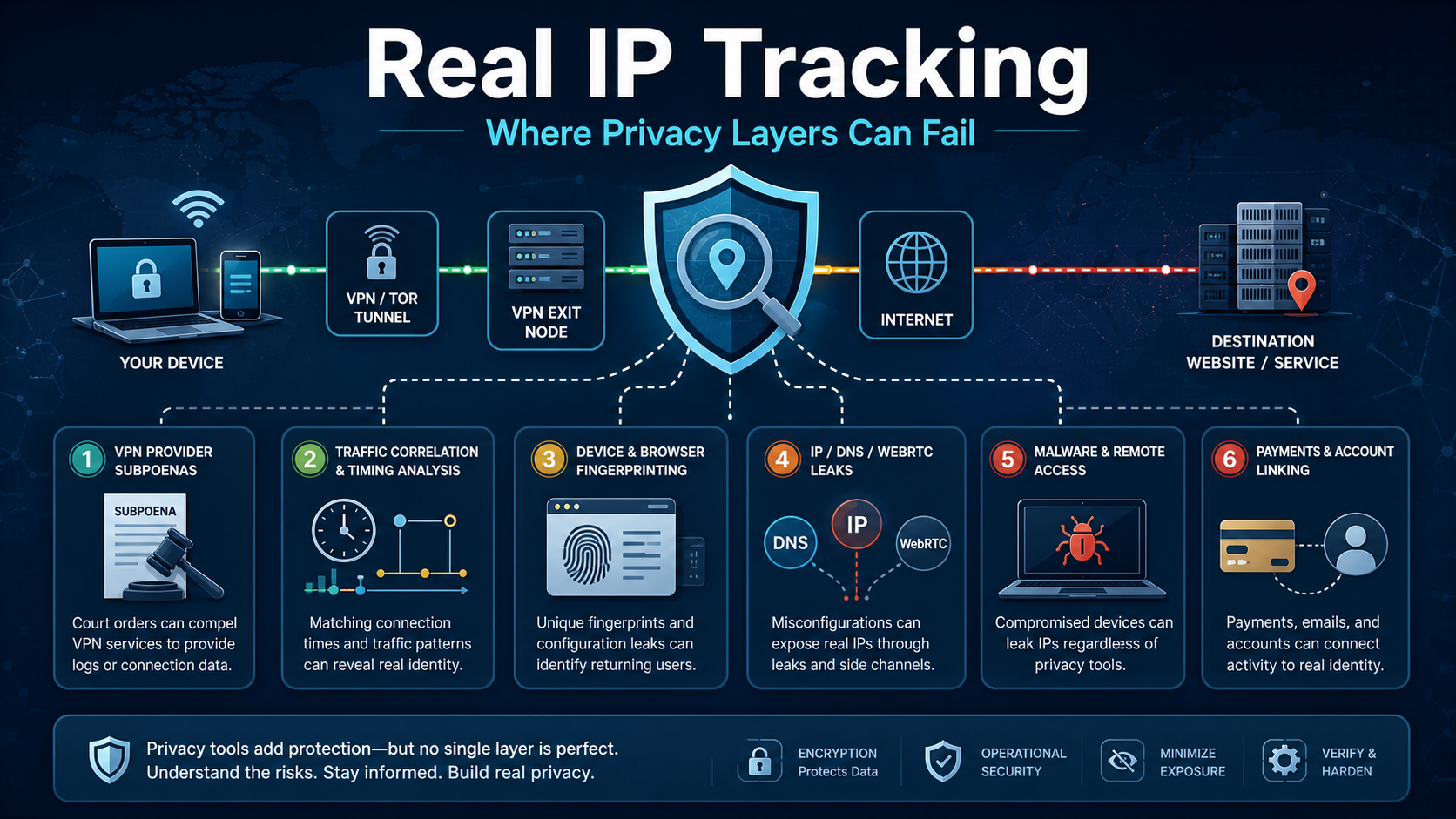
Think your VPN protects you? Here are 6 ways the FBI finds your real IP anyway.
This article was prepared for practitioners who care about routing quality, operational reliability, and the real-world tradeoffs behind IP privacy, cloud security, email verification, and automation workflows.
For official technical background, see IANA number resources, ARIN IPv4 resources, RFC 791 Internet Protocol, MDN X-Forwarded-For reference.
VPNs and Tor have become the go-to tools for users seeking online anonymity, whether for legitimate privacy concerns, security research, or less legal activities. But the reality is sobering: these tools don't guarantee anonymity. Law enforcement agencies have developed sophisticated techniques to pierce through privacy layers and identify real IP addresses. For privacy advocates, security researchers, and VPN users, understanding these methods isn't just academic curiosity. It's essential knowledge for making informed decisions about digital security.
This article reveals the actual methods federal investigators use to track IP addresses even when targets deploy privacy tools. These techniques aren't theoretical. They're documented in court cases, technical papers, and investigative journalism. Whether you're building automation workflows, conducting legitimate web scraping operations, or simply want to understand how IP privacy actually works, you need to know where the vulnerabilities lie.
VPN Provider Subpoenas and Logging Policies
The first and most straightforward method law enforcement uses is the direct approach: asking the VPN provider for logs.
The Reality of No-Logs Policies
Many VPN providers advertise strict no-logs policies. In practice, these policies vary dramatically in scope and enforcement. Some providers genuinely maintain zero connection logs. Others keep metadata that, while not technically "logs," still provides investigators with useful information.
When federal agencies serve subpoenas or court orders, VPN providers face a choice: comply with legal demands or face contempt charges. Several high-profile cases demonstrate this reality:
- A major VPN provider handed over limited connection data in 2017 after a court order, despite marketing itself as no-logs
- European VPN services have complied with data retention directives that contradict their public privacy claims
- Providers operating in Five Eyes countries (US, UK, Canada, Australia, New Zealand) face additional intelligence-sharing pressures
What Data Actually Gets Collected
Even providers with legitimate no-logs policies collect some information for basic operations:
- Payment information: Credit card details, PayPal accounts, and billing addresses create paper trails
- Account creation data: Email addresses, usernames, and registration timestamps
- Connection metadata: While not logging specific browsing activity, some providers record when users connect and disconnect
- Server load information: Aggregated data about which servers users connect to and when
- Bandwidth usage: Total data transferred, which can be correlated with known activities
Investigators combine this metadata with other intelligence sources. If they know a specific illegal file was uploaded at 3:47 PM on Tuesday, and a VPN provider's records show only one user connected to a specific server at that time, the anonymity breaks down.
Jurisdiction Shopping
Law enforcement agencies increasingly use international cooperation agreements to pressure VPN providers. A company incorporated in Panama but operating servers in Germany faces German legal requirements for those servers. Investigators exploit these jurisdictional complexities:
- Mutual Legal Assistance Treaties (MLATs) enable data requests across borders
- Interpol coordination allows simultaneous requests to multiple providers
- Server seizures in cooperative jurisdictions can expose logs that weren't supposed to exist
For users building legitimate infrastructure workflows like web scraping or geo-testing environments, this legal landscape matters. Your proxy or VPN provider's jurisdiction affects your operational security and compliance posture.
The Business Model Problem
Free VPN services present special risks. These providers need revenue, and if users aren't paying, someone else is. Common monetization methods include:
- Selling anonymized browsing data to advertisers
- Injecting ads into user traffic
- Participating in affiliate networks that track click-throughs
- Maintaining minimal security to reduce operational costs
Some free VPN providers have been caught logging and selling complete browsing histories. In investigative contexts, these providers often cooperate readily with law enforcement, seeing it as civic duty or hoping to avoid regulatory scrutiny.
Traffic Correlation and Timing Analysis Techniques
Even when VPN providers genuinely keep no logs, investigators can identify users through traffic analysis. These techniques exploit fundamental properties of network communication that encryption can't hide.
Explore LycheeIP Proxy Infrastructure
How Traffic Correlation Works
When you connect through a VPN or Tor, your encrypted traffic still has observable characteristics:
- Packet timing: The precise moments when data packets arrive and depart
- Traffic volume: How much data flows in each direction
- Connection duration: How long sessions last
- Traffic patterns: The rhythm and structure of communication
Investigators with access to both ends of the connection can correlate these patterns. If they observe distinctive traffic leaving your real IP address at the same time identical patterns emerge from a VPN exit node, statistical analysis can confirm they're the same user.
Entry and Exit Surveillance
This method requires surveillance capabilities at two points:
1. Entry point monitoring: Observing traffic entering the VPN or Tor network from your real IP
2. Exit point monitoring: Watching traffic emerge at the destination
For agencies like the FBI or NSA, this capability exists. They can:
- Monitor major internet exchange points where traffic concentrates
- Work with ISPs to observe specific suspects' connections
- Control or compromise VPN exit nodes
- Run their own Tor nodes to capture a percentage of traffic
Academic research has repeatedly demonstrated that timing analysis works against both VPNs and Tor with high accuracy rates. One study achieved over 90% success in correlating connections after observing traffic for just a few minutes.
Website Fingerprinting
Even through encrypted connections, the pattern of data transfer can reveal which websites you visit. Different pages have distinct signatures:
- Homepage loads have different packet patterns than article pages
- Video streaming creates recognizable traffic shapes
- Interactive applications generate specific timing patterns
- File downloads produce distinctive volume signatures
Researchers have built machine learning models that identify websites with 95%+ accuracy by analyzing only encrypted traffic metadata. No decryption required. Law enforcement agencies have access to similar or better tools.
ISP Cooperation
Internet service providers see everything entering and leaving your connection. They know:
- When you connect to VPN servers
- How much data you transfer
- The timing of your online activity
- Your physical location based on network infrastructure
With a court order or National Security Letter, ISPs provide detailed connection records. Combined with traffic correlation, this data helps investigators match anonymous online activities to real identities.
DNS Leaks and Query Correlation
Many VPN users unknowingly leak DNS queries outside their encrypted tunnel. When your computer requests a website's IP address, that query might bypass the VPN and go directly to your ISP's DNS server.
Investigators correlate DNS queries with known criminal activity:
- If a suspect website receives few visitors, anyone querying its DNS becomes a suspect
- Timing of DNS queries can match timing of anonymous uploads or posts
- Unusual DNS patterns (like querying obscure Tor bridge addresses) flag users for deeper investigation
This vulnerability affects not just privacy tools but also proxy infrastructure used for web scraping and automation. If your scraping workflow leaks DNS queries, target websites can identify your real location even when using residential or datacenter proxies.
BGP and Routing Analysis
Border Gateway Protocol (BGP) controls how internet traffic routes between networks. Sophisticated attackers (including state-level actors) can:
- Hijack BGP routes to redirect traffic through monitoring points
- Analyze routing paths to infer connection endpoints
- Identify VPN servers by their BGP announcements
- Correlate routing changes with user behavior
While beyond most criminal investigations, these techniques appear in national security cases and advanced persistent threat scenarios.
The One Common Mistake That Exposes Most People
After analyzing court documents and investigative disclosures, one pattern emerges: most people get caught not through sophisticated traffic analysis, but through simple mistakes that leak their real IP address.
Investigation and IP Tracking Video
WebRTC Leaks
Web Real-Time Communication (WebRTC) enables browser-based audio and video calls. It's built into Chrome, Firefox, Edge, and other modern browsers. The problem: WebRTC can expose your real IP address even when you're connected to a VPN.
WebRTC uses STUN (Session Traversal Utilities for NAT) servers to discover your public IP address for peer-to-peer connections. This discovery happens outside the VPN tunnel. A simple website with malicious JavaScript can trigger WebRTC and capture your real IP in milliseconds.
Investigators use this technique through:
- Honeypot websites designed to catch specific suspects
- Compromised legitimate websites serving tracking scripts
- Email HTML content that triggers WebRTC when viewed in browsers
- Forum posts containing invisible tracking elements
For security researchers and privacy advocates, the solution is straightforward: disable WebRTC in your browser or use extensions that block it. But many VPN users remain unaware of this vulnerability.
Browser Fingerprinting
Your browser reveals a unique fingerprint through:
- Screen resolution and color depth
- Installed fonts
- Browser plugins and extensions
- Timezone and language settings
- Canvas and WebGL rendering characteristics
- Audio context fingerprints
- Hardware specifications
Research shows that browser fingerprints are often unique enough to identify individuals across different IP addresses. If you browse both with and without privacy tools using the same browser profile, investigators can link those sessions even if the IP addresses differ.
Law enforcement creates fingerprint databases of suspects. When that unique fingerprint appears on an anonymous connection, they've established a link to investigate further.
Application Leaks
VPNs typically protect only traffic routed through them. Many applications bypass this protection:
- Torrent clients often make direct connections outside VPN tunnels
- Update services for operating systems and software may use different network interfaces
- Backup applications might sync using direct internet connections
- Mobile apps frequently ignore system-wide VPN settings
- Games and streaming services sometimes detect and bypass VPNs
Each leak provides investigators with your real IP address. In file-sharing cases, this is the most common exposure method. Users think they're protected because their torrent client shows they're connected to a VPN, not realizing that tracker connections or DHT queries are leaking their actual IP.
Social Engineering and Operational Security Failures
Technical tools only protect technical channels. Most people get caught through operational security mistakes:
- Using the same username across anonymous and real-identity accounts
- Posting during hours that match their local timezone
- Referencing location-specific information in supposedly anonymous communications
- Accessing personal accounts (email, social media) from the same anonymous session
- Paying for VPN services with payment methods linked to their real identity
- Using personal devices with unique hardware identifiers
Investigators build profiles by aggregating these small mistakes. Each piece of information narrows the suspect pool until only one person fits all criteria.
The Cognitive Bias Problem
People overestimate their anonymity when using privacy tools. This false confidence leads to sloppier operational security. They take risks they wouldn't take without protection, paradoxically making themselves more vulnerable.
Security researchers studying criminal forums found that users with VPNs made more identifying mistakes than those who assumed they had no protection. The sense of security itself becomes the vulnerability.
Proxy Infrastructure and IP Routing in Professional Contexts
For teams working with web scraping, automation, and public data collection, understanding IP tracking methods informs better infrastructure decisions.
Proxy Types and Detection Resistance
Different proxy types offer varying levels of detection resistance:
datacenter proxies provide fast, reliable connections but are easily identified through:
- IP range databases maintained by security companies
- AS (Autonomous System) number patterns
- Lack of residential ISP characteristics
- Consistent hosting provider patterns
residential proxies appear as legitimate home internet connections, making them harder to detect:
- They originate from actual ISP-assigned IP ranges
- Their behavior matches typical residential usage patterns
- They're distributed across geographic locations
- Target websites see them as real users
Static residential proxies combine residential legitimacy with consistent IP addresses:
- Useful for maintaining sessions across scraping workflows
- Enable account-based automation without triggering security alerts
- Support geo-testing that requires stable location indicators
For legitimate use cases like competitive research, price monitoring, ad verification, and SERP tracking, choosing the right proxy type balances detection resistance with operational requirements.
Responsible Proxy Usage
When implementing proxy infrastructure for data collection workflows:
- Review target website terms of service
- Respect robots.txt directives where applicable
- Implement rate limiting to avoid overloading servers
- Use appropriate user agents that identify your bot
- Rotate IPs reasonably rather than aggressively
- Focus on publicly available data rather than bypassing authentication
Providers like LycheeIP offer proxy infrastructure designed for professional workflows including web scraping, automation, geo-testing, and e-commerce research. When evaluating proxy solutions, consider:
- IP pool diversity and geographic coverage
- Session control and IP rotation policies
- Connection reliability and speed requirements
- Compliance with your target markets' regulations
- Integration with your existing automation tools
Developer-Controlled IP Routing
Modern proxy infrastructure gives developers fine-grained control over IP routing:
- Select specific geographic locations for localized testing
- Maintain consistent IPs for session-based scraping
- Rotate IPs on request or schedule basis
- Route different applications through different IP pools
- Implement fallback routing when primary IPs are blocked
This control helps teams build resilient data collection workflows that adapt to target website defenses while maintaining ethical scraping practices.
Common Mistakes in Privacy Tool Implementation
Beyond the critical WebRTC leak, users make several implementation mistakes that compromise their anonymity:
Split Tunneling Misconfigurations
Split tunneling routes some traffic through the VPN while other traffic uses your regular connection. Misconfigurations cause:
- Critical applications bypassing VPN protection
- DNS queries leaking outside the tunnel
- Background processes revealing real IP addresses
- Inconsistent protection across different network states
For professional workflows using proxy infrastructure, similar routing mistakes occur when:
- Some requests bypass proxy configuration
- Fallback settings revert to direct connections
- Environment variables override proxy settings
- Container or virtual machine networking bypasses host proxy configuration
Inconsistent Privacy Layers
Users often mix security levels inappropriately:
- Using Tor browser but connecting through regular VPN
- Enabling VPN but using non-hardened browser
- Protecting desktop traffic while mobile apps connect directly
- Routing some applications through proxies while others connect directly
Each inconsistency creates correlation opportunities for investigators.
Trusting Single Solutions
Relying entirely on one privacy tool creates single points of failure:
- VPN connection drops expose real IP unless kill switches are properly configured
- Tor circuit failures may fall back to direct connections
- Proxy authentication failures might retry without proxy protection
- Network changes (switching from WiFi to cellular) can bypass VPN configurations
Professional workflows implement multiple safeguards:
- Kill switches that block all traffic if proxy/VPN fails
- Automated monitoring to detect connection state changes
- Redundant proxy pools with automatic failover
- Network isolation that prevents direct internet access
Credential Reuse Across Contexts
Using the same accounts, passwords, or credentials across anonymous and identified contexts enables correlation:
- Email addresses registered to VPN accounts
- Payment methods that reveal identity
- API keys shared across projects
- SSH keys used on both personal and anonymous servers
For scraping and automation workflows, similar mistakes include:
- Reusing API credentials across different IP pools
- Using company email addresses in user agents when testing competitors
- Registering test accounts with traceable payment information
- Using personal development tools that phone home with telemetry
The Broader Surveillance Landscape
Understanding IP tracking requires recognizing the full surveillance ecosystem:
Mass Surveillance Programs
Documents from whistleblowers have revealed extensive surveillance programs:
- Bulk collection of internet metadata
- Taps on undersea fiber optic cables
- Cooperation between intelligence agencies and tech companies
- Backdoors in networking equipment
- Compromised encryption standards
These programs affect everyone, not just criminal suspects. For businesses handling sensitive research or competitive intelligence, this background surveillance represents a persistent risk.
Commercial Surveillance
Private companies also track IP addresses and online behavior:
- Ad networks correlate browsing across millions of websites
- Analytics platforms build detailed user profiles
- Security companies maintain threat intelligence databases
- Data brokers aggregate information from numerous sources
This commercial surveillance infrastructure often feeds into law enforcement investigations through:
- Subpoenas to advertising platforms
- Purchases of data broker information
- Partnerships with security companies
- Analysis of publicly available datasets
Device-Level Tracking
Beyond IP addresses, investigators track:
- IMEI numbers that uniquely identify mobile devices
- MAC addresses of network interfaces
- Hardware fingerprints from CPU, GPU, and other components
- Installed certificates that track across networks
- Persistent cookies and local storage
Changing your IP address doesn't change these device identifiers. Comprehensive anonymity requires addressing multiple tracking vectors simultaneously.
Practical Recommendations
For privacy advocates and security researchers seeking better anonymity:
Technical Hardening
1. Disable WebRTC in all browsers or use browsers that disable it by default
2. Configure kill switches that block all traffic if VPN disconnects
3. Use separate devices for anonymous and identified activities
4. Route all traffic through VPN at router level, not just application level
5. Verify connection state before each session to ensure protection is active
6. Isolate network environments using virtual machines with strict routing rules
Behavioral Practices
1. Maintain operational security by avoiding identifiable patterns
2. Use separate accounts that share no credentials with personal profiles
3. Never mix contexts by accessing personal services from anonymous sessions
4. Pay attention to metadata like timestamps, file properties, and exif data
5. Assume correlation between different activities unless you've proven isolation
Infrastructure Decisions
For professional teams building automation and data collection workflows:
1. Evaluate proxy providers based on IP quality, not just price
2. Test detection rates against your specific target websites
3. Implement monitoring to detect when IPs become flagged or blocked
4. Design for failure with automatic retry logic and IP rotation
5. Document your infrastructure so team members understand routing configurations
6. Regular security audits to identify configuration drift and new vulnerabilities
Why This Matters for Data Collection Workflows
Web scraping, automation, and public data collection teams face similar challenges to privacy advocates:
- Target websites try to identify and block automated traffic
- IP addresses get flagged through pattern recognition
- Session management requires appearing as legitimate users
- Geographic restrictions limit access to localized content
- Rate limiting and anti-bot measures detect suspicious behavior
The techniques law enforcement uses to track real IP addresses mirror the methods websites use to detect and block scrapers:
- Traffic pattern analysis identifies non-human behavior
- Fingerprinting recognizes the same client across different IPs
- Timing analysis detects automated request patterns
- Correlation attacks link different scraping sessions to the same operator
Understanding these tracking methods helps teams build more resilient scraping infrastructure that:
- Mimics legitimate user behavior patterns
- Distributes requests across diverse IP pools
- Manages sessions without triggering security alerts
- Adapts to target website defenses
- Maintains compliance with legal and ethical standards
Providers like LycheeIP offer proxy infrastructure specifically designed for these professional use cases, with features supporting web scraping, geo-testing, ad verification, e-commerce research, and developer-controlled IP routing workflows.
The Legal and Ethical Context
Discussing IP tracking methods requires acknowledging the legal and ethical dimensions:
Legitimate Privacy Needs
Many users have valid reasons to protect their IP addresses:
- Journalists protecting source confidentiality
- Security researchers investigating threats
- Political dissidents in repressive countries
- Privacy advocates exercising digital rights
- Businesses conducting competitive intelligence
- Individuals avoiding stalking or harassment
These legitimate needs deserve technical protection. Understanding tracking methods helps users make informed decisions about their security posture.
Law Enforcement Perspectives
Investigators argue they need IP tracking capabilities to:
- Investigate serious crimes like child exploitation
- Combat terrorism and national security threats
- Prosecute cybercrime and hacking
- Enforce laws in anonymous digital spaces
- Protect victims of online crimes
The tension between privacy and security creates ongoing policy debates about:
- Appropriate surveillance limits
- Warrant requirements for different tracking methods
- Encryption backdoor proposals
- Data retention mandates
- Cross-border investigation authorities
The Technology Neutrality Principle
proxy infrastructure, VPNs, and anonymity tools are technology-neutral. They enable both legitimate privacy protection and illegal activity. This duality appears throughout technology:
- Encryption protects both private communications and criminal planning
- Proxies enable both geo-testing and fraud
- Automation supports both research and spam
- Anonymity tools protect both whistleblowers and criminals
Responsible use requires understanding both capabilities and limits, choosing appropriate tools for legitimate purposes, and implementing safeguards against abuse.
Conclusion
VPNs and Tor don't guarantee anonymity. Law enforcement uses multiple techniques to identify real IP addresses, from simple provider subpoenas to sophisticated traffic correlation analysis. The most common exposure vector isn't advanced traffic analysis but simple mistakes like WebRTC leaks and browser fingerprinting.
For privacy advocates and security researchers, the lesson is clear: technical tools provide baseline protection, but comprehensive anonymity requires addressing multiple attack vectors simultaneously. No single solution suffices. Defense requires layers of technical hardening, operational security practices, and constant awareness of tracking methods.
For teams building professional workflows around web scraping, automation, and public data collection, similar principles apply. Understanding how IP tracking works informs better proxy infrastructure decisions, more resilient automation architectures, and compliant data collection practices. Whether protecting privacy or building business intelligence workflows, the same technical realities govern IP-based tracking and identification.
The surveillance landscape continues evolving. New tracking methods emerge as privacy tools improve. Staying ahead requires ongoing education about both defensive techniques and adversarial capabilities. The users who maintain long-term anonymity aren't those with the best tools but those who understand the complete threat model and address every vulnerability systematically.
Frequently Asked Questions
Can the FBI really track me through a VPN?
Yes. Federal investigators use multiple methods including VPN provider subpoenas, traffic correlation analysis, DNS leaks, WebRTC vulnerabilities, and browser fingerprinting. VPNs provide a layer of protection but aren't sufficient alone for complete anonymity against determined investigation.
What is traffic correlation and how does it work?
Traffic correlation matches the timing and volume patterns of encrypted traffic entering a VPN with traffic exiting it. If investigators monitor both your ISP connection and the VPN exit point, they can statistically correlate the traffic patterns to identify you even without decrypting the content.
How do WebRTC leaks expose my real IP address?
WebRTC uses STUN servers to discover your public IP for peer-to-peer connections. This discovery happens outside your VPN tunnel. Websites with JavaScript can trigger WebRTC and capture your real IP even while you're connected to a VPN. Disable WebRTC in browser settings to prevent this leak.
Are residential proxies better than datacenter proxies for anonymity?
residential proxies appear as legitimate home internet connections and are harder for websites to detect and block. Datacenter proxies are faster but easily identified through IP range databases. For anonymity and detection resistance, residential proxies generally perform better, though both have appropriate use cases.
What is browser fingerprinting and can it track me across different IPs?
Browser fingerprinting creates a unique identifier from your browser's characteristics including screen resolution, installed fonts, plugins, timezone, and rendering properties. This fingerprint often remains consistent even when your IP changes, allowing tracking across different VPN connections or proxy sessions.
Do no-logs VPN providers really keep no logs?
It varies. Some providers genuinely keep no connection logs, while others keep metadata like connection times and bandwidth usage. Additionally, payment information, account details, and server load data create indirect records. Court cases have revealed that some no-logs providers do share information when legally compelled.
How can I tell if my VPN is leaking my real IP?
Use IP leak testing tools that check for DNS leaks, WebRTC leaks, and IPv6 leaks. Test while connected to your VPN to verify that only the VPN IP appears and no information about your real IP or location leaks through various channels. Regular testing is essential as configurations can change.
What's the difference between using a VPN for privacy versus using proxies for web scraping?
VPNs route all device traffic through encrypted tunnels for privacy protection. Proxies typically route specific application traffic and are often used for web scraping, geo-testing, and automation. Proxies prioritize detection resistance and geographic distribution over encryption, while VPNs prioritize privacy and security.
Can law enforcement track Tor users?
Yes, though it's more difficult than tracking VPN users. Methods include running Tor nodes to observe traffic, timing correlation attacks, exploiting browser vulnerabilities, and detecting operational security mistakes. Tor provides strong anonymity but isn't bulletproof against well-resourced adversaries.
What should I look for when choosing proxy infrastructure for web scraping?
Evaluate IP pool quality and diversity, geographic coverage, session control capabilities, rotation policies, connection reliability, speed requirements, and compliance features. Consider whether you need residential or datacenter proxies based on your target websites' detection methods and your use case requirements.
Related LycheeIP Guides and Resources
- LycheeIP proxy infrastructure
- Static residential proxies
- Rotating residential proxies
- Datacenter proxies
- Cold email outreach after n8n scraping
- Auto-fill spreadsheets using AI agent web scraping
- LinkedIn lead scraping automation with n8n
- No-code AI agent web scraping
- Scale lead scraping to 100K+ with n8n
- Residential proxy guide
- Mobile proxy guide

Recommended Articles

AI Search API for AI Agents: How to Ground LLMs With Live Search Data
An AI search API gives an application or agent programmatic access to current search results. Its most useful role is discovery: the agent can find candidate sources, identify fresh information, and decide what to retrieve next instead of relying only on model memory.
View Details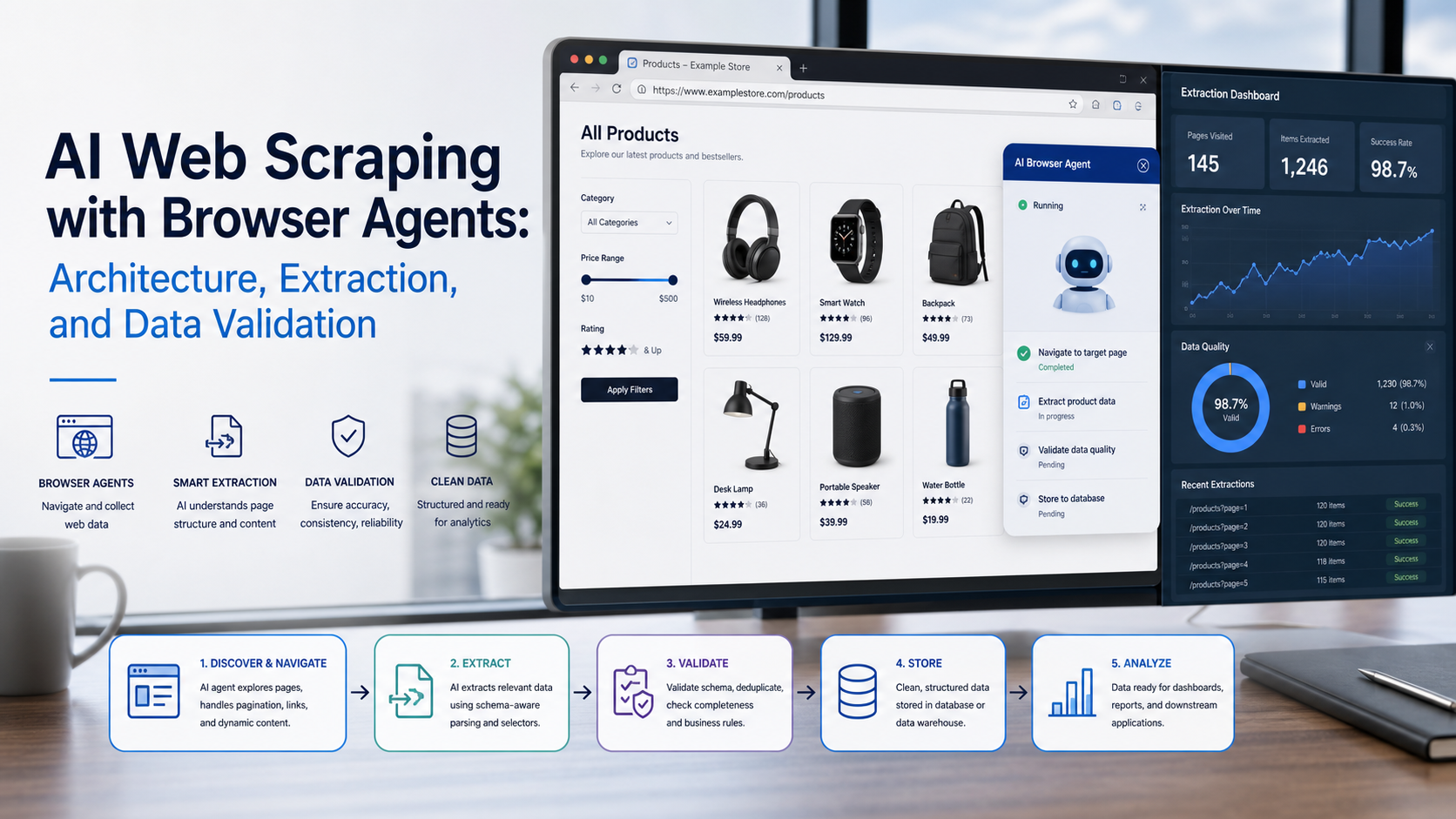
AI Web Scraping with Browser Agents: Architecture, Extraction, and Data Validation
AI web scraping uses AI to help discover, navigate, interpret, or extract information from websites. Browser agents are one implementation option when page interaction, rendering, or layout variation makes a simple scraper too brittle, but the agent should not become the entire data pipeline.
View Details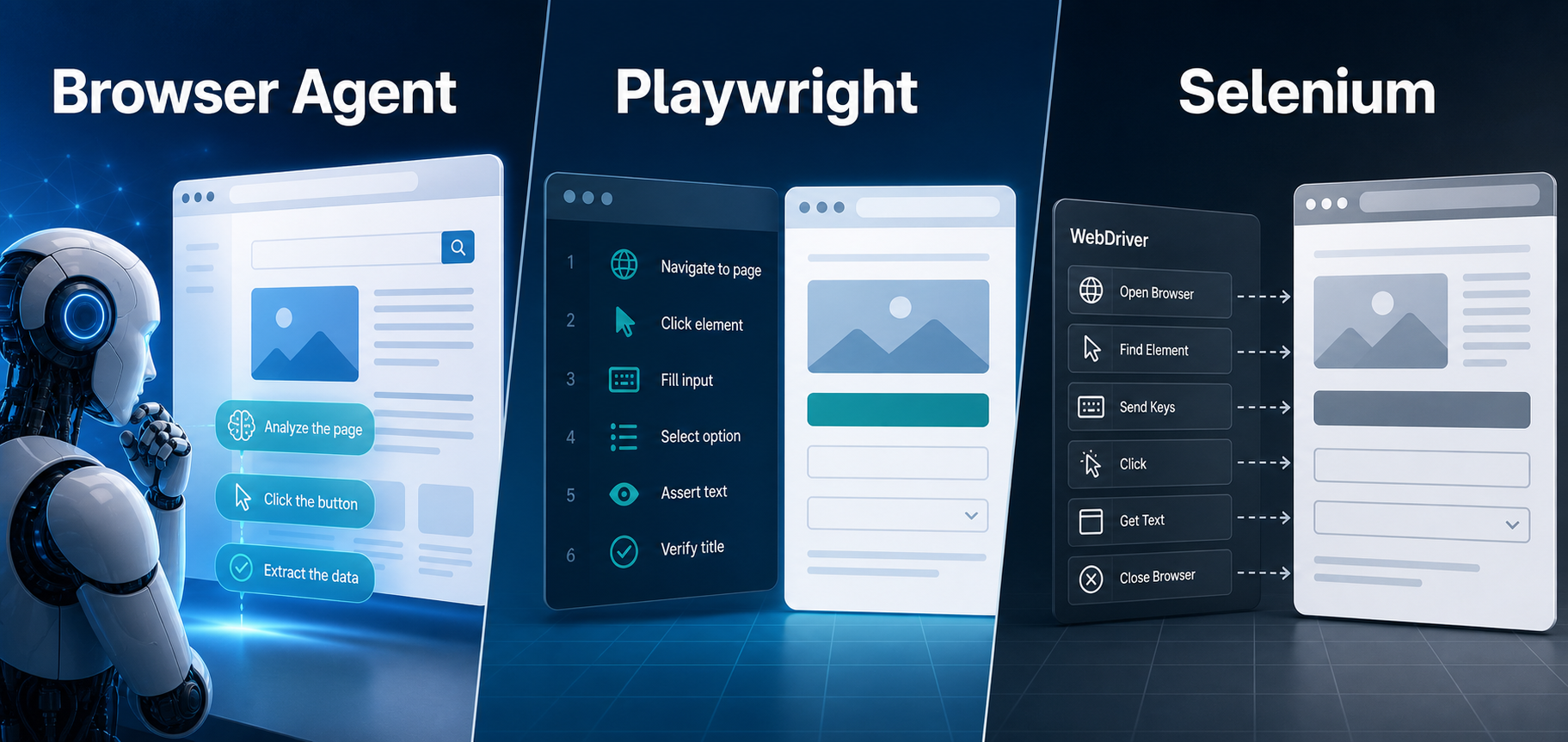
AI Browser Automation: Browser Agents vs Playwright vs Selenium
A browser agent interprets a goal and decides what browser action to take next. Playwright and Selenium can execute explicit, testable browser logic defined by developers. In 2026, however, Playwright also provides official MCP and agent-oriented workflows, so Playwright is no longer just the deterministic alternative to agentic automation. It can also serve as the browser-control layer inside an agent system.
View Details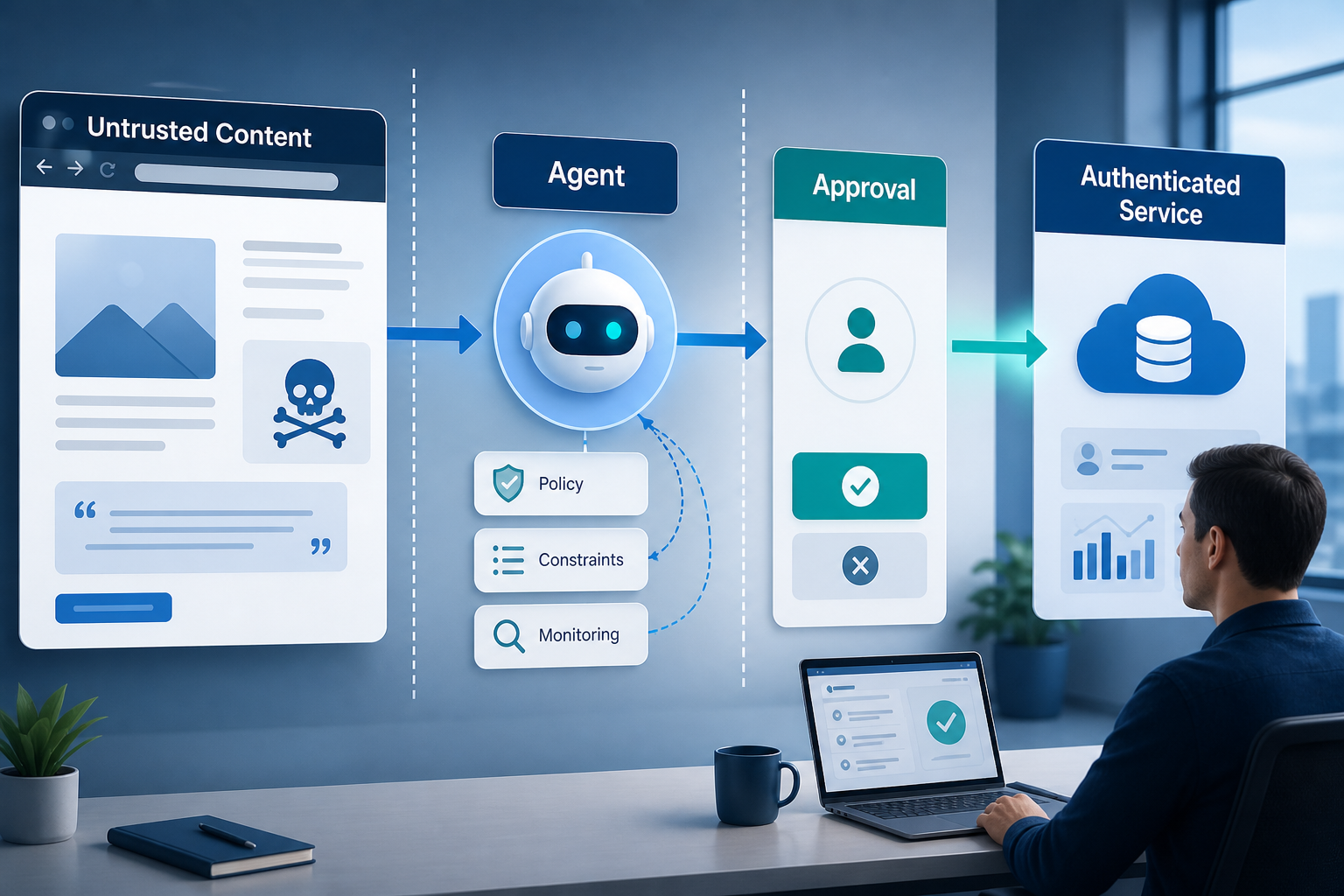
Agentic Browser Security: Prompt Injection, Permissions, and Safe Deployment
That combination creates risks that are different from ordinary browsing and traditional automation. The most important is indirect prompt injection, where hostile instructions hidden in web content attempt to redirect the agent away from the user's goal. Google describes indirect prompt injection as a primary new threat for agentic browsing and has introduced layered defenses that include origin constraints, independent action checks, threat detection, and user confirmation for sensitive actions. Google's Chrome security architecture is a useful reference for how browser-agent defenses are evolving.
View Details
How to Give AI Agents Reliable Real-Time Web Data
A production-ready solution therefore needs more than a web scraper. It needs a web data layer that connects acquisition, validation, storage, retrieval, security, and observability. This guide explains how to design that layer.
View Details