
Starlink vs 5G: Which Technology Actually Wins?
The satellite versus cellular war is heating up, and for network engineers, data teams, and enterprise decision-makers, navigating the marketing hype is exhausting. Here is the technical reality of what you need to know.
Why This Battle Matters Now
We are living through a massive connectivity revolution that is fundamentally altering internet infrastructure. As of early 2026, SpaceX's Starlink has launched and activated over 10,000 working satellites into Low Earth Orbit (LEO), actively serving over 10 million global subscribers. Simultaneously, telecom giants continue pouring billions into densifying 5G towers across the world's metropolitan centers.
The widespread confusion stems from their identical marketing promises: "blazing fast internet everywhere." So, which technology actually delivers on that promise?
The answer isn't simple—because they are fighting entirely different physical and economic battles.
Test Hybrid Networks with LycheeIP
The Latency Reality Check
Let's start with the metric that separates pretenders from true enterprise-grade connections: network latency (ping).
- Starlink's latency: 25–40ms (milliseconds)
- 5G latency: 1–10ms (in Standalone architectures)
That is a 4x to 20x difference. To put this in a practical context:
- Real-Time Applications: Algorithmic trading, automated industrial IoT, and competitive gaming require <20ms to prevent packet collisions and desync.
- Standard Use: Video calls and VoIP operate flawlessly at 40ms.
- Web Browsing: The human eye generally cannot perceive latency differences under 100ms during standard HTTP requests.
Starlink has achieved a monumental engineering feat by bringing satellite latency down from the legacy GEO (Geosynchronous Equatorial Orbit) standard of 600ms. However, 5G conclusively wins the responsiveness war. Physics remains undefeated—a signal traveling 340 miles up to space and back simply cannot beat a fiber-backed cellular tower located two miles down the street.
Download Speed Showdown
Now, let's examine raw throughput—the speeds that dominate billboard advertisements.
Starlink:
- Download: 100–250+ Mbps (driven by the newer V2 Mini satellites).
- Upload: 15–40 Mbps.
- Constraint: Highly variable based on local satellite cell congestion and network load during peak hours.
5G:
- Download: 100–1,000+ Mbps (mmWave bands can physically exceed 4 Gbps).
- Upload: 50–200 Mbps.
- Constraint: Depends entirely on the spectrum band being utilized (low, mid, or high-band).
In mathematically ideal conditions, 5G absolutely destroys Starlink. But there is a massive catch: "ideal conditions" for gigabit 5G require standing near a tower with clear, unobstructed line-of-sight. Starlink's speeds, while lower at their peak, offer more geographic consistency across its operational footprint.
The Coverage Paradigm Shift
This is where the entire game changes.
Starlink Coverage: Literally anywhere with an unobstructed view of the sky.
- Works seamlessly in rural Montana.
- Maintains high-speed links on maritime shipping vessels in the middle of the Pacific.
- Currently active in nearly 80 countries and rapidly expanding.
5G Coverage: Highly concentrated in urban, suburban, and major highway corridors.
- Requires phenomenally expensive ground infrastructure.
- Limited rural deployment (it is mathematically unprofitable for telcos).
- Indoor building penetration is notoriously poor, especially on high-frequency mmWave bands.
According to 2026 data from GSMA Intelligence, 5G networks currently cover roughly 61% of the global population. By stark contrast, Starlink can theoretically cover 100% of the landmass and oceans between the 53°N and 53°S latitudes.
Infrastructure: The Billion-Dollar Difference
To understand the coverage gap, you must look at the Capital Expenditure (CapEx).
5G Requirements:
- Cell towers placed every 2–10 miles (for low-band) or every 300 feet (for mmWave).
- High-capacity fiber-optic backhaul physically trenched to every single tower.
- Spectrum auction fees, land rights, permits, and massive construction crews.
- Estimated Cost: $200,000 to $500,000 per tower deployed according to standard 3GPP 5G specifications.
Starlink Requirements:
- A localized satellite dish (phased array antenna) at the user's location.
- A clear view of the sky.
- An active power source.
- Estimated Cost: ~$599 for the user hardware (the customer absorbs the final-mile infrastructure cost).
This stark economic reality explains the geographic divide: 5G dominates dense cities where thousands of users subsidize a single tower, while Starlink owns the rural market where traditional ISPs refuse to trench fiber.
Use Case #1: Rural and Remote Living
Winner: Starlink (By Knockout)
If you operate in an environment where cable lines end and cellular signals fade to 1G, Starlink is a transformative technology. It is the definitive choice for:
- Agriculture tech utilizing heavy IoT sensors in remote fields.
- Digital nomads and remote workers operating from national parks.
- Maritime freight, aviation, and offshore energy platforms.
Before Starlink, alternatives in these zones were DSL (1–10 Mbps), legacy GEO satellites (600ms latency), or heavily throttled 4G hotspots. Going from dial-up speeds to a consistent 150 Mbps with 30ms latency feels like technological magic.
Use Case #2: Urban High-Speed Everything
Winner: 5G (Decisively)
Inside city limits, 5G reigns supreme. It offers:
- Consistently faster speeds (often 300–500 Mbps on mid-band C-Band spectrums).
- Ultra-low latency for cloud gaming, edge computing, and real-time APIs.
- Zero external equipment installation required.
- True mobility (works inside moving cars, buses, and trains without dropping packets).
Starlink struggles in dense urban environments due to physical obstructions (skyscrapers blocking the sky), severe cell congestion (too many users attempting to hit the same satellite overhead), and the simple fact that it is absolute overkill when cheap, 1-Gigabit fiber is already wired into the building.
Use Case #3: True Mobile Connectivity
Winner: 5G (But Starlink is evolving)
Your standard smartphone cannot connect directly to a traditional Starlink dish without Wi-Fi routing. 5G was natively built from the ground up for highly mobile, battery-constrained devices.
However, the gap is narrowing. As of 2026, SpaceX's "Direct to Cell" satellite service is actively launching, enabling basic LTE text messaging and emergency voice calls directly from unmodified smartphones to LEO satellites. While this will not replace 5G for streaming 4K video on the subway, it guarantees emergency connectivity in total dead zones.
For true broadband mobility—smartphones, connected autonomous vehicles, and dense environments like stadiums—5G remains the only viable option.
Test Hybrid Networks with LycheeIP
The Cost Reality
Enterprise IT and consumer budgets dictate adoption.
Starlink:
- ~$599 upfront equipment fee.
- ~$120/month for standard residential service.
- ~$135 to $150/month for Roam/Mobile service.
- Benefit: Strictly enforced unlimited data (no hard caps).
5G Home Internet (FWA):
- $0–$50 upfront equipment (routers are typically subsidized).
- $50–$70/month.
- Drawback: Often subject to data caps or deprioritization limits based on the carrier.
Starlink requires a much steeper upfront investment, but it serves demographics where the only alternative is literally zero service. In those contexts, $120 a month is a bargain.
The Weather Factor
This is an engineering constraint that consumer reviews frequently gloss over.
- Starlink's Weakness (Rain Fade): Heavy rain, wet snow, and thick atmospheric cloud cover physically degrade Ku and Ka-band satellite signals. Users regularly report 5% to 30% speed reductions and minor latency spikes during severe storms.
- 5G's Reliability: Sub-6GHz 5G is largely unaffected by standard weather. Cellular radio frequencies penetrate precipitation and foliage exceptionally well.
For mission-critical infrastructure that requires "five nines" (99.999%) of uptime regardless of a blizzard, 5G offers superior environmental reliability.
LycheeIP (Developer-First Proxy Infrastructure)
LycheeIP is a developer-first proxy and data infrastructure platform that helps engineering teams reliably route and scale their network requests. As developers build applications meant to seamlessly hand off between high-speed 5G cellular networks and variable Starlink satellite connections, they must rigorously test how their APIs handle wild fluctuations in latency, packet loss, and IP routing.
By integrating a robust developer-first proxy infrastructure, QA teams can globally simulate these diverse network conditions. Utilizing dynamic IP networks allows automated test suites to seamlessly rotate geographic locations, mimicking users transitioning across different global mobile carriers and satellite ISPs. Alternatively, when DevSecOps and data engineering teams require highly stable, persistent connections for heavy backend data ingestion or scraping, datacenter IP solutions provide the dedicated bandwidth necessary to keep operations running flawlessly. Testing your edge cases with LycheeIP ensures your application remains resilient, regardless of how your end-users connect to the internet.
The Verdict: It's Not Either/Or
Stop viewing this as a zero-sum competition. 5G and Starlink are solving completely different infrastructure problems.
Deploy Starlink if you:
- Live or operate beyond the reach of municipal fiber and macro cell towers.
- Require reliable backup internet for remote edge-computing infrastructure.
- Operate maritime fleets, RVs, or highly mobile off-grid units.
- Value universal coverage over absolute peak gigabit speeds.
Deploy 5G if you:
- Operate in urban or heavily suburban sectors.
- Build products reliant on single-digit latency (IoT, robotics, high-frequency trading).
- Require true device portability without mounting an external dish.
- Need deep building penetration and weather immunity.
The Hybrid Approach: Enterprise network architects increasingly utilize both—deploying Starlink as a primary WAN in remote branches and configuring 5G routers as failover redundancies.
The Future is Hybrid
Looking toward 2030, the boundaries between space and terrestrial networks are dissolving.
We are actively entering an era of multi-path networking. With Direct-to-Cell integrations, low-orbit 5G base stations, and advanced network slicing, your smartphone or autonomous vehicle will soon seamlessly switch between a terrestrial 5G tower and an overhead Starlink satellite without dropping a single packet.
The real winner of this war? Universal connectivity. For the first time in human history, we have achieved true global internet access. Whether the TCP handshake comes from space or a tower down the street increasingly won't matter. The satellite versus cellular war isn't about winners and losers—it is about permanently filling the world's coverage gaps.
Test Hybrid Networks with LycheeIP
Frequently Asked Questions
Q: Is Starlink ultimately faster than 5G?
A: No, 5G is natively faster. In optimal conditions, 5G can deliver speeds from 300 Mbps to over 3 Gbps depending on the spectrum band (Mid-band vs mmWave). Starlink currently averages between 100 to 250 Mbps. However, Starlink's speeds are vastly more consistent in rural areas where 5G coverage drops off entirely.
Q: Which technology has better latency for online gaming and real-time APIs?
A: 5G provides significantly better latency, frequently testing between 1–10ms. Starlink averages 25–40ms. For competitive gaming or high-frequency automated tasks that require sub-20ms ping times, 5G is the superior choice. However, Starlink's latency is still highly acceptable for 95% of standard internet applications.
Q: Can Starlink work well in major cities, or is it strictly for rural areas?
A: Starlink can technically work in cities provided you have a 100% clear, unobstructed view of the sky. However, urban areas suffer from physical obstructions (buildings blocking the dish's field of view) and severe network congestion. In cities, cheaper, faster options like fiber or 5G Home Internet are vastly superior.
Q: Does weather affect Starlink and 5G differently?
A: Yes. Starlink performance can temporarily degrade by 5% to 30% during heavy rain, wet snow, or thick cloud cover (known as rain fade) because the signal must penetrate the atmosphere. Standard Sub-6GHz 5G is largely unaffected by weather, as its cellular radio waves penetrate precipitation easily over short distances.
Q: Will Starlink replace 5G in the future?
A: No, they are strictly complementary technologies. Starlink excels in remote geographic areas where trenching fiber for 5G towers is economically impossible. 5G dominates high-density urban areas with its superior speed, low latency, and mobile capabilities. Future network hardware will integrate both technologies seamlessly.

Recommended Articles

SERP API Troubleshooting: Fix Empty, Wrong, or Inconsistent Search Results
SERP API failures are not limited to obvious HTTP errors. A request can return successfully and still produce empty, incomplete, geographically wrong, duplicated, or misinterpreted search data. Production troubleshooting therefore has to separate transport problems from provider processing, SERP differences, and downstream parsing errors.
View Details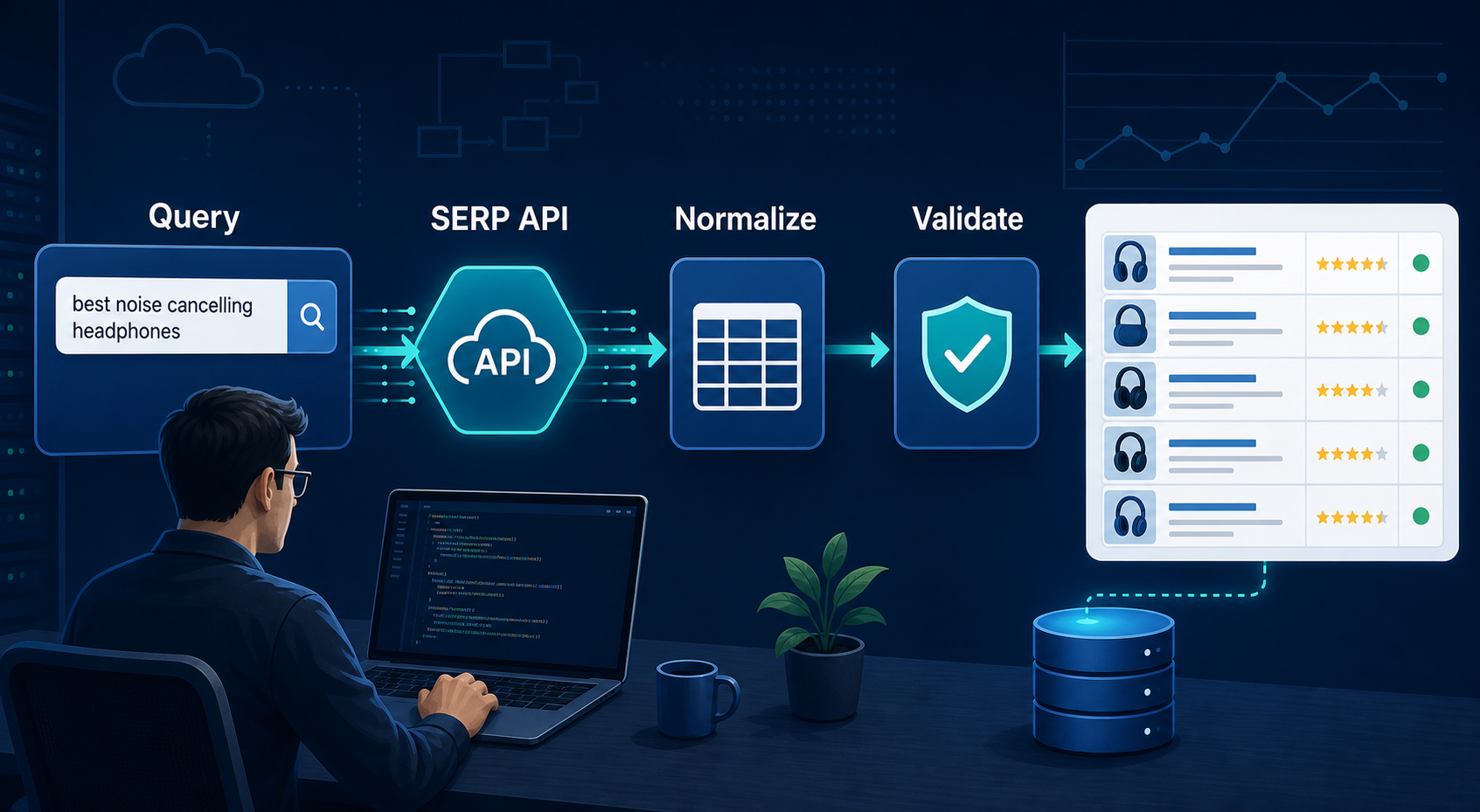
SERP API Python: How to Build a Reliable Search Data Pipeline
This guide shows a provider-neutral workflow for building that pipeline. It does not rank SERP API vendors. Instead, it focuses on the implementation choices that make a Python integration easier to operate, test, and migrate.
View Details
SERP Scraping API: How to Choose the Right Provider
Recommended Meta Description: Compare SERP scraping APIs by data coverage, localization, reliability, workflow fit, and cost structure, then choose and validate the right provider.
View Details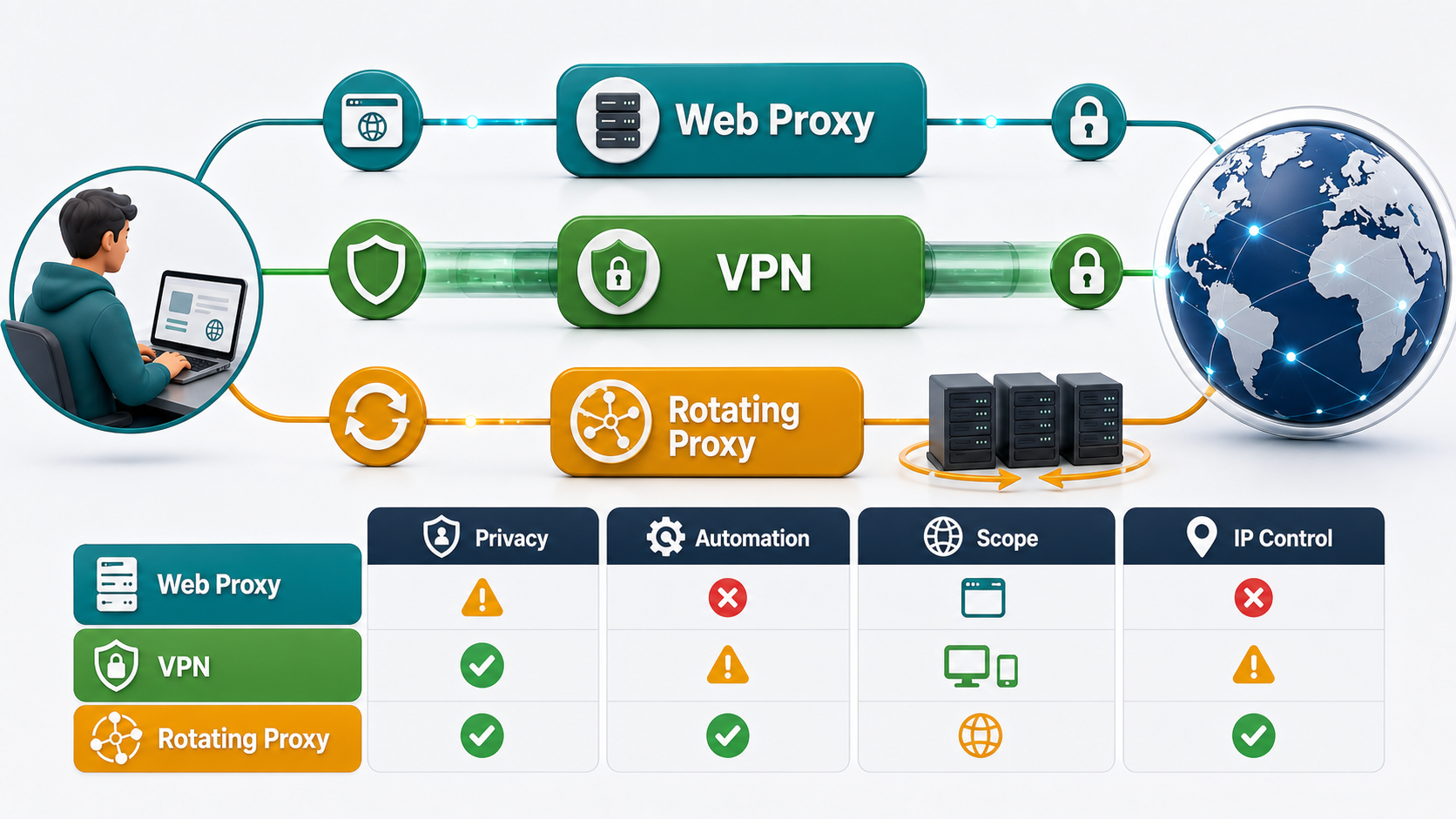
Free Web Proxy vs VPN vs Rotating Proxy: Which Should You Use?
Compare free web proxies, VPNs, rotating proxies, static proxies, and datacenter proxies by scope, encryption, IP control, automation, streaming, and account workflows.
View Details
BlockAway Not Working? Fix Common Proxy, Video, and Access Problems
Troubleshoot BlockAway when pages are blocked, YouTube fails, JavaScript breaks, speed drops, sessions expire, or mobile access behaves differently.
View Details