
MCP vs CLI: Which Should Your AI Agent Use?
Your AI agent can use a terminal or an MCP server. Picking the wrong interface can make the difference between a workflow that behaves predictably and one that breaks in ways that are difficult to debug.
This is now a practical architecture question for developers building agent pipelines. As AI agents become more capable of taking actions, calling tools, fetching data, running scripts, and coordinating multi-step workflows, the way they interact with external systems matters more than ever.
Use CLI where MCP is needed, and your agent may spend too much time interpreting raw output, recovering from formatting changes, or guessing what went wrong. Use MCP where a simple command would do, and you may add unnecessary infrastructure, context overhead, and maintenance work.
The right answer is not “CLI is old” or “MCP is better.” The right answer depends on the task.
This guide gives you a practical decision framework for choosing between CLI and MCP for AI agents. It explains what each approach offers, where they differ, how they behave under real workloads, and how the choice affects workflows involving APIs, file operations, proxy infrastructure, public-data collection, testing, and production automation.
Scale Agent Workflows Safely
ACT 1: The Core Difference Between CLI and MCP for AI Agents
At the simplest level, CLI and MCP represent two different ways for an AI agent to use tools.
A command-line interface lets the agent run a command and read the result. MCP gives the agent a structured tool interface with declared inputs, outputs, and behavior.
That may sound like a small difference, but it changes how reliable the entire workflow becomes.
Why the interface choice matters
AI agents are not just executing one instruction at a time. In real workflows, they often need to:
- Choose the right tool
- Construct parameters
- Handle errors
- Read outputs
- Decide the next step
- Pass data into another system
- Repeat the process many times
Every one of those steps depends on how clearly the tool communicates with the agent.
A CLI command can be fast and flexible, but it often returns plain text that the agent has to interpret. MCP is usually slower to set up, but it gives the agent a typed contract that is easier to reason about.
For small tasks, that distinction may not matter. For repeated production workflows, it matters a lot.
The practical architecture question
The real question is:
Does this task need speed and flexibility, or does it need structure and repeatability?
If the agent is exploring a local file system, running a script, checking a package version, or converting a file once, CLI is usually enough.
If the agent is repeatedly calling APIs, selecting parameters, routing HTTP requests, querying databases, or coordinating shared tools across multiple agents, MCP is often the cleaner interface.
That is the core difference: CLI gives your agent access. MCP gives your agent a contract.
What CLI Gives Your Agent
The command-line interface is the original programmable surface. Your agent sends a shell command, something runs, and output comes back as text.
That makes CLI extremely useful for agent development. It works with existing systems, requires little setup, and gives the agent access to a huge ecosystem of developer tools.
For AI agents, CLI interaction usually means the agent can:
- Execute shell commands through a subprocess
- Use existing binaries, scripts, and package managers
- Read stdout and stderr
- Interpret exit codes
- Chain commands with pipes or scripts
- Use operating-system-level utilities directly
Fast access to existing tools
The biggest advantage of CLI is reach.
If a tool already has a CLI, your agent can often use it immediately. That includes:
- Git
- Docker
- npm, pnpm, pip, cargo, and other package managers
- File conversion tools
- Build systems
- Testing frameworks
- Local scripts
- Database clients
- Cloud provider CLIs
- HTTP tools such as curl
This is why CLI is so attractive during prototyping. You do not need to design schemas, run a server, or build a wrapper. The agent can simply call the tool.
For teams experimenting with agent workflows, this speed matters. You can test an idea quickly, see where the workflow breaks, then decide whether a more structured interface is worth building.
The hidden cost of unstructured output
CLI’s strength is also its weakness: the output is usually unstructured text.
When an agent runs a command, the result may include:
- A clean JSON response
- A human-readable summary
- A progress bar
- Warning messages
- Debug logs
- Platform-specific formatting
- Version-specific wording changes
- Errors mixed into standard output
The agent then has to interpret that text correctly.
Sometimes this is easy. A command that returns true, false, or a single file path is simple to handle. But when the output is long, nested, noisy, or inconsistent, CLI becomes fragile.
This is especially important for HTTP and data workflows. HTTP responses can include status codes, headers, redirects, cookies, body content, compression, rate-limit signals, and authentication errors. If your agent needs to reason about those details, relying on raw terminal output can quickly become messy. A good grounding in HTTP request and response behavior helps, but the agent still needs a reliable way to process the result.
Where CLI still shines
CLI is still the right choice when the task is simple, local, or exploratory.
Use CLI when:
- The command is easy to test manually
- The output is short and predictable
- The task is not part of a repeated production workflow
- The tool has no MCP server
- You already have a trusted script
- The agent only needs success or failure, not detailed structured fields
For example, asking an agent to run a local test suite and check whether it passed is a good CLI use case. Asking an agent to repeatedly query an internal API, normalize the response, rotate sessions, and pass structured fields to another service is less ideal for raw CLI.
CLI is best when access matters more than contract.
Scale Agent Workflows Safely
What MCP Gives Your Agent
MCP, or Model Context Protocol, is designed to give AI agents a structured way to interact with external tools and services.
Instead of telling an agent to run a shell command and parse whatever comes back, MCP exposes tools with names, descriptions, parameters, and expected response structures. The agent sees the available tools, understands what inputs they accept, and calls them through a defined interface.
The official Model Context Protocol documentation describes MCP as a standard way to connect AI applications with external context and tools.
Structured tool contracts
From an agent design perspective, MCP gives you a contract.
A tool definition can describe:
- What the tool does
- Which parameters it accepts
- Which parameters are required
- What types those parameters should be
- What the output should look like
- What errors may occur
This changes how the model behaves. Instead of improvising a command, the agent selects a declared tool and fills in structured arguments.
That reduces ambiguity.
For example, instead of constructing a long shell command with flags, credentials, and output parsing rules, the agent might call a tool such as fetch_customer_record, query_inventory, run_search, or fetch_with_proxy with named parameters.
The server handles the actual implementation. The agent works with the structured interface.
Tool discovery and validation
MCP also improves tool discovery.
A CLI environment may contain hundreds of commands, but the agent does not automatically know which ones are safe, relevant, or available. With MCP, the available tools are explicitly declared.
That means the agent can reason from a curated set of capabilities instead of guessing.
Input validation is another major benefit. If a tool expects a date, enum, URL, ID, country code, or numeric limit, the MCP schema can define that expectation. Invalid inputs can be rejected before the operation runs.
That matters in agentic workflows because malformed inputs can be expensive. A bad shell command may fail noisily, but it may also trigger the wrong operation, hit the wrong endpoint, overwrite a file, or send a request with missing parameters.
MCP does not remove all risk, but it gives you better control points.
Why typed responses matter for agents
Agents are strongest when the next step is clear.
Typed responses make that easier. If a tool returns a structured object, the agent can work with specific fields instead of interpreting a wall of text.
For example:
- status_code
- response_body
- error_type
- retry_after
- session_id
- region
- request_id
- records_found
These fields are easier to test, log, validate, and pass downstream.
This is why MCP is attractive for production workflows. It turns tool use into something closer to API integration rather than terminal automation.
MCP is best when the workflow needs a reliable contract.
The Fundamental Tradeoff
The CLI vs MCP decision is not about old versus new. It is about what kind of failure you are willing to manage.
CLI fails when text output becomes hard to parse, commands become hard to construct, or local environment assumptions drift.
MCP fails when schemas become too complex, servers are unavailable, or tool definitions consume too much context.
Both approaches have costs. They just appear in different places.
CLI optimizes for reach and speed
CLI is usually the fastest path from idea to execution.
It is strong when you need to:
- Move quickly
- Use existing tools
- Work locally
- Chain simple commands
- Avoid building new infrastructure
- Test workflows before formalizing them
The cost is that your agent may need to interpret unstructured results. As the workflow grows, that interpretation layer can become the weakest part of the system.
MCP optimizes for structure and reliability
MCP is usually better when the workflow has to run repeatedly.
It is strong when you need:
- Typed parameters
- Consistent outputs
- Tool discovery
- Input validation
- Shared tools across agents
- More predictable error handling
- Cleaner production boundaries
The cost is setup overhead. You need an MCP server, tool definitions, schemas, and lifecycle management.
The real decision point
A practical way to think about the tradeoff:
CLI is better when the agent needs to do something quickly. MCP is better when the agent needs to do something correctly many times.
For prototypes, CLI often wins. For production systems, MCP often becomes more attractive.
The mistake is choosing one interface by default.
ACT 2: Context Window Cost, Output Verbosity, and Workflow Behavior
CLI and MCP also differ in how they consume context.
MCP tends to spend tokens upfront because the agent needs to see tool definitions. CLI tends to spend tokens during execution because command output can be long, noisy, or inconsistent.
That difference affects how your agent behaves over long workflows.
The cost is paid in different places
With MCP, the model needs to know which tools exist and how to call them. Tool names, descriptions, parameters, and schemas may be injected into the context window before the task begins.
With CLI, there may be little or no upfront tool description. But when a command runs, the output can consume a large amount of context.
Neither cost is automatically worse. The question is which cost is more predictable and manageable for your workflow.
Why long workflows expose weak interfaces
A short workflow can tolerate messy output.
A long workflow cannot.
When an agent performs one task, you may be able to recover from a vague error or noisy output. But when an agent performs 30 tool calls in sequence, small uncertainties compound.
That is why interface choice becomes more important as workflows become longer, more automated, or more expensive to rerun.
Scale Agent Workflows Safely
How MCP Tool Definitions Consume Tokens Upfront
When you connect an MCP server to an agent, the tool definitions need to be available to the model. The model must know which tools exist, what they do, and how to call them.
For a small server with a few focused tools, this cost may be minor. But for larger servers, the context overhead can become meaningful.
A database MCP server, for example, may expose many tools for listing tables, querying records, updating rows, inspecting schemas, and managing connections. Each tool may include a description and several parameters. If the agent is connected to multiple such servers, the upfront context grows quickly.
Tool schemas are useful but not free
This upfront cost buys reliability.
The agent can call tools with more precision because it understands the allowed parameters. It does not need to infer flags or parse help text. It can work from a defined interface.
But more tool definitions do not always mean better agent performance.
Too many tools can create:
- Larger prompts
- Slower reasoning
- Higher token usage
- More tool-selection confusion
- More room for overlapping capabilities
A large MCP surface can become its own kind of complexity.
How to reduce MCP context overhead
Good MCP design is not just about exposing tools. It is about exposing the right tools.
Practical ways to reduce overhead include:
- Keep tool names clear and specific
- Avoid exposing tools the agent does not need
- Split large servers into focused servers
- Use concise descriptions
- Avoid deeply nested schemas unless necessary
- Prefer fewer high-value tools over many tiny overlapping tools
- Version schemas when behavior changes
The goal is not to make MCP invisible. The goal is to make the interface compact, predictable, and useful.
How CLI Output Verbosity Creates Different Problems
CLI avoids most upfront tool-description cost. But it can create unpredictable context usage during execution.
A CLI command may return a few lines, or it may return thousands. The output may be clean JSON, or it may be mixed with logs, warnings, progress messages, and environment-specific notices.
For example, an agent might run npm audit --json. Ideally, it receives structured JSON. In practice, the output may include warnings, dependency noise, or very large vulnerability trees.
The model then has to process that output before deciding what to do next.
Per-call output can overwhelm the agent
The problem becomes more serious in repeated workflows.
An agent may run:
- A test command
- A build command
- A linter
- A migration script
- A data-fetching command
- A file-processing command
- A deployment command
Each command may produce logs. Those logs consume context. If the agent does not summarize or filter them, the useful task context can get pushed aside.
This is one reason production agents need careful output management. They should not always receive full raw logs. Sometimes they only need:
- Exit status
- Error summary
- Relevant lines
- Structured JSON fields
- File paths created
- Warnings that require action
Logs, warnings, and mixed output create parsing risk
CLI output also creates parsing risk.
A command may succeed but print warnings. Another command may fail but still produce partial output. A third tool may write errors to stdout instead of stderr. A fourth may change wording after an update.
If your agent depends on exact text matching, this is fragile.
For production CLI use, reduce the risk by:
- Using machine-readable output flags where available
- Pinning tool versions
- Capturing exit codes separately
- Separating logs from structured output
- Writing small wrapper scripts that normalize output
- Passing only the relevant summary back to the agent
CLI can be reliable, but only if you control the output boundary.
Practical Workflow Comparison
The best way to understand CLI and MCP is to compare how they behave on real tasks.
Task: Fetch and process structured data
Suppose an agent needs to fetch structured data from an internal API, inspect the response, and pass selected fields into another workflow.
With a CLI approach, the agent may:
- Construct a curl command with URL, headers, query parameters, and authentication.
- Run the command through a shell.
- Receive raw response text.
- Parse the body.
- Handle status codes, redirects, and errors.
- Decide what fields matter.
- Pass those fields into the next step.
This can work, especially for simple API calls. But it places a lot of responsibility on the agent. The agent must construct the command correctly and interpret the output correctly.
With an MCP approach, the agent may:
- Call a defined tool such as fetch_data.
- Provide typed arguments such as endpoint, filters, and limit.
- Let the MCP server handle authentication and HTTP behavior.
- Receive a structured response.
- Use typed fields directly in the next step.
The MCP version takes more work to set up, but it is easier to maintain. The agent is no longer responsible for constructing low-level command syntax or interpreting raw HTTP output.
Task: Run a one-off file conversion
Now suppose an agent needs to convert a single file.
With CLI, the agent can call the relevant conversion tool, check the exit code, and confirm the output file exists.
That is usually enough.
With MCP, you would need a server or wrapper that exposes the conversion tool, defines parameters, handles file access, and returns structured results.
For a one-off conversion, that overhead may not be justified.
What the comparison tells us
The lesson is simple:
- If the tool interaction is simple and temporary, CLI is usually better.
- If the tool interaction is repeated, structured, shared, or business-critical, MCP becomes more attractive.
The right choice depends less on the tool itself and more on how often the agent uses it, how complex the output is, and how costly failure would be.
Scale Agent Workflows Safely
The Reliability Spectrum
A useful mental model is this:
CLI reliability degrades with output complexity. MCP reliability degrades with schema complexity.
Neither approach is automatically reliable. Each has a different weak point.
CLI reliability depends on output stability
Simple CLI commands can be extremely reliable.
A command that returns a version number, creates a file, or exits with a clear success code is easy for an agent to handle.
CLI becomes less reliable when:
- Output is long
- Output format changes across versions
- Errors are mixed with normal output
- The command depends on local environment state
- The agent must infer meaning from human-readable text
- Multiple commands are chained together without clear checkpoints
The more the agent has to parse, the more brittle the workflow becomes.
MCP reliability depends on schema quality
MCP is strongest when schemas are clear.
A simple tool with required parameters and a predictable response object is easy for an agent to use. But MCP can become confusing if the schema is too large, too vague, or too flexible.
MCP becomes less reliable when:
- Tool descriptions overlap
- Too many optional parameters exist
- Parameters are poorly named
- Output schemas are inconsistent
- Errors are not clearly typed
- Tool behavior changes without schema updates
Bad MCP design can recreate CLI-style ambiguity inside a structured interface.
Match interface complexity to workflow complexity
The goal is not to make every tool structured. The goal is to structure the parts of the workflow that need structure.
Use simple interfaces for simple tasks. Use stronger contracts for repeated or high-risk tasks.
That is the practical middle ground.
Where Proxy Workflows Fit This Picture
Developers building agents for web scraping, public-data collection, geo-testing, localization QA, ad verification, e-commerce monitoring, or security testing with authorization often need to make HTTP requests through proxy infrastructure.
This is where the CLI vs MCP decision becomes especially important.
Proxy workflows can involve:
- Proxy authentication
- Session persistence
- IP rotation
- Country or region selection
- Datacenter versus residential routing
- Retry behavior
- HTTP status handling
- Rate-limit awareness
- Response parsing
- Credential management
A basic CLI command can test whether a proxy endpoint works. But a production agent needs more than a working request. It needs predictable behavior across many requests.
Why proxy workflows stress agent design
Proxy-assisted workflows often combine network behavior, data parsing, and compliance boundaries.
For legitimate use cases such as QA, geo-testing, localization checks, public-data collection where permitted, and authorized security testing, the agent still needs to behave responsibly. It should respect applicable laws, website terms, rate limits, and technical access controls.
The interface matters because mistakes can be costly.
A malformed proxy command may expose credentials. A poorly handled retry loop may overload a target server. A weak parser may treat an error page as valid data. A missing region parameter may produce misleading QA results.
Good architecture reduces those risks.
CLI proxy calls are useful for testing
For early testing, CLI is practical.
A developer can run a request through a proxy endpoint, inspect the response, verify authentication, and confirm routing behavior.
That kind of manual workflow is useful when you are still answering basic questions:
- Does the endpoint work?
- Are credentials valid?
- Is the target reachable?
- Is the response what we expected?
- Do we need residential, datacenter, or static residential routing?
For teams still comparing infrastructure patterns, a provider like LycheeIP’s proxy infrastructure can be evaluated alongside the interface design: not just “which proxy type fits the job,” but also “how will the agent safely and reliably call it?”
MCP-style proxy workflows are better for repeatable pipelines
Once proxy use becomes repeatable, MCP-style tooling becomes more attractive.
Instead of having an agent construct raw proxy commands, a structured tool could expose operations such as:
- Fetch a URL with a selected region
- Start or reuse a session
- Rotate a session
- Check endpoint health
- Return status code, headers, and response metadata
- Fail with structured error messages
This makes proxy usage easier to test and safer to operate.
For example, if a workflow depends on region-aware public-data collection, the agent should not have to remember every proxy flag manually. It should call a typed tool with a region parameter and receive a structured response.
That is where MCP can turn a fragile terminal workflow into a reliable pipeline component.
ACT 3: The Decision Framework
Choosing between CLI and MCP should start with the workflow, not with the technology.
Ask what the agent needs to do, how often it needs to do it, how structured the result must be, and what happens when the tool call fails.
Start with the workflow, not the tool
A useful decision process looks like this:
- Define the task.
- Identify the tool or service involved.
- Determine how often the agent will call it.
- Decide whether the output must be parsed programmatically.
- Estimate the cost of failure.
- Check whether an MCP server already exists.
- Decide whether CLI is enough or a structured wrapper is justified.
This keeps the decision grounded.
Think in terms of failure modes
The key question is not “Can the agent do this with CLI?”
Often, the answer is yes.
The better question is:
Will this still be reliable after repeated runs, tool updates, malformed inputs, network errors, and changing output formats?
If the answer is uncertain, MCP or a structured wrapper may be worth the setup cost.
Scale Agent Workflows Safely
When to Prefer CLI
CLI is the right choice when speed, reach, and simplicity matter more than structured contracts.
Prototyping and exploration
CLI is excellent in early development.
When you do not yet know what the final workflow should look like, CLI gives you room to experiment. You can run commands manually, inspect outputs, test assumptions, and iterate quickly.
At this stage, building an MCP server may be premature. You may not yet know which tools deserve formal wrappers.
Use CLI first when the workflow is still being discovered.
Simple output and low-frequency tasks
CLI is also appropriate when the output is simple.
Examples include:
- Checking a tool version
- Listing files
- Running a test command
- Creating an archive
- Converting one file
- Executing a script that already returns clean output
- Running a one-time diagnostic
If the task runs rarely and failure is easy to inspect manually, CLI is usually enough.
Existing scripts and system-level tools
Many teams already have scripts that work well.
If a script is stable, documented, and produces predictable output, there may be no immediate reason to wrap it in MCP.
The same applies to system-level tools. Many operating-system and developer utilities are naturally CLI-first. For these, MCP should only be considered when the workflow becomes repeated, shared, or hard to parse.
Prefer CLI when:
- The task is one-off
- The command is easy to test
- The output is short
- Existing automation already works
- The agent only needs success or failure
- A structured wrapper would add more complexity than value
When to Prefer MCP
MCP is the right choice when structure, validation, and repeatability matter.
Repeated structured operations
If the agent calls the same tool repeatedly, MCP becomes more attractive.
Repeated operations benefit from:
- Typed inputs
- Consistent outputs
- Centralized error handling
- Reusable tool definitions
- Cleaner logging
- Easier testing
This is especially true for API calls, database queries, search tools, CRM operations, data pipelines, proxy-routed requests, and multi-agent workflows.
If a tool call is part of the core workflow, it deserves a stronger interface.
Shared tools across agents
MCP is also useful when multiple agents or workflow stages need the same capability.
Without MCP, each agent may need its own CLI prompt instructions, parsing logic, and error handling. That creates duplication.
With MCP, the tool interface can be shared.
This makes it easier to maintain one implementation and expose it consistently across different agents.
Production workflows that need validation
Production workflows need stronger guardrails than prototypes.
MCP is useful when:
- Bad inputs could trigger costly operations
- Outputs must be processed by downstream systems
- Errors need to be classified
- Tool behavior must be logged
- Several agents use the same capability
- The workflow must be audited or debugged later
A production agent should not be guessing how to call critical tools. It should operate through clear boundaries.
Prefer MCP when:
- The task runs frequently
- The output is structured
- The operation is business-critical
- Multiple agents need the tool
- Input validation matters
- The workflow needs observability
- CLI parsing has already become fragile
Scale Agent Workflows Safely
The Hybrid Approach
Most real-world agent systems should use both CLI and MCP.
The goal is not to force every tool into one pattern. The goal is to place each tool behind the right kind of interface.
Use CLI for speed
CLI is useful for:
- Local scripts
- Development tooling
- System commands
- One-off operations
- Build and test commands
- File manipulation
- Tools without MCP support
This keeps the workflow flexible.
Use MCP for contracts
MCP is useful for:
- API calls
- Database operations
- Repeated data-fetching tasks
- Proxy-routed requests
- Shared internal tools
- Structured search
- Production integrations
- Workflows that need strong validation
This keeps the workflow reliable.
Promote CLI tools only when the workflow proves it
A good rule:
Start with CLI when exploring. Promote to MCP when the task becomes repeated, structured, or shared.
Do not wrap every command immediately. That creates unnecessary maintenance.
But do not leave critical production workflows dependent on fragile text parsing just because CLI was faster at the beginning.
The hybrid model works best when every interface has a reason.
Decision Checklist
Before choosing CLI or MCP, ask the following questions.
Questions to ask before choosing
- Is this task exploratory or production-critical?
- Will the agent run it once, occasionally, or repeatedly?
- Does the output need to be parsed into specific fields?
- Is the output short and predictable?
- Does the tool already provide machine-readable output?
- Does an MCP server already exist?
- Would multiple agents or workflow stages use this tool?
- Could malformed inputs cause damage, cost, or security issues?
- Does the task involve credentials or sensitive configuration?
- Does the workflow need structured logging or observability?
- Would a schema make the operation safer?
- Would an MCP server add more overhead than value?
How to interpret the answers
Choose CLI when most answers point toward:
- Speed
- Flexibility
- Low frequency
- Simple output
- Manual inspection
- Existing scripts
- Prototyping
Choose MCP when most answers point toward:
- Repeatability
- Structured output
- Shared tooling
- Input validation
- Production reliability
- Programmatic processing
- Clear error handling
The decision does not need to be permanent. Many workflows start with CLI and later move critical operations into MCP.
LycheeIP Context: Proxy Infrastructure in Agent Pipelines
Proxy routing is a common requirement in AI agent workflows built for public-data collection, SERP monitoring, localization testing, e-commerce research, ad verification, and QA across different regions.
These workflows face the same CLI vs MCP decision as any other agent tool interaction.
A simple proxy test can run through CLI. A production data workflow usually needs more structure.
Proxy routing as an agent design problem
When an agent uses proxy infrastructure, it is not only making a network request. It may also need to decide:
- Which proxy type fits the task
- Whether the session should persist
- Which region is needed
- How authentication should be handled
- How failed requests should be retried
- How to separate blocked, failed, and successful responses
- How to avoid exposing secrets
- How to remain within applicable laws and target-site terms
That makes proxy workflows architectural, not just operational.
For example, dynamic residential proxies may be relevant when a workflow needs rotating residential IP access for legitimate data operations, while datacenter proxy infrastructure may be a better fit for use cases where speed, cost efficiency, and simpler routing are the priority.
The product choice matters, but so does the interface the agent uses to call it.
Product choice and interface choice are separate decisions
A team can choose the right proxy product and still build the wrong agent integration.
For light testing, CLI may be enough. For a repeated workflow, it may be better to expose proxy behavior through a structured tool that validates region, session, and request parameters before execution.
A useful way to separate the decisions:
- Proxy product decision: What kind of IP infrastructure does the workflow need?
- Agent interface decision: Should the agent call it through CLI, MCP, or a custom wrapper?
- Governance decision: How will the workflow respect laws, website terms, robots.txt where applicable, and rate limits?
The robots exclusion protocol is formally defined in RFC 9309, and responsible data workflows should treat access rules and site policies as design inputs rather than afterthoughts.
LycheeIP (Developer-First Proxy Infrastructure)
LycheeIP is a proxy and data infrastructure provider for teams that need reliable IP routing options for technical workflows such as data access, testing, and automation.
A team would consider LycheeIP when its agent pipeline needs proxy infrastructure as part of a legitimate, repeatable workflow: for example, testing localized experiences, collecting public data where permitted, checking regional availability, or supporting QA processes that depend on network location. The key is to pair the right proxy type with the right agent interface.
For early experiments, a developer may test proxy behavior through CLI. As the workflow matures, that same proxy logic may be better handled behind a typed MCP-style tool or internal service wrapper.
LycheeIP’s static residential proxy options may be relevant when a workflow needs more consistent residential routing, while its broader developer-focused proxy infrastructure can be evaluated as part of the agent architecture rather than treated as a separate add-on.
In practice, the safest pattern is to keep proxy credentials out of prompts and command strings, route them through environment variables or a secrets manager, and expose only the minimum tool parameters the agent actually needs. That helps the agent stay focused on the task while the infrastructure layer handles authentication, routing, and operational controls.
Common Mistakes and Considerations
The CLI vs MCP decision becomes easier when you avoid the common traps.
Avoid premature abstraction
The first mistake is wrapping every CLI tool in MCP too early.
Not every command deserves a server. If a task is rare, simple, or still experimental, CLI is usually the right starting point.
Premature abstraction creates:
- More code to maintain
- More schemas to update
- More infrastructure to run
- More tool definitions in context
- More complexity before the workflow is proven
Start simple. Promote only the parts of the workflow that clearly need structure.
Control context, credentials, and failure handling
The second mistake is ignoring operational boundaries.
For MCP, this means watching tool-definition size. Large MCP servers can consume context before the agent begins the actual task. Keep tool surfaces focused.
For CLI, this means controlling command output. Do not feed huge logs into the agent unless the agent truly needs them. Summarize, filter, and normalize where possible.
For both approaches, credential management matters.
Avoid:
- Hardcoding secrets in prompts
- Embedding proxy credentials in command strings
- Logging sensitive headers
- Passing raw environment dumps to the model
- Letting agents construct high-risk commands without guardrails
Use secrets managers, environment variables, scoped credentials, and clear permission boundaries.
Security guidance such as the OWASP Secrets Management Cheat Sheet is especially relevant when agents interact with APIs, proxy credentials, cloud tools, and internal systems.
Keep proxy and data workflows responsible
A third mistake is treating “agent automation” as permission to ignore website rules.
Whether your agent uses CLI, MCP, or a hybrid interface, data workflows should be designed for legitimate use cases and responsible operation.
That means:
- Follow applicable laws
- Respect site Terms of Service
- Avoid overloading target systems
- Use rate limits and backoff logic
- Do not bypass access controls
- Use authorization for security testing
- Keep audit logs for production workflows
- Separate allowed use cases from prohibited ones
This is especially important for workflows involving public-data collection, scraping, ad verification, localization testing, and proxy routing.
The interface choice can help enforce these boundaries. An MCP tool can validate parameters and reject risky operations. A CLI wrapper can restrict allowed commands and normalize output. Either approach is better than allowing an unrestricted agent to improvise sensitive network operations.
Conclusion
The CLI vs MCP decision is not about which technology is better. It is about matching your agent’s tool interface to the workflow’s requirements.
CLI is fast, flexible, and widely supported. It is the right choice for prototyping, one-off tasks, system commands, existing scripts, and tools with simple output.
MCP provides typed contracts, structured responses, validation, and better production boundaries. It is the better fit for repeated operations, shared tools, structured data workflows, and agent pipelines where reliability matters.
The strongest agent architectures usually use both.
They use CLI where speed and flexibility matter. They use MCP where reliability and repeatability matter. They promote CLI workflows into structured tools only when the task proves it deserves that investment.
For workflows involving external data, proxy infrastructure, API access, or repeated structured operations, the interface is not a minor implementation detail. It is part of the system design.
Choose it deliberately.
Scale Agent Workflows Safely
Frequently Asked Questions
Q: What is MCP in the context of AI agents?
A: MCP, or Model Context Protocol, is a protocol that gives AI agents a structured way to interact with external tools and services. Instead of relying on shell commands and raw text output, agents can call defined tools with named parameters and receive structured responses. This makes tool interactions easier to validate, debug, and reuse.
Q: Can an AI agent use both CLI and MCP in the same pipeline?
A: Yes. In many real-world pipelines, using both is the most practical approach. CLI works well for local scripts, system tools, one-off commands, and early experimentation. MCP is better for repeated tool calls, shared integrations, structured API workflows, and production operations that need clear validation and error handling.
Q: Does using MCP increase token usage in my AI agent?
A: Yes, MCP can increase upfront token usage because tool definitions, descriptions, and schemas need to be available to the model. This is usually manageable for focused tool servers, but large MCP servers with many tools can consume a meaningful amount of context. Keep tool definitions concise and expose only what the agent needs.
Q: When is CLI the better choice for an AI agent?
A: CLI is better when the task is exploratory, low-frequency, simple, or already handled by an existing script. It is also useful when a tool only exposes a command-line interface. If the output is short and predictable, CLI may be the simplest and most efficient choice.
Q: What are the risks of relying on CLI output parsing in production agent pipelines?
A: CLI output is often designed for humans, not agents. It can change across tool versions, include warnings or logs, and vary by platform. If a production workflow depends on parsing exact text, small output changes can break the pipeline. Use machine-readable flags where available, pin tool versions, and normalize output before sending it to the agent.
Q: How does the CLI vs MCP choice affect proxy-based scraping workflows?
A: For simple proxy tests, CLI can be enough. For production workflows that involve session handling, region selection, authentication, retries, and structured response processing, MCP-style tooling or a structured internal wrapper is usually more reliable. It gives the agent a safer interface and reduces the risk of fragile command construction.
Q: Do I need to build an MCP server from scratch for every tool?
A: No. Start by checking whether a suitable MCP server or integration already exists. Build a custom MCP wrapper only when the workflow depends heavily on the tool, the output needs structure, or multiple agents need the same capability. For simple or infrequent tasks, CLI may remain the better option.
Q: What happens if an MCP server goes down during an agent workflow?
A: If an MCP server becomes unavailable, any tool call depending on it may fail. Production workflows should handle this explicitly with retries, fallback logic, clear error messages, and observability. MCP improves structure, but it also introduces a server or process boundary that must be managed.
Q: Is MCP supported by most major AI agent frameworks?
A: MCP adoption is growing, but support varies by platform and framework. Before making MCP central to your architecture, verify that your agent environment supports tool discovery, schema handling, error propagation, and the server deployment model you plan to use.
Q: How should I decide whether to promote a CLI-based tool interaction to MCP?
A: Promote a CLI interaction to MCP when the task runs frequently, the output needs to be parsed programmatically, multiple agents need the same capability, or malformed inputs could cause costly errors. If the command is rare, simple, and easy to inspect manually, CLI is likely sufficient.

Recommended Articles

AI Search API for AI Agents: How to Ground LLMs With Live Search Data
An AI search API gives an application or agent programmatic access to current search results. Its most useful role is discovery: the agent can find candidate sources, identify fresh information, and decide what to retrieve next instead of relying only on model memory.
View Details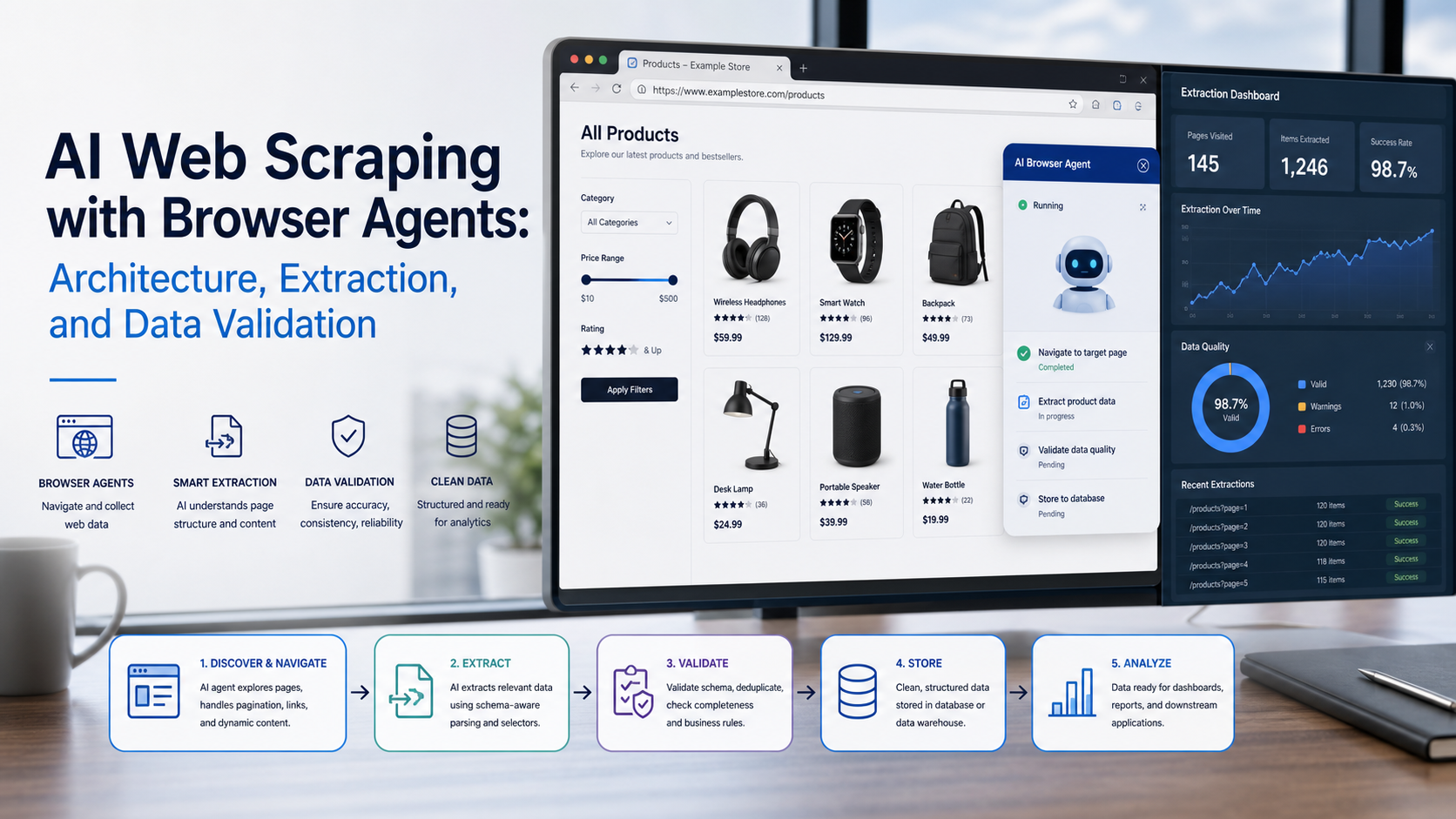
AI Web Scraping with Browser Agents: Architecture, Extraction, and Data Validation
AI web scraping uses AI to help discover, navigate, interpret, or extract information from websites. Browser agents are one implementation option when page interaction, rendering, or layout variation makes a simple scraper too brittle, but the agent should not become the entire data pipeline.
View Details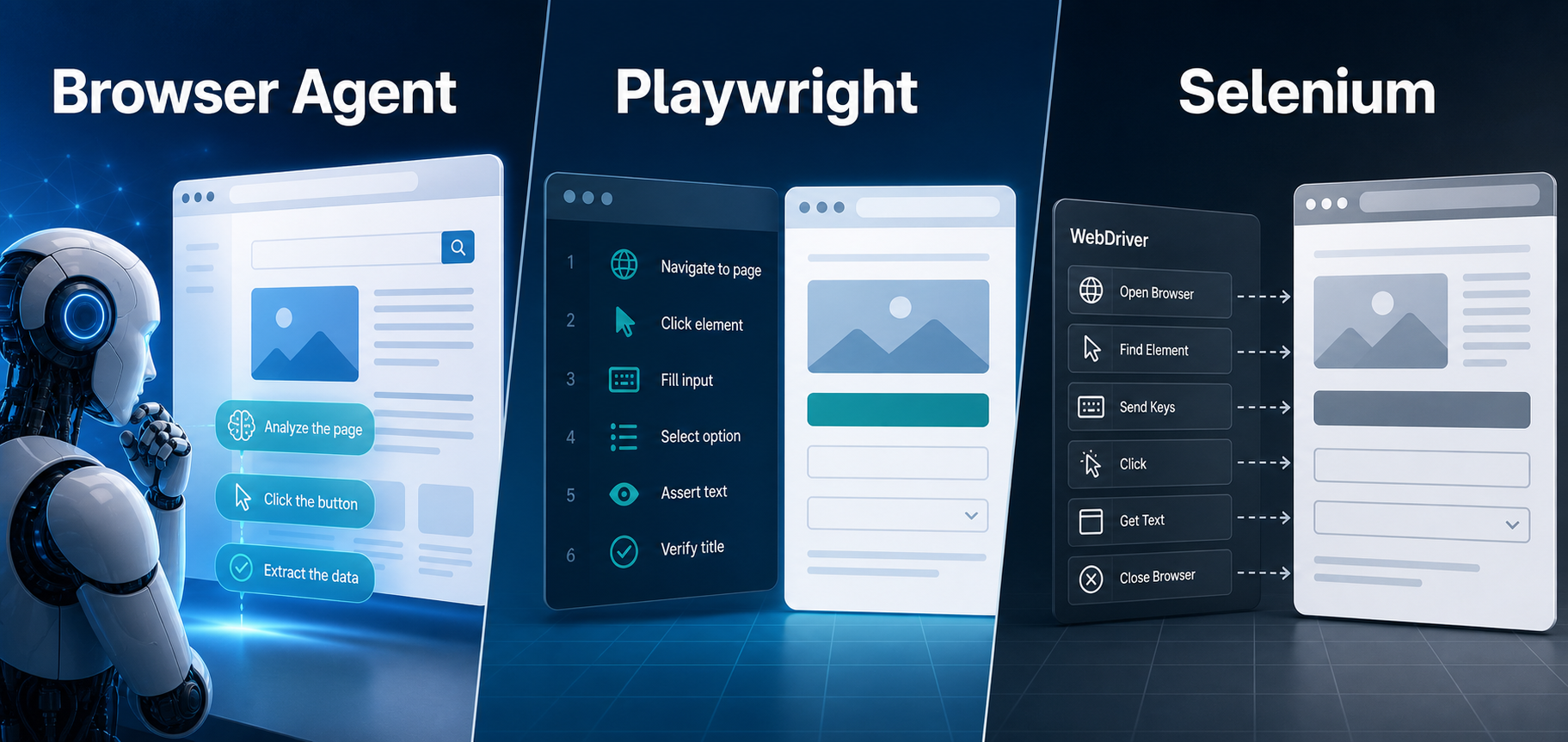
AI Browser Automation: Browser Agents vs Playwright vs Selenium
A browser agent interprets a goal and decides what browser action to take next. Playwright and Selenium can execute explicit, testable browser logic defined by developers. In 2026, however, Playwright also provides official MCP and agent-oriented workflows, so Playwright is no longer just the deterministic alternative to agentic automation. It can also serve as the browser-control layer inside an agent system.
View Details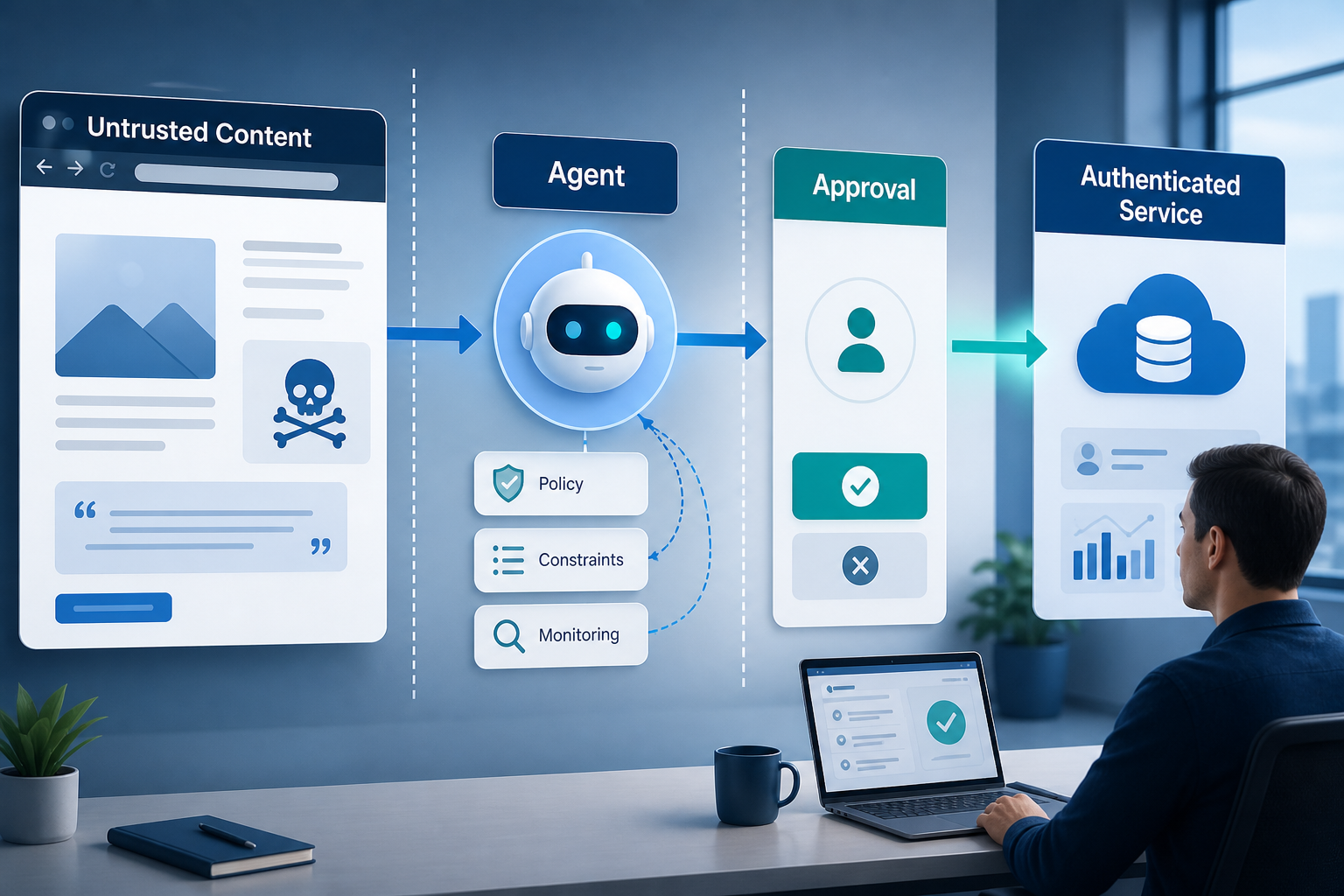
Agentic Browser Security: Prompt Injection, Permissions, and Safe Deployment
That combination creates risks that are different from ordinary browsing and traditional automation. The most important is indirect prompt injection, where hostile instructions hidden in web content attempt to redirect the agent away from the user's goal. Google describes indirect prompt injection as a primary new threat for agentic browsing and has introduced layered defenses that include origin constraints, independent action checks, threat detection, and user confirmation for sensitive actions. Google's Chrome security architecture is a useful reference for how browser-agent defenses are evolving.
View Details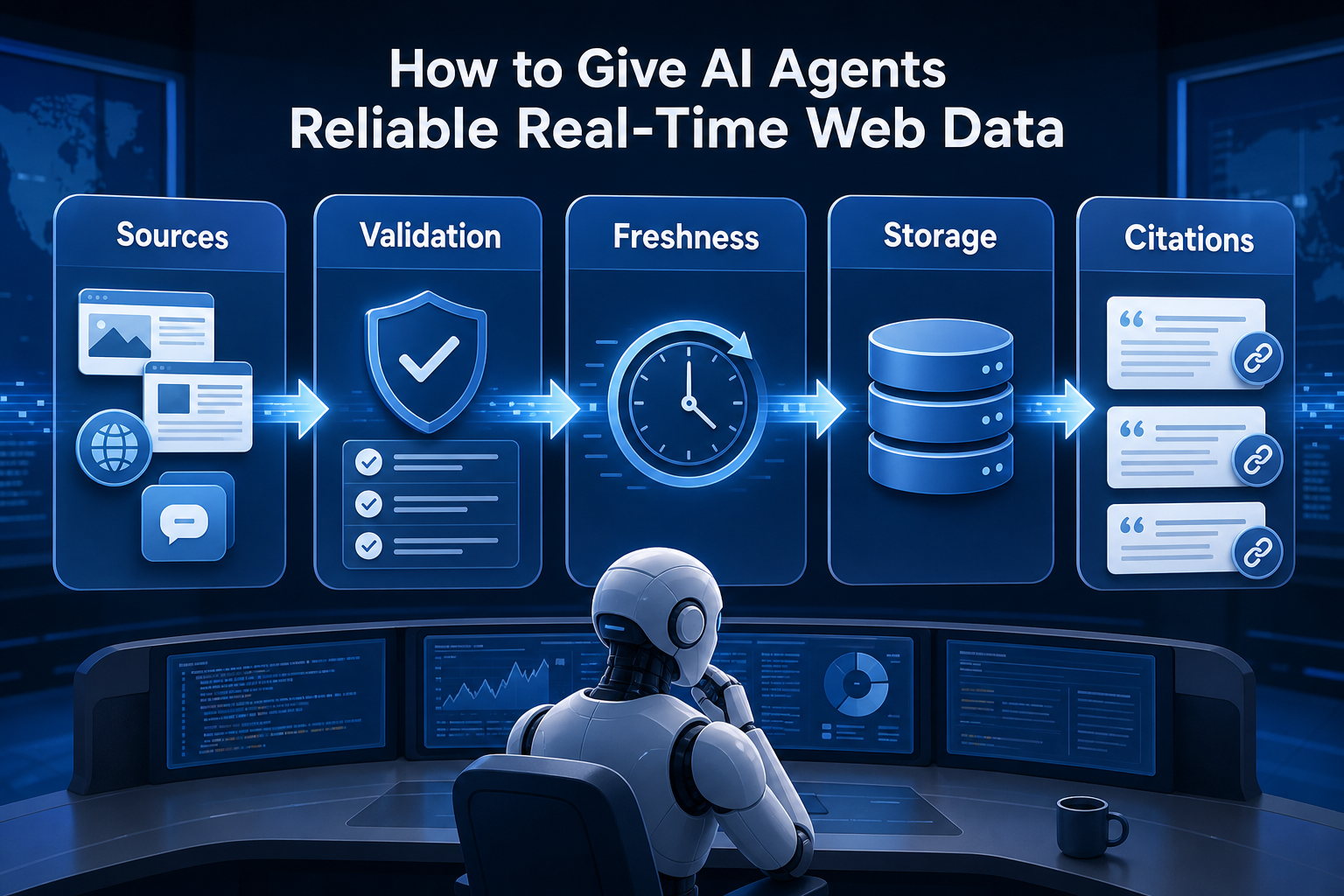
How to Give AI Agents Reliable Real-Time Web Data
A production-ready solution therefore needs more than a web scraper. It needs a web data layer that connects acquisition, validation, storage, retrieval, security, and observability. This guide explains how to design that layer.
View Details