
Is web scraping legal? A USA-focused, practical guide
Is web scraping legal? A USA-focused, practical guide
Web scraping is not automatically illegal in the USA. However, whether your specific web scraping project is legal depends entirely on three factors: how you access the site, what data you collect, and how you reuse it.
The safest approach is to treat scraping as a compliance project, not just a Python script. This guide provides the frameworks you need to assess risk before you write a single line of code.
Explore LycheeIP Proxy Solutions
What does “is web scraping legal” actually depend on?
Legality generally hinges on three "buckets." If you stay in the green for all three, your risk is low. If you cross into the red on even one, you risk cease-and-desist letters, IP bans, or litigation.
· Access (The "Trespass" Bucket): Are you collecting from publicly viewable pages, or are you bypassing logins, paywalls, or technical blocks (like CAPTCHAs)?
· Data Type (The "Privacy" Bucket): Are you scraping generic product prices, or are you collecting Personally Identifiable Information (PII) like names, emails, and user profiles?
· Reuse (The "Copyright" Bucket): Are you analyzing data for internal trends, or are you republishing the content in a way that competes with the source?
The Mental Model:
· Open Zone: Public URLs, no login required. (Lowest risk)
· Restricted Zone: Requires login, user session, or payment. (Medium risk)
· Protected Zone: Active technical defenses, encrypted data, or explicit blocks. (Highest risk)
Risk Scorecard: How to tell if your scrape is safe or risky
Use this scorecard to evaluate a project in minutes.
Instructions: Score each item as 0 (No), 1 (Somewhat), or 2 (Yes).
| Risk Signal | Score (0-2) |
| Access: Does scraping require a login, paywall, or user session? | |
| Access: Are you bypassing technical blocks (CAPTCHAs, rate limits, bot gates)? | |
| Warning: Have you received a cease-and-desist or IP ban from this host? | |
| ToS: Do the Terms of Service explicitly forbid automated collection? | |
| Data: Are you collecting personal info (names, addresses, photos)? | |
| Reuse: Will you republish the content (e.g., reviews, articles) publicly? | |
| Impact: Could your request volume degrade the site's performance? | |
| Competition: Does your use case directly compete with the source site? |
Interpreting your total:
· 0–4 (Green): Generally low-risk pattern. Maintain good-faith throttling and monitoring.
· 5–9 (Yellow): Medium risk. You are entering a grey area. Consider reducing scope, switching to permissioned access, or consulting legal counsel.
· 10–16 (Red): High risk. Pause immediately. This pattern strongly correlates with legal disputes (e.g., CFAA claims, breach of contract). Switch to an API or official licensing.
Explore LycheeIP Proxy Solutions
Which access methods create the biggest legal liabilities?
In the US legal landscape (referencing cases like hiQ v. LinkedIn or Van Buren), the method of access matters immensely. Courts often distinguish between accessing data that is "open to the public" versus breaking into a system.
High-Risk Access Patterns (Avoid)
· Credential sharing: Scraping behind a login using borrowed or fake accounts.
· Circumvention: Using tools specifically designed to solve CAPTCHAs or break encryption.
· Persisting after notice: Continuing to scrape after receiving a cease-and-desist letter or permanent IP ban.
Lower-Risk Access Patterns
· Public crawling: Accessing pages that any anonymous user can see in a browser.
· Respectful rates: Throttling requests to ensure you never burden the target server.
· Clean headers: Identifying your bot in the user agent string (e.g., MyBot/1.0 (+https://mysite.com/bot-info)).
Is it illegal if a site’s Terms of Service (ToS) forbid scraping?
Not automatically in a criminal sense, but it creates significant civil risk.
Violating ToS is generally a "breach of contract" issue. If you scrape a site that bans scraping, especially if you had to click "I Agree" to enter (browsewrap vs. clickwrap)—the site can sue for damages.
The risk spikes exponentially after you receive notice. If a site owner sends you a cease-and-desist letter telling you your access is unauthorized, continuing to scrape can shift the argument from "contract dispute" to "unauthorized access" (which carries heavier penalties under statutes like the CFAA).
Should you follow robots.txt if it isn’t law?
Yes. While robots.txt is a voluntary standard and not a law, following it is industry best practice for three reasons:
1. Good Faith Defense: It demonstrates you are trying to be a respectful web citizen, which helps in legal defense.
2. Operational Safety: It keeps you away from admin pages, calendars, and infinite loops that site owners don't want crawled.
3. Trust: Ignoring robots.txt makes your traffic look indistinguishable from malicious attacks.
Pro Tip: If you must scrape a disallowed path for a legitimate archival purpose, contact the site owner for whitelisting first.
Copyright vs. Data: What can you actually reuse?
"Scraping" is the collection; "Reuse" is what gets you sued for copyright infringement.
Facts vs. Expression
· Facts (Safer): Prices, dimensions, weather data, sports scores, stock quotes. You generally cannot copyright a bare fact.
· Expression (Risky): Product reviews, news articles, blog posts, forum discussions, unique photo arrangements. These are protected creative works.
If you scrape Amazon to analyze pricing trends (facts), that is legally distinct from scraping New York Times articles to republish them on your own blog (expression).
Explore LycheeIP Proxy Solutions
Privacy Check: Handling personal information (PII)
In 2025, privacy laws (like CCPA/CPRA in California and GDPR in Europe) impact scraping heavily. Even if data is "publicly available" on a social media profile, scraping it at scale can violate privacy statutes.
Privacy-by-Design Rules:
· Minimize: Do not scrape user IDs, names, or emails unless absolutely critical.
· Retention: Delete PII as soon as the analysis is done.
· Purpose: Ensure you aren't using the data for prohibited purposes (like building credit scores or background check databases without FCRA compliance).
SOP: How to run a compliant scraping workflow
Don't wing it. Use this standardized operating procedure to keep your team compliant.
1. Define Purpose: clearly document why you need the data.
2. Check Access Zone: Verify the data is public (no login required).
3. Review Rules: Check robots.txt and ToS.
4. Minimize Fields: Configure parsers to discard PII immediately.
5. Configure Throttling: Set delays to prevent server overload.
6. Setup Infrastructure: Route traffic through reliable, compliant proxies to maintain stability without evasion.
7. Audit Logs: Keep records of what you scraped and when.
How LycheeIP supports compliant workflows
Stability and transparency are critical for high-scale, legal data collection. LycheeIP provides the infrastructure to operationalize these rules:
· Ethical Sourcing: Resources are allocated directly from operators with a >6-month cooling period for IPs, ensuring clean usage history.
· Precise Geolocation: Use 200+ region options to ensure you view content as a local user, respecting regional data laws (e.g., GDPR boundaries).
· Session Control: Maintain sticky sessions naturally rather than blasting servers with erratic requests that look like DDoS attacks.
· Transparency: Monitor your usage in real-time via the dashboard to ensure you stay within your project's defined limits.
Explore LycheeIP Proxy Solutions
If you are unsure whether to build a scraper or buy access, climb this ladder. Stop at the first "Yes."
1. Can we meet the business goal without this data? (If Yes: Stop.)
2. Is there an official API available? (If Yes: Use it. It’s more stable.)
3. Is the data purely factual (prices/stats) and in the public zone? (If Yes: Low-risk scrape is likely viable.)
4. Are we planning to republish the content or train AI on it? (If Yes: License it.)
5. Does the site aggressively block bots or require login? (If Yes: License it.)
For commercial AI training or large-scale republishing, licensing is almost always the legally safer path than scraping.
Troubleshooting: Common failure modes and fixes
Most "legal" problems start as technical problems.
| Failure Mode | What it means | The Safer Fix |
| IP Blocks / 403 Errors | You look like a bot or an attack. | Slow down requests. Use legitimate user-agent headers. Rotate IPs using clean residential pools (not burned datacenter IPs). |
| CAPTCHA Loops | You are hitting a "gate." | Do not use auto-solvers if the ToS forbids it. Back off and reduce concurrency. |
| Cease-and-Desist Letter | You have been noticed. | Stop immediately. Archive your logs. Consult counsel. Switch to an official API. |
| Inconsistent Data | The site layout changed. | This is a maintenance issue, not legal—but frequent aggressive retries to fix it can trigger blocks. Fix the parser first. |
Assumptions and limitations
· Not Legal Advice: This guide is for educational purposes. We are data infrastructure experts, not lawyers.
· Dynamic Landscape: Case law regarding web scraping and AI is evolving rapidly (e.g., New York Times v. OpenAI).
· Jurisdiction Matters: This guide focuses on the USA. The EU (GDPR) has much stricter rules regarding personal data scraping.
Explore LycheeIP Proxy Solutions
Frequently Asked Questions:
1. Is web scraping legal in the USA?
Web scraping is not illegal in itself. However, it becomes legally risky if you scrape personal data, copyright-protected content, or bypass security measures (like logins) to access the data.
2. Is it illegal to scrape data if the Terms of Service (ToS) prohibit it?
It is not necessarily a crime, but it is a breach of contract. This opens you up to civil lawsuits, especially if you persist after being warned to stop.
3. Is price scraping legal?
Generally, yes. Prices are considered factual data, which typically cannot be copyrighted. However, scraping them at a volume that crashes the competitor's site or using the data to mislead consumers can still lead to legal trouble.
4. What is the difference between web scraping and an API?
Web scraping extracts data from the visual interface of a website (HTML). An API (Application Programming Interface) is a direct, permissioned pipe provided by the website owner. APIs are legally safer but often cost money or have limits.
5. Can I use scraped data for AI training?
This is a high-risk area. While some argue it is "fair use," major lawsuits are currently challenging the use of copyrighted scraped content for training LLMs. Using factual data is safer than using creative works.
6. Does LycheeIP prevent me from getting blocked?
LycheeIP provides high-quality residential and datacenter proxies that help you maintain stable connections and appear as a legitimate visitor. However, you must still configure your scraper to respect rate limits and site rules to avoid blocks.

Recommended Articles
Best Real Estate Scrapers in 2026
Best Real Estate Scrapers in 2026
View Details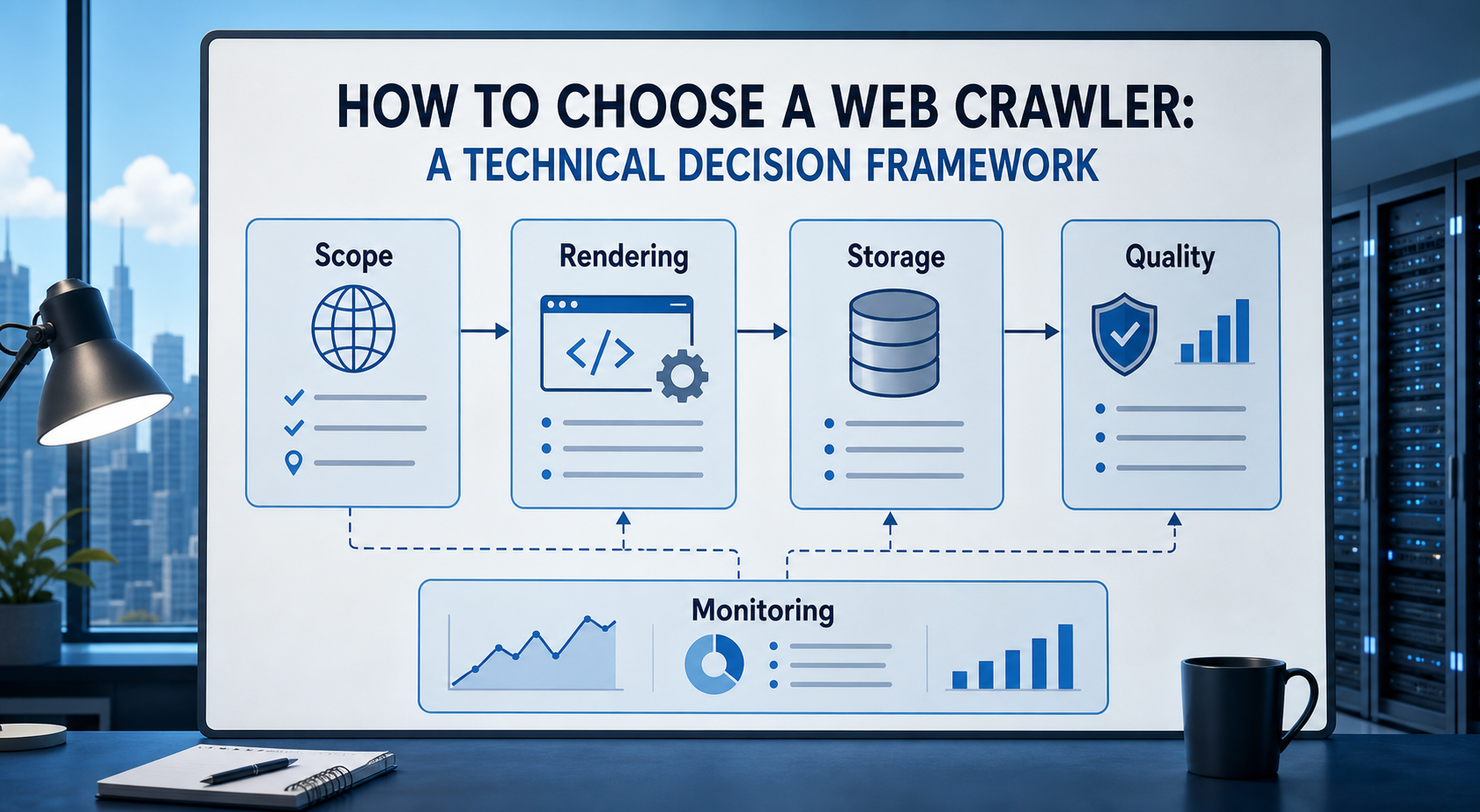
How to Choose a Web Crawler: A Technical Decision Framework
The wrong way to choose a web crawler is to begin with a list of products. The right starting point is the system you need to build. Before comparing tools, define:
View Details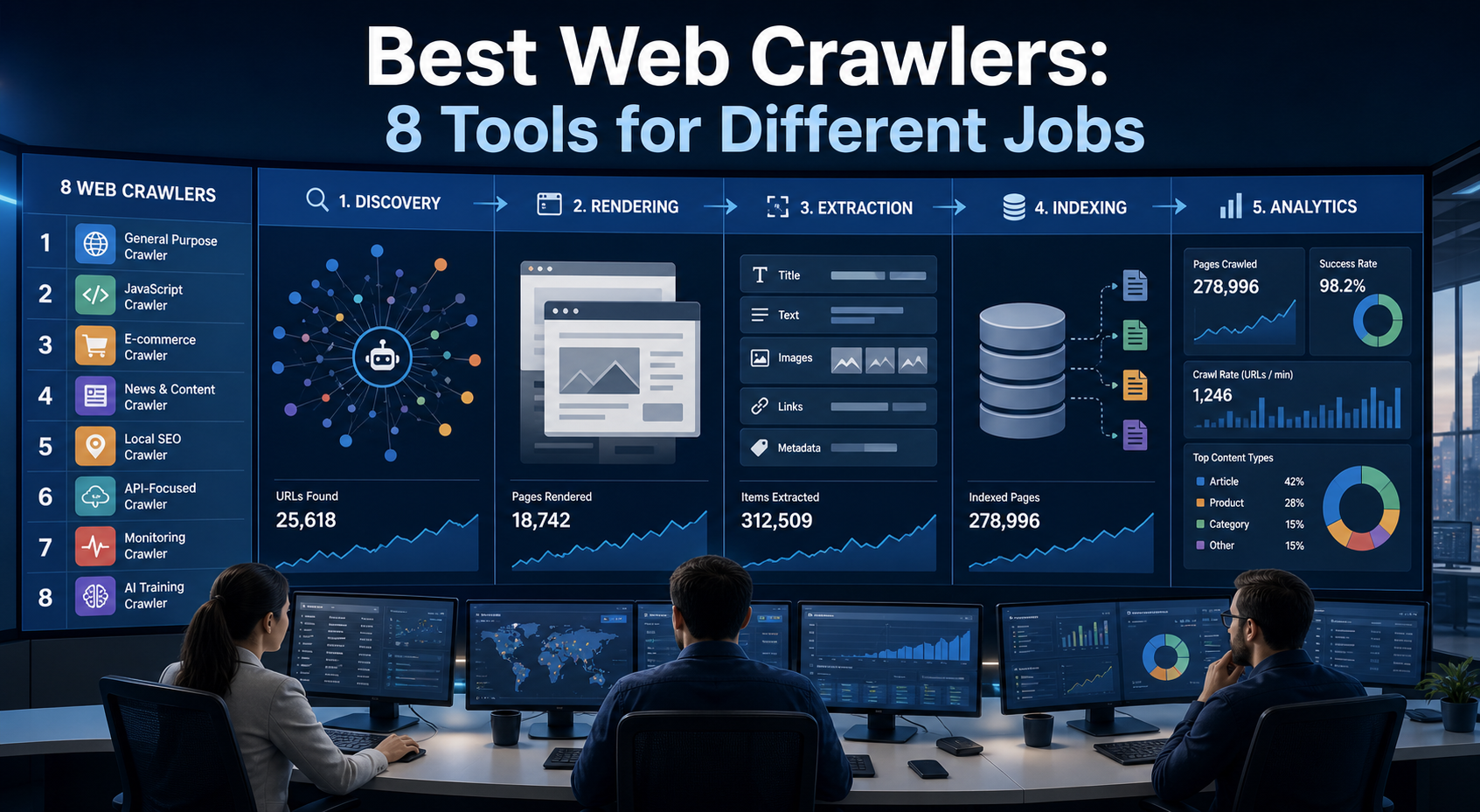
Best Web Crawlers: 8 Tools for Different Jobs
There is no single best web crawler for every project. A technical SEO audit, an AI knowledge pipeline, an internet archive, and a distributed search index may all involve crawling URLs, but they require different capabilities. The most useful way to compare web crawler tools is therefore to ask what job each one was designed to perform. This guide evaluates eight strong options across:
View Details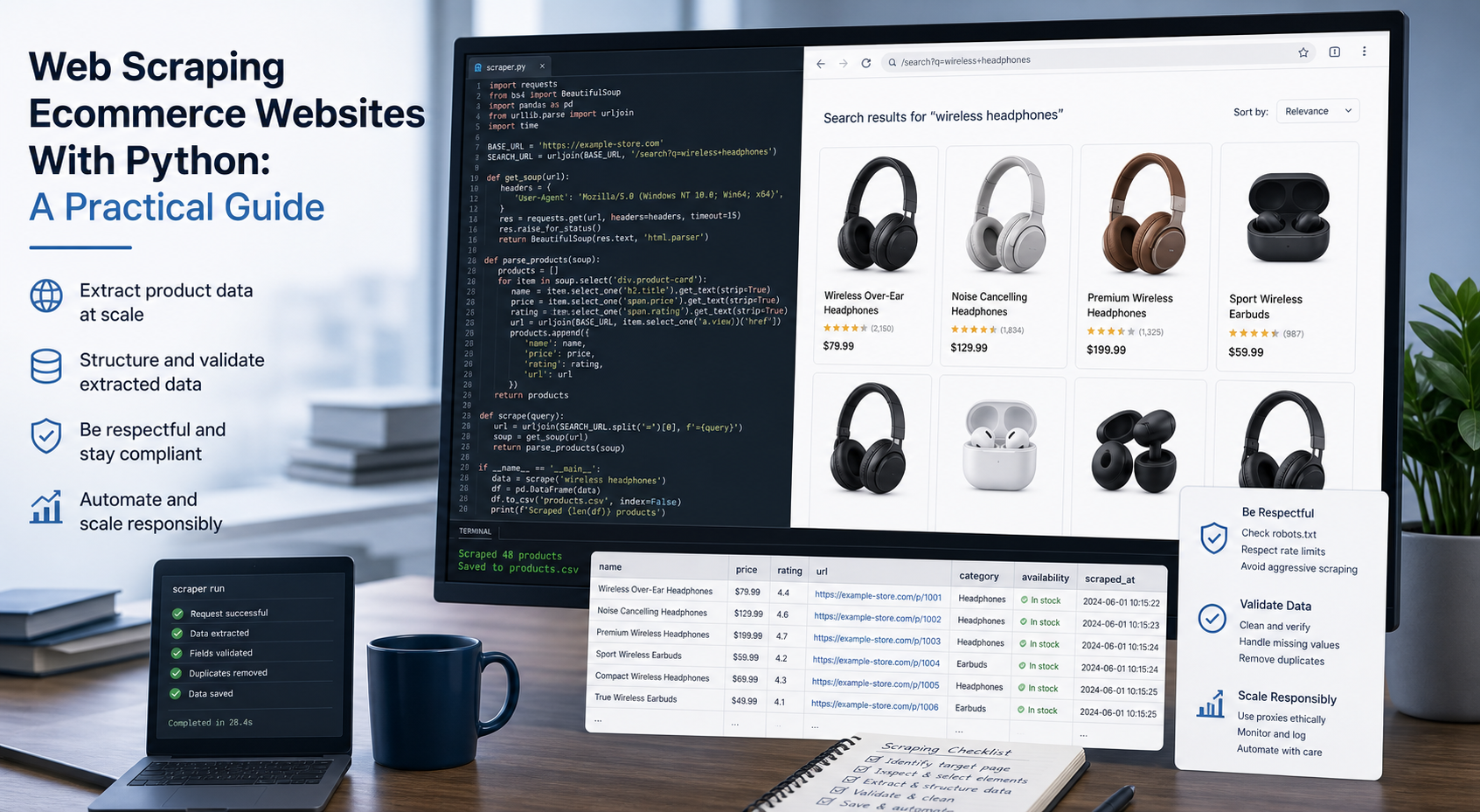
Web Scraping Ecommerce Websites With Python: A Practical Guide
Recommended meta title: Web Scraping Ecommerce Websites With Python: Guide Recommended meta description: Learn how to scrape ecommerce websites with Python using Requests, Beautiful Soup, Playwright, and Scrapy, with validation and scaling guidance. URL slug: /web-scraping-ecommerce-websites-python/
View Details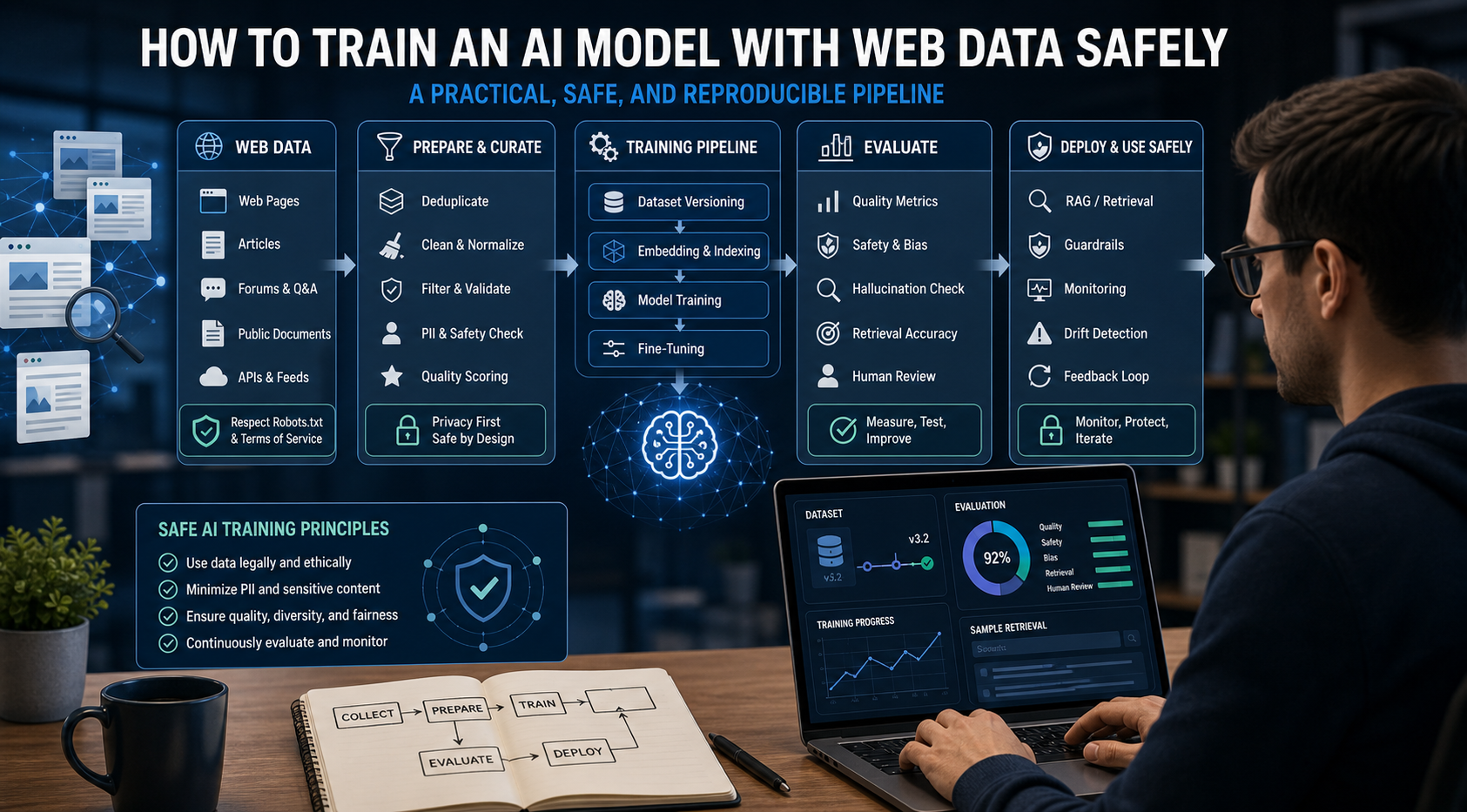
How to Train an AI Model With Web Data Safely
To train an AI model with web data, start by deciding whether you actually need training. Then collect representative sources, preserve provenance, remove duplicates and low-quality content, create leakage-resistant splits, build a baseline, fine-tune or train the appropriate model, and evaluate on real held-out examples before deployment.
View Details