
HTML in Canvas: What It Is and Why It Matters
You can now put real HTML inside a canvas element. Here's why that changes everything.
For years, the canvas element and the Document Object Model (DOM) have lived in completely separate worlds. Canvas gave you raw pixel control — great for games, data visualizations, and WebGL scenes — but the moment you needed a button, a form input, or any interactive UI element, you had to layer it awkwardly on top using absolute positioning and CSS hacks. That rigid boundary is now being challenged.
Chrome is actively experimenting with a feature that lets developers render actual, interactive HTML directly inside a canvas context, and the implications for how we build web applications are significant.
Build Globally with LycheeIP
What HTML-in-Canvas Actually Means
The feature, currently available as a Chrome experiment, introduces a mechanism to render DOM subtrees as part of a WebGL or 2D canvas scene. This isn't a simple screenshot of HTML or a static image conversion — it's live, interactive DOM content composited directly into the canvas rendering pipeline.
Traditionally, if you wanted to display HTML-like content within a canvas, your options were severely limited. You could use the foreignObject element inside an SVG, serialize it to a data URL, and draw it as an image onto the canvas. However, that approach strips interactivity entirely. Anything rendered that way becomes a flat bitmap: clicks don't register, text inputs don't work, and CSS animations freeze.
HTML-in-Canvas changes that constraint at the architecture level by introducing key new primitives:
* **The `layoutsubtree` attribute:** Added directly to the `<canvas>` tag, this tells the browser to treat child elements as real layout participants that go through normal CSS layout without being painted directly to the screen.
* **The drawing method:** New methods (like `drawElementImage`) take the child element and draw it into the canvas context at your specified coordinates.
* **The `onpaint` event:** Instead of relying on manual `requestAnimationFrame` polling, the browser natively fires an event whenever the canvas child's rendering changes.
The browser's rendering engine is essentially being asked to treat a DOM element as a first-class texture or composited layer. It lives inside the canvas scene while fully retaining its event handling, accessibility tree, and dynamic behavior. The browser even calculates a CSS transform to ensure the element's DOM location perfectly matches its drawn location, guaranteeing that native hit-testing works flawlessly.
The Use Cases It Unlocks
This might sound like a niche technical detail, but the practical applications are wide-ranging — especially for developers building at the intersection of UI and graphics.
* **In-canvas forms and controls.** Imagine a 3D product configurator where users fill out a form that floats seamlessly inside the 3D scene itself, perfectly attached to the model they're customizing. Right now, that requires complex z-index layering and constant coordinate math to fake the effect. With HTML-in-Canvas, the form is genuinely part of the 3D environment.
* **Game UI without the overhead.** Game developers building in WebGL have long had to choose between rolling their own UI system in GLSL/JavaScript from scratch or maintaining a parallel DOM overlay. Native HTML-in-Canvas means you can use standard HTML and CSS for your HUDs, inventory screens, and menus, while rendering them correctly within the game's native context.
* **Data dashboards with live components.** Creative coders building high-performance data visualizations can embed interactive chart controls, dropdowns, and text-heavy tooltips directly into a WebGL scene. This gracefully offloads complex text-wrapping and font-measurement tasks back to the browser's highly optimized layout engine.
* **Immersive web experiences.** For WebXR and spatial computing applications, the ability to place real HTML panels inside a 3D environment — panels that users can actually interact with — is a foundational capability. This feature moves that functionality out of workaround territory and into something the browser natively supports.
Build Globally with LycheeIP
LycheeIP (Developer-First Proxy Infrastructure)
As developers build richer, globally scalable applications—like interactive 3D product configurators or data-heavy dashboards rendered via canvas—they frequently need reliable ways to test localized UI elements and aggregate external data sets. LycheeIP is a developer-first proxy and data infrastructure platform that enables secure, high-performance web data extraction and global traffic routing.
When engineering and QA teams need to verify how a WebGL-based ad or a localized canvas UI renders across different global regions, they rely on LycheeIP's extensive network. By routing traffic through high-speed datacenter proxies for rapid, continuous data aggregation, or utilizing dynamic IPs to accurately emulate genuine regional user experiences, developers can ensure their complex canvas elements load flawlessly worldwide. For long-running automated QA testing of these intricate UI elements, a dedicated static proxy maintains essential session persistence. Integrating a robust proxy infrastructure ensures your advanced web applications scale and fetch public data reliably without facing IP blocks or aggressive rate limiting (provided your data collection always complies with applicable laws and site Terms of Service).
The Technical Reality Right Now
It's important to be clear: this technology is still in the experimental phase. According to the official Web Incubator Community Group (WICG) proposal, the feature is currently behind a flag in Chrome Canary and is not yet part of any stable specification. Browser compatibility is currently a non-starter for production use, as Firefox and Safari have not shipped equivalent functionality, and the API surface may change significantly.
Additionally, developers should be aware of several current technical constraints:
* **Performance hurdles:** Compositing interactive DOM content inside a GPU-accelerated canvas context introduces real complexity. The browser must juggle hit testing, event propagation, and focus management synchronously.
* **Security and privacy:** Rendering cross-origin HTML inside a canvas has massive security implications. To prevent fingerprinting and data leaks, cross-origin `<iframe>` elements or external images will not render inside the canvas.
* **Accessibility gaps:** While the goal is to map canvas elements directly to the accessibility tree, solutions for complex screen-reader interactions within dynamic 3D contexts are still being actively debated and developed.
Why It Signals Something Bigger
Even in its current experimental state, HTML-in-Canvas tells us something deeply important about the direction browser vendors are thinking. The hard wall between the DOM rendering model and the GPU-driven canvas rendering model has been a major source of developer friction for over a decade.
The fact that Chrome is investing heavy engineering effort into blurring that line — not just with CSS compositing tricks, but at the level of actually hosting DOM nodes inside the canvas — suggests the browser is evolving toward a much more unified rendering architecture. That has massive long-term implications for frontend frameworks, creative tools, and the kinds of high-performance applications that are practical to build on the open web.
For web developers and creative coders, now is the right time to start paying attention. Enable the Chrome flag, explore the Chromium tracker issues, and start conceptualizing what you could build if this constraint simply didn't exist anymore. The specific API isn't production-ready today — but the architectural shift it represents very much is.
Build Globally with LycheeIP
Frequently Asked Questions
Q: What is HTML-in-Canvas in Chrome?
A: HTML-in-Canvas is an experimental Chrome feature that allows developers to render live, interactive HTML DOM elements directly inside a WebGL or 2D canvas context, rather than awkwardly layering HTML on top of a canvas using CSS positioning tricks.
Q: Is HTML-in-Canvas available in all browsers?
A: No. As of now, this is only available as an experimental developer trial in Chromium-based browsers (behind a specific flag). Firefox and Safari have not shipped equivalent functionality, making it unsuitable for production use across the web today.
Q: How is this different from the existing SVG foreignObject workaround?
A: The SVG `foreignObject` approach renders HTML as a static bitmap — it completely strips interactivity, event handling, and live updates. HTML-in-Canvas preserves the DOM element's full interactivity, including clicks, text inputs, and CSS animations, because it is genuinely composited into the canvas scene rather than just converted to a flat image.
Q: What are the most exciting use cases for HTML-in-Canvas?
A: Key use cases include interactive forms and controls embedded naturally inside 3D scenes, video game HUDs built with standard HTML and CSS, hybrid data visualizations with live UI components, and WebXR spatial interfaces where HTML panels live inside a fully immersive environment.
Q: Should I use HTML-in-Canvas in a production project now?
A: Not yet. The feature is highly experimental, the API is almost guaranteed to change, browser support is limited to a Canary flag, and there are unresolved questions around performance and security. It is highly recommended to experiment with it locally, but it is not ready for production deployment.

Recommended Articles

SERP API Troubleshooting: Fix Empty, Wrong, or Inconsistent Search Results
SERP API failures are not limited to obvious HTTP errors. A request can return successfully and still produce empty, incomplete, geographically wrong, duplicated, or misinterpreted search data. Production troubleshooting therefore has to separate transport problems from provider processing, SERP differences, and downstream parsing errors.
View Details
SERP API Python: How to Build a Reliable Search Data Pipeline
This guide shows a provider-neutral workflow for building that pipeline. It does not rank SERP API vendors. Instead, it focuses on the implementation choices that make a Python integration easier to operate, test, and migrate.
View Details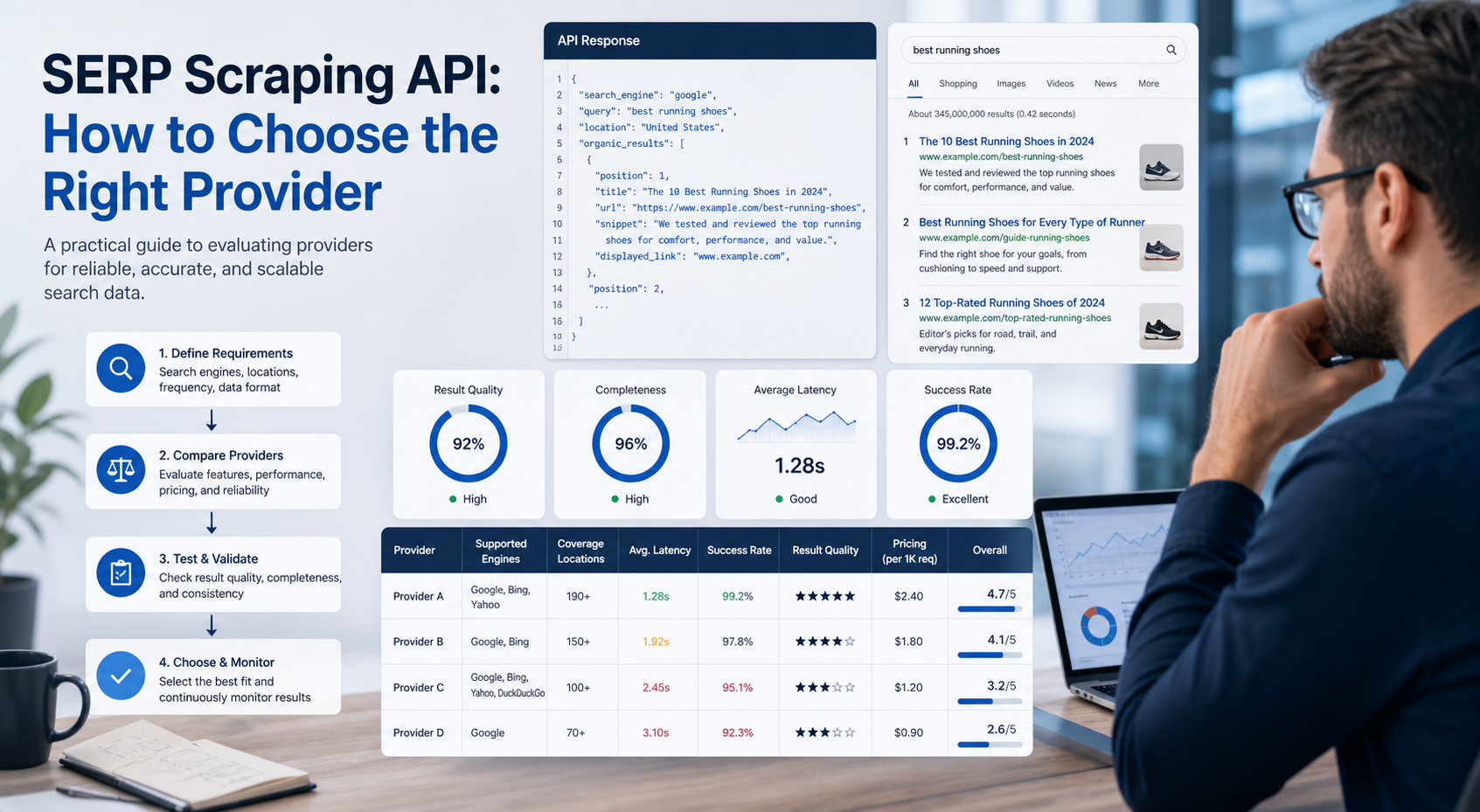
SERP Scraping API: How to Choose the Right Provider
Recommended Meta Description: Compare SERP scraping APIs by data coverage, localization, reliability, workflow fit, and cost structure, then choose and validate the right provider.
View Details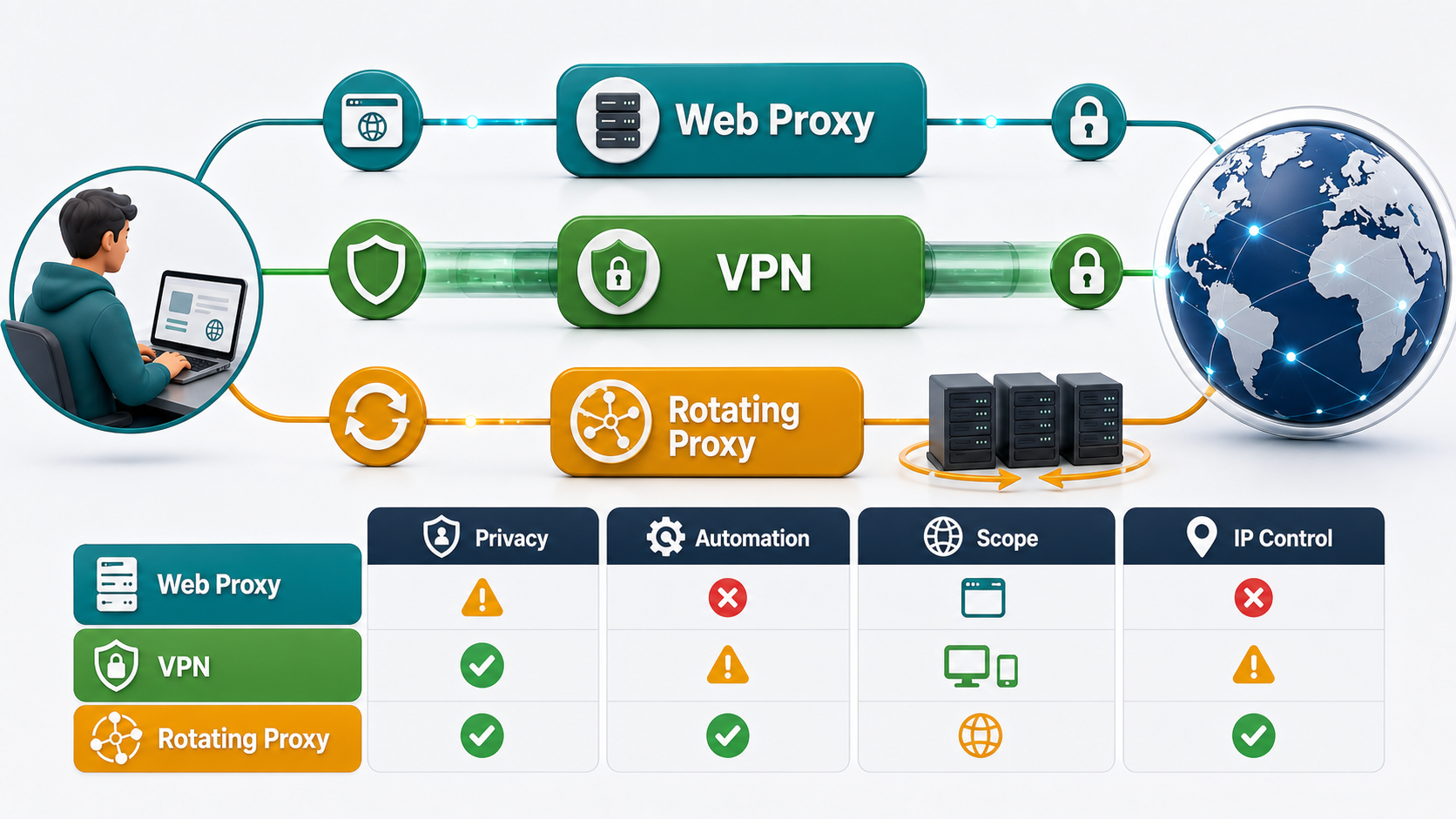
Free Web Proxy vs VPN vs Rotating Proxy: Which Should You Use?
Compare free web proxies, VPNs, rotating proxies, static proxies, and datacenter proxies by scope, encryption, IP control, automation, streaming, and account workflows.
View Details
BlockAway Not Working? Fix Common Proxy, Video, and Access Problems
Troubleshoot BlockAway when pages are blocked, YouTube fails, JavaScript breaks, speed drops, sessions expire, or mobile access behaves differently.
View Details