
CSS Random and New Layout APIs Explained Simply
CSS now has a random() function, and it's more useful than you think.
If you have stumbled across these features in a recent browser release note or changelog and felt slightly confused, you are not alone. New native CSS capabilities like the random() function and name-only container queries can sound highly abstract at first glance. However, for frontend developers, data teams, and technical operators, these tools represent a massive paradigm shift.
Once you see the exact engineering problems these APIs solve, they click immediately. The browser is rapidly absorbing logic that previously required heavy JavaScript dependencies, allowing your stylesheets to handle dynamic, context-aware UI logic natively.
Test global UI with LycheeIP
CSS random() — Dynamic Values Without JavaScript
The Old Workflow: Relying on JavaScript
Historically, generating visual variance required an imperative approach. Imagine you want five card components on a page, each rotated at a slightly different angle to feel organic or playful. To achieve this, you would write JavaScript to generate random numbers using Math.random(), then inject those values into the DOM as inline styles or CSS custom properties.
While it worked, it was structural overkill. It forced presentation logic into your scripting layer, increasing bundle sizes and triggering unnecessary recalculations.
The New Standard: Native CSS Randomness
The new random() function,W3C CSS Values and Units Module Level 5 draft, introduced in the , changes this entirely. It empowers CSS to generate a random value at render time, directly inside your stylesheet.
CSS
.card {
  rotate: random(range, -5deg, 5deg);
}
This simple declaration tells the browser: pick a random value between -5deg and 5deg and apply it. There is no JavaScript required, no messy inline styles, and no layout thrashing. CSS simply does the heavy lifting.
Key detail: By default, each element targeted by this class receives its own distinct random value. Therefore, your five cards will each rotate differently and automatically.
Synchronizing Randomness with Caching Keys
You can also force multiple elements to share the exact same random value by passing a named random-caching key:
CSS
.card {
  rotate: random(--shared-key, range, -5deg, 5deg);
}
Now, every .card element receives the same random rotation. This is incredibly useful when you want visual consistency across a repeated group of components while still letting the browser decide the exact value at render time.
When to Use CSS Random
CSS random() is not meant to replace true cryptographic randomness or logic-heavy features. Think of it as a tool for decorative variation:
- Scattered backgrounds: Slightly shifting background shapes or noise layers.
- Organic lists: Offsetting list items by random pixel values.
- Animation delays: Creating staggered entrance animations without complex nth-child math.
Test global UI with LycheeIP
Name-Only Container Queries — Context Without Size
You are likely already familiar with standard CSS Container Queries. They revolutionized responsive design by allowing developers to style a component based on the measured dimensions of its parent container, rather than the global viewport.
But a frustrating architectural gap remained: what if you do not care about the size? What if you simply need to know the semantic context of where a component lives?
That is exactly the problem name-only container queries solve.
How Context-Driven Queries Work
To establish context, you assign a container a specific name without explicitly defining a dimensional container type:
CSS
.sidebar {
  container-name: sidebar;
}

.main-content {
  container-name: main;
}
Then, you can target child components based purely on the named context they sit within:
CSS
@container sidebar {
  .card {
    font-size: 0.85rem;
    background-color: var(--surface-muted);
  }
}

@container main {
  .card {
    font-size: 1rem;
    background-color: var(--surface-default);
  }
}
The .card component now intuitively adapts its typography and spacing based on where it is placed in the DOM—sidebar or main content—without you needing to measure a single pixel or write a media query.
Why This Matters for Design Systems
In enterprise design systems, components constantly need to behave differently depending on their localized environment. Previously, frontend engineers handled this by passing modifier classes (e.g., card--sidebar) or using JavaScript to toggle context states.
Name-only container queries allow CSS to cleanly own that logic, eliminating redundant class names and keeping your component structures purely declarative.
The Bigger Picture
These two features are not just experimental novelties. They represent a clear, industry-wide direction: CSS is being aggressively upgraded to handle dynamic, context-aware UI logic that previously demanded JavaScript scaffolding.
- random() removes the need for JavaScript just to introduce visual variety.
- Name-only container queries remove the need for JavaScript to detect and manage structural layout context.
Both features drastically reduce codebase complexity and keep styling concerns exactly where they belong: in the stylesheet.
A Quick Migration Checklist
For developers looking to adopt these modern APIs, keep this practical checklist in mind:
- Audit your JS: Identify any JavaScript files solely dedicated to generating randomized visual styles and replace them with random().
- Prune modifier classes: Look for BEM-style modifier classes (like --in-modal or --in-sidebar) and replace them with name-only container queries.
- Use Progressive Enhancement: Always wrap bleeding-edge CSS in @supports blocks to ensure older browsers receive a stable fallback layout.
In 2024 and beyond, before you reach for JavaScript to solve a styling problem, it is highly worth checking if CSS has already caught up. The answer is increasingly yes.
LycheeIP (Developer-First Proxy Infrastructure)
As frontend teams deploy increasingly complex, context-aware CSS APIs, ensuring these dynamic layouts render flawlessly across different global regions becomes a critical challenge. LycheeIP is a developer-first proxy and data infrastructure provider designed specifically to help technical teams seamlessly route network traffic for automated global QA and secure data extraction.
When developers use modern CSS to adapt user interfaces based on localized container content, they must test how those layouts behave when injected with varying regional data (like longer translated text strings or geo-specific ad units). By integrating a reliable proxy network into your headless browser testing suites, your QA team can accurately simulate how international users experience your site. For high-volume automated visual regression testing, utilizing robust datacenter proxies ensures lightning-fast connection speeds, while testing specific mobile UI variants across different regional ISPs is perfectly handled via dynamic IP routing. By leveraging a dedicated data infrastructure provider, frontend engineers can confidently ship modern web features knowing their UI will hold up anywhere in the world.
Test global UI with LycheeIP
Frequently Asked Questions
Q: Is CSS random() supported in all browsers right now?
A: Not fully yet. CSS random() is part of the CSS Values Level 5 specification and is being implemented progressively across different rendering engines. Always check compatibility tables like caniuse.com for the latest support data before deploying it in a production environment.
Q: Does CSS random() generate a new value on every page refresh?
A: Yes. By default, the browser's rendering engine generates a brand new random value each time the page paints. The value is not stored or repeated between user sessions unless you utilize caching keys to explicitly synchronize values across specific elements.
Q: What is the core difference between a regular container query and a name-only container query?
A: A regular container query requires a defined containment context (like inline-size) and triggers responsive styles based on the physical measured dimensions of that container. A name-only container query responds purely to the semantic name of the container wrapper, with zero dimensional measurement involved.
Q: Can I use name-only container queries within a strict design system?
A: Absolutely. In fact, they are perfectly suited for design systems. They allow a baseline UI component to dynamically adapt its styling depending entirely on which named container it is placed inside, which cleanly eliminates the need for messy modifier classes or prop-drilling in frameworks like React.
Q: Should I stop using JavaScript for dynamic styles entirely now that CSS has random()?
A: Not entirely. JavaScript remains the correct architectural tool for application state, business logic, and complex interactive behaviors. However, for purely visual, decorative variation—like scattered visual assets or staggered animation delays—native CSS APIs are a much more performant and maintainable option.

Recommended Articles

SERP API Troubleshooting: Fix Empty, Wrong, or Inconsistent Search Results
SERP API failures are not limited to obvious HTTP errors. A request can return successfully and still produce empty, incomplete, geographically wrong, duplicated, or misinterpreted search data. Production troubleshooting therefore has to separate transport problems from provider processing, SERP differences, and downstream parsing errors.
View Details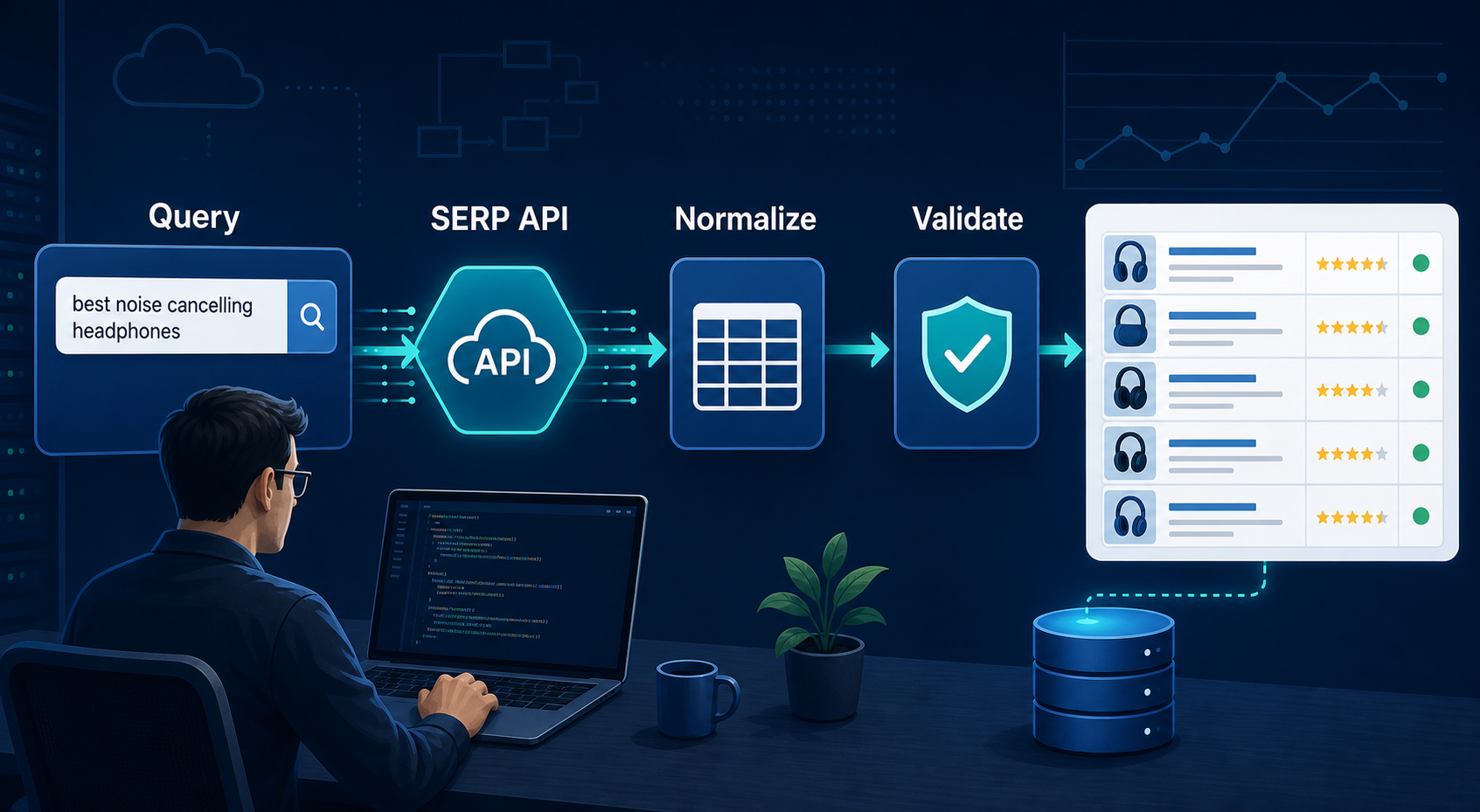
SERP API Python: How to Build a Reliable Search Data Pipeline
This guide shows a provider-neutral workflow for building that pipeline. It does not rank SERP API vendors. Instead, it focuses on the implementation choices that make a Python integration easier to operate, test, and migrate.
View Details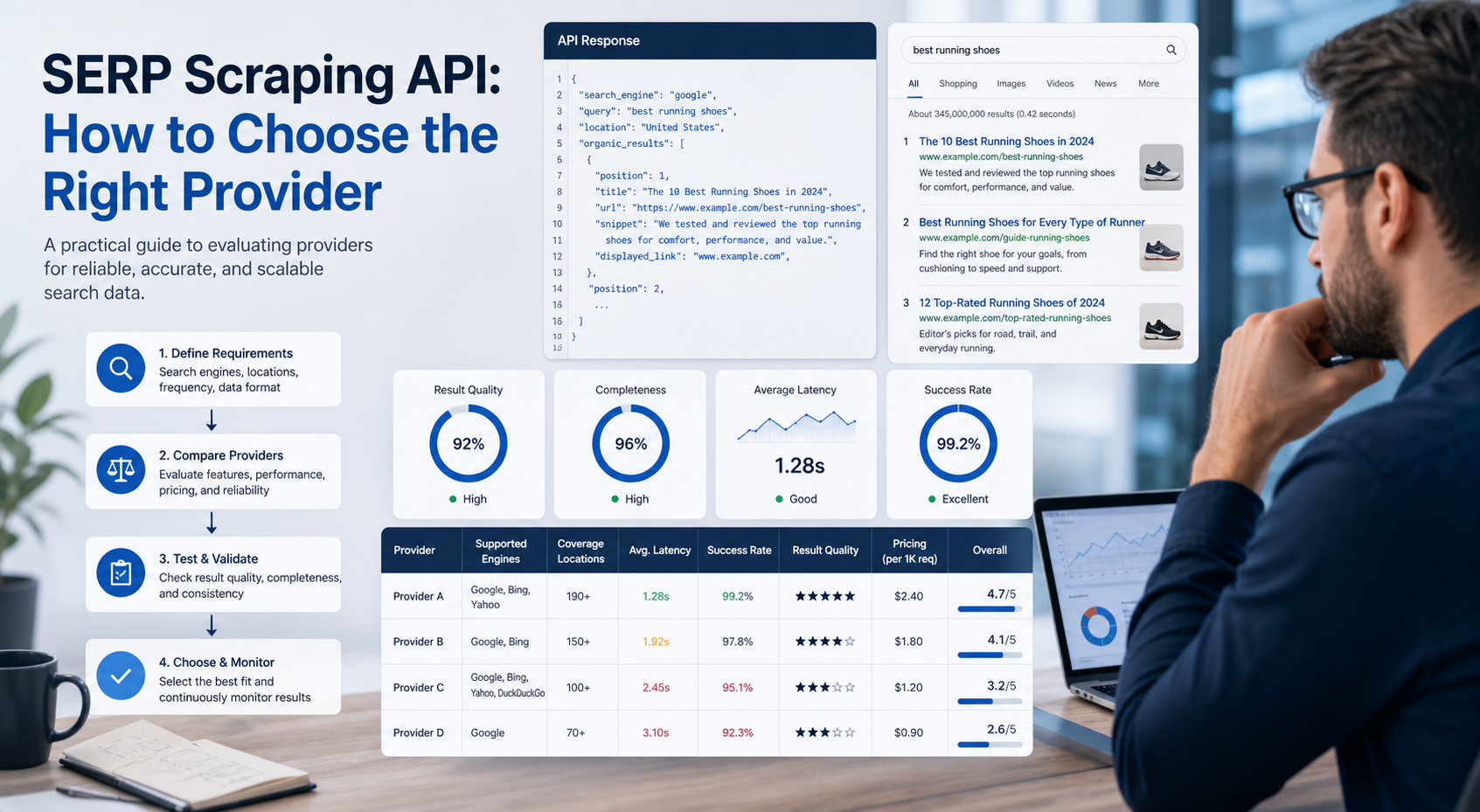
SERP Scraping API: How to Choose the Right Provider
Recommended Meta Description: Compare SERP scraping APIs by data coverage, localization, reliability, workflow fit, and cost structure, then choose and validate the right provider.
View Details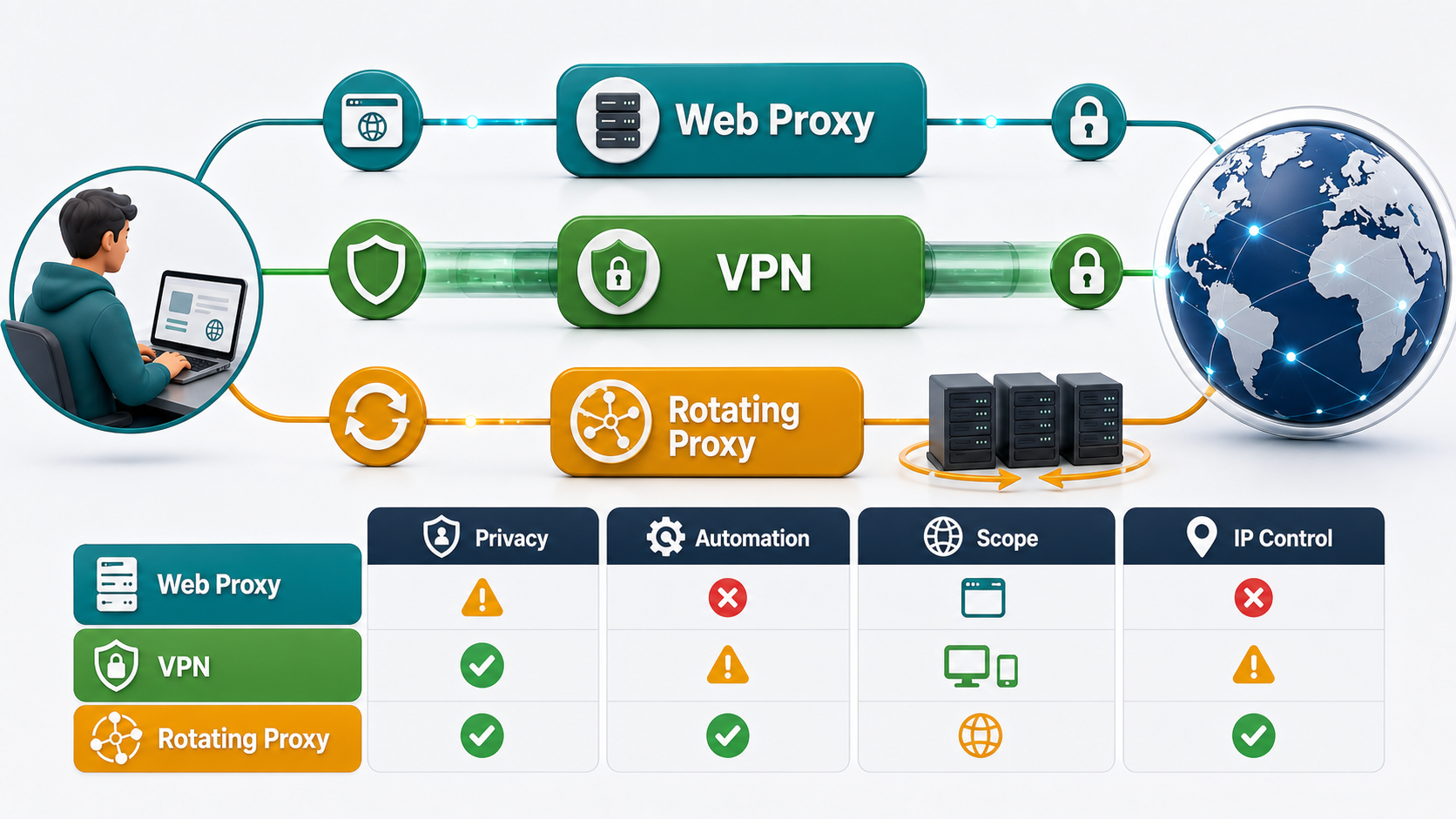
Free Web Proxy vs VPN vs Rotating Proxy: Which Should You Use?
Compare free web proxies, VPNs, rotating proxies, static proxies, and datacenter proxies by scope, encryption, IP control, automation, streaming, and account workflows.
View Details
BlockAway Not Working? Fix Common Proxy, Video, and Access Problems
Troubleshoot BlockAway when pages are blocked, YouTube fails, JavaScript breaks, speed drops, sessions expire, or mobile access behaves differently.
View Details