
Building Custom AI Tutors with GitHub Copilot SDK: A Guide for Educators
The rise of AI coding assistants has created a complex paradox in computer science education: students now have unprecedented access to tools that can instantly solve their programming assignments, yet this very capability fundamentally undermines the productive struggle necessary for genuine learning. Educators, bootcamp instructors, and course creators face a critical challenge, how do we harness the immense power of AI to support learning without simply automating the critical thinking that students need to develop?
The answer lies not in futile attempts to block AI tools, but in building custom AI tutors that strictly prioritize pedagogical guidance over direct solutions. Using the GitHub Copilot SDK, educators and developers can create intelligent, context-aware assistants that understand the crucial difference between helping students learn and doing the work for them.
This article explores how to architect a custom Python tutor that implements progressive hint systems, maintains strict educational integrity, and integrates seamlessly into existing learning management platforms.
Scale AI Tutors with LycheeIP
Understanding GitHub Copilot SDK for Custom AI Assistants
What Makes Copilot SDK Different
The GitHub Copilot SDK provides the underlying infrastructure that powers Copilot's world-class code understanding and generation capabilities—but with one crucial difference: you control the behavior. Unlike the standard Copilot IDE plugin, which is optimized to complete code as efficiently as possible for senior developers, the SDK allows you to define custom instructions, strict constraints, and distinct interaction patterns.
For educational applications, leveraging the SDK means you can:
- Control Response Granularity: Decide programmatically whether the AI provides a conceptual nudge, a partial hint, or a syntax correction.
- Implement Context Awareness: Train the assistant to recognize exactly where a student is in their curriculum journey.
- Enforce Pedagogical Rules: Establish hard guardrails that prevent the AI from giving away direct answers to core learning objectives.
- Customize the Interaction Model: Design conversation flows that accurately mirror effective human-to-human tutoring strategies, such as the Socratic method.
Setting Up Your Educational AI Environment
Before building the logic of your AI tutor, you need to establish a solid technical foundation. Here is how you initialize the environment with explicit educational constraints:
Python
from copilot_sdk import CopilotClient, SystemPrompt, CompletionConfig

# Initialize with educational constraints
client = CopilotClient(
    api_key=YOUR_API_KEY,
    model="gpt-4o",
    temperature=0.7 # Balances creative guidance with consistent logic
)

# Define the educational system prompt
educational_prompt = SystemPrompt(
    role="You are a Python tutor that helps students learn through guided discovery.",
    constraints=[
        "Never provide complete solutions to assignments",
        "Ask clarifying questions before giving hints",
        "Guide students to find their own errors",
        "Use the Socratic method when appropriate"
    ],
    context="This student is learning Python fundamentals"
)
The fundamental difference from standard enterprise AI implementations lies in the constraint system. By establishing explicit, programmatic rules about what the AI should and should not do, you create necessary guardrails that keep interactions strictly educational.
Key Features for Building Tutors
The Copilot SDK offers several out-of-the-box features that are particularly valuable for educational applications:
- Conversation Threading: Maintains context across multiple chat interactions, allowing the tutor to remember what hints have already been provided and adapt its next response accordingly.
- Semantic Code Analysis: Parses and understands broken student code to identify specific logical or syntax issues without explicitly revealing the fix.
- Contextual Prompting: Allows you to dynamically inject assignment rubrics, grading criteria, and specific learning objectives into the context window with each request.
- Response Filtering: Enables post-processing hooks to catch and rewrite overly helpful or direct responses before they reach the student.
Scale AI Tutors with LycheeIP
Designing Hint Systems That Promote Learning Over Copying
The Pedagogy Behind Effective AI Tutoring
Effective human tutors do not just know the answer—they know how to expertly guide a student to discover it themselves. Research in educational psychology identifies several key principles that must inform your AI tutor's design:
- Zone of Proximal Development (ZPD): Students learn best when challenged slightly beyond their current ability, provided they have appropriate support. Your AI tutor should accurately assess the student's current state and provide scaffolding for the next logical step, not the final destination.
- Productive Struggle: True learning happens when students grapple with complex problems. The AI must resist the urge to eliminate frustration entirely, instead helping students develop problem-solving resilience.
- Metacognitive Awareness: Good tutors help students think about how they are thinking. Your AI should constantly prompt students to articulate their reasoning and verbalize their debugging strategies.
Implementing Progressive Hint Systems: A Python Tutor Case Study
Let's build a concrete example using the SDK: an AI tutor for a Python assignment where students must write a function to find the second-largest number in a list.
Level 1: Conceptual Guidance
When a student first asks for help, the tutor starts with the highest-level architectural guidance:
Python
def generate_hint(student_code, hint_level=1):
    """
    Generate progressive hints based on student need
    """
    analysis = analyze_code(student_code)

    if hint_level == 1:
        return {
            "type": "conceptual",
            "message": "Think about this problem in steps: First, how would you find the largest number? Then, what approach could you use to find the second-largest?",
            "questions": [
                "What happens if there are duplicate values?",
                "How will you handle lists with fewer than 2 elements?"
            ]
        }
Note: This hint avoids mentioning sorting, max functions, or specific Python syntax. It strictly prompts metacognitive thinking.
Level 2: Strategic Direction
If the student remains stuck after attempting to map out an approach:
Python
    elif hint_level == 2:
        if "sort" not in student_code.lower() and "max" not in student_code.lower():
            return {
                "type": "strategic",
                "message": "There are multiple approaches to this problem. You could sort the list, or you could iterate through it keeping track of the largest and second-largest values you've seen. Which approach feels more natural to you?",
                "example": "For approach 1, consider Python's sorted() function. For approach 2, think about maintaining two variables."
            }
        else:
            return analyze_specific_approach(student_code)
Level 3: Tactical Hints
When students have chosen an approach but are struggling with the actual implementation:
Python
    elif hint_level == 3:
        errors = identify_errors(student_code)

        if errors["type"] == "off_by_one":
            return {
                "type": "tactical",
                "message": "You're very close! Check your list indexing carefully. Remember that Python uses zero-based indexing.",
                "debug_question": "What would happen if you print out the value at index [-2] for the sorted list [1, 2, 3, 4, 5]?"
            }
Level 4: Code-Specific Feedback
Only triggered when students are functionally nearly there but are missing a tiny syntactical detail:
Python
    elif hint_level == 4:
        return {
            "type": "specific",
            "message": f"On line {errors['line']}, your comparison operator might be backwards. Test this section with a simple example.",
            "test_suggestion": "Try running just that line with test_list = [5, 2, 8, 1] and see what you get."
        }
Preventing Answer-Giving Behavior
The most critical aspect of educational AI is knowing what NOT to say. You must implement response filters that catch overly helpful completions generated by the underlying LLM:
Python
def educational_filter(ai_response, assignment_context):
    """
    Check if response gives away too much code or answers directly.
    """
    red_flags = [
        len(extract_code_blocks(ai_response)) > 5, # Revealing too many lines of code
        contains_complete_solution(ai_response, assignment_context),
        lacks_questions(ai_response) # Every response should prompt thinking
    ]

    if any(red_flags):
        return {
            "approved": False,
            "replacement": "Let me help you think through this step by step instead of providing code directly. What have you tried so far?"
        }

    return {"approved": True, "response": ai_response}
Integrating AI Tutors into Learning Platforms
Architecture Considerations
Building an effective AI tutor is only half the battle; it needs to work frictionlessly within your existing learning ecosystem.
- Embedded Chat Interfaces: Integrate the tutor directly into the browser-based IDE where students write code. This minimizes context-switching.
- Assignment-Aware Context: Pass the specific assignment description, grading rubric, and learning objectives to the tutor in the background with every request.
- Progress Tracking: Store the hint history in your database to prevent students from simply spamming the "Help" button to extract the full solution.
API Integration Patterns
For Learning Management Systems (LMS) or custom educational platforms, expose your AI tutor through well-designed REST APIs:
Python
from flask import Flask, request, jsonify

app = Flask(__name__)

@app.route('/api/tutor/hint', methods=['POST'])
def get_hint():
    data = request.json

    session = AITutorSession(
        student_id=data['student_id'],
        assignment_id=data['assignment_id']
    )

    hint = session.get_help(
        question=data['question'],
        code_context=data['code']
    )

    return jsonify({
        "hint": hint,
        "remaining_hints": 4 - len(session.hint_history),
        "suggested_action": determine_next_step(hint)
    })
User Experience Design
The interface matters just as much as the intelligence. Design UI interactions that explicitly encourage good learning habits:
- Require Code Submission: Do not let the AI answer questions without first seeing what the student has attempted.
- Implement Cooldowns: Add brief, forced delays (e.g., 60 seconds) before showing the next hint level to encourage independent thought.
- Visualize Progress: Show students a progress bar indicating how close they are to solving the problem, gamifying the debugging process.
Monitoring and Improving Tutor Effectiveness
Educational AI requires continuous evaluation and refinement.
- Track Learning Outcomes: Compare success rates and time-to-completion metrics for students who use the AI tutor versus those who do not.
- Analyze Hint Patterns: If an entire cohort consistently requires Level 4 hints for a particular concept, it is a signal that your core curriculum—not the student—needs adjustment.
Real-World Deployment Considerations
- Cost Management: AI API calls become expensive at scale. Implement aggressive database caching for common conceptual questions.
- Accessibility: Ensure the tutor interface complies with the Web Content Accessibility Guidelines (WCAG) so it functions perfectly with screen readers.
- Academic Integrity: Attach a log of the tutor interactions directly to the student's final code submission so instructors can audit the help requested.
LycheeIP (Developer-First Proxy Infrastructure)
If you are an ed-tech developer building a custom AI tutor that needs to ingest massive amounts of external curriculum data, test its responses against geo-restricted educational APIs, or scrape public university documentation to build vector embeddings, you need highly resilient data collection networks. LycheeIP is a developer-first proxy and data infrastructure provider designed to manage high-volume, globally distributed network requests without disruption. You can route your data aggregation pipelines through dynamic IP routing to prevent rate limits and arbitrary blocking when scraping public resources to train your tutor's context. If your platform needs to execute student code securely or interact rapidly with external LLM services, high-performance datacenter proxies ensure low-latency API responses. Furthermore, integrating your custom AI tool into strict, enterprise-grade Learning Management Systems often requires bypassing rigid firewall allowlists; utilizing dedicated static IPs ensures a secure, uninterrupted handshake between your app and the university's servers. Leveraging a modern developer-first proxy infrastructure ensures your AI tutor remains highly available, secure, and continuously fed with the diverse educational data it needs to succeed.
Scale AI Tutors with LycheeIP
Conclusion: AI That Empowers Rather Than Replaces Learning
Building custom AI tutors with the GitHub Copilot SDK represents a massive paradigm shift in educational technology. Instead of fighting a losing battle against AI tools or relying on flawed AI detection software, educators can harness this exact technology to create deeply personalized learning experiences that scale human pedagogical expertise.
The core principles for success are:
- Progressive scaffolding that meets students exactly where they are.
- Explicit, programmatic constraints that prevent answer-giving.
- Pedagogical grounding in proven learning science.
- Continuous improvement through interaction analytics.
The future of education isn't about blocking AI—it is about building AI that teaches students how to think, not what to think.
Getting Started Checklist
Ready to build your first AI tutor? Start here:
- [ ] Identify a single, notoriously difficult assignment where students frequently get stuck.
- [ ] Map out a 4-step progression: Conceptual → Strategic → Tactical → Specific.
- [ ] Implement the SDK and apply basic regex filtering to prevent complete code generation.
- [ ] Beta test with a small cohort of students and analyze the chat logs.
- [ ] Iterate on your system prompt based on actual student learning outcomes.
Scale AI Tutors with LycheeIP
Frequently Asked Questions
Q: How do I prevent students from manipulating the AI tutor to get complete answers?A: You must implement a defense-in-depth strategy. First, design the system prompt with explicit constraints against providing full solutions. Second, use post-generation response filters to detect and block large code blocks. Third, log all tutor interactions and attach them to the student's final submission so instructors can review for prompt injection attempts. Finally, implement rate limits and cooldowns between hints.
Q: What is the difference between GitHub Copilot SDK and the standard Copilot tool?A: GitHub Copilot (the IDE extension) is optimized purely for developer velocity—it wants to write the code for you as fast as possible. The Copilot SDK is the underlying infrastructure that allows you to build your own applications. It gives you full control over system prompts, logic constraints, and interaction patterns, allowing you to configure the AI to guide learning rather than solve problems directly.
Q: How do I measure whether my AI tutor is actually helping students learn?A: Track transfer of learning, not just completion speed. Measure if students who use the tutor on Assignment A perform better on Assignment B (without the tutor's help). Analyze the hint level distribution; if the majority of students immediately click through to Level 4 (Code-Specific Feedback), your early conceptual hints are likely ineffective and need rewriting.
Q: Can I integrate an AI tutor into my existing LMS like Canvas or Moodle?A: Yes. Most modern LMS platforms support LTI (Learning Tools Interoperability) integrations. You can build your AI tutor as a standalone web service using the Copilot SDK, then create an LTI connector that embeds your custom tutor interface directly into the LMS assignment page.
Q: What are the cost considerations for running an AI tutor at scale?A: API costs can add up quickly depending on the foundation model you route the SDK to. Budget approximately $0.01–$0.05 per hint interaction. For a class of 100 students averaging 10 hints across 10 assignments, expect $100–$500 in API costs per semester. You can reduce this heavily by implementing semantic caching for common questions or routing simpler conceptual queries to cheaper, smaller models while reserving GPT-4-class models for complex code analysis.

Recommended Articles

AI Search API for AI Agents: How to Ground LLMs With Live Search Data
An AI search API gives an application or agent programmatic access to current search results. Its most useful role is discovery: the agent can find candidate sources, identify fresh information, and decide what to retrieve next instead of relying only on model memory.
View Details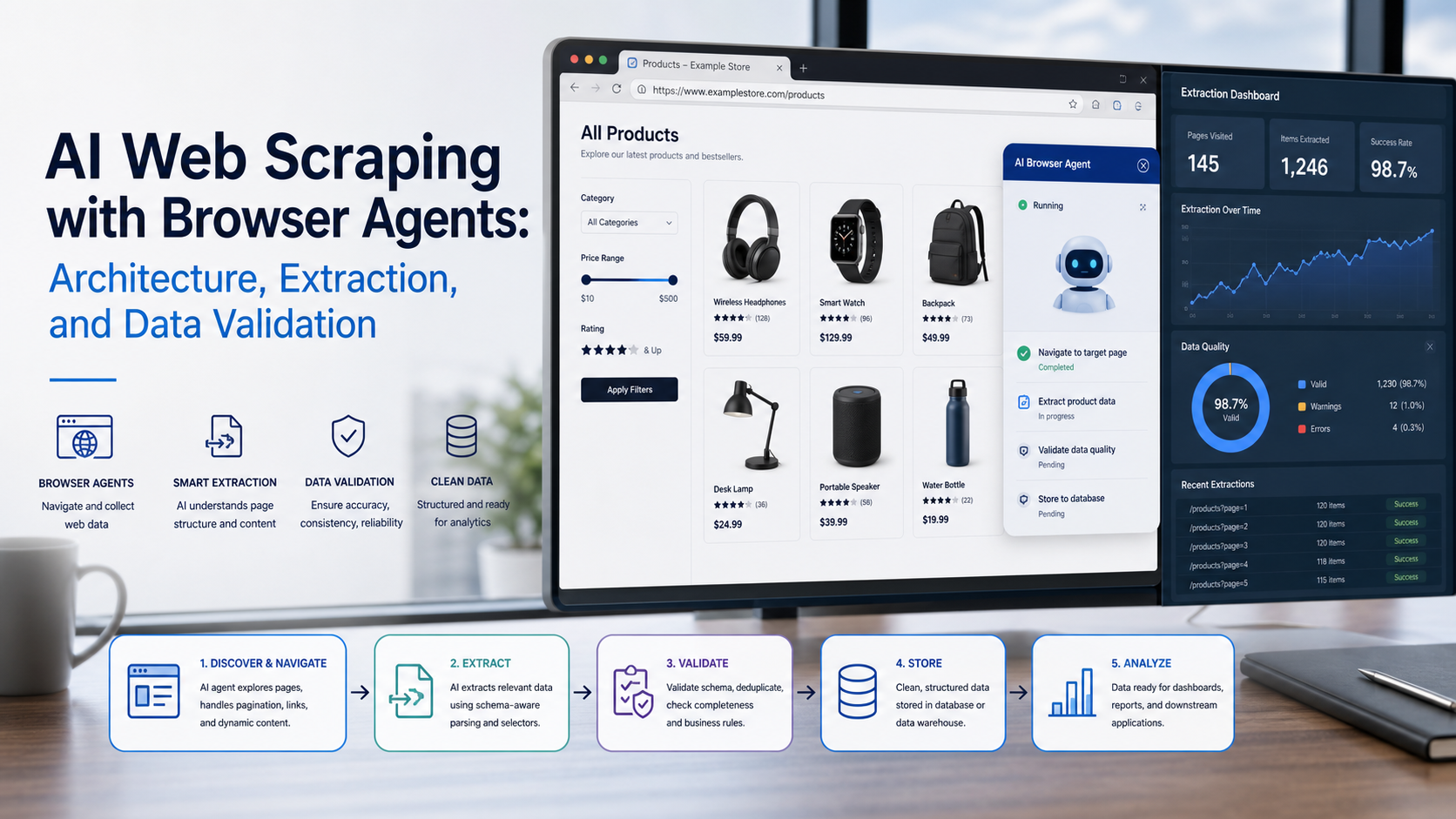
AI Web Scraping with Browser Agents: Architecture, Extraction, and Data Validation
AI web scraping uses AI to help discover, navigate, interpret, or extract information from websites. Browser agents are one implementation option when page interaction, rendering, or layout variation makes a simple scraper too brittle, but the agent should not become the entire data pipeline.
View Details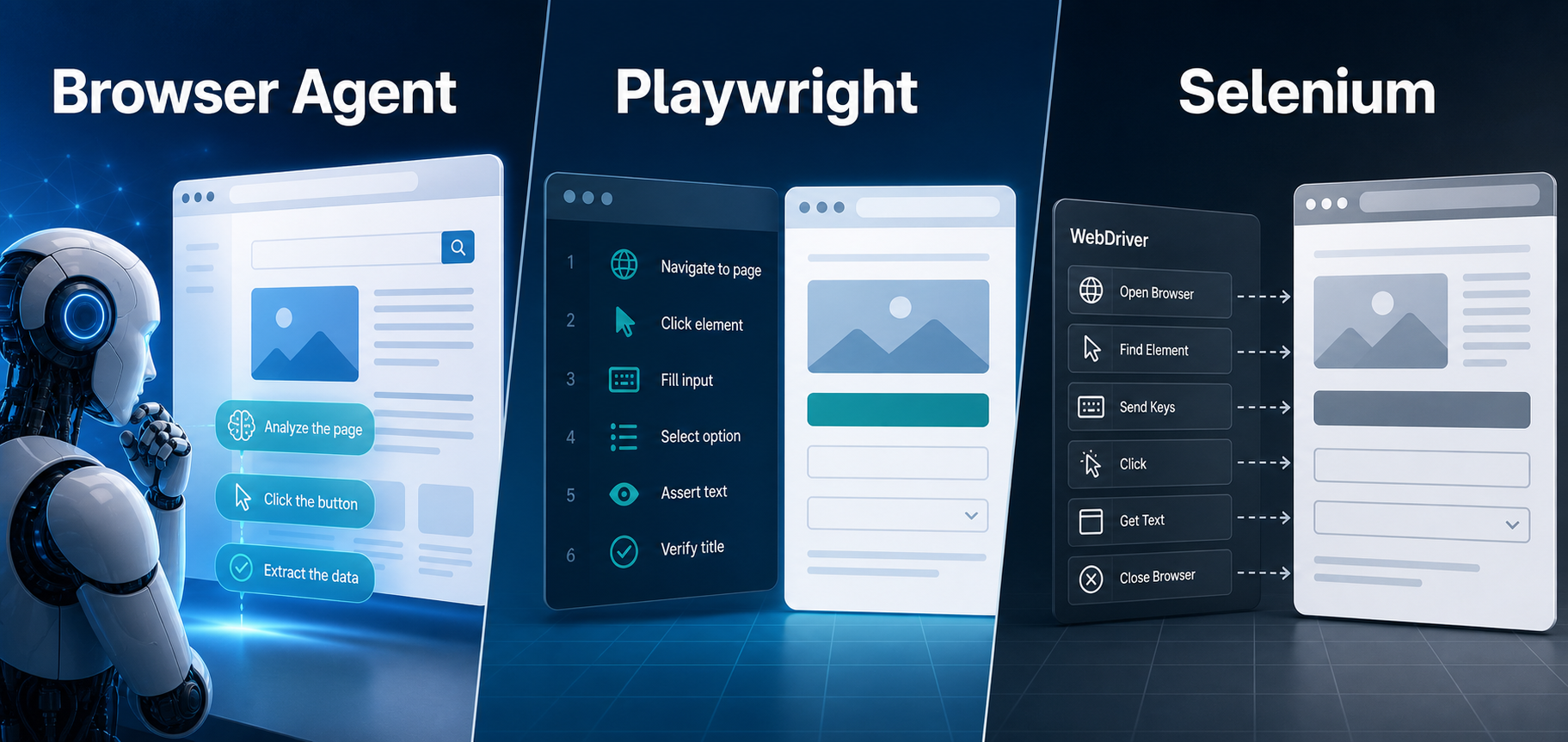
AI Browser Automation: Browser Agents vs Playwright vs Selenium
A browser agent interprets a goal and decides what browser action to take next. Playwright and Selenium can execute explicit, testable browser logic defined by developers. In 2026, however, Playwright also provides official MCP and agent-oriented workflows, so Playwright is no longer just the deterministic alternative to agentic automation. It can also serve as the browser-control layer inside an agent system.
View Details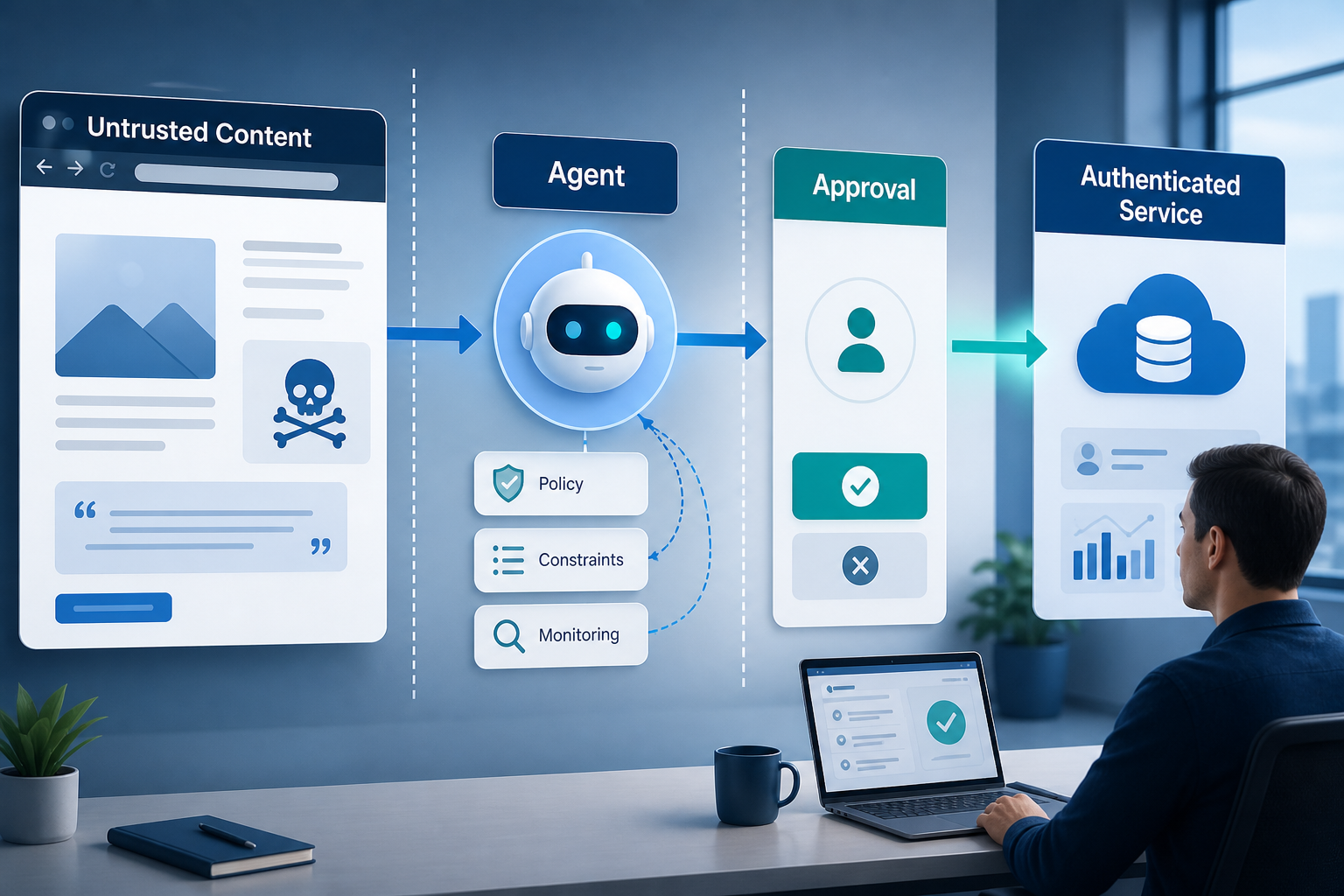
Agentic Browser Security: Prompt Injection, Permissions, and Safe Deployment
That combination creates risks that are different from ordinary browsing and traditional automation. The most important is indirect prompt injection, where hostile instructions hidden in web content attempt to redirect the agent away from the user's goal. Google describes indirect prompt injection as a primary new threat for agentic browsing and has introduced layered defenses that include origin constraints, independent action checks, threat detection, and user confirmation for sensitive actions. Google's Chrome security architecture is a useful reference for how browser-agent defenses are evolving.
View Details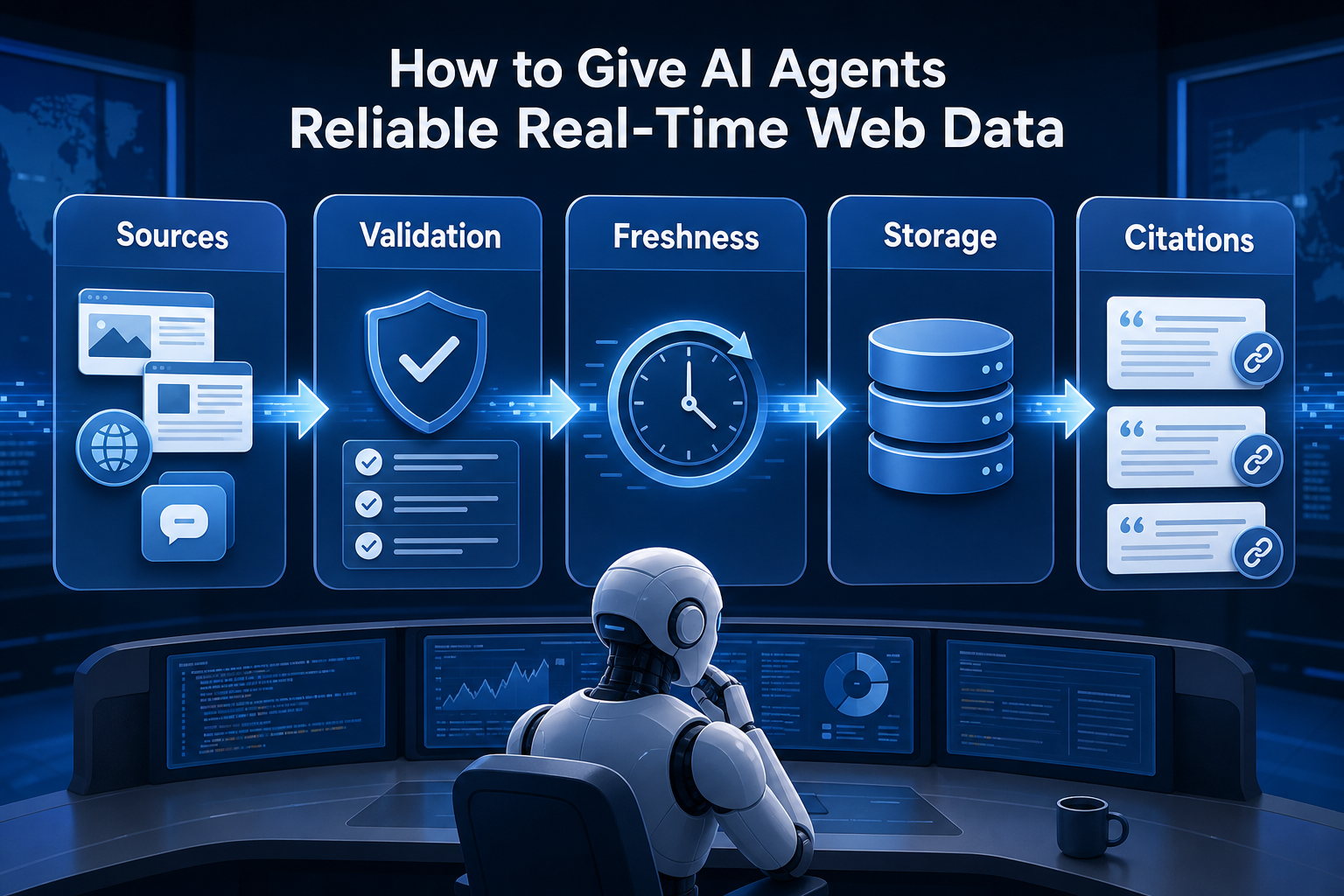
How to Give AI Agents Reliable Real-Time Web Data
A production-ready solution therefore needs more than a web scraper. It needs a web data layer that connects acquisition, validation, storage, retrieval, security, and observability. This guide explains how to design that layer.
View Details