
AI Data Collection: Methods, Tools, Quality Checks, and Risks
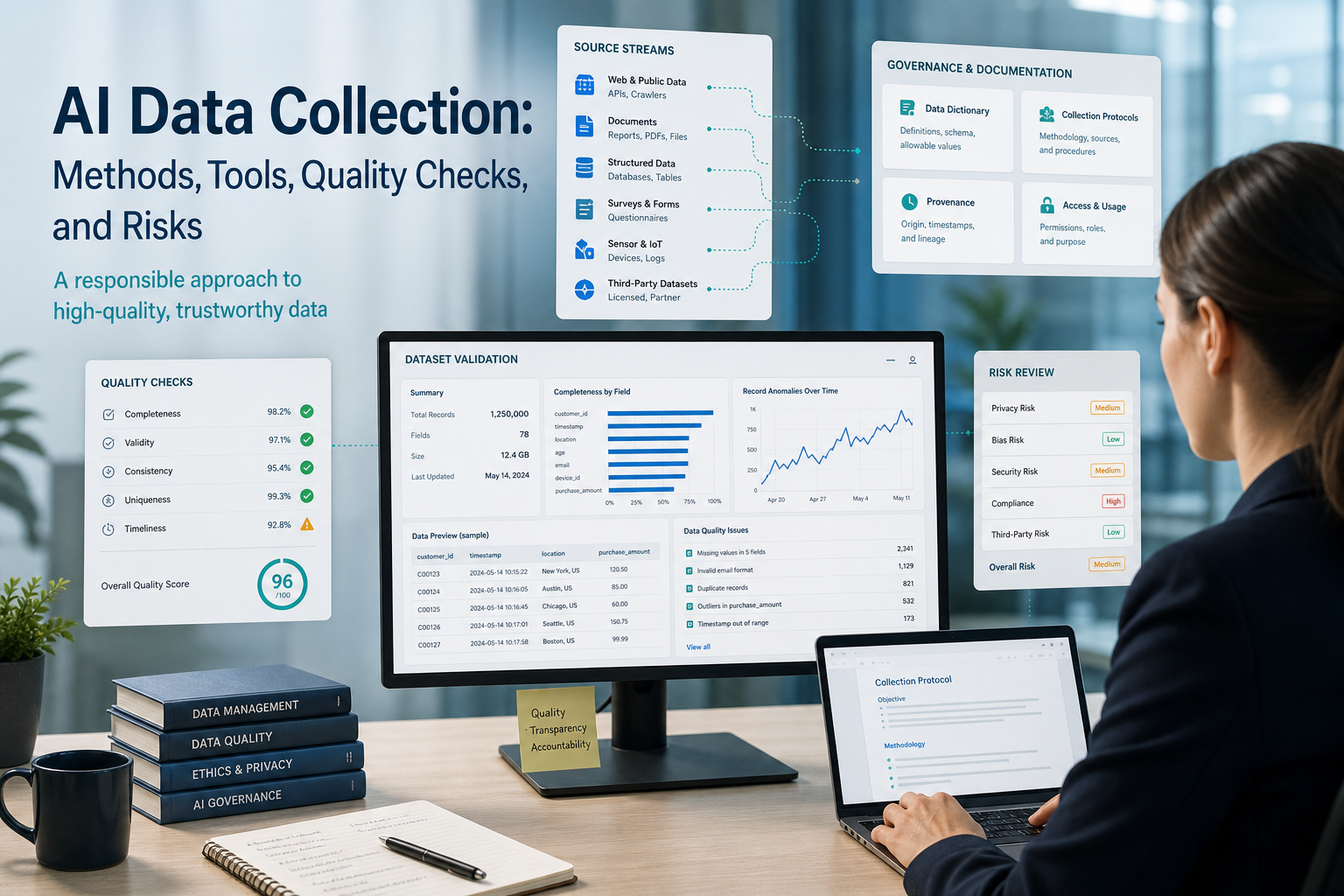
This guide is for data engineers, AI product teams, web-data teams, technical decision-makers, and organizations evaluating AI data collection tools.
AI data collection is the process of sourcing, acquiring, preparing, documenting, and maintaining the information used to train, fine-tune, evaluate, ground, or operate an artificial intelligence system. The data may come from internal systems, licensed datasets, public databases, APIs, human contributors, sensors, or authorized public-web collection.
The most important takeaway is that collecting more data does not automatically create a better AI system. The data must represent the intended use case, have traceable origins, meet quality requirements, and be collected under appropriate privacy, licensing, contractual, and security controls.
What this guide covers:
What Is AI Data Collection?
AI data collection is the systematic acquisition and preparation of information that an AI system needs to learn, retrieve knowledge, make predictions, generate responses, or undergo evaluation.
It usually includes more than downloading records. A complete collection process covers source selection, authorization, extraction, cleaning, deduplication, labeling, documentation, storage, versioning, validation, and ongoing monitoring.
The phrase is also used in three related but different ways.
| Meaning | What it describes | Example |
|---|---|---|
| Data collection for AI | Gathering data used to train, fine-tune, evaluate, or ground an AI system | Collecting labeled support tickets to train a classification model |
| AI-assisted data collection | Using AI to extract, categorize, validate, or structure incoming information | Using a language model to classify survey responses |
| Data collected by an AI product | Information gathered while people use an AI-powered application | Prompts, feedback, interaction logs, device data, or performance telemetry |
These meanings should not be treated as interchangeable. A tool that uses AI to organize survey responses is not necessarily a platform for building machine-learning training datasets. Similarly, the information an AI assistant processes while answering a question may be different from the data used to train its underlying model.
The OECD has emphasized that AI training data can be obtained through multiple collection mechanisms, each with different implications for developers, data subjects, rights holders, privacy, and data governance.
For the official technical reference behind this point, see Playwright documentation.
How Does AI Collect Data?
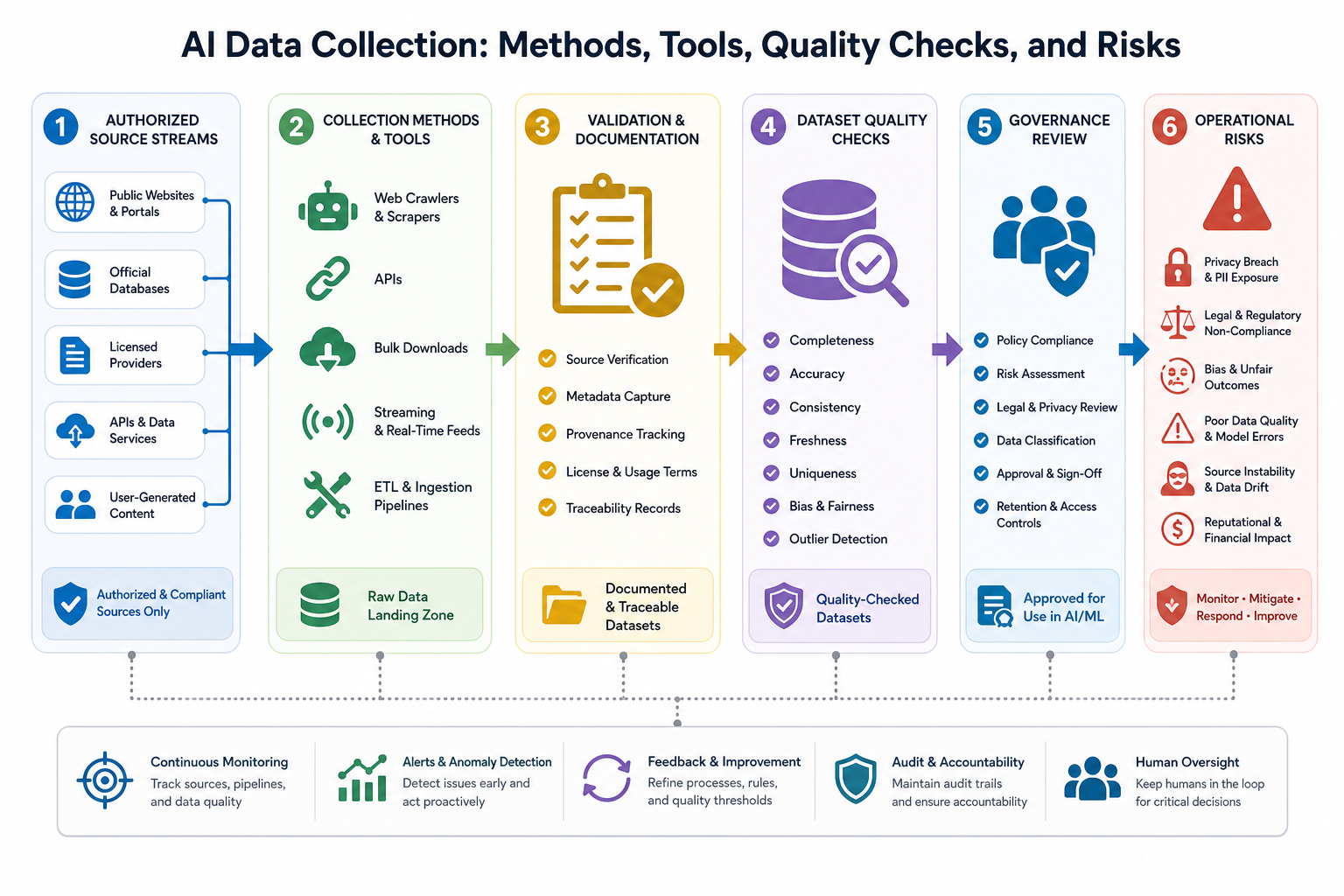
AI does not independently search for all the information it needs. People and software systems design collection pipelines that supply information to the model.
A typical pipeline works as follows:
- Define the intended AI task. The team determines what the system should predict, classify, generate, retrieve, or evaluate.
- Write a data specification. The specification describes required fields, formats, languages, time periods, geographic coverage, labels, quality thresholds, and exclusions.
- Identify permitted data sources. Sources may include internal databases, partner feeds, licensed datasets, official APIs, public repositories, voluntary human contributions, sensors, or permitted public-web pages.
- Acquire the raw data. Collection may use database queries, API requests, file transfers, event tracking, survey forms, crawlers, browser automation, data-labeling platforms, or physical devices.
- Prepare the information. The team parses records, standardizes formats, removes duplicates, handles missing values, filters sensitive information, and separates useful records from noise.
- Label or enrich the data when necessary. Human reviewers, rules, existing databases, or model-assisted processes may add categories, bounding boxes, rankings, summaries, metadata, or other annotations.
- Validate and document the dataset. The team checks accuracy, completeness, coverage, representativeness, licensing, provenance, security, and suitability for the intended task.
- Monitor the data after deployment. Collection pipelines must detect stale records, schema changes, source failures, distribution shifts, label degradation, and new compliance requirements.
Large foundation models may use combinations of publicly available information, licensed or partner-provided information, and data supplied or generated by users, researchers, or human trainers. However, the exact combination differs among developers and products.
What Types of Data Do AI Systems Collect?
AI systems can use structured, semi-structured, unstructured, and multimodal information.
Structured data
Structured data follows a predefined schema.
Examples include:
- Transaction records
- CRM fields
- Product catalogs
- Inventory tables
- Sensor readings
- Customer-support categories
- Financial or operational metrics
Structured information is usually easier to validate and query, but field definitions and collection logic can still introduce bias or inconsistencies.
Semi-structured data
Semi-structured information has identifiable keys or formatting without fitting neatly into a traditional relational table.
Examples include:
- JSON responses
- XML documents
- Application logs
- Email headers
- Event streams
- Webpage metadata
This data often requires parsing and normalization before it can be used consistently.
Unstructured data
Unstructured data does not arrive in a fixed tabular schema.
Examples include:
- Articles
- Reports
- Images
- Videos
- Audio recordings
- Support conversations
- Product reviews
- Survey comments
Unstructured information may require transcription, chunking, image processing, classification, entity extraction, or human annotation.
Multimodal data
Multimodal datasets combine two or more formats, such as text, images, audio, and video.
For example, a video dataset may include:
- The original video
- Audio
- A transcript
- Timestamps
- Captions
- Object labels
- Speaker information
- Usage rights
- Source metadata
The formats must remain aligned. A transcript that no longer matches the video timing can reduce the value of the complete dataset.
Main AI Data Collection Methods
No single collection method is appropriate for every AI project. The right choice depends on the intended task, available rights, quality requirements, freshness needs, budget, scale, and technical environment.
1. First-party operational data
First-party data is produced through an organization’s own products, services, systems, and customer interactions.
Examples include:
- Product usage events
- Customer-support tickets
- Internal documents
- Transaction histories
- Equipment readings
- Quality-control results
- User feedback
Best for: Building systems that reflect an organization’s own operations.
Main advantage: The organization may understand the data definitions, context, and collection process better than it understands third-party data.
Main limitation: Internal data can contain historical bias, inconsistent fields, missing consent records, sensitive information, or patterns that do not generalize beyond existing customers.
First-party ownership does not remove the need for purpose limitations, access controls, retention rules, privacy review, or documentation.
2. APIs and licensed data feeds
An API or licensed feed provides data through a defined technical and commercial arrangement.
Examples include:
- Government data APIs
- Weather feeds
- Financial data services
- Mapping services
- Research databases
- Commercial data providers
- Partner integrations
Best for: Teams that need structured, documented, and regularly refreshed information.
Main advantage: APIs usually offer a more stable schema and clearer access method than extracting information from webpages.
Main limitation: Coverage, rate limits, licensing terms, retention rights, allowed use cases, and costs may restrict how the data can be used.
An API should generally be evaluated before building a custom web collector. It may reduce engineering and maintenance work, but it does not automatically grant permission to use the returned information for model training.
3. Public and open datasets
Universities, governments, research institutions, and open-data programs publish datasets for research or public use.
Best for: Prototyping, benchmarking, academic research, and tasks supported by established datasets.
Main advantage: Open datasets can reduce collection costs and provide a useful baseline.
Main limitation: “Publicly accessible” does not always mean unrestricted. Teams still need to check licenses, intended uses, known limitations, collection dates, demographic coverage, and whether the dataset fits the new project.
Old benchmark data may also fail to represent current production conditions.
4. Authorized public-web collection
Public-web collection uses HTTP clients, crawlers, scraper APIs, or browser automation to retrieve permitted information from webpages.
It may support:
- Market research
- Search-result analysis
- Product availability monitoring
- Public price tracking
- News aggregation
- Geographic content verification
- Retrieval-augmented generation
- Dataset enrichment
Best for: Information that is publicly displayed, changes over time, and is not available through a suitable official API or licensed source.
Main advantage: Web collection can provide broad, current, and highly specific information.
Main limitation: Website structures change. Collection may also involve terms of service, robots directives, copyright, privacy, database rights, access controls, rate limits, and licensing considerations.
The Robots Exclusion Protocol is standardized in RFC 9309 and communicates which URI paths crawlers are requested to honor. It is one part of responsible collection, not a substitute for reviewing applicable terms, permissions, and laws.
5. Human-contributed and annotated data
People may create, review, rank, transcribe, label, or evaluate examples.
Examples include:
- Image annotation
- Speech transcription
- Preference rankings
- Safety evaluations
- Expert classifications
- User research
- Surveys
- Field observations
Best for: Tasks that require judgment, domain expertise, cultural understanding, or labels that cannot be reliably inferred from existing records.
Main advantage: Human contributors can identify ambiguity and context that automated rules may miss.
Main limitation: Contributors can disagree, misunderstand instructions, become fatigued, or introduce systematic bias.
Consent, participant expectations, compensation, working conditions, demographic coverage, and secure handling should be considered. Microsoft’s current guidance on sourcing human data for AI development also emphasizes informed consent and explaining how collected information will be used.
6. Sensors, devices, and real-world observations
Physical systems can collect measurements such as:
- Temperature
- Motion
- Images
- Sound
- Location
- Equipment status
- Vehicle telemetry
- Environmental conditions
Best for: Robotics, manufacturing, healthcare devices, autonomous systems, agriculture, and other applications involving physical environments.
Main advantage: Sensors provide direct observations of the conditions in which a system may operate.
Main limitation: Calibration errors, missing readings, hardware differences, environmental variation, sampling frequency, and privacy concerns can distort the dataset.
7. Synthetic data
Synthetic data is generated to imitate selected characteristics of real data.
It may be produced through:
- Simulation
- Rule-based generation
- Statistical models
- Generative models
- Digital twins
- Data augmentation
Best for: Rare scenarios, controlled tests, privacy-sensitive experimentation, class balancing, and environments where real examples are costly or dangerous to obtain.
Main advantage: Teams can generate targeted examples and test unusual conditions.
Main limitation: Synthetic data reflects the assumptions and weaknesses of the system that created it. It can omit unexpected real-world behavior or reproduce biases from seed data.
Synthetic data should usually be validated against appropriate real-world observations rather than treated as automatically accurate.
AI Data Collection Methods Compared
| Method | Best for | Main advantage | Main tradeoff | Typical freshness |
|---|---|---|---|---|
| First-party data | Organization-specific models | Strong operational context | Can reproduce internal bias | Near real time to historical |
| APIs and licensed feeds | Stable production pipelines | Structured delivery and clearer agreements | Cost, rate, and usage restrictions | Often current |
| Open datasets | Research and prototyping | Lower acquisition effort | May be old or poorly matched | Varies widely |
| Public-web collection | Current public information | Broad and customizable coverage | Maintenance and governance burden | Current when monitored |
| Human contribution | Judgment-intensive labels | Context and expertise | Cost and disagreement | Project dependent |
| Sensors and devices | Physical-world systems | Direct environmental observations | Calibration and privacy risks | Real time or periodic |
| Synthetic data | Rare scenarios and testing | Controllable generation | May not match reality | Generated as needed |
What Are AI Data Collection Tools?
AI data collection tools are applications or infrastructure components that help acquire, transform, label, validate, store, or monitor data used by an AI system.
A fixed list of “best tools” can be misleading because products that appear similar may operate at entirely different layers.
| Tool category | Primary function | Questions to ask |
|---|---|---|
| Forms and survey platforms | Collect direct responses | Does it record consent, timestamps, and response metadata? |
| Product analytics and event tools | Capture user or application activity | Are event definitions stable and documented? |
| API clients and connectors | Retrieve data from external systems | What are the rate, retention, and usage limits? |
| ETL and orchestration tools | Move and transform data | Can jobs be retried, versioned, and audited? |
| Crawlers and scraping tools | Collect permitted public-web information | Can they handle pagination, rendering, rate control, and change detection? |
| Browser automation frameworks | Interact with JavaScript-driven pages | Is browser execution genuinely necessary? |
| Annotation platforms | Coordinate human labeling | Can they measure reviewer agreement and manage sensitive data? |
| Synthetic-data systems | Generate artificial examples | How is realism measured against real data? |
| Validation and observability tools | Detect quality and schema problems | Can they alert on drift, missing fields, duplicates, and anomalies? |
| Storage and versioning systems | Preserve datasets and metadata | Can teams reproduce the exact dataset used for a model? |
| Data catalogs | Document ownership and lineage | Can users identify the source, license, purpose, and limitations? |
Are there free AI data collection tools?
Yes. Open-source crawlers, API clients, browser automation libraries, data-validation frameworks, databases, annotation tools, and workflow orchestrators are available.
However, “free software” does not mean “free collection.” Teams may still incur costs for:
- Engineering
- Hosting
- Storage
- Network traffic
- Human annotation
- Monitoring
- Security
- Maintenance
- Licensing
- Compliance review
The correct comparison is total operational cost, not subscription price alone.
How to Choose an AI Data Collection Approach
Use a source-to-model decision framework instead of choosing a tool based on popularity.
1. Start with the model’s job
Define the exact decision or output the system must produce.
A customer-support classifier requires different data from a retrieval system, fraud model, recommendation engine, or multimodal assistant.
2. Identify the minimum useful information
List the fields, examples, labels, time range, languages, locations, and edge cases required.
Avoid collecting personal or sensitive information merely because it may be useful later. The FTC recommends deliberate decisions about what information is collected, how long it is retained, and who can access it.
3. Prefer the most direct authorized source
Use this general sequence:
- Internal source with appropriate rights
- Official API or export
- Licensed or partner data
- Suitable open dataset
- Voluntary human collection
- Authorized public-web collection
- Synthetic data for targeted supplementation
The sequence is not absolute. It is a way to reduce unnecessary complexity and uncertainty.
4. Match the method to freshness requirements
A static dataset may support initial training but fail a real-time retrieval application.
Ask:
- How quickly does the information change?
- How stale can it become before the system is affected?
- Can incremental updates be collected?
- Can deleted or corrected source records be reflected?
- Is historical versioning necessary?
5. Evaluate coverage, not just volume
A large dataset may still omit:
- Important user groups
- Minority classes
- Regional variations
- Rare failure conditions
- New terminology
- Seasonal patterns
- Production edge cases
NIST’s AI Risk Management Framework recommends documenting considerations around data availability, representativeness, suitability, collection, selection, and construct validation.
6. Check provenance and permitted uses
For every source, record:
- Where it originated
- Who collected it
- When it was collected
- How it was obtained
- Which transformations were applied
- Applicable permissions or licenses
- Whether personal information is present
- Whether deletion or expiration requirements apply
- Which models or systems may use it
7. Estimate the maintenance burden
A collection process is not complete when the first dataset is delivered.
Consider:
- Source changes
- Schema drift
- Broken selectors
- API deprecations
- Label-policy changes
- Storage growth
- Reprocessing requirements
- Quality alerts
- Data deletions
- Contract renewals
8. Test before scaling
Begin with a small sample that includes normal records, missing fields, rare cases, duplicates, and likely production failures.
Scaling an unvalidated pipeline usually makes its problems more expensive.
A Practical AI Data Collection Workflow
The following workflow can be adapted for model training, fine-tuning, evaluation, retrieval, analytics, or agent grounding.
Step 1: Define the authorized use case
Write down:
- The problem being solved
- The intended users
- The model or system type
- The decisions the data will influence
- Prohibited uses
- Accuracy and risk requirements
Step 2: Create a data specification
Describe:
- Required fields
- Accepted formats
- Labels
- Languages
- Locations
- Time period
- Update frequency
- Minimum quality
- Excluded data
- Sensitive-data restrictions
Step 3: Build a source register
For every proposed source, document its owner, access method, license or permission status, collection period, reliability, and known limitations.
Step 4: Compare acquisition methods
Check whether an internal export, API, licensed dataset, open repository, direct human contribution, or sensor feed can satisfy the requirement before building a web collector.
Step 5: Collect a representative sample
Do not start with maximum volume. Use a smaller sample to test schemas, labels, edge cases, source stability, and legal or policy concerns.
Step 6: Preserve raw and processed versions
Keep the original record separate from transformed data when permitted and appropriate.
This helps teams:
- Reproduce transformations
- Investigate errors
- Update cleaning logic
- Compare pipeline versions
- Demonstrate provenance
Step 7: Clean, deduplicate, and normalize
Apply documented rules for:
- Duplicate detection
- Missing values
- Date and time formats
- Character encoding
- Units
- Language identification
- File corruption
- Unsupported formats
- Sensitive-information filtering
Step 8: Label and review
Create clear annotation instructions and examples.
For human-reviewed data, measure agreement between reviewers. Revisit labels with high disagreement instead of treating the majority decision as automatically correct.
Step 9: Validate against the intended use
Test whether the dataset covers the actual production conditions.
A dataset may be internally consistent but still unsuitable for the model’s real environment.
Step 10: Version, monitor, and refresh
Assign a dataset version and record:
- Source snapshot
- Collection dates
- Transformation code
- Labeling guidelines
- Quality results
- Known limitations
- Approval status
- Model versions using the data
Create alerts for schema changes, missing batches, unusual distributions, duplicate spikes, and freshness failures.
For the LycheeIP implementation details behind this step, review AI-powered browser automation hub.
For the LycheeIP implementation details behind this step, review scaling lead scraping with n8n.
How to Validate AI Data Quality
Google’s machine-learning guidance warns that unclear definitions, unknown collection methods, noise, and poor-quality datasets can lead to inaccurate analysis or model behavior.
A complete quality review should include the following dimensions.
Relevance
Does the data represent the task the system is expected to perform?
Accuracy
Do records and labels reflect the underlying source or observation?
Completeness
Are required fields, classes, time periods, and population segments sufficiently covered?
Consistency
Are formats, categories, units, and labels applied uniformly?
Uniqueness
Have exact and near-duplicate records been identified?
Representativeness
Does the dataset reflect the users, environments, languages, locations, and conditions in which the system will operate?
Timeliness
Is the information current enough for the intended use?
Label quality
Do reviewers agree, and are ambiguous examples handled consistently?
Provenance
Can the team trace each record or batch to its source, collection method, transformations, and permissions?
Security and privacy
Are sensitive records minimized, protected, access-controlled, and retained only as required?
Leakage control
Does the training data accidentally contain answers, future information, test examples, or target variables that would not be available during real use?
Production alignment
Do the training, validation, test, and live-production distributions reflect the conditions the model will encounter?
A successful data import does not prove that the dataset is correct. Validation must examine both technical integrity and suitability for the intended AI task.
AI Dataset Validation Checklist
Before approving a dataset, confirm that:
- The intended use is documented.
- Every source has an identifiable owner or origin.
- Access and usage rights have been reviewed.
- Collection dates and methods are recorded.
- Required fields meet completeness thresholds.
- Exact and near duplicates have been assessed.
- Labels have been reviewed for consistency.
- Important classes and user groups are represented.
- Sensitive data has been identified and minimized.
- Training and evaluation data are appropriately separated.
- Known limitations are documented.
- Transformations can be reproduced.
- Refresh and deletion procedures exist.
- Monitoring alerts are configured.
- A responsible owner has approved the dataset.
Dataset documentation can be formalized through a Data Card that explains the dataset’s source, characteristics, intended uses, limitations, and maintenance. Google’s Data Cards Playbook provides a structured approach to this kind of transparency.
Common AI Data Collection Problems
| Symptom | Likely cause | First check | Recommended next step |
|---|---|---|---|
| Model performs well in testing but poorly in production | Training data does not match live conditions | Compare feature and label distributions | Collect representative production examples and revise evaluation sets |
| Dataset contains repeated examples | Duplicate pages, records, or collection jobs | Check IDs, hashes, canonical URLs, and timestamps | Add exact and semantic deduplication |
| Labels vary between reviewers | Ambiguous instructions or subjective categories | Measure reviewer agreement | Clarify guidelines and add adjudication |
| Records suddenly have missing fields | API, webpage, or upstream schema changed | Inspect the most recent raw batch | Version the parser and add schema alerts |
| Web collection returns inconsistent values | Dynamic rendering, personalization, location, or session state | Compare raw responses and browser conditions | Standardize environment and document variable factors |
| Collection costs rise unexpectedly | Excessive retries, browser overuse, or duplicate work | Review request logs and retry rates | Cache results, reduce unnecessary rendering, and set retry limits |
| Dataset becomes stale | No refresh policy or failed scheduled job | Check last successful collection time | Define freshness thresholds and failure notifications |
| Sensitive information appears in training data | Weak source filtering or unclear minimization rules | Scan samples and source fields | Quarantine affected records and revise controls |
| Evaluation results seem unrealistically high | Leakage between training and test sets | Search for duplicates and temporal overlap | Rebuild the split using entity, group, or time boundaries |
| A source blocks collection | Rate, policy, authentication, or access-control issue | Review response codes, terms, permissions, and rate | Reduce requests, use an approved API, seek permission, or stop collecting |
Where Web Scraping Fits Into AI Data Collection
Web scraping is one possible acquisition method. It is not the entire AI data collection process.
A complete public-web pipeline usually contains several separate layers:
- Source layer: The website or public resource
- Collection layer: The crawler, scraper, API client, or browser script
- Network layer: DNS, routing, connections, IP addresses, and proxies
- Session layer: Cookies, accounts, authentication, and session state
- Parsing layer: Extraction and transformation logic
- Quality layer: Validation, deduplication, and anomaly detection
- Storage layer: Files, databases, object storage, catalogs, and versions
- Governance layer: Permissions, licenses, privacy, security, and retention
- Model layer: Training, retrieval, evaluation, or inference
Changing one layer does not automatically repair a problem in another.
For example:
- A proxy cannot fix an incorrect CSS selector.
- Browser automation cannot repair inaccurate labels.
- A new IP address cannot correct an expired account.
- A successful HTTP response does not prove that the extracted data is complete.
- An LLM-generated parser does not prove that its output matches the source.
For the LycheeIP implementation details behind this step, review LycheeIP proxy infrastructure.
For the LycheeIP implementation details behind this step, review rotating residential proxies.
For the official technical reference behind this point, see MDN HTTP overview.
When Does an AI Data Collection Pipeline Need Proxies?
A proxy changes the network route and source IP used for a request. It may also support geographic routing or session configuration.
A proxy does not collect, clean, label, validate, or license the underlying data by itself.
Proxy infrastructure may be relevant when an authorized public-web workflow requires:
- Geographic verification
- Distributed network testing
- Location-specific public content
- Separation of permitted collection workloads
- Stable long-running network sessions
- Testing how public resources appear from different regions
- Operational resilience across approved collection jobs
It may be unnecessary when:
- An official API already provides the required information
- The data comes from internal systems
- The dataset is delivered through a licensed file transfer
- A single outbound connection meets the requirement
- The collection lacks authorization
- The actual problem is parsing, labeling, or data quality
How LycheeIP fits into the network layer
Teams evaluating public-web collection should choose proxy infrastructure according to the network characteristics of the authorized workload.
Datacenter proxies may suit high-volume collection from open, stable sources where server-based IP routing is acceptable.
Dynamic residential proxies may be considered when permitted collection or geographic testing requires residential network routes across different locations.
Static residential proxies may be relevant when a legitimate workflow requires a more stable IP and longer session continuity.
These products solve network-routing requirements. They do not guarantee access, eliminate website challenges, repair collection code, or replace compliance and data-quality controls. Current LycheeIP product pages list HTTP, HTTPS, and SOCKS5 support across these product categories, while the dynamic residential page also describes configurable rotating and sticky sessions.
Before increasing collection volume, test a small sample, monitor response quality, and confirm that the network layer is the actual constraint.
Privacy, Copyright, and Governance Considerations
AI data collection can involve privacy, copyright, contract, consumer-protection, confidentiality, security, and sector-specific obligations.
The requirements vary according to the data, source, jurisdiction, participants, and intended use. The following is operational guidance, not legal advice.
Use purpose limitation
Document why each data category is required and prevent unrelated reuse without review.
Minimize personal and sensitive data
Do not collect information merely because storage is available. Remove unnecessary identifiers and limit retention.
Record consent and contributor expectations
When people deliberately provide data, explain:
- What will be collected
- Why it is being collected
- Who will use it
- Whether it may be used for AI training or evaluation
- How long it will be retained
- Which choices or deletion rights are available
Review licenses and ownership
Determine whether the intended use permits:
- Copying
- Transformation
- Model training
- Fine-tuning
- Evaluation
- Redistribution
- Commercial use
- Long-term storage
Respect access controls
Do not bypass authentication, payment controls, technical restrictions, or security measures.
Review website rules
For public-web collection, examine:
- Terms of service
- Robots directives
- Published API rules
- Rate limits
- Copyright notices
- Privacy policies
- Acceptable-use conditions
- Contractual obligations
Protect the collection pipeline
Use encryption, access controls, audit logs, secrets management, incident procedures, and retention limits.
Maintain training-data transparency
Documentation expectations are developing. California’s AB 2013 requires covered developers making generative AI systems or substantial modifications publicly available to Californians to publish specified high-level information about training datasets. The requirements took effect on January 1, 2026. Organizations should determine whether and how the law applies to their systems with qualified counsel.
Realistic AI Data Collection Use Cases
Retrieval-augmented generation
A company may collect approved internal documentation, product records, and licensed reference materials for a retrieval system.
The records must be current, permission-aware, searchable, and linked back to their sources.
Product classification
An e-commerce team may combine catalog fields, product descriptions, images, and human-reviewed categories to train a classification model.
The team should monitor new categories and changes in naming conventions.
Fraud and risk evaluation
A fintech team may use permitted transaction signals, device information, verified outcomes, and human investigations.
High-stakes use requires careful controls for fairness, privacy, error analysis, and human review.
Public market research
A research team may collect permitted public product information, availability, reviews, and geographic differences.
The pipeline should preserve collection times, source URLs, regional conditions, and parsing versions.
AI system evaluation
A team may gather expert-written tests, user feedback, model responses, safety examples, and failure cases.
Evaluation data should remain separate from training data when the goal is to measure unseen performance.
When Not to Use a Collection Approach
Do not build a complex AI data collection system when:
- A stable official API already provides the required data
- A licensed dataset can meet the need with lower risk
- The organization lacks permission to use the information
- The task involves private or protected data without appropriate authority
- The team cannot validate the resulting dataset
- The collection method creates disproportionate privacy or security risk
- The expected data volume does not justify the infrastructure
- The source is too unstable for the required reliability
- Synthetic examples cannot be validated against reality
- A rules-based system solves the problem without machine learning
- The project lacks an owner responsible for data quality and governance
The goal is not to maximize collection. It is to obtain the smallest reliable, representative, and supportable dataset that solves the intended problem.
Use LycheeIP Proxies for Reliable AI Data Collection Workflows
Final AI Data Collection Principles
A reliable AI data collection strategy should:
- Begin with a clearly defined AI task.
- Collect only the information required for that task.
- Prefer direct, authorized, and documented sources.
- Separate acquisition, networking, parsing, labeling, and validation.
- Record provenance and permissions.
- Validate representativeness and production fit.
- Protect sensitive information.
- Preserve dataset versions and transformation history.
- Monitor freshness, drift, and source changes.
- Scale only after quality and governance checks pass.
AI systems depend on the information available to them, but volume alone is not the objective. The strongest collection pipeline produces data that is relevant, traceable, reproducible, secure, and suitable for the decisions the system will make.
For authorized public-web projects where network routing is a genuine requirement, review the available LycheeIP proxy infrastructure and test the appropriate proxy type on a small, monitored collection sample before scaling.
Frequently Asked Questions
What is AI data collection?
AI data collection is the process of acquiring, preparing, documenting, and maintaining information used to train, fine-tune, evaluate, ground, or operate an AI system. It includes source selection, extraction, cleaning, labeling, validation, storage, and monitoring.
How does AI collect data?
AI systems receive data through pipelines designed by people and software. These pipelines may connect to internal databases, APIs, licensed feeds, public datasets, voluntary human contributions, sensors, or authorized public-web sources.
What are AI data collection tools?
AI data collection tools are systems that acquire, move, extract, label, validate, store, or monitor information for AI workflows. Different tools operate at different layers, so teams should identify whether they need a connector, crawler, annotation platform, validation framework, catalog, proxy, or storage system.
Are there free AI tools for collecting data?
Yes, free and open-source tools exist for API access, web crawling, browser automation, annotation, validation, orchestration, and storage. The complete workflow may still involve infrastructure, engineering, maintenance, annotation, security, and compliance costs.
What is the difference between data collection and data labeling?
Data collection acquires the raw examples or records. Data labeling adds target categories, rankings, annotations, or other information that helps a model learn or allows teams to evaluate its output.
Can synthetic data replace real data?
Synthetic data can supplement real data, especially for rare events, simulations, testing, and controlled augmentation. It should not automatically be treated as a complete replacement because it can reproduce the assumptions, gaps, and biases of the process that generated it.
Is web scraping legal for AI data collection?
There is no universal answer. The assessment may depend on the source, jurisdiction, information collected, access method, website terms, copyright, privacy, contracts, licensing, and intended use. Teams should avoid protected information and access controls, respect applicable rules, and obtain legal advice for material projects.
How can I opt out of Meta AI data collection?
Available controls depend on location, account status, and the specific Meta product. Meta’s Privacy Center currently explains that certain adults can object to the future use of eligible public information and interactions with AI at Meta for generative AI development. Users should check the current Meta Privacy Center while signed in because the available form and rights can differ by region.
Does a proxy prepare data for an AI model?
No. A proxy changes the network route or source IP used by the collection software. Parsing, cleaning, deduplication, labeling, validation, storage, and governance remain separate parts of the AI data pipeline. Embedded anchor text Destination page Article section Reason for placement Status Datacenter proxies LycheeIP Datacenter Proxies How LycheeIP fits into the network layer Supports evaluation of server-based proxy routing Embedded Dynamic residential proxies LycheeIP Dynamic Residential Proxies How LycheeIP fits into the network layer Supports location-diverse and configurable session requirements Embedded Static residential proxies LycheeIP Static Residential Proxies How LycheeIP fits into the network layer Supports stable-IP and session-continuity evaluation Embedded LycheeIP proxy infrastructure LycheeIP Homepage Article conclusion Provides a calm next step for readers with a verified network-layer requirement Embedded Hyperlinked source name Claim supported Article section Source type Date accessed OECD: Mapping Relevant Data Collection Mechanisms for AI Training AI training data is sourced through multiple mechanisms with different governance implications What Is AI Data Collection? Intergovernmental policy paper July 24, 2026 OpenAI: How ChatGPT and Foundation Models Are Developed Example categories of data used during foundation-model development How Does AI Collect Data? Official developer disclosure July 24, 2026 NIST AI Risk Management Framework Core Data collection, selection, availability, representativeness, and suitability should be documented How to Choose an AI Data Collection Approach Government framework July 24, 2026 Google Machine Learning Data Quality Guide Collection methods, definitions, noise, and dataset quality affect analysis How to Validate AI Data Quality Official technical guidance July 24, 2026 Google Data Cards Playbook Structured dataset documentation supports transparency and responsible use AI Dataset Validation Checklist Official technical guidance July 24, 2026 RFC 9309: Robots Exclusion Protocol Robots directives communicate crawler access preferences for URI paths Authorized public-web collection Internet standard July 24, 2026 FTC: Start With Security Organizations should minimize unnecessary personal-data collection and retention How to Choose an AI Data Collection Approach Government business guidance July 24, 2026 California AB 2013 Covered generative AI developers must publish specified training-data documentation Privacy, Copyright, and Governance Considerations State legislation July 24, 2026 Meta Privacy Center Current regional information and controls concerning the use of eligible information for generative AI development FAQs Official privacy resource July 24, 2026
Related LycheeIP Guides and Resources

Recommended Articles
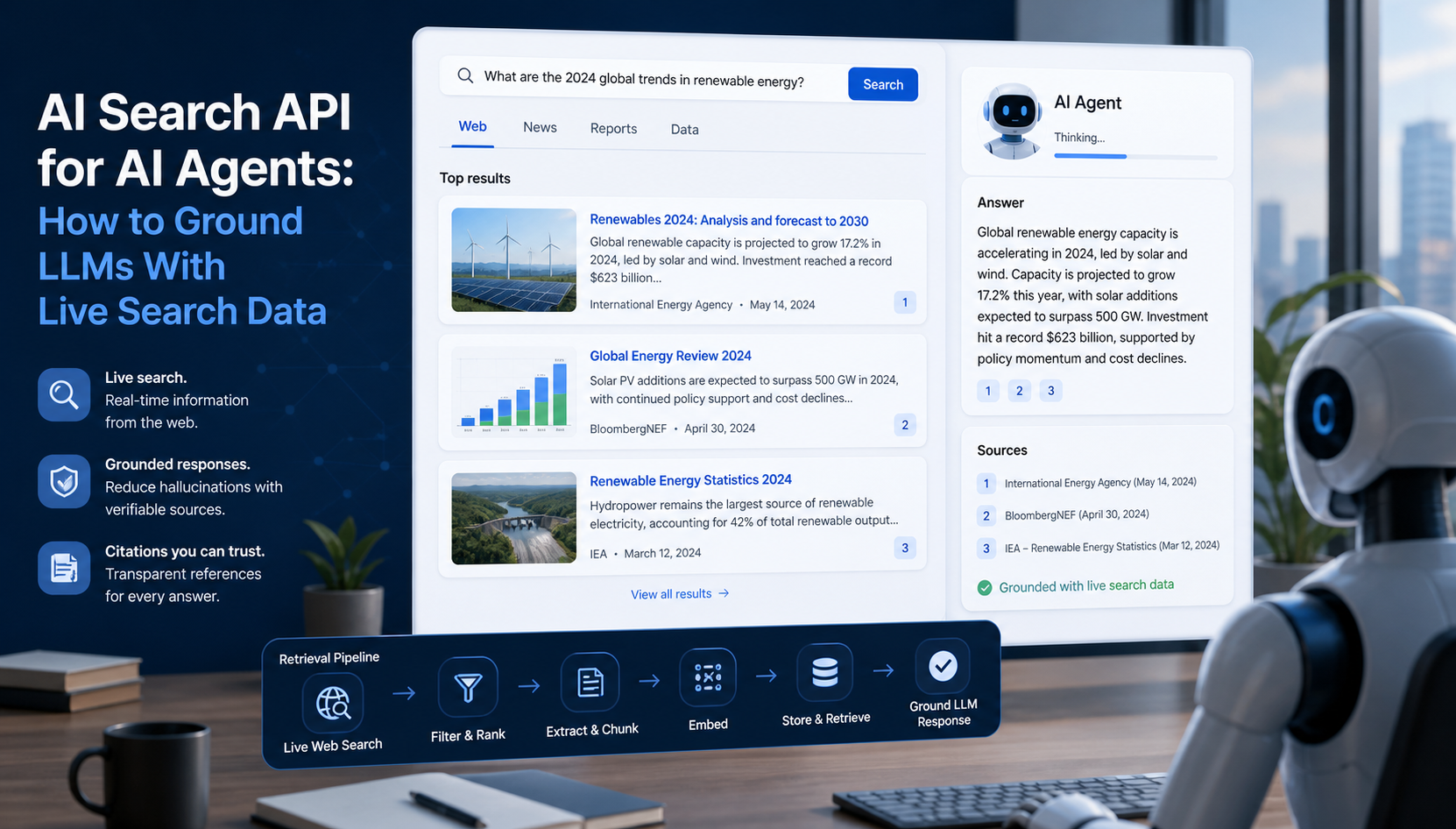
AI Search API for AI Agents: How to Ground LLMs With Live Search Data
An AI search API gives an application or agent programmatic access to current search results. Its most useful role is discovery: the agent can find candidate sources, identify fresh information, and decide what to retrieve next instead of relying only on model memory.
View Details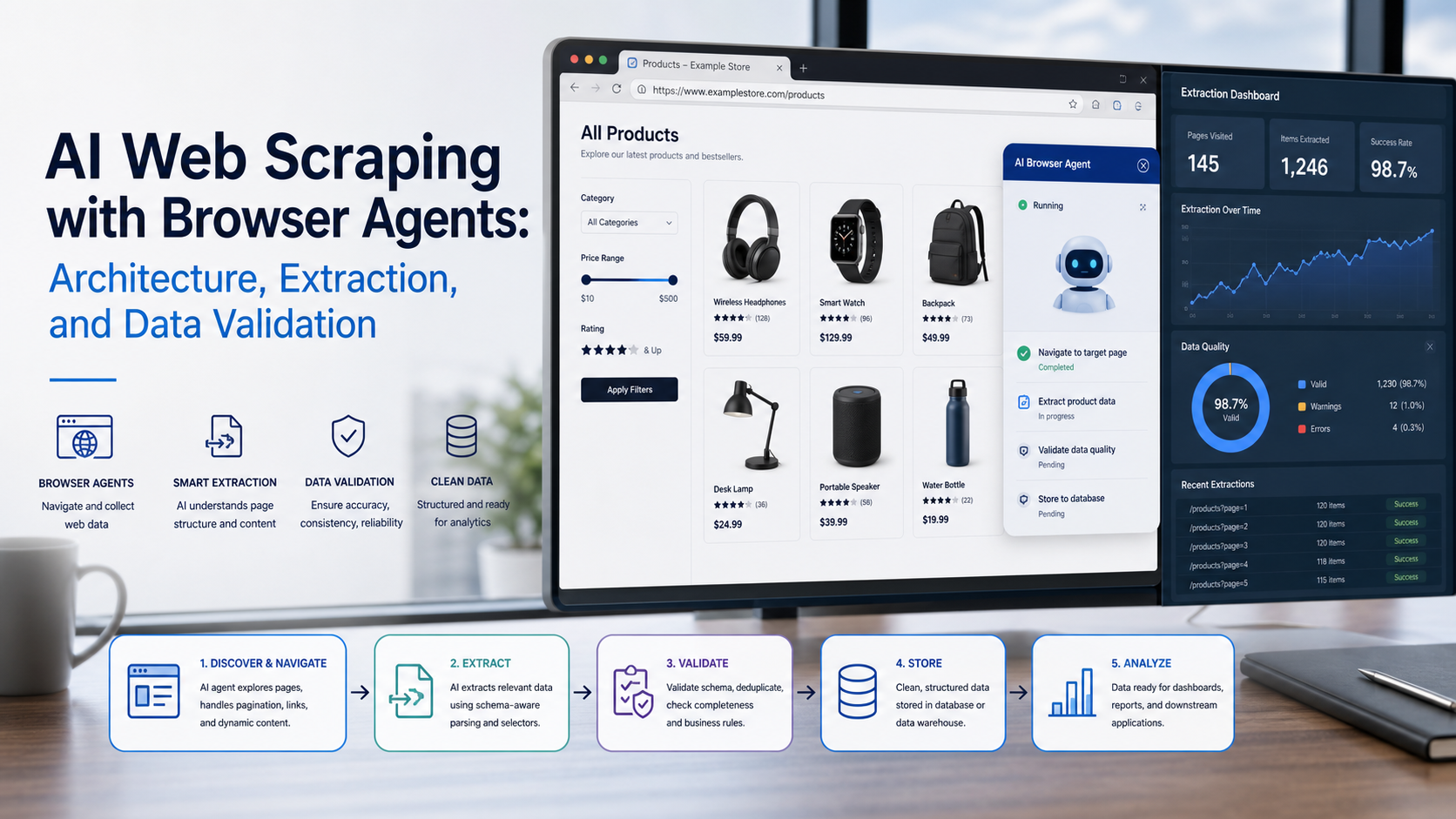
AI Web Scraping with Browser Agents: Architecture, Extraction, and Data Validation
AI web scraping uses AI to help discover, navigate, interpret, or extract information from websites. Browser agents are one implementation option when page interaction, rendering, or layout variation makes a simple scraper too brittle, but the agent should not become the entire data pipeline.
View Details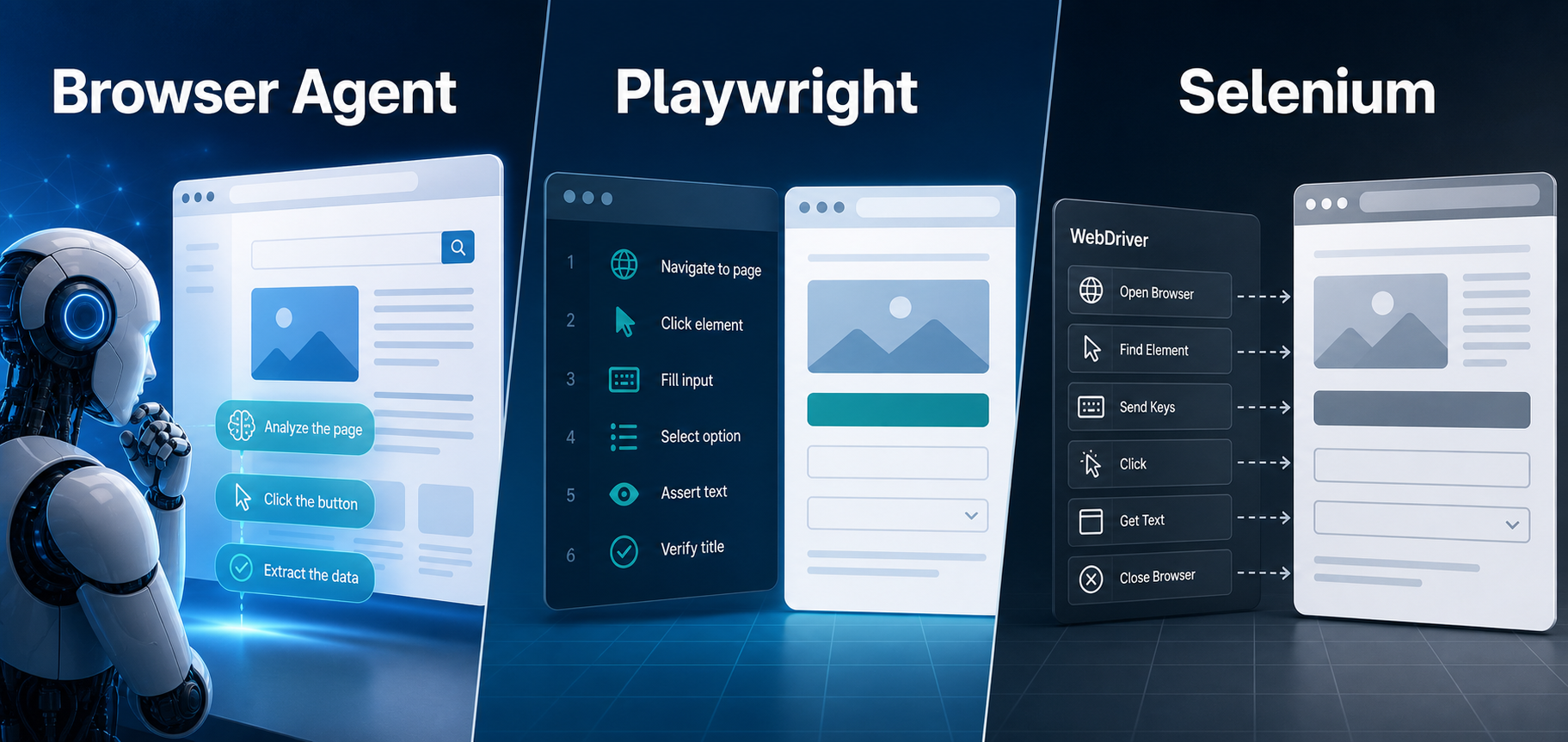
AI Browser Automation: Browser Agents vs Playwright vs Selenium
A browser agent interprets a goal and decides what browser action to take next. Playwright and Selenium can execute explicit, testable browser logic defined by developers. In 2026, however, Playwright also provides official MCP and agent-oriented workflows, so Playwright is no longer just the deterministic alternative to agentic automation. It can also serve as the browser-control layer inside an agent system.
View Details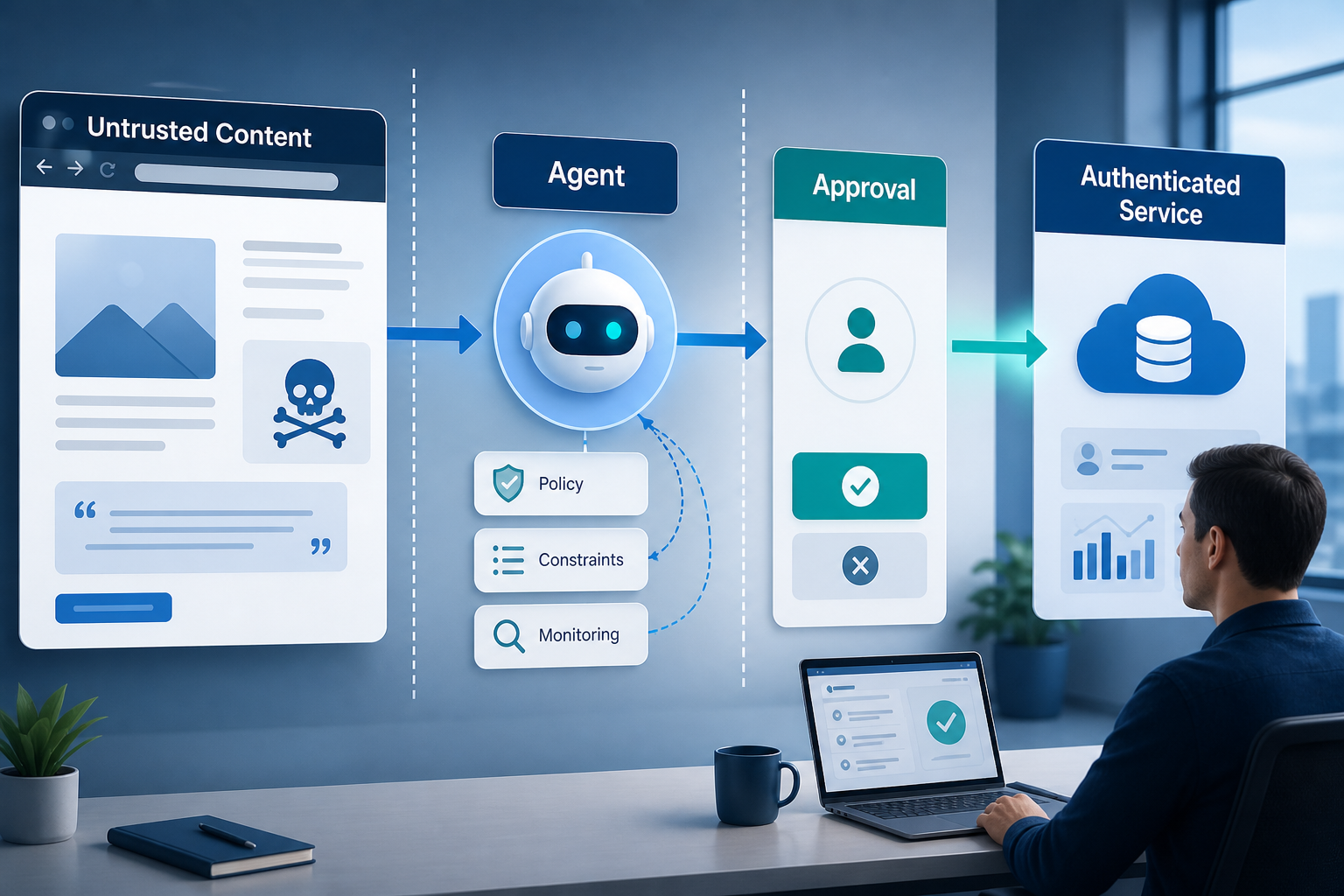
Agentic Browser Security: Prompt Injection, Permissions, and Safe Deployment
That combination creates risks that are different from ordinary browsing and traditional automation. The most important is indirect prompt injection, where hostile instructions hidden in web content attempt to redirect the agent away from the user's goal. Google describes indirect prompt injection as a primary new threat for agentic browsing and has introduced layered defenses that include origin constraints, independent action checks, threat detection, and user confirmation for sensitive actions. Google's Chrome security architecture is a useful reference for how browser-agent defenses are evolving.
View Details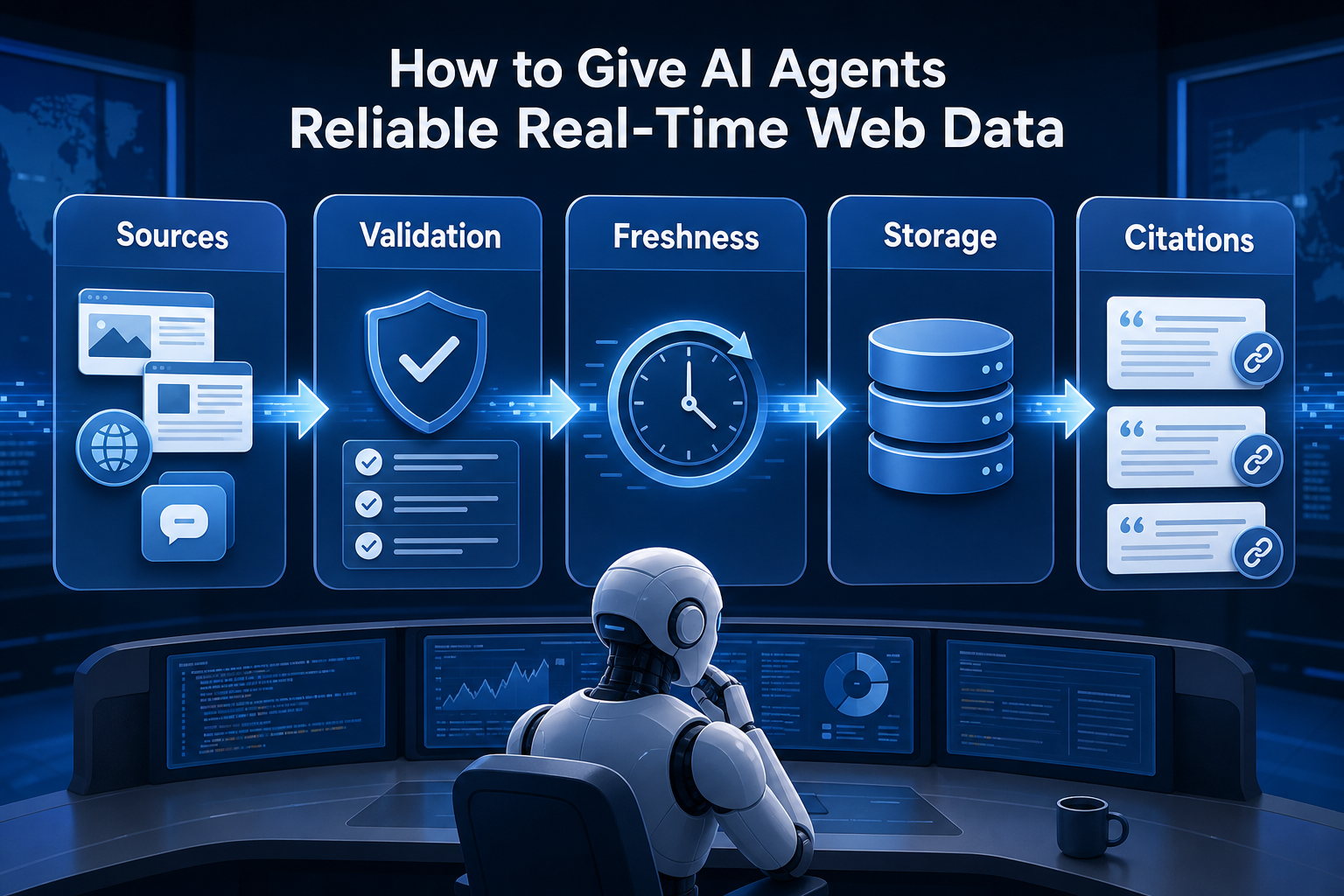
How to Give AI Agents Reliable Real-Time Web Data
A production-ready solution therefore needs more than a web scraper. It needs a web data layer that connects acquisition, validation, storage, retrieval, security, and observability. This guide explains how to design that layer.
View Details