
Janitor AI: A Technical Analysis for Developers and Researchers
Janitor AI: A Technical Analysis for Developers and Researchers

Platforms like Janitor AI have gained significant attention for their ability to create and interact with custom AI characters. While the primary use case for many is entertainment, for developers, data engineers, and researchers, Janitor AI serves as a fascinating case study in modern AI application architecture. It showcases the opportunities and challenges of building a platform on top of multiple, third-party Large Language Models (LLMs).
This technical analysis will deconstruct Janitor AI from a developer's perspective. We will examine its reliance on external API access, explore the common causes of service interruptions, and discuss how the underlying technology can be leveraged for practical data processing tasks. We'll also cover the critical role of data acquisition in building the unique datasets that power these specialized AI chatbots.
Power your AI training with LycheeIP.
What is Janitor AI from an Architectural Standpoint?
From an architectural view, Janitor AI is a sophisticated front-end application that orchestrates interactions between a user and various back-end LLMs. The platform itself does not generate all the conversational responses. Instead, it acts as a user-friendly interface and management layer that allows users to define AI characters (setting their persona, backstory, and dialogue style) and then route their conversations to a chosen language model, such as its own JanitorLLM or external services like OpenAI.
This modular architecture is powerful because it offers flexibility. Users are not locked into a single model, and the platform can adapt as new LLMs become available. However, this distributed nature also introduces multiple potential points of failure, which affects overall platform reliability and is a key reason users often search for "is Janitor AI down". This system design is common among modern AI chatbots, separating the user experience layer from the core intelligence layer.
How Does Janitor AI Integrate with External LLMs via API Access?
Janitor AI integrates with external LLMs through standard API access, requiring users to provide their own API key for services like OpenAI or Anthropic. When a user sends a message to one of their AI characters, the platform formats the request including the prompt, conversation history, and character parameters, and sends it to the selected third-party API endpoint. The external LLM then processes the request and returns a response, which Janitor AI displays to the user.
This reliance on external API access has several technical implications for developers building similar systems:
- Authentication and Security: Proper management of an API key is critical. These keys must be stored securely and transmitted over encrypted connections to prevent unauthorized use.
- Latency and Performance: The total response time is the sum of the latency from the Janitor AI platform and the external LLM provider. High network traffic or issues with the third-party service can lead to slow responses.
- Rate Limiting and Cost: Every API call to a paid service consumes tokens and is subject to rate limits. For intensive data processing tasks or long conversations, these costs can accumulate quickly, and hitting a rate limit can cause the integration to fail. In some high-throughput scenarios, developers route API calls through high-reputation proxies to ensure reliable API access and avoid blocks from cloud provider IP ranges.
Power your AI training with LycheeIP.
Users frequently ask "is Janitor AI down" because its distributed architecture has multiple points of failure that can disrupt service. An outage may not be due to the Janitor AI website itself but could originate from any of the components it depends on. For a data engineer, diagnosing such issues involves checking the entire chain.
Common points of failure include:
- Janitor AI Frontend: The website or user interface itself may be experiencing a service disruption or undergoing maintenance.
- Janitor AI Backend: The platform's own servers that manage user accounts, character data, and API routing could be overloaded or offline.
- External LLM Provider: The third-party API (e.g., OpenAI) may be experiencing its own outage or performance degradation, meaning even if Janitor AI is online, it cannot generate responses from that model.
- Network Issues: Problems with internet routing or DNS can prevent users from connecting to the platform or stop the platform from reaching external LLMs.
Troubleshooting whether "is Janitor AI down" requires isolating the problem: checking official status pages, community forums, and testing different LLMs to see if the issue is specific to one provider.
Which LLMs are Best for Different Data Processing Tasks?
The ability to switch between different LLMs is a powerful feature for developers looking to perform lightweight data processing. Each model has unique strengths, making it better suited for certain professional tasks beyond simple conversation with AI characters.
| Data Processing Task | Recommended LLM Type | Why It Excels |
| Data Classification & Tagging | Models like OpenAI's GPT series | Strong at understanding context and applying labels accurately. |
| Text Summarization | Models like Anthropic's Claude | excels at handling long contexts and producing coherent summaries. |
| Code Generation & Explanation | Specialized models (e.g., Code Llama, GPT-4) | Trained specifically on code, providing more accurate and relevant results. |
| Sentiment Analysis | General-purpose models (JanitorLLM, GPT) | Can effectively gauge sentiment with proper prompt engineering. |
| Entity Extraction | High-performance models (GPT-4, Claude 3) | Capable of identifying and extracting specific entities like names, dates, or locations from unstructured text. |
How Can AI Chatbots Be Used for Data Processing?
AI chatbots can serve as an intuitive front-end for performing various data processing and automation tasks. By wrapping a task in a conversational prompt, developers can quickly prototype and execute jobs without writing complex scripts. For instance, instead of writing a Python script for sentiment analysis, you could provide a list of customer reviews to an AI character and instruct it to "classify each of these reviews as positive, negative, or neutral."
This approach is particularly useful for:
- Data Cleaning: Instructing an LLM to correct typos, standardize date formats, or reformat text.
- Content Generation: Using AI chatbots to generate variations of marketing copy or product descriptions.
- Lightweight Analysis: Asking an LLM to identify the main themes or keywords in a block of text.
While not a replacement for robust data pipelines, using LLMs for this kind of ad-hoc data processing can significantly speed up workflows.
Power your AI training with LycheeIP.
What Role Does Data Collection Play in Creating Custom AI Characters?
Data collection is the foundation for creating truly unique and effective AI characters and specialized AI chatbots. While a base LLM has general knowledge, its persona is generic. To create a character with a specific personality, knowledge domain, or speech pattern, it must be trained or fine-tuned on a curated dataset.
This is where ethical web scraping becomes essential. For example, to create an AI character that is an expert on vintage sci-fi films, a developer might perform web scraping on public fan sites, film databases, and interview archives to gather relevant dialogue, facts, and terminology. This data provides the raw material to shape the character's responses.
This process requires a resilient data acquisition infrastructure. To collect this data at scale without being blocked, developers rely on high-quality proxy networks. A service like LycheeIP provides access to a clean, reliable pool of residential IPs, ensuring that the web scraping process is successful and the resulting dataset is comprehensive. This allows for the creation of more sophisticated and believable AI characters.
What are the Professional Alternatives to Janitor AI?
While Janitor AI is excellent for character-driven chat, businesses and researchers often require platforms with more robust features for deployment, analytics, and security.
- For Production AI Chatbots: Platforms like Voiceflow or Botpress offer visual builders, version control, and analytics dashboards for creating customer service and enterprise assistants.
- For In-depth LLM Research: Frameworks like LangChain or LlamaIndex provide open-source tools for building complex applications on top of LLMs, giving developers full control over the data flow.
- For Direct API Access: Interacting directly with providers like OpenAI, Google, or Anthropic offers the most control and is the standard for building custom, production-grade AI applications.
Power your AI training with LycheeIP.
Frequently Asked Questions:
1. What is the technology behind Janitor AI?
Janitor AI is a front-end application that connects to various Large Language Models (LLMs) via API access. It combines a user interface for creating AI characters with a back-end system that routes conversations to models like JanitorLLM, OpenAI's GPT series, or others.
2. How does API access work with these AI chatbots?
API access allows Janitor AI to send your prompts to powerful external LLMs. You provide your own API key from a provider like OpenAI, and the platform uses it to authenticate requests on your behalf, giving you access to more advanced models.
3. If Janitor AI is down, what are the likely causes?
If you find "is Janitor AI down", the issue could be with the Janitor AI website itself, its backend servers, or an outage at the third-party LLM provider (like OpenAI) that your selected bot uses.
4. Can I use Janitor AI for serious data processing?
Yes, it can be used for lightweight data processing tasks like text classification, summarization, or reformatting. By feeding data into a conversational prompt, you can leverage powerful LLMs for quick analysis without writing complex code.
5. What is the role of LLMs in these platforms?
LLMs are the "brains" of the operation. They are the massive, pre-trained models that generate the human-like text responses for the AI chatbots and AI characters you interact with on the platform.
6. How is web scraping related to creating custom AI characters?
Web scraping is often used to collect the specialized public data needed to train or fine-tune custom AI characters. This data helps give the AI a unique personality, knowledge base, and style of speaking.

Recommended Articles
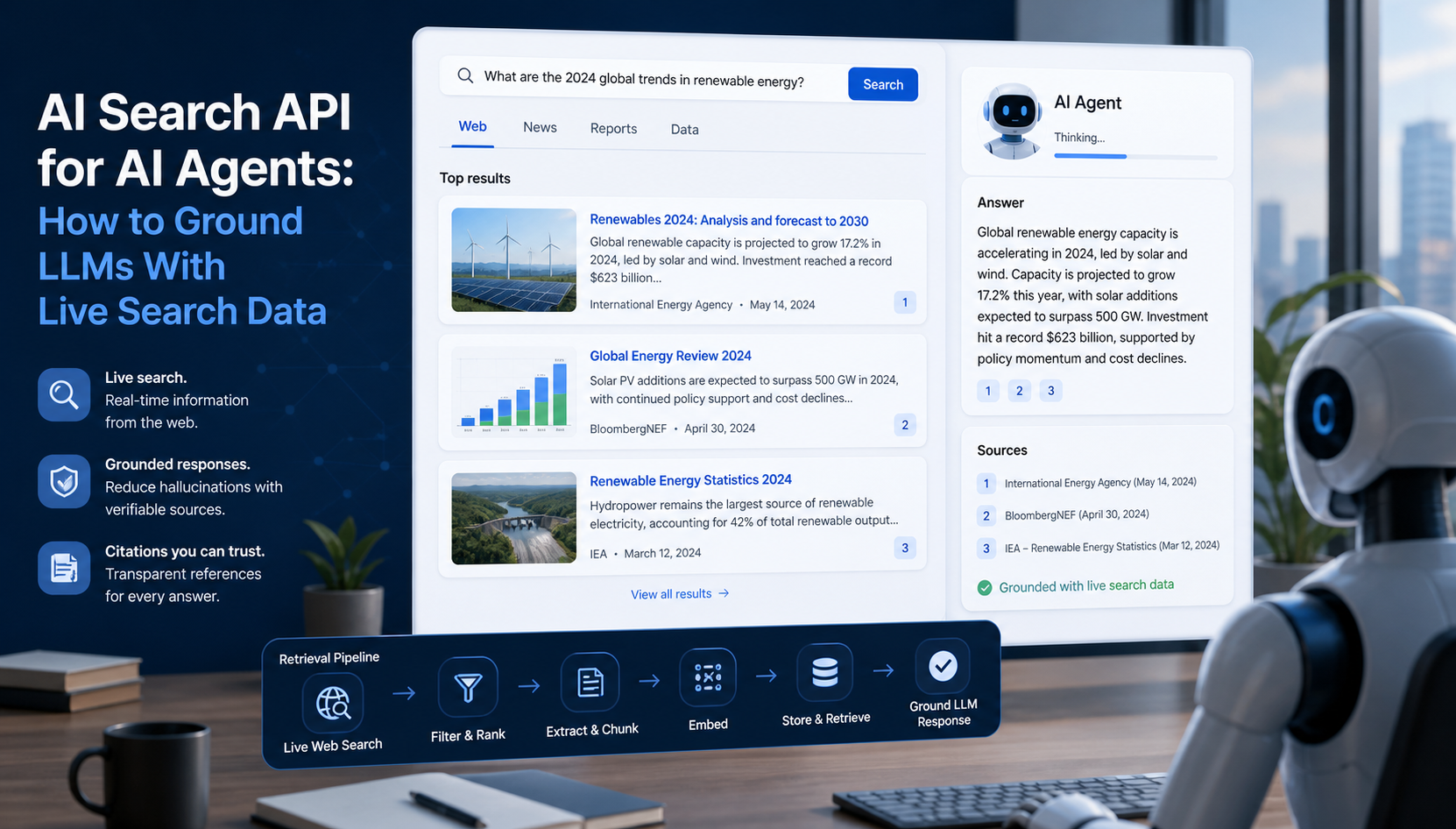
AI Search API for AI Agents: How to Ground LLMs With Live Search Data
An AI search API gives an application or agent programmatic access to current search results. Its most useful role is discovery: the agent can find candidate sources, identify fresh information, and decide what to retrieve next instead of relying only on model memory.
View Details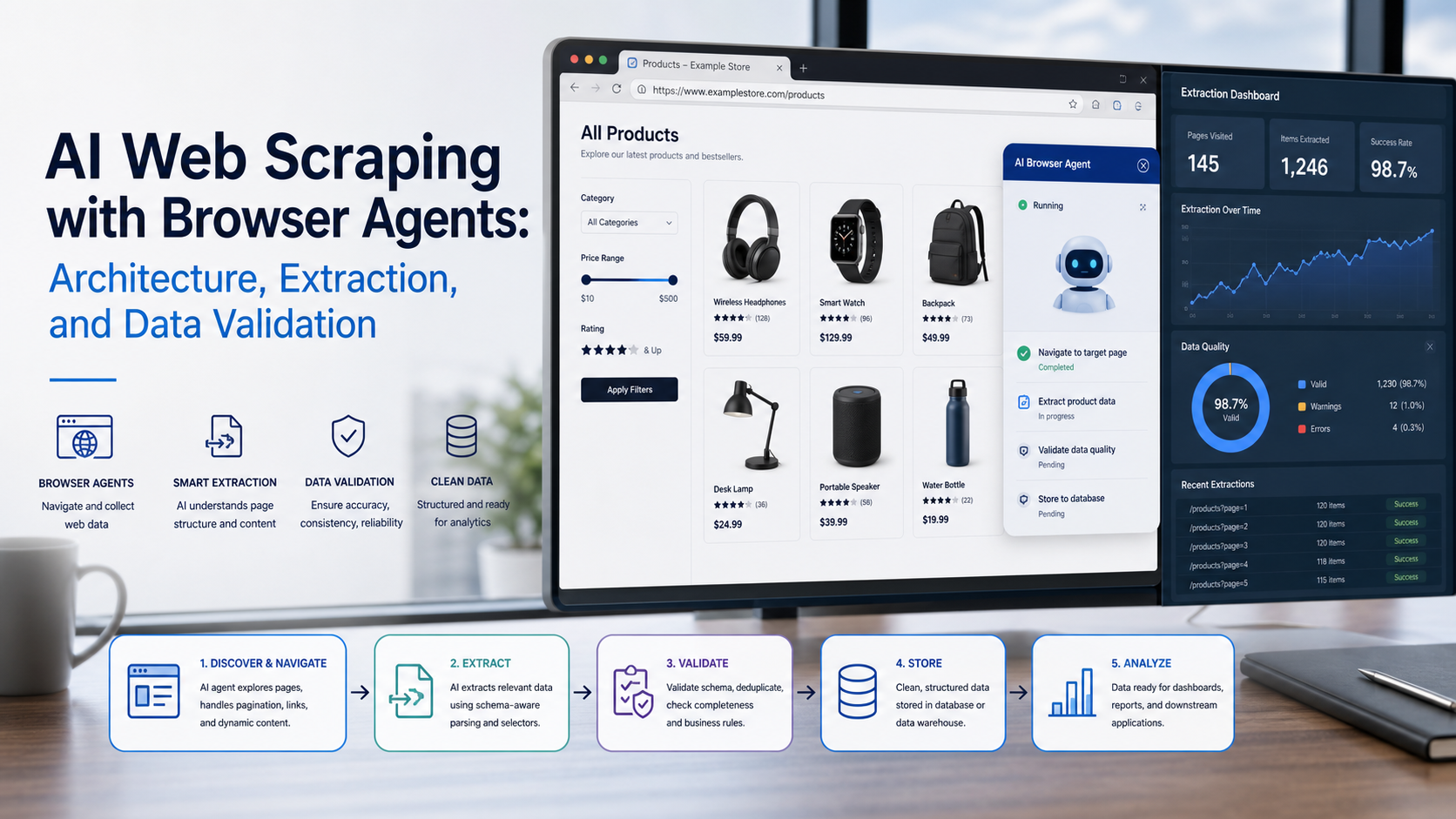
AI Web Scraping with Browser Agents: Architecture, Extraction, and Data Validation
AI web scraping uses AI to help discover, navigate, interpret, or extract information from websites. Browser agents are one implementation option when page interaction, rendering, or layout variation makes a simple scraper too brittle, but the agent should not become the entire data pipeline.
View Details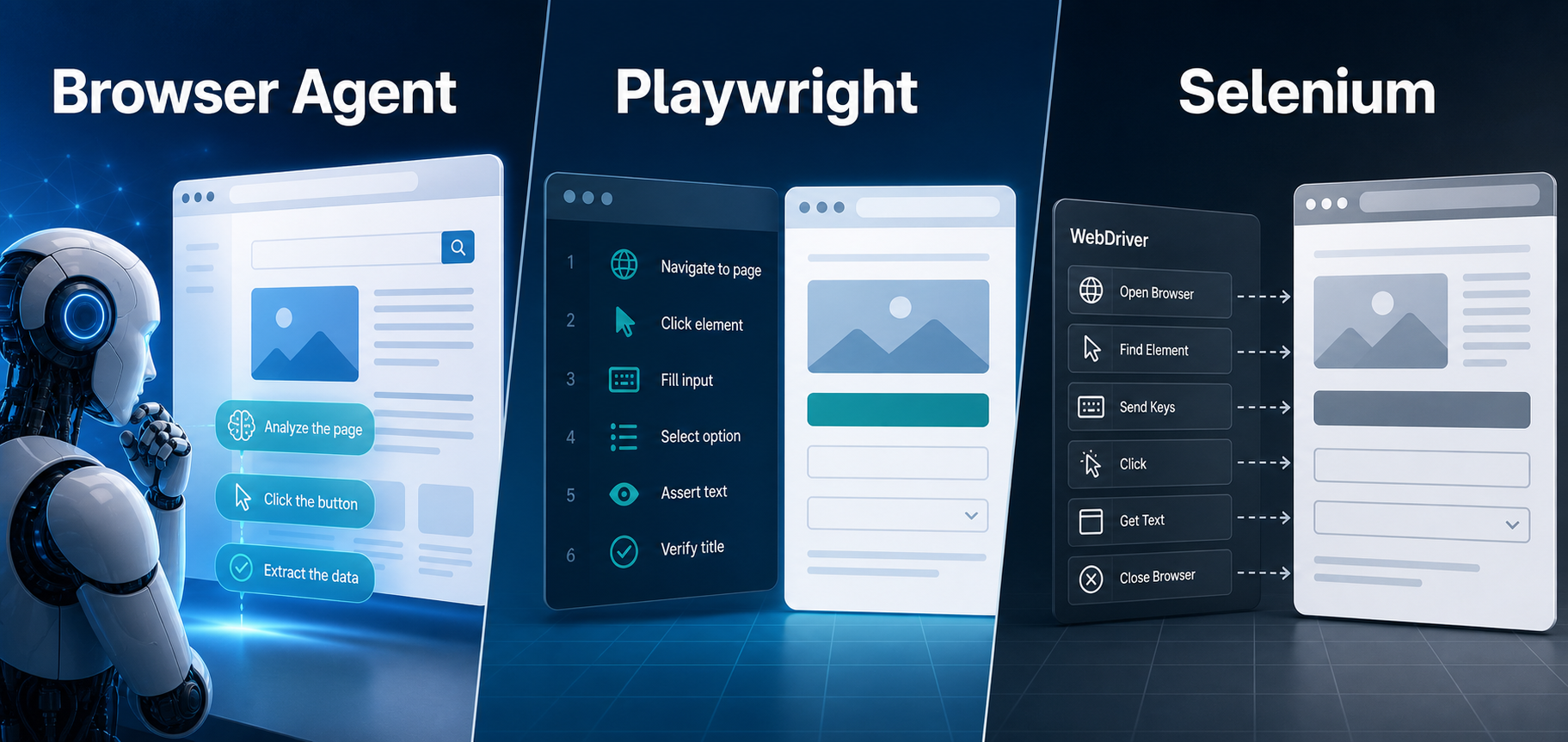
AI Browser Automation: Browser Agents vs Playwright vs Selenium
A browser agent interprets a goal and decides what browser action to take next. Playwright and Selenium can execute explicit, testable browser logic defined by developers. In 2026, however, Playwright also provides official MCP and agent-oriented workflows, so Playwright is no longer just the deterministic alternative to agentic automation. It can also serve as the browser-control layer inside an agent system.
View Details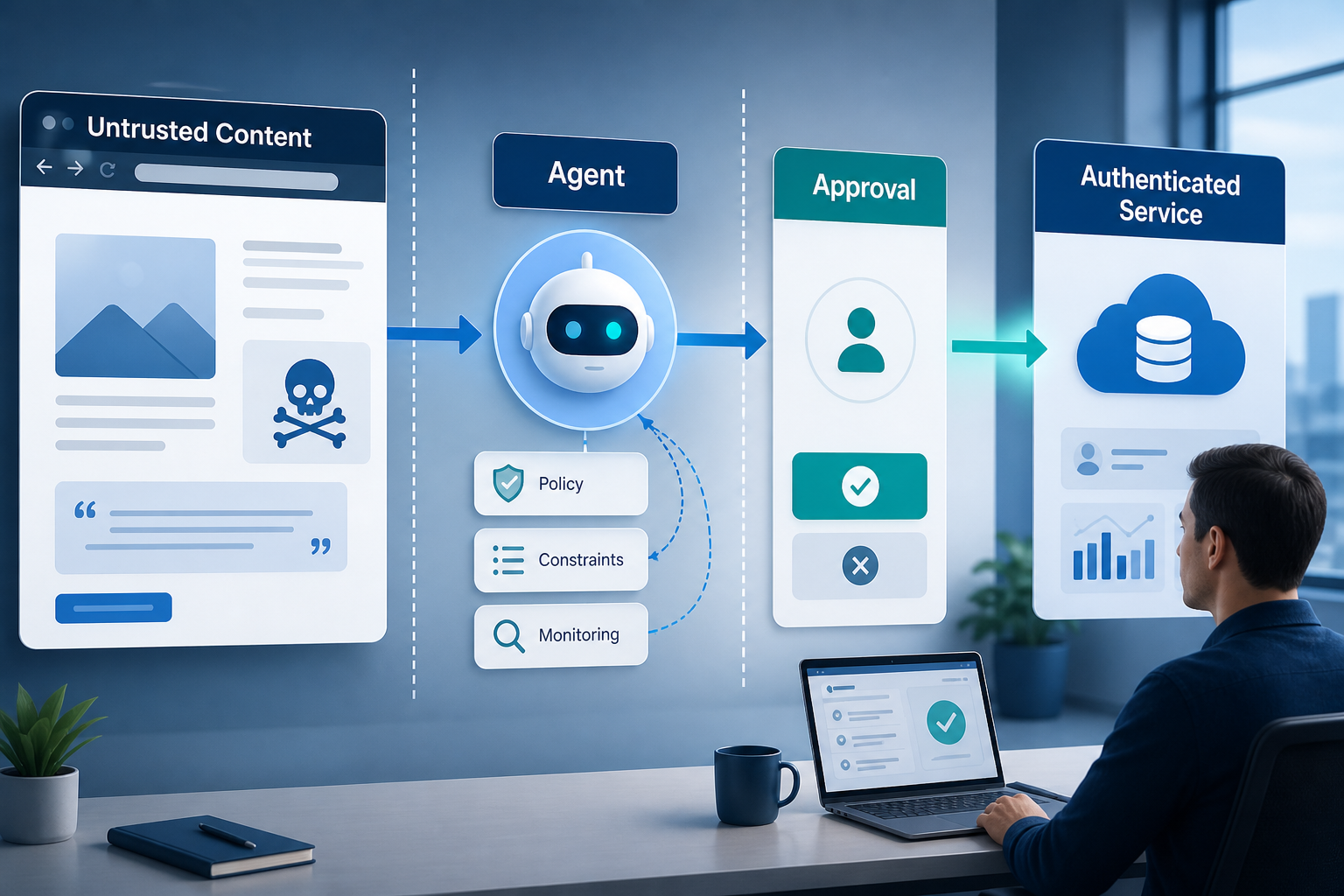
Agentic Browser Security: Prompt Injection, Permissions, and Safe Deployment
That combination creates risks that are different from ordinary browsing and traditional automation. The most important is indirect prompt injection, where hostile instructions hidden in web content attempt to redirect the agent away from the user's goal. Google describes indirect prompt injection as a primary new threat for agentic browsing and has introduced layered defenses that include origin constraints, independent action checks, threat detection, and user confirmation for sensitive actions. Google's Chrome security architecture is a useful reference for how browser-agent defenses are evolving.
View Details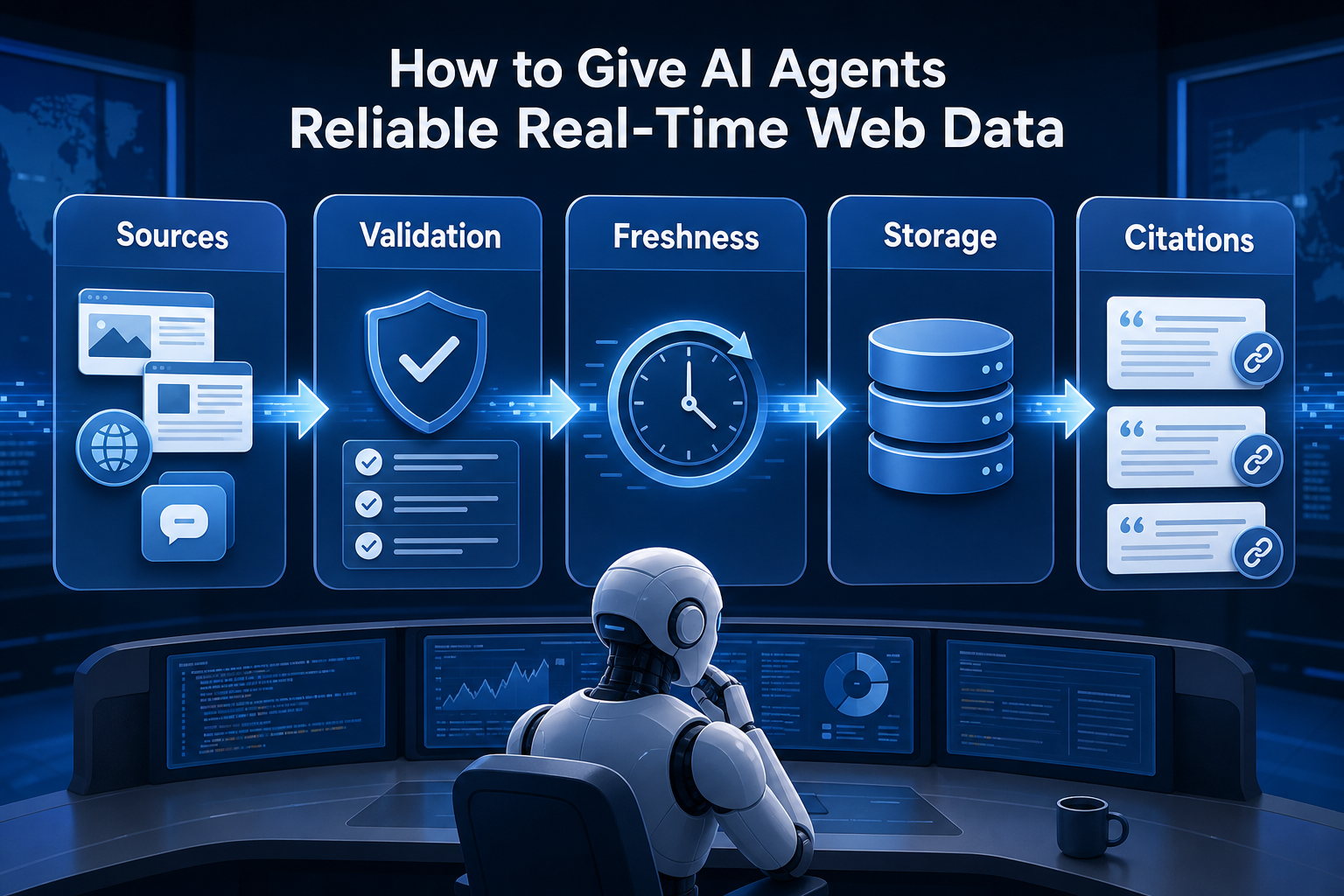
How to Give AI Agents Reliable Real-Time Web Data
A production-ready solution therefore needs more than a web scraper. It needs a web data layer that connects acquisition, validation, storage, retrieval, security, and observability. This guide explains how to design that layer.
View Details