
Go vs Python: A Practical Comparison for Performance, Scalability, and Data Collection
Go vs Python: A Practical Comparison for Performance, Scalability, and Data Collection

When developers debate Go vs Python, they are comparing two of the most influential languages in modern software. The choice impacts everything from raw speed to developer productivity and your ability to scale. The Go programming language vs Python decision is not just about syntax; it's a strategic choice between Go's compiled performance and Python's interpreted flexibility.
For data engineers and growth teams, this choice directly affects data collection pipelines, API performance, and infrastructure costs. This article provides a practical breakdown of go vs python performance, scalability, and core use cases like web scraping and machine learning, helping you select the right tool for your project.
Start building with LycheeIP's residential proxies
What Are the Core Differences Between Go and Python?
The core differences between Go and Python stem from their design philosophies: Go is a compiled vs interpreted language, and it uses static vs dynamic typing. Go was built at Google for reliable, high-performance systems, while Python was designed for readability and rapid development. These foundational differences create trade-offs in performance, safety, and flexibility.
Compiled vs Interpreted Languages
Go is a compiled language. This means your Go code is translated directly into a native machine code binary (an .exe file on Windows or a binary on Linux) before you run it. This results in exceptional go vs python performance and a very fast startup time, as the computer can execute the instructions directly.
Python is an interpreted language. When you run a Python script, an interpreter (like CPython) reads and executes your code line by line at runtime. This process adds overhead, making it slower than a compiled equivalent. However, it also makes Python incredibly flexible and platform-independent; you can run the same script anywhere a Python interpreter exists.
Static vs Dynamic Typing Explained
Go uses static vs dynamic typing. In Go, you must declare the type of each variable (e.g., string, int) when you write the code. The Go compiler checks these types before the program runs, catching many potential bugs early. This "static typing" makes code more predictable and easier to maintain in large systems.
Python uses dynamic typing. You do not have to declare variable types. Python figures out the type at runtime. This makes Python very beginner friendly and allows for faster prototyping. The trade-off is that type-related errors might only be found when you actually run the code, which can be challenging in complex applications.
Understanding Parallelism vs Concurrency
This is a key differentiator in the go vs python debate.
- Concurrency is about dealing with many things at once. Think of a chef working on three dishes: they chop vegetables (task 1), then check the oven (task 2), then stir a sauce (task 3). They are context-switching, but only doing one thing at any given microsecond. This is what Python's asyncio excels at.
- Parallelism is about doing many things at once. Imagine three chefs working together, each on their own dish. This requires multiple CPU cores.
Go was designed for both parallelism vs concurrency from day one. Its "goroutines" are extremely lightweight "threads" that can run concurrently by the thousands. The Go runtime can schedule these goroutines to run in true parallel across multiple CPU cores. Python, due to its Global Interpreter Lock (GIL), has historically struggled with true parallelism, excelling at I/O-bound concurrency instead.
Which Language Delivers Better Performance: Go vs Python?
Go almost always delivers better raw performance than Python for CPU-bound tasks. This superior go vs python performance is a direct result of it being a compiled language that produces optimized machine code.
Why Go Often Wins in Raw Speed
When you benchmark a CPU-intensive algorithm (like complex calculations or data serialization) in standard Go vs standard Python, Go will typically be an order of magnitude faster. Its static typing allows for memory layout optimizations, and its lack of an interpreter means zero runtime overhead. For high-throughput APIs, network services, and systems where latency is critical, Go's performance is a major advantage.
How Python Closes the Gap with C Extensions
Python is not always slow. The reason Python is the king of machine learning and data science is that its most popular libraries (like NumPy, Pandas, and TensorFlow) are not written in pure Python. They are Python "wrappers" around highly optimized, compiled C, C++, or Fortran code.
When your Python code spends 99% of its time inside a NumPy function, it's effectively running at compiled C speed. The "slow" part of Python is the "glue code" you write to connect these functions. Therefore, for data-heavy tasks, Python's performance can be excellent, but the go vs python performance gap widens in logic-heavy applications.
How Does Python’s GIL Affect Concurrency and Scalability?
Python's Global Interpreter Lock (GIL) is a mutex that prevents multiple threads from executing Python bytecode at the same time within a single process, even on multi-core processors. This mechanism simplifies CPython's memory management but effectively removes true CPU-bound parallelism for standard threaded code.
The Python core team has been actively working on this. Starting with Python 3.13, an experimental "free-threaded" build is available. This build removes the GIL, allowing threads to run in true parallel on multiple cores. However, as noted in the official Python 3.13 documentation, this is still experimental and can have performance trade-offs, particularly for single-threaded code. It will take time for the ecosystem to adapt, so while the future is promising, the GIL is still a factor for most production systems today.
True Parallelism vs. Async I/O
It is crucial to understand that the GIL does not block I/O. When a Python task is waiting for a network response or reading from a disk (I/O-bound), the GIL is released, allowing other tasks to run.
This is why Python's asyncio library is so effective for scalability in applications like web scraping or microservices. Using async and await, a single Python process can efficiently manage tens of thousands of concurrent network connections. This is a powerful form of concurrency, but it is not parallelism. Go's goroutines, by contrast, can achieve both: they can concurrently wait for I/O and run in parallel on multiple CPUs.
Which Web Frameworks Are Better: Python's Django/FastAPI or Go's Gin/Fiber?
Python frameworks are generally better for rapid development and projects that need a rich ecosystem, while Go frameworks are better for high-performance, low-latency microservices.
Comparing Developer Experience and Latency
- Python (Django, Flask, FastAPI): Django is "batteries-included," providing an ORM, admin panel, and more, making it ideal for building complex, data-driven web apps quickly. FastAPI is a modern, high-performance framework that uses static vs dynamic typing (via type hints) to provide data validation and OpenAPI docs, making it a fantastic choice for building robust APIs.
- Go (Gin, Echo, Fiber): Go frameworks are minimalist by design. They are extremely fast, have a very low memory footprint, and excel at routing requests and handling middleware. Their "developer experience" is focused on explicitness and performance. A simple API built in Gin will almost certainly have lower latency and higher requests-per-second than an equivalent one in Flask.
Choosing Between REST and gRPC
Both languages have excellent support for REST APIs. However, if your team is building a large microservices architecture, gRPC (a high-performance RPC framework from Google) is a strong consideration. Go has first-class, "out-of-the-box" support for gRPC, making it a natural fit. Python's gRPC support is also excellent and widely used, especially for connecting machine learning services.
Start building with LycheeIP's residential proxies
What Is the Impact on Docker Image Size and Startup Time?
Go applications produce significantly smaller Docker images and have a much faster startup time than Python applications. This directly impacts scalability, deployment speed, and serverless computing costs.
Go's Minimalist scratch Images
Because Go is a compiled language, it can produce a single, self-contained binary file with zero dependencies. You can build a Go program and copy just that one file into a scratch Docker image (an empty, 0MB image). The resulting container image can be as small as 5-10MB. This means a new container can be downloaded and started in milliseconds, a huge benefit for auto-scaling and "cold start" scenarios in serverless functions.
Python's slim Images and Dependency Management
A Python application requires the Python interpreter, its libraries (requirements.txt), and often various system-level dependencies. Even using a slim base image, a typical Python web app image will be hundreds of megabytes. This slower startup time and larger image size mean slower deployments and higher costs for "serverless" functions that are billed by their duration and memory usage.
Which Language Offers Better Scalability for Network-Heavy Apps?
Go generally offers more predictable and CPU-efficient scalability for network-heavy applications, such as proxy servers, load balancers, or chat applications.
Goroutines, Channels, and Go's Networking Model
Go's primary concurrency model relies on goroutines and channels, as explained in the Go blog's "Concurrency is not Parallelism" talk. A goroutine is a lightweight function managed by the Go runtime, not the OS. They have a tiny memory footprint (a few KBs), so you can easily spin up millions of them.
This makes it trivial to handle a new network connection per goroutine, a pattern that is impossibly expensive in many other languages. This model is perfect for data infrastructure, allowing a server to manage massive numbers of concurrent connections with low overhead and full use of all CPU cores.
Python's asyncio for High I/O
Python's asyncio provides excellent scalability for I/O-bound tasks. A single-threaded asyncio server can handle thousands of concurrent connections efficiently. This is more than enough for most web applications and microservices. The challenge arises when those tasks also need to perform heavy CPU work, which can "block" the event loop and stall all other concurrent tasks. Go's model, by contrast, simply schedules that work onto another CPU core.
Which Ecosystem Is Superior for Web Scraping?
Python's ecosystem is more mature and feature-rich for web scraping, but Go offers raw speed and simplicity for high-throughput tasks.
Python's Scrapy: The Feature-Rich Choice
Python is the dominant language for web scraping thanks to an incredible ecosystem.
- Scrapy: A full-fledged, asynchronous scraping framework. It manages requests, cookies, sessions, and data processing pipelines.
- Beautiful Soup & lxml: Excellent libraries for parsing malformed HTML.
- Requests: The standard for simple HTTP clients.
This mature tooling makes it fast to build and manage complex, multi-stage scraping projects.
Go's Colly: The Lightweight Speed Demon
Go's web scraping ecosystem is younger but very powerful.
- Colly: The most popular Go scraping framework. It's incredibly fast, asynchronous by default, and its simple API makes it easy to build high-performance crawlers.
- goquery: A library that brings a jQuery-like syntax to parsing HTML in Go.
The main benefit of using Go for web scraping is performance. A Go-based scraper can often achieve higher throughput on the same hardware due to its lightweight concurrency and efficient networking.
Integrating Proxies for Resilient Data Collection
Regardless of your go vs python choice, any serious web scraping operation requires a robust proxy solution.
LycheeIP Experience in Practice:
We see developers succeed with both languages. A common pattern is using Python's Scrapy framework for its complex pipeline management, combined with Rotating Residential Proxies to handle IP rotation and avoid blocks.
In high-throughput scenarios, teams use Go to build lightweight scrapers that can manage hundreds of thousands of concurrent requests. They integrate directly with LycheeIP's simple proxy API to get a clean IP for each request, leveraging Go's raw go vs python performance and scalability. The language choice is less important than having a reliable proxy pool that can handle your scraper's scale.
Start building with LycheeIP's residential proxies
Why Does Python Dominate Machine Learning?
Python dominates machine learning because of its ecosystem and its status as the "lingua franca" of data science, not because of its core language performance.
The Split: Training vs. Serving Models
The machine learning workflow is typically split in two:
- Training: This is the process of building a model. It's highly iterative, experimental, and mathematical. Python is perfect for this. Libraries like PyTorch, TensorFlow, scikit-learn, and Jupyter Notebooks create an unparalleled environment for research and development.
- Serving (Inference): This is the process of deploying a trained model to make predictions in a production application. This is where performance matters.
Using Go for High-Performance ML Inference
While most models are trained in Python, they are not always served in Python. For applications requiring extreme low-latency (like real-time bidding or fraud detection), serving a model from a Python web server (like FastAPI) can be too slow.
A common high-performance pattern is to train the model in Python, export it to a standardized format (like ONNX), and then load and serve it from a high-performance Go microservice. This gives you the best of both worlds: Python's beginner friendly and rich machine learning ecosystem for training, and Go's raw go vs python performance for serving.
Which Language Is More Beginner Friendly?
Python is almost universally considered more beginner friendly than Go.
Python's Gentle Learning Curve
Python was designed to be readable and intuitive. Its syntax is clean, flexible (thanks to static vs dynamic typing), and often reads like plain English. A beginner can write a useful script in just a few lines. The vast number of tutorials, courses, and a helpful community make it one of the easiest languages to start with.
Go is also a simple language, but in a different way. It has very few keywords and a very rigid, explicit style (e.g., error handling is mandatory and verbose). This can feel repetitive for a beginner.
However, Go's "boring" simplicity is considered a major advantage for large teams. The strict rules and lack of "clever" features mean that all Go code looks and feels the same, making it incredibly easy to read and maintain, even in a massive codebase. It's less beginner friendly at the start, but this "explicitness" pays dividends in long-term scalability and team collaboration.
What Should Your Startup Choose for Its MVP?
Your choice for a Minimum Viable Product (MVP) should depend entirely on your core business goals and your team's existing skills.
A Decision Framework for Common Use Cases
Use this table as a starting point for your go vs python decision.
| Use Case | Recommended Language | Why? |
| Data Science / ML App | Python | Unbeatable machine learning and data analysis ecosystem. |
| Standard Web App / CRUD | Python | Faster to market. Frameworks like Django/FastAPI are mature. |
| High-Performance API | Go | Needs to handle massive QPS with the lowest possible latency. |
| Large-Scale Web Scraping | Python (Scrapy) | Best for complex pipeline management and rich features. |
| High-Throughput Scraping | Go (Colly) | Best for raw speed, low memory use, and high concurrency. |
| Network Service / Proxy | Go | Superior parallelism vs concurrency model for networking. |
| DevOps / CLI Tools | Go | Produces single, fast binaries that are easy to distribute. |
| Your Team Knows It | (The one they know) | A productive team is more important than the "perfect" language. |
Factoring in Hiring and Long-Term Maintenance
- Hiring: It is generally easier to find Python developers. The talent pool is massive and diverse, spanning web development, data science, and automation. Go's talent pool is smaller but growing rapidly, and it often attracts engineers who specialize in systems programming and infrastructure.
- Maintenance: Go's static typing and simplicity often lead to codebases that are easier to maintain and refactor at scale. Python's dynamic nature can sometimes lead to runtime errors that are harder to track down in large, complex systems.
Ultimately, the go programming language vs python debate is about trade-offs. Python gives you speed of development. Go gives you speed of execution. Choose based on what your product needs most.
Start building with LycheeIP's residential proxies
Frequently Asked Questions:
- Which is faster, Go or Python?
Go is typically much faster than Python for CPU-bound tasks because it is compiled to native machine code. Python, being interpreted, has more overhead, but it can achieve high performance by using C-based libraries like NumPy. - Is Go or Python better for web scraping?
It depends on the task. Python (with Scrapy) has a more mature and feature-rich ecosystem for building complex, multi-stage web scraping pipelines. Go (with Colly) is often faster and uses fewer resources, making it ideal for high-throughput, concurrent scraping. - Why is Python used for machine learning instead of Go?
Python dominates machine learning due to its vast, mature ecosystem of libraries (like TensorFlow, PyTorch, and scikit-learn) and its use in research. The language itself is less important than the tools, which are all built for Python. - Is Python or Go more beginner friendly?
Python is widely considered more beginner friendly due to its readable syntax and flexible dynamic typing. Go is also simple, but its strict rules (like static typing and explicit error handling) can be more challenging for a complete novice. - What's the difference between Go's goroutines and Python's asyncio?
Go's goroutines can run in true parallelism across multiple CPU cores, handling both CPU-bound and I/O-bound tasks. Python's asyncio is a concurrency model that excels at handling many I/O-bound tasks (like network requests) on a single thread, but it doesn't provide true CPU parallelism by default. - Does the go vs python choice affect scalability?
Yes. Go's lightweight goroutines and compiled performance make it easier to achieve horizontal and vertical scalability for network-heavy services. Python's asyncio provides excellent I/O scalability, but its reliance on an interpreter and (historically) the GIL can create bottlenecks for CPU-bound scaling.

Recommended Articles
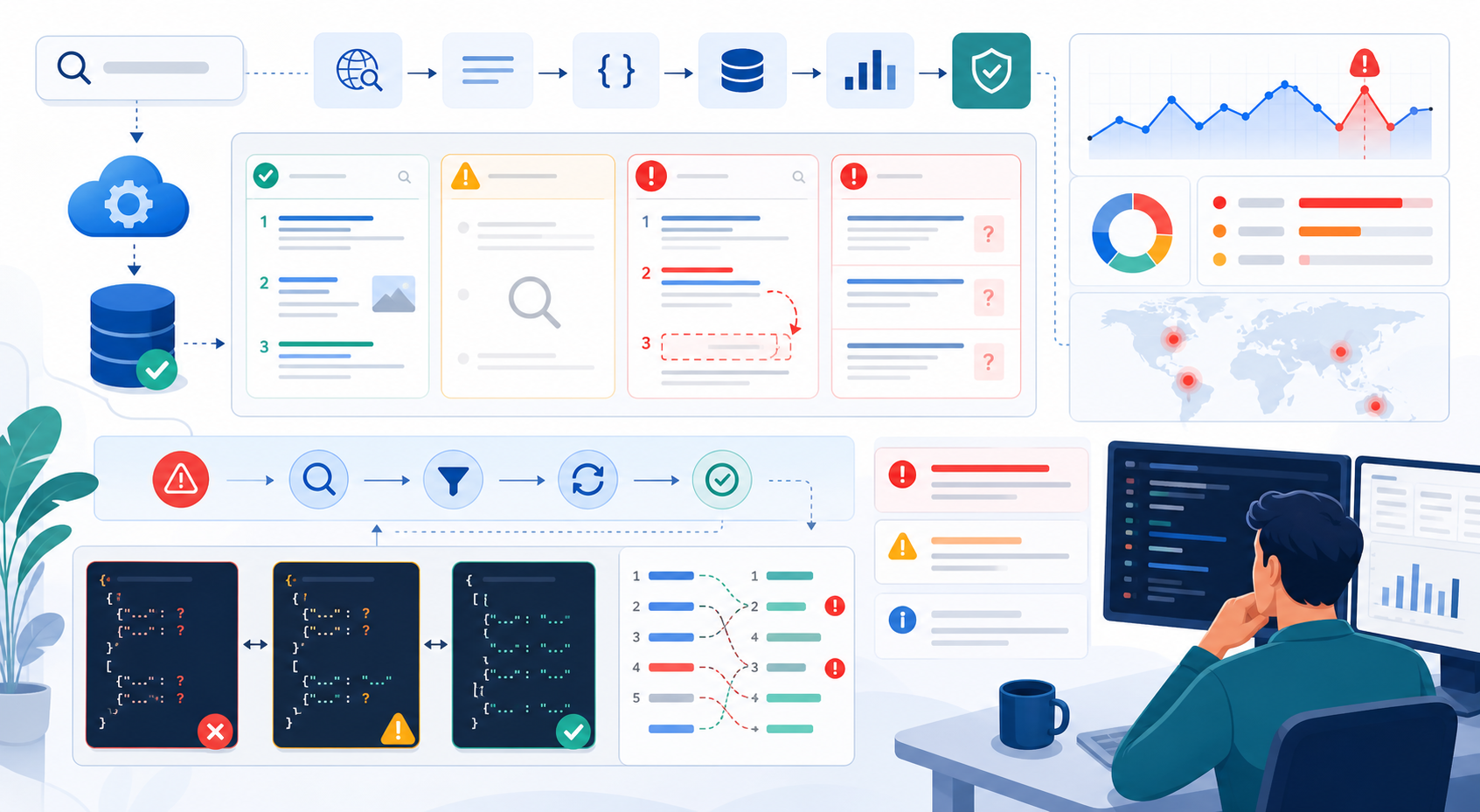
SERP API Troubleshooting: Fix Empty, Wrong, or Inconsistent Search Results
SERP API failures are not limited to obvious HTTP errors. A request can return successfully and still produce empty, incomplete, geographically wrong, duplicated, or misinterpreted search data. Production troubleshooting therefore has to separate transport problems from provider processing, SERP differences, and downstream parsing errors.
View Details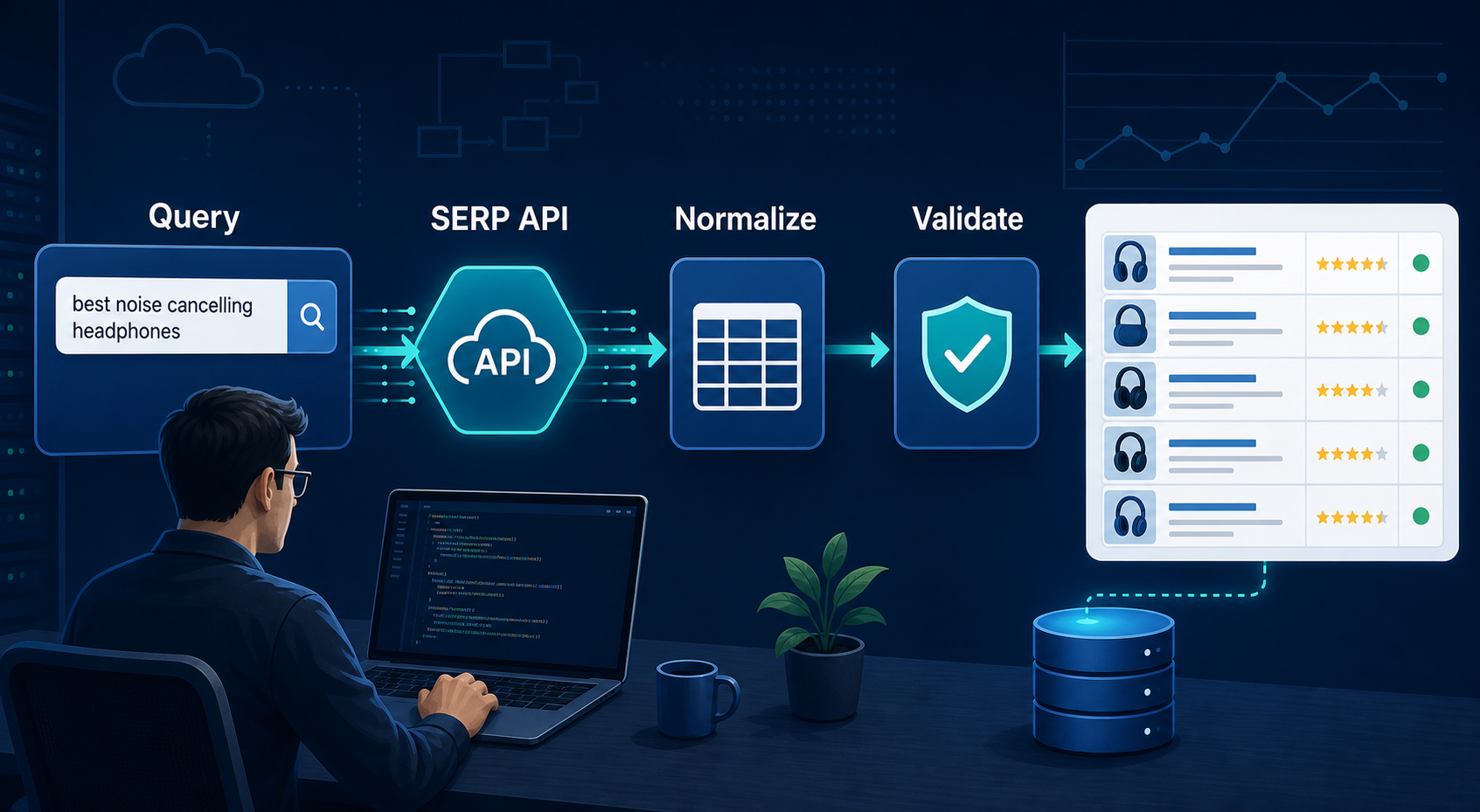
SERP API Python: How to Build a Reliable Search Data Pipeline
This guide shows a provider-neutral workflow for building that pipeline. It does not rank SERP API vendors. Instead, it focuses on the implementation choices that make a Python integration easier to operate, test, and migrate.
View Details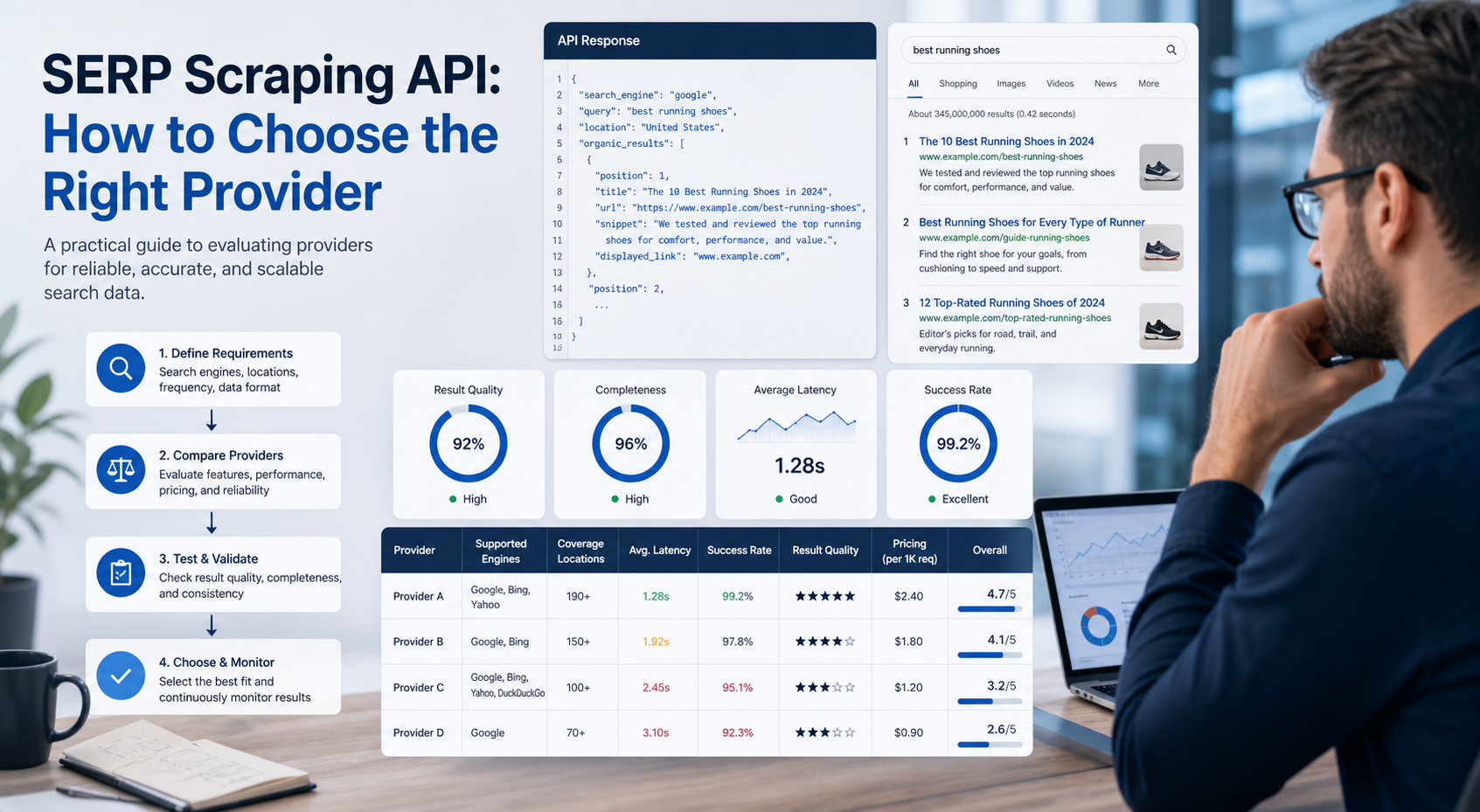
SERP Scraping API: How to Choose the Right Provider
Recommended Meta Description: Compare SERP scraping APIs by data coverage, localization, reliability, workflow fit, and cost structure, then choose and validate the right provider.
View Details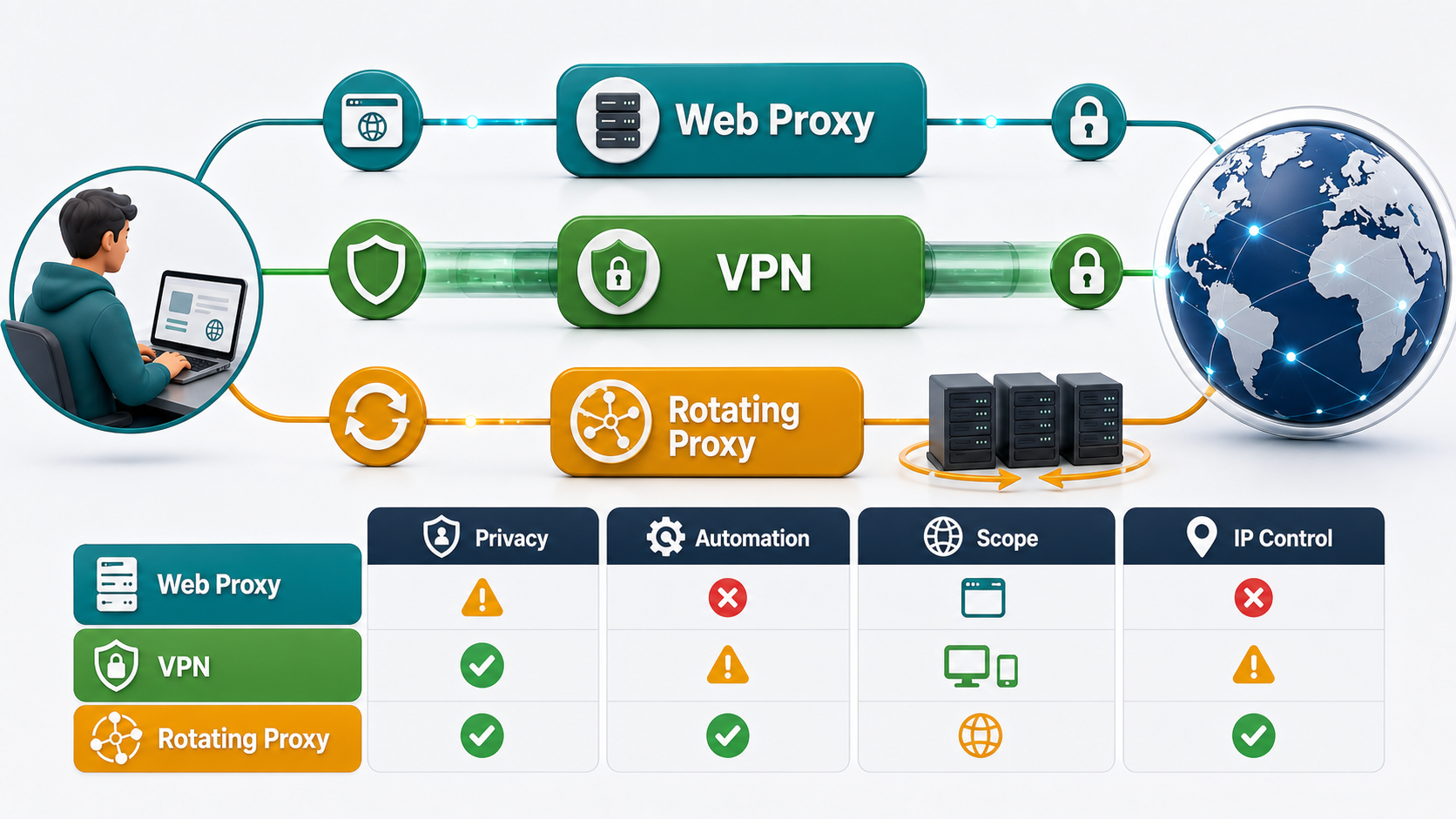
Free Web Proxy vs VPN vs Rotating Proxy: Which Should You Use?
Compare free web proxies, VPNs, rotating proxies, static proxies, and datacenter proxies by scope, encryption, IP control, automation, streaming, and account workflows.
View Details
BlockAway Not Working? Fix Common Proxy, Video, and Access Problems
Troubleshoot BlockAway when pages are blocked, YouTube fails, JavaScript breaks, speed drops, sessions expire, or mobile access behaves differently.
View Details