
Beautiful Soup find_all for 2026: Extract Data Faster and Fix Empty Results
The Python web scraping landscape continues to evolve, but extracting the right data from a complex DOM remains a core challenge for developers. Beautiful Soup find_all is still one of the simplest methods to pull repeated elements from HTML. However, modern extraction requires more than basic syntax knowledge. You must know whether your target content actually exists in the raw HTML payload, whether your selector logic handles CSS classes properly, and whether a different method is better suited for the task.
Recent updates to the Beautiful Soup official documentation highlight a more modern selector workflow heavily reliant on CSS support. At the same time, the rise of heavily JavaScript-rendered pages means developers often need to introduce browser rendering steps before parsing can even begin.
This guide breaks down exactly how to use this library efficiently today. You will learn how to troubleshoot empty lists, resolve multi-class confusion, and build a reliable extraction workflow.
Explore Python scraping with LycheeIP
What does Beautiful Soup find_all actually do?
Beautiful Soup find_all searches the descendants of a parsed HTML tag and returns a list of every match that meets your filter criteria. A descendant is any nested tag inside a parent element, regardless of how deep the nesting goes. The official Beautiful Soup documentation explicitly contrasts this behavior with the standard find method, which stops scanning the tree the moment it encounters the first valid match.
Because it returns a comprehensive list, you should make this your default choice when you expect multiple identical structures on a page. Examples include product cards on an e-commerce site, table rows in a financial report, or navigation links in a header.
Here is a basic example of how it operates in practice:
Python
from bs4 import BeautifulSoup
html = """
<ul>
<li class="item">Data A</li>
<li class="item">Data B</li>
<li class="item">Data C</li>
</ul>
"""
soup = BeautifulSoup(html, "html.parser")
items = soup.find_all("li", class_="item")
print([item.get_text(strip=True) for item in items])
The output yields all three list items in the exact order they appear in the parsed document.
How is Beautiful Soup find_all different from find and select?
You should use find when you need exactly one element, find_all when you need every matching descendant, and select when your target requires complex CSS selectors. The official documentation points out that scanning every descendant takes time. If you only need to extract a single page title or a primary article heading, the find method is far more efficient.
Alternatively, the select method utilizes Soup Sieve to support modern CSS selectors. If you are trying to target a tag based on its relationship to siblings or based on multiple specific classes, CSS selectors are generally easier to write and maintain than dictionary attributes. A practical rule of thumb is to use CSS if your selector reads naturally as a stylesheet rule. If you are doing simple tag and attribute matching, stick to the standard library methods.
Which filters can you pass to Beautiful Soup find_all?
You can filter searches using tag names, HTML attributes, CSS classes, exact strings, regular expressions, custom callable functions, limits, and recursive constraints. The library is highly flexible regarding how you define your target. The official documentation notes that the modern argument for text matching is string, whereas older tutorials might still reference the deprecated text argument.
Using the limit parameter allows you to stop the search early once a certain number of matches are found. Setting recursive=False restricts the search to direct children only, rather than scanning the entire descendant tree.
Here are a few useful patterns:
Python
# Extract all anchor links
soup.find_all("a")
# Filter by a specific class
soup.find_all("div", class_="card")
# Filter by custom data attributes
soup.find_all("span", attrs={"data-id": "42"})
# Find elements containing an exact string
soup.find_all("a", string="Login")
# Stop searching after 5 matches
soup.find_all("li", limit=5)
# Only search direct children of a specific container
container.find_all("p", recursive=False)
Why is Beautiful Soup find_all returning an empty list?
Empty results typically happen because your selector is incorrect, the underlying parser misread the HTML, your class logic is too strict, or the target data only loads via JavaScript. When developers see an empty bracket output [] for a class they can clearly see in their browser DevTools, the first instinct is often to blame the library.
However, Beautiful Soup does not execute JavaScript. If an application requires a client-side script to fetch data from an API and inject it into the DOM, the raw HTML returned by a basic HTTP request will be empty. Another common failure point occurs when developers attempt to match multiple classes using a strict string, which fails if the classes appear in a different order in the raw markup.
How do you parse multiple classes correctly with find_all?
Passing multiple classes directly to Beautiful Soup find_all requires an exact string match in the exact order they appear in the HTML. If a target element has the classes card and featured, searching for class_="card featured" will only work if the HTML is written exactly that way. The official documentation confirms that searching for "featured card" will return an empty list in this scenario.
For matching any one of multiple classes, simply passing the single class name like class_="card" works perfectly. But when you need to ensure an element has two or more specific classes simultaneously, CSS selectors are much safer.
This approach is fragile and prone to breaking:
soup.find_all("div", class_="card featured")
This approach is robust and ignores class order:
soup.select("div.card.featured")
How should you handle JavaScript-rendered pages in 2026?
You must render the page first using a browser automation library and then pass the fully loaded HTML into your parser. Official guidance from dynamic content tutorials confirms that you should split these tasks. A tool like Playwright handles the network requests and JavaScript execution. Once the DOM is fully loaded, Playwright extracts the raw HTML string, which you then feed into Python for fast, synchronous parsing.
When scaling this workflow across hundreds or thousands of pages, your network layer becomes just as critical as your parsing logic. If the server blocks your automated browser, your parser will only see a captcha page or an access denied message.
How LycheeIP fits a modern scraping stack:
- Developer-first simplicity: Manage your scraping operations via a simple API and web dashboard to monitor usage statistics in near real-time.
- Reliable dynamic residential IPs: Achieve 99.8% uptime with unlimited concurrency for heavy rendering workflows.
- Clean IP pools: AI and algorithm multi-filtering ensures high-quality IPs, with each IP undergoing a strict >6-month cooling period before use.
- Transparent pricing: Clear pay-as-you-go billing starts at $5.00/GB for dynamic residential traffic, with a 1 GB free test available.
Many proxy providers obscure their IP sources or enforce complex tiering that makes debugging network blocks difficult. LycheeIP allocates resources directly from underlying operators to maintain quality control and stability at scale.
Here is a practical Playwright pattern for rendering before parsing:
Python
from playwright.sync_api import sync_playwright
from bs4 import BeautifulSoup
url = "https://example.com/dynamic-data"
with sync_playwright() as p:
browser = p.chromium.launch(headless=True)
page = browser.new_page()
page.goto(url, wait_until="domcontentloaded")
page.wait_for_load_state("networkidle")
html = page.content()
browser.close()
soup = BeautifulSoup(html, "lxml")
cards = soup.select("article.card")
Explore Python scraping with LycheeIP
What makes Beautiful Soup find_all slower than it needs to be?
Your extraction slows down when you scan the entire document instead of scoping to a specific container first. Every time you call Beautiful Soup find_all without limits on the root document, the library traverses the entire parse tree. You can significantly improve script execution speed by identifying the main wrapper div or section element first, and then running your search only within that smaller subset of the DOM.
The official documentation highly recommends installing and explicitly declaring the lxml parser, which is written in C and is substantially faster than Python's built-in html.parser. Additionally, using SoupStrainer allows you to parse only the specific parts of the document you actually need, reducing memory consumption footprint.
Tailored use cases for performance optimization:
- Multi-account agencies: When managing concurrent data extraction streams, switching the parser to lxml reduces CPU load and allows for higher parallelism on the same server hardware.
- Fintech ops: Teams pulling daily ticker tables do not need to scan the whole page. By using the limit parameter, they can grab the top 10 rows instantly and exit the search function early.
- Security & fraud ops: Analysts scanning raw HTML for malicious script injections can scope their search strictly to the <head> or <body> tags, avoiding the overhead of parsing irrelevant inline SVGs or footer elements.
When should you not use Beautiful Soup find_all?
You should avoid this method when you only need a single element, when your extraction relies heavily on parent-child relationships, or when the data requires a headless browser to load. Defaulting to a full document scan for a unique page ID is a waste of compute resources.
Similarly, if you find yourself writing complex loops to check the siblings or parents of the results returned by your search, you are likely using the wrong tool. In those scenarios, CSS selectors via the select() method will make your code much cleaner. Beautiful Soup is an exceptional HTML parsing tool, but it is not a complete web scraping framework.
Which workflow should you use before shipping a scraper?
You must validate the raw HTML source, confirm your selectors are stable, explicitly define your parser, and test edge cases before running your code at scale. Parser differences can actively change how malformed HTML documents are converted into trees. If you build your script using html.parser locally but your production server defaults to lxml, a poorly formatted webpage might yield entirely different extraction results.
Assumptions & limitations to consider:
- This guide assumes you already have explicit permission to access and parse the target pages.
- Exact selectors will inevitably break when the target website updates its frontend framework.
- Performance guidance provided here solely addresses parsing behavior and does not cover full anti-bot evasion strategies.
- Parser choice directly influences output accuracy on broken or inconsistent markup.
Comparison Matrix: Method Selection
| Use case | Best method | Why it works |
| One page title, one price, one CTA | find() | Stops scanning the tree at the very first useful match. |
| All cards, rows, links, or repeating reviews | find_all() | Returns the complete set of matching descendants. |
| Multi-class or relationship-heavy matching | select() / .css.select() | CSS syntax is significantly clearer for complex DOM logic. |
| Content appears only after page scrolling/loading | Browser render + parser | Python web scraping libraries cannot execute JavaScript natively. |
Troubleshooting: Common Failure Modes
| Symptom | Likely cause | Fix |
| [] for a class visible in Chrome DevTools | Content is rendered dynamically by JavaScript | Render the page using Playwright first, then parse the output. |
| [] for class_="two one" | Class string order mismatch | Use CSS selectors (e.g., select(".one.two")) for multi-class matching. |
| Too many irrelevant matches | Selector is far too broad | Scope the search to a specific parent container first. |
| Extremely slow extraction | Scanning the whole document unnecessarily | Use find(), limit, recursive=False, or a narrower scope. |
| Different output on different environments | Parser differences handling broken HTML | Specify lxml or another parser explicitly in the soup constructor. |
Explore Python scraping with LycheeIP
Frequently Asked Questions:
1. What does find_all() do in Beautiful Soup?
It returns every descendant that matches the exact filters you pass in, rather than stopping at the first result. The official documentation describes it as a descendant search, which makes it ideal for extracting repeated elements like product cards, table rows, and navigation links.
2. When should I use find_all() instead of select()?
Use it when your tag and attribute matching requirements are simple and readable. Use select() when the target depends on multiple classes, specific ancestry, or CSS-style relationships that are much easier to express using standard CSS syntax.
3. Why is Beautiful Soup find_all returning an empty list?
The most common reasons are that your selector is wrong, your class string logic is too strict, or the data is missing from the raw HTML because client-side JavaScript inserts it later. If it is a rendering issue, load the page with a browser tool first.
4. Why is Beautiful Soup not finding my class?
A frequent cause is assuming class_="a b" means "has both classes" in any arbitrary order. The documentation confirms that exact class-string order matters in this context. Using CSS selectors is much safer when you need to ensure multiple classes are present.
5. How do I use Beautiful Soup find_all to parse multiple classes correctly?
For matching any single class among many, class_="name" works perfectly. For matching multiple classes simultaneously, prefer a CSS selector like soup.select("div.card.featured") because it expresses the condition clearly and avoids exact-string-order failures.
6. What is the difference between text and string in Beautiful Soup?
In search methods, the modern argument to use is string. The official documentation notes that older versions relied on text. For extracting content after finding an element, get_text() is the correct choice to pull combined human-readable text from a tag.
7. Does find_all() in Beautiful Soup return an ordered list?
Yes, in practice, it returns matches as it walks the descendants through the parse tree, meaning the result strictly follows the document's parse order. If you only want direct children, remember to use recursive=False.
8. How can I make Beautiful Soup find_all faster?
Reduce your search space by scoping to a container first, explicitly specify the lxml parser, use the limit argument when you do not need the full set, and utilize SoupStrainer to parse only necessary sections of the document.

Recommended Articles

SERP API Troubleshooting: Fix Empty, Wrong, or Inconsistent Search Results
SERP API failures are not limited to obvious HTTP errors. A request can return successfully and still produce empty, incomplete, geographically wrong, duplicated, or misinterpreted search data. Production troubleshooting therefore has to separate transport problems from provider processing, SERP differences, and downstream parsing errors.
View Details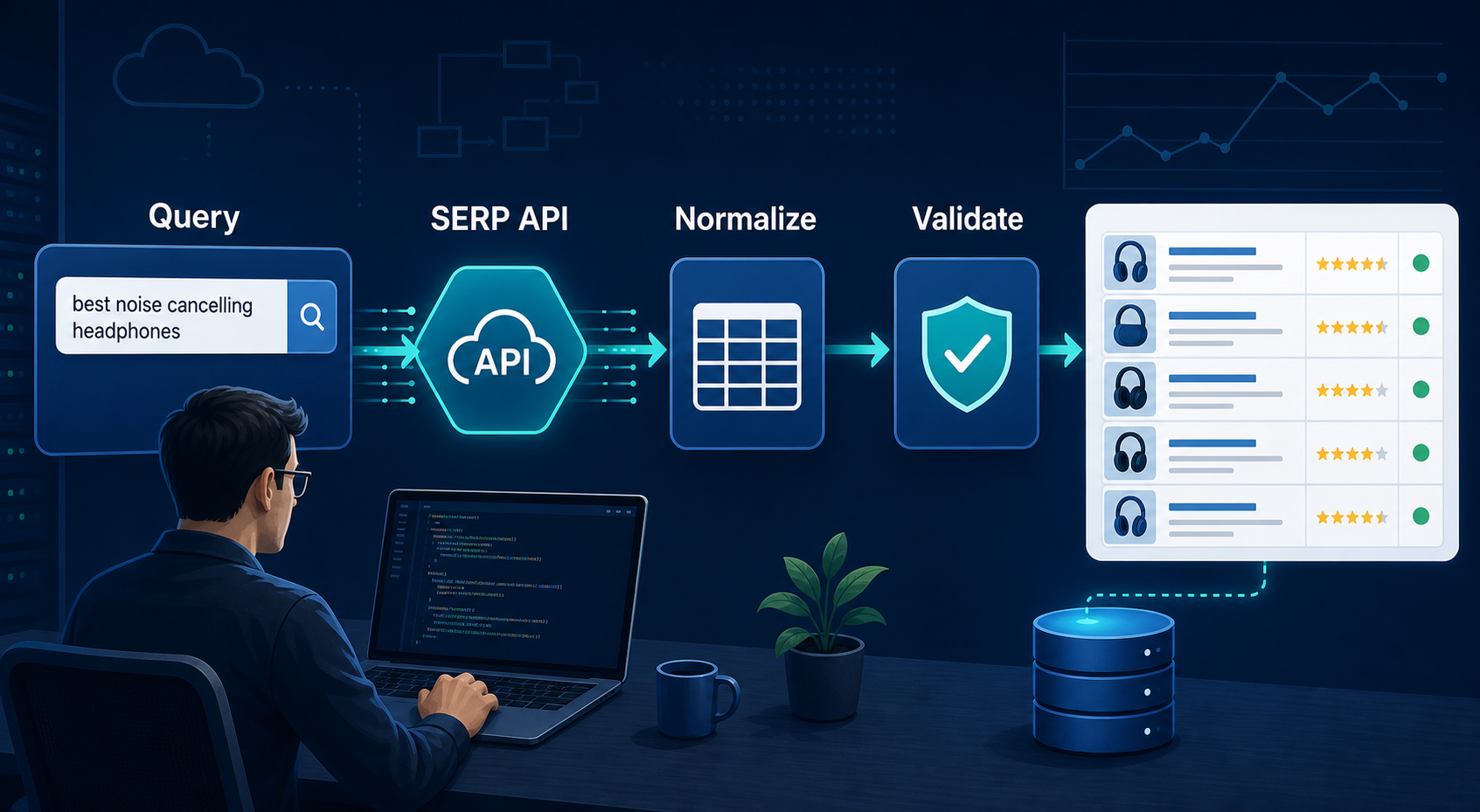
SERP API Python: How to Build a Reliable Search Data Pipeline
This guide shows a provider-neutral workflow for building that pipeline. It does not rank SERP API vendors. Instead, it focuses on the implementation choices that make a Python integration easier to operate, test, and migrate.
View Details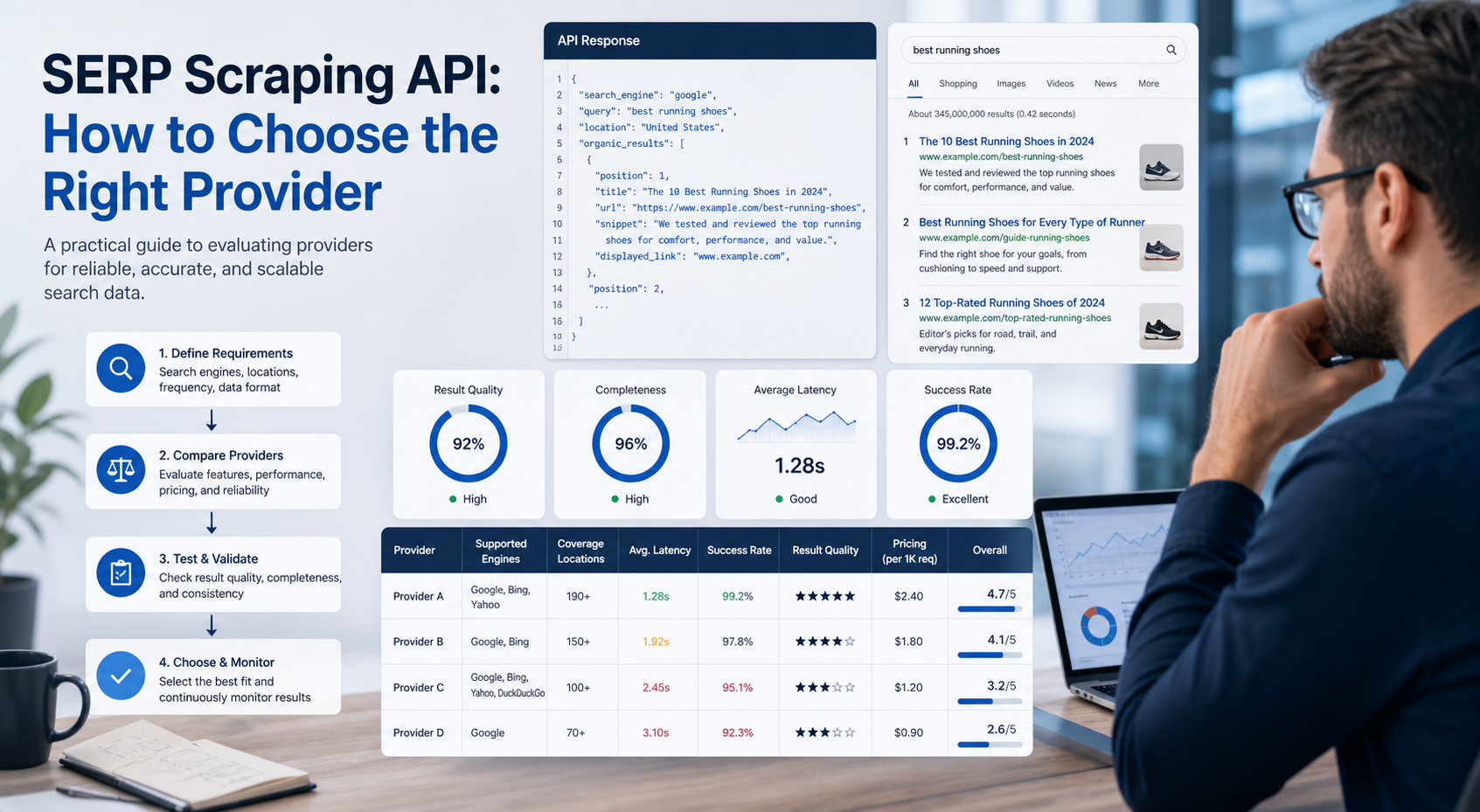
SERP Scraping API: How to Choose the Right Provider
Recommended Meta Description: Compare SERP scraping APIs by data coverage, localization, reliability, workflow fit, and cost structure, then choose and validate the right provider.
View Details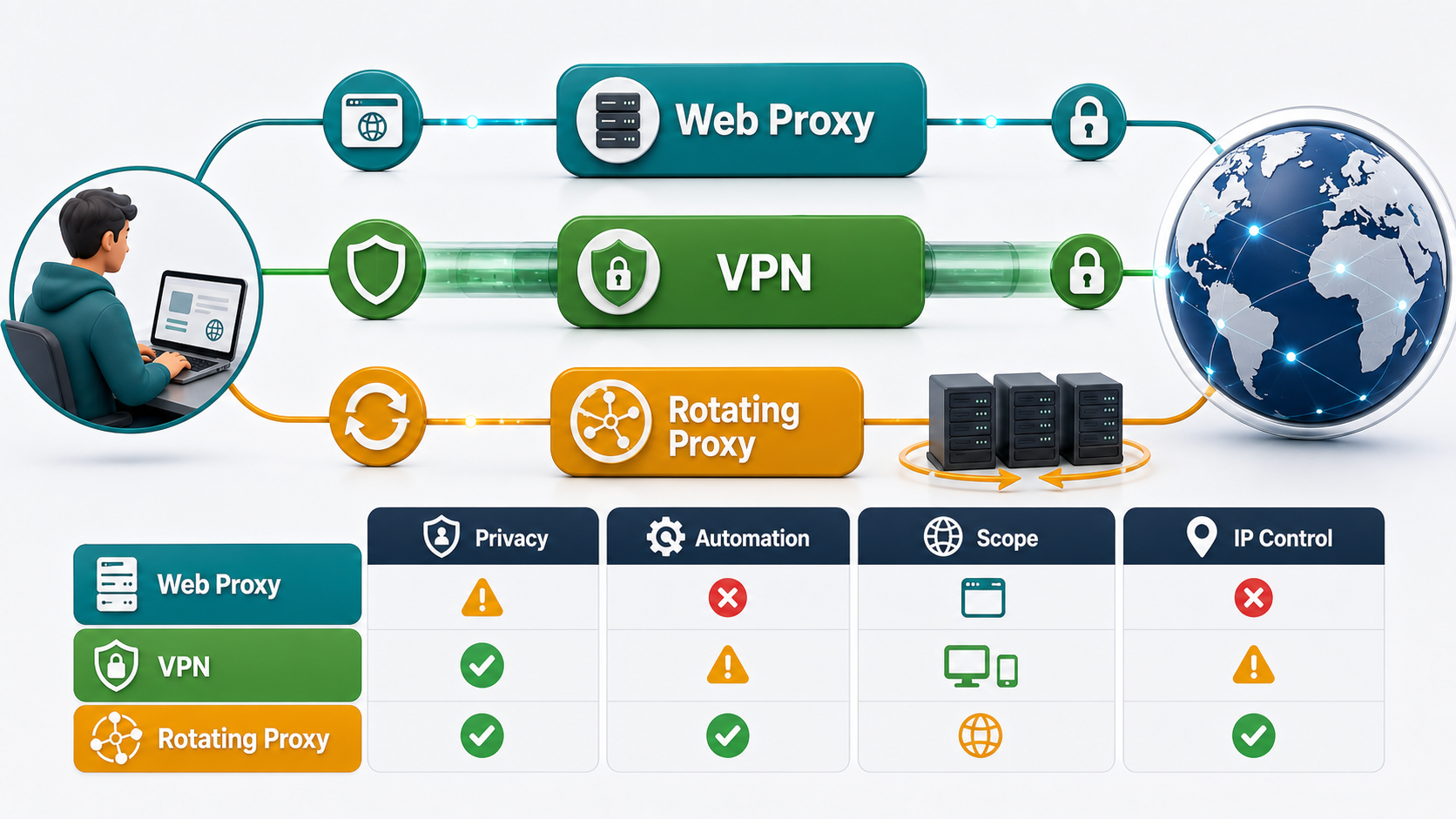
Free Web Proxy vs VPN vs Rotating Proxy: Which Should You Use?
Compare free web proxies, VPNs, rotating proxies, static proxies, and datacenter proxies by scope, encryption, IP control, automation, streaming, and account workflows.
View Details
BlockAway Not Working? Fix Common Proxy, Video, and Access Problems
Troubleshoot BlockAway when pages are blocked, YouTube fails, JavaScript breaks, speed drops, sessions expire, or mobile access behaves differently.
View Details