
AI Data Collection Services: How to Choose a Provider
AI Data Collection Services: How to Choose the Right Data Partner in 2026
AI data collection services source, create, clean, annotate, validate, and deliver datasets for training, fine-tuning, evaluating, or monitoring artificial intelligence systems. These datasets may contain text, images, video, audio, sensor readings, human feedback, or authorized public-web data.
The right provider is not simply the company with the largest contributor network. It is the provider that can supply data that matches your model’s intended users, environments, tasks, quality requirements, security controls, and legal obligations.
Data volume alone does not guarantee a useful model. Teams must also evaluate how the data was collected, whether it represents the intended use case, what transformations were applied, whether the necessary rights exist, and how the dataset will be validated. Google’s guidance on data collection and evaluation and the NIST AI Risk Management Framework both emphasize the importance of suitability, representativeness, documentation, testing, and risk management.
This guide explains:
- What AI data collection companies actually provide
- The main ways AI training data is sourced
- How the data collection process works
- How to compare providers without relying on marketing claims
- How AI agents, web data collection, and proxies fit into the architecture
- What to test before committing to a large contract
For the LycheeIP implementation details behind this step, review rotating residential proxies.
For the LycheeIP implementation details behind this step, review static residential proxies.
For the official technical reference behind this point, see MDN HTTP overview.
What Are AI Data Collection Services?
AI data collection services help organizations obtain the raw or structured information needed to develop and evaluate machine learning systems.
A provider may handle one part of the data lifecycle or deliver an end-to-end service that includes collection, cleaning, annotation, validation, delivery, and ongoing dataset refreshes.
Several related terms are often used interchangeably, but they describe different activities.
| Activity | What it involves | Typical output |
|---|---|---|
| Data collection | Obtaining or generating raw information | Images, recordings, documents, sensor readings or web records |
| Data annotation | Adding labels, classifications or descriptions | Bounding boxes, transcripts, entities, rankings or categories |
| Data curation | Selecting, filtering, deduplicating and organizing records | A cleaner, more relevant dataset |
| Data validation | Checking accuracy, completeness and consistency | Quality reports and approved datasets |
| Model evaluation | Testing how an AI system performs on defined tasks | Scores, error categories and human feedback |
| Data enrichment | Adding attributes from approved sources | Expanded records with additional fields |
| Data delivery | Formatting and transferring the final dataset | JSON, CSV, Parquet, media files or platform integration |
An AI data provider may offer all of these services, but buyers should verify which steps are included in the contract. A company that collects data is not automatically responsible for annotation quality, legal review, model evaluation, or production monitoring.
What Types of Data Can AI Data Collection Companies Provide?
The required modality depends on the model, task, intended users, and operating environment.
Text data
Text collection may include:
- Domain-specific documents
- Search queries
- Conversations
- Customer-support interactions
- Product descriptions
- Human-written prompts and responses
- Classification examples
- Summaries
- Translations
- Preference rankings
- Expert reasoning or evaluation data
Text datasets support applications such as natural language processing, retrieval systems, classification, generative AI, search, summarization, conversational systems, and model evaluation.
Audio and speech data
Audio collection can include:
- Scripted speech
- Natural conversations
- Wake words
- Voice commands
- Call-center recordings
- Environmental sounds
- Regional accents
- Code-switching
- Emotional speech
- Multi-speaker recordings
These datasets may be used for speech recognition, voice interfaces, speaker identification, transcription, translation, and conversational AI.
Image and video data
Image and video collection can capture:
- Objects and products
- Human actions
- Facial expressions
- Road conditions
- Retail environments
- Manufacturing processes
- Documents
- Medical images
- Security scenarios
- Geographic or environmental conditions
Depending on the model, the data may require object detection labels, segmentation masks, captions, pose estimation, tracking annotations, classifications, or quality scores.
Sensor, robotics and spatial data
Physical AI and robotics projects may require:
- LiDAR
- Radar
- GPS
- Motion capture
- Force and torque readings
- Depth images
- Point clouds
- Egocentric video
- Human demonstrations
- Equipment telemetry
These datasets often require synchronized collection across several devices and precise documentation of capture conditions.
Human feedback and model-evaluation data
Modern providers may also recruit qualified participants to:
- Rank model responses
- Score relevance
- Identify factual errors
- Evaluate safety
- Review search results
- Test agent trajectories
- Generate domain-specific demonstrations
- Perform red-team exercises
- Compare alternative outputs
Official service pages from Scale AI, Appen, LXT, and Defined.ai show that the current provider landscape extends beyond basic labeling into data generation, multimodal collection, human feedback, model evaluation, and specialized AI training workflows.
Five Common AI Data Collection Models
AI training data can come from several sources. Most production projects combine more than one.
| Collection model | Best suited to | Main advantage | Main limitation |
|---|---|---|---|
| Off-the-shelf licensed datasets | Prototypes, benchmarks and common use cases | Faster access than starting a custom collection | May not match the exact population or environment |
| Custom human collection | Speech, cultural, behavioral and specialized datasets | Can be designed around specific requirements | Requires careful participant recruitment and quality control |
| First-party organizational data | Product-specific models and internal workflows | Closely reflects the organization’s real operating context | Privacy, consent, retention and access controls may restrict use |
| Authorized web or API collection | Public information, market research and frequently changing data | Can provide broad and current coverage | Source rights, website changes and collection reliability require ongoing management |
| Synthetic or augmented data | Rare cases, simulations and privacy-sensitive scenarios | Can expand coverage where real examples are scarce | Synthetic distributions may fail to represent real-world complexity |
Off-the-shelf datasets
Off-the-shelf data is useful when an existing dataset already matches the required task, modality, population, licensing terms, and quality standard.
It can shorten the pilot stage, but teams should not assume that a widely used dataset is suitable for every application. Review its source, age, licensing, coverage, transformations, known limitations, and documentation.
Appen, Defined.ai, and other providers currently offer both ready-made datasets and custom collection options.
Custom human data collection
Custom collection gives the buyer more control over:
- Participant characteristics
- Languages and accents
- Capture devices
- Geographic coverage
- Environmental conditions
- Prompts and scenarios
- Consent procedures
- Output formats
- Labeling instructions
- Quality thresholds
This approach is useful when existing data does not accurately represent the model’s intended users or operating conditions.
First-party data
Product analytics, customer interactions, support conversations, transaction records, and internal documents may contain valuable information.
However, possessing data does not automatically mean it can be used for a new AI training purpose. Teams should confirm privacy commitments, user expectations, retention policies, contractual restrictions, security requirements, and the legal basis for the proposed use.
The U.S. Federal Trade Commission has warned AI companies against misusing customer data or disregarding existing privacy and confidentiality commitments when collecting data for model development.
Authorized web and API data
Public-web collection can support:
- Market research
- Price and availability monitoring
- Search-result analysis
- Geographic verification
- Public-document discovery
- Brand monitoring
- Product intelligence
- News and trend analysis
- Retrieval system updates
An official API, licensed feed, data partnership, or downloadable source should usually be considered before building a crawler.
When web collection is appropriate, teams should review the source’s terms, robots directives, access controls, copyright considerations, privacy implications, rate limits, and applicable laws. RFC 9309 defines the Robots Exclusion Protocol that compliant crawlers are requested to follow. Copyright questions relating to generative AI training remain a developing area reviewed by the U.S. Copyright Office.
Synthetic data
Synthetic data may help represent rare events, controlled simulations, or scenarios that are expensive, dangerous, or privacy-sensitive to collect.
It should not be treated as an automatic replacement for real data. Teams still need to test whether the generated distribution reflects production conditions and whether models trained on it perform correctly on independent real-world evaluation sets.
For the official technical reference behind this point, see Anthropic documentation.
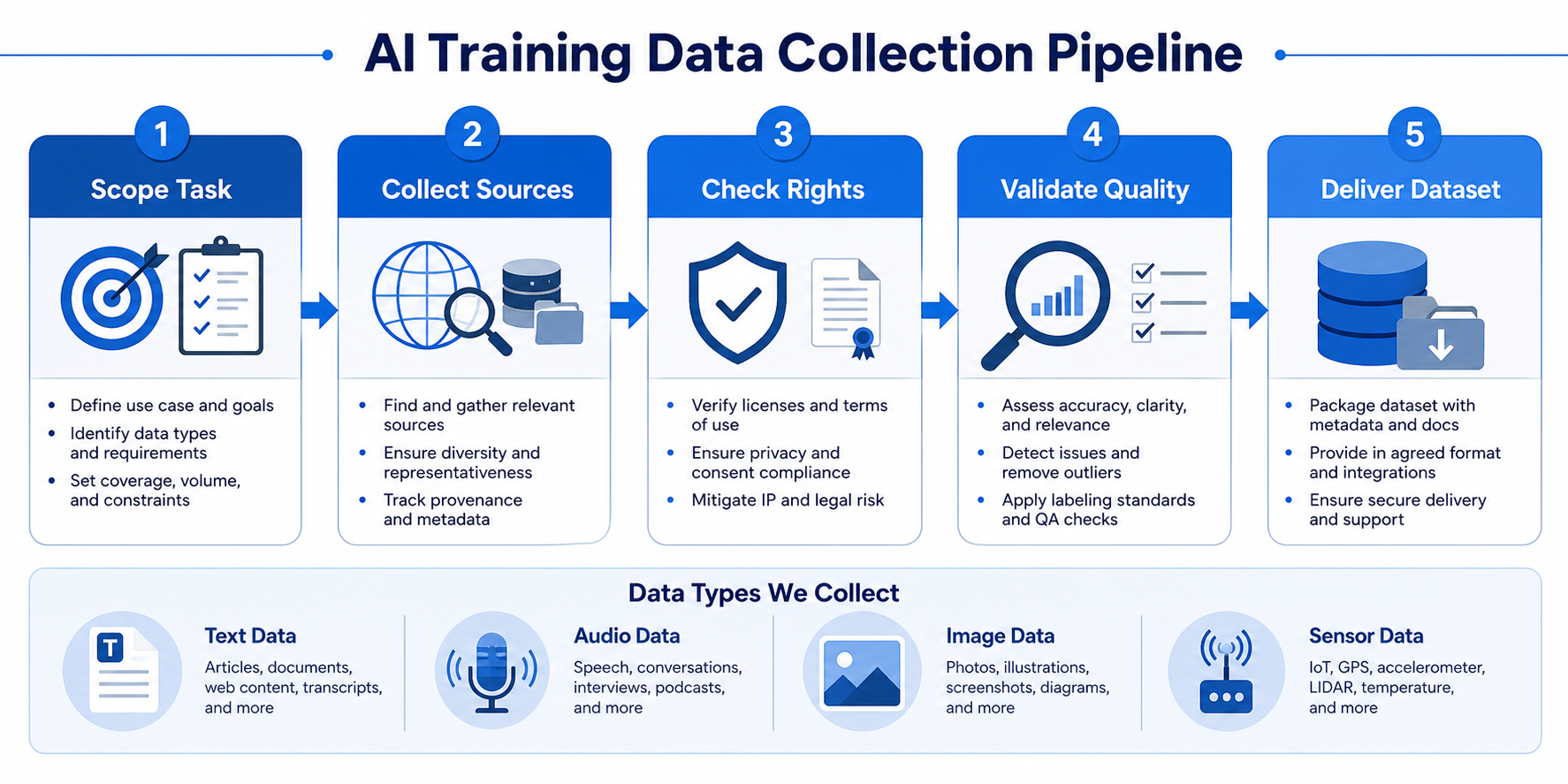
How Does the AI Data Collection Process Work?
A reliable data collection project should begin with the model’s intended behavior, not with a target number of records.
1. Define the model task
State exactly what the model must predict, generate, recognize, rank, retrieve, or evaluate.
For example, “collect customer-service conversations” is too broad. A clearer requirement would define:
- The supported languages
- The expected conversation channels
- The relevant customer intents
- The required speaker roles
- The expected audio environment
- The output labels
- The target error tolerance
2. Define the target population and environment
Document the users, languages, devices, regions, lighting conditions, acoustic environments, industries, object types, or edge cases the model must handle.
A dataset can be internally consistent yet still be unsuitable because it does not represent the environment in which the model will operate.
3. Create the data specification
The specification should define:
- Required modalities
- Sample unit
- Inclusion and exclusion criteria
- Metadata fields
- Capture conditions
- Annotation taxonomy
- File formats
- Naming conventions
- Quality thresholds
- Security requirements
- Required documentation
4. Select the collection model
Choose between:
- An existing licensed dataset
- Custom human collection
- First-party data
- Authorized API or web collection
- Sensor or field collection
- Synthetic generation
- A hybrid approach
Do not select a provider before deciding which collection model fits the task.
5. Review rights, privacy and governance
Before collection begins, document:
- Where the data will come from
- Who created or supplied it
- What permissions exist
- Whether personal or sensitive data is involved
- How consent is obtained and recorded
- How long the data will be retained
- Who can access it
- Which locations may store or process it
- Whether the data can be used for training, evaluation and future model versions
- How deletion, withdrawal or correction requests will be handled
6. Run a small pilot
A pilot should test the collection instructions, participant recruitment, capture tools, annotation schema, quality controls, delivery format, and downstream usability.
The objective is not merely to receive a sample. It is to discover what will fail before the project scales.
7. Collect and monitor the data
During production, monitor:
- Collection volume
- Rejection rate
- Contributor performance
- Demographic or geographic distribution
- Device distribution
- Missing fields
- Duplicate submissions
- Capture quality
- Security incidents
- Unexpected category imbalance
8. Clean, annotate and validate
Depending on the task, validation may include:
- Format checks
- Duplicate detection
- Outlier review
- Label consensus
- Expert adjudication
- Distribution analysis
- Audio or image quality review
- Personally identifiable information checks
- Schema validation
- Cross-source consistency checks
9. Deliver, version and document the dataset
The final delivery should include more than data files.
Request:
- Dataset version
- Collection methodology
- Source and rights documentation
- Inclusion and exclusion rules
- Annotation instructions
- Quality-control results
- Known limitations
- Data dictionary
- Change log
- File manifest
- Recommended uses
- Prohibited or unsupported uses
Google’s PAIR guidance recommends examining how data was collected, what transformations were applied, whether licensing information is available, whether the data is representative, and whether supporting documentation such as a data card exists.
10. Measure production performance and refresh the data
Collection should not end when the first dataset is delivered.
Real-world conditions change. Language evolves, products change, interfaces are redesigned, regional behavior shifts, and previously rare cases become more important.
Create refresh triggers based on:
- Model failure patterns
- Data drift
- Schema changes
- New geographies
- New devices
- Emerging user behavior
- Product updates
- Regulatory changes
- Changes to source permissions
How Do AI Agents Collect Data in 2026?
AI agents generally collect data by coordinating tools and systems that already have access to information. The agent is the orchestration layer, not the original source of authority.
An agent may retrieve information through:
- Approved APIs
- Enterprise databases
- Search indexes
- Document repositories
- User submissions
- CRM or support systems
- Sensors
- Event streams
- Browser automation
- Human task platforms
- Authorized web collectors
For example, a market-research agent might:
- Read a list of approved sources.
- Query official APIs where available.
- Collect permitted public pages.
- Extract selected fields.
- Normalize the results.
- flag incomplete or conflicting records.
- Request human review.
- Store approved outputs in a structured dataset.
An agent can automate this workflow, but it does not remove the need for permissions, data minimization, validation, access controls, or human oversight.
For the LycheeIP implementation details behind this step, review AI-powered browser automation hub.
How to Choose an AI Data Collection Provider
Use the following Dataset Fit Framework to evaluate potential partners.
1. Task fit
Ask:
- Has the provider handled the required modality?
- Can it support the annotation type?
- Does it understand the model’s intended task?
- Can it demonstrate a relevant workflow without exposing another client’s confidential information?
Warning sign: The provider describes every project using the same generic process.
2. Population and environment coverage
Ask:
- Which countries, languages and communities can the provider reach?
- How are participants recruited and verified?
- Can the provider reproduce the required devices and environmental conditions?
- How will coverage be measured?
- What happens when a target group is difficult to recruit?
Warning sign: The provider promises global coverage but cannot explain its sampling method.
3. Data rights and provenance
Ask:
- Where does every category of data originate?
- What rights does the provider obtain?
- How is consent documented?
- Can the provider distinguish owned, licensed, public, contributed and synthetic data?
- Can the data be reused for future model versions?
- What restrictions remain after delivery?
Warning sign: The provider treats “publicly accessible” as sufficient evidence of unrestricted training rights.
4. Quality-control design
Ask:
- How are collection instructions tested?
- How are contributors trained?
- Which tasks require expert review?
- How is annotator disagreement handled?
- What sampling rate is used for audits?
- Which error categories are reported?
- Can rejected data be traced and replaced?
Warning sign: Quality is described only as a single accuracy percentage without a measurement method.
5. Security and privacy
Ask:
- What data can contributors access?
- Are sensitive files segmented?
- Which locations process the data?
- Are devices managed?
- Are downloads restricted?
- How are audit logs maintained?
- How are incidents reported?
- Which security claims are independently verified?
Warning sign: The provider cites a certification without explaining which service, entity, facility or workflow it covers.
6. Integration and delivery
Ask:
- Which formats are supported?
- Can the provider match your schema?
- Is API delivery available?
- How are large media files transferred?
- Can the data be delivered incrementally?
- How are corrections and version updates handled?
Warning sign: The provider cannot supply a sample manifest, schema or documentation package.
7. Scalability and operating model
Ask:
- What limits the provider’s capacity?
- Does scaling introduce new contributors?
- How is consistency maintained across teams?
- What happens when the taxonomy changes?
- Can the provider support recurring collection?
- What are the escalation procedures?
Warning sign: The provider quotes a large workforce figure but cannot explain qualification, availability or quality by domain.
8. Commercial and contractual fit
Ask:
- Is pricing based on records, hours, tasks, accepted outputs, storage, usage or project milestones?
- What work is excluded from the quote?
- Who pays for rejected data?
- What happens when requirements change?
- What service levels apply?
- Who owns instructions, annotations and derived data?
- What warranties or indemnities apply to data rights?
Warning sign: The initial quote excludes quality review, project management, revisions or secure delivery.
Examples of AI Data Provider Models
The following examples illustrate different operating models. They are not a universal ranking, and current capabilities, certifications, geographic coverage, pricing, and contract terms should be verified directly.
| Provider model | Illustrative providers | Typical fit |
|---|---|---|
| Enterprise data lifecycle and model evaluation | Scale AI, Appen | Complex programs requiring collection, annotation, evaluation and managed delivery |
| Global multilingual and multimodal collection | LXT | Speech, text, image and video projects requiring broad language or regional coverage |
| Dataset marketplace plus custom collection | Defined.ai | Teams comparing ready-made data with custom speech, text or multimodal projects |
| Expert-in-the-loop project delivery | Twine AI | Projects requiring professional or domain-specific contributors |
| Managed human-in-the-loop annotation | Sama | Annotation, validation and evaluation projects where workforce practices are a major procurement criterion |
Scale AI publicly describes a data engine that collects, curates and annotates data, while Appen offers custom collections and off-the-shelf datasets. LXT advertises multimodal collection, annotation and evaluation across a large global contributor network, and Defined.ai combines custom collection with a training-data marketplace. Twine emphasizes expert recruitment and managed project delivery, while Sama describes an expert-led human-in-the-loop model and Certified B Corporation status.
Provider marketing pages should be treated as starting points for due diligence, not independent proof of performance.
Where Web Data Collection and Proxy Infrastructure Fit
Web data collection is only one part of an AI data pipeline. It should not be confused with annotation, dataset governance, model training, or evaluation.
A typical web-data architecture includes several separate layers:
- Source layer: The websites, APIs or repositories containing the information.
- Collection layer: The crawler, scraper or API client that sends requests.
- Browser layer: Browser automation used when pages require client-side rendering or interaction.
- Network layer: IP routing, proxy selection, location and connection management.
- Parsing layer: Extraction, normalization and schema mapping.
- Validation layer: Duplicate checks, source comparison and quality testing.
- Storage layer: Databases, object storage and version control.
- Governance layer: Authorization, privacy, licensing, security and retention.
A proxy operates at the network layer. It can change the source IP, route, geographic location, or session routing used for an authorized request.
A proxy does not:
- Grant permission to collect data
- Repair weak extraction code
- Correct an inaccurate selector
- Validate a dataset
- Remove copyright or privacy obligations
- Guarantee access to a website
- Make a browser session undetectable
- Prevent every challenge or block
- Turn public information into unrestricted training data
Dynamic residential proxies
LycheeIP dynamic residential proxies support rotating and sticky sessions, geographic targeting, and large-scale concurrent connections. These capabilities may be relevant when an authorized public-web collection project requires distributed geographic coverage or controlled IP rotation.
The current official product page states that the service supports coverage across more than 200 countries and regions, unlimited concurrent sessions, and configurable rotating or sticky sessions. These product details are time-sensitive and should be rechecked before publication or purchase.
Static residential proxies
LycheeIP static residential proxies provide fixed residential IP addresses. A stable address may be appropriate for legitimate workflows that require session continuity, consistent location, or an allowlisted endpoint.
Static routing should not be chosen when broad rotation is the primary requirement.
Datacenter proxies
LycheeIP datacenter proxies use hosted-server IP addresses and support HTTP, HTTPS, SOCKS5, API-based management, and dedicated use during the authorized subscription period. They may suit permitted collection environments where stable infrastructure is more important than residential network attributes.
Before selecting any proxy type, identify whether the actual problem originates in the network layer. A proxy change will not solve poor source selection, missing permissions, inconsistent labels, malformed schemas, weak parsing, or an unrepresentative dataset.
Teams can review the available categories on the LycheeIP homepage and compare them against the collection architecture rather than selecting a product solely by price or IP-pool size.
For the LycheeIP implementation details behind this step, review LycheeIP proxy infrastructure.
Quick-Start SOP for an AI Data Collection Project
- Define the intended AI task. Specify what the model must do and how success will be evaluated.
- List the required data conditions. Include modality, geography, language, devices, environments and edge cases.
- Check existing sources first. Review internal data, official APIs, licensed datasets and reputable public repositories.
- Document rights and restrictions. Record ownership, consent, licenses, retention rules and permitted uses.
- Write the collection specification. Define fields, formats, labels, metadata and acceptance criteria.
- Choose the collection model. Decide whether the project needs custom collection, licensed data, public-web data, synthetic data or a hybrid.
- Run a representative pilot. Test the most difficult segments, not only the easiest examples.
- Validate the complete pipeline. Confirm that collection, annotation, transfer, parsing and model ingestion work together.
- Review pilot errors. Update instructions, taxonomy, recruitment and quality controls.
- Scale gradually. Increase volume only after quality and coverage remain stable.
- Monitor production performance. Compare dataset assumptions with real model failures.
- Create refresh triggers. Recollect or rebalance data when the environment, model or source changes.
Common AI Data Collection Failure Modes
| Symptom | Likely cause | First check | Recommended next step |
|---|---|---|---|
| Strong test scores but weak production performance | The dataset does not represent real users or conditions | Compare training, test and production distributions | Collect missing environments and create an independent evaluation set |
| Annotators frequently disagree | The taxonomy or instructions are ambiguous | Review disagreement by label and task type | Rewrite examples, add edge-case guidance and use expert adjudication |
| Model memorizes examples | Duplicate or near-duplicate records exist across splits | Run similarity and leakage checks | Deduplicate before rebuilding train, validation and test sets |
| Performance varies by region or language | Coverage is imbalanced | Review results by geography, dialect and demographic group | Recruit targeted participants and report subgroup performance |
| Delivered files cannot enter the training pipeline | Schema, encoding or media requirements were unclear | Test the delivery against the real ingestion system | Require a sample manifest and automated schema validation |
| Web collection breaks without warning | Page structure, access rules or endpoints changed | Check source responses, selectors and change logs | Add monitoring, fallback sources and controlled retries |
| Collection works locally but fails on a server | Authentication, DNS, firewall, protocol or proxy configuration differs | Compare environment variables and network paths | Reproduce the issue with a minimal logged request |
| Data volume grows but model quality does not | New records repeat existing patterns | Measure novelty, coverage and failure reduction | Prioritize difficult or underrepresented examples |
| Legal or privacy review blocks deployment | Provenance, consent or reuse rights were not documented early | Audit the source and contract trail | Pause expansion and obtain qualified legal or privacy review |
AI Training Data Validation Checklist
Before accepting the final dataset, confirm that:
- The dataset matches the documented model task.
- Required populations and environments are represented.
- Every source category has provenance documentation.
- Licensing, consent and reuse terms are recorded.
- Personal and sensitive data have been identified.
- Collection and annotation instructions are versioned.
- Duplicate and leakage checks have been completed.
- Required metadata fields are present.
- Labels meet the defined agreement or adjudication standard.
- File formats match the production ingestion pipeline.
- Train, validation and test sets are appropriately separated.
- Known limitations are documented.
- Subgroup and edge-case performance can be evaluated.
- Rejected or corrected records can be traced.
- The dataset can be refreshed without rebuilding the entire process.
- Successful delivery has not been mistaken for successful model performance.
When Should You Avoid Outsourcing AI Data Collection?
A third-party provider may not be necessary when:
- A suitable licensed dataset already exists.
- An official API provides the required information.
- The dataset is small and can be collected safely in-house.
- Internal subject-matter experts must create every example.
- Data cannot leave a controlled environment.
- The provider cannot meet required security or residency conditions.
- The intended use lacks appropriate authorization.
- The team has not defined the model task or quality standard.
- The buyer cannot independently validate the delivered data.
- The proposed data source has unclear rights or provenance.
- Synthetic or simulated data can safely answer the narrow requirement.
- The cost of collection exceeds the likely value of the model improvement.
Outsourcing operations does not outsource accountability. The organization using the dataset remains responsible for deciding whether the data is appropriate for the intended system.
Use LycheeIP Proxies for Reliable AI Data Collection
Build the Data Strategy Before Buying the Data
The strongest AI data collection services do more than deliver large files. They help convert a defined model need into a documented, representative, secure, and testable dataset.
Begin with the task, users, operating environment, and acceptance criteria. Then evaluate providers based on source rights, coverage, quality controls, security, integration, documentation, and lifecycle support.
For projects that include authorized public-web collection, assess the entire architecture before changing the network layer. Where geographic routing, IP continuity, or distributed request infrastructure is a genuine requirement, compare the relevant LycheeIP proxy types and test a small controlled workflow before scaling.
Frequently Asked Questions
What are AI data collection services?
AI data collection services obtain, create, organize and validate data for training, fine-tuning or evaluating artificial intelligence systems. Depending on the provider, the service may include participant recruitment, field collection, web collection, annotation, quality assurance and secure delivery.
What is the difference between data collection and data annotation?
Data collection obtains or generates the raw examples, while annotation adds labels or structured meaning to those examples. A provider may offer both services, but they require different workflows, expertise and quality controls.
How much data is needed to train an AI model?
There is no universal number. The requirement depends on the model, task complexity, existing pretrained capabilities, label quality, population diversity, error tolerance and whether the dataset covers the difficult production cases. A smaller representative dataset can be more valuable than a much larger collection of repetitive or poorly matched examples.
How do AI agents collect data?
AI agents collect data by using approved tools such as APIs, databases, browser automation, enterprise applications, sensors, search indexes and human task platforms. The agent coordinates the workflow but does not replace permissions, security controls, source validation or human oversight.
Can synthetic data replace real data collection?
Synthetic data can supplement real data, especially for simulations, rare events or controlled scenarios. It should be evaluated against independent real-world data because generated examples may reproduce model assumptions rather than actual production conditions.
What should an AI data collection contract include?
The contract should address scope, data sources, rights, consent, ownership, permitted uses, security, processing locations, quality criteria, rejected records, delivery formats, service levels, confidentiality, deletion, retention, incident reporting and future reuse. Legal and privacy counsel should review high-risk or sensitive projects.
How do you verify the quality of AI training data?
Test the data against documented acceptance criteria. Review representativeness, duplicates, missing values, label agreement, source alignment, schema validity, subgroup coverage, leakage, edge cases and downstream model performance. Fluent text, attractive images, or a successful file transfer do not prove that the dataset is correct.
What is the difference between an AI data provider and a web scraping company?
An AI data provider may recruit participants, collect multiple data modalities, annotate examples, validate quality and support model evaluation. A web scraping company primarily extracts information from websites or online sources. Some providers offer both, but public-web extraction is only one possible source of AI training data.
Where do proxies fit into AI data collection?
Proxies operate at the network layer. They can support authorized geographic testing, IP rotation, session continuity, or distributed public-web collection. They do not provide source rights, annotate data, validate records, repair extraction code, or guarantee that a target website will accept automated requests.
Related LycheeIP Guides and Resources