
10 Residential Proxy Providers to Evaluate
How to choose a residential proxy provider
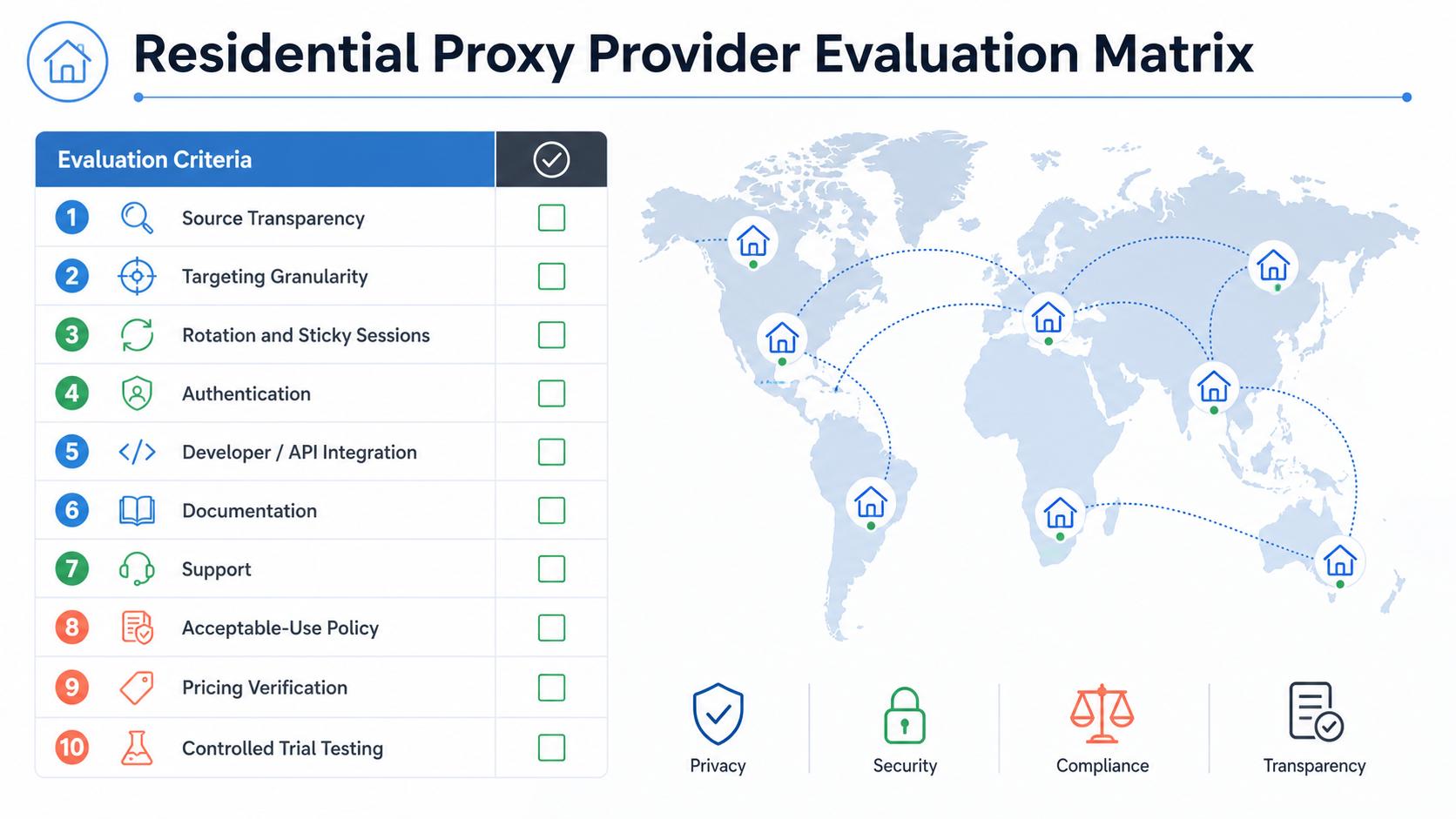
Start with the workload: target geography, protocol, request volume, session length, application, data sensitivity, and acceptable-use constraints. Then require evidence for network sourcing, consent, abuse handling, retention, authentication, and account controls. The MDN Proxy-Authorization reference documents the standard request header used for proxy credentials. The OWASP automated-threat guidance is a useful threat taxonomy for designing authorized tests that do not become abusive automation.
| Criterion | Questions to ask | Evidence to retain |
|---|---|---|
| Source transparency | How are endpoints obtained and participants informed? | Current policy, consent explanation, and abuse process |
| Targeting | Which country, region, city, ASN, or carrier controls are actually supported? | Dashboard screenshots and trial results |
| Sessions | How do rotation and sticky sessions behave? | Timestamped IP observations and documented limits |
| Authentication | Credentials, allowlists, secret rotation, and team access? | Security configuration and revocation test |
| Integration | HTTP, HTTPS, SOCKS5, API, browser, and code examples? | Working minimal client and error handling |
| Support | Can support diagnose a sanitized reproducible issue? | Trial ticket quality and response path |
Ten providers to evaluate
This is an alphabetical-style candidate set, not a performance ranking. Confirm current products and terms directly because provider portfolios change.
Bright Data
Evaluate its residential product against your sourcing, targeting, account-control, and integration requirements.
Decodo
Verify current residential plans, session controls, protocols, documentation, and trial terms for the intended workload.
Infatica
Review sourcing information, geographic controls, authentication, support, and acceptable-use requirements.
IPRoyal
Test the current residential offering for session behavior, location accuracy, developer integration, and support quality.
LycheeIP
LycheeIP is relevant to teams comparing residential proxy workflows, SOCKS5 routing, and rotating residential endpoints. Verify the current dashboard and terms for the specific use case rather than assuming coverage or performance.
NetNut
Check current network descriptions, targeting options, session controls, documentation, and account safeguards.
Oxylabs
Evaluate current residential products, APIs, authentication, policy controls, documentation, and support under the same test plan.
Rayobyte
Confirm the residential product's present sourcing, targeting, session, pricing, and support terms.
SOAX
Test geographic controls, protocol support, session behavior, dashboard usability, and policy documentation.
Webshare
Verify which residential features are included in the current plan and whether they meet the workload's integration and governance needs.
Run a controlled provider trial
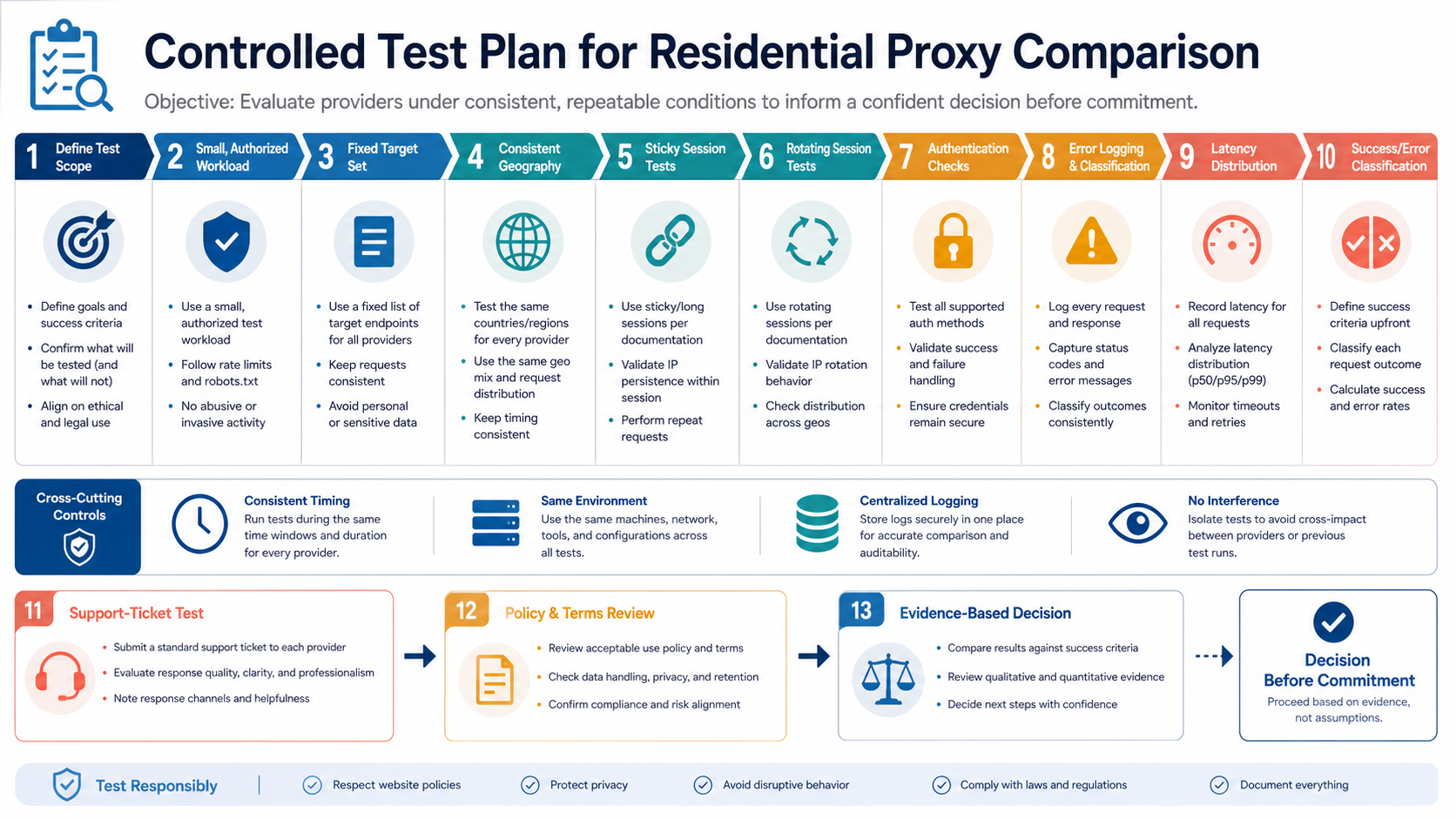
- Define a small authorized target set and success criteria.
- Use identical geography, schedule, application version, timeouts, and retry limits.
- Test credential creation, revocation, and IP allowlisting.
- Measure sticky continuity and rotating behavior separately.
- Record status codes, timeouts, connection errors, and latency distribution.
- Open the same sanitized support question with each provider.
- Review policy, billing unit, overage, cancellation, and data retention.
- Decide from the evidence, not a single speed-test result.
For application testing, the Playwright guide, Puppeteer comparison, and controlled bot-detection workflow provide repeatable browser methods. For network alternatives, compare static proxy setup, datacenter proxies, and VPN and proxy trust boundaries.
Pricing and contract verification
Record billing unit, minimum commitment, included traffic, overage, concurrency, location premiums, trial restrictions, refunds, taxes, and cancellation. Use a workload-derived cost model. Do not compare an advertised entry price from one provider with a production tier from another.
Safety, compliance, and limitations
A residential IP does not grant permission, guarantee access, eliminate CAPTCHAs, or make an activity anonymous. Obtain authorization, minimize personal data, respect service rules, use bounded rates, and maintain an incident path. The browser fingerprinting guide also explains why IP type is only one part of application context.
Turn requirements into a provider scorecard
Write pass/fail requirements before opening sales pages. If city targeting is essential, a country-only plan is not a partial success. If an authenticated workflow must keep one IP for twenty minutes, test that exact session length. If the team uses Python and Playwright, require working examples for both rather than awarding points for a generic API logo.
| Requirement | Minimum acceptance evidence | Reason to reject |
|---|---|---|
| Authorized use | Workload fits published acceptable-use terms | Provider cannot confirm the intended category |
| Endpoint sourcing | Clear, current sourcing and participant information | Vague or contradictory explanation |
| Geographic fit | Repeated trial observations in required locations | Labels do not match observed endpoints |
| Session control | Sticky and rotation behavior matches documentation | Unexpected changes break the workflow |
| Authentication | Secrets and allowlists can be created and revoked | No practical revocation or team controls |
| Integration | Minimal client passes with bounded errors | Examples are stale or incomplete |
| Support | Reproducible issue receives a useful response | No escalation path for service-impacting faults |
Source transparency and governance
Residential endpoints originate from consumer network connections, so sourcing deserves more scrutiny than a feature checklist. Ask how participants are informed, what control they retain, how software distribution works, how abuse complaints are handled, and what data the provider keeps. Keep the current answers with the procurement record. A low price does not compensate for an unclear network origin.
Review the provider's acceptable-use policy, privacy terms, data-processing terms, subprocessors where relevant, and security contacts. Confirm whether account administrators can restrict team access and rotate credentials. For regulated or sensitive workloads, legal and security reviewers should approve the data path before the trial handles production information.
Geographic targeting and location accuracy
Country, region, city, ASN, and carrier labels can come from different databases and may not match a destination's classification. Test against the actual authorized target and at least one independent diagnostic source. Record the provider selection, observed IP, timestamp, and destination result. Do not promise that every website will interpret a location identically.
Location accuracy and endpoint availability are separate. A narrowly targeted city may have fewer endpoints or less continuity than a country pool. Decide whether the workload needs a precise label, regional representation, or simply a diverse authorized sample. The location mismatch troubleshooting guide explains how account, device, DNS, and IP data can disagree.
Rotation and sticky-session controls
Test rotation with independent requests and sticky behavior with a multi-step session. Capture the username or session token format without recording secrets. Run more than one session because a single stable IP cannot prove the documented maximum. Note what happens when an endpoint disappears before the requested duration and whether the client receives a clear error or silent replacement.
Use sticky sessions for approved logins, carts, or workflows where network continuity matters. Use rotation for independent tasks that do not share cookies or account state. Rotation during an authenticated journey can create contradictory context and make diagnosis harder. For long-lived endpoints, compare the static proxy setup guide.
Authentication and credential management
Username/password authentication is portable but requires secret handling. IP allowlisting avoids embedding a password in some clients but can be awkward behind changing office or cloud egress. Test both if offered. Confirm how quickly revocation takes effect, whether credentials can be scoped, and whether usage can be attributed to a team or application.
Never put a live proxy URL in source code, screenshots, tickets, or article examples. Use environment variables or a secret manager, redact logs, and rotate a credential after accidental disclosure. An HTTP 407 indicates proxy authentication failure; it is not the same as a destination site's 401 response.
Developer integration and failure handling
A useful integration guide covers scheme, endpoint, authentication, timeout, DNS behavior, retries, session token, and error interpretation. Test a minimal cURL request first, then the production library. For browser automation, configure the proxy at context or browser launch and keep cookies aligned with the intended session.
Bound every timeout and retry. Classify DNS errors, proxy connection errors, TLS errors, 407 responses, destination 4xx responses, destination 5xx responses, and application parsing failures separately. A provider should not receive blame for a broken selector, and a client bug should not hide an endpoint failure. The browser fingerprinting model helps keep network and browser evidence separate.
Performance testing without misleading benchmarks
Use the same machine, target set, geography mix, concurrency, timeout, retry policy, and schedule for every provider. Run a direct control where policy permits. Report sample count, median, tail latency, status-code distribution, timeout rate, and complete-request result. Avoid a universal success-rate claim: results depend on target, route, time, account state, and request behavior.
Warm-up effects, DNS caching, connection reuse, and destination rate limits can distort results. Randomize provider order or run interleaved rounds. Keep raw logs with secrets removed. When a difference appears, reproduce it before choosing a winner.
Support and incident-response test
Open one standardized support ticket during the trial. Include a UTC timestamp, sanitized endpoint, protocol, region, error, and minimal reproduction. Evaluate whether support identifies the layer, requests relevant evidence, explains expected behavior, and provides an escalation path. Response speed matters, but diagnostic quality matters too.
Ask how abuse reports, compromised credentials, unexpected traffic, and endpoint incidents are handled. Record the emergency contact path. A team should be able to disable its own access quickly rather than waiting for a billing contact.
Match proxy type to the workload
| Proxy type | Potential fit | Trade-off to evaluate |
|---|---|---|
| Rotating residential | Authorized public-web collection and regional sampling | Session continuity, traffic billing, and sourcing |
| Static residential or ISP | Longer sessions and allowlisting | Allocation policy, replacement, and cost |
| Datacenter | High-throughput infrastructure and simple routing | Network classification and target fit |
| SOCKS5 | Applications that support generic TCP proxying | Client DNS and protocol behavior |
| VPN | Device-wide encrypted route to a trusted gateway | Broader scope and different trust boundary |
Read the SOCKS5 guide, VPN versus proxy decision guide, and datacenter proxy overview before forcing a residential product into every task.
Final procurement decision framework
- Reject any provider that fails authorization, sourcing, security, or mandatory geographic requirements.
- Compare remaining providers on the same workload evidence.
- Calculate total monthly cost from observed traffic and required features.
- Review support quality and the operational burden of credentials, sessions, and monitoring.
- Select a primary provider and document whether a secondary route is genuinely required.
- Set a review date because products, policies, and prices change.
The result should be explainable without a marketing ranking: this provider met the mandatory controls, performed acceptably on the authorized workload, fit the budget model, and supplied a workable support path. If the evidence changes, reopen the decision rather than defending an old list position.
What to monitor after purchase
Procurement is not the end of evaluation. Monitor authentication failures, endpoint availability, geographic mismatches, unexpected rotation, timeout distribution, destination errors, spend, and credential use. Separate provider-side incidents from target-side responses and client defects. Set alerts for abrupt usage or cost changes, and retain enough sanitized evidence to reproduce a fault without storing page content or personal data unnecessarily.
Review team access and allowlists on a schedule. Revoke credentials that no longer have an owner, rotate secrets according to policy, and confirm that old credentials stop working. Compare invoices with measured traffic and investigate unexplained overage. Revisit sourcing, privacy, acceptable-use, and retention documents when the provider announces a material change.
Reasons to reject a provider during trial
- The provider cannot explain endpoint sourcing or abuse handling clearly enough for the organization's risk requirements.
- Mandatory geography or session controls fail reproducibly under the documented configuration.
- Credentials cannot be scoped, revoked, or protected in the intended application.
- Support cannot distinguish a provider failure from a target response despite a sanitized reproduction.
- Pricing units, overage, cancellation, or renewal terms remain ambiguous after written clarification.
- The trial requires unsafe practices, unsupported TLS changes, or activity outside the authorized scope.
A rejection does not mean the provider is universally poor. It means the current product did not meet this workload's documented controls. Preserve that distinction so future teams can retest a changed product without inheriting an unsupported permanent ranking.
Document the final decision
The decision record should include the workload owner, approved target scope, trial dates, provider and plan, configuration, geographic mix, session model, client versions, raw-metric location, policy versions, cost model, support evidence, exceptions, and review date. Store secrets separately. This record makes the selection auditable and prevents the next renewal from relying on memory or an old article.
In the data-driven world of 2026, residential proxies have become an indispensable tool for modern businesses. These services route your internet traffic through IP addresses assigned to real households, allowing your connections to appear as legitimate users rather than automated bots. Consequently, this makes them invaluable for competitive intelligence, ad verification, and ethical data gathering where avoiding blocks is paramount.
However, the market is crowded, and not all providers are created equal. As demand for undetectable data collection rises, choosing the right residential proxy provider is more critical than ever. This guide moves beyond marketing claims to provide a definitive, data-backed ranking based on our synthesis of independent benchmarks and hands-on analysis.
Frequently Asked Questions
What is the best residential proxy provider?
There is no universal winner. Select from controlled workload results, sourcing and policy evidence, location fit, session behavior, integration, support, and total cost.
How should I test a residential proxy?
Use a small authorized target set, fixed settings, bounded requests, timestamped outcomes, sticky and rotating tests, and a direct control.
Are residential proxies better than datacenter proxies?
They represent a different network source. Datacenter proxies can be simpler and faster for some workloads; residential routes may fit authorized regional tests.
What is a sticky session?
It requests continuity with the same exit for a documented period or session token. Verify actual behavior during a trial.
What pricing details matter?
Check billing unit, minimum spend, included traffic, overage, concurrency, targeting premiums, trial rules, cancellation, and taxes.
Do residential proxies guarantee access?
No. Target policy, account state, browser signals, network reputation, rate, and application behavior can all affect access.
How many internal controls should a team require?
At minimum, require secret management, revocation, least-privilege access, usage logs, rate limits, and an abuse-response process.
Can a residential proxy make activity anonymous?
No anonymity guarantee is defensible. Providers, destinations, accounts, browsers, applications, and logs remain in the trust model.

推荐文章

什么是住宅IP代理?为什么越来越多人选择它?
住宅IP代理因其真实、稳定、不易被封的特点,成为数据采集和多账号运营的热门选择。本文从原理到实际应用,讲清住宅IP的核心价值和使用场景。
查看详情
为什么你访问网站总被限制?可能是IP出了问题
访问网站时突然被限制或无法打开,很多情况下都和IP被屏蔽有关。本文从实际使用场景出发,分析常见原因,并提供可落地的解决方案,帮助你快速恢复正常访问。
查看详情
为什么Socks5代理普遍比HTTP更快?
很多用户在使用代理时都会发现,Socks5通常比HTTP更快更稳定。本文从协议机制、传输方式和实际使用场景出发,解释两者的核心差异,帮助你选择更合适的代理方案。
查看详情
住宅IP代理如何帮助SEO提升排名?
在做SEO优化时,很多团队会遇到IP限制、搜索结果差异、数据抓取不稳定等问题。本文结合实际SEO场景,介绍住宅IP代理在数据采集、本地化SEO以及用户行为模拟中的应用方式。
查看详情
海外IP代理科普:代理池如何提升抓取成功率?
在高频数据采集与跨区域访问场景中,单一 IP 已难以满足稳定性与安全性要求。本文系统解析代理池的运作逻辑、核心价值以及构建时的关键考量因素,帮助企业搭建更高效、更稳定的网络采集环境。
查看详情